www.teachingpacks.co.uk
Images: © ThinkStock
©
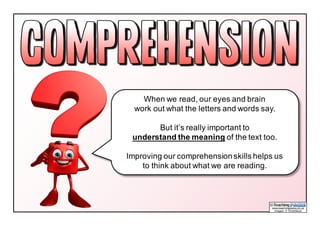
When we read, our eyes and brain
work out what the letters and words say.
But it’s really important to
understand the meaning of the text too.
Improving our comprehension skills helps us
to think about what we are reading.
www.teachingpacks.co.uk
Images: © ThinkStock
©
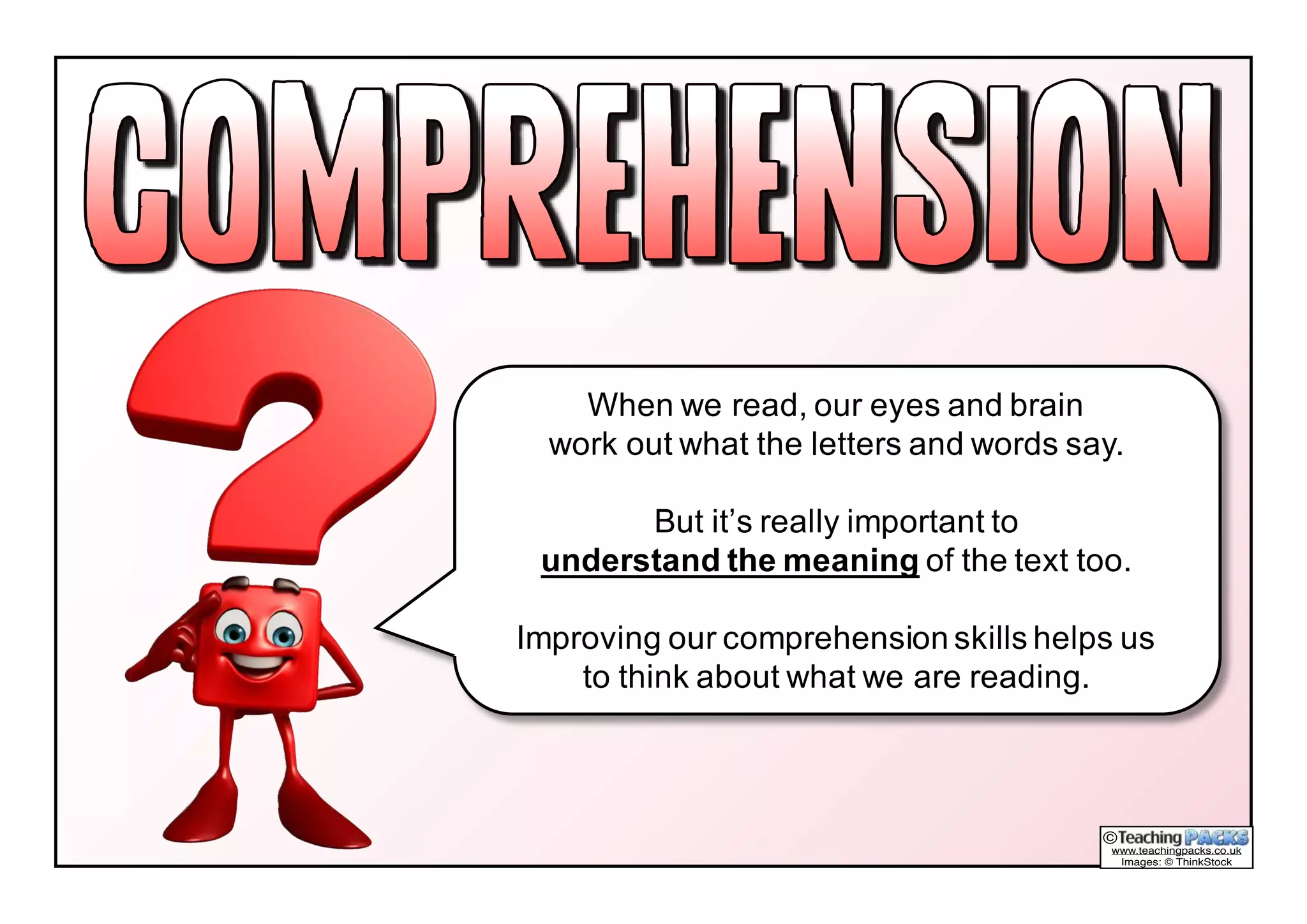
How many
times do you
read each day?
Finding out the
latest news.
Choosing
what to eat.
Learning
new things.
Following
instructions.
Finding our
way around.
Using
technology.
Can you think of any other times?
Reading fiction and
non-fiction books.
www.teachingpacks.co.uk
Images: © ThinkStock
©
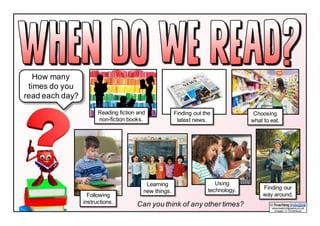
Relating
things
Making
predictions
Asking
questions
Checking
to what you
already know.
about what might
happen next.
to help your brain
understand what is
happening.
if what you have
read makes sense.
Forming
pictures
Summarising Identifying the
author’s purpose
Making
inferences
in your head to
visualise what is
happening.
the most
important parts.
Why have they
written this?
by using the
information to
form new ideas.
Making
decisions
Rereading Forming
opinions
Making
connections
about what is a fact
and what is opinion.
to check ideas
and information.
about what you
have read.
within the text and
with other texts.
... and more!
When you
read, you
use lots of
different
skills!
www.teachingpacks.co.uk
Images: © ThinkStock
©
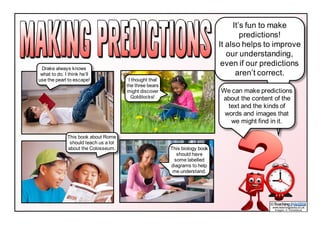
It’s fun to make
predictions!
It also helps to improve
our understanding,
even if our predictions
aren’t correct.
I thought that
the three bears
might discover
Goldilocks!
This book about Rome
should teach us a lot
about the Colosseum. This biology book
should have
some labelled
diagrams to help
me understand.
Drake always knows
what to do. I think he’ll
use the pearl to escape!
We can make predictions
about the content of the
text and the kinds of
words and images that
we might find in it.
www.teachingpacks.co.uk
Images: © ThinkStock
©
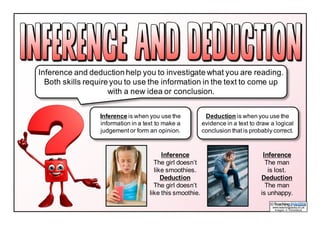
Inference is when you use the
information in a text to make a
judgement or form an opinion.
Inference and deduction help you to investigate what you are reading.
Both skills require you to use the information in the text to come up
with a new idea or conclusion.
Deduction is when you use the
evidence in a text to draw a logical
conclusion that is probably correct.
Inference
The girl doesn’t
like smoothies.
Deduction
The girl doesn’t
like this smoothie.
Inference
The man
is lost.
Deduction
The man
is unhappy.
www.teachingpacks.co.uk
Images: © ThinkStock©
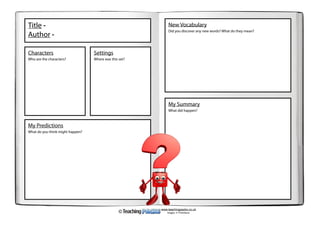
Title -
Author -
Characters
Who are the characters?
Settings
Where was this set?
My Predictions
What do you think might happen?
My Summary
What did happen?
New Vocabulary
Did you discover any new words? What do they mean?
One day, a Christian called Saint George arrived in a small
town. He met a poor man who told him about a terrible
dragon. The dragon was frightening the people of the town.
The dragon had made the villagers sacrifice a beautiful maiden
every day to keep him happy. Now the only maiden that was
left was the king’s daughter. The town had to find a brave
knight to slay the dragon.
As a reward, the knight could marry the king’s daughter.
Saint George wanted to slay the dragon and save the princess.
So, the next day he woke early and told the princess to stay at
home. George rode to the place where the dragon lived.
As soon as the dragon saw Saint George, it charged at him.
Saint George tried to use his spear, but the dragon’s scales
were too hard. The spear broke into a thousand pieces!
Saint George fell off his frightened horse.
Luckily, he rolled under an enchanted orange tree. The tree
protected him from the dragon and he rested until he was
ready to fight again.
Saint George attacked the dragon with his sword but the
dragon poured venom onto George’s armour and it split in
two. Saint George rested under the enchanted orange tree
again.
Saint George then launched his third and final attack on the
dragon, stabbing it under its wing where there were no scales.
The dragon fell dead at his feet.
George went back to the town. The people were delighted and
were so impressed by his bravery that they became Christians
too.
and the
www.teachingpacks.co.uk
©
Version 1
www.teachingpacks.co.uk
©
Version 1
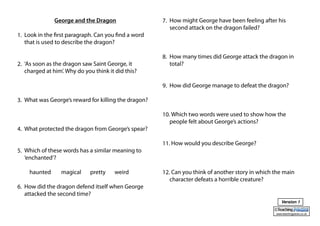
George and the Dragon
1. Look in the first paragraph. Can you find a word
that is used to describe the dragon?


2. ‘As soon as the dragon saw Saint George, it
charged at him’. Why do you think it did this?


3. What was George’s reward for killing the dragon?


4. What protected the dragon from George’s spear?


5. Which of these words has a similar meaning to
‘enchanted’?


haunted magical pretty weird

6. How did the dragon defend itself when George
attacked the second time?
7. How might George have been feeling after his
second attack on the dragon failed?


8. How many times did George attack the dragon in
total?


9. How did George manage to defeat the dragon?


10. Which two words were used to show how the
people felt about George’s actions?


11. How would you describe George?


12. Can you think of another story in which the main
character defeats a horrible creature?
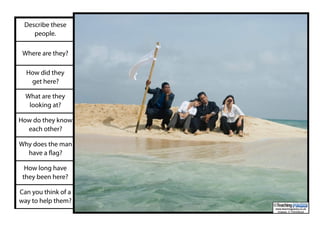
Describe these
people.
Where are they?
How did they
get here?
What are they
looking at?
How do they know
each other?
Why does the man
have a flag?
How long have
they been here?
Can you think of a
way to help them?
www.teachingpacks.co.uk
Images: © ThinkStock
©
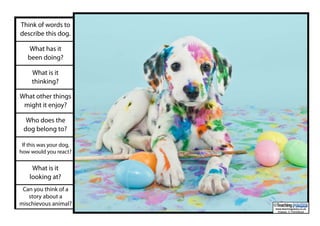
Think of words to
describe this dog.
What has it
been doing?
What is it
thinking?
What other things
might it enjoy?
Who does the
dog belong to?
If this was your dog,
how would you react?
What is it
looking at?
Can you think of a
story about a
mischievous animal?
www.teachingpacks.co.uk
Images: © ThinkStock
©
www.teachingpacks.co.uk
Images: © ThinkStock©
__________________________________________
__________________________________________
__________________________________________
__________________________________________
__________________________________________
__________________________________________
__________________________________________
__________________________________________
__________________________________________
__________________________________________
__________________________________________
__________________________________________
__________________________________________
__________________________________________
__________________________________________
__________________________________________
__________________________________________
__________________________________________
__________________________________________
__________________________________________
__________________________________________
__________________________________________
__________________________________________
__________________________________________
Book Title - Name -
What might happen? What did happen?
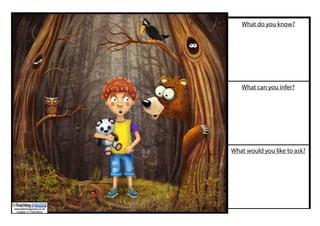
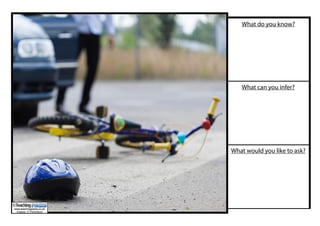
What do you know?
What can you infer?
What would you like to ask?
www.teachingpacks.co.uk
Images: © ThinkStock
©
What do you know?
What can you infer?
What would you like to ask?
www.teachingpacks.co.uk
Images: © ThinkStock
©
Thank you for looking at
our preview resources.
We hope that they are useful to you.
Join us today to download
thousands of resources from
our popular Teaching Packs!
Mark and Helen
www.teachingpacks.co.uk

The Comprehension Pack