WHAT WE DO IN TRANSFER PRICING SERVICES:
We advise Companies having commercials transactions with its international associate
enterprises for tax planning, Calculation of Arm’s Length Pricing, documentations,
certification under Transfer Pricing Rules in India. We provide services in following areas:
 Preparing a transfer pricing study Report
 Providing analysis on comparable available from database
 Certification of Form 3CEB under Income Tax Act (Transfer Price Certification by
Chartered Accountants)
 Handle matters in appellate stages / DRPs
 Providing legal briefs / advises on tax avoidance while entering international
transactions
 Find a way out for tax planning
 Providing in-house training, drafting agreements, and billing methodologies.
 Safe Harbour Rules Application
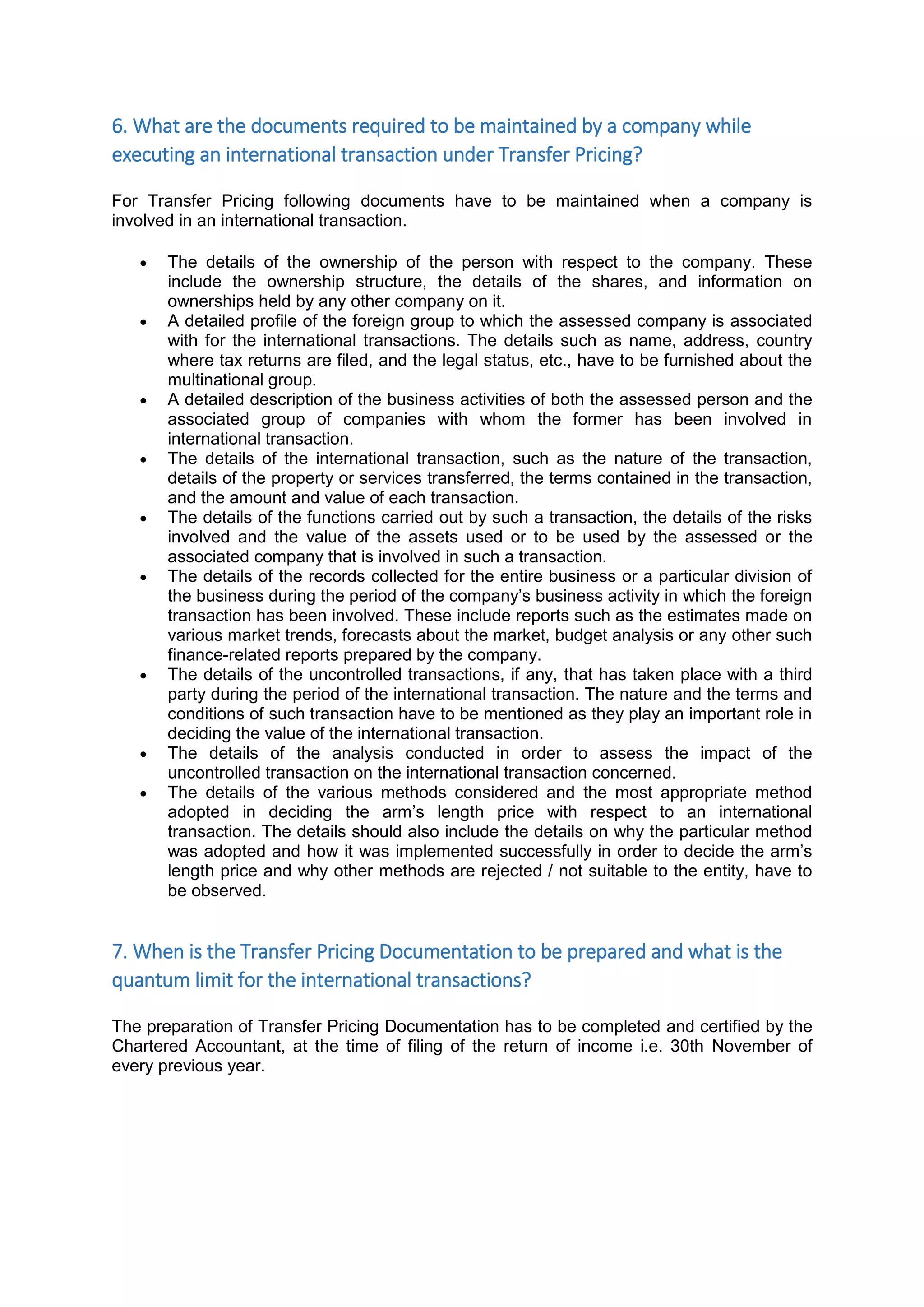
INDEX:
I. Legal Provisions for Transfer Pricing in India
II. When the transfer pricing rules do applies to a business entity?
III. Associated Enterprises
IV. International Transactions
V. Different Methods to calculate the arm’s length price under Transfer Pricing
VI. Documents required to be maintained by a company while executing an
international transaction
VII. When is the Transfer Pricing Documentation to be prepared and what is the
quantum limit for the international transactions?
VIII. Transfer Pricing Study Report (TP Report)
IX. Safe Harbour Rules
See below for details:
1. LEGAL PROVISIONS IN INDIA FOR TRANSFER PRICING:
For Transfer Pricing CHAPTER X OF INCOME TAX ACT, 1961 specified special provisions
relating to avoidance of tax. Section 92 to 94A Contains provisions for the same. Click here
Chapter X of IT Act, 1961
2. When do the transfers pricing rules applies to a business entity?
Generally, Transfer Pricing Rules triggers when two or more Associated Enterprises (AEs)
companies enter into a commercial contract during an international transaction in order to
allocate a particular cost incurred in relation with a Sales, Service or Facility presented by
any one or all of the companies, then such a cost/pricing shall be calculated taking into
account the arm’s length price of the particular assistance, service, or facility, as applicable.
3. Associated Enterprises in Transfer Pricing:
In Transfer Pricing, according to section 92A a company can be termed as an associated
enterprise with respect to the other enterprise, under the following conditions:
“Associated Enterprise", in relation to another enterprise, means an enterprise—
 (a) which participates, directly or indirectly, or through one or more intermediaries, in
the management or control or capital of the other enterprise; or
 (b) in respect of which one or more persons who participate, directly or indirectly, or
through one or more intermediaries, in its management or control or capital, are the
same persons who participate, directly or indirectly, or through one or more
intermediaries, in the management or control or capital of the other enterprise.
 Two enterprises shall be deemed to be associated enterprises if, at any time during
the previous year,
(a) one enterprise holds, directly or indirectly, shares carrying not less than twenty-six
per cent of the voting power in the other enterprise; or
(b) any person or enterprise holds, directly or indirectly, shares carrying not less than
twenty-six per cent of the voting power in each of such enterprises; or
(c) a loan advanced by one enterprise to the other enterprise constitutes not less than
fifty-one per cent of the book value of the total assets of the other enterprise; or
(d) one enterprise guarantees not less than ten per cent of the total borrowings of the
other enterprise; or
(e) more than half of the board of directors or members of the governing board, or one
or more executive directors or executive members of the governing board of one
enterprise, are appointed by the other enterprise; or
(f) more than half of the directors or members of the governing board, or one or more of
the executive directors or members of the governing board, of each of the two
enterprises are appointed by the same person or persons; or
(g) the manufacture or processing of goods or articles or business carried out by one
enterprise is wholly dependent on the use of know-how, patents, copyrights, trade-
marks, licences, franchises or any other business or commercial rights of similar nature,
or any data, documentation, drawing or specification relating to any patent, invention,
model, design, secret formula or process, of which the other enterprise is the owner or in
respect of which the other enterprise has exclusive rights; or
(h) ninety per cent or more of the raw materials and consumables required for the
manufacture or processing of goods or articles carried out by one enterprise, are
supplied by the other enterprise, or by persons specified by the other enterprise, and the
prices and other conditions relating to the supply are influenced by such other enterprise;
or
(i) the goods or articles manufactured or processed by one enterprise, are sold to the
other enterprise or to persons specified by the other enterprise, and the prices and other
conditions relating thereto are influenced by such other enterprise; or
(j) where one enterprise is controlled by an individual, the other enterprise is also
controlled by such individual or his relative or jointly by such individual and relative of
such individual; or
(k) where one enterprise is controlled by a Hindu undivided family, the other enterprise
is controlled by a member of such Hindu undivided family or by a relative of a member of
such Hindu undivided family or jointly by such member and his relative; or
(l) where one enterprise is a firm, association of persons or body of individuals, the
other enterprise holds not less than ten per cent interest in such firm, association of
persons or body of individuals; or
(m) there exists between the two enterprises, any relationship of mutual interest, as may
be prescribed.
4. INTERNATIONAL TRANSACTION IN TRANSFER PRICING:
In Transfer Pricing, Section 92B defines An international Transaction as follows:
"international transaction" means a transaction between two or more associated enterprises,
either or both of whom are non-residents, in the nature of purchase, sale or lease of tangible
or intangible property, or provision of services, or lending or borrowing money, or any other
transaction having a bearing on the profits, income, losses or assets of such enterprises,
and shall include a mutual agreement or arrangement between two or more associated
enterprises for the allocation or apportionment of, or any contribution to, any cost or expense
incurred or to be incurred in connection with a benefit, service or facility provided or to be
provided to any one or more of such enterprises.”
As such any transaction between two or more associated companies situated in different
countries in terms of a property that is tangible or intangible, a service offered by the
company, or any form of lending of money, etc. It is compulsory that at least one of the
participants involved in the transaction is a non-resident of India. However, a transaction that
has been carried out by two non-resident Indians, where one of them possesses a
permanent setup in India and whose income is taxable from India, such a type of transaction
is also considered as ‘International Transaction.’
(i) the expression "international transaction" shall include:
 Purchase of raw-material;
 Sale of finished goods;
 Software Development services;
 I T Enabled services;
 Support services;
 Technical Service fees;
 Royalty fee ;
 Management fees;
 Corporate Guarantee fees ;
 Loan received or paid;
 Purchase of fixed assets;
 Reimbursement of expenses paid / received ;
 Sale or purchase of machinery etc…
 Transactions of Intangible Assets and Properties such as Patent, Royalty, Goodwill
etc.
5. What are the different Methods to calculate the arm’s length price in Transfer
Pricing?
In Transfer Pricing, Section 92C Prescribes, following various Methods to calculate the arm’s
length price with respect to an international transaction are as under :
 Cost plus method (CPM): this method is generally used where semi finished
products are transferred.
 Comparable Uncontrolled Prices Method (CUP): ): this not favourable as no public
database is accessible concerning prices apply by autonomous enterprises in import
of comparable products.
 Resale Price Method (RPM):): In this method the vendor adds comparatively small
or no value to goods taken from associate enterprises. In the current case in this
method may be taken as the very important method as similar data of comparable
deals by independent entities is available.
 Profit Split Method (PSM): PSM method is used when associate enterprises are so
combined that it turns into difficult to make transfer pricing analysis on transactional
methods basis.
 Transactional Net Margin Method (TNMM): In this method generally apply in the
case of transfer of partially completed products, distribution of completed goods and
where RPM cannot be sufficiently applied. In general RPM more suitably applied in
this case, TNMM is also not right.
 Other Method as prescribed by the Board (CBDT). So far, no method is
prescribed by the Board.
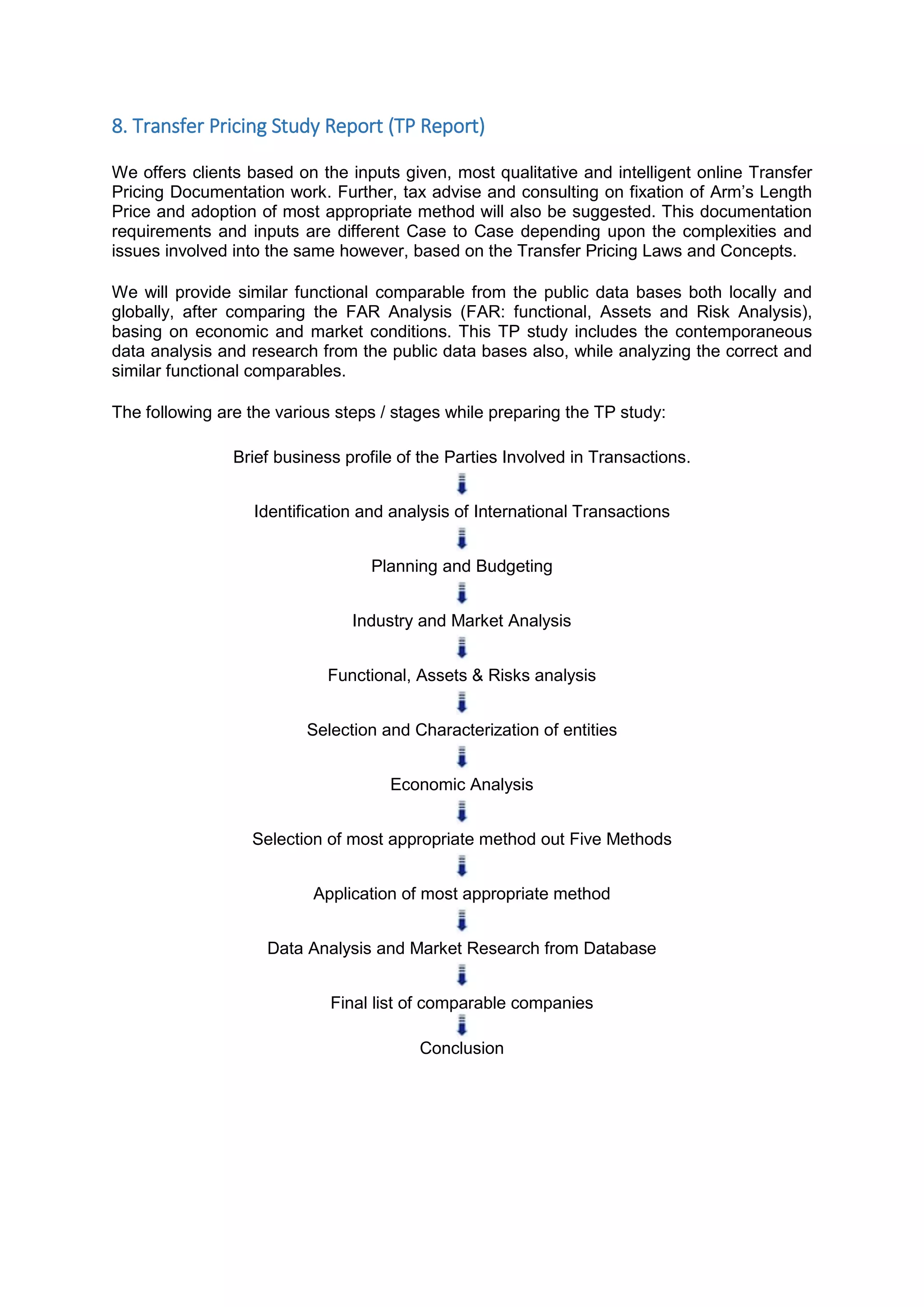
6. What are the documents required to be maintained by a company while
executing an international transaction under Transfer Pricing?
For Transfer Pricing following documents have to be maintained when a company is
involved in an international transaction.
 The details of the ownership of the person with respect to the company. These
include the ownership structure, the details of the shares, and information on
ownerships held by any other company on it.
 A detailed profile of the foreign group to which the assessed company is associated
with for the international transactions. The details such as name, address, country
where tax returns are filed, and the legal status, etc., have to be furnished about the
multinational group.
 A detailed description of the business activities of both the assessed person and the
associated group of companies with whom the former has been involved in
international transaction.
 The details of the international transaction, such as the nature of the transaction,
details of the property or services transferred, the terms contained in the transaction,
and the amount and value of each transaction.
 The details of the functions carried out by such a transaction, the details of the risks
involved and the value of the assets used or to be used by the assessed or the
associated company that is involved in such a transaction.
 The details of the records collected for the entire business or a particular division of
the business during the period of the company’s business activity in which the foreign
transaction has been involved. These include reports such as the estimates made on
various market trends, forecasts about the market, budget analysis or any other such
finance-related reports prepared by the company.
 The details of the uncontrolled transactions, if any, that has taken place with a third
party during the period of the international transaction. The nature and the terms and
conditions of such transaction have to be mentioned as they play an important role in
deciding the value of the international transaction.
 The details of the analysis conducted in order to assess the impact of the
uncontrolled transaction on the international transaction concerned.
 The details of the various methods considered and the most appropriate method
adopted in deciding the arm’s length price with respect to an international
transaction. The details should also include the details on why the particular method
was adopted and how it was implemented successfully in order to decide the arm’s
length price and why other methods are rejected / not suitable to the entity, have to
be observed.
7. When is the Transfer Pricing Documentation to be prepared and what is the
quantum limit for the international transactions?
The preparation of Transfer Pricing Documentation has to be completed and certified by the
Chartered Accountant, at the time of filing of the return of income i.e. 30th November of
every previous year.
8. Transfer Pricing Study Report (TP Report)
We offers clients based on the inputs given, most qualitative and intelligent online Transfer
Pricing Documentation work. Further, tax advise and consulting on fixation of Arm’s Length
Price and adoption of most appropriate method will also be suggested. This documentation
requirements and inputs are different Case to Case depending upon the complexities and
issues involved into the same however, based on the Transfer Pricing Laws and Concepts.
We will provide similar functional comparable from the public data bases both locally and
globally, after comparing the FAR Analysis (FAR: functional, Assets and Risk Analysis),
basing on economic and market conditions. This TP study includes the contemporaneous
data analysis and research from the public data bases also, while analyzing the correct and
similar functional comparables.
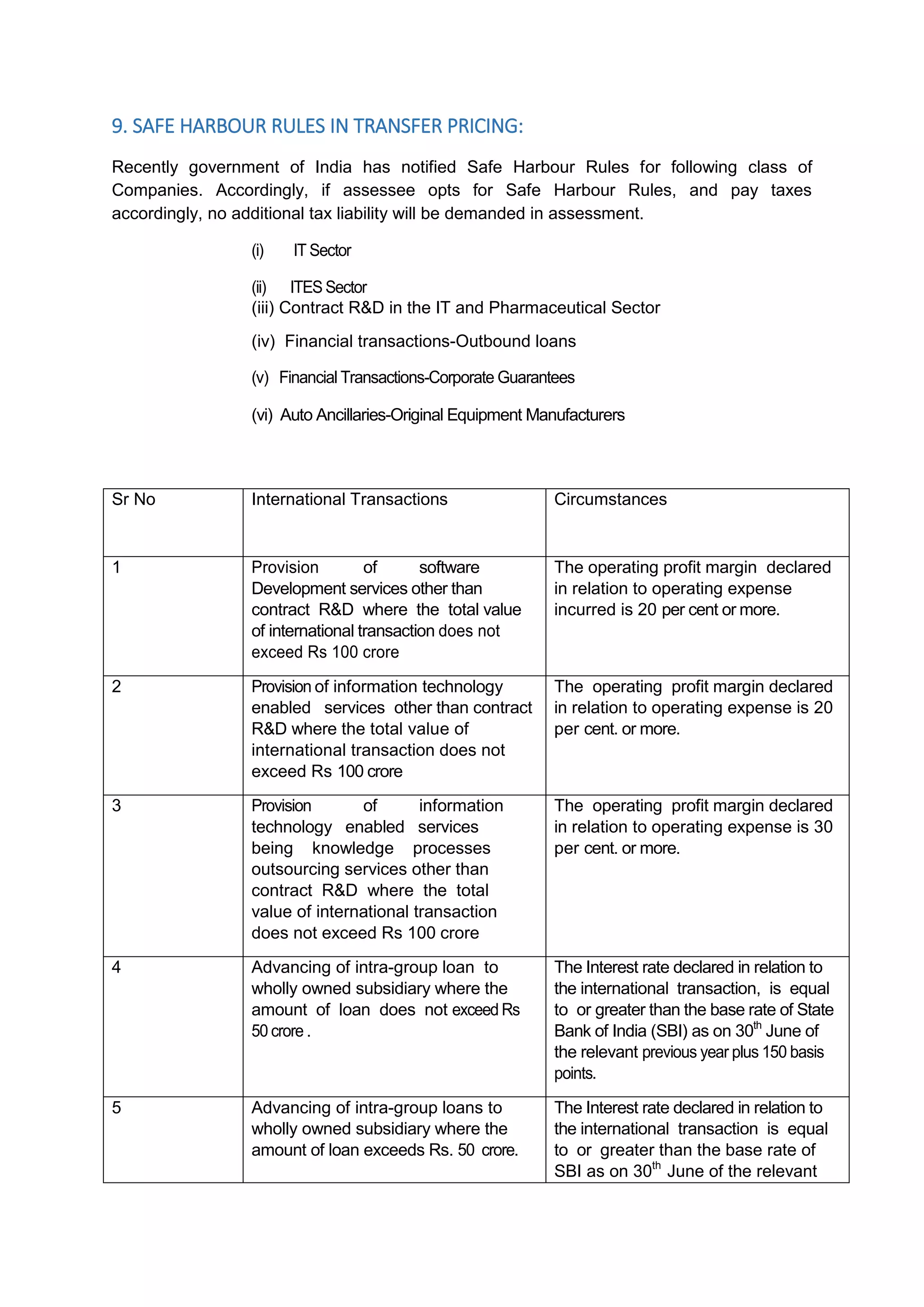
The following are the various steps / stages while preparing the TP study:
Brief business profile of the Parties Involved in Transactions.
Identification and analysis of International Transactions
Planning and Budgeting
Industry and Market Analysis
Functional, Assets & Risks analysis
Selection and Characterization of entities
Economic Analysis
Selection of most appropriate method out Five Methods
Application of most appropriate method
Data Analysis and Market Research from Database
Final list of comparable companies
Conclusion
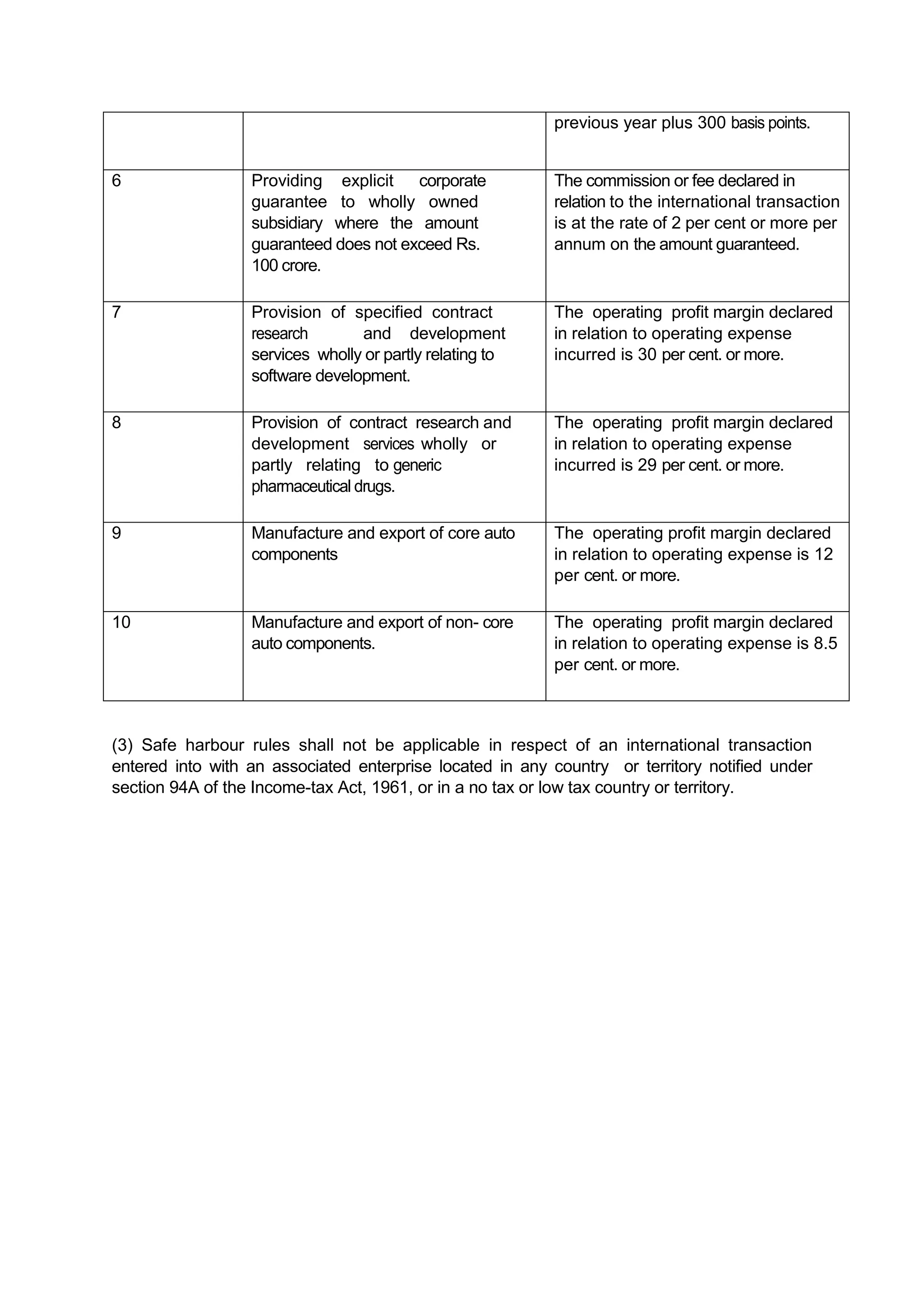
9. SAFE HARBOUR RULES IN TRANSFER PRICING:
Recently government of India has notified Safe Harbour Rules for following class of
Companies. Accordingly, if assessee opts for Safe Harbour Rules, and pay taxes
accordingly, no additional tax liability will be demanded in assessment.
(i) IT Sector
(ii) ITES Sector
(iii) Contract R&D in the IT and Pharmaceutical Sector
(iv) Financial transactions-Outbound loans
(v) Financial Transactions-Corporate Guarantees
(vi) Auto Ancillaries-Original Equipment Manufacturers
Sr No International Transactions Circumstances
1 Provision of software
Development services other than
contract R&D where the total value
of international transaction does not
exceed Rs 100 crore
The operating profit margin declared
in relation to operating expense
incurred is 20 per cent or more.
2 Provision of information technology
enabled services other than contract
R&D where the total value of
international transaction does not
exceed Rs 100 crore
The operating profit margin declared
in relation to operating expense is 20
per cent. or more.
3 Provision of information
technology enabled services
being knowledge processes
outsourcing services other than
contract R&D where the total
value of international transaction
does not exceed Rs 100 crore
The operating profit margin declared
in relation to operating expense is 30
per cent. or more.
4 Advancing of intra-group loan to
wholly owned subsidiary where the
amount of loan does not exceed Rs
50 crore .
The Interest rate declared in relation to
the international transaction, is equal
to or greater than the base rate of State
Bank of India (SBI) as on 30th
June of
the relevant previous year plus 150 basis
points.
5 Advancing of intra-group loans to
wholly owned subsidiary where the
amount of loan exceeds Rs. 50 crore.
The Interest rate declared in relation to
the international transaction is equal
to or greater than the base rate of
SBI as on 30th
June of the relevant
previous year plus 300 basis points.
6 Providing explicit corporate
guarantee to wholly owned
subsidiary where the amount
guaranteed does not exceed Rs.
100 crore.
The commission or fee declared in
relation to the international transaction
is at the rate of 2 per cent or more per
annum on the amount guaranteed.
7 Provision of specified contract
research and development
services wholly or partly relating to
software development.
The operating profit margin declared
in relation to operating expense
incurred is 30 per cent. or more.
8 Provision of contract research and
development services wholly or
partly relating to generic
pharmaceutical drugs.
The operating profit margin declared
in relation to operating expense
incurred is 29 per cent. or more.
9 Manufacture and export of core auto
components
The operating profit margin declared
in relation to operating expense is 12
per cent. or more.
10 Manufacture and export of non- core
auto components.
The operating profit margin declared
in relation to operating expense is 8.5
per cent. or more.
(3) Safe harbour rules shall not be applicable in respect of an international transaction
entered into with an associated enterprise located in any country or territory notified under
section 94A of the Income-tax Act, 1961, or in a no tax or low tax country or territory.

Transfer pricing report guidelines and safe harbour rules

  • 1.
    WHAT WE DOIN TRANSFER PRICING SERVICES: We advise Companies having commercials transactions with its international associate enterprises for tax planning, Calculation of Arm’s Length Pricing, documentations, certification under Transfer Pricing Rules in India. We provide services in following areas:  Preparing a transfer pricing study Report  Providing analysis on comparable available from database  Certification of Form 3CEB under Income Tax Act (Transfer Price Certification by Chartered Accountants)  Handle matters in appellate stages / DRPs  Providing legal briefs / advises on tax avoidance while entering international transactions  Find a way out for tax planning  Providing in-house training, drafting agreements, and billing methodologies.  Safe Harbour Rules Application INDEX: I. Legal Provisions for Transfer Pricing in India II. When the transfer pricing rules do applies to a business entity? III. Associated Enterprises IV. International Transactions V. Different Methods to calculate the arm’s length price under Transfer Pricing VI. Documents required to be maintained by a company while executing an international transaction VII. When is the Transfer Pricing Documentation to be prepared and what is the quantum limit for the international transactions? VIII. Transfer Pricing Study Report (TP Report) IX. Safe Harbour Rules See below for details: 1. LEGAL PROVISIONS IN INDIA FOR TRANSFER PRICING: For Transfer Pricing CHAPTER X OF INCOME TAX ACT, 1961 specified special provisions relating to avoidance of tax. Section 92 to 94A Contains provisions for the same. Click here Chapter X of IT Act, 1961
  • 2.
    2. When dothe transfers pricing rules applies to a business entity? Generally, Transfer Pricing Rules triggers when two or more Associated Enterprises (AEs) companies enter into a commercial contract during an international transaction in order to allocate a particular cost incurred in relation with a Sales, Service or Facility presented by any one or all of the companies, then such a cost/pricing shall be calculated taking into account the arm’s length price of the particular assistance, service, or facility, as applicable. 3. Associated Enterprises in Transfer Pricing: In Transfer Pricing, according to section 92A a company can be termed as an associated enterprise with respect to the other enterprise, under the following conditions: “Associated Enterprise", in relation to another enterprise, means an enterprise—  (a) which participates, directly or indirectly, or through one or more intermediaries, in the management or control or capital of the other enterprise; or  (b) in respect of which one or more persons who participate, directly or indirectly, or through one or more intermediaries, in its management or control or capital, are the same persons who participate, directly or indirectly, or through one or more intermediaries, in the management or control or capital of the other enterprise.  Two enterprises shall be deemed to be associated enterprises if, at any time during the previous year, (a) one enterprise holds, directly or indirectly, shares carrying not less than twenty-six per cent of the voting power in the other enterprise; or (b) any person or enterprise holds, directly or indirectly, shares carrying not less than twenty-six per cent of the voting power in each of such enterprises; or (c) a loan advanced by one enterprise to the other enterprise constitutes not less than fifty-one per cent of the book value of the total assets of the other enterprise; or (d) one enterprise guarantees not less than ten per cent of the total borrowings of the other enterprise; or (e) more than half of the board of directors or members of the governing board, or one or more executive directors or executive members of the governing board of one enterprise, are appointed by the other enterprise; or (f) more than half of the directors or members of the governing board, or one or more of the executive directors or members of the governing board, of each of the two enterprises are appointed by the same person or persons; or (g) the manufacture or processing of goods or articles or business carried out by one enterprise is wholly dependent on the use of know-how, patents, copyrights, trade- marks, licences, franchises or any other business or commercial rights of similar nature, or any data, documentation, drawing or specification relating to any patent, invention, model, design, secret formula or process, of which the other enterprise is the owner or in respect of which the other enterprise has exclusive rights; or
  • 3.
    (h) ninety percent or more of the raw materials and consumables required for the manufacture or processing of goods or articles carried out by one enterprise, are supplied by the other enterprise, or by persons specified by the other enterprise, and the prices and other conditions relating to the supply are influenced by such other enterprise; or (i) the goods or articles manufactured or processed by one enterprise, are sold to the other enterprise or to persons specified by the other enterprise, and the prices and other conditions relating thereto are influenced by such other enterprise; or (j) where one enterprise is controlled by an individual, the other enterprise is also controlled by such individual or his relative or jointly by such individual and relative of such individual; or (k) where one enterprise is controlled by a Hindu undivided family, the other enterprise is controlled by a member of such Hindu undivided family or by a relative of a member of such Hindu undivided family or jointly by such member and his relative; or (l) where one enterprise is a firm, association of persons or body of individuals, the other enterprise holds not less than ten per cent interest in such firm, association of persons or body of individuals; or (m) there exists between the two enterprises, any relationship of mutual interest, as may be prescribed. 4. INTERNATIONAL TRANSACTION IN TRANSFER PRICING: In Transfer Pricing, Section 92B defines An international Transaction as follows: "international transaction" means a transaction between two or more associated enterprises, either or both of whom are non-residents, in the nature of purchase, sale or lease of tangible or intangible property, or provision of services, or lending or borrowing money, or any other transaction having a bearing on the profits, income, losses or assets of such enterprises, and shall include a mutual agreement or arrangement between two or more associated enterprises for the allocation or apportionment of, or any contribution to, any cost or expense incurred or to be incurred in connection with a benefit, service or facility provided or to be provided to any one or more of such enterprises.” As such any transaction between two or more associated companies situated in different countries in terms of a property that is tangible or intangible, a service offered by the company, or any form of lending of money, etc. It is compulsory that at least one of the participants involved in the transaction is a non-resident of India. However, a transaction that has been carried out by two non-resident Indians, where one of them possesses a permanent setup in India and whose income is taxable from India, such a type of transaction is also considered as ‘International Transaction.’
  • 4.
    (i) the expression"international transaction" shall include:  Purchase of raw-material;  Sale of finished goods;  Software Development services;  I T Enabled services;  Support services;  Technical Service fees;  Royalty fee ;  Management fees;  Corporate Guarantee fees ;  Loan received or paid;  Purchase of fixed assets;  Reimbursement of expenses paid / received ;  Sale or purchase of machinery etc…  Transactions of Intangible Assets and Properties such as Patent, Royalty, Goodwill etc. 5. What are the different Methods to calculate the arm’s length price in Transfer Pricing? In Transfer Pricing, Section 92C Prescribes, following various Methods to calculate the arm’s length price with respect to an international transaction are as under :  Cost plus method (CPM): this method is generally used where semi finished products are transferred.  Comparable Uncontrolled Prices Method (CUP): ): this not favourable as no public database is accessible concerning prices apply by autonomous enterprises in import of comparable products.  Resale Price Method (RPM):): In this method the vendor adds comparatively small or no value to goods taken from associate enterprises. In the current case in this method may be taken as the very important method as similar data of comparable deals by independent entities is available.  Profit Split Method (PSM): PSM method is used when associate enterprises are so combined that it turns into difficult to make transfer pricing analysis on transactional methods basis.  Transactional Net Margin Method (TNMM): In this method generally apply in the case of transfer of partially completed products, distribution of completed goods and where RPM cannot be sufficiently applied. In general RPM more suitably applied in this case, TNMM is also not right.  Other Method as prescribed by the Board (CBDT). So far, no method is prescribed by the Board.
  • 5.
    6. What arethe documents required to be maintained by a company while executing an international transaction under Transfer Pricing? For Transfer Pricing following documents have to be maintained when a company is involved in an international transaction.  The details of the ownership of the person with respect to the company. These include the ownership structure, the details of the shares, and information on ownerships held by any other company on it.  A detailed profile of the foreign group to which the assessed company is associated with for the international transactions. The details such as name, address, country where tax returns are filed, and the legal status, etc., have to be furnished about the multinational group.  A detailed description of the business activities of both the assessed person and the associated group of companies with whom the former has been involved in international transaction.  The details of the international transaction, such as the nature of the transaction, details of the property or services transferred, the terms contained in the transaction, and the amount and value of each transaction.  The details of the functions carried out by such a transaction, the details of the risks involved and the value of the assets used or to be used by the assessed or the associated company that is involved in such a transaction.  The details of the records collected for the entire business or a particular division of the business during the period of the company’s business activity in which the foreign transaction has been involved. These include reports such as the estimates made on various market trends, forecasts about the market, budget analysis or any other such finance-related reports prepared by the company.  The details of the uncontrolled transactions, if any, that has taken place with a third party during the period of the international transaction. The nature and the terms and conditions of such transaction have to be mentioned as they play an important role in deciding the value of the international transaction.  The details of the analysis conducted in order to assess the impact of the uncontrolled transaction on the international transaction concerned.  The details of the various methods considered and the most appropriate method adopted in deciding the arm’s length price with respect to an international transaction. The details should also include the details on why the particular method was adopted and how it was implemented successfully in order to decide the arm’s length price and why other methods are rejected / not suitable to the entity, have to be observed. 7. When is the Transfer Pricing Documentation to be prepared and what is the quantum limit for the international transactions? The preparation of Transfer Pricing Documentation has to be completed and certified by the Chartered Accountant, at the time of filing of the return of income i.e. 30th November of every previous year.
  • 6.
    8. Transfer PricingStudy Report (TP Report) We offers clients based on the inputs given, most qualitative and intelligent online Transfer Pricing Documentation work. Further, tax advise and consulting on fixation of Arm’s Length Price and adoption of most appropriate method will also be suggested. This documentation requirements and inputs are different Case to Case depending upon the complexities and issues involved into the same however, based on the Transfer Pricing Laws and Concepts. We will provide similar functional comparable from the public data bases both locally and globally, after comparing the FAR Analysis (FAR: functional, Assets and Risk Analysis), basing on economic and market conditions. This TP study includes the contemporaneous data analysis and research from the public data bases also, while analyzing the correct and similar functional comparables. The following are the various steps / stages while preparing the TP study: Brief business profile of the Parties Involved in Transactions. Identification and analysis of International Transactions Planning and Budgeting Industry and Market Analysis Functional, Assets & Risks analysis Selection and Characterization of entities Economic Analysis Selection of most appropriate method out Five Methods Application of most appropriate method Data Analysis and Market Research from Database Final list of comparable companies Conclusion
  • 7.
    9. SAFE HARBOURRULES IN TRANSFER PRICING: Recently government of India has notified Safe Harbour Rules for following class of Companies. Accordingly, if assessee opts for Safe Harbour Rules, and pay taxes accordingly, no additional tax liability will be demanded in assessment. (i) IT Sector (ii) ITES Sector (iii) Contract R&D in the IT and Pharmaceutical Sector (iv) Financial transactions-Outbound loans (v) Financial Transactions-Corporate Guarantees (vi) Auto Ancillaries-Original Equipment Manufacturers Sr No International Transactions Circumstances 1 Provision of software Development services other than contract R&D where the total value of international transaction does not exceed Rs 100 crore The operating profit margin declared in relation to operating expense incurred is 20 per cent or more. 2 Provision of information technology enabled services other than contract R&D where the total value of international transaction does not exceed Rs 100 crore The operating profit margin declared in relation to operating expense is 20 per cent. or more. 3 Provision of information technology enabled services being knowledge processes outsourcing services other than contract R&D where the total value of international transaction does not exceed Rs 100 crore The operating profit margin declared in relation to operating expense is 30 per cent. or more. 4 Advancing of intra-group loan to wholly owned subsidiary where the amount of loan does not exceed Rs 50 crore . The Interest rate declared in relation to the international transaction, is equal to or greater than the base rate of State Bank of India (SBI) as on 30th June of the relevant previous year plus 150 basis points. 5 Advancing of intra-group loans to wholly owned subsidiary where the amount of loan exceeds Rs. 50 crore. The Interest rate declared in relation to the international transaction is equal to or greater than the base rate of SBI as on 30th June of the relevant
  • 8.
    previous year plus300 basis points. 6 Providing explicit corporate guarantee to wholly owned subsidiary where the amount guaranteed does not exceed Rs. 100 crore. The commission or fee declared in relation to the international transaction is at the rate of 2 per cent or more per annum on the amount guaranteed. 7 Provision of specified contract research and development services wholly or partly relating to software development. The operating profit margin declared in relation to operating expense incurred is 30 per cent. or more. 8 Provision of contract research and development services wholly or partly relating to generic pharmaceutical drugs. The operating profit margin declared in relation to operating expense incurred is 29 per cent. or more. 9 Manufacture and export of core auto components The operating profit margin declared in relation to operating expense is 12 per cent. or more. 10 Manufacture and export of non- core auto components. The operating profit margin declared in relation to operating expense is 8.5 per cent. or more. (3) Safe harbour rules shall not be applicable in respect of an international transaction entered into with an associated enterprise located in any country or territory notified under section 94A of the Income-tax Act, 1961, or in a no tax or low tax country or territory.