Materials for MEMS and
Microsystems
Presented by: Jitendra Jangid
MATERIALS FOR MEMS AND
MICROSYSTEMS
This chapter will cover the materials used in “silicon-based”
MEMS and microsystems. As such, silicon will be the
principal material to be studied.
Other materials to be dealt with are silicon compounds such
as: SiO2,SiC, Si3N4 and polysilicon.
Also will be covered are electrically conducting of silicon
piezoresistors and piezoelectric crystals for
electromechanical actuations and signal transductions.
An overview of polymers, which are the “rising stars” to be
used as MEMS and microsystems substrate materials, will
be studied too.
Silicon – an ideal substrate material for
MEMS
 Silicon is a host of materials commonly used in the
semiconductor integrated circuit industry.
 Normally deposited as thin films, they include silicon
oxides, silicon nitrides, and silicon carbides, metals such
as aluminum, titanium, tungsten, and copper, and
polymers such as photoresist and polyimide.
 It is mechanically stable and it is feasible to be
integrated into electronics on the same substrate (b/c it is
a semiconducting material).
 Electronics for signal transduction such as the p or n-
type piezoresistive can be readily integrated with the Si
substrate-ideal for transistors.
It has a melting point at 1400oC, which is about
twice higher than that of aluminum. This high
melting point makes silicon dimensionally stable
even at elevated temperature.
Its thermal expansion coefficient is about 8 times
smaller than that of steel, and is more than 10 times
smaller than that of aluminum
Single-Crystal Silicon
 For silicon to be used as a substrate material in
integrated circuits and MEMS, it has to be in a
pure single-crystal form.
 The most commonly used method of producing
single-crystal silicon is the Czochralski (CZ)
method.
 The Czochralski method for producing single-
crystal silicon
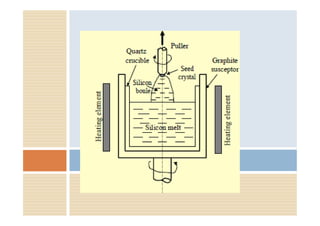
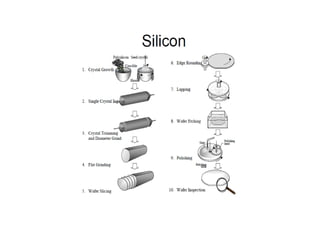
The Czochralski method for producing single-crystal silicon
Equipment: a crucible and a “puller”.
Procedure:
(1) Raw Si (quartzite) + coal, coke, woodchips)
are melted in the crucible.
(2) A “seed” crystal is brought to be in contact
with molten Si to form larger crystal.
(3) The “puller” slowly pulls the molten Si up
to form pure Si “boule” after the
solidification.
(4) The diameters of the “bologna-like” boules
vary from 100 mm (4”) to 300 mm (12”) in
diameters.
Chemical reaction for the process: SiC + SiO2 → Si + CO +
SiO
Pure silicon wafers
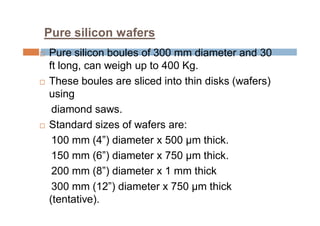
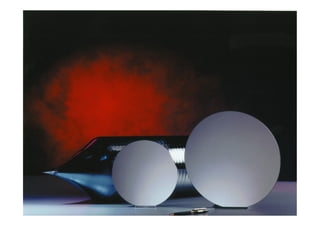
 Pure silicon boules of 300 mm diameter and 30
ft long, can weigh up to 400 Kg.
 These boules are sliced into thin disks (wafers)
using
diamond saws.
 Standard sizes of wafers are:
100 mm (4”) diameter x 500 μm thick.
150 mm (6”) diameter x 750 μm thick.
200 mm (8”) diameter x 1 mm thick
300 mm (12”) diameter x 750 μm thick
(tentative).
Single Silicon Crystal Structure
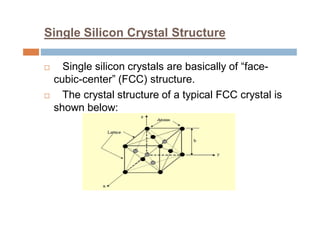
 Single silicon crystals are basically of “face-
cubic-center” (FCC) structure.
 The crystal structure of a typical FCC crystal is
shown below:
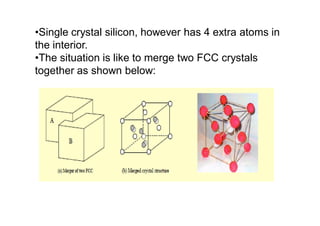
•Single crystal silicon, however has 4 extra atoms in
the interior.
•The situation is like to merge two FCC crystals
together as shown below:
•Total no. of atoms in a single silicon crystal =
18.
•The unsymmetrical distribution of atoms within
the crystal make pure
silicon anisotropic in its mechanical properties.
• In general, however, we treat silicon as an
isotropic material.
Silicon Compounds
 There are 3 principal silicon compounds used in
MEMS and microsystems:
 Silicon dioxide (SiO2), Silicon carbide (SiC) and
silicon nitride (Si3N4) – each has distinct
characteristic and unique applications.
Silicon dioxide (SiO2):
•It is least expensive material to offer good
thermal and electrical insulation.
•Also used a low-cost material for “masks” in
micro fabrication processes such as etching,
deposition and diffusion.
•Used as sacrificial material in “surface
micromachining”.
•Above all, it is very easy to produce:
- by dry heating of silicon: Si + O2 → SiO2
- or by oxide silicon in wet steam: Si + 2H2O →
SiO2 + 2H2
Silicon carbide (SiC)
 Its very high melting point and resistance to chemical reactions make
it ideal candidate material for being masks in micro fabrication
processes.
 It has superior dimensional stability.
Silicon nitride (Si3N4)
 Produced by chemical reaction:
3SiCl2H2 + 4NH3 → Si3N4 + 6HCL + 6H2
 Used as excellent barrier to diffusion to water and ions.
 Its ultra strong resistance to oxidation and many etchants make it a
superior material for masks in deep etching.
 Also used as high strength electric insulators.
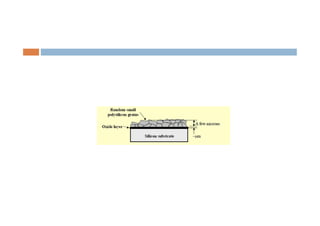
Polycrystalline silicon
 It is usually called “Polysilicon”.
 It is an aggregation of pure silicon crystals with
randomly orientations deposited on the top of
silicon substrates:
•These polysilicon usually are highly doped
silicon.
•They are deposited to the substrate surfaces to
produce localized “resistors” and “gates for
transistors”
•Being randomly oriented, polysilicon is even
stronger than single silicon crystals.
Silicon Piezoresistors
 Piezoresistance = a change in electrical
resistance of solids when
subjected to stress fields. Doped silicon are
piezoresistors (p-type or n-type).
 Relationship between change of resistance {ΔR}
and stresses {σ}:
{ΔR} = [π] {σ}
where {ΔR} = { ΔRxx ΔRyy ΔRzz ΔRxy ΔRxz
ΔRyz}T represents the change of resistances in
an infinitesimally small cubic piezoresistive crystal
element with corresponding stress components:
{σ} = {σxx σyy σzz σxy σxz σyz}T and [π] =
piezoresistive coefficient matrix.
Gallium Arsenide (GaAs)
 GaAs is a compound simiconductor with equal
number of Ga and As atoms.
 Because it is a compound, it is more difficult to
process.
 It is excellent material for monolithic integration
of electronic and photonic devices on a single
substrate.
 GaAs is also a good thermal insulator.
 Low yield strength (only 1/3 of that of silicon) –
“bad”.
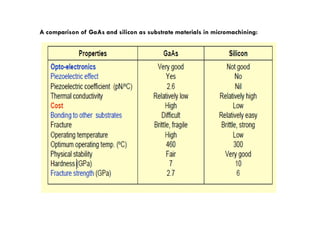
A comparison of GaAs and silicon as substrate materials in micromachining:
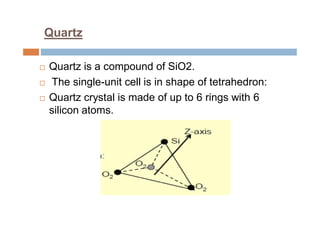
Quartz
 Quartz is a compound of SiO2.
 The single-unit cell is in shape of tetrahedron:
 Quartz crystal is made of up to 6 rings with 6
silicon atoms.
Quartz is ideal material for sensors because of
its extreme dimensional
stability.
● It is used as piezoelectric material in many
devices.
● It is also excellent material for microfluics
systems used in biomedical
applications.
● It offers excellent electric insulation in
microsystems.
● A major disadvantage is its hard in machining.
It is usually etched in
HF/NH4F into desired shapes.
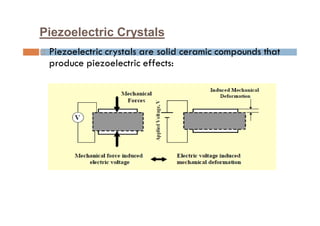
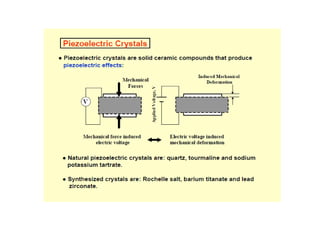
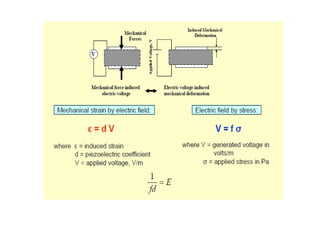
Piezoelectric Crystals
 Piezoelectric crystals are solid ceramic compounds that
produce piezoelectric effects:
•Natural piezoelectric crystals are: quartz,
tourmaline and sodium potassium tartrate.
•Synthesized crystals are: Rochelle salt, barium
titanate and leadzirconate.
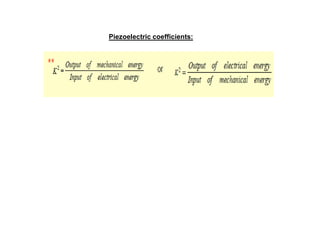
Piezoelectric coefficients:
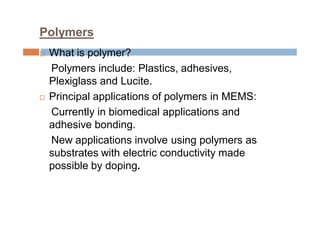
Polymers
 What is polymer?
Polymers include: Plastics, adhesives,
Plexiglass and Lucite.
 Principal applications of polymers in MEMS:
Currently in biomedical applications and
adhesive bonding.
New applications involve using polymers as
substrates with electric conductivity made
possible by doping.
Molecular structure of polymers:
 It is made up of long chains of organic
(hydrocarbon) molecules.
 The molecules can be as long as a few
hundred nm.
Characteristics of polymers:
 Low melting point; Poor electric
conductivity
 Thermoplastics and thermosets are
common industrial products
 Thermoplastics are easier to form into
shapes.
 Thermosets have higher mechanical
strength even at temperature up to 350oC
Polymers as industrial materials
 Polymers are popular materials used for many
industrial products for the following advantages:
 Light weight
 Ease in processing
 Low cost of raw materials and processes for producing
polymers
 High corrosion resistance
 High electrical resistance
 High flexibility in structures
 High dimensional stability
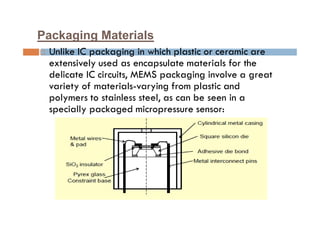
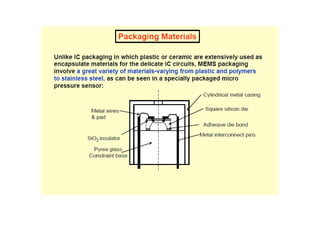
Packaging Materials
 Unlike IC packaging in which plastic or ceramic are
extensively used as encapsulate materials for the
delicate IC circuits, MEMS packaging involve a great
variety of materials-varying from plastic and
polymers to stainless steel, as can be seen in a
specially packaged micropressure sensor:
The radio frequency microelectromechanical system (RF MEMS)  Materials

The radio frequency microelectromechanical system (RF MEMS) Materials

  • 1.
    Materials for MEMSand Microsystems Presented by: Jitendra Jangid
  • 2.
    MATERIALS FOR MEMSAND MICROSYSTEMS This chapter will cover the materials used in “silicon-based” MEMS and microsystems. As such, silicon will be the principal material to be studied. Other materials to be dealt with are silicon compounds such as: SiO2,SiC, Si3N4 and polysilicon. Also will be covered are electrically conducting of silicon piezoresistors and piezoelectric crystals for electromechanical actuations and signal transductions. An overview of polymers, which are the “rising stars” to be used as MEMS and microsystems substrate materials, will be studied too.
  • 3.
    Silicon – anideal substrate material for MEMS  Silicon is a host of materials commonly used in the semiconductor integrated circuit industry.  Normally deposited as thin films, they include silicon oxides, silicon nitrides, and silicon carbides, metals such as aluminum, titanium, tungsten, and copper, and polymers such as photoresist and polyimide.  It is mechanically stable and it is feasible to be integrated into electronics on the same substrate (b/c it is a semiconducting material).  Electronics for signal transduction such as the p or n- type piezoresistive can be readily integrated with the Si substrate-ideal for transistors.
  • 4.
    It has amelting point at 1400oC, which is about twice higher than that of aluminum. This high melting point makes silicon dimensionally stable even at elevated temperature. Its thermal expansion coefficient is about 8 times smaller than that of steel, and is more than 10 times smaller than that of aluminum
  • 5.
    Single-Crystal Silicon  Forsilicon to be used as a substrate material in integrated circuits and MEMS, it has to be in a pure single-crystal form.  The most commonly used method of producing single-crystal silicon is the Czochralski (CZ) method.  The Czochralski method for producing single- crystal silicon
  • 7.
    The Czochralski methodfor producing single-crystal silicon Equipment: a crucible and a “puller”. Procedure: (1) Raw Si (quartzite) + coal, coke, woodchips) are melted in the crucible. (2) A “seed” crystal is brought to be in contact with molten Si to form larger crystal. (3) The “puller” slowly pulls the molten Si up to form pure Si “boule” after the solidification. (4) The diameters of the “bologna-like” boules vary from 100 mm (4”) to 300 mm (12”) in diameters. Chemical reaction for the process: SiC + SiO2 → Si + CO + SiO
  • 9.
    Pure silicon wafers Pure silicon boules of 300 mm diameter and 30 ft long, can weigh up to 400 Kg.  These boules are sliced into thin disks (wafers) using diamond saws.  Standard sizes of wafers are: 100 mm (4”) diameter x 500 μm thick. 150 mm (6”) diameter x 750 μm thick. 200 mm (8”) diameter x 1 mm thick 300 mm (12”) diameter x 750 μm thick (tentative).
  • 11.
    Single Silicon CrystalStructure  Single silicon crystals are basically of “face- cubic-center” (FCC) structure.  The crystal structure of a typical FCC crystal is shown below:
  • 12.
    •Single crystal silicon,however has 4 extra atoms in the interior. •The situation is like to merge two FCC crystals together as shown below:
  • 13.
    •Total no. ofatoms in a single silicon crystal = 18. •The unsymmetrical distribution of atoms within the crystal make pure silicon anisotropic in its mechanical properties. • In general, however, we treat silicon as an isotropic material.
  • 15.
    Silicon Compounds  Thereare 3 principal silicon compounds used in MEMS and microsystems:  Silicon dioxide (SiO2), Silicon carbide (SiC) and silicon nitride (Si3N4) – each has distinct characteristic and unique applications.
  • 16.
    Silicon dioxide (SiO2): •Itis least expensive material to offer good thermal and electrical insulation. •Also used a low-cost material for “masks” in micro fabrication processes such as etching, deposition and diffusion. •Used as sacrificial material in “surface micromachining”. •Above all, it is very easy to produce: - by dry heating of silicon: Si + O2 → SiO2 - or by oxide silicon in wet steam: Si + 2H2O → SiO2 + 2H2
  • 17.
    Silicon carbide (SiC) Its very high melting point and resistance to chemical reactions make it ideal candidate material for being masks in micro fabrication processes.  It has superior dimensional stability. Silicon nitride (Si3N4)  Produced by chemical reaction: 3SiCl2H2 + 4NH3 → Si3N4 + 6HCL + 6H2  Used as excellent barrier to diffusion to water and ions.  Its ultra strong resistance to oxidation and many etchants make it a superior material for masks in deep etching.  Also used as high strength electric insulators.
  • 18.
    Polycrystalline silicon  Itis usually called “Polysilicon”.  It is an aggregation of pure silicon crystals with randomly orientations deposited on the top of silicon substrates:
  • 20.
    •These polysilicon usuallyare highly doped silicon. •They are deposited to the substrate surfaces to produce localized “resistors” and “gates for transistors” •Being randomly oriented, polysilicon is even stronger than single silicon crystals.
  • 21.
    Silicon Piezoresistors  Piezoresistance= a change in electrical resistance of solids when subjected to stress fields. Doped silicon are piezoresistors (p-type or n-type).  Relationship between change of resistance {ΔR} and stresses {σ}: {ΔR} = [π] {σ} where {ΔR} = { ΔRxx ΔRyy ΔRzz ΔRxy ΔRxz ΔRyz}T represents the change of resistances in
  • 22.
    an infinitesimally smallcubic piezoresistive crystal element with corresponding stress components: {σ} = {σxx σyy σzz σxy σxz σyz}T and [π] = piezoresistive coefficient matrix.
  • 23.
    Gallium Arsenide (GaAs) GaAs is a compound simiconductor with equal number of Ga and As atoms.  Because it is a compound, it is more difficult to process.  It is excellent material for monolithic integration of electronic and photonic devices on a single substrate.  GaAs is also a good thermal insulator.  Low yield strength (only 1/3 of that of silicon) – “bad”.
  • 24.
    A comparison ofGaAs and silicon as substrate materials in micromachining:
  • 25.
    Quartz  Quartz isa compound of SiO2.  The single-unit cell is in shape of tetrahedron:  Quartz crystal is made of up to 6 rings with 6 silicon atoms.
  • 26.
    Quartz is idealmaterial for sensors because of its extreme dimensional stability. ● It is used as piezoelectric material in many devices. ● It is also excellent material for microfluics systems used in biomedical applications. ● It offers excellent electric insulation in microsystems. ● A major disadvantage is its hard in machining. It is usually etched in HF/NH4F into desired shapes.
  • 27.
    Piezoelectric Crystals  Piezoelectriccrystals are solid ceramic compounds that produce piezoelectric effects:
  • 28.
    •Natural piezoelectric crystalsare: quartz, tourmaline and sodium potassium tartrate. •Synthesized crystals are: Rochelle salt, barium titanate and leadzirconate.
  • 31.
  • 33.
    Polymers  What ispolymer? Polymers include: Plastics, adhesives, Plexiglass and Lucite.  Principal applications of polymers in MEMS: Currently in biomedical applications and adhesive bonding. New applications involve using polymers as substrates with electric conductivity made possible by doping.
  • 34.
    Molecular structure ofpolymers:  It is made up of long chains of organic (hydrocarbon) molecules.  The molecules can be as long as a few hundred nm. Characteristics of polymers:  Low melting point; Poor electric conductivity  Thermoplastics and thermosets are common industrial products  Thermoplastics are easier to form into shapes.  Thermosets have higher mechanical strength even at temperature up to 350oC
  • 35.
    Polymers as industrialmaterials  Polymers are popular materials used for many industrial products for the following advantages:  Light weight  Ease in processing  Low cost of raw materials and processes for producing polymers  High corrosion resistance  High electrical resistance  High flexibility in structures  High dimensional stability
  • 36.
    Packaging Materials  UnlikeIC packaging in which plastic or ceramic are extensively used as encapsulate materials for the delicate IC circuits, MEMS packaging involve a great variety of materials-varying from plastic and polymers to stainless steel, as can be seen in a specially packaged micropressure sensor: