




The Progressive Era (1890-1920) 
Benedict Gombocz
Twentieth Century Progressivism 
• In the early twentieth century, a number of far-reaching economic 
and social reforms changed American society; among these reforms 
were improvements in science and technology, economic production, 
mass communication, and mass entertainment, health and living 
standards, the role of government, gender roles, and formations of 
liberty. 
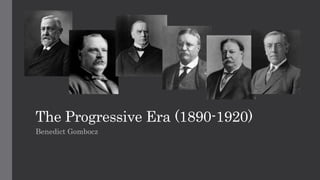
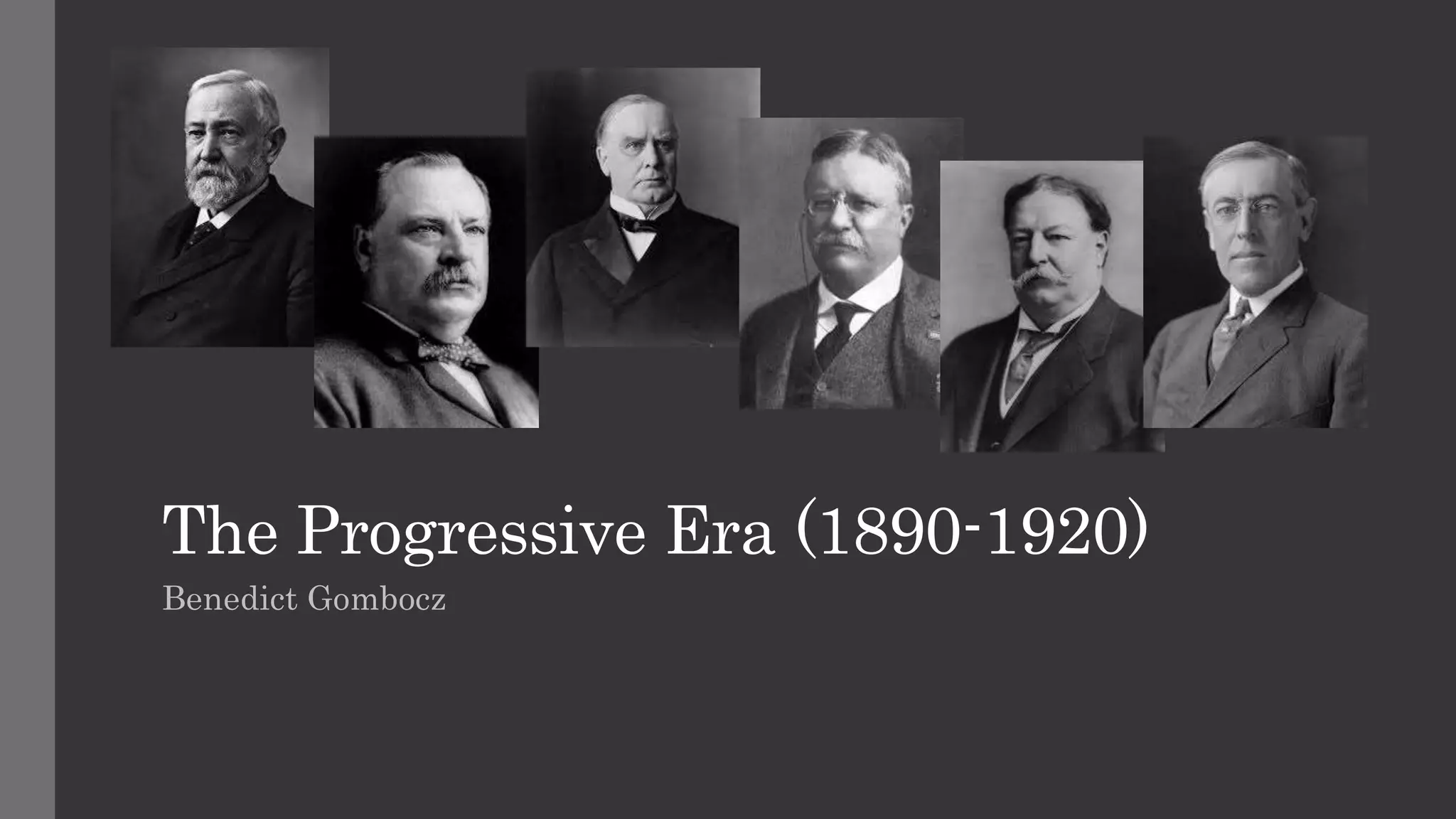
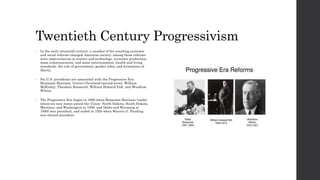
• Six U.S. presidents are associated with the Progressive Era: 
Benjamin Harrison, Grover Cleveland (second term), William 
McKinley, Theodore Roosevelt, William Howard Taft, and Woodrow 
Wilson. 
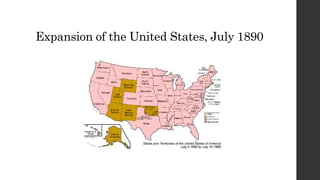
• The Progressive Era began in 1890 when Benjamin Harrison (under 
whom six new states joined the Union- North Dakota, South Dakota, 
Montana, and Washington in 1889, and Idaho and Wyoming in 
1890) was president, and ended in 1920 when Warren G. Harding 
was elected president.
Expansion of the United States, July 1890
Progressive Era: Goals 
• The term progressivism is an umbrella label for an extensive range of economic, political, social, and decent changes to society; these 
included the following efforts: ban on selling alcohol, manage child labor and sweatshops, scientifically regulate natural re sources, 
Americanize immigrants or limit immigration completely, and bust or regulate trusts. 
• Winning support from the urban, college-educated middle class, Progressive reformers were interested in reducing corruption in 
government, managing business practices, focusing on health risks, and advancing working conditions. 
• These reformers additionally fought to give the American people more direct control over government by means of direct primar ies to 
nominate candidates for public office, direct election of senators, the advantage, referendum, recall, and women’s suffrage.
Progressive Era: Early Accomplishments 
• By the early twentieth century, muckraking journalists were turning their focus to the misuse of child labor, corruption in c ity 
governments, the horror of lynching, and the cruel business practices of businessmen like John D. Rockefeller. 
• At the local level, numerous Progressive individuals wanted to destroy red-light districts, enlarge high schools, build playgrounds, and 
replace dishonest urban political machines with more effective systems of municipal government. 
• At the state level, Progressives passed minimum wage laws for women in the labor force, established industrial accident insurance, 
limited child labor, and improved factory regulation. 
• At the national level, Congress enacted laws that created federal regulation of the meat-packing, drug, and railroad industries; anti-trust 
laws were also tightened. 
• Congress additionally reduced the tariff, established government regulation over the banking system, and passed legislation t o improve 
labor conditions. 
• During the Progressive Era, four constitutional amendments were signed into law: authorizing an income tax (submitted 1909; ratified 
1913), providing for the direct election of senators (submitted 1912; ratified 1913), outlawing the manufacture and sale of alcoholic 
drinks (submitted 1917; ratified 1919; repealed 1933), and extending the right to vote to women (submitted 1919; ratified 1920).
Along the Color Line 
• The time between the late nineteenth and early twentieth centuries 
symbolized the lowest point of race relations in the United States. 
• Nine in ten African Americans lived in the South, where they generally 
worked as tenant farmers or sharecroppers. 
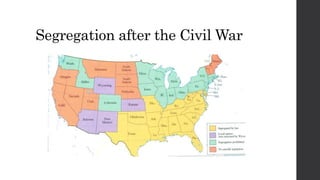
• Most southern and border states enforced a legal system of segregation 
after the Civil War, demoting African Americans to separate schools and 
other public places. 
• Under the Mississippi Plan of 1875, which involved the practice of poll 
taxes and literacy tests, African Americans lost their voting rights. 
• The Supreme Court ignored the fourteenth and fifteenth amendments, 
particularly in the court case Plessy v. Ferguson (1896), which ruled that 
“separate but equal” facilities, under the fourteenth amendment, were 
permitted. 
• Every year, almost one hundred African Americans were subject to 
lynching. 
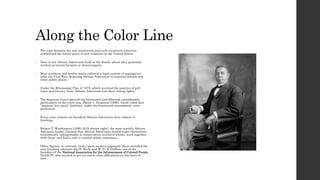
• Booker T. Washington (1856-1915; shown right), the most notable African 
American leader, claimed that African Americans should make themselves 
economically indispensable to conservative southern whites, work together 
with them, and find a role to counter white supremacy. 
• Other figures, in contrast, took a more modern approach; these included the 
anti-lynching advocate Ida B. Wells and W. E. B. DuBois, one of the 
founders of the National Association for the Advancement of Colored People 
(NAACP), who wanted to put an end to class differences on the basis of 
race.
Segregation after the Civil War
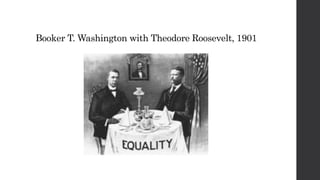
Booker T. Washington with Theodore Roosevelt, 1901
Along the Color Line – cont. 
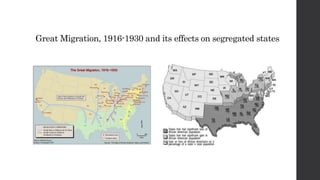
• A tight work market during World War I (1914-1918) led to the 
“Great Migration” of African Americans to the North; this 
continued into the 1920s. 
• But the relocation to the North did not mean a better life; the 
movement from the South instead caused racial violence in 
Chicago, East St. Louis, Houston, Tulsa, and other cities outside 
of the South. 
• However, the Great Migration was accompanied by new attempts 
at black political and economic organization and racial 
expression. 
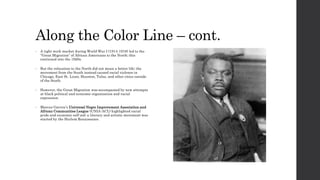
• Marcus Garvey’s Universal Negro Improvement Association and 
African Communities League (UNIA-ACL) highlighted racial 
pride and economic self-aid; a literary and artistic movement was 
started by the Harlem Renaissance.
Great Migration
Great Migration, 1916-1930 and its effects on segregated states
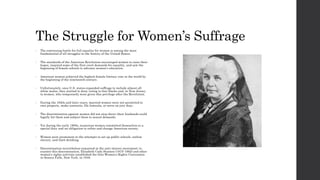
The Struggle for Women’s Suffrage 
• The continuing battle for full equality for women is among the most 
fundamental of all struggles in the history of the United States. 
• The standards of the American Revolution encouraged women to raise their 
hopes, inspired some of the first overt demands for equality, and saw the 
beginning of female schools to advance women’s education. 
• American women achieved the highest female literacy rate in the world by 
the beginning of the nineteenth century. 
• Unfortunately, once U.S. states expanded suffrage to include almost all 
white males, they started to deny voting to free blacks and, in New Jersey, 
to women, who temporarily were given this privilege after the Revolution. 
• During the 1820s and later years, married women were not permitted to 
own property, make contracts, file lawsuits, or serve on jury duty. 
• The discrimination against women did not stop there; their husbands could 
legally hit them and subject them to sexual demands. 
• Yet during the early 1800s, numerous women committed themselves to a 
special duty and an obligation to refine and change American society. 
• Women were prominent in the attempts to set up public schools, outlaw 
slavery, and limit drinking. 
• Discrimination nevertheless remained in the anti-slavery movement; to 
counter this discrimination, Elizabeth Cady Stanton (1815-1902) and other 
women’s rights activists established the first Women’s Rights Convention 
in Seneca Falls, New York, in 1848.
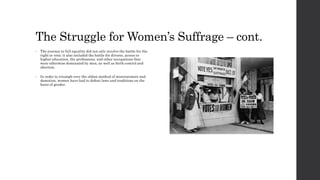
The Struggle for Women’s Suffrage – cont. 
• The journey to full equality did not only involve the battle for the 
right to vote; it also included the battle for divorce, access to 
higher education, the professions, and other occupations that 
were otherwise dominated by men, as well as birth control and 
abortion. 
• In order to triumph over the oldest method of mistreatment and 
demotion, women have had to defeat laws and traditions on the 
basis of gender.
What else did the Progressive Era achieve in 
the twentieth century? 
• 1954: Brown v. Board of Education overturns Plessy v. Furgeson; notion of “separate but equal” is stuck down 
• 1955: Rosa Parks is arrested for refusing to give up her seat on a Montgomery bus, leading to the Montgomery Bus Boycott 
• 1956: Supreme Court rules that segregation on city buses is unconstitutional 
• 1957: Southern Christian Leadership Conference (SCLC) founded 
• 1964 (July): Civil Rights Act is signed into law and bans discrimination on basis of race, color, religion, sex, or national origin; polling 
taxes and literacy tests are also banned 
• 1964 (October): Billy Mills becomes the second Native American (after Jim Thorpe) to win the Olympic gold medal 
• 1965: Voting Rights Act enforces voting rights guaranteed by fourteenth and fifteen amendments 
• 1967: Thurgood Marshall is appointed first African American Associate Justice of the Supreme Court 
• 1968: Civil Rights Act provides for equal housing opportunities with no regard to race, creed, or national origin and makes c ertain acts of 
violence or fear punishable by law 
• 1976: Dixy Lee Ray is elected first female governor of Washington 
• 1994: Violence Against Women Act (VAWA) passed, providing $1.6 billion for investigation and prosecution of violent crimes against 
women 
• 2004: Massachusetts becomes the first state (and the sixth jurisdiction) to legalize same-sex marriage (it was also the first state to give 
marriage licenses to same-sex couples)
What else did the Progressive Era achieve in 
the twentieth century? – cont. 
• 2006: Deval Patrick is elected the first African American governor of Massachusetts, and second in the U.S. after P. B. S. 
Pinchback (Louisiana) in 1872 
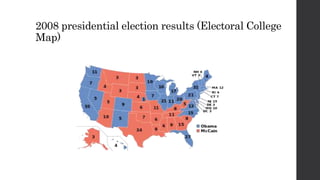
• 2008: Barack Obama is elected president, making him the first African American to hold the office (before he won the 
Democratic nomination in June of that year, Hillary Clinton was widely perceived to become the first female president) 
• 2012: Elizabeth Warren is elected the first female senator from Massachusetts
2008 presidential election results (Electoral College 
Map)
Which states are considered progressive? 
• States that are commonly seen as progressive include (in no specific order): 
 Massachusetts (often seen as the most liberal state in the country) 
 Vermont 
 Minnesota 
 New York 
 California 
 Washington 
 Rhode Island 
 Connecticut 
 Oregon 
 New Jersey 
 Colorado 
 Hawaii 
 New Hampshire 
 Delaware
References 
• http://www.digitalhistory.uh.edu/era.cfm?eraid=11

The Progressive Era (1890-1920)

  • 1.
    The Progressive Era(1890-1920) Benedict Gombocz
  • 2.
    Twentieth Century Progressivism • In the early twentieth century, a number of far-reaching economic and social reforms changed American society; among these reforms were improvements in science and technology, economic production, mass communication, and mass entertainment, health and living standards, the role of government, gender roles, and formations of liberty. • Six U.S. presidents are associated with the Progressive Era: Benjamin Harrison, Grover Cleveland (second term), William McKinley, Theodore Roosevelt, William Howard Taft, and Woodrow Wilson. • The Progressive Era began in 1890 when Benjamin Harrison (under whom six new states joined the Union- North Dakota, South Dakota, Montana, and Washington in 1889, and Idaho and Wyoming in 1890) was president, and ended in 1920 when Warren G. Harding was elected president.
  • 3.
    Expansion of theUnited States, July 1890
  • 4.
    Progressive Era: Goals • The term progressivism is an umbrella label for an extensive range of economic, political, social, and decent changes to society; these included the following efforts: ban on selling alcohol, manage child labor and sweatshops, scientifically regulate natural re sources, Americanize immigrants or limit immigration completely, and bust or regulate trusts. • Winning support from the urban, college-educated middle class, Progressive reformers were interested in reducing corruption in government, managing business practices, focusing on health risks, and advancing working conditions. • These reformers additionally fought to give the American people more direct control over government by means of direct primar ies to nominate candidates for public office, direct election of senators, the advantage, referendum, recall, and women’s suffrage.
  • 5.
    Progressive Era: EarlyAccomplishments • By the early twentieth century, muckraking journalists were turning their focus to the misuse of child labor, corruption in c ity governments, the horror of lynching, and the cruel business practices of businessmen like John D. Rockefeller. • At the local level, numerous Progressive individuals wanted to destroy red-light districts, enlarge high schools, build playgrounds, and replace dishonest urban political machines with more effective systems of municipal government. • At the state level, Progressives passed minimum wage laws for women in the labor force, established industrial accident insurance, limited child labor, and improved factory regulation. • At the national level, Congress enacted laws that created federal regulation of the meat-packing, drug, and railroad industries; anti-trust laws were also tightened. • Congress additionally reduced the tariff, established government regulation over the banking system, and passed legislation t o improve labor conditions. • During the Progressive Era, four constitutional amendments were signed into law: authorizing an income tax (submitted 1909; ratified 1913), providing for the direct election of senators (submitted 1912; ratified 1913), outlawing the manufacture and sale of alcoholic drinks (submitted 1917; ratified 1919; repealed 1933), and extending the right to vote to women (submitted 1919; ratified 1920).
  • 6.
    Along the ColorLine • The time between the late nineteenth and early twentieth centuries symbolized the lowest point of race relations in the United States. • Nine in ten African Americans lived in the South, where they generally worked as tenant farmers or sharecroppers. • Most southern and border states enforced a legal system of segregation after the Civil War, demoting African Americans to separate schools and other public places. • Under the Mississippi Plan of 1875, which involved the practice of poll taxes and literacy tests, African Americans lost their voting rights. • The Supreme Court ignored the fourteenth and fifteenth amendments, particularly in the court case Plessy v. Ferguson (1896), which ruled that “separate but equal” facilities, under the fourteenth amendment, were permitted. • Every year, almost one hundred African Americans were subject to lynching. • Booker T. Washington (1856-1915; shown right), the most notable African American leader, claimed that African Americans should make themselves economically indispensable to conservative southern whites, work together with them, and find a role to counter white supremacy. • Other figures, in contrast, took a more modern approach; these included the anti-lynching advocate Ida B. Wells and W. E. B. DuBois, one of the founders of the National Association for the Advancement of Colored People (NAACP), who wanted to put an end to class differences on the basis of race.
  • 7.
  • 8.
    Booker T. Washingtonwith Theodore Roosevelt, 1901
  • 9.
    Along the ColorLine – cont. • A tight work market during World War I (1914-1918) led to the “Great Migration” of African Americans to the North; this continued into the 1920s. • But the relocation to the North did not mean a better life; the movement from the South instead caused racial violence in Chicago, East St. Louis, Houston, Tulsa, and other cities outside of the South. • However, the Great Migration was accompanied by new attempts at black political and economic organization and racial expression. • Marcus Garvey’s Universal Negro Improvement Association and African Communities League (UNIA-ACL) highlighted racial pride and economic self-aid; a literary and artistic movement was started by the Harlem Renaissance.
  • 10.
  • 11.
    Great Migration, 1916-1930and its effects on segregated states
  • 12.
    The Struggle forWomen’s Suffrage • The continuing battle for full equality for women is among the most fundamental of all struggles in the history of the United States. • The standards of the American Revolution encouraged women to raise their hopes, inspired some of the first overt demands for equality, and saw the beginning of female schools to advance women’s education. • American women achieved the highest female literacy rate in the world by the beginning of the nineteenth century. • Unfortunately, once U.S. states expanded suffrage to include almost all white males, they started to deny voting to free blacks and, in New Jersey, to women, who temporarily were given this privilege after the Revolution. • During the 1820s and later years, married women were not permitted to own property, make contracts, file lawsuits, or serve on jury duty. • The discrimination against women did not stop there; their husbands could legally hit them and subject them to sexual demands. • Yet during the early 1800s, numerous women committed themselves to a special duty and an obligation to refine and change American society. • Women were prominent in the attempts to set up public schools, outlaw slavery, and limit drinking. • Discrimination nevertheless remained in the anti-slavery movement; to counter this discrimination, Elizabeth Cady Stanton (1815-1902) and other women’s rights activists established the first Women’s Rights Convention in Seneca Falls, New York, in 1848.
  • 13.
    The Struggle forWomen’s Suffrage – cont. • The journey to full equality did not only involve the battle for the right to vote; it also included the battle for divorce, access to higher education, the professions, and other occupations that were otherwise dominated by men, as well as birth control and abortion. • In order to triumph over the oldest method of mistreatment and demotion, women have had to defeat laws and traditions on the basis of gender.
  • 14.
    What else didthe Progressive Era achieve in the twentieth century? • 1954: Brown v. Board of Education overturns Plessy v. Furgeson; notion of “separate but equal” is stuck down • 1955: Rosa Parks is arrested for refusing to give up her seat on a Montgomery bus, leading to the Montgomery Bus Boycott • 1956: Supreme Court rules that segregation on city buses is unconstitutional • 1957: Southern Christian Leadership Conference (SCLC) founded • 1964 (July): Civil Rights Act is signed into law and bans discrimination on basis of race, color, religion, sex, or national origin; polling taxes and literacy tests are also banned • 1964 (October): Billy Mills becomes the second Native American (after Jim Thorpe) to win the Olympic gold medal • 1965: Voting Rights Act enforces voting rights guaranteed by fourteenth and fifteen amendments • 1967: Thurgood Marshall is appointed first African American Associate Justice of the Supreme Court • 1968: Civil Rights Act provides for equal housing opportunities with no regard to race, creed, or national origin and makes c ertain acts of violence or fear punishable by law • 1976: Dixy Lee Ray is elected first female governor of Washington • 1994: Violence Against Women Act (VAWA) passed, providing $1.6 billion for investigation and prosecution of violent crimes against women • 2004: Massachusetts becomes the first state (and the sixth jurisdiction) to legalize same-sex marriage (it was also the first state to give marriage licenses to same-sex couples)
  • 15.
    What else didthe Progressive Era achieve in the twentieth century? – cont. • 2006: Deval Patrick is elected the first African American governor of Massachusetts, and second in the U.S. after P. B. S. Pinchback (Louisiana) in 1872 • 2008: Barack Obama is elected president, making him the first African American to hold the office (before he won the Democratic nomination in June of that year, Hillary Clinton was widely perceived to become the first female president) • 2012: Elizabeth Warren is elected the first female senator from Massachusetts
  • 16.
    2008 presidential electionresults (Electoral College Map)
  • 17.
    Which states areconsidered progressive? • States that are commonly seen as progressive include (in no specific order):  Massachusetts (often seen as the most liberal state in the country)  Vermont  Minnesota  New York  California  Washington  Rhode Island  Connecticut  Oregon  New Jersey  Colorado  Hawaii  New Hampshire  Delaware
  • 18.