The Gilded AgeChapter 7, Sections 1 & 3
Essential QuestionHow was the Gilded Age a time of social and political change in the United States?
The New ImmigrantsChapter 7 – Section 1
Why did they come?Escape religious persecutionRising population in EuropeIndependent lives in AmericaShortage of work in homeland
Where did they come from?Southern and Eastern EuropeNortheast StatesChina & JapanWest CoastWest IndiesEastern and Southeast StatesMexicoSouthwestern States
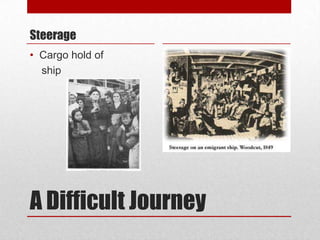
A Difficult JourneySteerageCargo hold of     ship
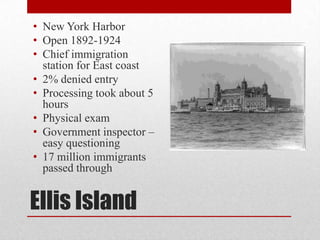
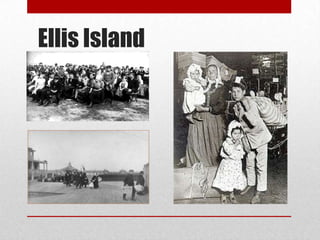
Ellis IslandNew York HarborOpen 1892-1924 Chief immigration station for East coast2% denied entryProcessing took about 5 hoursPhysical examGovernment inspector – easy questioning17 million immigrants passed through
Ellis Island
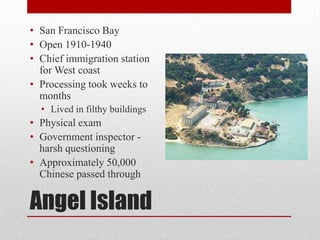
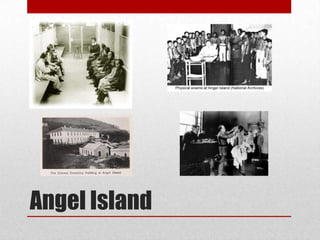
Angel IslandSan Francisco BayOpen 1910-1940 Chief immigration station for West coastProcessing took weeks to monthsLived in filthy buildingsPhysical examGovernment inspector - harsh questioningApproximately 50,000 Chinese passed through
Angel Island
NativismFavoritism toward native born Americans
What did they believe?Anglo-Saxons superiorImmigrants from“right”countries OKImmigrants from“wrong”countries caused the problemsObjected to religious beliefs of Jews and Roman CatholicsImmigration restrictions
Nativism GroupsAmerican Protective AssociationVicious anti-Catholic attacksImmigration Restriction LeaguePushed for literacy tests
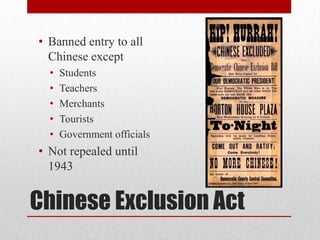
Chinese Exclusion Act	Banned entry to all Chinese exceptStudentsTeachersMerchantsTouristsGovernment officialsNot repealed until 1943
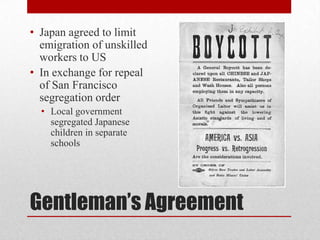
Gentleman’s AgreementJapan agreed to limit emigration of unskilled workers to USIn exchange for repeal of San Francisco segregation orderLocal government segregated Japanese children in separate schools
Politics in the Gilded AgeSection 3
What does it mean?Gild: to coat with gold leaf or a gold color.  To make seem more attractive or valuable than it is.Synonyms:  overlay with gold, varnish, give glitter to, paint in rosy colors
The Gilded Age1876-1900The term Gilded Age refers to the political and economic situation of the United States from approximately 1876-1900.It created a number of immensely successful businessmen as public figures; these were often referred to as the“robber barons”.
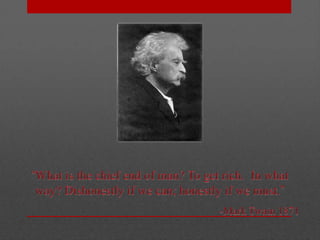
“What is the chief end of man? To get rich.  In what way? Dishonestly if we can; honestly if we must.”-Mark Twain 1871
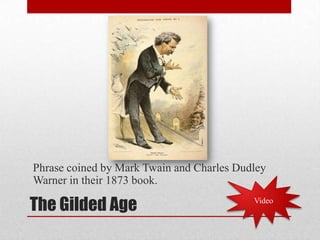
The Gilded AgePhrase coined by Mark Twain and Charles Dudley Warner in their 1873 book.Video
It was the best of times for the rich, it was the worst of times for the poor.At the height of the Gilded Age, 90% of the nation’s families earned less than $1,200 a year and the average annual income was $380, well below the poverty line.
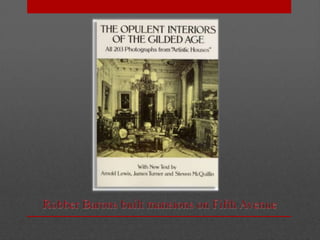
Robber Barons built mansions on Fifth Avenue
While the rich wore diamonds, many wore rags.For immediate relief, the urban poor turned to political machines.Video
The Political MachineAn organized group that controlled the activities of a political party in a city by taking advantage of the needs of the immigrants and urban poor.Ensured voter loyalty by providing jobs and social services to immigrants’ most pressing problems.
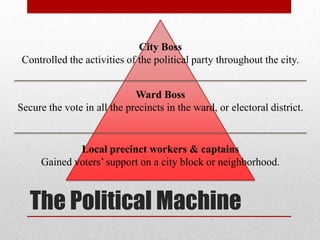
The Political MachineCity BossControlled the activities of the political party throughout the city.Ward BossSecure the vote in all the precincts in the ward, or electoral district.Local precinct workers & captainsGained voters’ support on a city block or neighborhood.
What was the role of the political boss?Controlled access to municipal jobs and business licensesInfluenced the courts and other municipal agenciesProvide government support for new businessesOften paid extremely wellReinforce voters’ loyaltyWin additional political supportExtend influence
What role did immigrants play?Immigrants provided the political machine with votes.Many precinct captains and political bosses were 1st or 2nd generation immigrantsEntered politics & worked way up from bottomAble to provide solutions
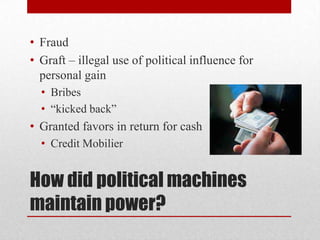
How did political machines maintain power?FraudGraft – illegal use of political influence for personal gainBribes“kicked back”Granted favors in return for cashCredit Mobilier
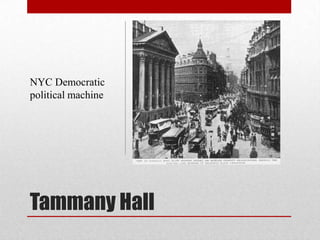
Tammany HallNYC Democratic political machine
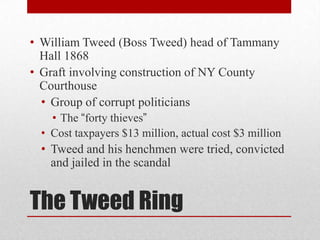
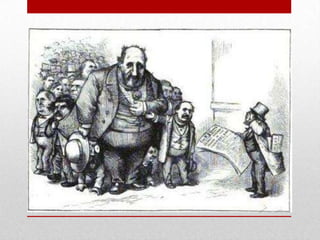
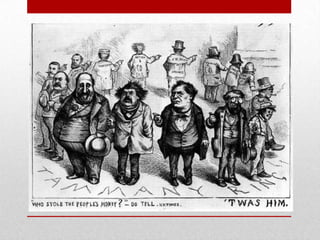
The Tweed RingWilliam Tweed (Boss Tweed) head of Tammany Hall 1868Graft involving construction of NY County CourthouseGroup of corrupt politiciansThe “forty thieves”Cost taxpayers $13 million, actual cost $3 millionTweed and his henchmen were tried, convicted and jailed in the scandal
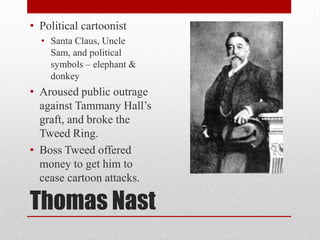
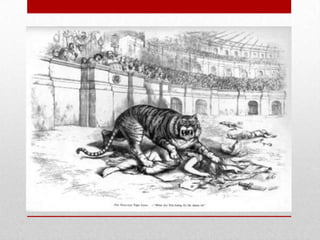
Thomas NastPolitical cartoonistSanta Claus, Uncle Sam, and political symbols – elephant & donkeyAroused public outrage against Tammany Hall’s graft, and broke the Tweed Ring.Boss Tweed offered money to get him to cease cartoon attacks.
PatronageGiving of government jobs to people who had helped a candidate get elected.“spoils system”Employees not qualified for positionsUsed positions for personal gainReformers pressed for adoption of merit systemCivil service
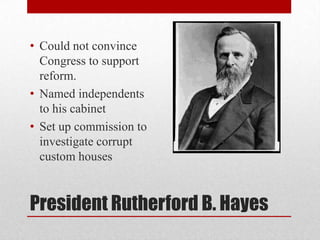
Could not convince Congress to support reform.Named independents to his cabinetSet up commission to investigate corrupt custom housesPresident Rutherford B. Hayes
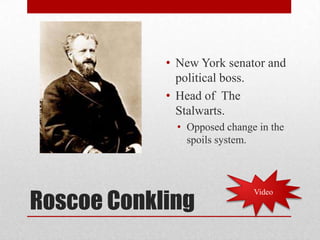
Roscoe ConklingNew York senator and political boss.Head of The Stalwarts.Opposed change in the spoils system.Video
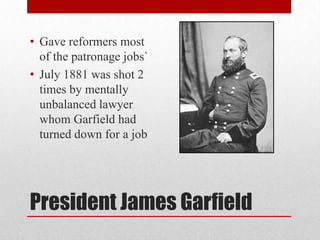
President James GarfieldGave reformers most of the patronage jobs`July 1881 was shot 2 times by mentally unbalanced lawyer whom Garfield had turned down for a job
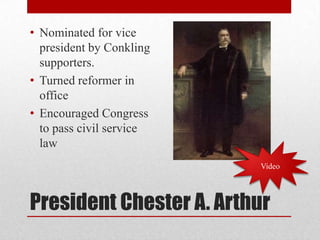
President Chester A. ArthurNominated for vice president by Conkling supporters.Turned reformer in officeEncouraged Congress to pass civil service lawVideo
Pendleton Civil Service Act of 1883Authorized a bipartisan (supported by two parties) civil service commission To make appointments to federal jobs through a merit system Based on performance on an examinationVideo
Business Buys InfluenceWith civil service reform, employees no longer source of campaign contributionsTurned to wealthy business ownersAlliance between government and big businessBusiness wanted tariffs raised to protect domestic industry from foreign competition
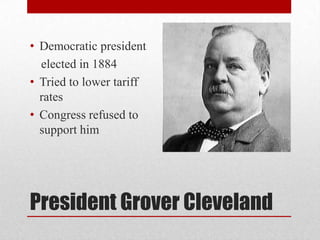
President Grover ClevelandDemocratic presidentelected in 1884Tried to lower tariff ratesCongress refused to support him
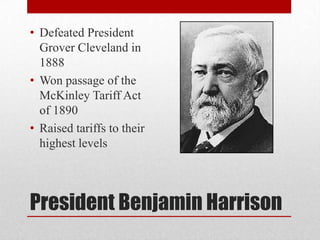
President Benjamin HarrisonDefeated President Grover Cleveland in 1888Won passage of the McKinley Tariff Act of 1890Raised tariffs to their highest levels
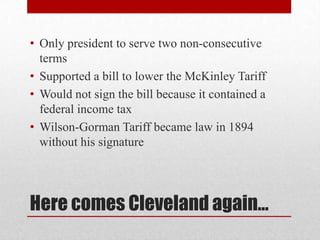
Here comes Cleveland again…Only president to serve two non-consecutive termsSupported a bill to lower the McKinley TariffWould not sign the bill because it contained a federal income taxWilson-Gorman Tariff became law in 1894 without his signature
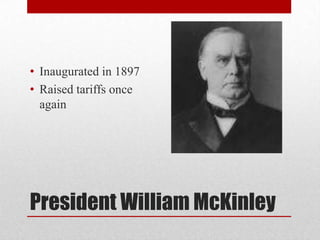
President William McKinleyInaugurated in 1897Raised tariffs once again
Taking NotesIn a chart like the one shown, list examples of corruption in 19th century politics.Corruption
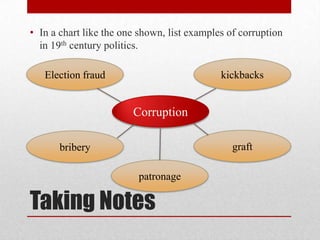
Taking NotesIn a chart like the one shown, list examples of corruption in 19th century politics.Election fraudkickbacksCorruptiongraftbriberypatronage

The gilded age

  • 1.
    The Gilded AgeChapter7, Sections 1 & 3
  • 2.
    Essential QuestionHow wasthe Gilded Age a time of social and political change in the United States?
  • 3.
    The New ImmigrantsChapter7 – Section 1
  • 4.
    Why did theycome?Escape religious persecutionRising population in EuropeIndependent lives in AmericaShortage of work in homeland
  • 5.
    Where did theycome from?Southern and Eastern EuropeNortheast StatesChina & JapanWest CoastWest IndiesEastern and Southeast StatesMexicoSouthwestern States
  • 6.
  • 7.
    Ellis IslandNew YorkHarborOpen 1892-1924 Chief immigration station for East coast2% denied entryProcessing took about 5 hoursPhysical examGovernment inspector – easy questioning17 million immigrants passed through
  • 8.
  • 9.
    Angel IslandSan FranciscoBayOpen 1910-1940 Chief immigration station for West coastProcessing took weeks to monthsLived in filthy buildingsPhysical examGovernment inspector - harsh questioningApproximately 50,000 Chinese passed through
  • 10.
  • 11.
  • 12.
    What did theybelieve?Anglo-Saxons superiorImmigrants from“right”countries OKImmigrants from“wrong”countries caused the problemsObjected to religious beliefs of Jews and Roman CatholicsImmigration restrictions
  • 13.
    Nativism GroupsAmerican ProtectiveAssociationVicious anti-Catholic attacksImmigration Restriction LeaguePushed for literacy tests
  • 14.
    Chinese Exclusion Act Bannedentry to all Chinese exceptStudentsTeachersMerchantsTouristsGovernment officialsNot repealed until 1943
  • 15.
    Gentleman’s AgreementJapan agreedto limit emigration of unskilled workers to USIn exchange for repeal of San Francisco segregation orderLocal government segregated Japanese children in separate schools
  • 17.
    Politics in theGilded AgeSection 3
  • 18.
    What does itmean?Gild: to coat with gold leaf or a gold color. To make seem more attractive or valuable than it is.Synonyms: overlay with gold, varnish, give glitter to, paint in rosy colors
  • 19.
    The Gilded Age1876-1900Theterm Gilded Age refers to the political and economic situation of the United States from approximately 1876-1900.It created a number of immensely successful businessmen as public figures; these were often referred to as the“robber barons”.
  • 20.
    “What is thechief end of man? To get rich. In what way? Dishonestly if we can; honestly if we must.”-Mark Twain 1871
  • 21.
    The Gilded AgePhrasecoined by Mark Twain and Charles Dudley Warner in their 1873 book.Video
  • 22.
    It was thebest of times for the rich, it was the worst of times for the poor.At the height of the Gilded Age, 90% of the nation’s families earned less than $1,200 a year and the average annual income was $380, well below the poverty line.
  • 23.
    Robber Barons builtmansions on Fifth Avenue
  • 24.
    While the richwore diamonds, many wore rags.For immediate relief, the urban poor turned to political machines.Video
  • 25.
    The Political MachineAnorganized group that controlled the activities of a political party in a city by taking advantage of the needs of the immigrants and urban poor.Ensured voter loyalty by providing jobs and social services to immigrants’ most pressing problems.
  • 26.
    The Political MachineCityBossControlled the activities of the political party throughout the city.Ward BossSecure the vote in all the precincts in the ward, or electoral district.Local precinct workers & captainsGained voters’ support on a city block or neighborhood.
  • 27.
    What was therole of the political boss?Controlled access to municipal jobs and business licensesInfluenced the courts and other municipal agenciesProvide government support for new businessesOften paid extremely wellReinforce voters’ loyaltyWin additional political supportExtend influence
  • 28.
    What role didimmigrants play?Immigrants provided the political machine with votes.Many precinct captains and political bosses were 1st or 2nd generation immigrantsEntered politics & worked way up from bottomAble to provide solutions
  • 29.
    How did politicalmachines maintain power?FraudGraft – illegal use of political influence for personal gainBribes“kicked back”Granted favors in return for cashCredit Mobilier
  • 30.
  • 31.
    The Tweed RingWilliamTweed (Boss Tweed) head of Tammany Hall 1868Graft involving construction of NY County CourthouseGroup of corrupt politiciansThe “forty thieves”Cost taxpayers $13 million, actual cost $3 millionTweed and his henchmen were tried, convicted and jailed in the scandal
  • 32.
    Thomas NastPolitical cartoonistSantaClaus, Uncle Sam, and political symbols – elephant & donkeyAroused public outrage against Tammany Hall’s graft, and broke the Tweed Ring.Boss Tweed offered money to get him to cease cartoon attacks.
  • 36.
    PatronageGiving of governmentjobs to people who had helped a candidate get elected.“spoils system”Employees not qualified for positionsUsed positions for personal gainReformers pressed for adoption of merit systemCivil service
  • 37.
    Could not convinceCongress to support reform.Named independents to his cabinetSet up commission to investigate corrupt custom housesPresident Rutherford B. Hayes
  • 38.
    Roscoe ConklingNew Yorksenator and political boss.Head of The Stalwarts.Opposed change in the spoils system.Video
  • 39.
    President James GarfieldGavereformers most of the patronage jobs`July 1881 was shot 2 times by mentally unbalanced lawyer whom Garfield had turned down for a job
  • 40.
    President Chester A.ArthurNominated for vice president by Conkling supporters.Turned reformer in officeEncouraged Congress to pass civil service lawVideo
  • 41.
    Pendleton Civil ServiceAct of 1883Authorized a bipartisan (supported by two parties) civil service commission To make appointments to federal jobs through a merit system Based on performance on an examinationVideo
  • 42.
    Business Buys InfluenceWithcivil service reform, employees no longer source of campaign contributionsTurned to wealthy business ownersAlliance between government and big businessBusiness wanted tariffs raised to protect domestic industry from foreign competition
  • 43.
    President Grover ClevelandDemocraticpresidentelected in 1884Tried to lower tariff ratesCongress refused to support him
  • 44.
    President Benjamin HarrisonDefeatedPresident Grover Cleveland in 1888Won passage of the McKinley Tariff Act of 1890Raised tariffs to their highest levels
  • 45.
    Here comes Clevelandagain…Only president to serve two non-consecutive termsSupported a bill to lower the McKinley TariffWould not sign the bill because it contained a federal income taxWilson-Gorman Tariff became law in 1894 without his signature
  • 46.
    President William McKinleyInauguratedin 1897Raised tariffs once again
  • 47.
    Taking NotesIn achart like the one shown, list examples of corruption in 19th century politics.Corruption
  • 48.
    Taking NotesIn achart like the one shown, list examples of corruption in 19th century politics.Election fraudkickbacksCorruptiongraftbriberypatronage