The Process ofThe Process of
ListeningListening
We have two ears and one mouth so that we can listen
twice as much as we speak. ~ Epictetus
Listening is the most powerful
form of acknowledgment
…a way of saying to your
customer, “You are important.”
What is Listening?What is Listening?
• Listening is a highly complex,
interactive process "by which spoken
language is converted to meaning in
the mind” and to hear something
with thoughtful attention.
• Effective communication is 2-way
– depends on speaking and listening
L-Look interested-get interested
I-Involve yourself by responding
S-Stay on target
T-Test your understanding
E-Evaluate the message
N-Neutralize your feelings
Why is listening important?
Listening will help you in…
•School
•Relationships
•Social groups & organizations
•Making informed decisions
•On the job
Fast FactsFast Facts
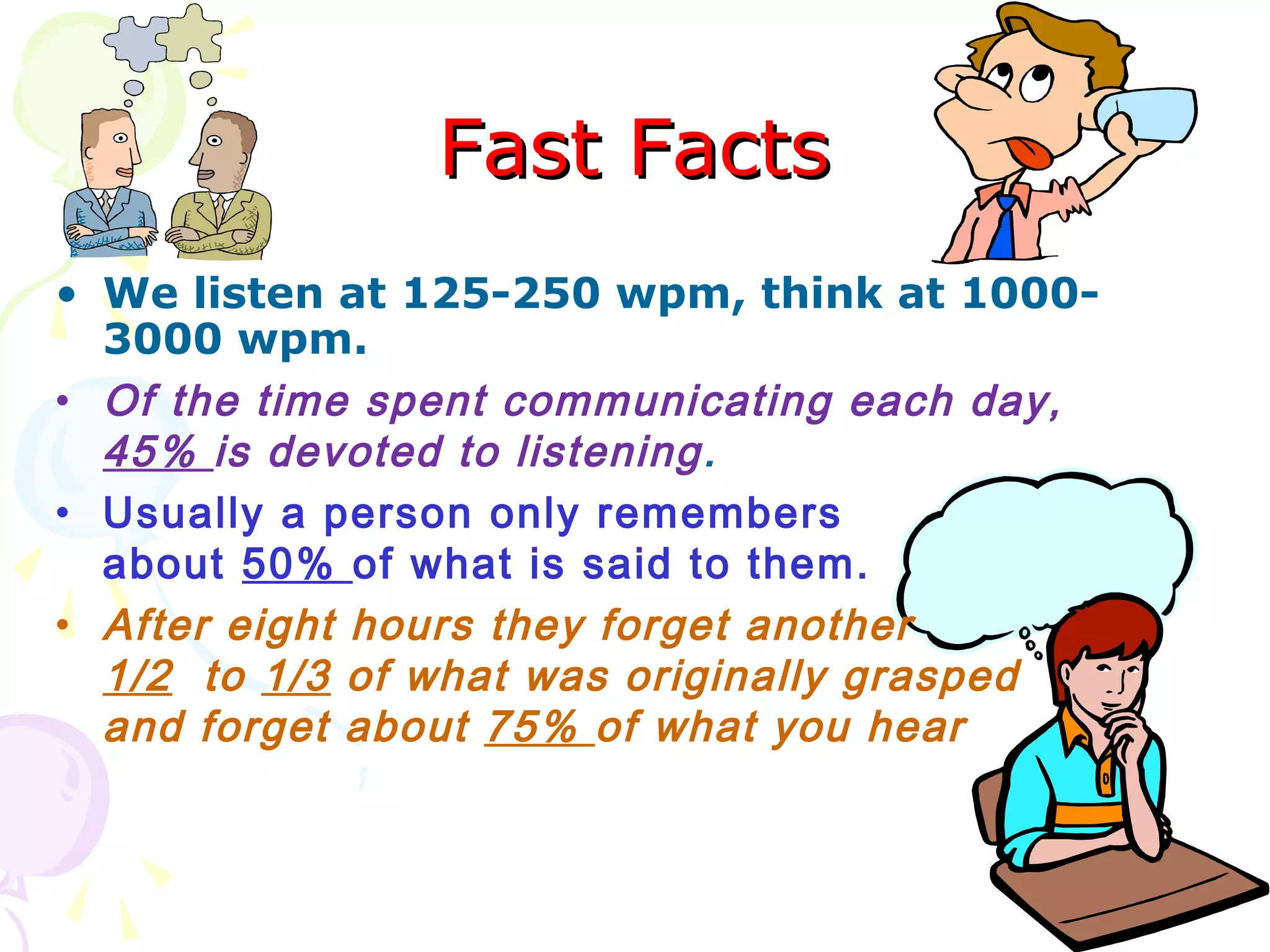
• We listen at 125-250 wpm, think at 1000-
3000 wpm.
• Of the time spent communicating each day,
45% is devoted to listening.
• Usually a person only remembers
about 50% of what is said to them.
• After eight hours they forget another
1/2 to 1/3 of what was originally grasped
and forget about 75% of what you hear
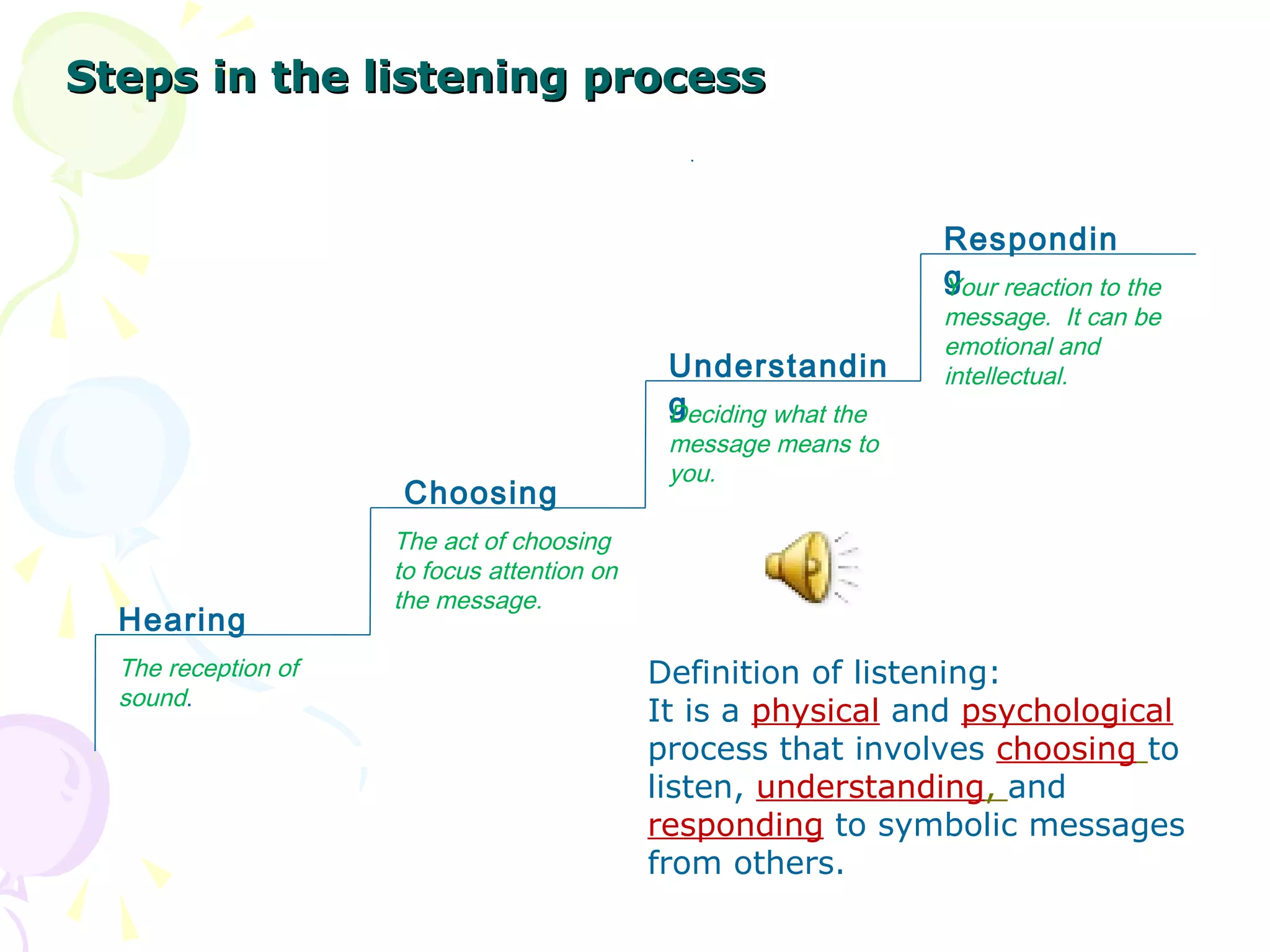
Hearing
Choosing
Understandin
g
Respondin
g
The reception of
sound.
The act of choosing
to focus attention on
the message.
Deciding what the
message means to
you.
Your reaction to the
message. It can be
emotional and
intellectual.
Steps in the listening processSteps in the listening process
Definition of listening:
It is a physical and psychological
process that involves choosing to
listen, understanding, and
responding to symbolic messages
from others.
.
RECEIVINGRECEIVING -Hearing-Hearing
• It refers to the response caused
by sound waves stimulating the
sensory receptors of the ear.
• It is physical response.
• You must hear to listen, but you
need not listen to hear .
ATTENTION
• Brain screens stimuli and permits
only a select few to come into focus-
these selective perception is known
as attention.
• Selectivity, strength, and
sustainment determine attention.
UNDERSTANDINGUNDERSTANDING
• Effective communication depends on
understanding.
• Effective communication does not
take place until the receiver
understands the message.
BarriersBarriers
• The same words mean different
things to different people.
• Different words sometimes mean the
same thing.
• Misinterpretation of the action.
• Misinterpretation of non action
symbols and voices.
REMEMBERING
• It is important listening process
because it means that an individual
has not only received and interpreted
a message but has also added it to
the mind's storage bank.
• What is remembered may be quite
different from what was originally
seen or heard.
EVALUATING
It is a stage in which active listeners
participate.
Ordinary listeners part is over with
remembering.
It is at these point that the active listener
weighs evidence, sorts fact from opinion,
and determines the presence or absence of
bias or prejudice in a message.
RESPONDING
• It is important listening process
because the speaker has no other
way to determine if a message has
been received. And there are
different types of responses.
1. Direct verbal responses.
2. Responses that seek clarification
3. Nonverbal responses.
FACTORS THAT AFFECT THE LISTENING PROCESSFACTORS THAT AFFECT THE LISTENING PROCESS
• Noise – Internal and external distractions
– Examples: outside sounds, distracting thoughts
• Barriers – Blocks listening/understanding.
– Unfamiliar language, anger,beliefs, fear, hearing
problems, stress, ignorance, tired.
• Memory – 3 types
– Immediate – Recalling information for a brief period of
time.
– Short term – Recalling information for carrying out a
routine or daily task.
– Long term – Recalling information from past
experience.
THANK YOU

The process of listening

  • 1.
    The Process ofTheProcess of ListeningListening We have two ears and one mouth so that we can listen twice as much as we speak. ~ Epictetus
  • 2.
    Listening is themost powerful form of acknowledgment …a way of saying to your customer, “You are important.”
  • 3.
    What is Listening?Whatis Listening? • Listening is a highly complex, interactive process "by which spoken language is converted to meaning in the mind” and to hear something with thoughtful attention. • Effective communication is 2-way – depends on speaking and listening
  • 4.
    L-Look interested-get interested I-Involveyourself by responding S-Stay on target T-Test your understanding E-Evaluate the message N-Neutralize your feelings
  • 5.
    Why is listeningimportant? Listening will help you in… •School •Relationships •Social groups & organizations •Making informed decisions •On the job
  • 6.
    Fast FactsFast Facts •We listen at 125-250 wpm, think at 1000- 3000 wpm. • Of the time spent communicating each day, 45% is devoted to listening. • Usually a person only remembers about 50% of what is said to them. • After eight hours they forget another 1/2 to 1/3 of what was originally grasped and forget about 75% of what you hear
  • 7.
    Hearing Choosing Understandin g Respondin g The reception of sound. Theact of choosing to focus attention on the message. Deciding what the message means to you. Your reaction to the message. It can be emotional and intellectual. Steps in the listening processSteps in the listening process Definition of listening: It is a physical and psychological process that involves choosing to listen, understanding, and responding to symbolic messages from others. .
  • 8.
    RECEIVINGRECEIVING -Hearing-Hearing • Itrefers to the response caused by sound waves stimulating the sensory receptors of the ear. • It is physical response. • You must hear to listen, but you need not listen to hear .
  • 9.
    ATTENTION • Brain screensstimuli and permits only a select few to come into focus- these selective perception is known as attention. • Selectivity, strength, and sustainment determine attention.
  • 10.
    UNDERSTANDINGUNDERSTANDING • Effective communicationdepends on understanding. • Effective communication does not take place until the receiver understands the message.
  • 11.
    BarriersBarriers • The samewords mean different things to different people. • Different words sometimes mean the same thing. • Misinterpretation of the action. • Misinterpretation of non action symbols and voices.
  • 12.
    REMEMBERING • It isimportant listening process because it means that an individual has not only received and interpreted a message but has also added it to the mind's storage bank. • What is remembered may be quite different from what was originally seen or heard.
  • 13.
    EVALUATING It is astage in which active listeners participate. Ordinary listeners part is over with remembering. It is at these point that the active listener weighs evidence, sorts fact from opinion, and determines the presence or absence of bias or prejudice in a message.
  • 14.
    RESPONDING • It isimportant listening process because the speaker has no other way to determine if a message has been received. And there are different types of responses. 1. Direct verbal responses. 2. Responses that seek clarification 3. Nonverbal responses.
  • 15.
    FACTORS THAT AFFECTTHE LISTENING PROCESSFACTORS THAT AFFECT THE LISTENING PROCESS • Noise – Internal and external distractions – Examples: outside sounds, distracting thoughts • Barriers – Blocks listening/understanding. – Unfamiliar language, anger,beliefs, fear, hearing problems, stress, ignorance, tired. • Memory – 3 types – Immediate – Recalling information for a brief period of time. – Short term – Recalling information for carrying out a routine or daily task. – Long term – Recalling information from past experience.
  • 19.