German Expressionist Films and their impact upon the
Modern Film Industry
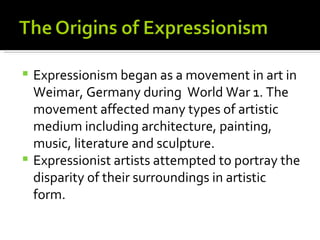
 Expressionism began as a movement in art in
  Weimar, Germany during World War 1. The
  movement affected many types of artistic
  medium including architecture, painting,
  music, literature and sculpture.
 Expressionist artists attempted to portray the
  disparity of their surroundings in artistic
  form.
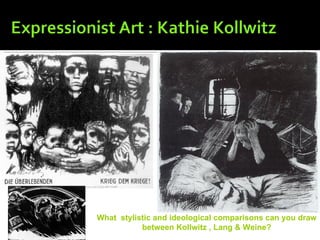
What stylistic and ideological comparisons can you draw
           between Kollwitz , Lang & Weine?
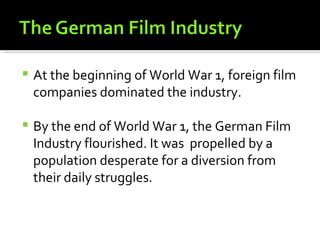
   At the beginning of World War 1, foreign film
    companies dominated the industry.

   By the end of World War 1, the German Film
    Industry flourished. It was propelled by a
    population desperate for a diversion from
    their daily struggles.
   UFA (Universum Film Aktiengelleschaft) became a leader in
    the German Film Industry.
   Created by German government in 1917 as a WWI
    propaganda arm, by consolidating most of Germany‘s
    commercial studios
   After a 1921 merger with Decla-Bioscop, "with government,
    industrial and banking support," UFA enjoyed a near-
    monopoly
   Produced many great and influential works during the
    Weimar Republic years (1919-1933 approx.)
   Through many incarnations, UFA still exists today
   UFA produced many German Expressionist films which were
    destined to become classics.
   Many of the films, which achieved infamy outside of
    Germany, are still recognized and watched today.
•   Because of the deteriorating post-World War
    I economy in Germany, filmmakers were
    unable to create films which could compete
    with the grandiosity of Hollywood pictures.

•   By using the elements of expressionism,
    German filmmakers developed their own
    style of filmmaking which incorporated
    symbolism to expose deeper meanings and
    emotions.
   German Expressionist films were made
    during the silent film era. They contained
    sounds and music as opposed to dialogue.

   For many of the silent films, a piano player
    was hired to play as live accompaniment.
• Expressionism manipulated sound, lighting and
  stage design to reveal emotions and realities in
  an abstract manner.
• Stage sets were very artificial and were made to
  appear as “paintings come to life”. All realism
  was removed from sets in order to allow them to
  become symbols of specific emotions and
  conditions.
• Angular structures were utilized to exploit stage
  design and influence the mood of a picture.
   “Mise-en-scene” is a French term used to
    describe the technique of story telling
    through stage design and cinematography.
    “Mise-en-scene” is used in Expressionist films
    to contribute to the design aspect.
• Expressionism conveyed a tone of dissonance
  by effectively abolishing normal relationships
  between objects and focusing upon the
  abstract.
• Expressionist techniques aimed to conjure
  feelings of mystery, alienation, disharmony
  and destabilization.
• Plots incorporated dream sequences,
  flashbacks and distorted chronology to
  promote instability.
•   Expressionist actors engaged in harsh and
    amplified movements that were often stiff or
    jerky to represent inner turmoil.

•   Overstated costumes and makeup
    contributed to an actor’s ability to portray
    inner realities and tumultuous emotions.
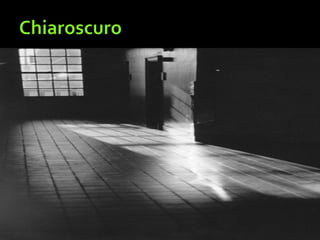
•   The technique of “chiaroscuro” was
    employed in expressionism. Chiaroscuro is an
    artistic technique in which light and darkness
    are manipulated to achieve a heightened
    illusion of depth.

•   Expressionist directors contrasted light and
    dark to create shadows and other effects
    which were intended to portray and arouse
    emotion.
   In order to put forth the abstract, it was
    necessary for the Expressionist filmmaker to
    obliterate nature and eradicate the natural
    world.

   Expressionist filmmakers believed landscapes
    should emit a soul and should be considered
    as significant as a character in the film.
•   Mainstream and popular films of the period
    were focused upon action, adventure and
    romance.

•   Expressionist films developed themes based
    on insanity, madness, discordance and
    betrayal.
•   Since its origin, many films have been labeled
    as works of Expressionism.

•   The “Cabinet of Dr. Caligari” a German horror
    classic directed by Robert Weine, best
    personifies the Expressionist film genre.
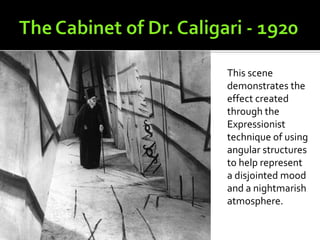
This scene
demonstrates the
effect created
through the
Expressionist
technique of using
angular structures
to help represent
a disjointed mood
and a nightmarish
atmosphere.
•   The “Cabinet of Dr. Caligari” employed the
    Expressionist technique of using dream
    sequences and flashbacks to twist reality and
    warp chronology.

•   The unnatural and exaggerated character of
    Cesare carried out frightening acts during the
    dream sequences.
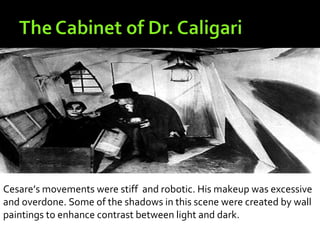
Cesare’s movements were stiff and robotic. His makeup was excessive
and overdone. Some of the shadows in this scene were created by wall
paintings to enhance contrast between light and dark.
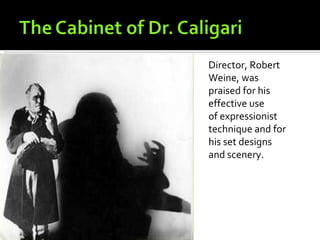
Director, Robert
Weine, was
praised for his
effective use
of expressionist
technique and for
his set designs
and scenery.
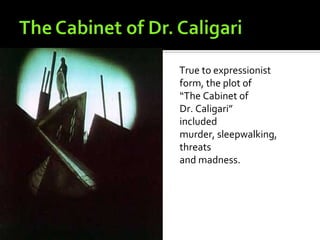
True to expressionist
form, the plot of
“The Cabinet of
Dr. Caligari”
included
murder, sleepwalking,
threats
and madness.
Designed by the
Expressionist
Bahaus School,
the films’ sets were
contorted and artificial.

The distorted designs
Helped to develop the
atmosphere
Of disorientation.
   Expressionist elements (particularly sinister
    plots, horrific events, and chiaroscuro
    lighting) continued to be highlighted in
    German cinema throughout 1920’s and into
    the 1930’s.
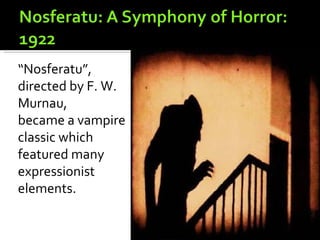
“Nosferatu”,
directed by F. W.
Murnau,
became a vampire
classic which
featured many
expressionist
elements.
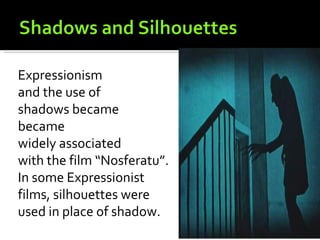
Expressionism
and the use of
shadows became
became
widely associated
with the film “Nosferatu”.
In some Expressionist
films, silhouettes were
used in place of shadow.
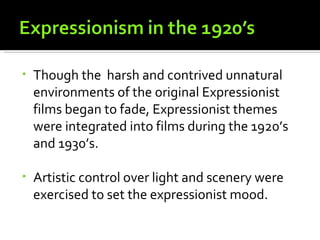
•   Though the harsh and contrived unnatural
    environments of the original Expressionist
    films began to fade, Expressionist themes
    were integrated into films during the 1920’s
    and 1930’s.

•   Artistic control over light and scenery were
    exercised to set the expressionist mood.
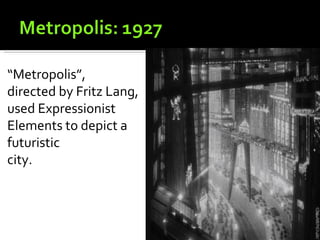
“Metropolis”,
directed by Fritz Lang,
used Expressionist
Elements to depict a
futuristic
city.
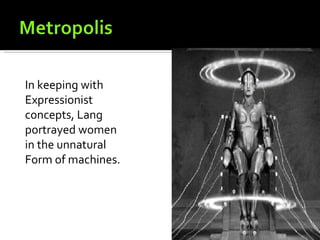
In keeping with
Expressionist
concepts, Lang
portrayed women
in the unnatural
Form of machines.
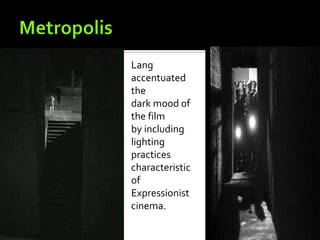
Lang
accentuated
the
dark mood of
the film
by including
lighting
practices
characteristic
of
Expressionist
cinema.
•   During the period of Expressionist
    filmmaking in Germany, other notable
    directors included Paul Wegener, Karl Heinz
    Martin, Leon Brinsky and George Wilhelm
    Pabst.
• When the Nazi party came to power in
  Germany, many filmmakers felt it
  necessary to leave the country. They
  emigrated to America and integrated
  Expressionism into American cinema.

• Expressionist films became successful
  in America and largely impacted the
  American film industry.
•   American Horror films and Film Noir were
    two American film genres that were heavily
    influenced by Expressionism.

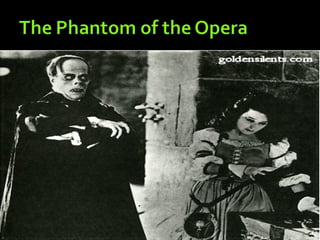
•   The silent film “The Phantom of the Opera,”
    starring Lon Chaney incorporated many
    Expressionist elements.
•   German filmmakers such as Karl Freund,
    designed dark sets for use in American classic
    films such as Universal Studios 1931 release
    of “Dracula”.

•   German directors, Fritz Lang and Otto
    Preminger, expanded Expressionist themes
    into American crime dramas which further
    spread the influence of Expressionism.
•   Alfred Hitchcock had worked in Germany in the
    1920s. He became greatly influenced by
    Expressionism which became evident in many of
    his films.

•   Hitchcock’s early British films and his black and
    white films of the 1950’s were permeated with
    Expressionist techniques. The Expressionist
    influence can be seen in his color films of the
    1960’s as well.
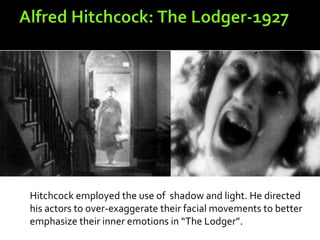
Hitchcock employed the use of shadow and light. He directed
his actors to over-exaggerate their facial movements to better
emphasize their inner emotions in “The Lodger”.
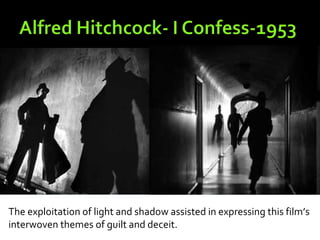
The exploitation of light and shadow assisted in expressing this film’s
interwoven themes of guilt and deceit.
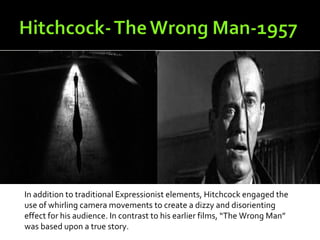
In addition to traditional Expressionist elements, Hitchcock engaged the
use of whirling camera movements to create a dizzy and disorienting
effect for his audience. In contrast to his earlier films, “The Wrong Man”
was based upon a true story.
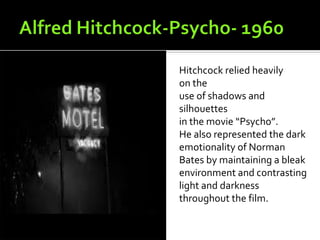
Hitchcock relied heavily
on the
use of shadows and
silhouettes
in the movie “Psycho”.
He also represented the dark
emotionality of Norman
Bates by maintaining a bleak
environment and contrasting
light and darkness
throughout the film.
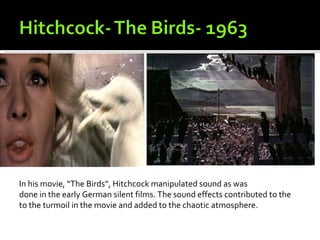
In his movie, “The Birds”, Hitchcock manipulated sound as was
done in the early German silent films. The sound effects contributed to the
to the turmoil in the movie and added to the chaotic atmosphere.
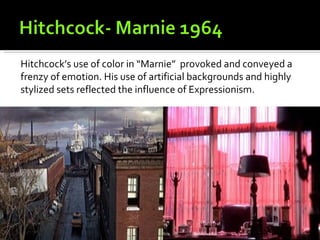
Hitchcock’s use of color in “Marnie” provoked and conveyed a
frenzy of emotion. His use of artificial backgrounds and highly
stylized sets reflected the influence of Expressionism.
   Alfred Hitchcock was exceedingly popular
    and many other filmmakers copied his
    techniques.

   Because he was mimicked by so many other
    directors, Hitchcock inadvertently acted as a
    vehicle to propel the influence of
    expressionism more widely into filmmaking
    than ever before.
   Many analysts believe that Expressionist
    media often contains an underlying and
    ambiguous social critique.

   In the science fiction movie, “Blade Runner”,
    directed by Ridley Scott, poetic speeches
    contained vague political themes and
    ideologies.
•   In the manner of Expressionism, Ridley Scott
    incorporated dark shadows, hazy lighting and odd
    camera movements into the film.
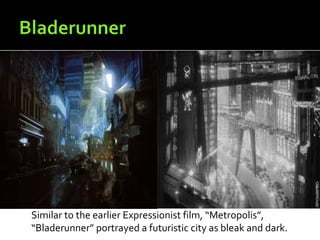
•   In addition to the parallels to movie “Metropolis”,
    “Blade Runner” imitated sequences from other
    German Expressionist films. Bladerunner’s
    emphasis on the degraded, alienating city
    resembled that of many expressionist "street
    films" taken together. Some propose that
    “Bladerunner” was a remake of Lang's
    Metropolis.
Similar to the earlier Expressionist film, “Metropolis”,
“Bladerunner” portrayed a futuristic city as bleak and dark.
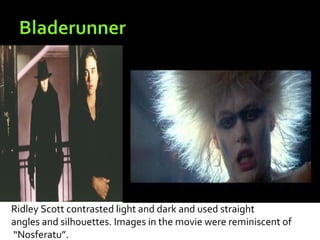
Ridley Scott contrasted light and dark and used straight
angles and silhouettes. Images in the movie were reminiscent of
“Nosferatu”.
   Tim Burton is a modern-day director for
    whom the influence of Expressionism is
    evident in many of his films.
The painted backdrops used in “Beetlejuice”
mimic those seen in “The Cabinet of Dr.
Caligari”.
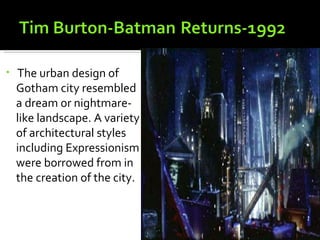
   Burton’s depiction of Gotham City in his
    movie “Batman Returns” was also compared
    to Fritz Lang’s “Metropolis”. The angular
    building designs and severe looking city
    squares of Gotham City bore resemblance to
    Lang’s futuristic city.
•   The urban design of
    Gotham city resembled
    a dream or nightmare-
    like landscape. A variety
    of architectural styles
    including Expressionism
    were borrowed from in
    the creation of the city.
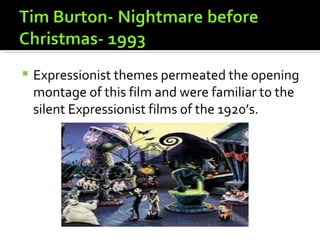
   Expressionist themes permeated the opening
    montage of this film and were familiar to the
    silent Expressionist films of the 1920’s.
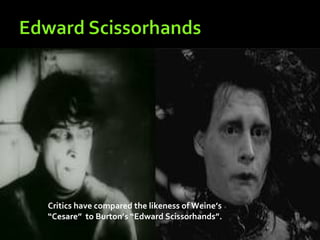
Critics have compared the likeness of Weine’s
“Cesare” to Burton’s “Edward Scissorhands”.
   In addition to the direct influence of
    emigrated German filmmakers, filmmakers in
    other countries were impressed with
    expressionist style and techniques. They
    incorporated the style into their own films
    which expanded the influence of
    Expressionism to international films from the
    1930’s to the films of today.
   Explore the meaning and legacy of German Expressionist film.
   Expressionism as a movement in Germany covered many different creative media - such as visual art, literature
    and theatre, as well as its influence on the world of cinema. Its visual style and themes represent in many ways
    the personal and social conflict felt in Germany at the time, and as expressed by Klinge & Klinge (1983, p.106), to
    find answers, artists turned inward, to project human emotion through their films. This resulted in a collection of
    dark, mysterious horror films, the style of which has made a great impact on filmmakers since the period, and
    right up to the present day.
   An early expressionist film that embodies most of the characteristics associated with the movement is The
    Cabinet of Dr. Caligari (Wiene, 1920), and I shall be looking at this film in particular detail -with reference to other
    Expressionist films and those influenced by them - to understand further the techniques used in making the film
    and the meaning behind them. In order to understand the meaning behind the movement, it is vital to consider
    events previous to the period. From the unification of Germany in 1871, Europe suffered from civil unrest at the
    balance of powers within the continent, and WW1 (1914-1918) caused devastation and Germany suffered under
    the Treaty of Versailles (1919), which ended the war. A common theme in German Expressionist film is that of
    authority, or more specifically, the idea of tyranny (Kraucauer, 1947). In The Cabinet of Dr. Caligari, Caligari uses
    his hypnotic power as a means of control of Cesare, who he makes commit murder. This idea of being under
    power which cannot be fought against may well be an analogy for Germany's treatment, and in their view,
    oppression, during the war years. In the end of the film, however, it is made clear that Francis is seemingly
    delusional, with the tyrannical figure of Caligari triumphing. In writers Hanz Janowitz and Carl Mayer's original
    script, this did not happen, and the story exposed the 'madness inherent in an obsession with authority' (Klinge &
    Klinge, 1983). However, Wiene made the directorial choice to change this ending, so authority triumphed. This
    message was not followed in other expressionist films, such as Nosferatu (Murnau, 1922), where the film's
    tyrannical antagonist is finally defeated.
   The aesthetic movement of Expressionism gained prominence during the early twentieth century, and had a
    profound impact on the arts - especially theater, painting, sculpture, and film. Expressionism was particularly
    popular between 1910 and 1920, and the movement ushered in a rebellion against the established Impressionist
    style that had previously dominated the fine arts. Whereas Impressionism concentrated on the artist's
    interpretation of a given subject, Expressionism was rooted in the artist's own state of mind or vision.
    Expressionists infused their subjects with a rich emotional quality through a concentration of systematized
    symbols.
   The movement was largely inspired by Nietzsche's philosophy of art, which held that the artistic impulse inspired
    a wondrous vitality - a reawakening of the senses - in the artist himself. In other words, the artist breathes in the
    basic gestures of creation, which are then expressed in his work. Developed during a period of history that saw
    Germany undergo severe social, political, and economic dislocation following the country's defeat in World War
    I, German Expressionism conveyed a feeling of chaos through the usage of darkly violent images that reflected
    the state of mind of both the artist and society in general. Art became an action, and the human gestures being
    portrayed became a reflection of the artist's personality and sensibility. The artist's medium was thus
    transformed into a vehicle for social and political critique. The works were driven by activist impulses and colored
    by the emotional registers of the revolutionary spirit.
   While Expressionist painters were predominantly inspired by Vincent Van Gogh and Paul Gauguin, and thus paid
    special attention to color and symbolism and employed exaggerated imagery, German Expressionism focused
    on the more sinister aspects of the human psyche. German Expressionism conveyed a feeling of darkness,
    eccentricity, madness, paranoia, and obsession. German Expressionists often focused on the criminal
    underworld, infusing their works with a surreal, eerie atmosphere, anti-heroic characters, and elements of evil
    and betrayal. They also utilized geometric shapes, and often examined the contrast between the city and the
    country. They did not aim to offer a realistic portrayal of the world, but rather strove to elicit a powerful,
    authentic emotional response from their audiences. Deliberately dream-like, their images were filled with
    distorted lines and shapes, and often included intensely sexual - even orgiastic - scenes.
Section A - International Film Styles
Your answer should be based on a minimum of two films and focus on one of the following:
German and/or Soviet Cinema of the 1920s
Neo Realism
Surrealism
New Waves

Either,
Explore in detail the use of a particular micro feature in your chosen international film
style.[35]

Discuss some of the factors that contributed to the development of your chosen international
film style. [35]

Discuss characteristic features of casting and/or performance, exploring how far these
features contribute the overall effect of the films you have studied. [35]

What is the relationship between visual style and the subject matter of the films you have
studied? [35]
International Film Styles
Questions 3 and 4

• A knowledge and appreciation of the importance of the relevant historical,
   political, social, cultural and artistic contexts.

• A specific understanding of the chosen films and their stylistic features –
   and of the relationship of these chosen features to thematic
   preoccupations.

• An understanding of what is distinctive – and innovative – in the films
   studied.

The impact of_german_expressionist_films exam prep

  • 1.
    German Expressionist Filmsand their impact upon the Modern Film Industry
  • 2.
     Expressionism beganas a movement in art in Weimar, Germany during World War 1. The movement affected many types of artistic medium including architecture, painting, music, literature and sculpture.  Expressionist artists attempted to portray the disparity of their surroundings in artistic form.
  • 3.
    What stylistic andideological comparisons can you draw between Kollwitz , Lang & Weine?
  • 4.
    At the beginning of World War 1, foreign film companies dominated the industry.  By the end of World War 1, the German Film Industry flourished. It was propelled by a population desperate for a diversion from their daily struggles.
  • 5.
    UFA (Universum Film Aktiengelleschaft) became a leader in the German Film Industry.  Created by German government in 1917 as a WWI propaganda arm, by consolidating most of Germany‘s commercial studios  After a 1921 merger with Decla-Bioscop, "with government, industrial and banking support," UFA enjoyed a near- monopoly  Produced many great and influential works during the Weimar Republic years (1919-1933 approx.)  Through many incarnations, UFA still exists today  UFA produced many German Expressionist films which were destined to become classics.  Many of the films, which achieved infamy outside of Germany, are still recognized and watched today.
  • 6.
    Because of the deteriorating post-World War I economy in Germany, filmmakers were unable to create films which could compete with the grandiosity of Hollywood pictures. • By using the elements of expressionism, German filmmakers developed their own style of filmmaking which incorporated symbolism to expose deeper meanings and emotions.
  • 7.
    German Expressionist films were made during the silent film era. They contained sounds and music as opposed to dialogue.  For many of the silent films, a piano player was hired to play as live accompaniment.
  • 8.
    • Expressionism manipulatedsound, lighting and stage design to reveal emotions and realities in an abstract manner. • Stage sets were very artificial and were made to appear as “paintings come to life”. All realism was removed from sets in order to allow them to become symbols of specific emotions and conditions. • Angular structures were utilized to exploit stage design and influence the mood of a picture.
  • 9.
    “Mise-en-scene” is a French term used to describe the technique of story telling through stage design and cinematography. “Mise-en-scene” is used in Expressionist films to contribute to the design aspect.
  • 10.
    • Expressionism conveyeda tone of dissonance by effectively abolishing normal relationships between objects and focusing upon the abstract. • Expressionist techniques aimed to conjure feelings of mystery, alienation, disharmony and destabilization. • Plots incorporated dream sequences, flashbacks and distorted chronology to promote instability.
  • 11.
    Expressionist actors engaged in harsh and amplified movements that were often stiff or jerky to represent inner turmoil. • Overstated costumes and makeup contributed to an actor’s ability to portray inner realities and tumultuous emotions.
  • 12.
    The technique of “chiaroscuro” was employed in expressionism. Chiaroscuro is an artistic technique in which light and darkness are manipulated to achieve a heightened illusion of depth. • Expressionist directors contrasted light and dark to create shadows and other effects which were intended to portray and arouse emotion.
  • 14.
    In order to put forth the abstract, it was necessary for the Expressionist filmmaker to obliterate nature and eradicate the natural world.  Expressionist filmmakers believed landscapes should emit a soul and should be considered as significant as a character in the film.
  • 15.
    Mainstream and popular films of the period were focused upon action, adventure and romance. • Expressionist films developed themes based on insanity, madness, discordance and betrayal.
  • 16.
    Since its origin, many films have been labeled as works of Expressionism. • The “Cabinet of Dr. Caligari” a German horror classic directed by Robert Weine, best personifies the Expressionist film genre.
  • 17.
    This scene demonstrates the effectcreated through the Expressionist technique of using angular structures to help represent a disjointed mood and a nightmarish atmosphere.
  • 18.
    The “Cabinet of Dr. Caligari” employed the Expressionist technique of using dream sequences and flashbacks to twist reality and warp chronology. • The unnatural and exaggerated character of Cesare carried out frightening acts during the dream sequences.
  • 19.
    Cesare’s movements werestiff and robotic. His makeup was excessive and overdone. Some of the shadows in this scene were created by wall paintings to enhance contrast between light and dark.
  • 20.
    Director, Robert Weine, was praisedfor his effective use of expressionist technique and for his set designs and scenery.
  • 21.
    True to expressionist form,the plot of “The Cabinet of Dr. Caligari” included murder, sleepwalking, threats and madness.
  • 22.
    Designed by the Expressionist BahausSchool, the films’ sets were contorted and artificial. The distorted designs Helped to develop the atmosphere Of disorientation.
  • 23.
    Expressionist elements (particularly sinister plots, horrific events, and chiaroscuro lighting) continued to be highlighted in German cinema throughout 1920’s and into the 1930’s.
  • 24.
    “Nosferatu”, directed by F.W. Murnau, became a vampire classic which featured many expressionist elements.
  • 25.
    Expressionism and the useof shadows became became widely associated with the film “Nosferatu”. In some Expressionist films, silhouettes were used in place of shadow.
  • 26.
    Though the harsh and contrived unnatural environments of the original Expressionist films began to fade, Expressionist themes were integrated into films during the 1920’s and 1930’s. • Artistic control over light and scenery were exercised to set the expressionist mood.
  • 27.
    “Metropolis”, directed by FritzLang, used Expressionist Elements to depict a futuristic city.
  • 28.
    In keeping with Expressionist concepts,Lang portrayed women in the unnatural Form of machines.
  • 29.
    Lang accentuated the dark mood of thefilm by including lighting practices characteristic of Expressionist cinema.
  • 30.
    During the period of Expressionist filmmaking in Germany, other notable directors included Paul Wegener, Karl Heinz Martin, Leon Brinsky and George Wilhelm Pabst.
  • 31.
    • When theNazi party came to power in Germany, many filmmakers felt it necessary to leave the country. They emigrated to America and integrated Expressionism into American cinema. • Expressionist films became successful in America and largely impacted the American film industry.
  • 32.
    American Horror films and Film Noir were two American film genres that were heavily influenced by Expressionism. • The silent film “The Phantom of the Opera,” starring Lon Chaney incorporated many Expressionist elements.
  • 34.
    German filmmakers such as Karl Freund, designed dark sets for use in American classic films such as Universal Studios 1931 release of “Dracula”. • German directors, Fritz Lang and Otto Preminger, expanded Expressionist themes into American crime dramas which further spread the influence of Expressionism.
  • 35.
    Alfred Hitchcock had worked in Germany in the 1920s. He became greatly influenced by Expressionism which became evident in many of his films. • Hitchcock’s early British films and his black and white films of the 1950’s were permeated with Expressionist techniques. The Expressionist influence can be seen in his color films of the 1960’s as well.
  • 36.
    Hitchcock employed theuse of shadow and light. He directed his actors to over-exaggerate their facial movements to better emphasize their inner emotions in “The Lodger”.
  • 37.
    The exploitation oflight and shadow assisted in expressing this film’s interwoven themes of guilt and deceit.
  • 38.
    In addition totraditional Expressionist elements, Hitchcock engaged the use of whirling camera movements to create a dizzy and disorienting effect for his audience. In contrast to his earlier films, “The Wrong Man” was based upon a true story.
  • 39.
    Hitchcock relied heavily onthe use of shadows and silhouettes in the movie “Psycho”. He also represented the dark emotionality of Norman Bates by maintaining a bleak environment and contrasting light and darkness throughout the film.
  • 40.
    In his movie,“The Birds”, Hitchcock manipulated sound as was done in the early German silent films. The sound effects contributed to the to the turmoil in the movie and added to the chaotic atmosphere.
  • 41.
    Hitchcock’s use ofcolor in “Marnie” provoked and conveyed a frenzy of emotion. His use of artificial backgrounds and highly stylized sets reflected the influence of Expressionism.
  • 42.
    Alfred Hitchcock was exceedingly popular and many other filmmakers copied his techniques.  Because he was mimicked by so many other directors, Hitchcock inadvertently acted as a vehicle to propel the influence of expressionism more widely into filmmaking than ever before.
  • 43.
    Many analysts believe that Expressionist media often contains an underlying and ambiguous social critique.  In the science fiction movie, “Blade Runner”, directed by Ridley Scott, poetic speeches contained vague political themes and ideologies.
  • 44.
    In the manner of Expressionism, Ridley Scott incorporated dark shadows, hazy lighting and odd camera movements into the film. • In addition to the parallels to movie “Metropolis”, “Blade Runner” imitated sequences from other German Expressionist films. Bladerunner’s emphasis on the degraded, alienating city resembled that of many expressionist "street films" taken together. Some propose that “Bladerunner” was a remake of Lang's Metropolis.
  • 45.
    Similar to theearlier Expressionist film, “Metropolis”, “Bladerunner” portrayed a futuristic city as bleak and dark.
  • 46.
    Ridley Scott contrastedlight and dark and used straight angles and silhouettes. Images in the movie were reminiscent of “Nosferatu”.
  • 47.
    Tim Burton is a modern-day director for whom the influence of Expressionism is evident in many of his films.
  • 48.
    The painted backdropsused in “Beetlejuice” mimic those seen in “The Cabinet of Dr. Caligari”.
  • 49.
    Burton’s depiction of Gotham City in his movie “Batman Returns” was also compared to Fritz Lang’s “Metropolis”. The angular building designs and severe looking city squares of Gotham City bore resemblance to Lang’s futuristic city.
  • 50.
    The urban design of Gotham city resembled a dream or nightmare- like landscape. A variety of architectural styles including Expressionism were borrowed from in the creation of the city.
  • 51.
    Expressionist themes permeated the opening montage of this film and were familiar to the silent Expressionist films of the 1920’s.
  • 52.
    Critics have comparedthe likeness of Weine’s “Cesare” to Burton’s “Edward Scissorhands”.
  • 53.
    In addition to the direct influence of emigrated German filmmakers, filmmakers in other countries were impressed with expressionist style and techniques. They incorporated the style into their own films which expanded the influence of Expressionism to international films from the 1930’s to the films of today.
  • 54.
    Explore the meaning and legacy of German Expressionist film.  Expressionism as a movement in Germany covered many different creative media - such as visual art, literature and theatre, as well as its influence on the world of cinema. Its visual style and themes represent in many ways the personal and social conflict felt in Germany at the time, and as expressed by Klinge & Klinge (1983, p.106), to find answers, artists turned inward, to project human emotion through their films. This resulted in a collection of dark, mysterious horror films, the style of which has made a great impact on filmmakers since the period, and right up to the present day.  An early expressionist film that embodies most of the characteristics associated with the movement is The Cabinet of Dr. Caligari (Wiene, 1920), and I shall be looking at this film in particular detail -with reference to other Expressionist films and those influenced by them - to understand further the techniques used in making the film and the meaning behind them. In order to understand the meaning behind the movement, it is vital to consider events previous to the period. From the unification of Germany in 1871, Europe suffered from civil unrest at the balance of powers within the continent, and WW1 (1914-1918) caused devastation and Germany suffered under the Treaty of Versailles (1919), which ended the war. A common theme in German Expressionist film is that of authority, or more specifically, the idea of tyranny (Kraucauer, 1947). In The Cabinet of Dr. Caligari, Caligari uses his hypnotic power as a means of control of Cesare, who he makes commit murder. This idea of being under power which cannot be fought against may well be an analogy for Germany's treatment, and in their view, oppression, during the war years. In the end of the film, however, it is made clear that Francis is seemingly delusional, with the tyrannical figure of Caligari triumphing. In writers Hanz Janowitz and Carl Mayer's original script, this did not happen, and the story exposed the 'madness inherent in an obsession with authority' (Klinge & Klinge, 1983). However, Wiene made the directorial choice to change this ending, so authority triumphed. This message was not followed in other expressionist films, such as Nosferatu (Murnau, 1922), where the film's tyrannical antagonist is finally defeated.
  • 55.
    The aesthetic movement of Expressionism gained prominence during the early twentieth century, and had a profound impact on the arts - especially theater, painting, sculpture, and film. Expressionism was particularly popular between 1910 and 1920, and the movement ushered in a rebellion against the established Impressionist style that had previously dominated the fine arts. Whereas Impressionism concentrated on the artist's interpretation of a given subject, Expressionism was rooted in the artist's own state of mind or vision. Expressionists infused their subjects with a rich emotional quality through a concentration of systematized symbols.  The movement was largely inspired by Nietzsche's philosophy of art, which held that the artistic impulse inspired a wondrous vitality - a reawakening of the senses - in the artist himself. In other words, the artist breathes in the basic gestures of creation, which are then expressed in his work. Developed during a period of history that saw Germany undergo severe social, political, and economic dislocation following the country's defeat in World War I, German Expressionism conveyed a feeling of chaos through the usage of darkly violent images that reflected the state of mind of both the artist and society in general. Art became an action, and the human gestures being portrayed became a reflection of the artist's personality and sensibility. The artist's medium was thus transformed into a vehicle for social and political critique. The works were driven by activist impulses and colored by the emotional registers of the revolutionary spirit.  While Expressionist painters were predominantly inspired by Vincent Van Gogh and Paul Gauguin, and thus paid special attention to color and symbolism and employed exaggerated imagery, German Expressionism focused on the more sinister aspects of the human psyche. German Expressionism conveyed a feeling of darkness, eccentricity, madness, paranoia, and obsession. German Expressionists often focused on the criminal underworld, infusing their works with a surreal, eerie atmosphere, anti-heroic characters, and elements of evil and betrayal. They also utilized geometric shapes, and often examined the contrast between the city and the country. They did not aim to offer a realistic portrayal of the world, but rather strove to elicit a powerful, authentic emotional response from their audiences. Deliberately dream-like, their images were filled with distorted lines and shapes, and often included intensely sexual - even orgiastic - scenes.
  • 56.
    Section A -International Film Styles Your answer should be based on a minimum of two films and focus on one of the following: German and/or Soviet Cinema of the 1920s Neo Realism Surrealism New Waves Either, Explore in detail the use of a particular micro feature in your chosen international film style.[35] Discuss some of the factors that contributed to the development of your chosen international film style. [35] Discuss characteristic features of casting and/or performance, exploring how far these features contribute the overall effect of the films you have studied. [35] What is the relationship between visual style and the subject matter of the films you have studied? [35]
  • 57.
    International Film Styles Questions3 and 4 • A knowledge and appreciation of the importance of the relevant historical, political, social, cultural and artistic contexts. • A specific understanding of the chosen films and their stylistic features – and of the relationship of these chosen features to thematic preoccupations. • An understanding of what is distinctive – and innovative – in the films studied.