The Dynasty
South Indian Dynasty
Capital: Kanchipuram
Dominated Parts: Telugu and Northern
Indian Parts of Tamil Region.
Major Rulers:
Mahendravarman (571 to 630CE)
Narasimhavarman (630 to 668CE)
Period: 275CE to 897CE
Government: Monarchy
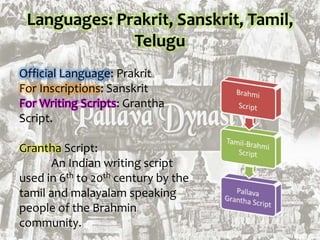
Languages: Prakrit, Sanskrit, Tamil,
Telugu
Official Language: Prakrit
For Inscriptions: Sanskrit
For Writing Scripts: Grantha
Script.
Grantha Script:
An Indian writing script
used in 6th to 20th century by the
tamil and malayalam speaking
people of the Brahmin
community.
Religion- Hinduism
Once when a Chinese monk XuangZang
visited the regions of Pallava dynasty he
reported that there were 100 Buddhist
monasteries and 80 Buddhist temples in
Kanchipuram.
This shows that though they practiced
Hinduism, they had respect towards other
religions.
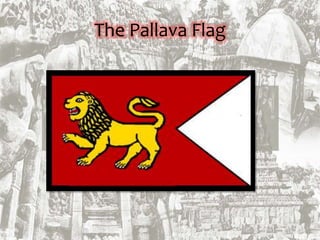
The Pallava Flag
Origin of Pallava kings
Born to the daughter of a Naga King
named Pilivalai and Chola King Kilivalan.
He was then lost in a shipwreck and then
found with a twig of a Tondai (also called
as creeper/Pallava)plant around his ankle
and hence he was named as Tondai-man.
The copper plate inscriptions that are found at Bahur
which is an ancient Siva temple located at 20kms
from Pondy is called as Bahur Plates.
In that it is mentioned as,
“From Ashvatthama was born the king named
Pallava”
Which later explains that the first pallava king was
born to the Brahmin Ashvatthama and a Naga
Princess.
Education & Literature
The Pallavas were a great patron of learning and their
capital Kanchi was an ancient center of learning.
The most famous educational institution Ghatika attracted
students from all over the world.
It is also said that many scholars studied in Kanchi which
even includes:
The founder of Kadamba dynasty, Mayurasarmam.
(Studied Vedas)
The buddhist writer, Dinganaga who in later years
became the head of Nalandha University.
The great sanscrit scholar- Bharavi
Art & Architecture
Developed the art of excavating temples
from the rock.
Dravidian style of temple architecture
began.
There were three stages of development.
Stage-1
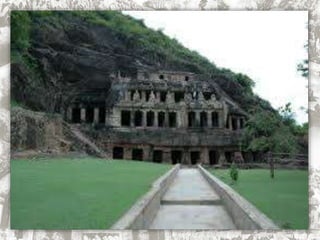
Mahendravarman 1
introduced the Rock cut
temples.
They were seen in Mamandur,
Trichy, Vallam etc.
Stage-2
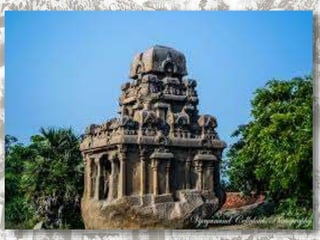
Narasimhavarman 1 introduced the
Monolithic Rathas and Mandapas.
Mono means One; Lithic means Rock.
This mean that the entire structure is built
using one Single rock.
They were seen in Mamallapuram.
Stage-3
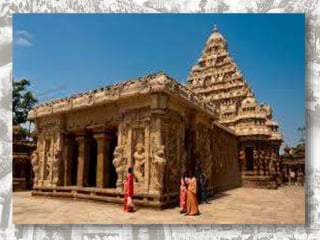
Rajasimha introduced the Structural
temples.
The temples those that are built using
soft sand rocks.
One of the famous monument of that
king is the Kanchi Kailasanatha Temple.
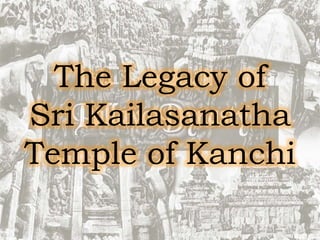
The Legacy of
Sri Kailasanatha
Temple of Kanchi
The Kanchi
The Pallavas had their powers over Kanchi during the 7th to
9th century when they established supremacy over their
southern rivals.
They established their territory extending from the Krishna
in the north to Cauvery in the south.
Kanchi was also home to the famous 6th century poet
Bharavi who wrote the Kiratarjuniya . Hsuan Tsang, the
Chinese-Buddhist monk, scholar, traveler and translator
who visited Kanchi during the 7th century, wrote glowingly
about the splendor of the city and its intellectual wealth.
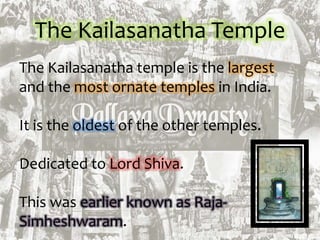
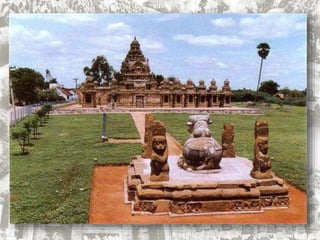
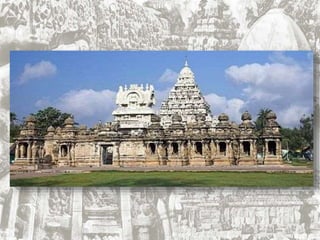
The Kailasanatha Temple
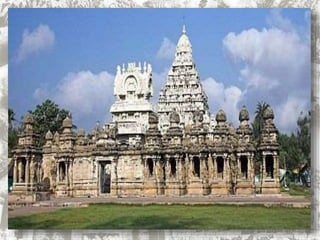
The Kailasanatha temple is the largest
and the most ornate temples in India.
It is the oldest of the other temples.
Dedicated to Lord Shiva.
This was earlier known as Raja-
Simheshwaram.
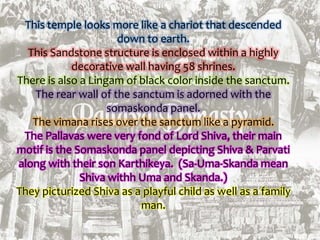
This temple looks more like a chariot that descended
down to earth.
This Sandstone structure is enclosed within a highly
decorative wall having 58 shrines.
There is also a Lingam of black color inside the sanctum.
The rear wall of the sanctum is adorned with the
somaskonda panel.
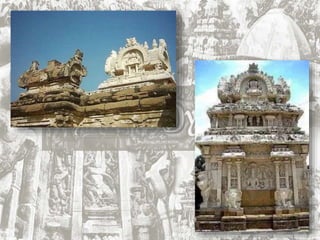
The vimana rises over the sanctum like a pyramid.
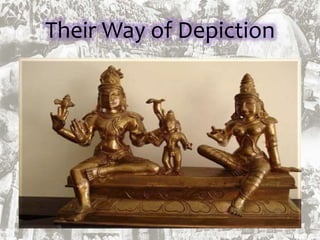
The Pallavas were very fond of Lord Shiva, their main
motif is the Somaskonda panel depicting Shiva & Parvati
along with their son Karthikeya. (Sa-Uma-Skanda mean
Shiva withh Uma and Skanda.)
They picturized Shiva as a playful child as well as a family
man.
Their Way of Depiction
Depicting Shiva…
Their depictions were very specific.
Complexation of Rising Sun/Coral.
Matted hair with a crown of Ganges with Crescent.
Wears a Patra and Makara. (Kundals in Left and
Right ear respectively.)
Upper hands carry a cane/Antelope.
Lower two gestures benediction & Assurance.
Sits in one leg bent and other stretched
down.(Lambaka Padam)
Depicting Parvati..
Parvati sits in his left.
She has two hands and one holds a
blue Lotus.
Leg position one bent and other
stretched.
Both have a pleasant countenance ,
as they sit in a relaxed position.
Depicting Skanda..
This playful child Skanda is inbetween
the lovable couple.
The child has a normal stature and
holds a flower in one hand.
His complextion is blue.
The Vimanas
Most of the largest and complex structures.
Stories were depicted in the form of architectural designs.
They are four-storeyed structures containing two walls of
ambulatory pasage.
Three exterior walls have seven lesser shrines placed around them
and they contain images of Shiva.
Whole of their exterior contains sculptors of Lions, Nandis, Shiva and
other deities.
The Gopuras
The Gopuras were not an essential feature of
the early temples.
At the Kailasanatha there is just a suggestion of
a Gopura- dwara.
It was only by about 11th century that tall,
colossal and overwhelming Gopura emerged as
a unique feature of the South Indian temple
architecture.
The Uniqueness..
The Kailasanatha temple is perhaps the biggest
sandstone temple structure in the world.
Among the ancient temples in Kanchi, the Kailasanatha
is the only temple whose structure has not been
meddled with or re-constructed.
It still retains its pristine form and structure. It’s another
unique feature is the 58 devakulikas (mini-shrines) that
run round the main temple.
Thank You !!

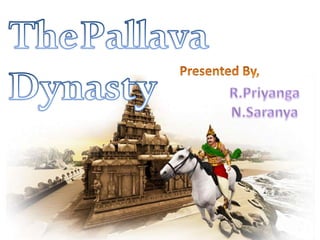
The pallava dynasty

  • 2.
    The Dynasty South IndianDynasty Capital: Kanchipuram Dominated Parts: Telugu and Northern Indian Parts of Tamil Region. Major Rulers: Mahendravarman (571 to 630CE) Narasimhavarman (630 to 668CE) Period: 275CE to 897CE Government: Monarchy
  • 3.
    Languages: Prakrit, Sanskrit,Tamil, Telugu Official Language: Prakrit For Inscriptions: Sanskrit For Writing Scripts: Grantha Script. Grantha Script: An Indian writing script used in 6th to 20th century by the tamil and malayalam speaking people of the Brahmin community.
  • 4.
    Religion- Hinduism Once whena Chinese monk XuangZang visited the regions of Pallava dynasty he reported that there were 100 Buddhist monasteries and 80 Buddhist temples in Kanchipuram. This shows that though they practiced Hinduism, they had respect towards other religions.
  • 5.
  • 6.
  • 7.
    Born to thedaughter of a Naga King named Pilivalai and Chola King Kilivalan. He was then lost in a shipwreck and then found with a twig of a Tondai (also called as creeper/Pallava)plant around his ankle and hence he was named as Tondai-man.
  • 8.
    The copper plateinscriptions that are found at Bahur which is an ancient Siva temple located at 20kms from Pondy is called as Bahur Plates. In that it is mentioned as, “From Ashvatthama was born the king named Pallava” Which later explains that the first pallava king was born to the Brahmin Ashvatthama and a Naga Princess.
  • 9.
    Education & Literature ThePallavas were a great patron of learning and their capital Kanchi was an ancient center of learning. The most famous educational institution Ghatika attracted students from all over the world. It is also said that many scholars studied in Kanchi which even includes: The founder of Kadamba dynasty, Mayurasarmam. (Studied Vedas) The buddhist writer, Dinganaga who in later years became the head of Nalandha University. The great sanscrit scholar- Bharavi
  • 10.
    Art & Architecture Developedthe art of excavating temples from the rock. Dravidian style of temple architecture began. There were three stages of development.
  • 11.
    Stage-1 Mahendravarman 1 introduced theRock cut temples. They were seen in Mamandur, Trichy, Vallam etc.
  • 13.
    Stage-2 Narasimhavarman 1 introducedthe Monolithic Rathas and Mandapas. Mono means One; Lithic means Rock. This mean that the entire structure is built using one Single rock. They were seen in Mamallapuram.
  • 15.
    Stage-3 Rajasimha introduced theStructural temples. The temples those that are built using soft sand rocks. One of the famous monument of that king is the Kanchi Kailasanatha Temple.
  • 17.
    The Legacy of SriKailasanatha Temple of Kanchi
  • 18.
    The Kanchi The Pallavashad their powers over Kanchi during the 7th to 9th century when they established supremacy over their southern rivals. They established their territory extending from the Krishna in the north to Cauvery in the south. Kanchi was also home to the famous 6th century poet Bharavi who wrote the Kiratarjuniya . Hsuan Tsang, the Chinese-Buddhist monk, scholar, traveler and translator who visited Kanchi during the 7th century, wrote glowingly about the splendor of the city and its intellectual wealth.
  • 19.
    The Kailasanatha Temple TheKailasanatha temple is the largest and the most ornate temples in India. It is the oldest of the other temples. Dedicated to Lord Shiva. This was earlier known as Raja- Simheshwaram.
  • 20.
    This temple looksmore like a chariot that descended down to earth. This Sandstone structure is enclosed within a highly decorative wall having 58 shrines. There is also a Lingam of black color inside the sanctum. The rear wall of the sanctum is adorned with the somaskonda panel. The vimana rises over the sanctum like a pyramid. The Pallavas were very fond of Lord Shiva, their main motif is the Somaskonda panel depicting Shiva & Parvati along with their son Karthikeya. (Sa-Uma-Skanda mean Shiva withh Uma and Skanda.) They picturized Shiva as a playful child as well as a family man.
  • 22.
    Their Way ofDepiction
  • 23.
    Depicting Shiva… Their depictionswere very specific. Complexation of Rising Sun/Coral. Matted hair with a crown of Ganges with Crescent. Wears a Patra and Makara. (Kundals in Left and Right ear respectively.) Upper hands carry a cane/Antelope. Lower two gestures benediction & Assurance. Sits in one leg bent and other stretched down.(Lambaka Padam)
  • 24.
    Depicting Parvati.. Parvati sitsin his left. She has two hands and one holds a blue Lotus. Leg position one bent and other stretched. Both have a pleasant countenance , as they sit in a relaxed position.
  • 25.
    Depicting Skanda.. This playfulchild Skanda is inbetween the lovable couple. The child has a normal stature and holds a flower in one hand. His complextion is blue.
  • 26.
    The Vimanas Most ofthe largest and complex structures. Stories were depicted in the form of architectural designs. They are four-storeyed structures containing two walls of ambulatory pasage. Three exterior walls have seven lesser shrines placed around them and they contain images of Shiva. Whole of their exterior contains sculptors of Lions, Nandis, Shiva and other deities.
  • 28.
    The Gopuras The Gopuraswere not an essential feature of the early temples. At the Kailasanatha there is just a suggestion of a Gopura- dwara. It was only by about 11th century that tall, colossal and overwhelming Gopura emerged as a unique feature of the South Indian temple architecture.
  • 30.
    The Uniqueness.. The Kailasanathatemple is perhaps the biggest sandstone temple structure in the world. Among the ancient temples in Kanchi, the Kailasanatha is the only temple whose structure has not been meddled with or re-constructed. It still retains its pristine form and structure. It’s another unique feature is the 58 devakulikas (mini-shrines) that run round the main temple.
  • 32.