www.company.com
Central India
Khajuraho
By Dhirendranath Thakur
BVA
www.company.com
Parsavanath Temple
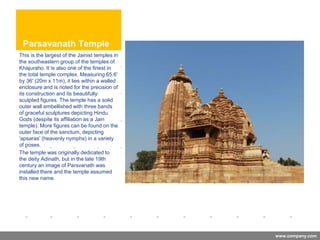
This is the largest of the Jainist temples in
the southeastern group of the temples of
Khajuraho. It is also one of the finest in
the total temple complex. Measuring 65.6'
by 36' (20m x 11m), it lies within a walled
enclosure and is noted for the precision of
its construction and its beautifully
sculpted figures. The temple has a solid
outer wall embellished with three bands
of graceful sculptures depicting Hindu
Gods (despite its affiliation as a Jain
temple). More figures can be found on the
outer face of the sanctum, depicting
'apsaras' (heavenly nymphs) in a variety
of poses.
The temple was originally dedicated to
the deity Adinath, but in the late 19th
century an image of Parsvanath was
installed there and the temple assumed
this new name.
www.company.com
Kandariyâ Mahâdeva
Temple
he Kandariyâ Mahâdeva Temple is the
largest and most ornateHindu temple in
the medieval temple group found
at Khajuraho in Madhya Pradesh, India. It
is considered one of the best examples of
temples preserved from the medieval
period in India.[2] Khajuraho was once the
religious capital of
the ChandelaRajputs and today is one of
the most popular tourist destinations in
India. The Kandariya Mahadeva temple is
the largest of the Western group of
temples and was built by
Vidyadhara[citation needed], arguably one of
the greatest Chandela kings. The temple
was built around 1050 on Hindu beliefs
dating back to 1000 BC; The main spire
or sikhara rises 31 m to depict Mount
Kailash, the Himalayan mountain abode
of Shiva and is surrounded by 84
miniature spires (or Urushringas). Inside
the sanctum is a
marblelinga representing Shiva.[3] The Arc
haeological Survey of India protects the
temple,
www.company.com
Jagadambika temple
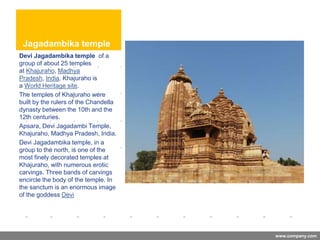
Devi Jagadambika temple of a
group of about 25 temples
at Khajuraho, Madhya
Pradesh, India. Khajuraho is
a World Heritage site.
The temples of Khajuraho were
built by the rulers of the Chandella
dynasty between the 10th and the
12th centuries.
Apsara, Devi Jagadambi Temple,
Khajuraho, Madhya Pradesh, India.
Devi Jagadambika temple, in a
group to the north, is one of the
most finely decorated temples at
Khajuraho, with numerous erotic
carvings. Three bands of carvings
encircle the body of the temple. In
the sanctum is an enormous image
of the goddess Devi
www.company.com
Chaturbhuj temple
Chaturbhuj temple is dedicated to
Lord Vishnu.The name Chaturbhuj
is a derived from Sanskrit words
चतु: = four and भुजा = arms,
which literally means One who has
four arms; and refers to
Lord Vishnu.
The temple is Date-able to CIRCA
1100 A.D.[1] This temple is also
known as
Jatakari[1](Devanagri:जटकारी)
Temple on the name of the village
Jatakari[1](Devanagri:जटकारी),
where it is located.
www.company.com
Chausath
Yogini Temple
www.company.com
Bramha Temple
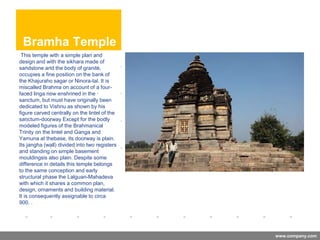
This temple with a simple plan and
design and with the sikhara made of
sandstone and the body of granite,
occupies a fine position on the bank of
the Khajuraho sagar or Ninora-tal. It is
miscalled Brahma on account of a four-
faced linga now enshrined in the
sanctum, but must have originally been
dedicated to Vishnu as shown by his
figure carved centrally on the lintel of the
sanctum-doorway Except for the bodly
modeled figures of the Brahmanical
Trinity on the lintel and Ganga and
Yamuna at thebase, its doorway is plain.
Its jangha (wall) divided into two registers
and standing on simple basement
mouldingsis also plain. Despite some
difference in details this temple belongs
to the same conception and early
structural phase the Lalguan-Mahadeva
with which it shares a common plan,
design, ornaments and building material.
It is consequently assignable to circa
900. .
www.company.com
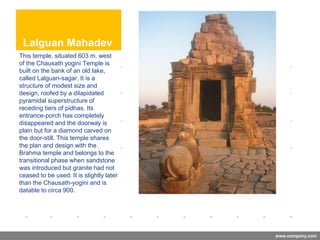
Lalguan Mahadev
This temple, situated 603 m. west
of the Chausath yogini Temple is
built on the bank of an old lake,
called Lalguan-sagar. It is a
structure of modest size and
design, roofed by a dilapidated
pyramidal superstructure of
receding tiers of pidhas. Its
entrance-porch has completely
disappeared and the doorway is
plain but for a diamond carved on
the door-still. This temple shares
the plan and design with the
Brahma temple and belongs to the
transitional phase when sandstone
was introduced but granite had not
ceased to be used. It is slightly later
than the Chausath-yogini and is
datable to circa 900.
www.company.com
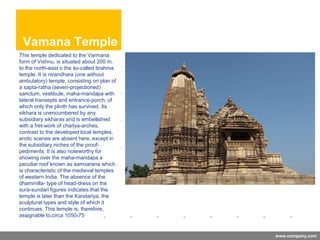
Vamana Temple
This temple dedicated to the Varmana
form of Vishnu, is situated about 200 m.
to the north-east o the so-called brahma
temple. It is nirandhara (one without
ambulatory) temple, consisting on plan of
a sapta-ratha (seven-projectioned)
sanctum, vestibule, maha-mandapa with
lateral transepts and entrance-porch, of
which only the plinth has survived. Its
sikhara is unencumbered by any
subsidiary sikharas and is embellished
with a fret-work of chaitya-arches,
contrast to the developed local temples,
erotic scenes are absent here, except in
the subsidiary niches of the proof-
pediments. It is also noteworthy for
showing over the maha-mandapa a
peculiar roof known as samvarana which
is characteristic of the medieval temples
of western India. The absence of the
dhammilla- type of head-dress on the
sura-sundari figures indicates that the
temple is later than the Kandariya, the
sculptural types and style of which it
continues. This temple is, therefore,
assignable to circa 1050-75
www.company.com
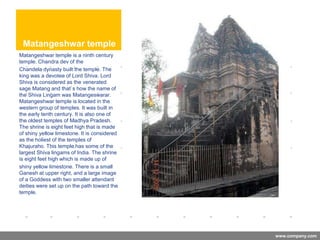
Matangeshwar temple
Matangeshwar temple is a ninth century
temple. Chandra dev of the
Chandela dynasty built the temple. The
king was a devotee of Lord Shiva. Lord
Shiva is considered as the venerated
sage Matang and that`s how the name of
the Shiva Lingam was Matangeswarar.
Matangeshwar temple is located in the
western group of temples. It was built in
the early tenth century. It is also one of
the oldest temples of Madhya Pradesh.
The shrine is eight feet high that is made
of shiny yellow limestone. It is considered
as the holiest of the temples of
Khajuraho. This temple has some of the
largest Shiva lingams of India. The shrine
is eight feet high which is made up of
shiny yellow limestone. There is a small
Ganesh at upper right, and a large image
of a Goddess with two smaller attendant
deities were set up on the path toward the
temple.

Gupta architecture

  • 1.
  • 2.
    www.company.com Parsavanath Temple This isthe largest of the Jainist temples in the southeastern group of the temples of Khajuraho. It is also one of the finest in the total temple complex. Measuring 65.6' by 36' (20m x 11m), it lies within a walled enclosure and is noted for the precision of its construction and its beautifully sculpted figures. The temple has a solid outer wall embellished with three bands of graceful sculptures depicting Hindu Gods (despite its affiliation as a Jain temple). More figures can be found on the outer face of the sanctum, depicting 'apsaras' (heavenly nymphs) in a variety of poses. The temple was originally dedicated to the deity Adinath, but in the late 19th century an image of Parsvanath was installed there and the temple assumed this new name.
  • 3.
    www.company.com Kandariyâ Mahâdeva Temple he KandariyâMahâdeva Temple is the largest and most ornateHindu temple in the medieval temple group found at Khajuraho in Madhya Pradesh, India. It is considered one of the best examples of temples preserved from the medieval period in India.[2] Khajuraho was once the religious capital of the ChandelaRajputs and today is one of the most popular tourist destinations in India. The Kandariya Mahadeva temple is the largest of the Western group of temples and was built by Vidyadhara[citation needed], arguably one of the greatest Chandela kings. The temple was built around 1050 on Hindu beliefs dating back to 1000 BC; The main spire or sikhara rises 31 m to depict Mount Kailash, the Himalayan mountain abode of Shiva and is surrounded by 84 miniature spires (or Urushringas). Inside the sanctum is a marblelinga representing Shiva.[3] The Arc haeological Survey of India protects the temple,
  • 4.
    www.company.com Jagadambika temple Devi Jagadambikatemple of a group of about 25 temples at Khajuraho, Madhya Pradesh, India. Khajuraho is a World Heritage site. The temples of Khajuraho were built by the rulers of the Chandella dynasty between the 10th and the 12th centuries. Apsara, Devi Jagadambi Temple, Khajuraho, Madhya Pradesh, India. Devi Jagadambika temple, in a group to the north, is one of the most finely decorated temples at Khajuraho, with numerous erotic carvings. Three bands of carvings encircle the body of the temple. In the sanctum is an enormous image of the goddess Devi
  • 5.
    www.company.com Chaturbhuj temple Chaturbhuj templeis dedicated to Lord Vishnu.The name Chaturbhuj is a derived from Sanskrit words चतु: = four and भुजा = arms, which literally means One who has four arms; and refers to Lord Vishnu. The temple is Date-able to CIRCA 1100 A.D.[1] This temple is also known as Jatakari[1](Devanagri:जटकारी) Temple on the name of the village Jatakari[1](Devanagri:जटकारी), where it is located.
  • 6.
  • 7.
    www.company.com Bramha Temple This templewith a simple plan and design and with the sikhara made of sandstone and the body of granite, occupies a fine position on the bank of the Khajuraho sagar or Ninora-tal. It is miscalled Brahma on account of a four- faced linga now enshrined in the sanctum, but must have originally been dedicated to Vishnu as shown by his figure carved centrally on the lintel of the sanctum-doorway Except for the bodly modeled figures of the Brahmanical Trinity on the lintel and Ganga and Yamuna at thebase, its doorway is plain. Its jangha (wall) divided into two registers and standing on simple basement mouldingsis also plain. Despite some difference in details this temple belongs to the same conception and early structural phase the Lalguan-Mahadeva with which it shares a common plan, design, ornaments and building material. It is consequently assignable to circa 900. .
  • 8.
    www.company.com Lalguan Mahadev This temple,situated 603 m. west of the Chausath yogini Temple is built on the bank of an old lake, called Lalguan-sagar. It is a structure of modest size and design, roofed by a dilapidated pyramidal superstructure of receding tiers of pidhas. Its entrance-porch has completely disappeared and the doorway is plain but for a diamond carved on the door-still. This temple shares the plan and design with the Brahma temple and belongs to the transitional phase when sandstone was introduced but granite had not ceased to be used. It is slightly later than the Chausath-yogini and is datable to circa 900.
  • 9.
    www.company.com Vamana Temple This templededicated to the Varmana form of Vishnu, is situated about 200 m. to the north-east o the so-called brahma temple. It is nirandhara (one without ambulatory) temple, consisting on plan of a sapta-ratha (seven-projectioned) sanctum, vestibule, maha-mandapa with lateral transepts and entrance-porch, of which only the plinth has survived. Its sikhara is unencumbered by any subsidiary sikharas and is embellished with a fret-work of chaitya-arches, contrast to the developed local temples, erotic scenes are absent here, except in the subsidiary niches of the proof- pediments. It is also noteworthy for showing over the maha-mandapa a peculiar roof known as samvarana which is characteristic of the medieval temples of western India. The absence of the dhammilla- type of head-dress on the sura-sundari figures indicates that the temple is later than the Kandariya, the sculptural types and style of which it continues. This temple is, therefore, assignable to circa 1050-75
  • 10.
    www.company.com Matangeshwar temple Matangeshwar templeis a ninth century temple. Chandra dev of the Chandela dynasty built the temple. The king was a devotee of Lord Shiva. Lord Shiva is considered as the venerated sage Matang and that`s how the name of the Shiva Lingam was Matangeswarar. Matangeshwar temple is located in the western group of temples. It was built in the early tenth century. It is also one of the oldest temples of Madhya Pradesh. The shrine is eight feet high that is made of shiny yellow limestone. It is considered as the holiest of the temples of Khajuraho. This temple has some of the largest Shiva lingams of India. The shrine is eight feet high which is made up of shiny yellow limestone. There is a small Ganesh at upper right, and a large image of a Goddess with two smaller attendant deities were set up on the path toward the temple.