THE SATAVAHANAS
THE SATAVAHANAS
 The Satavahanas based from
Dharanikota and Amaravati in Andhra Pradesh
Junnar (Pune) and Prathisthan (Paithan) in
Maharashtra.
 There is a lot of controversy regarding the original
home of the Satavahanas.
 The Puranas speak only of the Andhra rule and not
of the Satavahana rule.
 The name Andhra does not occur in the Satvahana
inscriptions.
 The Aitareya Brahmana speaks of them as the
 Date- Matsyapurana- 230 b.c to 220 a.d, ruled
for 450 years
 The kings represented in epigraphic records
are mentioned in the Puranas as
a) Andhras
b) Andhra – bhrityah
C) and Andhrajatiyah
 Pliny the Elder a Roman author and
Megasthenes, refers to the Andhras
 On their coins the dynasty is variously referred to as
the Satavahanas or Salavahana, Satakarnis
 The Early Satavahanas ruled Telangana and
Andhra Pradesh regions which were always their
heartland.
The Puranas listed 30 rulers
Many are known from their coins and inscriptions
as well.
 The founder of the Satavahana dynasty was
Simuka- independent around 230 BCE
 Satakarni I as ‘Dakshina -pathapati in the
Nanaghat inscription of Nayanika
 Satakarni I performed two Asvamedha
sacrifices and one Rajasuya sacrifice.
 Hala was one more great king of the
Satavahanas who was 17th King of the
Satavahana line.
 Compiled the “Gatha saptasati” or Gaha
Sattasai which mainly a text on love theme in
Prakrat.
 He is also mentioned in another text Lilavati
Theories on orign of
Satavahanas
 DR.V.S SUKTANKAR- Bellary
 Prof. V.V Mirashal - Berar
 Dr. Gopalachari- Maharashtra ( epigraphic and
numismatic )
 Rapson, Smith and Bhandarkar- between the
rivers Krishna and Godavari
 The Matsya Purana, Vayu Purana, Brahmanda
Purana,Vishnu Purana giving the account of
Satavahana king killed the last Kanva ruler of
Magadha and presumably took possession of his
kingdom.
 The 1st century CE saw another incursion of the
Sakas of Central Asia into India, where they
formed the dynasty of the Western Kshatrapas.
 During the reign of the Western Satrap Nahapana,
the Satavahanas lost a considerable territory to
the satraps, including eastern Malwa, Southern
Gujarat, and Northern Konkan, from Broach to
Sopara and the Nasik and Pune.
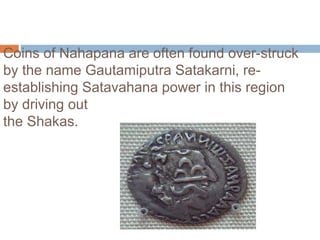
Silver coin of Nahapana, with ruler
profile and written
“King Kshaharata Nahapana”
Coins of Nahapana are often found over-struck
by the name Gautamiputra Satakarni, re-
establishing Satavahana power in this region
by driving out
the Shakas.
Inscriptional sources
 Nasik Cave Inscriptions
 Sanchi Inscription of Satakarni-I
 Naneghat Cave Inscription of Naganika
 Naneghat Cave Status Inscription
 Nasik Cave Inscriptions of Bhatapalika
 Nasik Cave Inscriptions of Gautamiputra
Satakarni
 Karle Cave Inscriptions of Gautamiputra
Satakarni
 Nasik Cave Inscription of Vasishthiputra Pulamavi
 Karle Cave Inscription of the Reigh of
Vasishthiputra Pulamavi
 Amaravati Stupe Inscription of the reign of
Vasishthiputra Pulumavi
 Vanavasi Stone Inscription of Vasishthi Putra
Pulumavi
 Naneghat Inscription of the Reign of Satakarni
 Amaravati Fragmentary Stone Inscription of Siva-
Make-Sada
 Kanheri Cave Inscription of Vasishthiputra
Satakarni
 Kanheri Cave Inscription of the Reign of Yajna
Satakarni
 China Stone Inscription of the Reign of Yajna
Satakarni
 Kanheri Cave Inscription of the Reign of
Mathariputra Sakasena
 Nagarjunakond Pillar Inscription of Vijaya
Satakarni
 Adoni rock Inscription of the reign of Pulumavi
 Kanheri Cave Inscription of the reign of
Chutukulananda Satakarni
 Vanavasi Stone Inscription of Chutukulananda
Satakarni
Inscriptions of western
Kshatrapas
 Nasik Cave Inscription of Rishabhudatta
 Karle Cave Inscription of Rishabhudatta
 Nasik Cave Inscription of Dakshamitra
 Junnar Cave Inscription of Nahapana
 Girnar rock or Junagadh inscription of
Rudradaman
Gautamiputra Satakarni -A.D. 106 -
130
 Gautamiputra Satakarni is said to have
destroyed the power of the Shakas and the
pride of the Khastriyas
 Promoted the interests of the twice-born
(Dvija) and stopped the mixing of the four
varnas.
 His achievements are recorded in glowing
terms in the Nasik prasasti by his mother
Gautami Balasri.
According to the Nasik
inscription
 “he is the one who crushed down the pride and
conceit of the Kshatriyas (the native Indian
princes, the Rajputs of Rajputana, Gujarat and
Central India); who destroyed the Shakas
(Western Kshatrapas), Yavanas (Indo-Greeks)
and Pahlavas (Indo-Parthians),… who rooted the
Khakharata family (The Kshaharata family of
Nahapana); who restored the glory of the
Satavahana race”
 To the Buddhists he made munificent donations.
 His patronage to Brahmanism is revealed by the
epithet ‘Ekabrahmana’
 Gautamiputra was the first Satavahana ruler to issue
the portrait-type coinage, in a style
 derived from the Western Satraps Gautamiputra
Satakarni took the titles of
a) Trisamudrapibatohayavahana (one whose horses
had drunk waters from 3 oceans)
b) and Sakayavanapallavanisudana (destroyer of
Saka, Yavana and Pahlavas).
Vasisthiputra Sri Pulamavi(78–114
CE):
 He was mentioned by Ptolemy under the name
Siriptolemaios (Shri-Pulumayi).
 He was a contemporary of the Western satrap
Chastana.
 Some of the lead coins of Sri Pulamavi depict two-
masted ships, a testimony to the seafaring and
trading capabilities of the Satavahanas during the
1st-2nd century CE.
 He was succeeded by his brother Vashishtiputra
Satakarni.
Vashishtiputra Satakarni -130-160
CE
 Vashishtiputra Sātakarni was in great conflict with
the Scythian Western Kshatrapas in the West, but
he eventually married the daughter of
Rudradaman I of the Western Kshatrapa dynasty,
in order to forge an alliance.
 He was defeated by Rudradaman I
Junagadh rock inscription: “Rudradaman, who
obtained good report because he, in spite of
having twice in fair fight completely defeated
Satakarni, the lord of Dakshinapatha, on account
of the nearness of their connection did not destroy
Shivaskanda Satakarni
 He was one of the lter rulers of the
Satavahana dynasty in India. He succeeded
Vashishtiputra Satakarni in 145 CE, but he
was defeated twice in battle by his Western
Satrap enemy Rudradaman
Yajna Sri Satakarni-167-196 CE
 He is considered to be the last great king of
the Satavahana Dynasty.He is known from his
coins, and from the mention of his name in the
regnal lists of the Matsya Purana.
The lead coins of Sri Pulamavi

The Satavahanas

  • 1.
  • 2.
    THE SATAVAHANAS  TheSatavahanas based from Dharanikota and Amaravati in Andhra Pradesh Junnar (Pune) and Prathisthan (Paithan) in Maharashtra.  There is a lot of controversy regarding the original home of the Satavahanas.  The Puranas speak only of the Andhra rule and not of the Satavahana rule.  The name Andhra does not occur in the Satvahana inscriptions.  The Aitareya Brahmana speaks of them as the
  • 3.
     Date- Matsyapurana-230 b.c to 220 a.d, ruled for 450 years  The kings represented in epigraphic records are mentioned in the Puranas as a) Andhras b) Andhra – bhrityah C) and Andhrajatiyah  Pliny the Elder a Roman author and Megasthenes, refers to the Andhras
  • 4.
     On theircoins the dynasty is variously referred to as the Satavahanas or Salavahana, Satakarnis  The Early Satavahanas ruled Telangana and Andhra Pradesh regions which were always their heartland. The Puranas listed 30 rulers Many are known from their coins and inscriptions as well.  The founder of the Satavahana dynasty was Simuka- independent around 230 BCE
  • 5.
     Satakarni Ias ‘Dakshina -pathapati in the Nanaghat inscription of Nayanika  Satakarni I performed two Asvamedha sacrifices and one Rajasuya sacrifice.  Hala was one more great king of the Satavahanas who was 17th King of the Satavahana line.  Compiled the “Gatha saptasati” or Gaha Sattasai which mainly a text on love theme in Prakrat.  He is also mentioned in another text Lilavati
  • 6.
    Theories on orignof Satavahanas  DR.V.S SUKTANKAR- Bellary  Prof. V.V Mirashal - Berar  Dr. Gopalachari- Maharashtra ( epigraphic and numismatic )  Rapson, Smith and Bhandarkar- between the rivers Krishna and Godavari
  • 7.
     The MatsyaPurana, Vayu Purana, Brahmanda Purana,Vishnu Purana giving the account of Satavahana king killed the last Kanva ruler of Magadha and presumably took possession of his kingdom.  The 1st century CE saw another incursion of the Sakas of Central Asia into India, where they formed the dynasty of the Western Kshatrapas.  During the reign of the Western Satrap Nahapana, the Satavahanas lost a considerable territory to the satraps, including eastern Malwa, Southern Gujarat, and Northern Konkan, from Broach to Sopara and the Nasik and Pune.
  • 8.
    Silver coin ofNahapana, with ruler profile and written “King Kshaharata Nahapana”
  • 9.
    Coins of Nahapanaare often found over-struck by the name Gautamiputra Satakarni, re- establishing Satavahana power in this region by driving out the Shakas.
  • 10.
    Inscriptional sources  NasikCave Inscriptions  Sanchi Inscription of Satakarni-I  Naneghat Cave Inscription of Naganika  Naneghat Cave Status Inscription  Nasik Cave Inscriptions of Bhatapalika  Nasik Cave Inscriptions of Gautamiputra Satakarni  Karle Cave Inscriptions of Gautamiputra Satakarni
  • 11.
     Nasik CaveInscription of Vasishthiputra Pulamavi  Karle Cave Inscription of the Reigh of Vasishthiputra Pulamavi  Amaravati Stupe Inscription of the reign of Vasishthiputra Pulumavi  Vanavasi Stone Inscription of Vasishthi Putra Pulumavi  Naneghat Inscription of the Reign of Satakarni  Amaravati Fragmentary Stone Inscription of Siva- Make-Sada
  • 12.
     Kanheri CaveInscription of Vasishthiputra Satakarni  Kanheri Cave Inscription of the Reign of Yajna Satakarni  China Stone Inscription of the Reign of Yajna Satakarni  Kanheri Cave Inscription of the Reign of Mathariputra Sakasena  Nagarjunakond Pillar Inscription of Vijaya Satakarni  Adoni rock Inscription of the reign of Pulumavi
  • 13.
     Kanheri CaveInscription of the reign of Chutukulananda Satakarni  Vanavasi Stone Inscription of Chutukulananda Satakarni
  • 14.
    Inscriptions of western Kshatrapas Nasik Cave Inscription of Rishabhudatta  Karle Cave Inscription of Rishabhudatta  Nasik Cave Inscription of Dakshamitra  Junnar Cave Inscription of Nahapana  Girnar rock or Junagadh inscription of Rudradaman
  • 15.
    Gautamiputra Satakarni -A.D.106 - 130  Gautamiputra Satakarni is said to have destroyed the power of the Shakas and the pride of the Khastriyas  Promoted the interests of the twice-born (Dvija) and stopped the mixing of the four varnas.  His achievements are recorded in glowing terms in the Nasik prasasti by his mother Gautami Balasri.
  • 16.
    According to theNasik inscription  “he is the one who crushed down the pride and conceit of the Kshatriyas (the native Indian princes, the Rajputs of Rajputana, Gujarat and Central India); who destroyed the Shakas (Western Kshatrapas), Yavanas (Indo-Greeks) and Pahlavas (Indo-Parthians),… who rooted the Khakharata family (The Kshaharata family of Nahapana); who restored the glory of the Satavahana race”
  • 17.
     To theBuddhists he made munificent donations.  His patronage to Brahmanism is revealed by the epithet ‘Ekabrahmana’  Gautamiputra was the first Satavahana ruler to issue the portrait-type coinage, in a style  derived from the Western Satraps Gautamiputra Satakarni took the titles of a) Trisamudrapibatohayavahana (one whose horses had drunk waters from 3 oceans) b) and Sakayavanapallavanisudana (destroyer of Saka, Yavana and Pahlavas).
  • 18.
    Vasisthiputra Sri Pulamavi(78–114 CE): He was mentioned by Ptolemy under the name Siriptolemaios (Shri-Pulumayi).  He was a contemporary of the Western satrap Chastana.  Some of the lead coins of Sri Pulamavi depict two- masted ships, a testimony to the seafaring and trading capabilities of the Satavahanas during the 1st-2nd century CE.  He was succeeded by his brother Vashishtiputra Satakarni.
  • 19.
    Vashishtiputra Satakarni -130-160 CE Vashishtiputra Sātakarni was in great conflict with the Scythian Western Kshatrapas in the West, but he eventually married the daughter of Rudradaman I of the Western Kshatrapa dynasty, in order to forge an alliance.  He was defeated by Rudradaman I Junagadh rock inscription: “Rudradaman, who obtained good report because he, in spite of having twice in fair fight completely defeated Satakarni, the lord of Dakshinapatha, on account of the nearness of their connection did not destroy
  • 20.
    Shivaskanda Satakarni  Hewas one of the lter rulers of the Satavahana dynasty in India. He succeeded Vashishtiputra Satakarni in 145 CE, but he was defeated twice in battle by his Western Satrap enemy Rudradaman
  • 21.
    Yajna Sri Satakarni-167-196CE  He is considered to be the last great king of the Satavahana Dynasty.He is known from his coins, and from the mention of his name in the regnal lists of the Matsya Purana.
  • 22.
    The lead coinsof Sri Pulamavi