What to learn?
• Rise of Cholas
• Rajaraja & Rajendra
• Aspects of Chola Imperialism
• Administration
• Village Administration
• Economy
• Cultural aspects
• Architecture
• Decline of Cholas
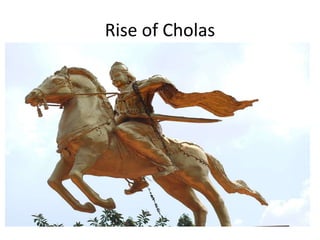
Rise of Cholas
Rise of Cholas
• Vijayalaya Chola the founder, was a feudatory
of Pallavas
• He captured Tanjore in 850 CE
• Won over Pallavas and Pandyas
• Rashtrakutas (Krishna III) defeated Cholas and
took some parts of their territory in the north.
• After death of Krishna III (965 CE), Cholas rose
once again.
Rajaraja & Rajendra
• Rajaraja and his son Rajendra I are the
greatest of all Chola Rulers.
• They took up to military conquest for the
expansion of their territory
• Nevertheless they established a sound
administration in their kingdom
• Fought constantly with Chalukyas of Kalyani
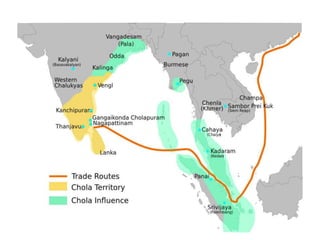
• Bay of Bengal became a Chola Lake
• They captured many kingdoms:
1. Cheras
2. Pallavas
3. Pandyas
4. Sri Lanka
5. Gangas (Karnataka)
6. Kalinga
7. Pala
8. Maldives
9. Sailendra Dynasty (Sri Vijaya Empire)
• Rajaraja & Rajendra erected temples to
commemorate their victories
• Rajarajeshwara Temple at Tanjore (1010) by
Rajaraja
• Gangaikondacholapuram city was created by
Rajendra
• Rajendra, After annexing Kadaram, became
Kadaram Kondan
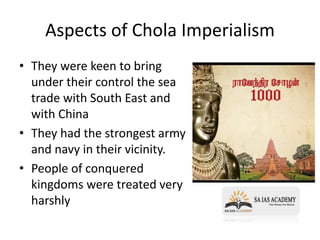
Aspects of Chola Imperialism
• They were keen to bring
under their control the sea
trade with South East and
with China
• They had the strongest army
and navy in their vicinity.
• People of conquered
kingdoms were treated very
harshly
Chola Administration
• King held the ultimate
authority
• He had a council of ministers
• There was a fully developed
secretariat to oversee the
functioning of Central
administration.
• Maintained a large standing
army (Cavalry, infantry,
elephantry)
• King’s navy controlled Malabar
and Coromandel Coast.
• The empire was divided into provinces called
Mandalams
• The Mandalams were subdivided into
divisions known as Kottams or Valanadus.
• The next administrative subdivisions of Cholas
were Nadus, each of which consisted of a
number of villages
• Important Mandalams were placed under the
charges of the Viceroys who were generally
the Princes
• Officials were paid by land grants
Village Administration
• 2 types of Villages: Normal Villages, Agraharas
(village which were settled by Brahmanas)
• Agraharas were land given by the king rent-
free
• 2 Village Assemblies: Ur & Sabha (or
Mahasabha)
• Ur: General assembly of Village
• Mahasabha: Gathering of adult men from
Agraharas
• Affairs of the village was managed by an
executive committee
• Members of the executive committee were
elected from a group of educated persons
owning property.
• They were elected by drawing lots or by
rotation
• The members serve for a term of 3 years
• ▪ Other committees for:
1. Land assessment
2. Revenue collection
3. Law and order
4. Justice delivery
5. Tank maintenance (for irrigation)
• Such a self-government helped in the smooth
running of village administration
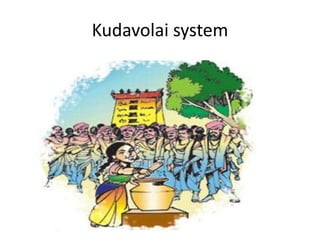
Kudavolai system
• Uttaramerur inscriptions talk about Kudavolai
system
• This system was a very notable and unique
feature of the village administration of the Cholas
• There were 30 wards in each village.
• A representative for each ward was elected
through Kudavolai system
• Names of the contestants from whom one could
be chosen were written on palm leaf ticket
Chola Economy
• They built a network of roads
for catalysing trade and the
for the movement of Army
• Irrigation was given a lot of
importance
• Tanks and irrigation canals
were built
• Rajaraja carried out an
elaborate land survey to
determine the government’s
share of land revenue
• They levied tolls on trade,
and numerous taxes
• Plunder and spoils of war
was also an important
source of income
• Chola rulers were wealthy
as evident from the huge
structures they were able
to build.
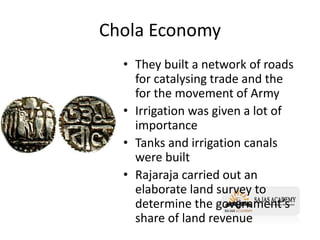
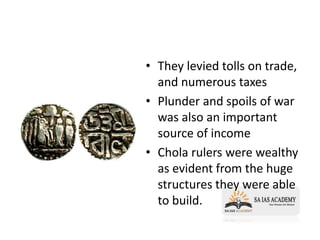
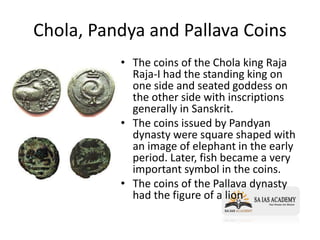
Chola, Pandya and Pallava Coins
• The coins of the Chola king Raja
Raja-I had the standing king on
one side and seated goddess on
the other side with inscriptions
generally in Sanskrit.
• The coins issued by Pandyan
dynasty were square shaped with
an image of elephant in the early
period. Later, fish became a very
important symbol in the coins.
• The coins of the Pallava dynasty
had the figure of a lion
Cultural aspects
• They built great capitals:
Thanjavur and
Gangaikondacholapuram
• Built huge palaces,
multistoried houses for
chiefs
• Temple architecture reached
its climax during the time of
Cholas
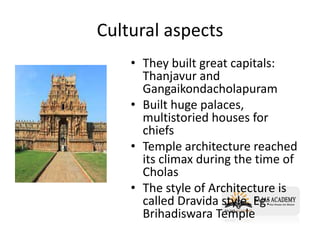
• The style of Architecture is
called Dravida style. Eg:
Brihadiswara Temple
Dravida Style
• ▪ Developed during the time of Cholas. It is
considered as a continuation of the Pallava Style.
Features:
1. High boundary walls
2. High entrance gateway known as the gopuram
3. Premise laid out in Panchayatan Style.
4. The spire is in the form of a stepped pyramid,
known as Vimana
5. The crowning element is shaped in the form of an
octagon and is known as shikhara
• There is only one vimana in the Dravidian architecture
on top of the main temple. The subsidiary shrines do
not have vimanas, unlike in Nagara architecture.
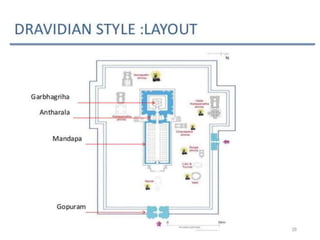
• The assembly hall was connected with the garbhagriha
by a vestibular tunnel known as antarala.
• The entrance of the garbhagriha had sculptures of
Dwaarpal, mithun and yakshas.
• The presence of a water tank inside the temple
enclosure was a unique feature of the Dravidian style.
Dravida Style – Brihadeeshwarar
Temple
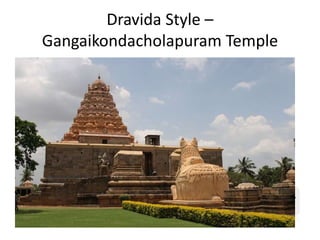
Dravida Style –
Gangaikondacholapuram Temple
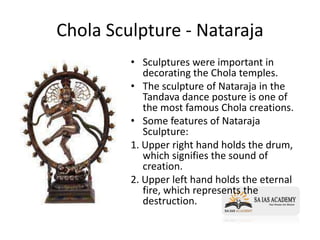
Chola Sculpture - Nataraja
• Sculptures were important in
decorating the Chola temples.
• The sculpture of Nataraja in the
Tandava dance posture is one of
the most famous Chola creations.
• Some features of Nataraja
Sculpture:
1. Upper right hand holds the drum,
which signifies the sound of
creation.
2. Upper left hand holds the eternal
fire, which represents the
destruction.
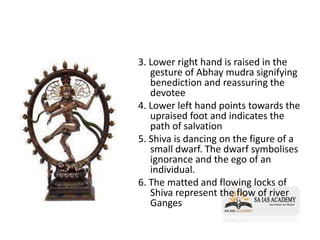
3. Lower right hand is raised in the
gesture of Abhay mudra signifying
benediction and reassuring the
devotee
4. Lower left hand points towards the
upraised foot and indicates the
path of salvation
5. Shiva is dancing on the figure of a
small dwarf. The dwarf symbolises
ignorance and the ego of an
individual.
6. The matted and flowing locks of
Shiva represent the flow of river
Ganges
7. On one ear of Shiva has a male
earring while on the other, he
has female. This represents the
fusion of the male and the
female
8. A snake is twisted around the
arm of Shiva, symbolising the
kundalini power.
9. The Nataraja is surrounded by a
nimbus of glowing lights which
symbolises the vast unending
cycles of time
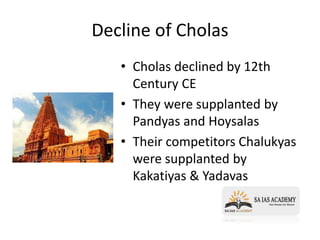
Decline of Cholas
• Cholas declined by 12th
Century CE
• They were supplanted by
Pandyas and Hoysalas
• Their competitors Chalukyas
were supplanted by
Kakatiyas & Yadavas
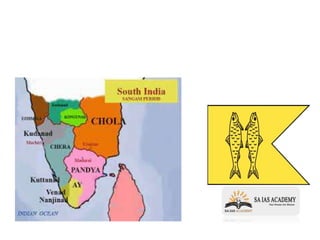
• Korkai, a town historically associated with pearl
fisheries, is believed to have been their early
capital and port. They moved to Madurai later.
• Madurai is mentioned as Matirai in these Tamil
inscriptions, whereas Tamil classics refer to the
city as Kudal, which means assemblage.
• The Pandyas established their supremacy in
South Tamil Nadu by the end of the sixth century
CE.
• The territory of Pandyas is called
Pandymandalam, Thenmandalam or Pandynadu
Pandya Revival (600–920)
• The revival of the Pandyas seems to have taken
place after the disappearance of the Kalabhras.
• Kadunkon, who recovered Pandya territory from
the Kalabhras
• Arikesari Maravarman (624–674 ascended the
throne in 642, according to a Vaigai river bed
inscription.
• He was a contemporary of Mahendravarman I
and Narsimahvarman I.
• Arikesari is identified with Kun Pandian, the
persecutor of Jains.
• Saivite saint Thirugnanasambandar converted
Arikesari from Jainism to Saivism.
• Jatila Parantaka Nedunjadayn (Varaguna I)
(765–815), the donor of the Velvikkudi plates.
• He was also known as the greatest of his
dynasty and successfully handled the Pallavas
and the Cheras.
• king Srimara Srivallabha (815–862) invaded
Ceylon and maintained his authority.
• Parantaka I defeated the Pandya king
Rajasimha II who fled the country in 920CE.
Rise of Pandyas Again (1190–1310)
• In the wake of the vacuum in Chola state in the
last quarter of 12th century after the demise of
Adhi Rajendra,
• Sri Vallaba Pandyan fought Rajaraja II and lost his
son in the battle.
• Using this situation, the five Pandyas waged a war
against Kulotunga I (1070–1120) and were
defeated.
• Marco Polo, the famous traveller from Venice,
visited Kayal twice, in 1288 and in 1293.
• Kayal was their great port.
Sadaiyavarman Sundarapandyan
• Sadaiyavarman (Jatavarman) Sundarapandyan
(1251–1268), brought the entire Tamil Nadu
under his rule
• Under his reign, the Pandya state reached its
zenith, keeping the Hoysalas in check.
• Sundarapandyan conquered the Chera ruler
Maravarman Kulasekharan
• He ascended the throne in 1268 and ruled till
1312.
• The king’s appointment of Sundarapandyan as a
co-regent provoked the other son Vira Pandyan
and so he killed his father Maravarman
Kulasekharan.
• Sundara Pandyan, fled to Delhi and took refuge
under the protection of Alauddin Khalji.
• This turn of events provided an opening for the
invasion of Malik Kafur.
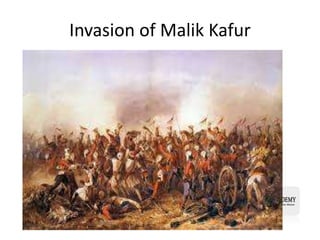
Invasion of Malik Kafur
• When Malik Kafur arrived in Madurai in 1311, he
found the city empty and Vira Pandyan had
already fled.
• The Madurai temple was desecrated and an
enormous amount of wealth was looted.
• wealth he carried was later used in Delhi by
Alauddin Khalji
• After Malik Kafur’s invasion, In
• Madurai, a Muslim state subordinate to the Delhi
Sultan came to be established and continued
until 1335 CE
• The kings are traditionally revered as Kudalkon,
Kudal Nagar Kavalan, Madurapura Paramesvaran.
• The titles of the early Pandyas are:
Pandiyatirasan, Pandiya Maharasan, Mannar
Mannan, Avaniba Sekaran, Eka Viran,
Sakalapuvana Chakkaravarti
• Titles of the later Pandyas in Sanskrit include
Kodanda Raman, Kolakalan, Puvanekaviran, and
Kaliyuga Raman.
• The Pandyas derived military advantage over their
neighbours by means of their horses, which they
imported through their connection to a wider Arab
commercial and cultural world.
• Royal palaces were called Tirumaligai and
Manaparanan Tirumaligai.
• The prime minister was called uttaramantri.
• The royal secretariat was known as Eluttu Mandapam.
The titles
• of military commanders were Palli Velan, Parantakan
Pallivelan, Maran Adittan and Tennavan Tamizhavel.
Society
• Kings and local chiefs created Brahmin
settlements called Mangalam or
Chaturvedimangalam with irrigation facilities.
• More liberal and enlightened policy towards the
overseas traders. Hence promoted trade with
Arabs
• The goods traded were spices, pearls, precious
stones, horses, elephants and birds.
• Those who were trading in horses were called
kudirai-chetti.
Religion
• It is said that Pandyas were Jains initially and
later adopted Saivism.
• Medieval Pandyas and later Pandyas repaired
many temples and endowed them with gold
and land.
• Pandyas extended patronage to Vedic
practices.
• Some kings were ardent Saivite; some were
ardent Vaishnvavites.
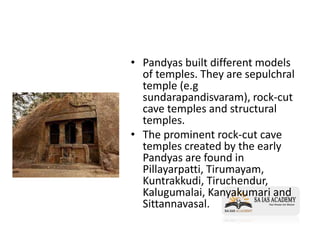
• Pandyas built different models
of temples. They are sepulchral
temple (e.g
sundarapandisvaram), rock-cut
cave temples and structural
temples.
• The prominent rock-cut cave
temples created by the early
Pandyas are found in
Pillayarpatti, Tirumayam,
Kuntrakkudi, Tiruchendur,
Kalugumalai, Kanyakumari and
Sittannavasal.
Sittannavasal Painting
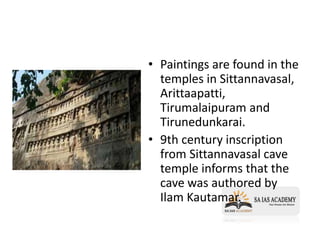
• Paintings are found in the
temples in Sittannavasal,
Arittaapatti,
Tirumalaipuram and
Tirunedunkarai.
• 9th century inscription
from Sittannavasal cave
temple informs that the
cave was authored by
Ilam Kautamar.
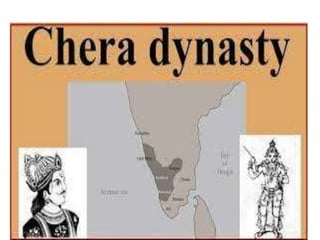
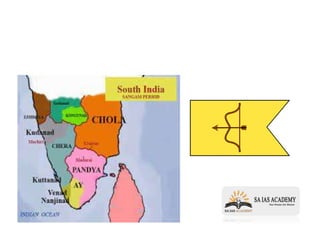
• The Cheras controlled the central and
northern parts of Kerala and the Kongu
region of Tamil Nadu.
• Vanji was their capital
• Keralaputra and Satyaputra is mentioned in
the Rock Edict II and Girnar Inscription
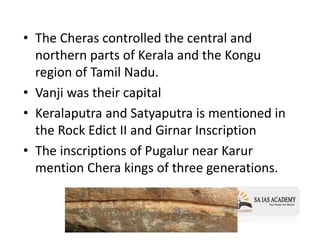
• The inscriptions of Pugalur near Karur
mention Chera kings of three generations.
• The First Chera dynasty ruled from 300 BC to
300 AD in the Sangam Era and another
dynasty from the 9th century AD onwards
• The only source of knowledge of the first
Chera dynasty is Sangam Text
• Cheral Irumporai issued coins in his name.
• Imayavaramban Neduncheralathan and
Chenguttuvan are some of the prominent
Chera kings.
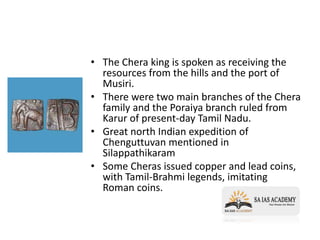
• The Chera king is spoken as receiving the
resources from the hills and the port of
Musiri.
• There were two main branches of the Chera
family and the Poraiya branch ruled from
Karur of present-day Tamil Nadu.
• Great north Indian expedition of
Chenguttuvan mentioned in
Silappathikaram
• Some Cheras issued copper and lead coins,
with Tamil-Brahmi legends, imitating
Roman coins.
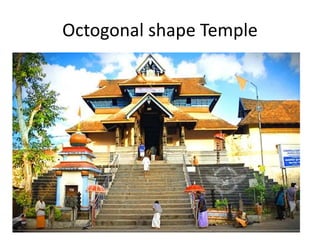
Octogonal shape Temple
• Their architecture was called as, Dravidian
architecture
• Their temples, are mostly octagonal,
rectangular, that sandstones, granite are used
to build
• Their temples are divided into 4 parts-Vimana,
Mandapas, gopurams and grabagriha

Chola , pandya and chera

  • 2.
    What to learn? •Rise of Cholas • Rajaraja & Rajendra • Aspects of Chola Imperialism • Administration • Village Administration • Economy • Cultural aspects • Architecture • Decline of Cholas
  • 4.
  • 5.
    Rise of Cholas •Vijayalaya Chola the founder, was a feudatory of Pallavas • He captured Tanjore in 850 CE • Won over Pallavas and Pandyas • Rashtrakutas (Krishna III) defeated Cholas and took some parts of their territory in the north. • After death of Krishna III (965 CE), Cholas rose once again.
  • 6.
    Rajaraja & Rajendra •Rajaraja and his son Rajendra I are the greatest of all Chola Rulers. • They took up to military conquest for the expansion of their territory • Nevertheless they established a sound administration in their kingdom • Fought constantly with Chalukyas of Kalyani • Bay of Bengal became a Chola Lake
  • 7.
    • They capturedmany kingdoms: 1. Cheras 2. Pallavas 3. Pandyas 4. Sri Lanka 5. Gangas (Karnataka) 6. Kalinga 7. Pala 8. Maldives 9. Sailendra Dynasty (Sri Vijaya Empire)
  • 8.
    • Rajaraja &Rajendra erected temples to commemorate their victories • Rajarajeshwara Temple at Tanjore (1010) by Rajaraja • Gangaikondacholapuram city was created by Rajendra • Rajendra, After annexing Kadaram, became Kadaram Kondan
  • 9.
    Aspects of CholaImperialism • They were keen to bring under their control the sea trade with South East and with China • They had the strongest army and navy in their vicinity. • People of conquered kingdoms were treated very harshly
  • 11.
    Chola Administration • Kingheld the ultimate authority • He had a council of ministers • There was a fully developed secretariat to oversee the functioning of Central administration. • Maintained a large standing army (Cavalry, infantry, elephantry) • King’s navy controlled Malabar and Coromandel Coast.
  • 12.
    • The empirewas divided into provinces called Mandalams • The Mandalams were subdivided into divisions known as Kottams or Valanadus. • The next administrative subdivisions of Cholas were Nadus, each of which consisted of a number of villages • Important Mandalams were placed under the charges of the Viceroys who were generally the Princes • Officials were paid by land grants
  • 13.
    Village Administration • 2types of Villages: Normal Villages, Agraharas (village which were settled by Brahmanas) • Agraharas were land given by the king rent- free • 2 Village Assemblies: Ur & Sabha (or Mahasabha) • Ur: General assembly of Village • Mahasabha: Gathering of adult men from Agraharas
  • 14.
    • Affairs ofthe village was managed by an executive committee • Members of the executive committee were elected from a group of educated persons owning property. • They were elected by drawing lots or by rotation • The members serve for a term of 3 years
  • 15.
    • ▪ Othercommittees for: 1. Land assessment 2. Revenue collection 3. Law and order 4. Justice delivery 5. Tank maintenance (for irrigation) • Such a self-government helped in the smooth running of village administration
  • 16.
  • 17.
    • Uttaramerur inscriptionstalk about Kudavolai system • This system was a very notable and unique feature of the village administration of the Cholas • There were 30 wards in each village. • A representative for each ward was elected through Kudavolai system • Names of the contestants from whom one could be chosen were written on palm leaf ticket
  • 18.
    Chola Economy • Theybuilt a network of roads for catalysing trade and the for the movement of Army • Irrigation was given a lot of importance • Tanks and irrigation canals were built • Rajaraja carried out an elaborate land survey to determine the government’s share of land revenue
  • 19.
    • They leviedtolls on trade, and numerous taxes • Plunder and spoils of war was also an important source of income • Chola rulers were wealthy as evident from the huge structures they were able to build.
  • 20.
    Chola, Pandya andPallava Coins • The coins of the Chola king Raja Raja-I had the standing king on one side and seated goddess on the other side with inscriptions generally in Sanskrit. • The coins issued by Pandyan dynasty were square shaped with an image of elephant in the early period. Later, fish became a very important symbol in the coins. • The coins of the Pallava dynasty had the figure of a lion
  • 21.
    Cultural aspects • Theybuilt great capitals: Thanjavur and Gangaikondacholapuram • Built huge palaces, multistoried houses for chiefs • Temple architecture reached its climax during the time of Cholas • The style of Architecture is called Dravida style. Eg: Brihadiswara Temple
  • 22.
    Dravida Style • ▪Developed during the time of Cholas. It is considered as a continuation of the Pallava Style. Features: 1. High boundary walls 2. High entrance gateway known as the gopuram 3. Premise laid out in Panchayatan Style. 4. The spire is in the form of a stepped pyramid, known as Vimana 5. The crowning element is shaped in the form of an octagon and is known as shikhara
  • 24.
    • There isonly one vimana in the Dravidian architecture on top of the main temple. The subsidiary shrines do not have vimanas, unlike in Nagara architecture. • The assembly hall was connected with the garbhagriha by a vestibular tunnel known as antarala. • The entrance of the garbhagriha had sculptures of Dwaarpal, mithun and yakshas. • The presence of a water tank inside the temple enclosure was a unique feature of the Dravidian style.
  • 25.
    Dravida Style –Brihadeeshwarar Temple
  • 26.
  • 27.
    Chola Sculpture -Nataraja • Sculptures were important in decorating the Chola temples. • The sculpture of Nataraja in the Tandava dance posture is one of the most famous Chola creations. • Some features of Nataraja Sculpture: 1. Upper right hand holds the drum, which signifies the sound of creation. 2. Upper left hand holds the eternal fire, which represents the destruction.
  • 28.
    3. Lower righthand is raised in the gesture of Abhay mudra signifying benediction and reassuring the devotee 4. Lower left hand points towards the upraised foot and indicates the path of salvation 5. Shiva is dancing on the figure of a small dwarf. The dwarf symbolises ignorance and the ego of an individual. 6. The matted and flowing locks of Shiva represent the flow of river Ganges
  • 29.
    7. On oneear of Shiva has a male earring while on the other, he has female. This represents the fusion of the male and the female 8. A snake is twisted around the arm of Shiva, symbolising the kundalini power. 9. The Nataraja is surrounded by a nimbus of glowing lights which symbolises the vast unending cycles of time
  • 30.
    Decline of Cholas •Cholas declined by 12th Century CE • They were supplanted by Pandyas and Hoysalas • Their competitors Chalukyas were supplanted by Kakatiyas & Yadavas
  • 33.
    • Korkai, atown historically associated with pearl fisheries, is believed to have been their early capital and port. They moved to Madurai later. • Madurai is mentioned as Matirai in these Tamil inscriptions, whereas Tamil classics refer to the city as Kudal, which means assemblage. • The Pandyas established their supremacy in South Tamil Nadu by the end of the sixth century CE. • The territory of Pandyas is called Pandymandalam, Thenmandalam or Pandynadu
  • 34.
    Pandya Revival (600–920) •The revival of the Pandyas seems to have taken place after the disappearance of the Kalabhras. • Kadunkon, who recovered Pandya territory from the Kalabhras • Arikesari Maravarman (624–674 ascended the throne in 642, according to a Vaigai river bed inscription. • He was a contemporary of Mahendravarman I and Narsimahvarman I.
  • 35.
    • Arikesari isidentified with Kun Pandian, the persecutor of Jains. • Saivite saint Thirugnanasambandar converted Arikesari from Jainism to Saivism.
  • 36.
    • Jatila ParantakaNedunjadayn (Varaguna I) (765–815), the donor of the Velvikkudi plates. • He was also known as the greatest of his dynasty and successfully handled the Pallavas and the Cheras. • king Srimara Srivallabha (815–862) invaded Ceylon and maintained his authority. • Parantaka I defeated the Pandya king Rajasimha II who fled the country in 920CE.
  • 37.
    Rise of PandyasAgain (1190–1310) • In the wake of the vacuum in Chola state in the last quarter of 12th century after the demise of Adhi Rajendra, • Sri Vallaba Pandyan fought Rajaraja II and lost his son in the battle. • Using this situation, the five Pandyas waged a war against Kulotunga I (1070–1120) and were defeated. • Marco Polo, the famous traveller from Venice, visited Kayal twice, in 1288 and in 1293. • Kayal was their great port.
  • 38.
    Sadaiyavarman Sundarapandyan • Sadaiyavarman(Jatavarman) Sundarapandyan (1251–1268), brought the entire Tamil Nadu under his rule • Under his reign, the Pandya state reached its zenith, keeping the Hoysalas in check. • Sundarapandyan conquered the Chera ruler
  • 39.
    Maravarman Kulasekharan • Heascended the throne in 1268 and ruled till 1312. • The king’s appointment of Sundarapandyan as a co-regent provoked the other son Vira Pandyan and so he killed his father Maravarman Kulasekharan. • Sundara Pandyan, fled to Delhi and took refuge under the protection of Alauddin Khalji. • This turn of events provided an opening for the invasion of Malik Kafur.
  • 40.
  • 41.
    Invasion of MalikKafur • When Malik Kafur arrived in Madurai in 1311, he found the city empty and Vira Pandyan had already fled. • The Madurai temple was desecrated and an enormous amount of wealth was looted. • wealth he carried was later used in Delhi by Alauddin Khalji • After Malik Kafur’s invasion, In • Madurai, a Muslim state subordinate to the Delhi Sultan came to be established and continued until 1335 CE
  • 42.
    • The kingsare traditionally revered as Kudalkon, Kudal Nagar Kavalan, Madurapura Paramesvaran. • The titles of the early Pandyas are: Pandiyatirasan, Pandiya Maharasan, Mannar Mannan, Avaniba Sekaran, Eka Viran, Sakalapuvana Chakkaravarti • Titles of the later Pandyas in Sanskrit include Kodanda Raman, Kolakalan, Puvanekaviran, and Kaliyuga Raman.
  • 43.
    • The Pandyasderived military advantage over their neighbours by means of their horses, which they imported through their connection to a wider Arab commercial and cultural world. • Royal palaces were called Tirumaligai and Manaparanan Tirumaligai. • The prime minister was called uttaramantri. • The royal secretariat was known as Eluttu Mandapam. The titles • of military commanders were Palli Velan, Parantakan Pallivelan, Maran Adittan and Tennavan Tamizhavel.
  • 44.
    Society • Kings andlocal chiefs created Brahmin settlements called Mangalam or Chaturvedimangalam with irrigation facilities. • More liberal and enlightened policy towards the overseas traders. Hence promoted trade with Arabs • The goods traded were spices, pearls, precious stones, horses, elephants and birds. • Those who were trading in horses were called kudirai-chetti.
  • 45.
    Religion • It issaid that Pandyas were Jains initially and later adopted Saivism. • Medieval Pandyas and later Pandyas repaired many temples and endowed them with gold and land. • Pandyas extended patronage to Vedic practices. • Some kings were ardent Saivite; some were ardent Vaishnvavites.
  • 46.
    • Pandyas builtdifferent models of temples. They are sepulchral temple (e.g sundarapandisvaram), rock-cut cave temples and structural temples. • The prominent rock-cut cave temples created by the early Pandyas are found in Pillayarpatti, Tirumayam, Kuntrakkudi, Tiruchendur, Kalugumalai, Kanyakumari and Sittannavasal.
  • 47.
  • 48.
    • Paintings arefound in the temples in Sittannavasal, Arittaapatti, Tirumalaipuram and Tirunedunkarai. • 9th century inscription from Sittannavasal cave temple informs that the cave was authored by Ilam Kautamar.
  • 51.
    • The Cherascontrolled the central and northern parts of Kerala and the Kongu region of Tamil Nadu. • Vanji was their capital • Keralaputra and Satyaputra is mentioned in the Rock Edict II and Girnar Inscription • The inscriptions of Pugalur near Karur mention Chera kings of three generations.
  • 52.
    • The FirstChera dynasty ruled from 300 BC to 300 AD in the Sangam Era and another dynasty from the 9th century AD onwards • The only source of knowledge of the first Chera dynasty is Sangam Text • Cheral Irumporai issued coins in his name. • Imayavaramban Neduncheralathan and Chenguttuvan are some of the prominent Chera kings.
  • 53.
    • The Cheraking is spoken as receiving the resources from the hills and the port of Musiri. • There were two main branches of the Chera family and the Poraiya branch ruled from Karur of present-day Tamil Nadu. • Great north Indian expedition of Chenguttuvan mentioned in Silappathikaram • Some Cheras issued copper and lead coins, with Tamil-Brahmi legends, imitating Roman coins.
  • 54.
  • 55.
    • Their architecturewas called as, Dravidian architecture • Their temples, are mostly octagonal, rectangular, that sandstones, granite are used to build • Their temples are divided into 4 parts-Vimana, Mandapas, gopurams and grabagriha