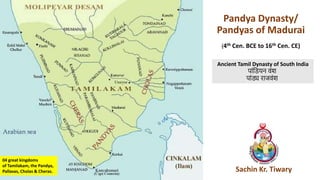
Pandya Dynasty/
Pandyas of Madurai
(4th Cen. BCE to 16th Cen. CE)
Sachin Kr. Tiwary
04 great kingdoms
of Tamilakam, the Pandya,
Pallavas, Cholas & Cheras.
Ancient Tamil Dynasty of South India
प ांडियन वांश
प ांड्य र जवांश
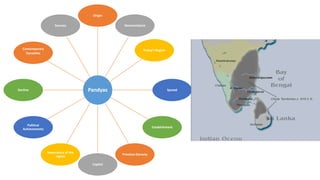
Pandyas
Origin
Nomenclature
Today’s Region
Spread
Establishment
Previous Dynasty
Capital
Importance of the
region
Political
Achievements
Decline
Contemporary
Dynasties
Sources
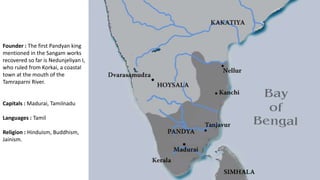
Founder : The first Pandyan king
mentioned in the Sangam works
recovered so far is Nedunjeliyan I,
who ruled from Korkai, a coastal
town at the mouth of the
Tamraparni River.
Capitals : Madurai, Tamilnadu
Languages : Tamil
Religion : Hinduism, Buddhism,
Jainism.
Directed Mani Ratnam
Release 30 September 2022
Music A. R. Rahman
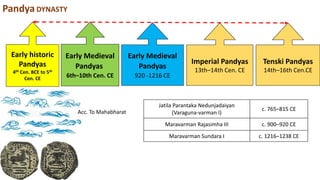
Early historic
Pandyas
4th Cen. BCE to 5th
Cen. CE
Early Medieval
Pandyas
6th–10th Cen. CE
Imperial Pandyas
13th–14th Cen. CE
Early Medieval
Pandyas
920 -1216 CE
Pandya DYNASTY
Tenski Pandyas
14th–16th Cen.CE
Jatila Parantaka Nedunjadaiyan
(Varaguna-varman I)
c. 765–815 CE
Maravarman Rajasimha III c. 900–920 CE
Maravarman Sundara I c. 1216–1238 CE
Acc. To Mahabharat
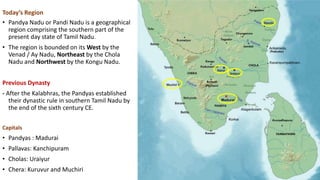
Today’s Region
• Pandya Nadu or Pandi Nadu is a geographical
region comprising the southern part of the
present day state of Tamil Nadu.
• The region is bounded on its West by the
Venad / Ay Nadu, Northeast by the Chola
Nadu and Northwest by the Kongu Nadu.
Previous Dynasty
- After the Kalabhras, the Pandyas established
their dynastic rule in southern Tamil Nadu by
the end of the sixth century CE.
Capitals
• Pandyas : Madurai
• Pallavas: Kanchipuram
• Cholas: Uraiyur
• Chera: Kuruvur and Muchiri
Sources
Inscription-
• Inscriptions of Maurya emperor Asoka: In his
inscriptions (2nd and 13th Major Rock
Edict) Asoka refers to the peoples of south India –
the Cholas, Cheras, Pandyas and Satiyaputras. These
polities, although not part of the Maurya empire,
were on friendly terms with Asoka:
The conquest by dharma has been won here,
on the borders, and even six
hundred yojanas (5,400–9,600 km) away,
where the Greek king Antiochos rules,
beyond there where the four kings
named Ptolemy, Antigonos, Magas and Alexa
nder rule, likewise in the south among
the Cholas, the Pandyas, and as far
as Tamraparni river.
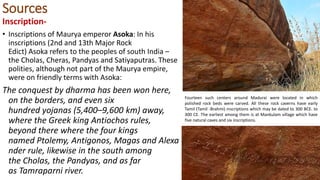
Fourteen such centers around Madurai were located in which
polished rock beds were carved. All these rock caverns have early
Tamil (Tamil -Brahmi) inscriptions which may be dated to 300 BCE. to
300 CE. The earliest among them is at Mankulam village which have
five natural caves and six inscriptions.
Sources Inscription-
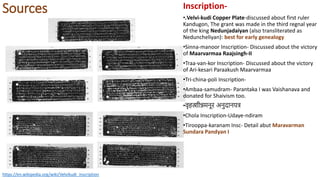
•.Velvi-kudi Copper Plate-discussed about first ruler
Kandugon, The grant was made in the third regnal year
of the king Nedunjadaiyan (also transliterated as
Neduncheliyan): best for early genealogy
•Sinna-manoor Inscription- Discussed about the victory
of Maarvarmaa Raajsingh-II
•Traa-van-kor Inscription- Discussed about the victory
of Ari-kesari Paraakush Maarvarmaa
•Tri-china-poli Inscription-
•Ambaa-samudram- Parantaka I was Vaishanava and
donated for Shaivism too.
•वृहत्शीन्नमनूर अनुद नपत्र
•Chola Inscription-Udaye-ndiram
•Tirooppa-karanam Insc- Detail abut Maravarman
Sundara Pandyan I
https://en.wikipedia.org/wiki/Velvikudi_inscription
Literary Sources:
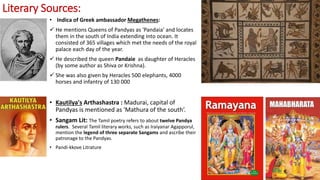
• Indica of Greek ambassador Megathenes:
 He mentions Queens of Pandyas as 'Pandaia' and locates
them in the south of India extending into ocean. It
consisted of 365 villages which met the needs of the royal
palace each day of the year.
 He described the queen Pandaie as daughter of Heracles
(by some author as Shiva or Krishna).
 She was also given by Heracles 500 elephants, 4000
horses and infantry of 130 000
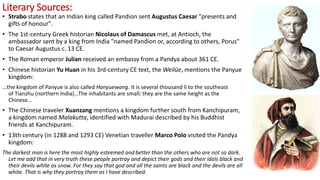
• Kautilya's Arthashastra : Madurai, capital of
Pandyas is mentioned as 'Mathura of the south‘.
• Sangam Lit: The Tamil poetry refers to about twelve Pandya
rulers. Several Tamil literary works, such as Iraiyanar Agapporul,
mention the legend of three separate Sangams and ascribe their
patronage to the Pandyas.
• Pandi-kkove Litrature
Literary Sources:
• Mahabhashya of Katyayan
Strabo Arian Pliny the country
was ruled by
women ruler.
• Strabo states that an Indian king called Pandion sent Augustus Caesar "presents and
gifts of honour".
• The 1st-century Greek historian Nicolaus of Damascus met, at Antioch, the
ambassador sent by a king from India "named Pandion or, according to others, Porus"
to Caesar Augustus c. 13 CE.
• The Roman emperor Julian received an embassy from a Pandya about 361 CE.
• Chinese historian Yu Huan in his 3rd-century CE text, the Weilüe, mentions the Panyue
kingdom:
...the kingdom of Panyue is also called Hanyuewang. It is several thousand li to the southeast
of Tianzhu (northern India)...The inhabitants are small; they are the same height as the
Chinese...
• The Chinese traveler Xuanzang mentions a kingdom further south from Kanchipuram,
a kingdom named Malakutta, identified with Madurai described by his Buddhist
friends at Kanchipuram.
• 13th century (in 1288 and 1293 CE) Venetian traveller Marco Polo visited the Pandya
kingdom:
The darkest man is here the most highly esteemed and better than the others who are not so dark.
Let me add that in very truth these people portray and depict their gods and their idols black and
their devils white as snow. For they say that god and all the saints are black and the devils are all
white. That is why they portray them as I have described.
Literary Sources:
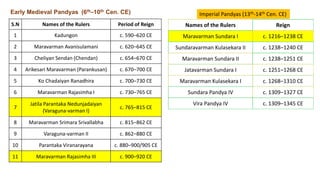
S.N Names of the Rulers Period of Reign
1 Kadungon c. 590–620 CE
2 Maravarman Avanisulamani c. 620–645 CE
3 Cheliyan Sendan (Chendan) c. 654–670 CE
4 Arikesari Maravarman (Parankusan) c. 670–700 CE
5 Ko Chadaiyan Ranadhira c. 700–730 CE
6 Maravarman Rajasimha I c. 730–765 CE
7
Jatila Parantaka Nedunjadaiyan
(Varaguna-varman I)
c. 765–815 CE
8 Maravarman Srimara Srivallabha c. 815–862 CE
9 Varaguna-varman II c. 862–880 CE
10 Parantaka Viranarayana c. 880–900/905 CE
11 Maravarman Rajasimha III c. 900–920 CE
Early Medieval Pandyas (6th–10th Cen. CE) Imperial Pandyas (13th-14th Cen. CE)
Names of the Rulers Reign
Maravarman Sundara I c. 1216–1238 CE
Sundaravarman Kulasekara II c. 1238–1240 CE
Maravarman Sundara II c. 1238–1251 CE
Jatavarman Sundara I c. 1251–1268 CE
Maravarman Kulasekara I c. 1268–1310 CE
Sundara Pandya IV c. 1309–1327 CE
Vira Pandya IV c. 1309–1345 CE
Other
Names
Varaguna-I
Jatil
Parantaka
Jatil Varma
Maranjadaiyan
Jatila Parantaka Nedunjadaiyan c. 765–815 CE
War
Pallava
War at
Pennaagadam near
Thanjaur
Organized by Ayowel
War at Tirunelveli &
Travenkor
North-West Enemies
Names are not
mentiioned
War with
Adigaimaan (He was
supported by Pallva
and Kerala)
At North Side of the
Kaveri Aayirveli,
Ayiroor, Pugaliyar
Western Kongu,
Vellur, Vilinjam,
Puligire
Were defeated
Karoonandan of
Aaya Dynasty
788 CE
Madras Museum Copper
Plate Inscription
Tri-china-poli Inscription
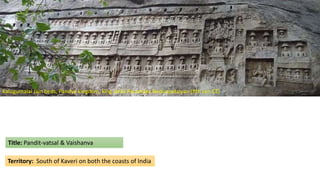
Kalugumalai Jain beds, Pandya kingdom, king Jatila Parantaka Nedunjadaiyan (8th cen CE)
Territory: South of Kaveri on both the coasts of India
Title: Pandit-vatsal & Vaishanva
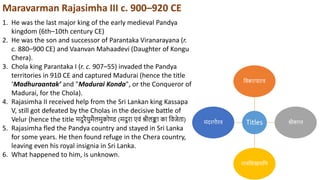
Maravarman Rajasimha III c. 900–920 CE
1. He was the last major king of the early medieval Pandya
kingdom (6th–10th century CE)
2. He was the son and successor of Parantaka Viranarayana (r.
c. 880–900 CE) and Vaanvan Mahaadevi (Daughter of Kongu
Chera).
3. Chola king Parantaka I (r. c. 907–55) invaded the Pandya
territories in 910 CE and captured Madurai (hence the title
‘Madhuraantak’ and "Madurai Konda", or the Conqueror of
Madurai, for the Chola).
4. Rajasimha II received help from the Sri Lankan king Kassapa
V, still got defeated by the Cholas in the decisive battle of
Velur (hence the title मदुरैयुमैलमुकोण्ड (मदुर एवां श्रीलङ्क क डवजेत )
5. Rajasimha fled the Pandya country and stayed in Sri Lanka
for some years. He then found refuge in the Chera country,
leaving even his royal insignia in Sri Lanka.
6. What happened to him, is unknown.
Titles
डवकटप टव
श्रीक न्त
र जडशख मडि
मांदरगौरव
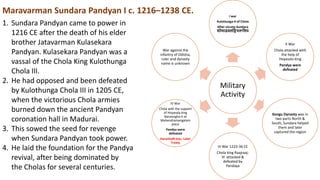
Maravarman Sundara Pandyan I c. 1216–1238 CE.
1. Sundara Pandyan came to power in
1216 CE after the death of his elder
brother Jatavarman Kulasekara
Pandyan. Kulasekara Pandyan was a
vassal of the Chola King Kulothunga
Chola III.
2. He had opposed and been defeated
by Kulothunga Chola III in 1205 CE,
when the victorious Chola armies
burned down the ancient Pandyan
coronation hall in Madurai.
3. This sowed the seed for revenge
when Sundara Pandyan took power.
4. He laid the foundation for the Pandya
revival, after being dominated by
the Cholas for several centuries.
Military
Activity
I war
Kulottunga-II of Chola
After vicroty Sundara
शोणाडवलङ्गियरूङ्गलय
II War
Chola attacked with
the help of
Hoyasala king
Pandya were
defeated
Kongu Dynasty was in
two parts North &
South, Sundara helped
them and later
captured the region
III War 1223-36 CE
Chola king Raajraaj-
III attacked &
defeated by
Pandaya
IV War
Chola with the support
of Hoyasala king
Narasingha-II at
Mahendramangalam
place
Pandya were
defeated
Haranhalli Insc. Later
Treaty
War against the
infantry of Odisha,
ruler and dynasty
name is unknown
Thank You
Any Question ?

PANDYA DYNASTY.ppt

  • 1.
    Pandya Dynasty/ Pandyas ofMadurai (4th Cen. BCE to 16th Cen. CE) Sachin Kr. Tiwary 04 great kingdoms of Tamilakam, the Pandya, Pallavas, Cholas & Cheras. Ancient Tamil Dynasty of South India प ांडियन वांश प ांड्य र जवांश
  • 2.
    Pandyas Origin Nomenclature Today’s Region Spread Establishment Previous Dynasty Capital Importanceof the region Political Achievements Decline Contemporary Dynasties Sources
  • 3.
    Founder : Thefirst Pandyan king mentioned in the Sangam works recovered so far is Nedunjeliyan I, who ruled from Korkai, a coastal town at the mouth of the Tamraparni River. Capitals : Madurai, Tamilnadu Languages : Tamil Religion : Hinduism, Buddhism, Jainism.
  • 4.
    Directed Mani Ratnam Release30 September 2022 Music A. R. Rahman
  • 5.
    Early historic Pandyas 4th Cen.BCE to 5th Cen. CE Early Medieval Pandyas 6th–10th Cen. CE Imperial Pandyas 13th–14th Cen. CE Early Medieval Pandyas 920 -1216 CE Pandya DYNASTY Tenski Pandyas 14th–16th Cen.CE Jatila Parantaka Nedunjadaiyan (Varaguna-varman I) c. 765–815 CE Maravarman Rajasimha III c. 900–920 CE Maravarman Sundara I c. 1216–1238 CE Acc. To Mahabharat
  • 6.
    Today’s Region • PandyaNadu or Pandi Nadu is a geographical region comprising the southern part of the present day state of Tamil Nadu. • The region is bounded on its West by the Venad / Ay Nadu, Northeast by the Chola Nadu and Northwest by the Kongu Nadu. Previous Dynasty - After the Kalabhras, the Pandyas established their dynastic rule in southern Tamil Nadu by the end of the sixth century CE. Capitals • Pandyas : Madurai • Pallavas: Kanchipuram • Cholas: Uraiyur • Chera: Kuruvur and Muchiri
  • 7.
    Sources Inscription- • Inscriptions ofMaurya emperor Asoka: In his inscriptions (2nd and 13th Major Rock Edict) Asoka refers to the peoples of south India – the Cholas, Cheras, Pandyas and Satiyaputras. These polities, although not part of the Maurya empire, were on friendly terms with Asoka: The conquest by dharma has been won here, on the borders, and even six hundred yojanas (5,400–9,600 km) away, where the Greek king Antiochos rules, beyond there where the four kings named Ptolemy, Antigonos, Magas and Alexa nder rule, likewise in the south among the Cholas, the Pandyas, and as far as Tamraparni river. Fourteen such centers around Madurai were located in which polished rock beds were carved. All these rock caverns have early Tamil (Tamil -Brahmi) inscriptions which may be dated to 300 BCE. to 300 CE. The earliest among them is at Mankulam village which have five natural caves and six inscriptions.
  • 8.
    Sources Inscription- •.Velvi-kudi CopperPlate-discussed about first ruler Kandugon, The grant was made in the third regnal year of the king Nedunjadaiyan (also transliterated as Neduncheliyan): best for early genealogy •Sinna-manoor Inscription- Discussed about the victory of Maarvarmaa Raajsingh-II •Traa-van-kor Inscription- Discussed about the victory of Ari-kesari Paraakush Maarvarmaa •Tri-china-poli Inscription- •Ambaa-samudram- Parantaka I was Vaishanava and donated for Shaivism too. •वृहत्शीन्नमनूर अनुद नपत्र •Chola Inscription-Udaye-ndiram •Tirooppa-karanam Insc- Detail abut Maravarman Sundara Pandyan I https://en.wikipedia.org/wiki/Velvikudi_inscription
  • 9.
    Literary Sources: • Indicaof Greek ambassador Megathenes:  He mentions Queens of Pandyas as 'Pandaia' and locates them in the south of India extending into ocean. It consisted of 365 villages which met the needs of the royal palace each day of the year.  He described the queen Pandaie as daughter of Heracles (by some author as Shiva or Krishna).  She was also given by Heracles 500 elephants, 4000 horses and infantry of 130 000 • Kautilya's Arthashastra : Madurai, capital of Pandyas is mentioned as 'Mathura of the south‘. • Sangam Lit: The Tamil poetry refers to about twelve Pandya rulers. Several Tamil literary works, such as Iraiyanar Agapporul, mention the legend of three separate Sangams and ascribe their patronage to the Pandyas. • Pandi-kkove Litrature
  • 10.
    Literary Sources: • Mahabhashyaof Katyayan Strabo Arian Pliny the country was ruled by women ruler.
  • 11.
    • Strabo statesthat an Indian king called Pandion sent Augustus Caesar "presents and gifts of honour". • The 1st-century Greek historian Nicolaus of Damascus met, at Antioch, the ambassador sent by a king from India "named Pandion or, according to others, Porus" to Caesar Augustus c. 13 CE. • The Roman emperor Julian received an embassy from a Pandya about 361 CE. • Chinese historian Yu Huan in his 3rd-century CE text, the Weilüe, mentions the Panyue kingdom: ...the kingdom of Panyue is also called Hanyuewang. It is several thousand li to the southeast of Tianzhu (northern India)...The inhabitants are small; they are the same height as the Chinese... • The Chinese traveler Xuanzang mentions a kingdom further south from Kanchipuram, a kingdom named Malakutta, identified with Madurai described by his Buddhist friends at Kanchipuram. • 13th century (in 1288 and 1293 CE) Venetian traveller Marco Polo visited the Pandya kingdom: The darkest man is here the most highly esteemed and better than the others who are not so dark. Let me add that in very truth these people portray and depict their gods and their idols black and their devils white as snow. For they say that god and all the saints are black and the devils are all white. That is why they portray them as I have described. Literary Sources:
  • 12.
    S.N Names ofthe Rulers Period of Reign 1 Kadungon c. 590–620 CE 2 Maravarman Avanisulamani c. 620–645 CE 3 Cheliyan Sendan (Chendan) c. 654–670 CE 4 Arikesari Maravarman (Parankusan) c. 670–700 CE 5 Ko Chadaiyan Ranadhira c. 700–730 CE 6 Maravarman Rajasimha I c. 730–765 CE 7 Jatila Parantaka Nedunjadaiyan (Varaguna-varman I) c. 765–815 CE 8 Maravarman Srimara Srivallabha c. 815–862 CE 9 Varaguna-varman II c. 862–880 CE 10 Parantaka Viranarayana c. 880–900/905 CE 11 Maravarman Rajasimha III c. 900–920 CE Early Medieval Pandyas (6th–10th Cen. CE) Imperial Pandyas (13th-14th Cen. CE) Names of the Rulers Reign Maravarman Sundara I c. 1216–1238 CE Sundaravarman Kulasekara II c. 1238–1240 CE Maravarman Sundara II c. 1238–1251 CE Jatavarman Sundara I c. 1251–1268 CE Maravarman Kulasekara I c. 1268–1310 CE Sundara Pandya IV c. 1309–1327 CE Vira Pandya IV c. 1309–1345 CE
  • 13.
    Other Names Varaguna-I Jatil Parantaka Jatil Varma Maranjadaiyan Jatila ParantakaNedunjadaiyan c. 765–815 CE War Pallava War at Pennaagadam near Thanjaur Organized by Ayowel War at Tirunelveli & Travenkor North-West Enemies Names are not mentiioned War with Adigaimaan (He was supported by Pallva and Kerala) At North Side of the Kaveri Aayirveli, Ayiroor, Pugaliyar Western Kongu, Vellur, Vilinjam, Puligire Were defeated Karoonandan of Aaya Dynasty 788 CE Madras Museum Copper Plate Inscription Tri-china-poli Inscription
  • 14.
    Kalugumalai Jain beds,Pandya kingdom, king Jatila Parantaka Nedunjadaiyan (8th cen CE) Territory: South of Kaveri on both the coasts of India Title: Pandit-vatsal & Vaishanva
  • 15.
    Maravarman Rajasimha IIIc. 900–920 CE 1. He was the last major king of the early medieval Pandya kingdom (6th–10th century CE) 2. He was the son and successor of Parantaka Viranarayana (r. c. 880–900 CE) and Vaanvan Mahaadevi (Daughter of Kongu Chera). 3. Chola king Parantaka I (r. c. 907–55) invaded the Pandya territories in 910 CE and captured Madurai (hence the title ‘Madhuraantak’ and "Madurai Konda", or the Conqueror of Madurai, for the Chola). 4. Rajasimha II received help from the Sri Lankan king Kassapa V, still got defeated by the Cholas in the decisive battle of Velur (hence the title मदुरैयुमैलमुकोण्ड (मदुर एवां श्रीलङ्क क डवजेत ) 5. Rajasimha fled the Pandya country and stayed in Sri Lanka for some years. He then found refuge in the Chera country, leaving even his royal insignia in Sri Lanka. 6. What happened to him, is unknown. Titles डवकटप टव श्रीक न्त र जडशख मडि मांदरगौरव
  • 16.
    Maravarman Sundara PandyanI c. 1216–1238 CE. 1. Sundara Pandyan came to power in 1216 CE after the death of his elder brother Jatavarman Kulasekara Pandyan. Kulasekara Pandyan was a vassal of the Chola King Kulothunga Chola III. 2. He had opposed and been defeated by Kulothunga Chola III in 1205 CE, when the victorious Chola armies burned down the ancient Pandyan coronation hall in Madurai. 3. This sowed the seed for revenge when Sundara Pandyan took power. 4. He laid the foundation for the Pandya revival, after being dominated by the Cholas for several centuries. Military Activity I war Kulottunga-II of Chola After vicroty Sundara शोणाडवलङ्गियरूङ्गलय II War Chola attacked with the help of Hoyasala king Pandya were defeated Kongu Dynasty was in two parts North & South, Sundara helped them and later captured the region III War 1223-36 CE Chola king Raajraaj- III attacked & defeated by Pandaya IV War Chola with the support of Hoyasala king Narasingha-II at Mahendramangalam place Pandya were defeated Haranhalli Insc. Later Treaty War against the infantry of Odisha, ruler and dynasty name is unknown
  • 17.