“ONE STATE MANY WORLDS”
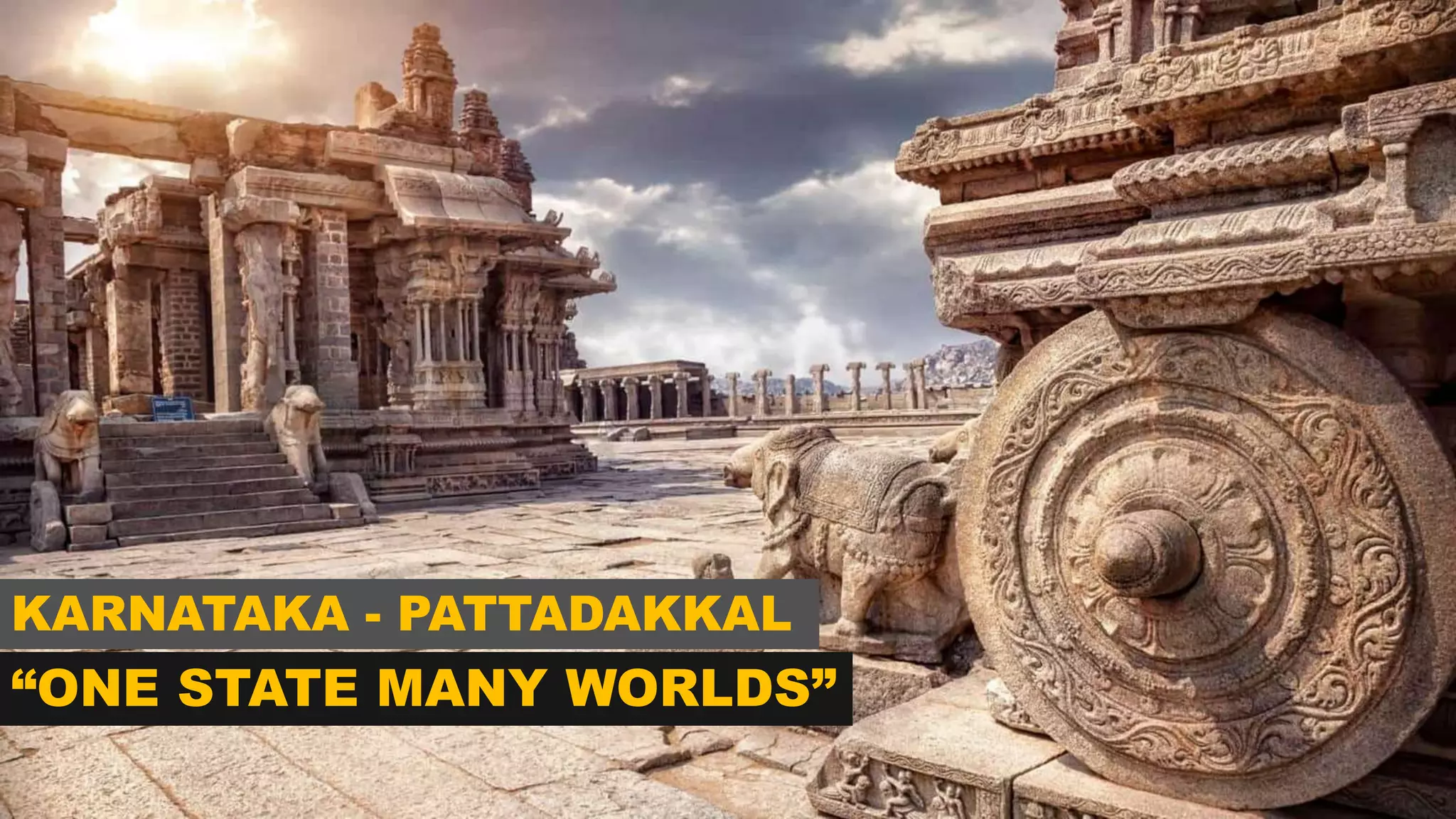
KARNATAKA - PATTADAKKAL
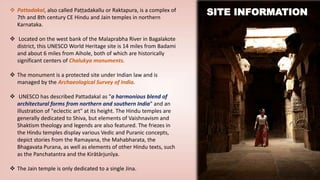
 Pattadakal, also called Paṭṭadakallu or Raktapura, is a complex of
7th and 8th century CE Hindu and Jain temples in northern
Karnataka.
 Located on the west bank of the Malaprabha River in Bagalakote
district, this UNESCO World Heritage site is 14 miles from Badami
and about 6 miles from Aihole, both of which are historically
significant centers of Chalukya monuments.
 The monument is a protected site under Indian law and is
managed by the Archaeological Survey of India.
 UNESCO has described Pattadakal as "a harmonious blend of
architectural forms from northern and southern India" and an
illustration of "eclectic art" at its height. The Hindu temples are
generally dedicated to Shiva, but elements of Vaishnavism and
Shaktism theology and legends are also featured. The friezes in
the Hindu temples display various Vedic and Puranic concepts,
depict stories from the Ramayana, the Mahabharata, the
Bhagavata Purana, as well as elements of other Hindu texts, such
as the Panchatantra and the Kirātārjunīya.
 The Jain temple is only dedicated to a single Jina.
SITE INFORMATION
 GROUP OF MONUMENTS AT PATTADAKKAL
(UNESCO WORLD HERITAGE SITE)
 PAPANATHA TEMPLE
 VIRUPAKSHA TEMPLE
 SANGAMESHWARA TEMPLE
 MALLIKARJUNA TEMPLE
 JAIN NARAYNA TEMPLE
ATTRACTIONSATTRACTIONS
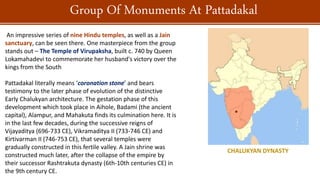
An impressive series of nine Hindu temples, as well as a Jain
sanctuary, can be seen there. One masterpiece from the group
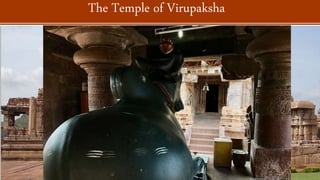
stands out – The Temple of Virupaksha, built c. 740 by Queen
Lokamahadevi to commemorate her husband's victory over the
kings from the South
Pattadakal literally means ‘coronation stone’ and bears
testimony to the later phase of evolution of the distinctive
Early Chalukyan architecture. The gestation phase of this
development which took place in Aihole, Badami (the ancient
capital), Alampur, and Mahakuta finds its culmination here. It is
in the last few decades, during the successive reigns of
Vijayaditya (696-733 CE), Vikramaditya II (733-746 CE) and
Kirtivarman II (746-753 CE), that several temples were
gradually constructed in this fertile valley. A Jain shrine was
constructed much later, after the collapse of the empire by
their successor Rashtrakuta dynasty (6th-10th centuries CE) in
the 9th century CE.
Group Of Monuments At Pattadakal
CHALUKYAN DYNASTY
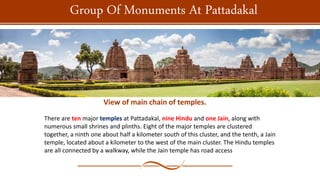
There are ten major temples at Pattadakal, nine Hindu and one Jain, along with
numerous small shrines and plinths. Eight of the major temples are clustered
together, a ninth one about half a kilometer south of this cluster, and the tenth, a Jain
temple, located about a kilometer to the west of the main cluster. The Hindu temples
are all connected by a walkway, while the Jain temple has road access
Group Of Monuments At Pattadakal
View of main chain of temples.
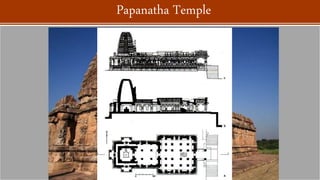
The Papanatha temple is situated apart from the main cluster of eight
monuments. It is about half kilometer to the south of Virupaksha and
has been dated towards the end of the Early Chalukya rule period,
approximately mid 8th-century.
This temple do not have a defined style of architecture. One may
notice various style of architecture on various parts of the temple.
This temple is dedicated to Lord Shiva.
Papanatha Temple
 The epigraphy reveals this to have been built by Queen Loka Mahadevi (originally named as Lokeswara)
after the successful military campaigns of King Vikramaditya II against the Pallavas (4th-9th centuries CE).
 A square garbha griha, with an ambulatory path surrounding it, is connected to the antarala. Two small
shrines are laterally placed to the antarala, one for Ganesh and the other for Mahisasurmardini. Three
porches from the east, north and south open up to an expansive mandapa.
 Further east, a separate Nandi mandapa is placed on a plinth. The whole temple is surrounded
by prakara (enclosure) walls that are provided with subsidiary shrines on its inner side.
 The magnificently built Dravida shikhara with a well-preserved sukanasa ('nose,' arched projection) on the
front is one of the hallmarks of the temple. The superstructure is three-storied and topped by a four-
sided amalaka with a kalash at its finial
The Temple of Virupaksha
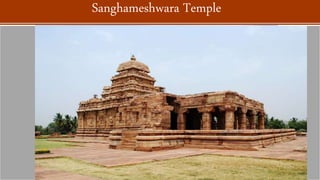
Sangameshwara temple, also called the Vijayeshvara temple, is a large, Dravida style
east facing temple located on the south side of the Chandrashekhara
temple. Inscriptions at the temple, and other evidence, date it to between 720 CE and
733 CE. The death of its patron king, Vijayaditya, in 734 CE resulted in the temple
being left unfinished, although work continued intermittently in later centuries
Inside the sanctum is a Shiva Linga. In front of the sanctum is a vestibule that is flanked
on each side by smaller shrines. These shrines once contained carvings of Ganesha and
Durga, but the carvings have since gone missing.
Sanghameshwara Temple
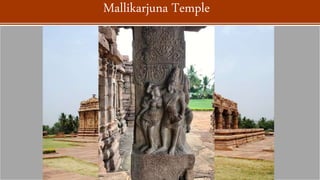
The temple reflects a fully developed South Indian vimana style architecture.
Its garbha griya (sanctum) has a Shiva linga, and features a
circumambulatory path (pradakshina patha). In front of the sanctum is an
antechamber (antarala) with small shrines for Durga
as Mahishasuramardini killing the buffalo demon and another for Ganesha on
each side, both currently empty. A Nandi-mandapa is included in the temple
wherein Nandi faces the sanctum. Access to the sanctum is through a
pillared sabha-mandapa (community hall) with entrance porches, enclosures
(prakara) and a gateway (pratoli)
Mallikarjuna Temple
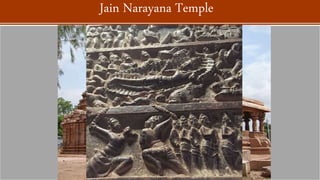
The Jaina temple at Pattadakal was built during the 9th century, possibly with
sponsorship from the Rashtrakuta King Krishna II or the Kalyani Chalukyas.
Unlike the other nine temples, the Narayana temple lacks Hindu deities and
intricate panels of the other nine, but instead has a statue of a Jina carved
into the north side kapota .
The mandapa has a row of lathe-turned sand stone pillars.
The kakshasana are decorated with the figures of dancers, purna-ghata,
nidhis, vyalas but some of the artwork is only partially finished. The entrance
features carvings of a life sized elephant torso with riders. According to Adam
Hardy, the niches of this Jain temple mandapa may have previously featured
images
Jain Narayana Temple
According to art historian Cathleen Cummings, the monuments at Pattadakal are a
historically significant example of religion, society and culture, particularly Hindu and
Jain, in the Deccan region and is an expression of Hindu kingship and religious worldview
of 8th-century India. She writes that the artisans express the conflicting concepts
of Dharma (duty, virtue, righteousness) and Moksha (liberation) in Hindu theology,
particularly Pashupata Shaivism. Furthermore, she states that the significance lies not just
within individual images but also in their relative location and sequence as well how it
expresses the historic tension in Hindu religious tradition between the stately life of the
householder and the life of the renouncer monk.
The temples at Pattadakal are symbolic of the Chalukya inclination towards integration,
and experimentation, resulting in a merging of the Northern and Southern Indian
architectural styles.
Significance
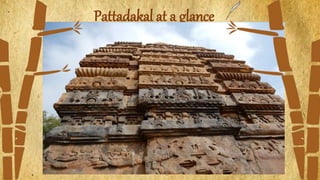
Pattadakal at a glance

Pattadakkal

  • 1.
    “ONE STATE MANYWORLDS” KARNATAKA - PATTADAKKAL
  • 2.
     Pattadakal, alsocalled Paṭṭadakallu or Raktapura, is a complex of 7th and 8th century CE Hindu and Jain temples in northern Karnataka.  Located on the west bank of the Malaprabha River in Bagalakote district, this UNESCO World Heritage site is 14 miles from Badami and about 6 miles from Aihole, both of which are historically significant centers of Chalukya monuments.  The monument is a protected site under Indian law and is managed by the Archaeological Survey of India.  UNESCO has described Pattadakal as "a harmonious blend of architectural forms from northern and southern India" and an illustration of "eclectic art" at its height. The Hindu temples are generally dedicated to Shiva, but elements of Vaishnavism and Shaktism theology and legends are also featured. The friezes in the Hindu temples display various Vedic and Puranic concepts, depict stories from the Ramayana, the Mahabharata, the Bhagavata Purana, as well as elements of other Hindu texts, such as the Panchatantra and the Kirātārjunīya.  The Jain temple is only dedicated to a single Jina. SITE INFORMATION
  • 3.
     GROUP OFMONUMENTS AT PATTADAKKAL (UNESCO WORLD HERITAGE SITE)  PAPANATHA TEMPLE  VIRUPAKSHA TEMPLE  SANGAMESHWARA TEMPLE  MALLIKARJUNA TEMPLE  JAIN NARAYNA TEMPLE ATTRACTIONSATTRACTIONS
  • 4.
    An impressive seriesof nine Hindu temples, as well as a Jain sanctuary, can be seen there. One masterpiece from the group stands out – The Temple of Virupaksha, built c. 740 by Queen Lokamahadevi to commemorate her husband's victory over the kings from the South Pattadakal literally means ‘coronation stone’ and bears testimony to the later phase of evolution of the distinctive Early Chalukyan architecture. The gestation phase of this development which took place in Aihole, Badami (the ancient capital), Alampur, and Mahakuta finds its culmination here. It is in the last few decades, during the successive reigns of Vijayaditya (696-733 CE), Vikramaditya II (733-746 CE) and Kirtivarman II (746-753 CE), that several temples were gradually constructed in this fertile valley. A Jain shrine was constructed much later, after the collapse of the empire by their successor Rashtrakuta dynasty (6th-10th centuries CE) in the 9th century CE. Group Of Monuments At Pattadakal CHALUKYAN DYNASTY
  • 5.
    There are tenmajor temples at Pattadakal, nine Hindu and one Jain, along with numerous small shrines and plinths. Eight of the major temples are clustered together, a ninth one about half a kilometer south of this cluster, and the tenth, a Jain temple, located about a kilometer to the west of the main cluster. The Hindu temples are all connected by a walkway, while the Jain temple has road access Group Of Monuments At Pattadakal View of main chain of temples.
  • 6.
    The Papanatha templeis situated apart from the main cluster of eight monuments. It is about half kilometer to the south of Virupaksha and has been dated towards the end of the Early Chalukya rule period, approximately mid 8th-century. This temple do not have a defined style of architecture. One may notice various style of architecture on various parts of the temple. This temple is dedicated to Lord Shiva. Papanatha Temple
  • 7.
     The epigraphyreveals this to have been built by Queen Loka Mahadevi (originally named as Lokeswara) after the successful military campaigns of King Vikramaditya II against the Pallavas (4th-9th centuries CE).  A square garbha griha, with an ambulatory path surrounding it, is connected to the antarala. Two small shrines are laterally placed to the antarala, one for Ganesh and the other for Mahisasurmardini. Three porches from the east, north and south open up to an expansive mandapa.  Further east, a separate Nandi mandapa is placed on a plinth. The whole temple is surrounded by prakara (enclosure) walls that are provided with subsidiary shrines on its inner side.  The magnificently built Dravida shikhara with a well-preserved sukanasa ('nose,' arched projection) on the front is one of the hallmarks of the temple. The superstructure is three-storied and topped by a four- sided amalaka with a kalash at its finial The Temple of Virupaksha
  • 8.
    Sangameshwara temple, alsocalled the Vijayeshvara temple, is a large, Dravida style east facing temple located on the south side of the Chandrashekhara temple. Inscriptions at the temple, and other evidence, date it to between 720 CE and 733 CE. The death of its patron king, Vijayaditya, in 734 CE resulted in the temple being left unfinished, although work continued intermittently in later centuries Inside the sanctum is a Shiva Linga. In front of the sanctum is a vestibule that is flanked on each side by smaller shrines. These shrines once contained carvings of Ganesha and Durga, but the carvings have since gone missing. Sanghameshwara Temple
  • 9.
    The temple reflectsa fully developed South Indian vimana style architecture. Its garbha griya (sanctum) has a Shiva linga, and features a circumambulatory path (pradakshina patha). In front of the sanctum is an antechamber (antarala) with small shrines for Durga as Mahishasuramardini killing the buffalo demon and another for Ganesha on each side, both currently empty. A Nandi-mandapa is included in the temple wherein Nandi faces the sanctum. Access to the sanctum is through a pillared sabha-mandapa (community hall) with entrance porches, enclosures (prakara) and a gateway (pratoli) Mallikarjuna Temple
  • 10.
    The Jaina templeat Pattadakal was built during the 9th century, possibly with sponsorship from the Rashtrakuta King Krishna II or the Kalyani Chalukyas. Unlike the other nine temples, the Narayana temple lacks Hindu deities and intricate panels of the other nine, but instead has a statue of a Jina carved into the north side kapota . The mandapa has a row of lathe-turned sand stone pillars. The kakshasana are decorated with the figures of dancers, purna-ghata, nidhis, vyalas but some of the artwork is only partially finished. The entrance features carvings of a life sized elephant torso with riders. According to Adam Hardy, the niches of this Jain temple mandapa may have previously featured images Jain Narayana Temple
  • 11.
    According to arthistorian Cathleen Cummings, the monuments at Pattadakal are a historically significant example of religion, society and culture, particularly Hindu and Jain, in the Deccan region and is an expression of Hindu kingship and religious worldview of 8th-century India. She writes that the artisans express the conflicting concepts of Dharma (duty, virtue, righteousness) and Moksha (liberation) in Hindu theology, particularly Pashupata Shaivism. Furthermore, she states that the significance lies not just within individual images but also in their relative location and sequence as well how it expresses the historic tension in Hindu religious tradition between the stately life of the householder and the life of the renouncer monk. The temples at Pattadakal are symbolic of the Chalukya inclination towards integration, and experimentation, resulting in a merging of the Northern and Southern Indian architectural styles. Significance
  • 12.