Jeevan Lal
University of Kerala
MVA Art History and Aesthetics.
RRV Centre of Excellence for Visual Arts
Mavelikkara, Kerala.
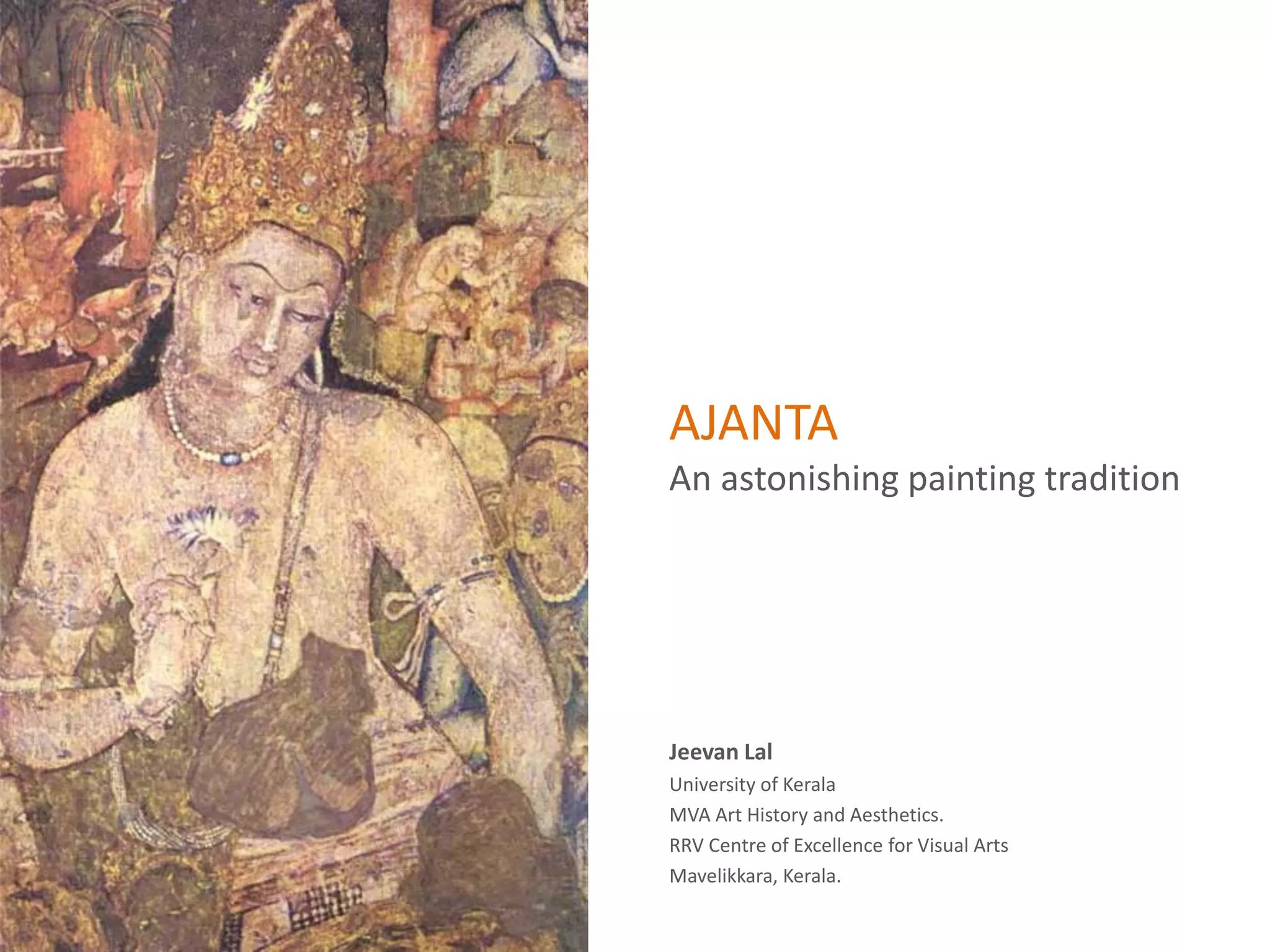
AJANTA
An astonishing painting tradition
Location
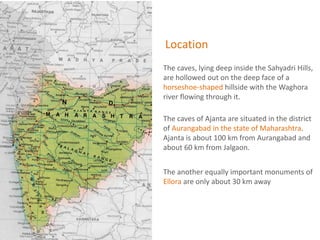
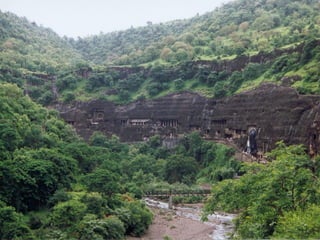
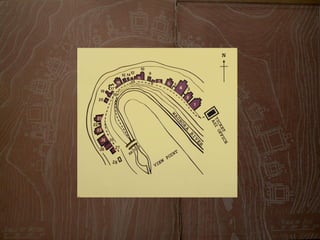
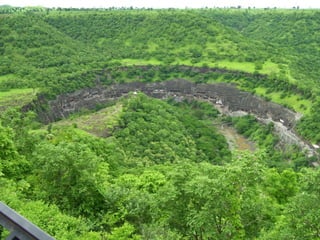
The caves, lying deep inside the Sahyadri Hills,
are hollowed out on the deep face of a
horseshoe-shaped hillside with the Waghora
river flowing through it.
The caves of Ajanta are situated in the district
of Aurangabad in the state of Maharashtra.
Ajanta is about 100 km from Aurangabad and
about 60 km from Jalgaon.
The another equally important monuments of
Ellora are only about 30 km away
The caves of Ajanta offer an instructive field
for the study of the evolution of rock-cut
architecture. The evolution of rock architecture
took place during two periods.
The Hinayana period and
The later Mahayana period.
First Phase-Hinayana period
(2nd - 1st centuries BC)
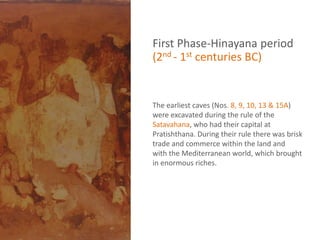
The earliest caves (Nos. 8, 9, 10, 13 & 15A)
were excavated during the rule of the
Satavahana, who had their capital at
Pratishthana. During their rule there was brisk
trade and commerce within the land and
with the Mediterranean world, which brought
in enormous riches.
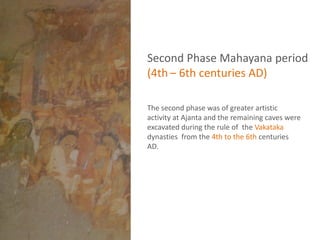
Second Phase Mahayana period
(4th – 6th centuries AD)
The second phase was of greater artistic
activity at Ajanta and the remaining caves were
excavated during the rule of the Vakataka
dynasties from the 4th to the 6th centuries
AD.
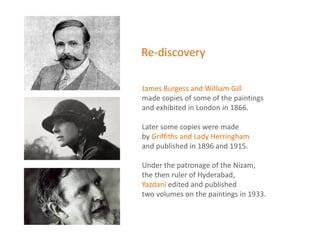
Re-discovery
James Burgess and William Gill
made copies of some of the paintings
and exhibited in London in 1866.
Later some copies were made
by Griffiths and Lady Herringham
and published in 1896 and 1915.
Under the patronage of the Nizam,
the then ruler of Hyderabad,
Yazdani edited and published
two volumes on the paintings in 1933.
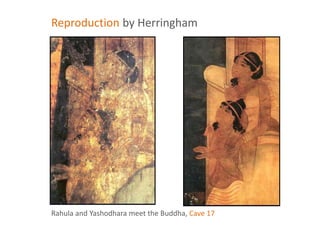
Rahula and Yashodhara meet the Buddha, Cave 17
Reproduction by Herringham
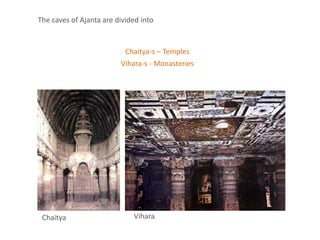
Chaitya-s – Temples
Vihara-s - Monasteries
The caves of Ajanta are divided into
Chaitya Vihara
Themes of Paintings
The subjects of the paintings are
mostly from the jataka-s, Buddhist
mythological stories of the previous lives
of the Master
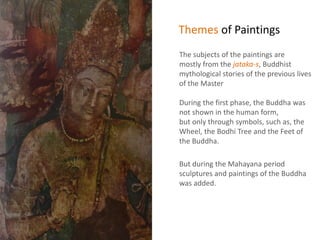
During the first phase, the Buddha was
not shown in the human form,
but only through symbols, such as, the
Wheel, the Bodhi Tree and the Feet of
the Buddha.
But during the Mahayana period
sculptures and paintings of the Buddha
was added.
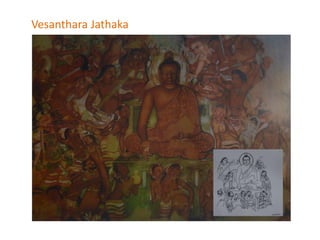
Vesanthara Jathaka
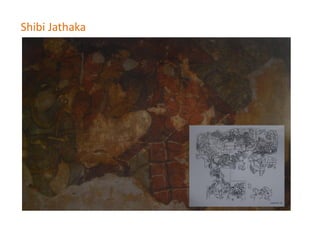
Shibi Jathaka
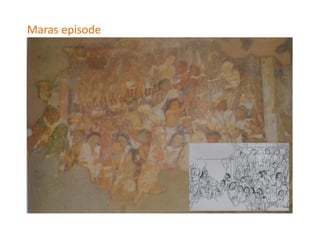
Maras episode
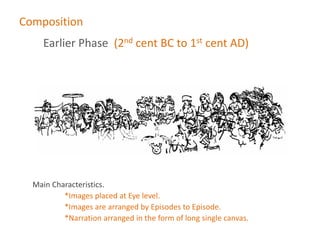
Earlier Phase (2nd cent BC to 1st cent AD)
Main Characteristics.
*Images placed at Eye level.
*Images are arranged by Episodes to Episode.
*Narration arranged in the form of long single canvas.
Composition
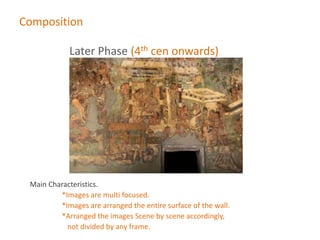
Later Phase (4th cen onwards)
Main Characteristics.
*Images are multi focused.
*Images are arranged the entire surface of the wall.
*Arranged the images Scene by scene accordingly,
not divided by any frame.
Composition
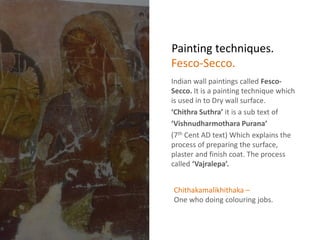
Painting techniques.
Indian wall paintings called Fesco-
Secco. It is a painting technique which
is used in to Dry wall surface.
‘Chithra Suthra’ it is a sub text of
‘Vishnudharmothara Purana’
(7th Cent AD text) Which explains the
process of preparing the surface,
plaster and finish coat. The process
called ‘Vajralepa’.
Fesco-Secco.
Chithakamalikhithaka –
One who doing colouring jobs.
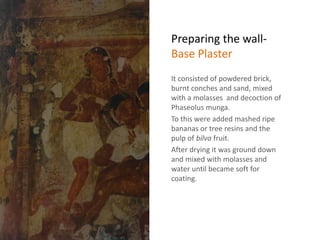
Preparing the wall-
Base Plaster
It consisted of powdered brick,
burnt conches and sand, mixed
with a molasses and decoction of
Phaseolus munga.
To this were added mashed ripe
bananas or tree resins and the
pulp of bilva fruit.
After drying it was ground down
and mixed with molasses and
water until became soft for
coating.
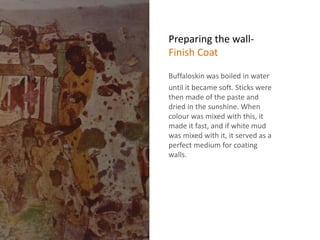
Preparing the wall-
Finish Coat
Buffaloskin was boiled in water
until it became soft. Sticks were
then made of the paste and
dried in the sunshine. When
colour was mixed with this, it
made it fast, and if white mud
was mixed with it, it served as a
perfect medium for coating
walls.
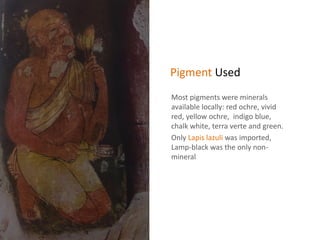
Pigment Used
Most pigments were minerals
available locally: red ochre, vivid
red, yellow ochre, indigo blue,
chalk white, terra verte and green.
Only Lapis lazuli was imported,
Lamp-black was the only non-
mineral
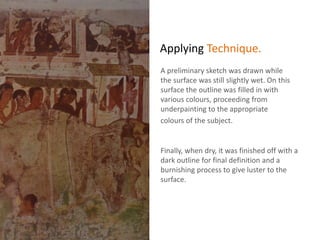
Applying Technique.
A preliminary sketch was drawn while
the surface was still slightly wet. On this
surface the outline was filled in with
various colours, proceeding from
underpainting to the appropriate
colours of the subject.
Finally, when dry, it was finished off with a
dark outline for final definition and a
burnishing process to give luster to the
surface.
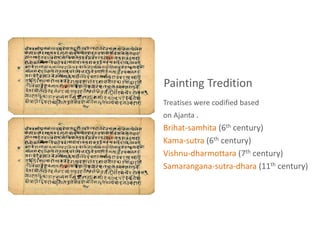
Painting Tredition
Treatises were codified based
on Ajanta .
Brihat-samhita (6th century)
Kama-sutra (6th century)
Vishnu-dharmottara (7th century)
Samarangana-sutra-dhara (11th century)
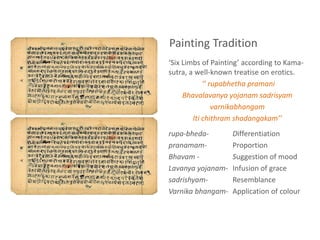
Painting Tradition
‘Six Limbs of Painting’ according to Kama-
sutra, a well-known treatise on erotics.
‘’ rupabhetha pramani
Bhavalavanya yojanam sadrisyam
varnikabhangam
Iti chithram shadangakam’’
rupa-bheda- Differentiation
pranamam- Proportion
Bhavam - Suggestion of mood
Lavanya yojanam- Infusion of grace
sadrishyam- Resemblance
Varnika bhangam- Application of colour
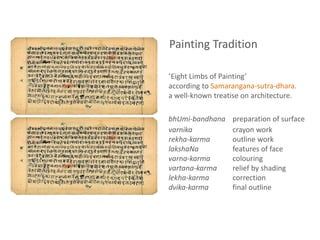
‘Eight Limbs of Painting’
according to Samarangana-sutra-dhara.
a well-known treatise on architecture.
bhUmi-bandhana preparation of surface
varnika crayon work
rekha-karma outline work
lakshaNa features of face
varna-karma colouring
vartana-karma relief by shading
lekha-karma correction
dvika-karma final outline
Painting Tradition
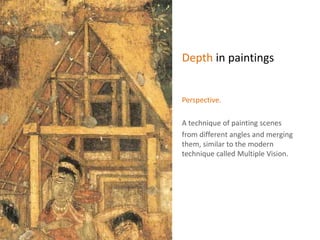
Depth in paintings
Perspective.
A technique of painting scenes
from different angles and merging
them, similar to the modern
technique called Multiple Vision.
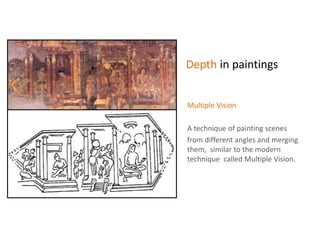
Depth in paintings
Multiple Vision
A technique of painting scenes
from different angles and merging
them, similar to the modern
technique called Multiple Vision.
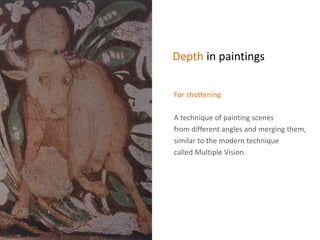
Depth in paintings
For shottening
A technique of painting scenes
from different angles and merging them,
similar to the modern technique
called Multiple Vision.
Depth in paintings
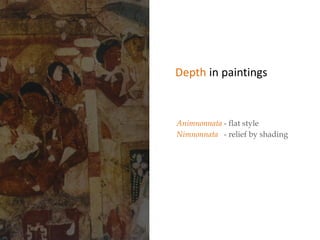
Animnonnata - flat style
Nimnonnata - relief by shading
Depth in paintings
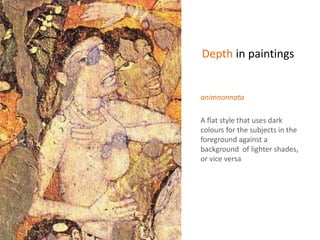
animnonnata
A flat style that uses dark
colours for the subjects in the
foreground against a
background of lighter shades,
or vice versa
Depth in paintings
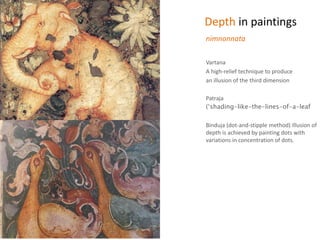
Vartana
A high-relief technique to produce
an illusion of the third dimension
Patraja
(‘shading-like-the-lines-of-a-leaf
Binduja (dot-and-stipple method) Illusion of
depth is achieved by painting dots with
variations in concentration of dots.
nimnonnata
Depth in paintings
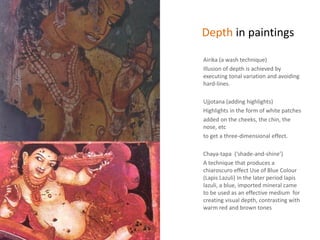
Airika (a wash technique)
Illusion of depth is achieved by
executing tonal variation and avoiding
hard-lines.
Ujjotana (adding highlights)
Highlights in the form of white patches
added on the cheeks, the chin, the
nose, etc
to get a three-dimensional effect.
Chaya-tapa (‘shade-and-shine’)
A technique that produces a
chiaroscuro effect Use of Blue Colour
(Lapis Lazuli) In the later period lapis
lazuli, a blue, imported mineral came
to be used as an effective medium for
creating visual depth, contrasting with
warm red and brown tones
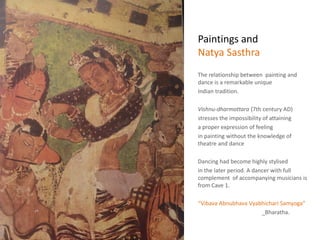
Paintings and
Natya Sasthra
The relationship between painting and
dance is a remarkable unique
Indian tradition.
Vishnu-dharmottara (7th century AD)
stresses the impossibility of attaining
a proper expression of feeling
in painting without the knowledge of
theatre and dance
Dancing had become highly stylised
in the later period. A dancer with full
complement of accompanying musicians is
from Cave 1.
“Vibava Abnubhava Vyabhichari Samyoga”
_Bharatha.
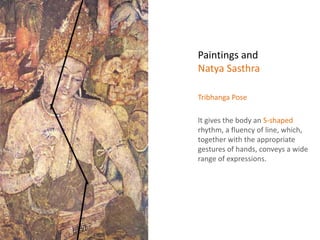
Tribhanga Pose
It gives the body an S-shaped
rhythm, a fluency of line, which,
together with the appropriate
gestures of hands, conveys a wide
range of expressions.
Paintings and
Natya Sasthra
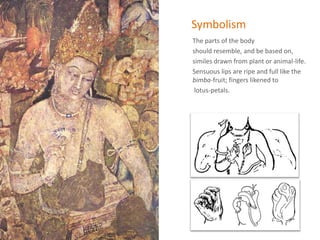
Symbolism
The parts of the body
should resemble, and be based on,
similes drawn from plant or animal-life.
Sensuous lips are ripe and full like the
bimba-fruit; fingers likened to
lotus-petals.
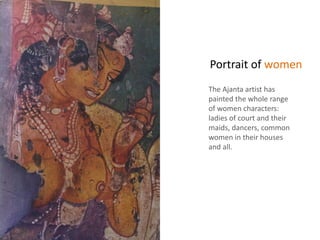
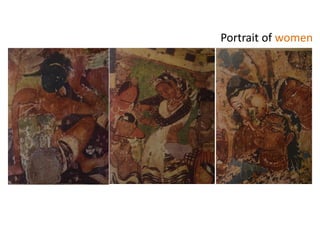
Portrait of women
The Ajanta artist has
painted the whole range
of women characters:
ladies of court and their
maids, dancers, common
women in their houses
and all.
Portrait of women
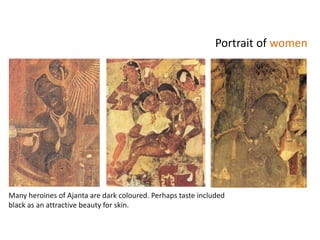
Many heroines of Ajanta are dark coloured. Perhaps taste included
black as an attractive beauty for skin.
Portrait of women
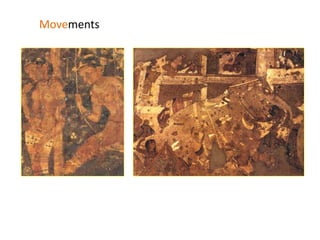
Movements
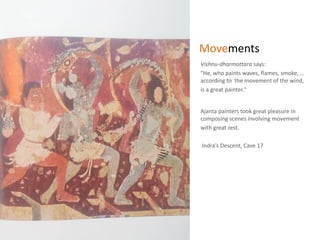
Vishnu-dharmottara says:
"He, who paints waves, flames, smoke, …
according to the movement of the wind,
is a great painter."
Ajanta painters took great pleasure in
composing scenes involving movement
with great zest.
Indra’s Descent, Cave 17
Movements
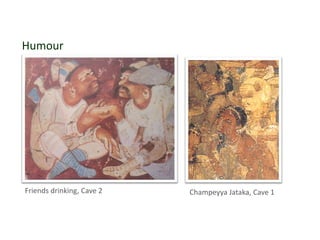
Humour
Champeyya Jataka, Cave 1
Friends drinking, Cave 2
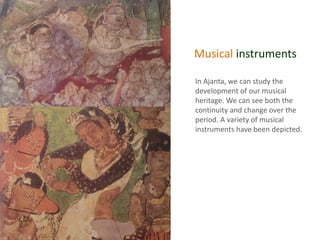
Musical instruments
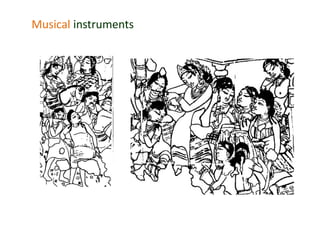
In Ajanta, we can study the
development of our musical
heritage. We can see both the
continuity and change over the
period. A variety of musical
instruments have been depicted.
Musical instruments
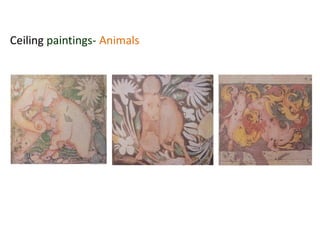
Ceiling paintings- Animals
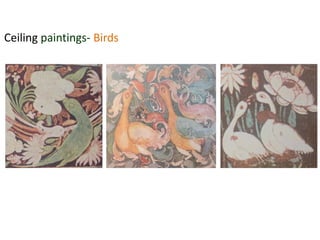
Ceiling paintings- Birds
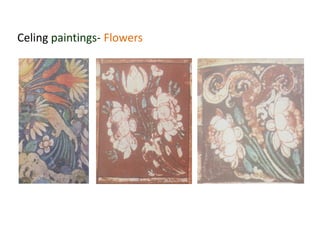
Celing paintings- Flowers
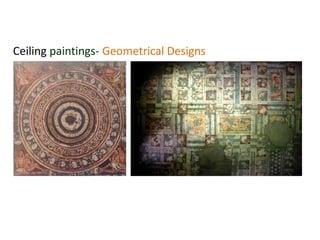
Ceiling paintings- Geometrical Designs
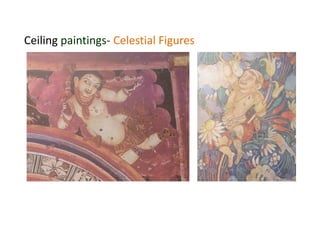
Ceiling paintings- Celestial Figures
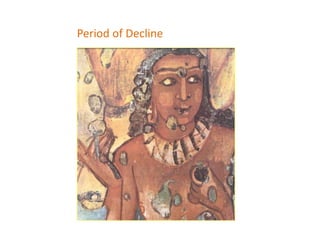
Period of Decline
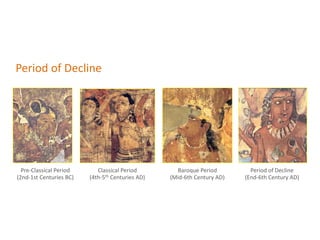
Period of Decline
Pre-Classical Period
(2nd-1st Centuries BC)
Classical Period
(4th-5th Centuries AD)
Baroque Period
(Mid-6th Century AD)
Period of Decline
(End-6th Century AD)
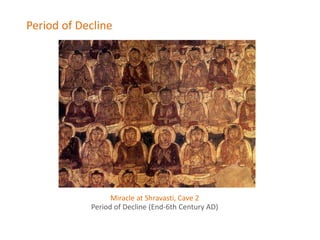
Period of Decline
Miracle at Shravasti, Cave 2
Period of Decline (End-6th Century AD)
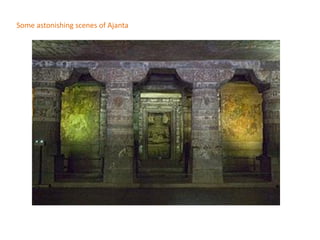
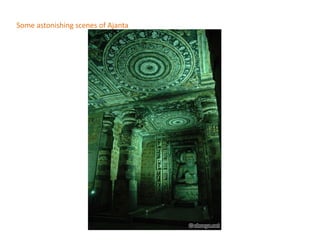
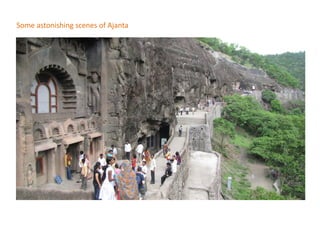
Some astonishing scenes of Ajanta
Thank You
pn.jeevanart@gmail.com
Bibliography
1.Dieter Schlingloff-Ajanta Narrative wall paintings/
Indira gandhi national centre.
2.Mira Seth/Indian Paintings-The great mural
tredition/Abrams,Newyork/ 2013.
3.Meera Talim-Ajanta Painting-Unidentified
&Misinterpreted/2013.
4.google images, www.wikipedia.com/ ajanta 2016
5.www.ajantacaves.org/ ajanta:need for inter-deceplinary
research/oct 12 2013
6.S.Swaminathan/Ajantha paintings/powershow.com.
7.RRVCEVA-Lecture class- Deepak Kannal,Amal,2016-17.

Ajanta paintings _ Traditions and Techniques.

  • 1.
    Jeevan Lal University ofKerala MVA Art History and Aesthetics. RRV Centre of Excellence for Visual Arts Mavelikkara, Kerala. AJANTA An astonishing painting tradition
  • 2.
    Location The caves, lyingdeep inside the Sahyadri Hills, are hollowed out on the deep face of a horseshoe-shaped hillside with the Waghora river flowing through it. The caves of Ajanta are situated in the district of Aurangabad in the state of Maharashtra. Ajanta is about 100 km from Aurangabad and about 60 km from Jalgaon. The another equally important monuments of Ellora are only about 30 km away
  • 3.
    The caves ofAjanta offer an instructive field for the study of the evolution of rock-cut architecture. The evolution of rock architecture took place during two periods. The Hinayana period and The later Mahayana period.
  • 4.
    First Phase-Hinayana period (2nd- 1st centuries BC) The earliest caves (Nos. 8, 9, 10, 13 & 15A) were excavated during the rule of the Satavahana, who had their capital at Pratishthana. During their rule there was brisk trade and commerce within the land and with the Mediterranean world, which brought in enormous riches.
  • 5.
    Second Phase Mahayanaperiod (4th – 6th centuries AD) The second phase was of greater artistic activity at Ajanta and the remaining caves were excavated during the rule of the Vakataka dynasties from the 4th to the 6th centuries AD.
  • 6.
    Re-discovery James Burgess andWilliam Gill made copies of some of the paintings and exhibited in London in 1866. Later some copies were made by Griffiths and Lady Herringham and published in 1896 and 1915. Under the patronage of the Nizam, the then ruler of Hyderabad, Yazdani edited and published two volumes on the paintings in 1933.
  • 7.
    Rahula and Yashodharameet the Buddha, Cave 17 Reproduction by Herringham
  • 10.
    Chaitya-s – Temples Vihara-s- Monasteries The caves of Ajanta are divided into Chaitya Vihara
  • 11.
    Themes of Paintings Thesubjects of the paintings are mostly from the jataka-s, Buddhist mythological stories of the previous lives of the Master During the first phase, the Buddha was not shown in the human form, but only through symbols, such as, the Wheel, the Bodhi Tree and the Feet of the Buddha. But during the Mahayana period sculptures and paintings of the Buddha was added.
  • 12.
  • 13.
  • 14.
  • 15.
    Earlier Phase (2ndcent BC to 1st cent AD) Main Characteristics. *Images placed at Eye level. *Images are arranged by Episodes to Episode. *Narration arranged in the form of long single canvas. Composition
  • 16.
    Later Phase (4thcen onwards) Main Characteristics. *Images are multi focused. *Images are arranged the entire surface of the wall. *Arranged the images Scene by scene accordingly, not divided by any frame. Composition
  • 17.
    Painting techniques. Indian wallpaintings called Fesco- Secco. It is a painting technique which is used in to Dry wall surface. ‘Chithra Suthra’ it is a sub text of ‘Vishnudharmothara Purana’ (7th Cent AD text) Which explains the process of preparing the surface, plaster and finish coat. The process called ‘Vajralepa’. Fesco-Secco. Chithakamalikhithaka – One who doing colouring jobs.
  • 18.
    Preparing the wall- BasePlaster It consisted of powdered brick, burnt conches and sand, mixed with a molasses and decoction of Phaseolus munga. To this were added mashed ripe bananas or tree resins and the pulp of bilva fruit. After drying it was ground down and mixed with molasses and water until became soft for coating.
  • 19.
    Preparing the wall- FinishCoat Buffaloskin was boiled in water until it became soft. Sticks were then made of the paste and dried in the sunshine. When colour was mixed with this, it made it fast, and if white mud was mixed with it, it served as a perfect medium for coating walls.
  • 20.
    Pigment Used Most pigmentswere minerals available locally: red ochre, vivid red, yellow ochre, indigo blue, chalk white, terra verte and green. Only Lapis lazuli was imported, Lamp-black was the only non- mineral
  • 21.
    Applying Technique. A preliminarysketch was drawn while the surface was still slightly wet. On this surface the outline was filled in with various colours, proceeding from underpainting to the appropriate colours of the subject. Finally, when dry, it was finished off with a dark outline for final definition and a burnishing process to give luster to the surface.
  • 22.
    Painting Tredition Treatises werecodified based on Ajanta . Brihat-samhita (6th century) Kama-sutra (6th century) Vishnu-dharmottara (7th century) Samarangana-sutra-dhara (11th century)
  • 23.
    Painting Tradition ‘Six Limbsof Painting’ according to Kama- sutra, a well-known treatise on erotics. ‘’ rupabhetha pramani Bhavalavanya yojanam sadrisyam varnikabhangam Iti chithram shadangakam’’ rupa-bheda- Differentiation pranamam- Proportion Bhavam - Suggestion of mood Lavanya yojanam- Infusion of grace sadrishyam- Resemblance Varnika bhangam- Application of colour
  • 24.
    ‘Eight Limbs ofPainting’ according to Samarangana-sutra-dhara. a well-known treatise on architecture. bhUmi-bandhana preparation of surface varnika crayon work rekha-karma outline work lakshaNa features of face varna-karma colouring vartana-karma relief by shading lekha-karma correction dvika-karma final outline Painting Tradition
  • 25.
    Depth in paintings Perspective. Atechnique of painting scenes from different angles and merging them, similar to the modern technique called Multiple Vision.
  • 26.
    Depth in paintings MultipleVision A technique of painting scenes from different angles and merging them, similar to the modern technique called Multiple Vision.
  • 27.
    Depth in paintings Forshottening A technique of painting scenes from different angles and merging them, similar to the modern technique called Multiple Vision.
  • 28.
    Depth in paintings Animnonnata- flat style Nimnonnata - relief by shading
  • 29.
    Depth in paintings animnonnata Aflat style that uses dark colours for the subjects in the foreground against a background of lighter shades, or vice versa
  • 30.
    Depth in paintings Vartana Ahigh-relief technique to produce an illusion of the third dimension Patraja (‘shading-like-the-lines-of-a-leaf Binduja (dot-and-stipple method) Illusion of depth is achieved by painting dots with variations in concentration of dots. nimnonnata
  • 31.
    Depth in paintings Airika(a wash technique) Illusion of depth is achieved by executing tonal variation and avoiding hard-lines. Ujjotana (adding highlights) Highlights in the form of white patches added on the cheeks, the chin, the nose, etc to get a three-dimensional effect. Chaya-tapa (‘shade-and-shine’) A technique that produces a chiaroscuro effect Use of Blue Colour (Lapis Lazuli) In the later period lapis lazuli, a blue, imported mineral came to be used as an effective medium for creating visual depth, contrasting with warm red and brown tones
  • 32.
    Paintings and Natya Sasthra Therelationship between painting and dance is a remarkable unique Indian tradition. Vishnu-dharmottara (7th century AD) stresses the impossibility of attaining a proper expression of feeling in painting without the knowledge of theatre and dance Dancing had become highly stylised in the later period. A dancer with full complement of accompanying musicians is from Cave 1. “Vibava Abnubhava Vyabhichari Samyoga” _Bharatha.
  • 33.
    Tribhanga Pose It givesthe body an S-shaped rhythm, a fluency of line, which, together with the appropriate gestures of hands, conveys a wide range of expressions. Paintings and Natya Sasthra
  • 34.
    Symbolism The parts ofthe body should resemble, and be based on, similes drawn from plant or animal-life. Sensuous lips are ripe and full like the bimba-fruit; fingers likened to lotus-petals.
  • 35.
    Portrait of women TheAjanta artist has painted the whole range of women characters: ladies of court and their maids, dancers, common women in their houses and all.
  • 36.
  • 37.
    Many heroines ofAjanta are dark coloured. Perhaps taste included black as an attractive beauty for skin. Portrait of women
  • 38.
    Movements Vishnu-dharmottara says: "He, whopaints waves, flames, smoke, … according to the movement of the wind, is a great painter." Ajanta painters took great pleasure in composing scenes involving movement with great zest. Indra’s Descent, Cave 17
  • 39.
  • 40.
    Humour Champeyya Jataka, Cave1 Friends drinking, Cave 2
  • 41.
    Musical instruments In Ajanta,we can study the development of our musical heritage. We can see both the continuity and change over the period. A variety of musical instruments have been depicted.
  • 42.
  • 43.
  • 44.
  • 45.
  • 46.
  • 47.
  • 48.
  • 49.
    Period of Decline Pre-ClassicalPeriod (2nd-1st Centuries BC) Classical Period (4th-5th Centuries AD) Baroque Period (Mid-6th Century AD) Period of Decline (End-6th Century AD)
  • 50.
    Period of Decline Miracleat Shravasti, Cave 2 Period of Decline (End-6th Century AD)
  • 51.
  • 52.
  • 53.
  • 55.
    Thank You pn.jeevanart@gmail.com Bibliography 1.Dieter Schlingloff-AjantaNarrative wall paintings/ Indira gandhi national centre. 2.Mira Seth/Indian Paintings-The great mural tredition/Abrams,Newyork/ 2013. 3.Meera Talim-Ajanta Painting-Unidentified &Misinterpreted/2013. 4.google images, www.wikipedia.com/ ajanta 2016 5.www.ajantacaves.org/ ajanta:need for inter-deceplinary research/oct 12 2013 6.S.Swaminathan/Ajantha paintings/powershow.com. 7.RRVCEVA-Lecture class- Deepak Kannal,Amal,2016-17.