NERVOUS SYSTEM
• Organ system that is responsible fro coordinating the functions of the other
systems of the body.
• It plays a vital role in your life as it directs all the voluntary and involuntary
activities of the body.
• It controls the thoughts, actions, and vital signs such as heartbeat and blood
flow.
• It is impossible to live without this system.
– composed of brain and the spinal cord.
– consists of the different nerves spread
throughout the body.
These two divisions work together in response to or detectable
changes in the environment.
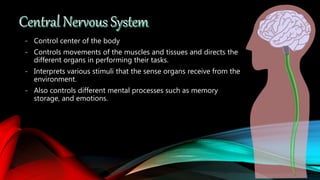
- Control center of the body
- Controls movements of the muscles and tissues and directs the
different organs in performing their tasks.
- Interprets various stimuli that the sense organs receive from the
environment.
- Also controls different mental processes such as memory
storage, and emotions.
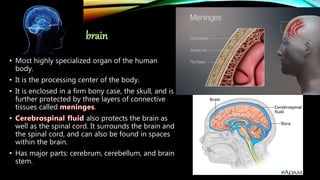
• Most highly specialized organ of the human
body.
• It is the processing center of the body.
• It is enclosed in a firm bony case, the skull, and is
further protected by three layers of connective
tissues called .
also protects the brain as
well as the spinal cord. It surrounds the brain and
the spinal cord, and can also be found in spaces
within the brain.
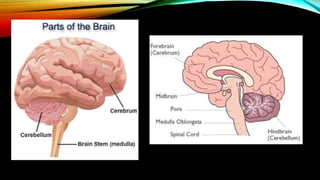
• Has major parts: cerebrum, cerebellum, and brain
stem.
Description: constitutes 70 of the brain, the biggest and most functional part, and
composed of two halves that are firmly connected with a set of nerve fibers.
Functions:
a.) responsible for mental processes such as solving mathematical problems,
reasoning, learning, memory, and imagination.
B.) processes all the information coming from the different parts of the body
and directs all the necessary response to the information.
c.) receives and interprets messages from the sense organs.
d.) recognize different sights, odors, tastes, sounds, and textures.
e.) controls the voluntary and involuntary movements of the muscles.
Cerebrum initiates the muscle movement.
Description: second largest part of the brain.
Functions:
a.) coordinates the movements of the muscles and maintains body posture
and balance.
b.) controls some of the common activities that you perform such as
jumping, and dancing.
c.) cerebrum initiates the movement, the cerebellum ensures the
and accuracy of such movement.
Description: connects the cerebrum to the spinal cord. It is made up of:
- topmost part of the brain stem
– lies below the midbrain.
– lowest part, and located on top of the spinal cord.
Functions:
Brain stem – maintain the essential regulatory mechanisms of the body.
– associated with vision, hearing, motor control, and temperature
regulation.
– regulates the rate of breathing. Also responsible for rapid eye movement
(REM), the stage in a sleep that is associated with dreaming.
– control involuntary movements like breathing, blood
circulation, heart rate, digestion, vomiting, hiccupping, and coughing.
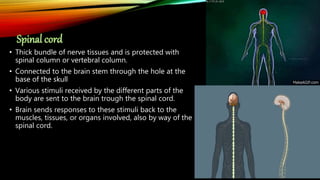
• Thick bundle of nerve tissues and is protected with
spinal column or vertebral column.
• Connected to the brain stem through the hole at the
base of the skull
• Various stimuli received by the different parts of the
body are sent to the brain trough the spinal cord.
• Brain sends responses to these stimuli back to the
muscles, tissues, or organs involved, also by way of the
spinal cord.
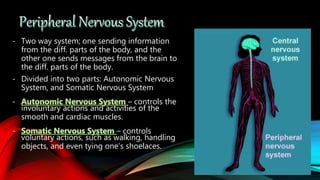
- Two way system; one sending information
from the diff. parts of the body, and the
other one sends messages from the brain to
the diff. parts of the body.
- Divided into two parts: Autonomic Nervous
System, and Somatic Nervous System
– controls the
involuntary actions and activities of the
smooth and cardiac muscles.
– controls
voluntary actions, such as walking, handling
objects, and even tying one’s shoelaces.
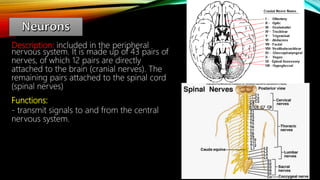
Description: included in the peripheral
nervous system. It is made up of 43 pairs of
nerves, of which 12 pairs are directly
attached to the brain (cranial nerves). The
remaining pairs attached to the spinal cord
(spinal nerves)
Functions:
- transmit signals to and from the central
nervous system.
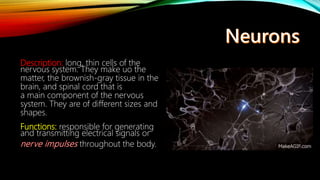
Description: long, thin cells of the
nervous system. They make uo the
matter, the brownish-gray tissue in the
brain, and spinal cord that is
a main component of the nervous
system. They are of different sizes and
shapes.
Functions: responsible for generating
and transmitting electrical signals or
throughout the body.
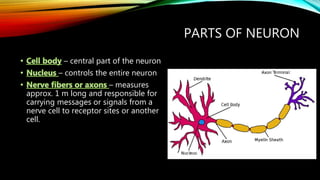
PARTS OF NEURON
– central part of the neuron
– controls the entire neuron
– measures
approx. 1 m long and responsible for
carrying messages or signals from a
nerve cell to receptor sites or another
cell.
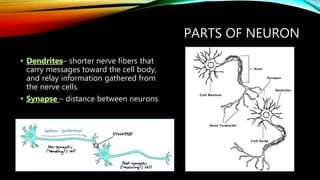
PARTS OF NEURON
– shorter nerve fibers that
carry messages toward the cell body,
and relay information gathered from
the nerve cells.
– distance between neurons
TYPES OF NEURONS
– responsible for detecting different sensations. Nerve
fibers in this neuron are spread out all over the body. They carry messages
from the different sense organs to the CNS.
– deals with diff. movements of the body. It is connected to
the muscles, tissues, and organs. They send impulses from the CNS to the
muscles, causing the muscles to contract.
– connects sensory and motor neurons,
allowing impulses to travel from one nerve to another. It also enable the
CNS to sort or process information.

The nervous system

  • 2.
    NERVOUS SYSTEM • Organsystem that is responsible fro coordinating the functions of the other systems of the body. • It plays a vital role in your life as it directs all the voluntary and involuntary activities of the body. • It controls the thoughts, actions, and vital signs such as heartbeat and blood flow. • It is impossible to live without this system.
  • 3.
    – composed ofbrain and the spinal cord. – consists of the different nerves spread throughout the body. These two divisions work together in response to or detectable changes in the environment.
  • 4.
    - Control centerof the body - Controls movements of the muscles and tissues and directs the different organs in performing their tasks. - Interprets various stimuli that the sense organs receive from the environment. - Also controls different mental processes such as memory storage, and emotions.
  • 5.
    • Most highlyspecialized organ of the human body. • It is the processing center of the body. • It is enclosed in a firm bony case, the skull, and is further protected by three layers of connective tissues called . also protects the brain as well as the spinal cord. It surrounds the brain and the spinal cord, and can also be found in spaces within the brain. • Has major parts: cerebrum, cerebellum, and brain stem.
  • 6.
    Description: constitutes 70of the brain, the biggest and most functional part, and composed of two halves that are firmly connected with a set of nerve fibers. Functions: a.) responsible for mental processes such as solving mathematical problems, reasoning, learning, memory, and imagination. B.) processes all the information coming from the different parts of the body and directs all the necessary response to the information. c.) receives and interprets messages from the sense organs. d.) recognize different sights, odors, tastes, sounds, and textures. e.) controls the voluntary and involuntary movements of the muscles. Cerebrum initiates the muscle movement.
  • 7.
    Description: second largestpart of the brain. Functions: a.) coordinates the movements of the muscles and maintains body posture and balance. b.) controls some of the common activities that you perform such as jumping, and dancing. c.) cerebrum initiates the movement, the cerebellum ensures the and accuracy of such movement.
  • 8.
    Description: connects thecerebrum to the spinal cord. It is made up of: - topmost part of the brain stem – lies below the midbrain. – lowest part, and located on top of the spinal cord. Functions: Brain stem – maintain the essential regulatory mechanisms of the body. – associated with vision, hearing, motor control, and temperature regulation. – regulates the rate of breathing. Also responsible for rapid eye movement (REM), the stage in a sleep that is associated with dreaming. – control involuntary movements like breathing, blood circulation, heart rate, digestion, vomiting, hiccupping, and coughing.
  • 10.
    • Thick bundleof nerve tissues and is protected with spinal column or vertebral column. • Connected to the brain stem through the hole at the base of the skull • Various stimuli received by the different parts of the body are sent to the brain trough the spinal cord. • Brain sends responses to these stimuli back to the muscles, tissues, or organs involved, also by way of the spinal cord.
  • 11.
    - Two waysystem; one sending information from the diff. parts of the body, and the other one sends messages from the brain to the diff. parts of the body. - Divided into two parts: Autonomic Nervous System, and Somatic Nervous System – controls the involuntary actions and activities of the smooth and cardiac muscles. – controls voluntary actions, such as walking, handling objects, and even tying one’s shoelaces.
  • 12.
    Description: included inthe peripheral nervous system. It is made up of 43 pairs of nerves, of which 12 pairs are directly attached to the brain (cranial nerves). The remaining pairs attached to the spinal cord (spinal nerves) Functions: - transmit signals to and from the central nervous system.
  • 13.
    Description: long, thincells of the nervous system. They make uo the matter, the brownish-gray tissue in the brain, and spinal cord that is a main component of the nervous system. They are of different sizes and shapes. Functions: responsible for generating and transmitting electrical signals or throughout the body.
  • 14.
    PARTS OF NEURON –central part of the neuron – controls the entire neuron – measures approx. 1 m long and responsible for carrying messages or signals from a nerve cell to receptor sites or another cell.
  • 15.
    PARTS OF NEURON –shorter nerve fibers that carry messages toward the cell body, and relay information gathered from the nerve cells. – distance between neurons
  • 16.
    TYPES OF NEURONS –responsible for detecting different sensations. Nerve fibers in this neuron are spread out all over the body. They carry messages from the different sense organs to the CNS. – deals with diff. movements of the body. It is connected to the muscles, tissues, and organs. They send impulses from the CNS to the muscles, causing the muscles to contract. – connects sensory and motor neurons, allowing impulses to travel from one nerve to another. It also enable the CNS to sort or process information.