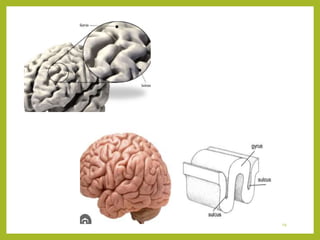
1
OVERVIEW OF NERVOUS
SYSTEM
DR. ZUNAIRA ANWAR
2
Nervous System
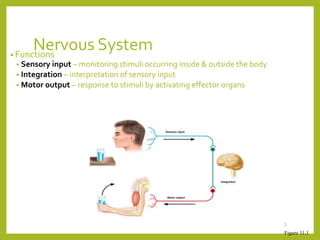
• Functions
• Sensory input – monitoring stimuli occurring inside & outside the body
• Integration – interpretation of sensory input
• Motor output – response to stimuli by activating effector organs
3
Figure 11.1
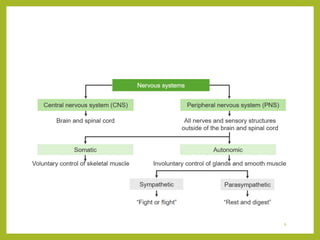
Organization of the Nervous System
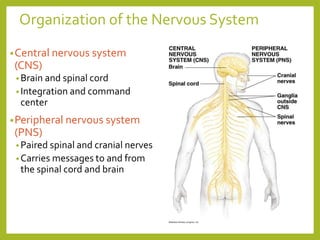
•Central nervous system
(CNS)
•Brain and spinal cord
•Integration and command
center
•Peripheral nervous system
(PNS)
•Paired spinal and cranial nerves
•Carries messages to and from
the spinal cord and brain
4
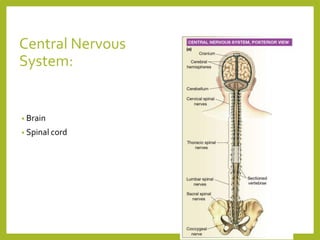
Central Nervous
System:
• Brain
• Spinal cord
5
6
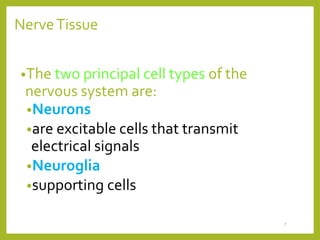
NerveTissue
•The two principal cell types of the
nervous system are:
•Neurons
•are excitable cells that transmit
electrical signals
•Neuroglia
•supporting cells
7
Neuron Classification
•Functional:
•Sensory (afferent)
• transmit impulses toward the CNS
•Motor (efferent)
•carry impulses away from the CNS
•Interneurons (association neurons)
•shuttle signals through CNS pathways
8
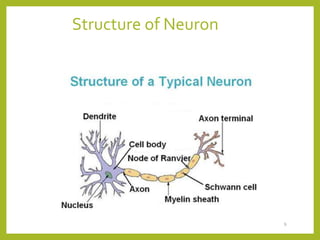
Structure of Neuron
9
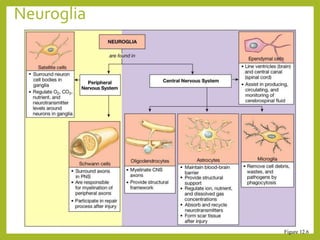
Neuroglia
10
Figure 12.6
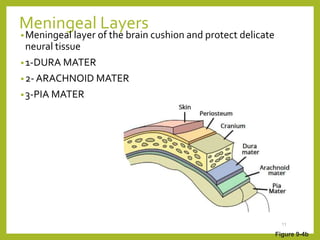
Meningeal Layers
•Meningeal layer of the brain cushion and protect delicate
neural tissue
•1-DURA MATER
•2- ARACHNOID MATER
•3-PIA MATER
11
Figure 9-4b
Blood Brain Barrier
•Extensive capillaries & sinuses
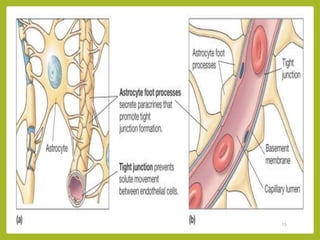
•Tight junctions promoted by astrocyte
•Limits permeability for most molecules except O2,
CO2, alcohol, steroids, water
•Protects brain: hormones & circulating chemicals
•Protects CNS from chemical fluctuations
•Prevents entry of harmful substances
•Prevents entry of molecules that could act as
neurotransmitters
12
Figure 9-6: The blood-brain barrier
13
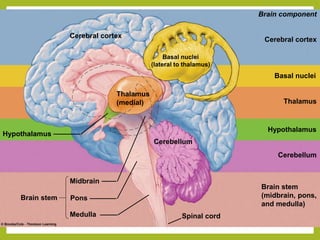
Brain Organization
•Trillion interneurons fill the brain
•Up to 200,000 synapses each
•Levels of complexity:
Cerebral cortex
Basal nuclei
Thalamus
Hypothalamus
Cerebellum
Brain stem
14
15
Hypothalamus
Brain stem
Cerebral cortex
Thalamus
(medial)
Basal nuclei
(lateral to thalamus)
Cerebellum
Spinal cord
Midbrain
Pons
Medulla
Brain component
Cerebral cortex
Basal nuclei
Thalamus
Hypothalamus
Cerebellum
Brain stem
(midbrain, pons,
and medulla)
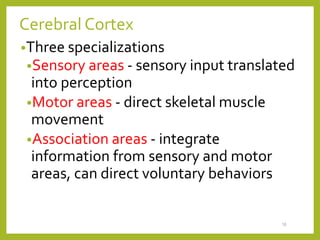
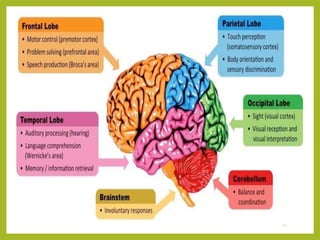
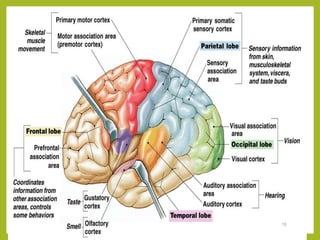
Cerebral Cortex
•Three specializations
•Sensory areas - sensory input translated
into perception
•Motor areas - direct skeletal muscle
movement
•Association areas - integrate
information from sensory and motor
areas, can direct voluntary behaviors
16
17
18
19
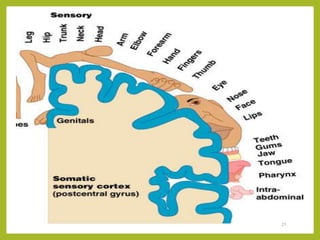
Primary Somatosensory Cortex
•Located in the postcentral gyrus, this area:
•Receives information from the skin and
skeletal muscles
•Exhibits spatial discrimination
•Somatosensory homunculus – caricature of
relative amounts of cortical tissue devoted
to each sensory function
20
21
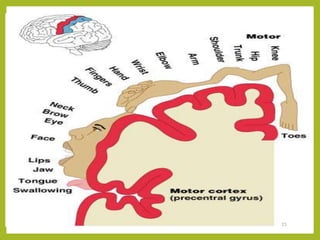
Primary Motor Cortex
•Located in the precentral gyrus
•Composed of pyramidal cells whose axons
make up the corticospinal tracts
•Allows conscious control of precise, skilled,
voluntary movements
•Motor homunculus – caricature of relative
amounts of cortical tissue devoted to each
motor function
22
23
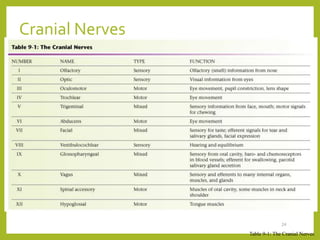
Cranial Nerves
24
Table 9-1: The Cranial Nerves
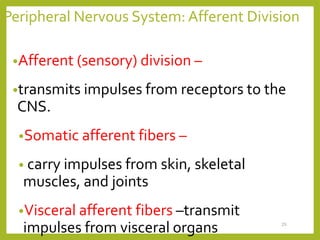
Peripheral Nervous System: Afferent Division
•Afferent (sensory) division –
•transmits impulses from receptors to the
CNS.
•Somatic afferent fibers –
• carry impulses from skin, skeletal
muscles, and joints
•Visceral afferent fibers –transmit
impulses from visceral organs 25
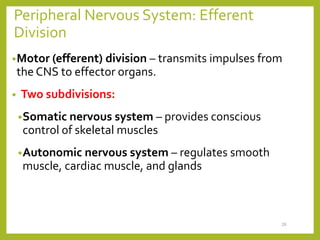
Peripheral Nervous System: Efferent
Division
•Motor (efferent) division – transmits impulses from
the CNS to effector organs.
• Two subdivisions:
•Somatic nervous system – provides conscious
control of skeletal muscles
•Autonomic nervous system – regulates smooth
muscle, cardiac muscle, and glands
26
Sensory
•General somatic senses – receptors are widely spread
Touch
Pain
Vibration
Pressure
Temperature
•Proprioceptive senses – detect stretch in tendons and
muscle
•Body sense – position and movement of body in space
27
Motor
•General somatic motor – signals contraction of skeletal
muscles
•Under our voluntary control
•Often called “voluntary nervous system”
•Visceral motor
•Regulates the contraction of smooth and cardiac
muscle
•Makes up autonomic nervous system
•Controls function of visceral organs
•Often called “involuntary nervous system”
•Autonomic nervous system
28
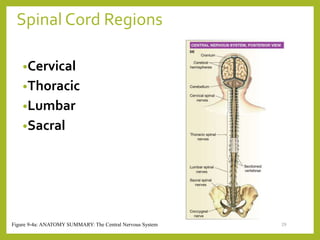
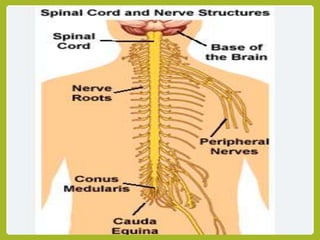
Spinal Cord Regions
•Cervical
•Thoracic
•Lumbar
•Sacral
29
Figure 9-4a: ANATOMY SUMMARY: The Central Nervous System
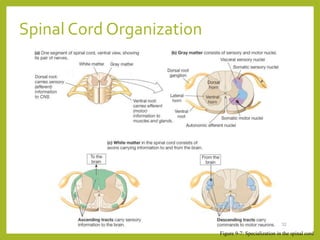
Spinal Cord Organization
•Gray matter: mostly cell bodies
•Dendrites & terminals
•Spinal reflex integrating center
•White matter
•Bundles of myelinated axons
•Ascending tracts – sensory
•Descending tracts – motor
•Dorsal roots
•Ventral roots
30
31
Spinal Cord Organization
32
Figure 9-7: Specialization in the spinal cord
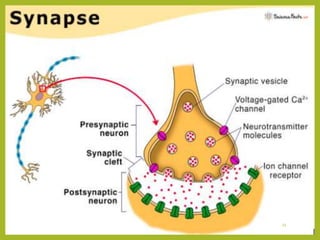
SYNAPSE
• the site of transmission of electric nerve impulses between
two nerve cells (neurons) or between a neuron and a gland or
muscle cell (effector).
33
34
Properties of synaptic transmission
•Excitation
•Inhibition
•Spatial summation
•Temporal summation
•Facilitation
•Fatigue
•Effect of acidosis or alkalosis
•Effect of hypoxia
•Effect of drugs
•Synaptic delay
35

1CNS.ppt Central Nervous system Human brain

  • 1.
  • 2.
  • 3.
    Nervous System • Functions •Sensory input – monitoring stimuli occurring inside & outside the body • Integration – interpretation of sensory input • Motor output – response to stimuli by activating effector organs 3 Figure 11.1
  • 4.
    Organization of theNervous System •Central nervous system (CNS) •Brain and spinal cord •Integration and command center •Peripheral nervous system (PNS) •Paired spinal and cranial nerves •Carries messages to and from the spinal cord and brain 4
  • 5.
  • 6.
  • 7.
    NerveTissue •The two principalcell types of the nervous system are: •Neurons •are excitable cells that transmit electrical signals •Neuroglia •supporting cells 7
  • 8.
    Neuron Classification •Functional: •Sensory (afferent) •transmit impulses toward the CNS •Motor (efferent) •carry impulses away from the CNS •Interneurons (association neurons) •shuttle signals through CNS pathways 8
  • 9.
  • 10.
  • 11.
    Meningeal Layers •Meningeal layerof the brain cushion and protect delicate neural tissue •1-DURA MATER •2- ARACHNOID MATER •3-PIA MATER 11 Figure 9-4b
  • 12.
    Blood Brain Barrier •Extensivecapillaries & sinuses •Tight junctions promoted by astrocyte •Limits permeability for most molecules except O2, CO2, alcohol, steroids, water •Protects brain: hormones & circulating chemicals •Protects CNS from chemical fluctuations •Prevents entry of harmful substances •Prevents entry of molecules that could act as neurotransmitters 12 Figure 9-6: The blood-brain barrier
  • 13.
  • 14.
    Brain Organization •Trillion interneuronsfill the brain •Up to 200,000 synapses each •Levels of complexity: Cerebral cortex Basal nuclei Thalamus Hypothalamus Cerebellum Brain stem 14
  • 15.
    15 Hypothalamus Brain stem Cerebral cortex Thalamus (medial) Basalnuclei (lateral to thalamus) Cerebellum Spinal cord Midbrain Pons Medulla Brain component Cerebral cortex Basal nuclei Thalamus Hypothalamus Cerebellum Brain stem (midbrain, pons, and medulla)
  • 16.
    Cerebral Cortex •Three specializations •Sensoryareas - sensory input translated into perception •Motor areas - direct skeletal muscle movement •Association areas - integrate information from sensory and motor areas, can direct voluntary behaviors 16
  • 17.
  • 18.
  • 19.
  • 20.
    Primary Somatosensory Cortex •Locatedin the postcentral gyrus, this area: •Receives information from the skin and skeletal muscles •Exhibits spatial discrimination •Somatosensory homunculus – caricature of relative amounts of cortical tissue devoted to each sensory function 20
  • 21.
  • 22.
    Primary Motor Cortex •Locatedin the precentral gyrus •Composed of pyramidal cells whose axons make up the corticospinal tracts •Allows conscious control of precise, skilled, voluntary movements •Motor homunculus – caricature of relative amounts of cortical tissue devoted to each motor function 22
  • 23.
  • 24.
    Cranial Nerves 24 Table 9-1:The Cranial Nerves
  • 25.
    Peripheral Nervous System:Afferent Division •Afferent (sensory) division – •transmits impulses from receptors to the CNS. •Somatic afferent fibers – • carry impulses from skin, skeletal muscles, and joints •Visceral afferent fibers –transmit impulses from visceral organs 25
  • 26.
    Peripheral Nervous System:Efferent Division •Motor (efferent) division – transmits impulses from the CNS to effector organs. • Two subdivisions: •Somatic nervous system – provides conscious control of skeletal muscles •Autonomic nervous system – regulates smooth muscle, cardiac muscle, and glands 26
  • 27.
    Sensory •General somatic senses– receptors are widely spread Touch Pain Vibration Pressure Temperature •Proprioceptive senses – detect stretch in tendons and muscle •Body sense – position and movement of body in space 27
  • 28.
    Motor •General somatic motor– signals contraction of skeletal muscles •Under our voluntary control •Often called “voluntary nervous system” •Visceral motor •Regulates the contraction of smooth and cardiac muscle •Makes up autonomic nervous system •Controls function of visceral organs •Often called “involuntary nervous system” •Autonomic nervous system 28
  • 29.
    Spinal Cord Regions •Cervical •Thoracic •Lumbar •Sacral 29 Figure9-4a: ANATOMY SUMMARY: The Central Nervous System
  • 30.
    Spinal Cord Organization •Graymatter: mostly cell bodies •Dendrites & terminals •Spinal reflex integrating center •White matter •Bundles of myelinated axons •Ascending tracts – sensory •Descending tracts – motor •Dorsal roots •Ventral roots 30
  • 31.
  • 32.
    Spinal Cord Organization 32 Figure9-7: Specialization in the spinal cord
  • 33.
    SYNAPSE • the siteof transmission of electric nerve impulses between two nerve cells (neurons) or between a neuron and a gland or muscle cell (effector). 33
  • 34.
  • 35.
    Properties of synaptictransmission •Excitation •Inhibition •Spatial summation •Temporal summation •Facilitation •Fatigue •Effect of acidosis or alkalosis •Effect of hypoxia •Effect of drugs •Synaptic delay 35