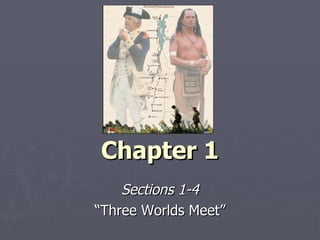
Chapter 1 Sections 1-4 “Three Worlds Meet”
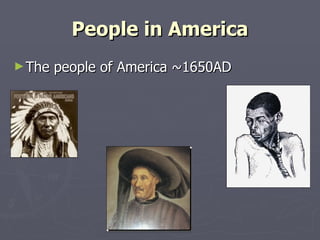
People in America The people of America ~1650AD
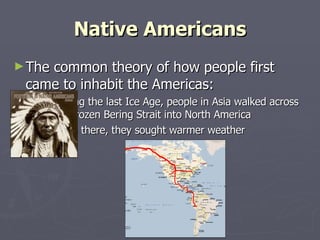
Native Americans The common theory of how people first came to inhabit the Americas: During the last Ice Age, people in Asia walked across the frozen Bering Strait into North America From there, they sought warmer weather
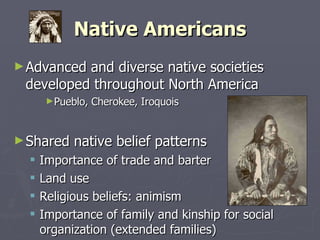
Advanced and diverse native societies developed throughout North America Pueblo, Cherokee, Iroquois Shared native belief patterns Importance of trade and barter Land use Religious beliefs: animism Importance of family and kinship for social organization (extended families) Native Americans
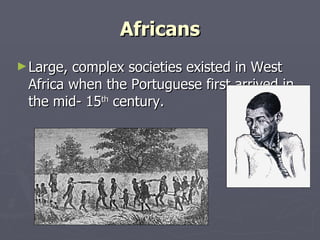
Africans Large, complex societies existed in West Africa when the Portuguese first arrived in the mid- 15 th  century.
Beliefs in West African culture Strong ties of family and kinship Councils of elders made up government Extended families Animism Also, rulers descended from gods Collective ownership of land Slave labor was common Prisoners of war, etc. Not always lifelong Africans
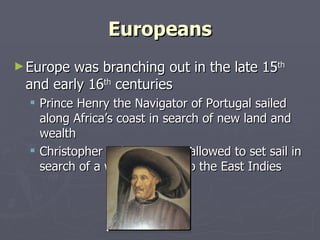
Europeans Europe was branching out in the late 15 th  and early 16 th  centuries Prince Henry the Navigator of Portugal sailed along Africa’s coast in search of new land and wealth Christopher Columbus was allowed to set sail in search of a western route to the East Indies
Europe at the end of the 15 th  century (pgs 21-26): Society is arranged by class/social rank Nuclear family is most important Christianity– Roman Catholic Church Call to convert people of other faiths Crusades Recovering from the Middle Ages Floods, disease, anthrax, Black Death, wars Europeans
Europe at the end of the 15 th  century (pg. 24): Growth of commerce Growth of population Growth of Nations The Renaissance Spirit– the rebirth of knowledge and learning led to the invention of the printing press Travel stories were popular Europeans
Age of Exploration Sailing technology encourages the search for sea routes to Asia Christopher Columbus, page 27 What things convinced Queen Isabella of Spain to finance Columbus’ journey? “In 1492, Columbus sailed the ocean blue…” The Spanish gained a foothold in the Americas Europeans
 
Impacts of Colonization: …on Native Americans Disease Resistance to European control …on Africans Slavery Population in Africa …on Europeans National rivalries The Columbian Exchange A New Society is Born
 
Comparing Societies In groups of two or three, answer the following questions: How were the three societies (Native Americans, Africans, Europeans)  similar ? How were the three societies  different ? How might European colonization of the Americas  benefited  each society? How might colonization have  harmed  each society?
Comparing Societies Native American Society European Society African Society
Comparing Societies Benefits: Detriments: Benefits: Detriments: Benefits: Detriments: European African Native American
Comparing Societies In groups of two or three, answer the following questions: How were the three societies (Native Americans, Africans, Europeans)  similar ? How were the three societies  different ? How might European colonization of the Americas  benefited  each society? How might colonization have  harmed  each society?

American History Chapter 1

  • 1.
    Chapter 1 Sections1-4 “Three Worlds Meet”
  • 2.
    People in AmericaThe people of America ~1650AD
  • 3.
    Native Americans Thecommon theory of how people first came to inhabit the Americas: During the last Ice Age, people in Asia walked across the frozen Bering Strait into North America From there, they sought warmer weather
  • 4.
    Advanced and diversenative societies developed throughout North America Pueblo, Cherokee, Iroquois Shared native belief patterns Importance of trade and barter Land use Religious beliefs: animism Importance of family and kinship for social organization (extended families) Native Americans
  • 5.
    Africans Large, complexsocieties existed in West Africa when the Portuguese first arrived in the mid- 15 th century.
  • 6.
    Beliefs in WestAfrican culture Strong ties of family and kinship Councils of elders made up government Extended families Animism Also, rulers descended from gods Collective ownership of land Slave labor was common Prisoners of war, etc. Not always lifelong Africans
  • 7.
    Europeans Europe wasbranching out in the late 15 th and early 16 th centuries Prince Henry the Navigator of Portugal sailed along Africa’s coast in search of new land and wealth Christopher Columbus was allowed to set sail in search of a western route to the East Indies
  • 8.
    Europe at theend of the 15 th century (pgs 21-26): Society is arranged by class/social rank Nuclear family is most important Christianity– Roman Catholic Church Call to convert people of other faiths Crusades Recovering from the Middle Ages Floods, disease, anthrax, Black Death, wars Europeans
  • 9.
    Europe at theend of the 15 th century (pg. 24): Growth of commerce Growth of population Growth of Nations The Renaissance Spirit– the rebirth of knowledge and learning led to the invention of the printing press Travel stories were popular Europeans
  • 10.
    Age of ExplorationSailing technology encourages the search for sea routes to Asia Christopher Columbus, page 27 What things convinced Queen Isabella of Spain to finance Columbus’ journey? “In 1492, Columbus sailed the ocean blue…” The Spanish gained a foothold in the Americas Europeans
  • 11.
  • 12.
    Impacts of Colonization:…on Native Americans Disease Resistance to European control …on Africans Slavery Population in Africa …on Europeans National rivalries The Columbian Exchange A New Society is Born
  • 13.
  • 14.
    Comparing Societies Ingroups of two or three, answer the following questions: How were the three societies (Native Americans, Africans, Europeans) similar ? How were the three societies different ? How might European colonization of the Americas benefited each society? How might colonization have harmed each society?
  • 15.
    Comparing Societies NativeAmerican Society European Society African Society
  • 16.
    Comparing Societies Benefits:Detriments: Benefits: Detriments: Benefits: Detriments: European African Native American
  • 17.
    Comparing Societies Ingroups of two or three, answer the following questions: How were the three societies (Native Americans, Africans, Europeans) similar ? How were the three societies different ? How might European colonization of the Americas benefited each society? How might colonization have harmed each society?