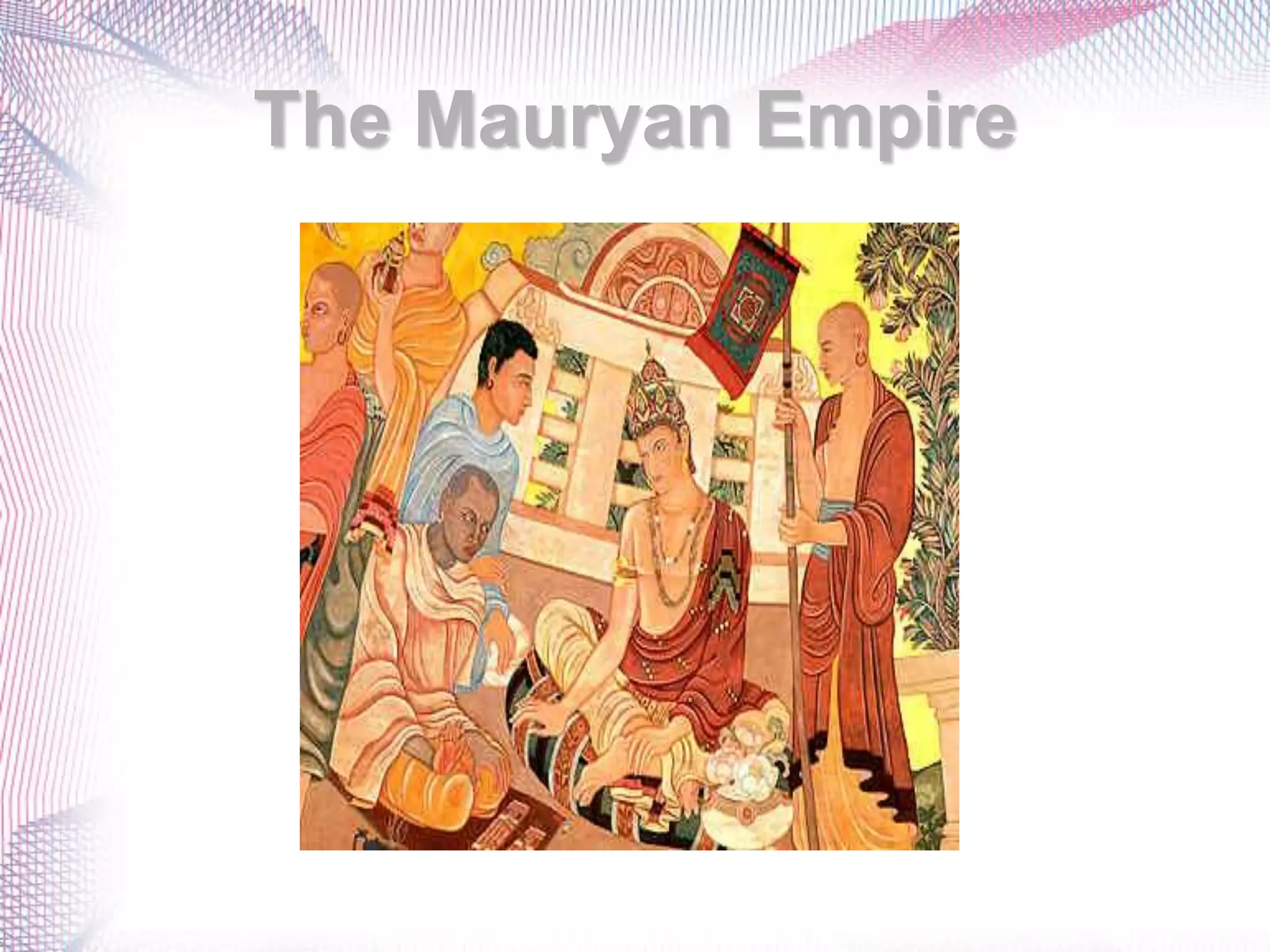
The Mauryan Empire
India Just before Mauryans
 By the 500s BC, India was divided into
several small kingdoms.
 Conflict over land and trade weakened the
kingdoms  left them open to invasion.
 Armies from Persia conquer the Indus Valley
in the 500s BC and made it part of the
Persian Empire
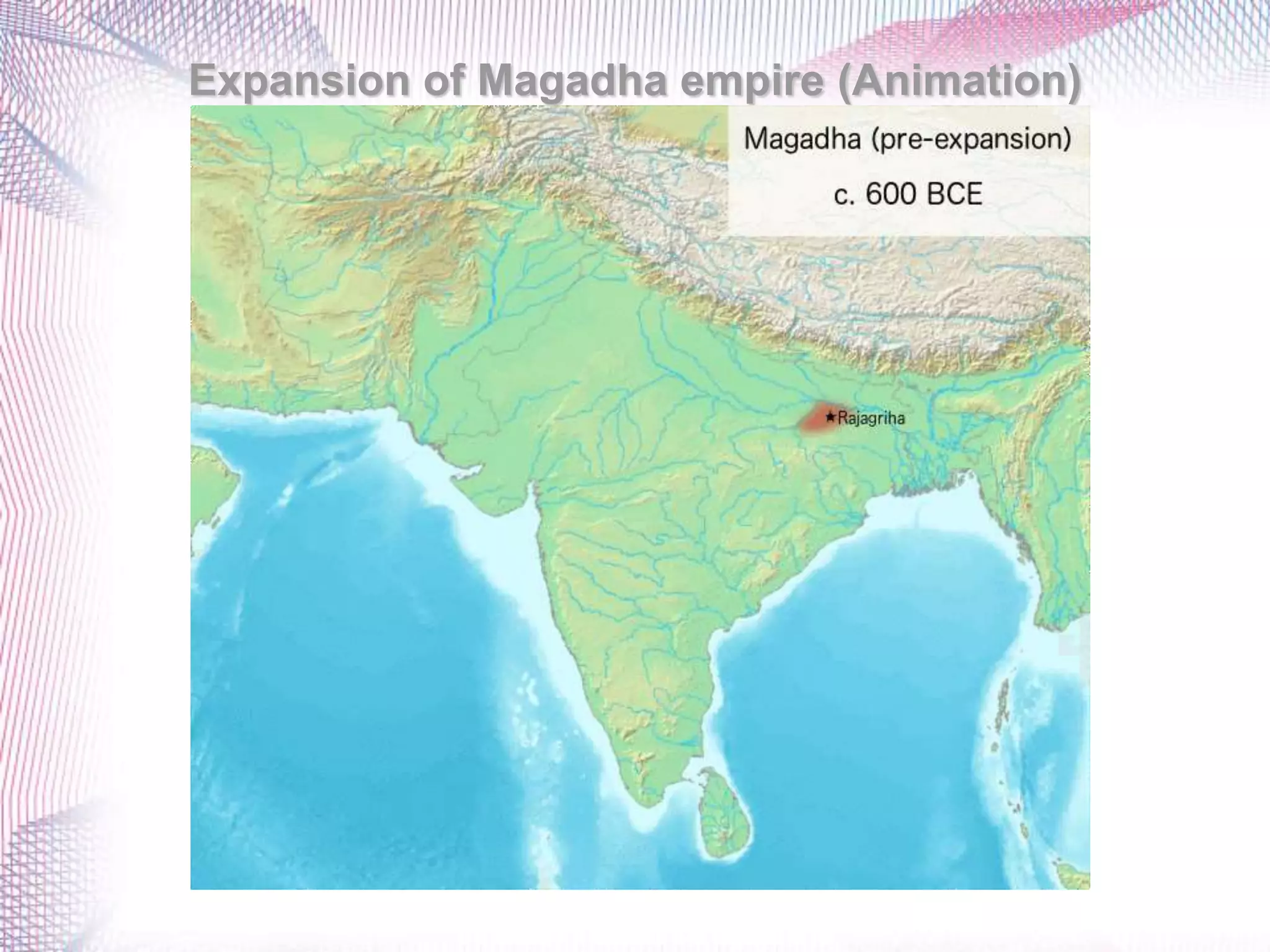
 By the time 350 BCE, Magadha rose up as
most strong Kingdom among other and
gradually consodited its position by Merging
other smaller kingdoms.
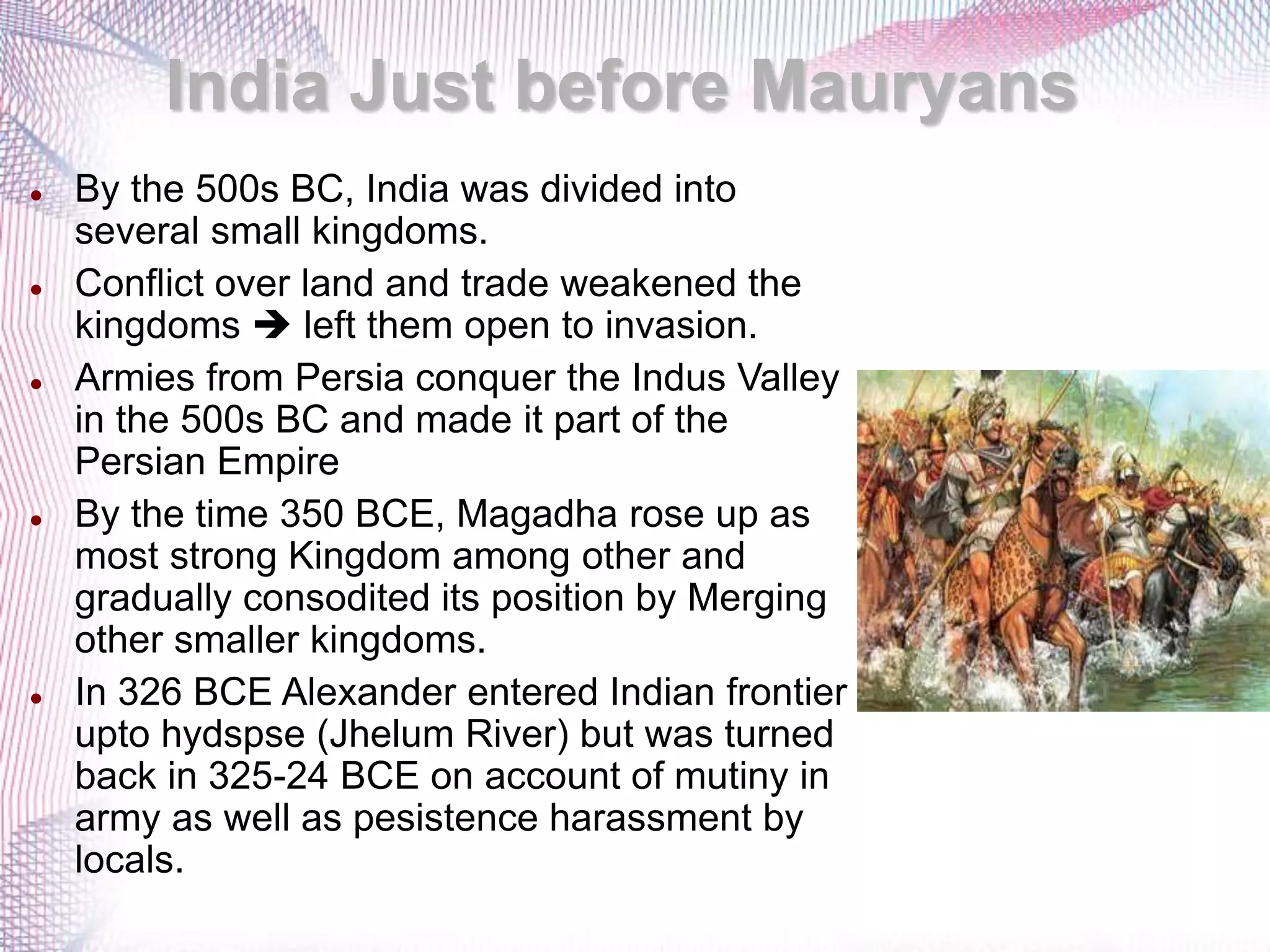
 In 326 BCE Alexander entered Indian frontier
upto hydspse (Jhelum River) but was turned
back in 325-24 BCE on account of mutiny in
army as well as pesistence harassment by
locals.
Expansion of Magadha empire (Animation)
India’s First Empire
CHANDRA GUPTA MAURYA:
 After Alexander left India, builds a strong army in India.
 He deposes Nanda empire in 323 BCE and ascended the
throne of Magadha Empire forging Maurya Dynasty.
 He also conquers northern India and unifies the region
under his rule.
 With the help of Chanakya and other capable ministers
(Amatyas), he Sets up a good government.
Chandragupta Maurya (Cont...)
 Starts an efficient postal system – improves
communication throughout his empire.
 His built a strong and large army crushed any
resistance to his rule.
 He also used a wide network of spies to report
any disloyalty among his subjects
Maurya Empire (300 BCE)
"The Indians occupy [in part] some of the
countries situated along the Indus, which
formerly belonged to the Persians:
Alexander deprived the Ariana of them, and
established there settlements of his own.
But Seleucus Nicator gave them to
Sandrocottus in consequence of a marriage
contract, and received in return five
hundred elephants.”
- Strabo, a Greek historian
Bindusara (Amitraghāta)
 Bindusar ascends on throne in the year 297 BCE, after his
father Chandragupta abdicates in favour of ascetism.
 Bindusara consolidated the empire created by his father.
Some of the Buddhist literature credits his administration
with extensive territorial conquests in southern India.
 There is not much detail of Bindusara available with us. But
he ruled for 25-30 years. After him his famous son Ashoka
ascended on throne.
Asia, 270 BCE
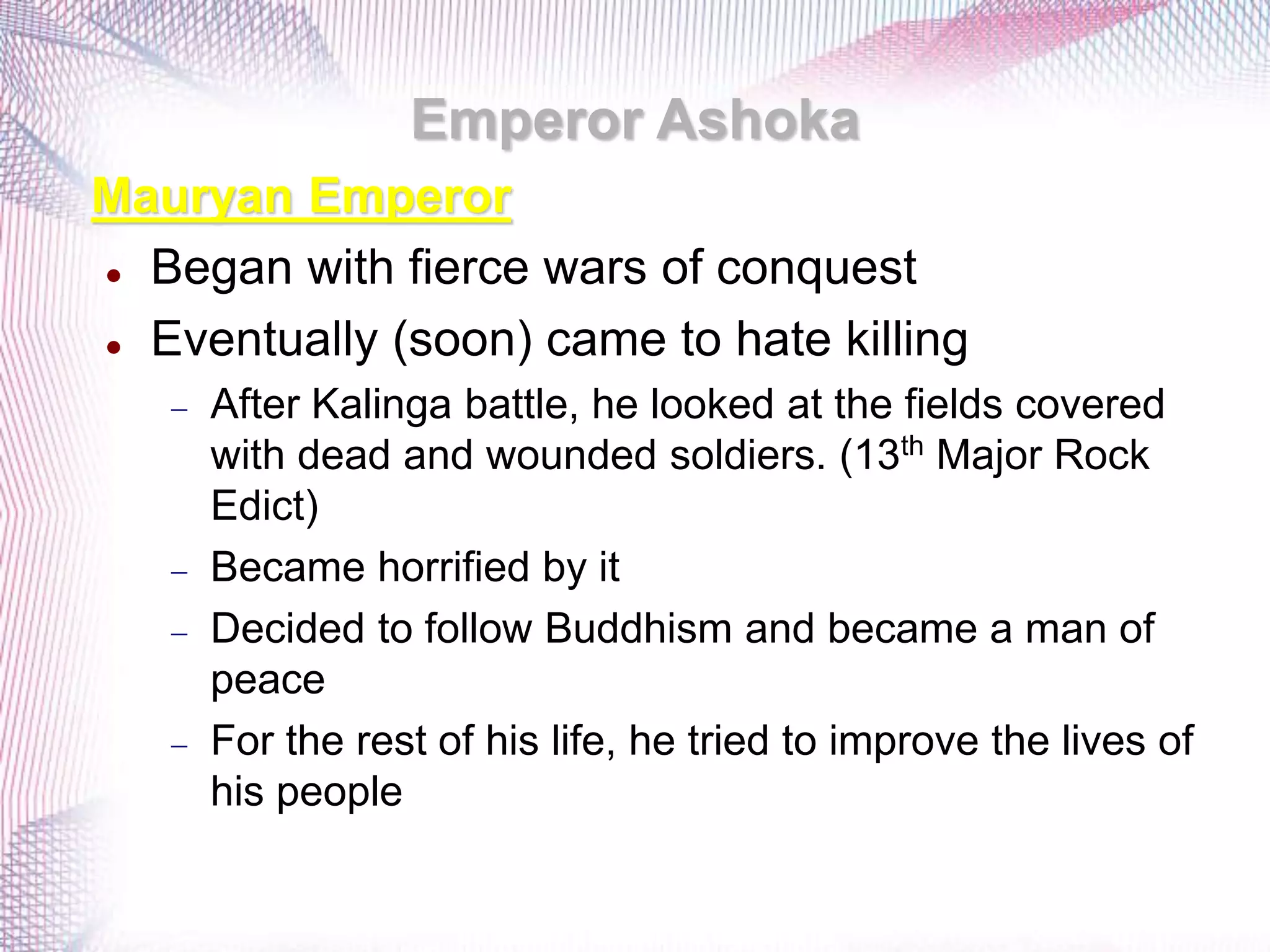
Emperor Ashoka
Mauryan Emperor
 Chandra Gupta’s grandson
 Helped the Mauryan Empire reach the height of glory
 Governed most of northern central India from about 273
– 232 BC
Emperor Ashoka
Mauryan Emperor
 Began with fierce wars of conquest
 Eventually (soon) came to hate killing
 After Kalinga battle, he looked at the fields covered
with dead and wounded soldiers. (13th Major Rock
Edict)
 Became horrified by it
 Decided to follow Buddhism and became a man of
peace
 For the rest of his life, he tried to improve the lives of
his people
Emperor Ashoka Great
achievements:
Political Achievements
 Made laws that encouraged
people to do good deeds,
practice nonviolence and
respect others
 Created hospitals for people
and for animals
 Build fine roads with rest
houses and shade trees for
travelers’ comfort
 The good roads helped India
become the center of a large
trade network that stretched
to the Mediterranean Sea
Moral Achievements
Promoted Buddhism
Made regular visits to rural
villages in his empire to find
out what they needed
Sent Missionary to spread the
religion throughout India and
other parts of Asia
Built many stupas = Buddhist
shrines shaped like a dome
or burial mount
Ecourged people to live with
Compassion, honesty.
Was tolerant of all beliefs even if
Asokan pillar and
rock edicts help
to decide
Mauryan
territories.
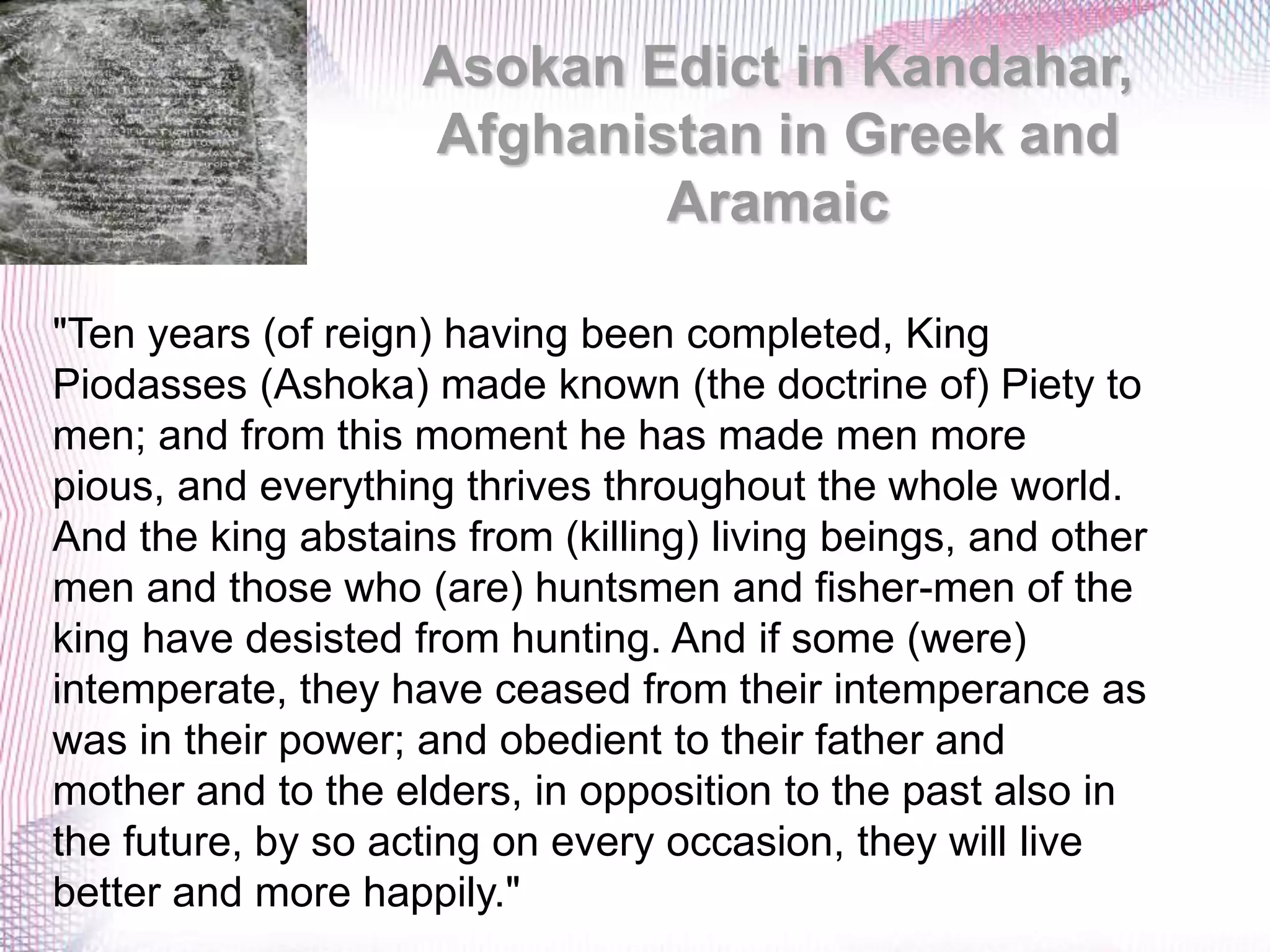
Asokan Edict in Kandahar,
Afghanistan in Greek and
Aramaic
Asokan Edict in Kandahar,
Afghanistan in Greek and
Aramaic
"Ten years (of reign) having been completed, King
Piodasses (Ashoka) made known (the doctrine of) Piety to
men; and from this moment he has made men more
pious, and everything thrives throughout the whole world.
And the king abstains from (killing) living beings, and other
men and those who (are) huntsmen and fisher-men of the
king have desisted from hunting. And if some (were)
intemperate, they have ceased from their intemperance as
was in their power; and obedient to their father and
mother and to the elders, in opposition to the past also in
the future, by so acting on every occasion, they will live
better and more happily."
Fall of the Mauryan Empire
 Ashoka died in 232 BC 
 After Ashoka died there was no ruler to guide the people
of India.
 India falls into a time period of invasion and turmoil.
Empire declines
 The later emperors after him
 Were not as generous
 Made merchants pay heavy taxes
 Took land from peasants
Fall of the Mauryan Empire
 Ashoka died in 232 BC
 After Ashoka died there was no ruler to guide the
people of India.
 India falls into a time period of invasion and turmoil.
Empire declines
 The later emperors after him
 Were not as generous
 Made merchants pay heavy taxes
 Took land from peasants
 Rebels in different parts of kingdom.
 Empire was split into many small kingdoms that
fought amongst themselves.
List of short lived kings after Ashoka
 Dasharatha 232–224 BCE
 Samprati 224–215 BCE
 Shalishuka 215–202 BCE
 Devavarman 202–195 BCE
 Shatadhanvan 195–187 BCE
 Brihadratha 187–180 BCE
 Finally Brihadratha (187-180 BCE) was slained by
his own Miliary commander Pusyamitra Shunga,
when he was attending a Miliary parade and ends
Mauryan dynasty.
 Mauryans did not terminated from everywhere, we
still find record of some regional Mauryan dynasties
during the time of Shungas in Avanti and western
coastal region.

THE MAURYAN EMPIRE

  • 1.
  • 2.
    India Just beforeMauryans  By the 500s BC, India was divided into several small kingdoms.  Conflict over land and trade weakened the kingdoms  left them open to invasion.  Armies from Persia conquer the Indus Valley in the 500s BC and made it part of the Persian Empire  By the time 350 BCE, Magadha rose up as most strong Kingdom among other and gradually consodited its position by Merging other smaller kingdoms.  In 326 BCE Alexander entered Indian frontier upto hydspse (Jhelum River) but was turned back in 325-24 BCE on account of mutiny in army as well as pesistence harassment by locals.
  • 3.
    Expansion of Magadhaempire (Animation)
  • 4.
    India’s First Empire CHANDRAGUPTA MAURYA:  After Alexander left India, builds a strong army in India.  He deposes Nanda empire in 323 BCE and ascended the throne of Magadha Empire forging Maurya Dynasty.  He also conquers northern India and unifies the region under his rule.  With the help of Chanakya and other capable ministers (Amatyas), he Sets up a good government.
  • 5.
    Chandragupta Maurya (Cont...) Starts an efficient postal system – improves communication throughout his empire.  His built a strong and large army crushed any resistance to his rule.  He also used a wide network of spies to report any disloyalty among his subjects
  • 6.
  • 7.
    "The Indians occupy[in part] some of the countries situated along the Indus, which formerly belonged to the Persians: Alexander deprived the Ariana of them, and established there settlements of his own. But Seleucus Nicator gave them to Sandrocottus in consequence of a marriage contract, and received in return five hundred elephants.” - Strabo, a Greek historian
  • 8.
    Bindusara (Amitraghāta)  Bindusarascends on throne in the year 297 BCE, after his father Chandragupta abdicates in favour of ascetism.  Bindusara consolidated the empire created by his father. Some of the Buddhist literature credits his administration with extensive territorial conquests in southern India.  There is not much detail of Bindusara available with us. But he ruled for 25-30 years. After him his famous son Ashoka ascended on throne.
  • 9.
  • 10.
    Emperor Ashoka Mauryan Emperor Chandra Gupta’s grandson  Helped the Mauryan Empire reach the height of glory  Governed most of northern central India from about 273 – 232 BC
  • 11.
    Emperor Ashoka Mauryan Emperor Began with fierce wars of conquest  Eventually (soon) came to hate killing  After Kalinga battle, he looked at the fields covered with dead and wounded soldiers. (13th Major Rock Edict)  Became horrified by it  Decided to follow Buddhism and became a man of peace  For the rest of his life, he tried to improve the lives of his people
  • 12.
    Emperor Ashoka Great achievements: PoliticalAchievements  Made laws that encouraged people to do good deeds, practice nonviolence and respect others  Created hospitals for people and for animals  Build fine roads with rest houses and shade trees for travelers’ comfort  The good roads helped India become the center of a large trade network that stretched to the Mediterranean Sea Moral Achievements Promoted Buddhism Made regular visits to rural villages in his empire to find out what they needed Sent Missionary to spread the religion throughout India and other parts of Asia Built many stupas = Buddhist shrines shaped like a dome or burial mount Ecourged people to live with Compassion, honesty. Was tolerant of all beliefs even if
  • 13.
    Asokan pillar and rockedicts help to decide Mauryan territories.
  • 14.
    Asokan Edict inKandahar, Afghanistan in Greek and Aramaic
  • 15.
    Asokan Edict inKandahar, Afghanistan in Greek and Aramaic "Ten years (of reign) having been completed, King Piodasses (Ashoka) made known (the doctrine of) Piety to men; and from this moment he has made men more pious, and everything thrives throughout the whole world. And the king abstains from (killing) living beings, and other men and those who (are) huntsmen and fisher-men of the king have desisted from hunting. And if some (were) intemperate, they have ceased from their intemperance as was in their power; and obedient to their father and mother and to the elders, in opposition to the past also in the future, by so acting on every occasion, they will live better and more happily."
  • 16.
    Fall of theMauryan Empire  Ashoka died in 232 BC   After Ashoka died there was no ruler to guide the people of India.  India falls into a time period of invasion and turmoil. Empire declines  The later emperors after him  Were not as generous  Made merchants pay heavy taxes  Took land from peasants
  • 17.
    Fall of theMauryan Empire  Ashoka died in 232 BC  After Ashoka died there was no ruler to guide the people of India.  India falls into a time period of invasion and turmoil. Empire declines  The later emperors after him  Were not as generous  Made merchants pay heavy taxes  Took land from peasants
  • 18.
     Rebels indifferent parts of kingdom.  Empire was split into many small kingdoms that fought amongst themselves. List of short lived kings after Ashoka  Dasharatha 232–224 BCE  Samprati 224–215 BCE  Shalishuka 215–202 BCE  Devavarman 202–195 BCE  Shatadhanvan 195–187 BCE  Brihadratha 187–180 BCE
  • 19.
     Finally Brihadratha(187-180 BCE) was slained by his own Miliary commander Pusyamitra Shunga, when he was attending a Miliary parade and ends Mauryan dynasty.  Mauryans did not terminated from everywhere, we still find record of some regional Mauryan dynasties during the time of Shungas in Avanti and western coastal region.