


The Market System
Demand, Supply and Price
Determination
Adapted from www.bized.co.uk
The Market System
• Market consists (is made up) of:
– Consumers (people that buy a product) - create a demand for a
product
– Businesses (sellers and creators of products)
• Inputs and Outputs (Factors of Production and
Products)
• Factors of Production
– Land
– Labor
– Capital
– Entrepreneurship
What is Demand?
• Demand
– the amount consumers desire to purchase at various prices
– Not what they will buy, but what they would like to buy!
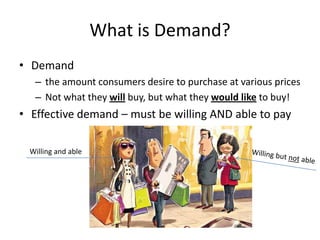
• Effective demand – must be willing AND able to pay
Willing and able
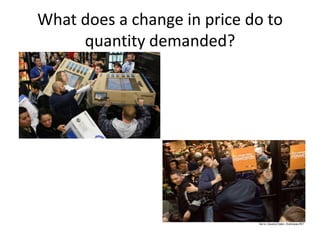
What does a change in price do to
quantity demanded?
Individual and Market Demand
• Market demand – made up of all individual demand
schedules in the market
– Represented by a demand curve
• Demand curve – negative slope, downward sloping from left to
right
– At higher prices, people purchase less than at lower prices
– Note: Quantity demanded is always on the X axis and price
on the Y axis
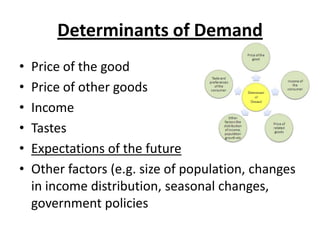
Determinants of Demand
• Price of the good
• Price of other goods
• Income
• Tastes
• Expectations of the future
• Other factors (e.g. size of population, changes
in income distribution, seasonal changes,
government policies
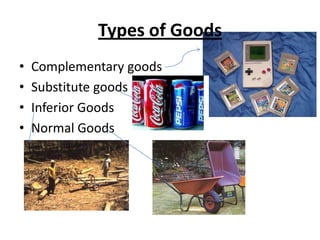
Types of Goods
• Complementary goods
• Substitute goods
• Inferior Goods
• Normal Goods
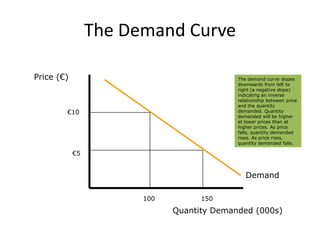
The Demand Curve
Price (€)
Quantity Demanded (000s)
Demand
€10
€5
100 150
The demand curve slopes
downwards from left to
right (a negative slope)
indicating an inverse
relationship between price
and the quantity
demanded. Quantity
demanded will be higher
at lower prices than at
higher prices. As price
falls, quantity demanded
rises. As price rises,
quantity demanded falls.
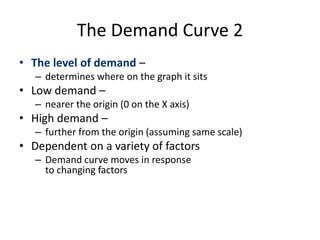
The Demand Curve 2
• The level of demand –
– determines where on the graph it sits
• Low demand –
– nearer the origin (0 on the X axis)
• High demand –
– further from the origin (assuming same scale)
• Dependent on a variety of factors
– Demand curve moves in response
to changing factors
The Demand Curve 3
Factors influencing demand
• Price (does not create a shift in the curve itself - but instead up and
down along the curve)
• Factors that may cause a shift (left or right) in the curve itself
– Prices of other goods – substitutes and complements
– Incomes – the level and distribution of income
– Tastes and fashions
– The level and structure of the population
– Advertising
– Expectations of consumers
The Demand Curve 4
Changes in any of the factors other than price causes
the demand curve to shift either:
• Left (Less demanded at each price) or
• Right (More demanded at each price)
The Demand Curve 5
Price (€)
Quantity Demanded (000s)
Demand
€10
100
D1
D2
10 200
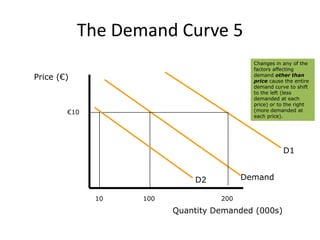
Changes in any of the
factors affecting
demand other than
price cause the entire
demand curve to shift
to the left (less
demanded at each
price) or to the right
(more demanded at
each price).
Demand
Demand Video
Determinants of Supply
• Cost of factors of production (land, labour,
capital, entrepreneurship)
• Technology
• Government intervention
• Expectations of the future
The Supply Curve
Factors influencing supply:
• Price
• Profitability of other goods in production
and prices of goods in joint supply
• Technology
• Natural shocks
• Costs of production
• Expectations of producers
• Social factors
The Supply Curve
• Changes in any of the factors OTHER than price cause a shift
in the supply curve
• A shift in supply to the left – the amount producers offer for
sale at every price will be less
• A shift in supply to the right – the amount producers wish to
sell at every price increases
• HINT: Be careful not to confuse supply going ‘up’ and ‘down’
with the direction of the shift!
The Supply Curve
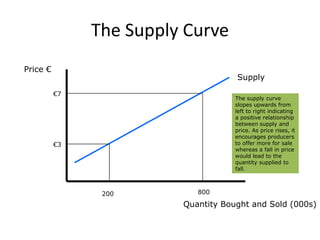
Price €
Quantity Bought and Sold (000s)
Supply
€3
200
€7
800
The supply curve
slopes upwards from
left to right indicating
a positive relationship
between supply and
price. As price rises, it
encourages producers
to offer more for sale
whereas a fall in price
would lead to the
quantity supplied to
fall.
The Supply Curve
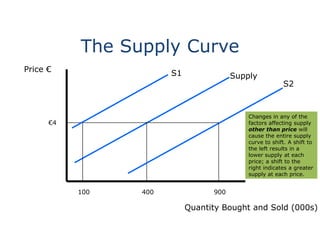
Price €
Quantity Bought and Sold (000s)
Supply
€4
400
S1
100
S2
900
Changes in any of the
factors affecting supply
other than price will
cause the entire supply
curve to shift. A shift to
the left results in a
lower supply at each
price; a shift to the
right indicates a greater
supply at each price.
Supply
Supply Video
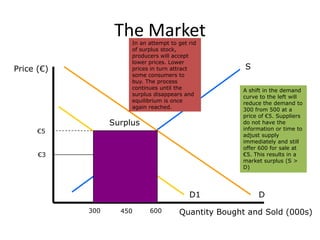
The Market
Price (€)
Quantity Bought and Sold (000s)
S
D
€5
600
D1
300
Surplus
€3
450
A shift in the demand
curve to the left will
reduce the demand to
300 from 500 at a
price of €5. Suppliers
do not have the
information or time to
adjust supply
immediately and still
offer 600 for sale at
€5. This results in a
market surplus (S >
D)
In an attempt to get rid
of surplus stock,
producers will accept
lower prices. Lower
prices in turn attract
some consumers to
buy. The process
continues until the
surplus disappears and
equilibrium is once
again reached.
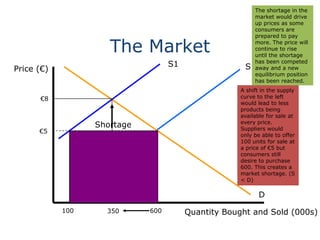
The Market
Price (€)
Quantity Bought and Sold (000s)
S
D
€5
600
S1
100
Shortage
€8
350
A shift in the supply
curve to the left
would lead to less
products being
available for sale at
every price.
Suppliers would
only be able to offer
100 units for sale at
a price of €5 but
consumers still
desire to purchase
600. This creates a
market shortage. (S
< D)
The shortage in the
market would drive
up prices as some
consumers are
prepared to pay
more. The price will
continue to rise
until the shortage
has been competed
away and a new
equilibrium position
has been reached.
Market Equilibrium
Market Equilibrium Video

The market system

  • 1.
    The Market System Demand,Supply and Price Determination Adapted from www.bized.co.uk
  • 2.
    The Market System •Market consists (is made up) of: – Consumers (people that buy a product) - create a demand for a product – Businesses (sellers and creators of products) • Inputs and Outputs (Factors of Production and Products) • Factors of Production – Land – Labor – Capital – Entrepreneurship
  • 3.
    What is Demand? •Demand – the amount consumers desire to purchase at various prices – Not what they will buy, but what they would like to buy! • Effective demand – must be willing AND able to pay Willing and able
  • 4.
    What does achange in price do to quantity demanded?
  • 5.
    Individual and MarketDemand • Market demand – made up of all individual demand schedules in the market – Represented by a demand curve • Demand curve – negative slope, downward sloping from left to right – At higher prices, people purchase less than at lower prices – Note: Quantity demanded is always on the X axis and price on the Y axis
  • 6.
    Determinants of Demand •Price of the good • Price of other goods • Income • Tastes • Expectations of the future • Other factors (e.g. size of population, changes in income distribution, seasonal changes, government policies
  • 7.
    Types of Goods •Complementary goods • Substitute goods • Inferior Goods • Normal Goods
  • 8.
    The Demand Curve Price(€) Quantity Demanded (000s) Demand €10 €5 100 150 The demand curve slopes downwards from left to right (a negative slope) indicating an inverse relationship between price and the quantity demanded. Quantity demanded will be higher at lower prices than at higher prices. As price falls, quantity demanded rises. As price rises, quantity demanded falls.
  • 9.
    The Demand Curve2 • The level of demand – – determines where on the graph it sits • Low demand – – nearer the origin (0 on the X axis) • High demand – – further from the origin (assuming same scale) • Dependent on a variety of factors – Demand curve moves in response to changing factors
  • 10.
    The Demand Curve3 Factors influencing demand • Price (does not create a shift in the curve itself - but instead up and down along the curve) • Factors that may cause a shift (left or right) in the curve itself – Prices of other goods – substitutes and complements – Incomes – the level and distribution of income – Tastes and fashions – The level and structure of the population – Advertising – Expectations of consumers
  • 11.
    The Demand Curve4 Changes in any of the factors other than price causes the demand curve to shift either: • Left (Less demanded at each price) or • Right (More demanded at each price)
  • 12.
    The Demand Curve5 Price (€) Quantity Demanded (000s) Demand €10 100 D1 D2 10 200 Changes in any of the factors affecting demand other than price cause the entire demand curve to shift to the left (less demanded at each price) or to the right (more demanded at each price).
  • 13.
  • 14.
    Determinants of Supply •Cost of factors of production (land, labour, capital, entrepreneurship) • Technology • Government intervention • Expectations of the future
  • 15.
    The Supply Curve Factorsinfluencing supply: • Price • Profitability of other goods in production and prices of goods in joint supply • Technology • Natural shocks • Costs of production • Expectations of producers • Social factors
  • 16.
    The Supply Curve •Changes in any of the factors OTHER than price cause a shift in the supply curve • A shift in supply to the left – the amount producers offer for sale at every price will be less • A shift in supply to the right – the amount producers wish to sell at every price increases • HINT: Be careful not to confuse supply going ‘up’ and ‘down’ with the direction of the shift!
  • 17.
    The Supply Curve Price€ Quantity Bought and Sold (000s) Supply €3 200 €7 800 The supply curve slopes upwards from left to right indicating a positive relationship between supply and price. As price rises, it encourages producers to offer more for sale whereas a fall in price would lead to the quantity supplied to fall.
  • 18.
    The Supply Curve Price€ Quantity Bought and Sold (000s) Supply €4 400 S1 100 S2 900 Changes in any of the factors affecting supply other than price will cause the entire supply curve to shift. A shift to the left results in a lower supply at each price; a shift to the right indicates a greater supply at each price.
  • 19.
  • 20.
    The Market Price (€) QuantityBought and Sold (000s) S D €5 600 D1 300 Surplus €3 450 A shift in the demand curve to the left will reduce the demand to 300 from 500 at a price of €5. Suppliers do not have the information or time to adjust supply immediately and still offer 600 for sale at €5. This results in a market surplus (S > D) In an attempt to get rid of surplus stock, producers will accept lower prices. Lower prices in turn attract some consumers to buy. The process continues until the surplus disappears and equilibrium is once again reached.
  • 21.
    The Market Price (€) QuantityBought and Sold (000s) S D €5 600 S1 100 Shortage €8 350 A shift in the supply curve to the left would lead to less products being available for sale at every price. Suppliers would only be able to offer 100 units for sale at a price of €5 but consumers still desire to purchase 600. This creates a market shortage. (S < D) The shortage in the market would drive up prices as some consumers are prepared to pay more. The price will continue to rise until the shortage has been competed away and a new equilibrium position has been reached.
  • 22.