DEMAND, SUPPLY, AND
MARKET EQUILIBRIUM
Significance:
 The tools of demand and supply can be applied to a
range of important topics such as:
 evaluating how global weather conditions will affect
agricultural production and market prices of agricultural
commodities;
 assessing the impact of government rent control on the
housing market;
 understanding how taxes, subsidies, and other government
policies affect both consumers and producers.
 Demand and supply analysis deals with how prices of
products and resources are determined.
2
The Concept of DEMAND:
 Demand - refers to the various quantities of a good or
service that consumers are willing and able to
purchase at alternative prices, ceteris paribus (other things
remaining equal).
 It conveys both the elements of desire for the commodity
and capacity to pay (must be willing and able).
 It emphasizes the relationship between quantity bought and
its price, although there may be other factors that determine
how much a consumer wants to purchase.
3
The Law of Demand:
 Asserts that the quantity demanded of a good or
service is negatively or inversely related to its
own price – the First Law of Demand.
 When the price increases, less of the good or service
will be bought
 When the price decreases, more of the commodity
will be purchased.
WHY SO?
4
Two Reasons for the Inverse
Relationship:
 Substitution effect
 When price of a good decreases, the consumer
substitutes the lower priced good for the more
expensive ones.
 Income effect
 When price decreases, the consumer’s real income
(or purchasing power) increases, so he tends to buy
more of the good.
P Q
5
Presentation of the Demand
Relationship:
The relationship between quantity purchased
and alternative prices may be presented in 3
ways:
 Demand schedule – in tabular form.
 Demand curve – in graphical form.
 Demand function – in equation form.
6
Demand Schedule:
Demand Schedule for Shoes
Price of a pair of shoes
(in pounds) Quantity demanded/year
0 8
50 7
100 6
150 5
200 4
250 3
300 2
350 1
400 0
7
8
Demand Curve:
Quantity
Price(inpounds)
P
Q0 2 4 6 8
100
200
300
400
D
Figure 1: Demand Curve. The negative slope of the
demand curve depicts the inverse relationship between
price and quantity demanded.
Demand Function:
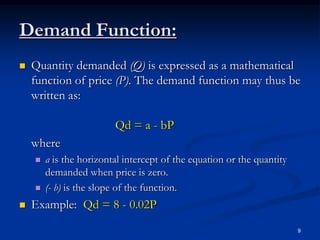
 Quantity demanded (Q) is expressed as a mathematical
function of price (P). The demand function may thus be
written as:
Qd = a - bP
where
 a is the horizontal intercept of the equation or the quantity
demanded when price is zero.
 (- b) is the slope of the function.
 Example: Qd = 8 - 0.02P
9
Important Factors Affecting
Demand:
1. Price of the commodity.
2. Consumer incomes.
3. Prices of related commodities (substitutes and
complements).
4. Tastes and preferences.
5. Consumer expectations.
6. Number of consumers.
10
(Cont.)
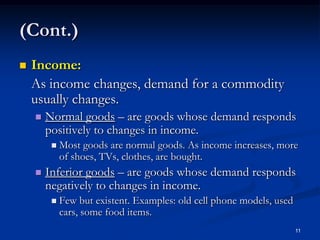
 Income:
As income changes, demand for a commodity
usually changes.
 Normal goods – are goods whose demand responds
positively to changes in income.
 Most goods are normal goods. As income increases, more
of shoes, TVs, clothes, are bought.
 Inferior goods – are goods whose demand responds
negatively to changes in income.
 Few but existent. Examples: old cell phone models, used
cars, some food items.
11
(Cont.)
 Prices of Related Commodities in Consumption:
 Substitutes – are goods that are substitutable with each other
(not necessarily perfect).
 Examples are coffee and tea, Coke and Pepsi.
 When the price of a substitute increases (Py ), quantity bought of the
other good (Qx) increases - (direct relationship)
 Complements – are goods that are used or consumed
together.
 Examples are coffee and sugar, bread and butter, tennis rackets and
tennis balls, computers and software packages.
 When the price of a complement increases, quantity bought of the
other good decreases - (inverse relationship).
12
(Cont.)
 Consumer Tastes and Preferences:
 When consumer tastes shift towards a particular good, greater
amounts of a good are demanded at each price.
 Example: if consumers’ preference for drinking bottled water
increases its demand curve will shift rightward.
 If consumer preferences change away from a good, its
demand will decrease. At every possible price less of the good
is demanded than before.
 Example: the demand for cassette tapes decreased due to preference
for DVDs.
13
(Cont.)
 Consumer Expectations:
Expectations about future prices and incomes affect
current demand for many goods and services.
 If we expect price of sugar to increase, we might stock up on
the good to avoid the expected price increase. Thus, current
demand for sugar might increase.
 Those who expect to lose their jobs due to bad economic
conditions, will reduce their demand for a variety of goods in
the current period.
14
(Cont.)
 Number of Consumers:
It affects the total demand for a good.
 Total demand is also known as market demand. It is the
horizontal summation of the individual demands of all
consumers.
 An increase in the number of consumers shifts the
market demand curve to the right.
 Example: demand for housing and transportation increases
with an increase in population.
 On the other hand, less consumers will cause the
market demand to decrease, resulting in a shift to the
left of the entire demand curve.
15
Change in Quantity Demanded vs.
Change in Demand:
 Change in quantity demanded – is a movement
along the same demand curve, due solely to a
change in price, i.e., all other factors held
constant.
 Change in demand – is a shift in the entire
demand curve (either to the left or to the right)
as a result of changes in other factors affecting
demand.
16
Change in quantity demanded:
Price
Quantity
p1
p2
q1 q2
D
• A decrease in price from p1
to p2 brings about an
increase in quantity
demanded from q1 to q2
• It is shown as a movement
along the same demand
curve from A to B
17
A
B
Change in demand:
Price
Quantity
p1
q1
• An increase in demand
means that at the same
price such as p1 more will be
bought, due to other factors
such as increased
incomes, increase in number
of consumers, etc.
• It is shown as a shift in the
entire demand curve.
D0
D1
q2
This is a
decrease in
demand
D2
18
Change in Demand:
P
Q
D
D’
Increase in Demand
P
Q
DD’
Decrease in Demand
19
The Concept of SUPPLY:
 Supply refers to the various quantities of a good or
service that producers are willing to sell at alternative
prices, ceteris paribus.
 Obviously, firms are motivated to produce and sell more at
higher prices.
 Supply emphasizes the relationship between quantity sold of
a commodity and its price. However, there are other factors
that determine how much a producer would like to produce
and sell.
20
The Law of Supply:
 It states that the quantity sold of a good or
service is positively or directly related to its own
price.
 When the price increases, more of the good or
service will be supplied.
 When the price decreases, less of the commodity will
be supplied.
21
Presentation of the Supply
Relationship:
The relationship between quantity supplied
and alternative prices may be presented in 3
ways:
 Supply schedule –in tabular form.
 Supply curve – in graphical form
 Supply function – in equation form
22
Supply Schedule:
Supply Schedule of Shoes
Price of a pair of shoes
(in pounds) Quantity supplied/year
0 0
50 1
100 2
150 3
200 4
250 5
300 6
350 7
400 8
23
Supply Curve:
Quantity
Price(inpesos)
P
Q0 2 4 6 8
100
200
300
400
S
Figure 2: Supply Curve. The positive slope of the supply
curve depicts the direct relationship between price and
quantity supplied.
24
Supply Function:
 Quantity supplied (Qs) is expressed as a mathematical
function of price (P). The supply function may thus be
written as:
Qs = c + dP
where
 c is the horizontal intercept of the equation or the quantity
supplied when price is zero
 d is the slope of the function.
 Example: Qs = 0 + 0.02P
25
Factors Affecting Supply:
 There are other factors aside from price that
affect the supply schedule. Some of the most
important of these factors include:
1. Resource prices.
2. Prices of related goods in production.
3. Technology.
4. Expectations.
5. Number of sellers.
26
(Cont.)
 Resource Prices:
 When prices of inputs to production increase, the
supply of the firm's product decreases.
 Decreases in resource prices, however, translate
into an increase in supply. The entire supply curve
shifts to the right.
27
(Cont.)
 Prices of Related Goods in Production:
 Resources can be employed to produce several alternative
goods and services.
 Examples from agriculture:
 a piece of farmland can be used to grow cotton, corn, or
sugarcane. An increase in price of sugarcane may result in
decreased supply of cotton and corn.
 farmers can use their land and labor to produce ornamental
flowers instead of vegetables. If vegetable prices decrease, the
supply of ornamental flowers may increase.
28
(Cont.)
 Technology:
A change in production techniques can lower or raise
production costs and affect supply.
 Improvements in technology shift the supply curve to
the right.
 A cost-saving invention will enable firms to produce and
sell more goods than before at any given price.
 New high yielding crop varieties will increase production
on the same amount of land.
29
(Cont.)
 Producer Expectations:
 When producers expect the price of their product to
increase in the future, they may hoard their output for later
sale, thus reducing supply in the present period. Thus the
supply curve shifts to the left.
 If firms expect that the price of their product will fall in the
near future, supply may increase in the current period as
firms try to increase production as well as to dispose of
their inventory.
30
(Cont.)
 Number of Sellers:
As the number of sellers increases, so will total
supply.
 The market supply is the horizontal summation of the
supply schedules of individual producers.
 As more firms enter the market, more will be offered for
sale at each possible price, thus shifting the supply curve to
the right.
 Similarly, the supply curve shifts to the left when firms exit
the market.
31
Change in Quantity Supplied vs.
Change in Supply:
 Change in quantity supplied – is a movement
along the same supply curve, due solely to a
change in price, i.e., all other factors held
constant.
 Change in supply – is a shift in the entire supply
curve (either to the left or to the right) as a result
of changes in other factors affecting supply.
32
Change in Quantity Supplied:
Price
Quantity
p1
p2
q1 q2
S
• An increase in price from p1
to p2 results in an increase in
quantity supplied from q1 to
q2
• It is shown as a movement
along the same supply curve
from A to B.
33
A
B
Change in Supply:
Price
Quantity
p1
q1
• An increase in supply
means that at the same
price such as p1 more will be
supplied, due to other
factors such as improvement
in technology, increase in
number of producers, etc.
• It is shown as a shift in the
entire supply curve.
S0
S1
q2
This is a
decrease in
supply
S2
34
(Cont.)
P
Q
S
S’
Increase in Supply
P
Q
DD’
Decrease in Supply
S
S’
35
Market Equilibrium
 Market equilibrium is that state in which the quantity
that firms want to supply equals the quantity that
consumers want to buy.
 The price that clears the market is called the equilibrium
price and the quantity (sold and bought) is called the
equilibrium quantity.
 The market is said to be "at rest" since the equilibrium price
and equilibrium quantity will stay at those levels until either
demand or supply changes.
36
(Cont.)
Market for Shoes
Price of a Pair of Shoes
(in pounds)
Quantity Demanded per
Year
Quantity Supplied
per Year
0 8 0
50 7 1
100 6 2
150 5 3
200 4 4
250 3 5
300 2 6
350 1 7
400 0 8
Equilibrium Quantity=4
Equilibrium
Price=200
37
(Cont.)
 At prices above the equilibrium price, quantity supplied is
greater than quantity demanded, resulting in a temporary
surplus.
 In a surplus situation, producers will try to reduce price to
entice consumers to buy more shoes. Actions by both
producers and the public will wipe out the temporary surplus.
 At prices below the equilibrium price, consumers desire to
buy more shoes than are available, creating a temporary
shortage.
 Consumers will try to outbid each other, thus pushing up the
price. As price rises, firms increase their production while
some consumers reduce their purchases.
38
(Cont.)
Quantity
Price(inpounds)
P
Q0 2 4 6 8
100
200
300
400
S
Shortage
Surplus
39
(Cont.)
 Algebraic solution: equate the demand and supply
equations (Qd=Qs).
Qd = 8 - 0.02P
Qs = 0 + 0.02 P
 Step by step solution:
 8 - 0.02P = 0 + 0.02 P
 0.04P = 8
 P* = 8/0.04 = 200
 Qd = 8 – 0.02(200) = 8 – 4 = 4
 P* =200 per unit, Q* = 4 per year
40

3 demand and supply

  • 1.
  • 2.
    Significance:  The toolsof demand and supply can be applied to a range of important topics such as:  evaluating how global weather conditions will affect agricultural production and market prices of agricultural commodities;  assessing the impact of government rent control on the housing market;  understanding how taxes, subsidies, and other government policies affect both consumers and producers.  Demand and supply analysis deals with how prices of products and resources are determined. 2
  • 3.
    The Concept ofDEMAND:  Demand - refers to the various quantities of a good or service that consumers are willing and able to purchase at alternative prices, ceteris paribus (other things remaining equal).  It conveys both the elements of desire for the commodity and capacity to pay (must be willing and able).  It emphasizes the relationship between quantity bought and its price, although there may be other factors that determine how much a consumer wants to purchase. 3
  • 4.
    The Law ofDemand:  Asserts that the quantity demanded of a good or service is negatively or inversely related to its own price – the First Law of Demand.  When the price increases, less of the good or service will be bought  When the price decreases, more of the commodity will be purchased. WHY SO? 4
  • 5.
    Two Reasons forthe Inverse Relationship:  Substitution effect  When price of a good decreases, the consumer substitutes the lower priced good for the more expensive ones.  Income effect  When price decreases, the consumer’s real income (or purchasing power) increases, so he tends to buy more of the good. P Q 5
  • 6.
    Presentation of theDemand Relationship: The relationship between quantity purchased and alternative prices may be presented in 3 ways:  Demand schedule – in tabular form.  Demand curve – in graphical form.  Demand function – in equation form. 6
  • 7.
    Demand Schedule: Demand Schedulefor Shoes Price of a pair of shoes (in pounds) Quantity demanded/year 0 8 50 7 100 6 150 5 200 4 250 3 300 2 350 1 400 0 7
  • 8.
    8 Demand Curve: Quantity Price(inpounds) P Q0 24 6 8 100 200 300 400 D Figure 1: Demand Curve. The negative slope of the demand curve depicts the inverse relationship between price and quantity demanded.
  • 9.
    Demand Function:  Quantitydemanded (Q) is expressed as a mathematical function of price (P). The demand function may thus be written as: Qd = a - bP where  a is the horizontal intercept of the equation or the quantity demanded when price is zero.  (- b) is the slope of the function.  Example: Qd = 8 - 0.02P 9
  • 10.
    Important Factors Affecting Demand: 1.Price of the commodity. 2. Consumer incomes. 3. Prices of related commodities (substitutes and complements). 4. Tastes and preferences. 5. Consumer expectations. 6. Number of consumers. 10
  • 11.
    (Cont.)  Income: As incomechanges, demand for a commodity usually changes.  Normal goods – are goods whose demand responds positively to changes in income.  Most goods are normal goods. As income increases, more of shoes, TVs, clothes, are bought.  Inferior goods – are goods whose demand responds negatively to changes in income.  Few but existent. Examples: old cell phone models, used cars, some food items. 11
  • 12.
    (Cont.)  Prices ofRelated Commodities in Consumption:  Substitutes – are goods that are substitutable with each other (not necessarily perfect).  Examples are coffee and tea, Coke and Pepsi.  When the price of a substitute increases (Py ), quantity bought of the other good (Qx) increases - (direct relationship)  Complements – are goods that are used or consumed together.  Examples are coffee and sugar, bread and butter, tennis rackets and tennis balls, computers and software packages.  When the price of a complement increases, quantity bought of the other good decreases - (inverse relationship). 12
  • 13.
    (Cont.)  Consumer Tastesand Preferences:  When consumer tastes shift towards a particular good, greater amounts of a good are demanded at each price.  Example: if consumers’ preference for drinking bottled water increases its demand curve will shift rightward.  If consumer preferences change away from a good, its demand will decrease. At every possible price less of the good is demanded than before.  Example: the demand for cassette tapes decreased due to preference for DVDs. 13
  • 14.
    (Cont.)  Consumer Expectations: Expectationsabout future prices and incomes affect current demand for many goods and services.  If we expect price of sugar to increase, we might stock up on the good to avoid the expected price increase. Thus, current demand for sugar might increase.  Those who expect to lose their jobs due to bad economic conditions, will reduce their demand for a variety of goods in the current period. 14
  • 15.
    (Cont.)  Number ofConsumers: It affects the total demand for a good.  Total demand is also known as market demand. It is the horizontal summation of the individual demands of all consumers.  An increase in the number of consumers shifts the market demand curve to the right.  Example: demand for housing and transportation increases with an increase in population.  On the other hand, less consumers will cause the market demand to decrease, resulting in a shift to the left of the entire demand curve. 15
  • 16.
    Change in QuantityDemanded vs. Change in Demand:  Change in quantity demanded – is a movement along the same demand curve, due solely to a change in price, i.e., all other factors held constant.  Change in demand – is a shift in the entire demand curve (either to the left or to the right) as a result of changes in other factors affecting demand. 16
  • 17.
    Change in quantitydemanded: Price Quantity p1 p2 q1 q2 D • A decrease in price from p1 to p2 brings about an increase in quantity demanded from q1 to q2 • It is shown as a movement along the same demand curve from A to B 17 A B
  • 18.
    Change in demand: Price Quantity p1 q1 •An increase in demand means that at the same price such as p1 more will be bought, due to other factors such as increased incomes, increase in number of consumers, etc. • It is shown as a shift in the entire demand curve. D0 D1 q2 This is a decrease in demand D2 18
  • 19.
    Change in Demand: P Q D D’ Increasein Demand P Q DD’ Decrease in Demand 19
  • 20.
    The Concept ofSUPPLY:  Supply refers to the various quantities of a good or service that producers are willing to sell at alternative prices, ceteris paribus.  Obviously, firms are motivated to produce and sell more at higher prices.  Supply emphasizes the relationship between quantity sold of a commodity and its price. However, there are other factors that determine how much a producer would like to produce and sell. 20
  • 21.
    The Law ofSupply:  It states that the quantity sold of a good or service is positively or directly related to its own price.  When the price increases, more of the good or service will be supplied.  When the price decreases, less of the commodity will be supplied. 21
  • 22.
    Presentation of theSupply Relationship: The relationship between quantity supplied and alternative prices may be presented in 3 ways:  Supply schedule –in tabular form.  Supply curve – in graphical form  Supply function – in equation form 22
  • 23.
    Supply Schedule: Supply Scheduleof Shoes Price of a pair of shoes (in pounds) Quantity supplied/year 0 0 50 1 100 2 150 3 200 4 250 5 300 6 350 7 400 8 23
  • 24.
    Supply Curve: Quantity Price(inpesos) P Q0 24 6 8 100 200 300 400 S Figure 2: Supply Curve. The positive slope of the supply curve depicts the direct relationship between price and quantity supplied. 24
  • 25.
    Supply Function:  Quantitysupplied (Qs) is expressed as a mathematical function of price (P). The supply function may thus be written as: Qs = c + dP where  c is the horizontal intercept of the equation or the quantity supplied when price is zero  d is the slope of the function.  Example: Qs = 0 + 0.02P 25
  • 26.
    Factors Affecting Supply: There are other factors aside from price that affect the supply schedule. Some of the most important of these factors include: 1. Resource prices. 2. Prices of related goods in production. 3. Technology. 4. Expectations. 5. Number of sellers. 26
  • 27.
    (Cont.)  Resource Prices: When prices of inputs to production increase, the supply of the firm's product decreases.  Decreases in resource prices, however, translate into an increase in supply. The entire supply curve shifts to the right. 27
  • 28.
    (Cont.)  Prices ofRelated Goods in Production:  Resources can be employed to produce several alternative goods and services.  Examples from agriculture:  a piece of farmland can be used to grow cotton, corn, or sugarcane. An increase in price of sugarcane may result in decreased supply of cotton and corn.  farmers can use their land and labor to produce ornamental flowers instead of vegetables. If vegetable prices decrease, the supply of ornamental flowers may increase. 28
  • 29.
    (Cont.)  Technology: A changein production techniques can lower or raise production costs and affect supply.  Improvements in technology shift the supply curve to the right.  A cost-saving invention will enable firms to produce and sell more goods than before at any given price.  New high yielding crop varieties will increase production on the same amount of land. 29
  • 30.
    (Cont.)  Producer Expectations: When producers expect the price of their product to increase in the future, they may hoard their output for later sale, thus reducing supply in the present period. Thus the supply curve shifts to the left.  If firms expect that the price of their product will fall in the near future, supply may increase in the current period as firms try to increase production as well as to dispose of their inventory. 30
  • 31.
    (Cont.)  Number ofSellers: As the number of sellers increases, so will total supply.  The market supply is the horizontal summation of the supply schedules of individual producers.  As more firms enter the market, more will be offered for sale at each possible price, thus shifting the supply curve to the right.  Similarly, the supply curve shifts to the left when firms exit the market. 31
  • 32.
    Change in QuantitySupplied vs. Change in Supply:  Change in quantity supplied – is a movement along the same supply curve, due solely to a change in price, i.e., all other factors held constant.  Change in supply – is a shift in the entire supply curve (either to the left or to the right) as a result of changes in other factors affecting supply. 32
  • 33.
    Change in QuantitySupplied: Price Quantity p1 p2 q1 q2 S • An increase in price from p1 to p2 results in an increase in quantity supplied from q1 to q2 • It is shown as a movement along the same supply curve from A to B. 33 A B
  • 34.
    Change in Supply: Price Quantity p1 q1 •An increase in supply means that at the same price such as p1 more will be supplied, due to other factors such as improvement in technology, increase in number of producers, etc. • It is shown as a shift in the entire supply curve. S0 S1 q2 This is a decrease in supply S2 34
  • 35.
  • 36.
    Market Equilibrium  Marketequilibrium is that state in which the quantity that firms want to supply equals the quantity that consumers want to buy.  The price that clears the market is called the equilibrium price and the quantity (sold and bought) is called the equilibrium quantity.  The market is said to be "at rest" since the equilibrium price and equilibrium quantity will stay at those levels until either demand or supply changes. 36
  • 37.
    (Cont.) Market for Shoes Priceof a Pair of Shoes (in pounds) Quantity Demanded per Year Quantity Supplied per Year 0 8 0 50 7 1 100 6 2 150 5 3 200 4 4 250 3 5 300 2 6 350 1 7 400 0 8 Equilibrium Quantity=4 Equilibrium Price=200 37
  • 38.
    (Cont.)  At pricesabove the equilibrium price, quantity supplied is greater than quantity demanded, resulting in a temporary surplus.  In a surplus situation, producers will try to reduce price to entice consumers to buy more shoes. Actions by both producers and the public will wipe out the temporary surplus.  At prices below the equilibrium price, consumers desire to buy more shoes than are available, creating a temporary shortage.  Consumers will try to outbid each other, thus pushing up the price. As price rises, firms increase their production while some consumers reduce their purchases. 38
  • 39.
    (Cont.) Quantity Price(inpounds) P Q0 2 46 8 100 200 300 400 S Shortage Surplus 39
  • 40.
    (Cont.)  Algebraic solution:equate the demand and supply equations (Qd=Qs). Qd = 8 - 0.02P Qs = 0 + 0.02 P  Step by step solution:  8 - 0.02P = 0 + 0.02 P  0.04P = 8  P* = 8/0.04 = 200  Qd = 8 – 0.02(200) = 8 – 4 = 4  P* =200 per unit, Q* = 4 per year 40