The Magnet
Journey
What is Magnet
Recognition Program?
The Magnet Recognition Program® recognizes
healthcare organizations for quality patient care, nursing excellence and
innovations in professional nursing practice.
Consumers rely on Magnet designation as the ultimate credential for
high quality nursing.
What is Magnet
Designation??
Being named a Magnet Organization is the
highest level of recognition that the American Nurses Credentialing
Center (ANCC) can accord to healthcare organizations which provide
nursing care.
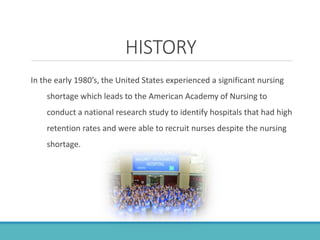
HISTORY
In the early 1980’s, the United States experienced a significant nursing
shortage which leads to the American Academy of Nursing to
conduct a national research study to identify hospitals that had high
retention rates and were able to recruit nurses despite the nursing
shortage.
The study also attempted to identify organizational and nursing
administration attributes that could be responsible for such success. As
a result of this study, 41 Magnet hospitals were selected based on their
ability to attract and retain registered nurses.
These 41 hospitals successfully operationalized organizational traits that
later known as the 14 Forces of Magnetism.
Years of trending and program development have led to the new 5 Model
Components, which reduce redundancy while capturing the depth and
breadth of the Forces of Magnetism.
The new 5 Model Components that encompasses all 14 Forces of
Magnetism are:
I. Transformational Leadership
II. Structural Empowerment
III. Exemplary Professional Practice
IV. New knowledge , innovation & improvement
V. Empirical Outcomes
1993 – Magnet Program was introduced.
1994 – First Magnet Award was designated to the University of
Washington Medical Center, Seattle USA.
2008 – 280 plus Magnet hospitals
2010 – 372 Magnet hospitals ,
USA, Australia, Lebanon, Singapore
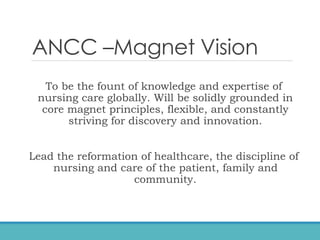
ANCC –Magnet Vision
To be the fount of knowledge and expertise of
nursing care globally. Will be solidly grounded in
core magnet principles, flexible, and constantly
striving for discovery and innovation.
Lead the reformation of healthcare, the discipline of
nursing and care of the patient, family and
community.
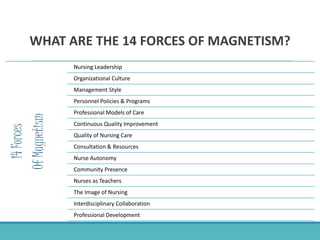
WHAT ARE THE 14 FORCES OF MAGNETISM?
14Forces
OfMagnetism
Nursing Leadership
Organizational Culture
Management Style
Personnel Policies & Programs
Professional Models of Care
Continuous Quality Improvement
Quality of Nursing Care
Consultation & Resources
Nurse Autonomy
Community Presence
Nurses as Teachers
The Image of Nursing
Interdisciplinary Collaboration
Professional Development
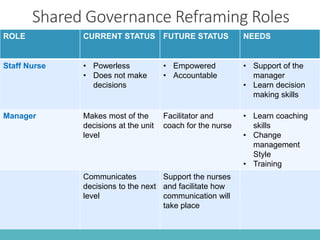
Shared Governance Reframing Roles
ROLE CURRENT STATUS FUTURE STATUS NEEDS
Staff Nurse • Powerless
• Does not make
decisions
• Empowered
• Accountable
• Support of the
manager
• Learn decision
making skills
Manager Makes most of the
decisions at the unit
level
Facilitator and
coach for the nurse
• Learn coaching
skills
• Change
management
Style
• Training
Communicates
decisions to the next
level
Support the nurses
and facilitate how
communication will
take place
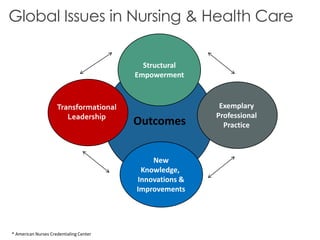
Global Issues in Nursing & Health Care
Outcomes
Structural
Empowerment
Exemplary
Professional
Practice
New
Knowledge,
Innovations &
Improvements
* American Nurses Credentialing Center
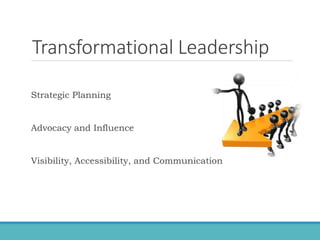
Transformational
Leadership
Strategic Planning
Advocacy and Influence
Visibility, Accessibility, and Communication
Transformational Leadership
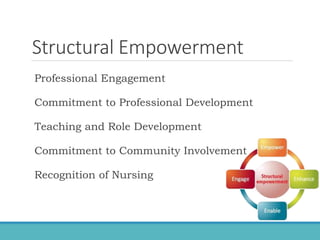
Professional Engagement
Commitment to Professional Development
Teaching and Role Development
Commitment to Community Involvement
Recognition of Nursing
Structural Empowerment
Professional Practice Model
Care Delivery Systems
Staffing, Scheduling, and Budgeting Processes
Interdisciplinary Care
Accountability, Competence, and Autonomy
Ethics, Privacy, Security, and Confidentiality
Diversity and Workplace Advocacy
Culture of Safety
Quality Care Monitoring and Improvement
Exemplary Professional
Practice
Patients
Nurses
Organization
Consumers
Empirical Outcomes
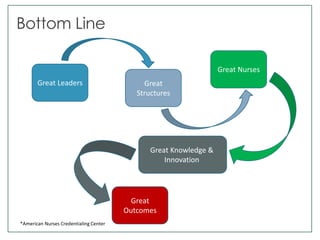
Bottom Line
Great Leaders Great
Structures
Great Nurses
Great Knowledge &
Innovation
Great
Outcomes
*American Nurses Credentialing Center
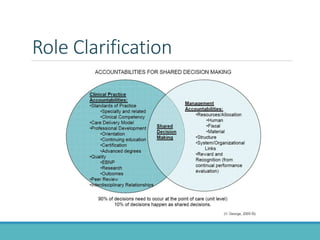
Role Clarification
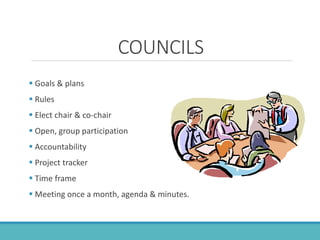
COUNCILS
 Goals & plans
 Rules
 Elect chair & co-chair
 Open, group participation
 Accountability
 Project tracker
 Time frame
 Meeting once a month, agenda & minutes.
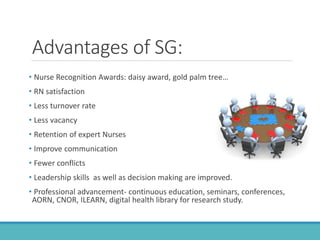
Advantages of SG:
• Nurse Recognition Awards: daisy award, gold palm tree…
• RN satisfaction
• Less turnover rate
• Less vacancy
• Retention of expert Nurses
• Improve communication
• Fewer conflicts
• Leadership skills as well as decision making are improved.
• Professional advancement- continuous education, seminars, conferences,
AORN, CNOR, ILEARN, digital health library for research study.
Advantages of SG
• Quality care - , less complication, less hospital stay --Patient
satisfaction- less complaints.
• Organization and is viewed to provide excellent care as a result of the
quality nursing care given to the patient.
• Prestige and pride.
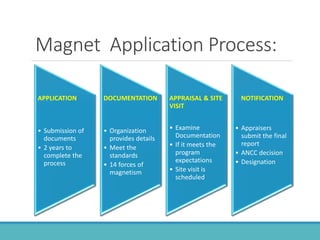
Magnet Application Process:
APPLICATION
• Submission of
documents
• 2 years to
complete the
process
DOCUMENTATION
• Organization
provides details
• Meet the
standards
• 14 forces of
magnetism
APPRAISAL & SITE
VISIT
• Examine
Documentation
• If it meets the
program
expectations
• Site visit is
scheduled
NOTIFICATION
• Appraisers
submit the final
report
• ANCC decision
• Designation
Obstacles to Expect:
Change is
slow
Resistance
to change
Criticism
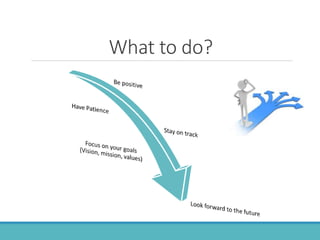
What to do?
The Magnet Journey

The Magnet Journey

  • 1.
  • 2.
    What is Magnet RecognitionProgram? The Magnet Recognition Program® recognizes healthcare organizations for quality patient care, nursing excellence and innovations in professional nursing practice. Consumers rely on Magnet designation as the ultimate credential for high quality nursing.
  • 3.
    What is Magnet Designation?? Beingnamed a Magnet Organization is the highest level of recognition that the American Nurses Credentialing Center (ANCC) can accord to healthcare organizations which provide nursing care.
  • 4.
    HISTORY In the early1980’s, the United States experienced a significant nursing shortage which leads to the American Academy of Nursing to conduct a national research study to identify hospitals that had high retention rates and were able to recruit nurses despite the nursing shortage.
  • 5.
    The study alsoattempted to identify organizational and nursing administration attributes that could be responsible for such success. As a result of this study, 41 Magnet hospitals were selected based on their ability to attract and retain registered nurses. These 41 hospitals successfully operationalized organizational traits that later known as the 14 Forces of Magnetism.
  • 6.
    Years of trendingand program development have led to the new 5 Model Components, which reduce redundancy while capturing the depth and breadth of the Forces of Magnetism. The new 5 Model Components that encompasses all 14 Forces of Magnetism are: I. Transformational Leadership II. Structural Empowerment III. Exemplary Professional Practice IV. New knowledge , innovation & improvement V. Empirical Outcomes
  • 7.
    1993 – MagnetProgram was introduced. 1994 – First Magnet Award was designated to the University of Washington Medical Center, Seattle USA. 2008 – 280 plus Magnet hospitals 2010 – 372 Magnet hospitals , USA, Australia, Lebanon, Singapore
  • 8.
    ANCC –Magnet Vision Tobe the fount of knowledge and expertise of nursing care globally. Will be solidly grounded in core magnet principles, flexible, and constantly striving for discovery and innovation. Lead the reformation of healthcare, the discipline of nursing and care of the patient, family and community.
  • 9.
    WHAT ARE THE14 FORCES OF MAGNETISM? 14Forces OfMagnetism Nursing Leadership Organizational Culture Management Style Personnel Policies & Programs Professional Models of Care Continuous Quality Improvement Quality of Nursing Care Consultation & Resources Nurse Autonomy Community Presence Nurses as Teachers The Image of Nursing Interdisciplinary Collaboration Professional Development
  • 10.
    Shared Governance ReframingRoles ROLE CURRENT STATUS FUTURE STATUS NEEDS Staff Nurse • Powerless • Does not make decisions • Empowered • Accountable • Support of the manager • Learn decision making skills Manager Makes most of the decisions at the unit level Facilitator and coach for the nurse • Learn coaching skills • Change management Style • Training Communicates decisions to the next level Support the nurses and facilitate how communication will take place
  • 11.
    Global Issues inNursing & Health Care Outcomes Structural Empowerment Exemplary Professional Practice New Knowledge, Innovations & Improvements * American Nurses Credentialing Center Transformational Leadership
  • 12.
    Strategic Planning Advocacy andInfluence Visibility, Accessibility, and Communication Transformational Leadership
  • 13.
    Professional Engagement Commitment toProfessional Development Teaching and Role Development Commitment to Community Involvement Recognition of Nursing Structural Empowerment
  • 14.
    Professional Practice Model CareDelivery Systems Staffing, Scheduling, and Budgeting Processes Interdisciplinary Care Accountability, Competence, and Autonomy Ethics, Privacy, Security, and Confidentiality Diversity and Workplace Advocacy Culture of Safety Quality Care Monitoring and Improvement Exemplary Professional Practice
  • 15.
  • 16.
    Bottom Line Great LeadersGreat Structures Great Nurses Great Knowledge & Innovation Great Outcomes *American Nurses Credentialing Center
  • 17.
  • 18.
    COUNCILS  Goals &plans  Rules  Elect chair & co-chair  Open, group participation  Accountability  Project tracker  Time frame  Meeting once a month, agenda & minutes.
  • 19.
    Advantages of SG: •Nurse Recognition Awards: daisy award, gold palm tree… • RN satisfaction • Less turnover rate • Less vacancy • Retention of expert Nurses • Improve communication • Fewer conflicts • Leadership skills as well as decision making are improved. • Professional advancement- continuous education, seminars, conferences, AORN, CNOR, ILEARN, digital health library for research study.
  • 20.
    Advantages of SG •Quality care - , less complication, less hospital stay --Patient satisfaction- less complaints. • Organization and is viewed to provide excellent care as a result of the quality nursing care given to the patient. • Prestige and pride.
  • 21.
    Magnet Application Process: APPLICATION •Submission of documents • 2 years to complete the process DOCUMENTATION • Organization provides details • Meet the standards • 14 forces of magnetism APPRAISAL & SITE VISIT • Examine Documentation • If it meets the program expectations • Site visit is scheduled NOTIFICATION • Appraisers submit the final report • ANCC decision • Designation
  • 22.
    Obstacles to Expect: Changeis slow Resistance to change Criticism
  • 23.

Editor's Notes

  • #11 the
  • #12 This is another way of visualizing the Essential elements. Notice the large orange circle which anchors the other elements. If you think about it, this makes sense that it should be such a big piece of the picture. All other elements are important – but the bottom line is outcomes – whether it is for our patients, for nurses, for our organization or for the community.
  • #13 Strategy: The CNO must be positioned in the organization to effectively influence executive stakeholders AND Nurse leaders at all levels of the organization convey a strong sense of advocacy and support on behalf of staff and patients. Strategic planning: Does the nursing mission vision, values, and strategic/quality plan reflect the organization’s priorities (hint – think about organizational Elevate goals – are the nursing goals in alignment?) Advocacy: Does the CNO influence organization wide change? How do nurse leaders guide the transition during periods of planned or unplanned change. Think about Marilyn’s leadership role in organizational initiatives. Think about efforts that are in place to help develop frontline nursing leaders (Center for Frontline Nursing Leadership Program, S3 – new orientation program for leaders such as charge nurses, asst. managers, etc) Visibility, Accessibility, and Communication: The various methods the CNO is visible and accesses direct care nurses. (think CNO newsletter, State of Nursing Address, Staff Councils, etc) Various nurse leader use input from direct care nurses to improve the work environment and patient care.
  • #14 This essential element includes opportunities for us to provide evidence about how we: (use some or all of the following descriptors) Enable nurses from different settings and roles to participate in organizational decision making through committees, councils, etc Demonstrate improvements in practices that happen through groups that staff are involved with are involved in local, state, and national professional organizations – and outcomes of that involvement How the organization supports staff working on additional nursing degrees – or advancing in VPNPP. Progress within the organization related to number of staff certified in specialty Provide continuing education programs for staff (such as Aprilfest and Octoberfest activities – as well as programs throughout year) Ways that the organization promotes the teaching role of nurses (preceptors, clinical faculty, instructors for different initiatives) How the organization supports the transition of new graduates into practice How the organization works with schools of nursing to provide clinical experiences Participation of nurses at all levels of service to the community Visibility of nurses in the community
  • #15 This is an essential element which includes a lot! It includes: How the nurses apply our Interdisciplinary Collaborative Practice Model How nurses develop, implement & evaluate standards of practice and standards of care How direct care nurses are involved in tracking and analyzing nurse satisfaction data How nurse satisfaction data performs in relation to national/other results How the care delivery system model involves the patient and his/her support system in the planning and delivery of care How assignments are made to ensure continuity, quality and effectiveness – how regulatory and professional standards are incorporated How we engage internal or external consultant or experts – and what improvements happen as a result. How direct care nurses participate in staffing and scheduling processes. How nurses are involved in analyzing data to guide decisions regarding unit and departmental budget processes. How nurses assume leadership roles in interdisciplinary communication – and other processes that affect use of information systems, patient education processes. How nurses have ready access to literature, professional standards, etc to support their practice How nurse at all levels participate in self appraisal for the assurance of competence and professional development How nurses access available Ethics resources How nurses resolve issues r/t patient privacy/confidentiality How the organization works to address disparities in the management of healthcare needs of diverse patient groups How the organization works to improve workforce safety for nurses (Smooth Moves, Nurse Wellness initiatives ) How the organization works to support a culture of patient safety and to decrease the incidence of hospital acquired infections. Patient satisfaction data that is nurse specific (management of pain, patient education, courtesy & respect, careful listening by nurses, response time)
  • #16 Patients: Mortality Healthcare acquired infections Falls and associated injuries Pressure ulcer prevalence Patient satisfaction (overall and with nursing care and with educational information) Satisfaction with pain management Perception of Safety Specialty population specific outcomes Nurses: Level of nurse engagement and satisfaction Perception of Nurse Autonomy Turnover and vacancy rates % direct care nurses and nurse leaders with certification Educational preparation of all staff Rates and types of staff injuries Staff perception of safe culture and work environment Staff perception of orientation and effectiveness of continuing education programs Organization: Efficiency and elimination of waste CNO impact on system level change Consumers: Impact of community outreach programs Community Health and Welfare
  • #17 This sums the essential elements all up!