Literacy across the 
curriculum 
Lindsay Maughan 
Intervention Lead and Specialist 
Leader of Education (SLE) 
@UKLiteracy
Aim: 
To explore how and why supporting literacy 
improves the quality of teaching and learning 
Understand 
how poor 
literacy can be 
a barrier to 
learning 
Know the 
three literacy 
strands 
Explore some 
strategies that 
can ‘scaffold’ 
learning
Rising standards at KS2 
 79% achieved at least level 4 in reading, 
writing and arithmetic 
 76% reached at least level 4 in the new 
spelling, punctuation and grammar test 
 86% reached at least level 4 in maths
The context 
http://www.youtube.com/watch?v=drNv48RLg78
Literacy: a few facts 
 1 in 6 people in the UK struggle with literacy. This means their 
literacy is below the level of an 11 year old. 
 92% of the British public say literacy is vital to the economy, and 
essential for getting a good job. 
 14% of children and young people from lower income homes rarely 
or never read books for pleasure. 
 Parents are the most important reading role models for their 
children. 
 Children and young people who engage in technology based 
texts, such as blogs, enjoy writing more and have more positive 
attitudes towards writing. 
Source: Geoff Barton, ‘Don’t Call it Literacy!”
1. The bandage was wound around the wound. 
2. The farm was used to produce produce. 
3. The dump was so full that it had to refuse more 
refuse. 
4. We must polish the Polish furniture. 
5. He could lead if he would get the lead out. 
6. The soldier decided to desert his dessert in the 
desert. 
7. Since there is no time like the present, he 
thought it was time to present the present.
The Matthew Effect 
“While good readers gain new skills very rapidly, and quickly move from 
learning to read to reading to learn, poor readers become increasingly 
frustrated with the act of reading, and try to avoid reading where 
possible.” 
“Students who begin with high verbal aptitudes find themselves in 
verbally enriched social environments and have a double advantage” 
“Good readers may choose friends who also read avidly while poor 
readers seek friends with whom they share other enjoyments” 
The Matthew Effect 
Daniel Rigney
Age 7 
 John (top quartile) 
 7100 words 
 Jennifer (lowest quartile) 
 3000 words! 
Age 16: 1 in 12 have a working vocabulary of 800 words!
? 
Unconfident Confident 
Repetition 
Reinforcement 
Rigour
Who is most responsible for supporting 
students in their development of literacy? 
Teaching Standards: 
“demonstrate an understanding of and take responsibility for 
promoting high standards of literacy, articulacy and the correct use 
of standard English, whatever the teacher’s specialist subject” 
Ofsted: 
“When evaluating the achievement of pupils, inspectors consider 
how well...pupils develop a range of skills, including reading, 
writing, communication and mathematical skills, and how well they 
apply these across the curriculum”
Case study: class context 
Y10 class 
 20 students 
 16 F/ 4 M 
 10 Ever 6 
 7 SEN 
 6 students with literacy difficulties – ranging from mild to 
severe incl. 1 with dyslexia 
 1 student with an eyesight impairment 
 76% have an average KS2 point score of 21 or below. This 
means they were working at an average ks2 level 3 at age 11
Some issues that may arise in the 
classroom 
Students may be: 
 Unable to read information you 
give them 
 Unable to independently 
research 
 Unable to access the curriculum 
 Unable to articulate themselves 
 Unable to sustain attention and 
focus in the lesson 
Poor behaviour 
Lack of motivation 
Lack of drive and 
ambition 
Poor attainment – low 
levels of progress
Literacy: what’s in it for 
departments? 
Reasons why 
departments should 
support literacy 
Most 
important 
Least 
important
Speaking and listening 
 Teacher talk/ student 
talk 
 Often assumed to be 
‘natural’, but is not for 
many 
 Oral frameworks 
needed
Different types of talk 
 Explaining 
 Instructing 
 Questioning 
 Describing 
 Analysing 
 Evaluating 
 Speculating 
and 
hypothesising
Why talk? 
Summarising 
ideas 
Asking 
questions 
Justifying 
responses 
Challenging 
responses 
Analysing 
Building on, 
clarifying, 
modifying 
others’ ideas 
and 
evaluating 
ideas
Questioning 
Bad questions 
 Lots of closed question 
 A ‘scattergun’ approach 
 Don’t involve the whole 
class 
 First answer will be 
accepted 
Good questions 
 May be pre-planned 
 Will focus on the why and 
how not the what 
 Will build in ‘thinking time’ 
and ‘oral rehearsal’
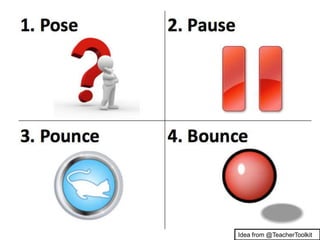
Idea from @TeacherToolkit
How do geographers talk? 
 Think about people who represent the public 
face of geography. 
– programmes about the natural world 
– weather forecasters 
– geography teachers 
– documentaries about geographical issues 
– serious travel programmes 
 How do geographers talk?
How do geographers talk? 
 specialist vocabulary 
 semi-formal 
 factual, explanatory 
 enthusiasm, passion and respect for other 
places and perspectives
Oral frames 
Develop sentence 
openers that are 
specific to your 
subject/topic. 
Embed in talk first
10 tips to develop talk in the classroom 
1. Never accept the 1st answer 
2. Never accept a 1 word answer 
3. Encourage students to respond by saying, “I agree/disagree 
because... “ 
4. Develop their use of sophisticated sentence openers 
5. Encourage students to use connectives in talk 
6. Encourage students to question/challenge the talk of others 
7. Encourage your students to provide more than 1 reason to support 
their views 
8. Persistently ask them to develop/ tell me more/ explain/ 
9. Encourage them to sum up their ideas into a formalised statement 
10. Encourage formal talk where possible- avoid contractions “I’d”  “I 
would”
Writing
Writing 
 What is the purpose? audience? format? 
(PAF) 
 Style - formal or informal? 
 Layout and presentation? 
 Tone 
 Conventions?
What to explore 
 Generating ideas + effective planning 
 Connectives 
 Sentence discourse markers 
 Spelling, punctuation and grammar (SPG)
Purposes 
 Inform 
 Explain 
 Persuade 
 Evaluate 
 Review 
 Argue 
 Advise
Writing Provide 
model 
Deconstr 
-uct 
model 
Analyse 
effective-ness 
Provide 
scaffold 
Evaluate 
Construct 
collabor-atively 
and 
review 
Create 
indepen-dently
Make writing real 
“Write a letter advising another scientist 
about DNA.” 
Why? 
What’s the point? 
Avoid meaningless writing tasks.
Better... 
format audience 
Write an online article aimed at teenagers 
to be published on Science Today’s 
website explaining recent research on 
DNA. 
purpose 
theme
teacher 
Model expectations of writing 
checklists exemplars 
peer
Tense 
• Past 
– I walked 
• Present 
– I am walking 
• Future 
– I am going to walk 
Voice 
• First person 
– I, we, my, our, us 
• Second person 
– You 
• Third person 
– He, she, they, it
Sentence types 
• Short 
Sentence types Openings 
– Used to emphasise a point 
– Create tension 
– To give clarity (good when 
used before or after longer, 
more detailed sentences or 
at the beginning or end of 
writing) 
• Long 
– To develop a point 
– To show extending thinking 
Vary Openings 
• Adverbs 
– “Interestingly, ...” 
Shows personal opinion first 
• Connectives 
– Introduce ideas and other 
lines of thinking 
– However, ... 
– Consequently, ... 
– Although... 
– Despite... 
– Since...
“The limits of my language are 
the limits of my world” 
Ludwig Wittgenstein (1889–1951)
Vocab matrix 
Adjectives 
Words that describe 
Verbs (-ing -ed) 
Words that are actions 
Adverbs 
Words that describe an action 
Connectives 
Words that link ideas 
Prepositions 
Words that show the 
relationship between words 
e.g. distraught e.g. thinking e.g. furiously e.g. Despite that.... e.g. Yesterday... 
troubled 
discussing Even though... 
annoyingly 
after
Developing students’ vocabulary 
 Read challenging texts 
(suited to ability) 
 Provide glossaries 
 Dictionaries / 
thesaurus 
 Word of the week 
 Key quotes board 
 ‘Up-cycling’ words
Reading
Ways of reading 
 Continuous reading 
 Close reading 
 Skimming 
 Scanning
Supporting reading in the 
classroom 
 Enlarge the font size for your weakest students 
 Print on yellow paper for students with dyslexia 
 Think about the vocabulary you use in the classroom – 
challenge your more able students! 
 Point out tricky words and explain what they mean when 
reading – give glossaries for those students who may need 
them
Supporting reading in the 
classroom 
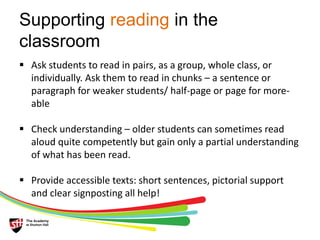
 Ask students to read in pairs, as a group, whole class, or 
individually. Ask them to read in chunks – a sentence or 
paragraph for weaker students/ half-page or page for more-able 
 Check understanding – older students can sometimes read 
aloud quite competently but gain only a partial understanding 
of what has been read. 
 Provide accessible texts: short sentences, pictorial support 
and clear signposting all help!
Word Clouds (Tagxedo.com)
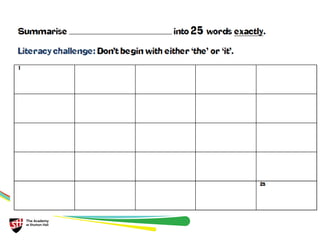
Describe your educational philosophy in 25 words. 
1 All children deserve the right 
to a quality education . No 
matter what their social background 
is or what their learning 
needs are . Education for all . 25
Spelling strategies
QR codes 
 Literacy in PE blog @davidfawcett27
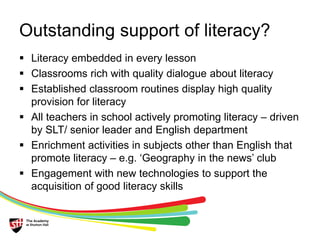
Outstanding support of literacy? 
 Literacy embedded in every lesson 
 Classrooms rich with quality dialogue about literacy 
 Established classroom routines display high quality 
provision for literacy 
 All teachers in school actively promoting literacy – driven 
by SLT/ senior leader and English department 
 Enrichment activities in subjects other than English that 
promote literacy – e.g. ‘Geography in the news’ club 
 Engagement with new technologies to support the 
acquisition of good literacy skills
Questions Ofsted may use when 
observing ‘literacy’ in any subject: 
 Are key terms and vocabulary clear and explored with pupils to ensure 
that they recognise and understand them? Are they related to similar 
words or the root from which they are derived? 
 Do teachers identify any particular features of key terms and help 
pupils with strategies for remembering how to spell them or why they 
might be capitalised (e.g. ‘Parliament’ in history or citizenship)? 
 Do teachers remind pupils of important core skills – for example how to 
skim a text to extract the main elements of its content quickly or to scan 
a text for information about a key word or topic?
 Do teachers make expectations clear before pupils begin a task – for 
example on the conventions of layout in a formal letter or on the main 
features of writing persuasively? 
 Do teachers reinforce the importance of accuracy in spoken or written 
language – for example, emphasising the need for correct sentence 
punctuation in one-sentence answers or correcting ‘we was…’ in 
pupils’ speech? 
 Do teachers identify when it is important to use standard English and 
when other registers or dialects may be used – for example, in a 
formal examination answer and when recreating dialogue as part of 
narrative writing?
 Do teachers help pupils with key elements of literacy as they support 
them in lessons? Do they point out spelling, grammar or punctuation 
issues as they look at work around the class? 
 Does teachers’ marking support key literacy points? For example, 
are key subject terms always checked for correct spelling? Is 
sentence punctuation always corrected?
Further reading 
http://www.scoop.it/t/literacy-in-secondary-education
#LiteracyDropbox 
 Literacy in…geography/history/RE/maths/ 
science/PE

LearnEDITT literacy session

  • 1.
    Literacy across the curriculum Lindsay Maughan Intervention Lead and Specialist Leader of Education (SLE) @UKLiteracy
  • 2.
    Aim: To explorehow and why supporting literacy improves the quality of teaching and learning Understand how poor literacy can be a barrier to learning Know the three literacy strands Explore some strategies that can ‘scaffold’ learning
  • 3.
    Rising standards atKS2  79% achieved at least level 4 in reading, writing and arithmetic  76% reached at least level 4 in the new spelling, punctuation and grammar test  86% reached at least level 4 in maths
  • 4.
  • 5.
    Literacy: a fewfacts  1 in 6 people in the UK struggle with literacy. This means their literacy is below the level of an 11 year old.  92% of the British public say literacy is vital to the economy, and essential for getting a good job.  14% of children and young people from lower income homes rarely or never read books for pleasure.  Parents are the most important reading role models for their children.  Children and young people who engage in technology based texts, such as blogs, enjoy writing more and have more positive attitudes towards writing. Source: Geoff Barton, ‘Don’t Call it Literacy!”
  • 6.
    1. The bandagewas wound around the wound. 2. The farm was used to produce produce. 3. The dump was so full that it had to refuse more refuse. 4. We must polish the Polish furniture. 5. He could lead if he would get the lead out. 6. The soldier decided to desert his dessert in the desert. 7. Since there is no time like the present, he thought it was time to present the present.
  • 7.
    The Matthew Effect “While good readers gain new skills very rapidly, and quickly move from learning to read to reading to learn, poor readers become increasingly frustrated with the act of reading, and try to avoid reading where possible.” “Students who begin with high verbal aptitudes find themselves in verbally enriched social environments and have a double advantage” “Good readers may choose friends who also read avidly while poor readers seek friends with whom they share other enjoyments” The Matthew Effect Daniel Rigney
  • 8.
    Age 7 John (top quartile)  7100 words  Jennifer (lowest quartile)  3000 words! Age 16: 1 in 12 have a working vocabulary of 800 words!
  • 9.
    ? Unconfident Confident Repetition Reinforcement Rigour
  • 11.
    Who is mostresponsible for supporting students in their development of literacy? Teaching Standards: “demonstrate an understanding of and take responsibility for promoting high standards of literacy, articulacy and the correct use of standard English, whatever the teacher’s specialist subject” Ofsted: “When evaluating the achievement of pupils, inspectors consider how well...pupils develop a range of skills, including reading, writing, communication and mathematical skills, and how well they apply these across the curriculum”
  • 12.
    Case study: classcontext Y10 class  20 students  16 F/ 4 M  10 Ever 6  7 SEN  6 students with literacy difficulties – ranging from mild to severe incl. 1 with dyslexia  1 student with an eyesight impairment  76% have an average KS2 point score of 21 or below. This means they were working at an average ks2 level 3 at age 11
  • 13.
    Some issues thatmay arise in the classroom Students may be:  Unable to read information you give them  Unable to independently research  Unable to access the curriculum  Unable to articulate themselves  Unable to sustain attention and focus in the lesson Poor behaviour Lack of motivation Lack of drive and ambition Poor attainment – low levels of progress
  • 14.
    Literacy: what’s init for departments? Reasons why departments should support literacy Most important Least important
  • 15.
    Speaking and listening  Teacher talk/ student talk  Often assumed to be ‘natural’, but is not for many  Oral frameworks needed
  • 16.
    Different types oftalk  Explaining  Instructing  Questioning  Describing  Analysing  Evaluating  Speculating and hypothesising
  • 18.
    Why talk? Summarising ideas Asking questions Justifying responses Challenging responses Analysing Building on, clarifying, modifying others’ ideas and evaluating ideas
  • 19.
    Questioning Bad questions  Lots of closed question  A ‘scattergun’ approach  Don’t involve the whole class  First answer will be accepted Good questions  May be pre-planned  Will focus on the why and how not the what  Will build in ‘thinking time’ and ‘oral rehearsal’
  • 20.
  • 23.
    How do geographerstalk?  Think about people who represent the public face of geography. – programmes about the natural world – weather forecasters – geography teachers – documentaries about geographical issues – serious travel programmes  How do geographers talk?
  • 24.
    How do geographerstalk?  specialist vocabulary  semi-formal  factual, explanatory  enthusiasm, passion and respect for other places and perspectives
  • 25.
    Oral frames Developsentence openers that are specific to your subject/topic. Embed in talk first
  • 27.
    10 tips todevelop talk in the classroom 1. Never accept the 1st answer 2. Never accept a 1 word answer 3. Encourage students to respond by saying, “I agree/disagree because... “ 4. Develop their use of sophisticated sentence openers 5. Encourage students to use connectives in talk 6. Encourage students to question/challenge the talk of others 7. Encourage your students to provide more than 1 reason to support their views 8. Persistently ask them to develop/ tell me more/ explain/ 9. Encourage them to sum up their ideas into a formalised statement 10. Encourage formal talk where possible- avoid contractions “I’d”  “I would”
  • 28.
  • 29.
    Writing  Whatis the purpose? audience? format? (PAF)  Style - formal or informal?  Layout and presentation?  Tone  Conventions?
  • 30.
    What to explore  Generating ideas + effective planning  Connectives  Sentence discourse markers  Spelling, punctuation and grammar (SPG)
  • 31.
    Purposes  Inform  Explain  Persuade  Evaluate  Review  Argue  Advise
  • 32.
    Writing Provide model Deconstr -uct model Analyse effective-ness Provide scaffold Evaluate Construct collabor-atively and review Create indepen-dently
  • 34.
    Make writing real “Write a letter advising another scientist about DNA.” Why? What’s the point? Avoid meaningless writing tasks.
  • 35.
    Better... format audience Write an online article aimed at teenagers to be published on Science Today’s website explaining recent research on DNA. purpose theme
  • 36.
    teacher Model expectationsof writing checklists exemplars peer
  • 37.
    Tense • Past – I walked • Present – I am walking • Future – I am going to walk Voice • First person – I, we, my, our, us • Second person – You • Third person – He, she, they, it
  • 38.
    Sentence types •Short Sentence types Openings – Used to emphasise a point – Create tension – To give clarity (good when used before or after longer, more detailed sentences or at the beginning or end of writing) • Long – To develop a point – To show extending thinking Vary Openings • Adverbs – “Interestingly, ...” Shows personal opinion first • Connectives – Introduce ideas and other lines of thinking – However, ... – Consequently, ... – Although... – Despite... – Since...
  • 39.
    “The limits ofmy language are the limits of my world” Ludwig Wittgenstein (1889–1951)
  • 40.
    Vocab matrix Adjectives Words that describe Verbs (-ing -ed) Words that are actions Adverbs Words that describe an action Connectives Words that link ideas Prepositions Words that show the relationship between words e.g. distraught e.g. thinking e.g. furiously e.g. Despite that.... e.g. Yesterday... troubled discussing Even though... annoyingly after
  • 41.
    Developing students’ vocabulary  Read challenging texts (suited to ability)  Provide glossaries  Dictionaries / thesaurus  Word of the week  Key quotes board  ‘Up-cycling’ words
  • 42.
  • 46.
    Ways of reading  Continuous reading  Close reading  Skimming  Scanning
  • 47.
    Supporting reading inthe classroom  Enlarge the font size for your weakest students  Print on yellow paper for students with dyslexia  Think about the vocabulary you use in the classroom – challenge your more able students!  Point out tricky words and explain what they mean when reading – give glossaries for those students who may need them
  • 48.
    Supporting reading inthe classroom  Ask students to read in pairs, as a group, whole class, or individually. Ask them to read in chunks – a sentence or paragraph for weaker students/ half-page or page for more-able  Check understanding – older students can sometimes read aloud quite competently but gain only a partial understanding of what has been read.  Provide accessible texts: short sentences, pictorial support and clear signposting all help!
  • 49.
  • 51.
    Describe your educationalphilosophy in 25 words. 1 All children deserve the right to a quality education . No matter what their social background is or what their learning needs are . Education for all . 25
  • 52.
  • 53.
    QR codes Literacy in PE blog @davidfawcett27
  • 54.
    Outstanding support ofliteracy?  Literacy embedded in every lesson  Classrooms rich with quality dialogue about literacy  Established classroom routines display high quality provision for literacy  All teachers in school actively promoting literacy – driven by SLT/ senior leader and English department  Enrichment activities in subjects other than English that promote literacy – e.g. ‘Geography in the news’ club  Engagement with new technologies to support the acquisition of good literacy skills
  • 55.
    Questions Ofsted mayuse when observing ‘literacy’ in any subject:  Are key terms and vocabulary clear and explored with pupils to ensure that they recognise and understand them? Are they related to similar words or the root from which they are derived?  Do teachers identify any particular features of key terms and help pupils with strategies for remembering how to spell them or why they might be capitalised (e.g. ‘Parliament’ in history or citizenship)?  Do teachers remind pupils of important core skills – for example how to skim a text to extract the main elements of its content quickly or to scan a text for information about a key word or topic?
  • 56.
     Do teachersmake expectations clear before pupils begin a task – for example on the conventions of layout in a formal letter or on the main features of writing persuasively?  Do teachers reinforce the importance of accuracy in spoken or written language – for example, emphasising the need for correct sentence punctuation in one-sentence answers or correcting ‘we was…’ in pupils’ speech?  Do teachers identify when it is important to use standard English and when other registers or dialects may be used – for example, in a formal examination answer and when recreating dialogue as part of narrative writing?
  • 57.
     Do teachershelp pupils with key elements of literacy as they support them in lessons? Do they point out spelling, grammar or punctuation issues as they look at work around the class?  Does teachers’ marking support key literacy points? For example, are key subject terms always checked for correct spelling? Is sentence punctuation always corrected?
  • 58.
  • 59.
    #LiteracyDropbox  Literacyin…geography/history/RE/maths/ science/PE

Editor's Notes

  • #4 Not all bad! 2014 ks2 results data taken from 550,000 children in final year of primary school.
  • #7 Just how complex the English language is!
  • #18 Consider the graphic above from a y9 lesson on tourism geography. Rather than the vague “Discuss the benefits of tourism” question, how else could you shape the talk to support better quality literacy?
  • #19 Create sentence openers
  • #26 Embed in talk first
  • #44 What a child with reading difficulties sees
  • #45 Add the noun earthquake – can you guess the other words?
  • #51 Summarise your educational philosophy
  • #52 Summarise your educational philosophy