Brought to you by
Rockset: Realtime Indexing for
Fast Queries on Massive
Semi-Structured Data
Dhruba Borthakur
CTO at
About Me
■ CTO and Co-Founder of Rockset
■ RocksDB @ Facebook
■ Hadoop File System @ Yahoo
■ HBase & Hive
■ Andrew File System (AFS)
2
Overview of the Talk
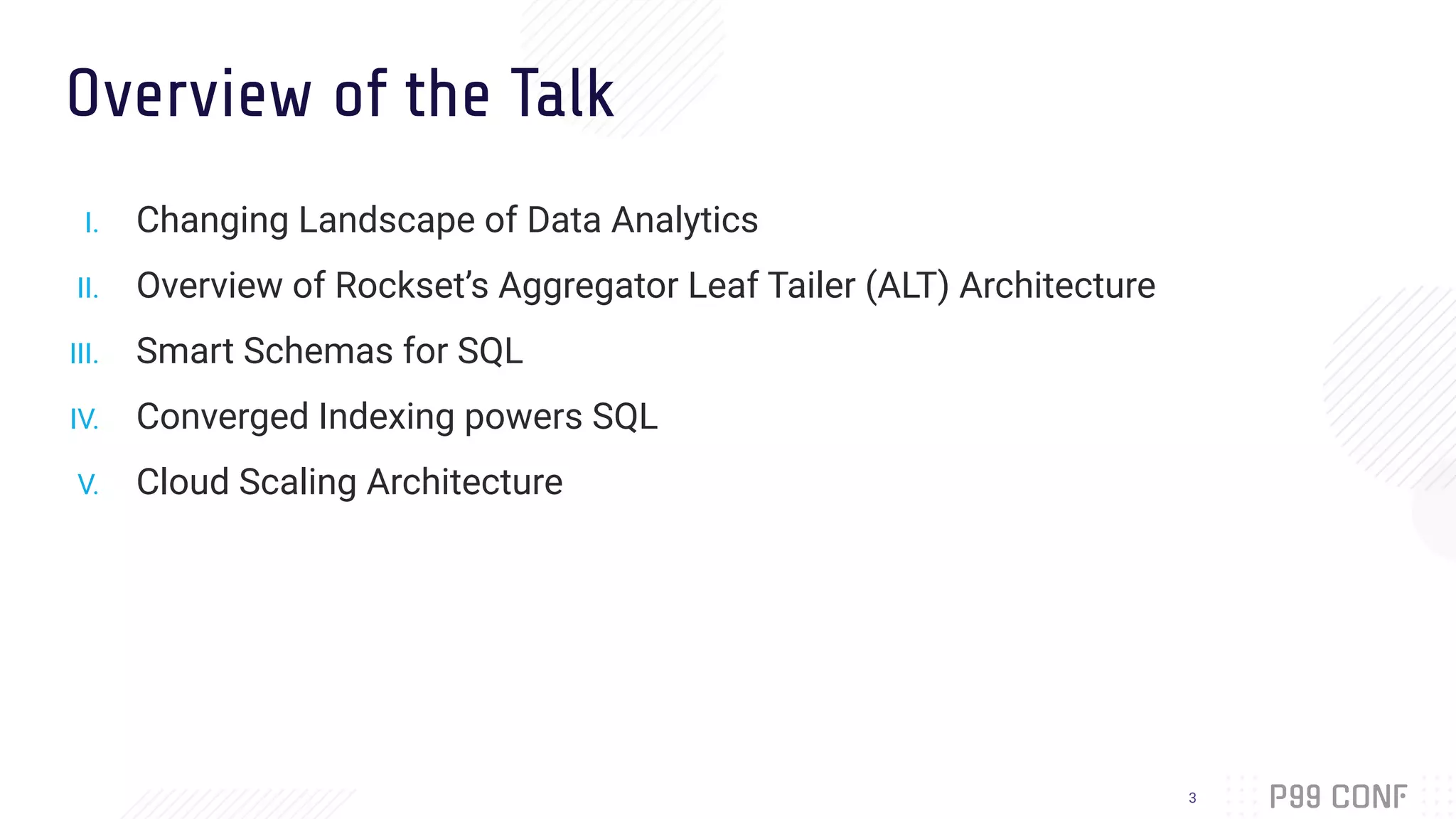
I. Changing Landscape of Data Analytics
II. Overview of Rockset’s Aggregator Leaf Tailer (ALT) Architecture
III. Smart Schemas for SQL
IV. Converged Indexing powers SQL
V. Cloud Scaling Architecture
3
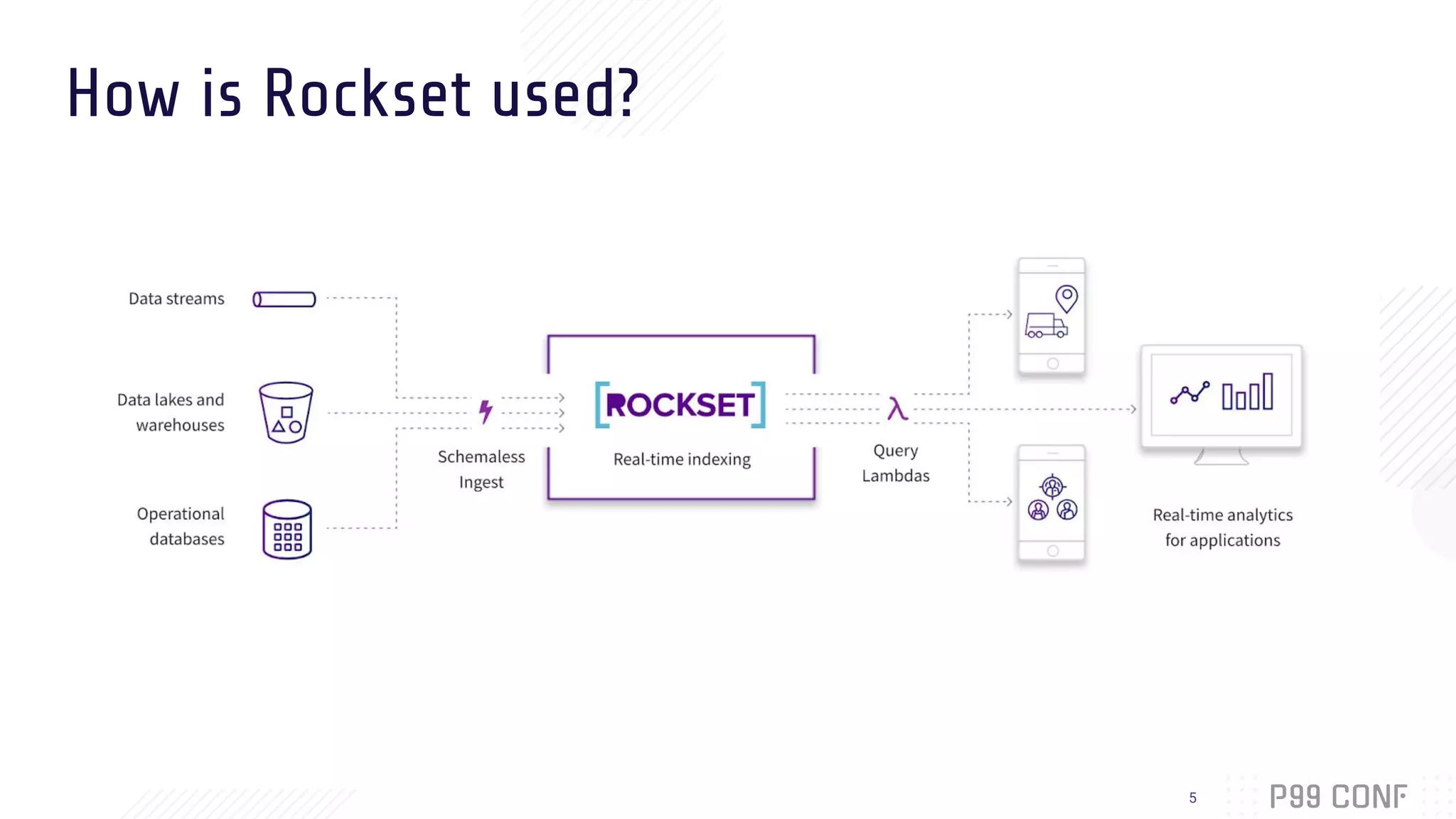
Real-time Indexing on massive datasets
for building real-time apps on live data
without ETL or pipelines.
What is Rockset?
4
How is Rockset used?
5


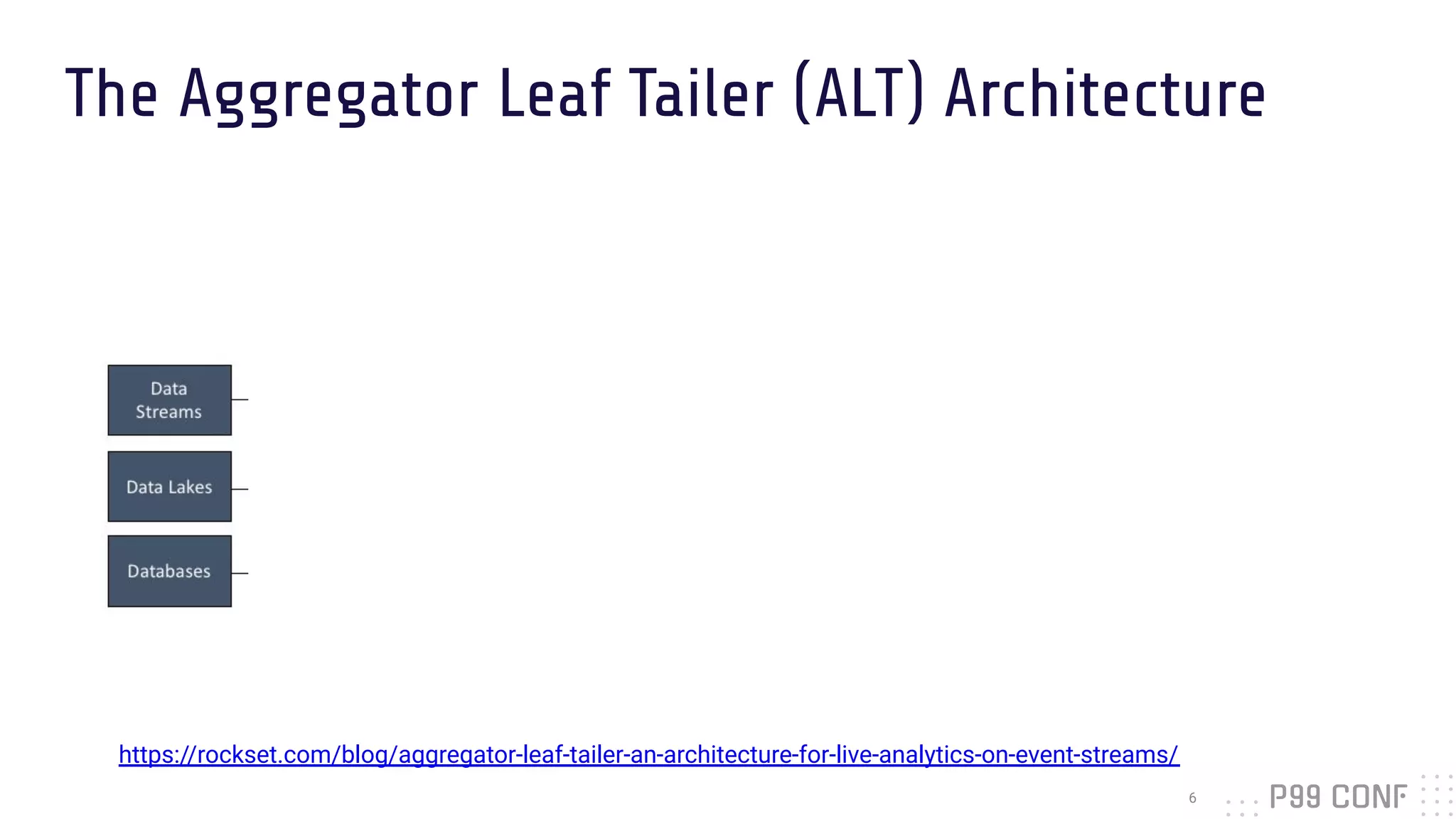
The Aggregator Leaf Tailer (ALT) Architecture
6
https://rockset.com/blog/aggregator-leaf-tailer-an-architecture-for-live-analytics-on-event-streams/
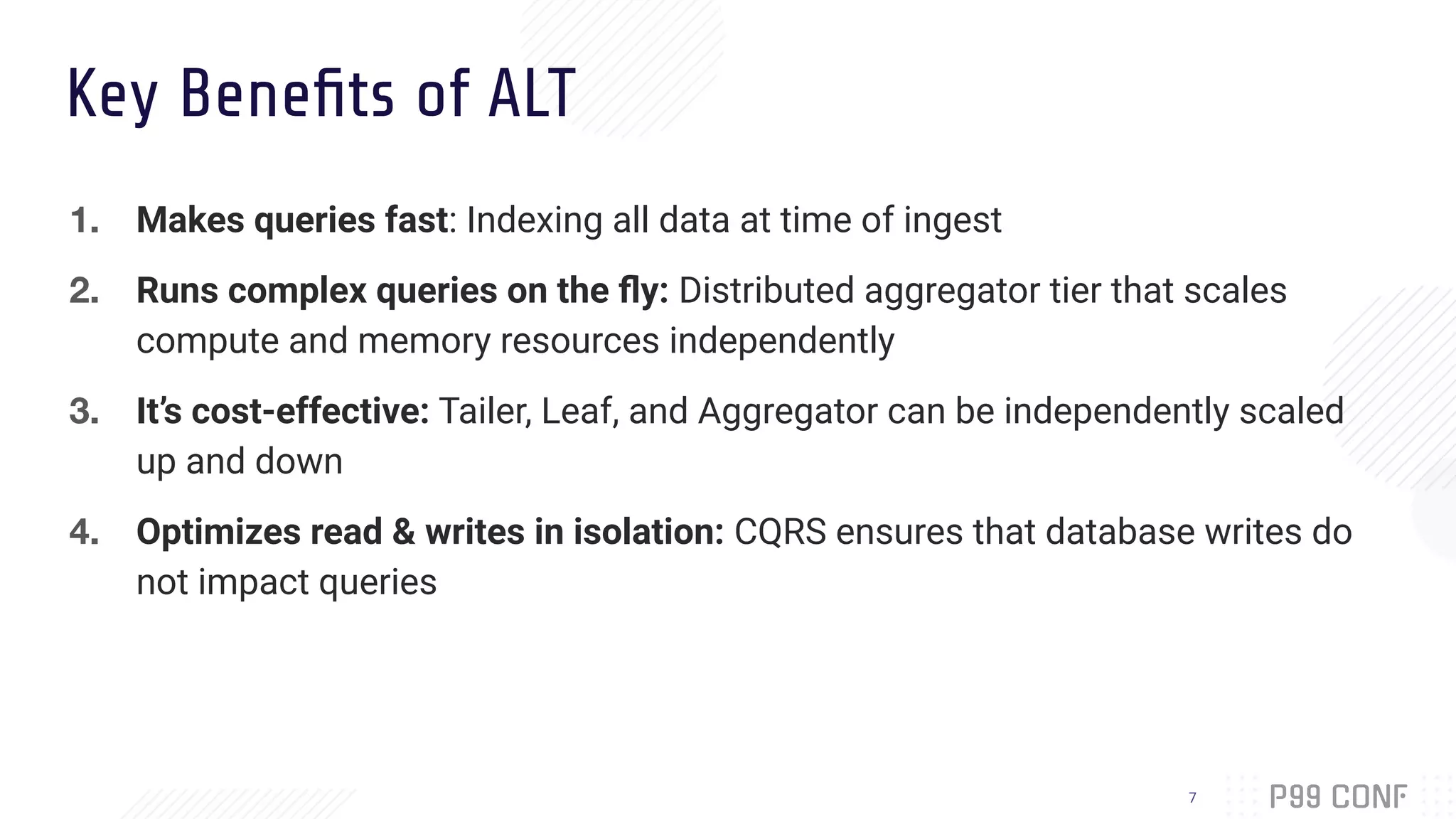
Key Benefits of ALT
1. Makes queries fast: Indexing all data at time of ingest
2. Runs complex queries on the fly: Distributed aggregator tier that scales
compute and memory resources independently
3. It’s cost-effective: Tailer, Leaf, and Aggregator can be independently scaled
up and down
4. Optimizes read & writes in isolation: CQRS ensures that database writes do
not impact queries
7
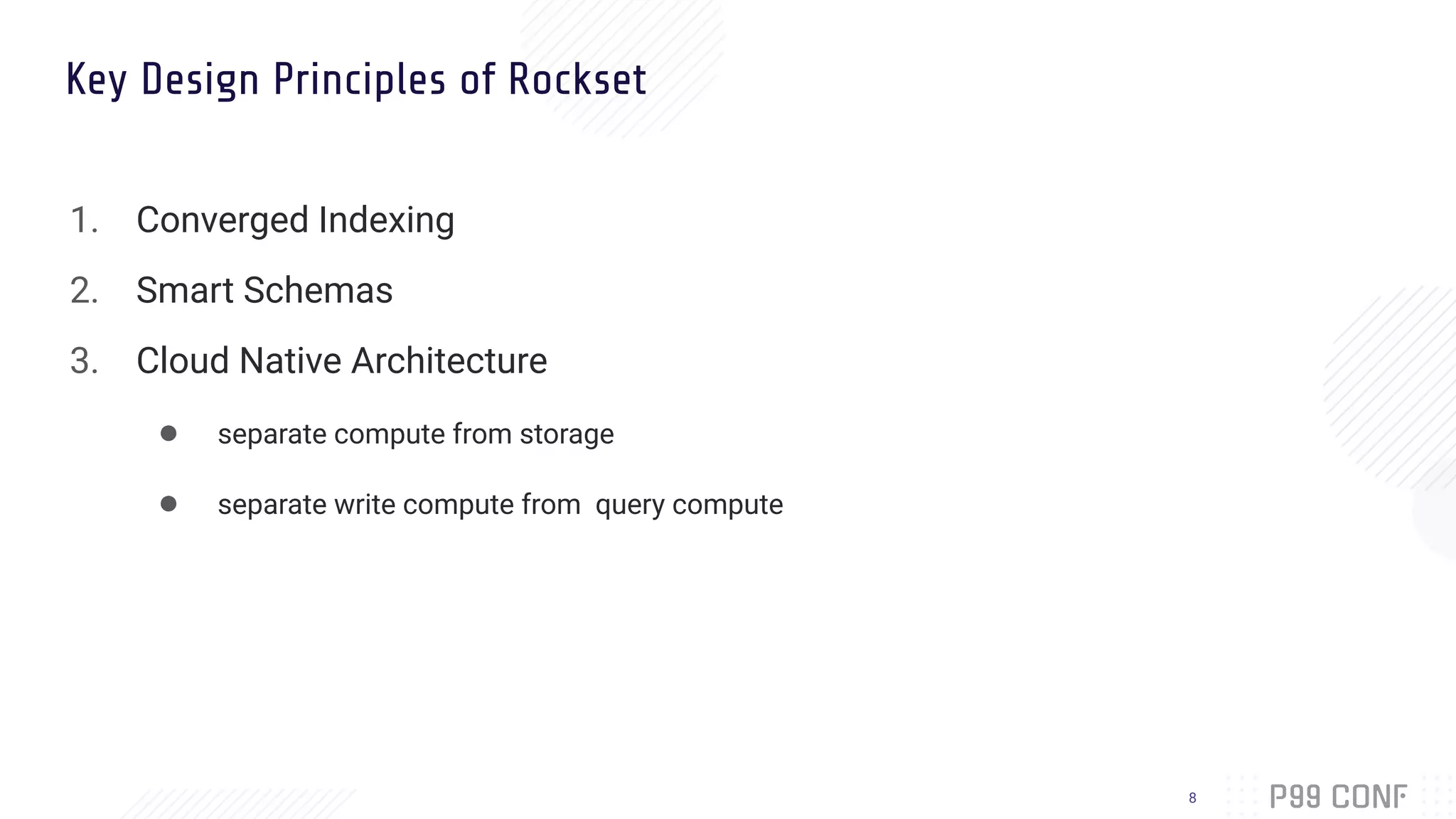
Key Design Principles of Rockset
1. Converged Indexing
2. Smart Schemas
3. Cloud Native Architecture
● separate compute from storage
● separate write compute from query compute
8
Converged Indexing
9
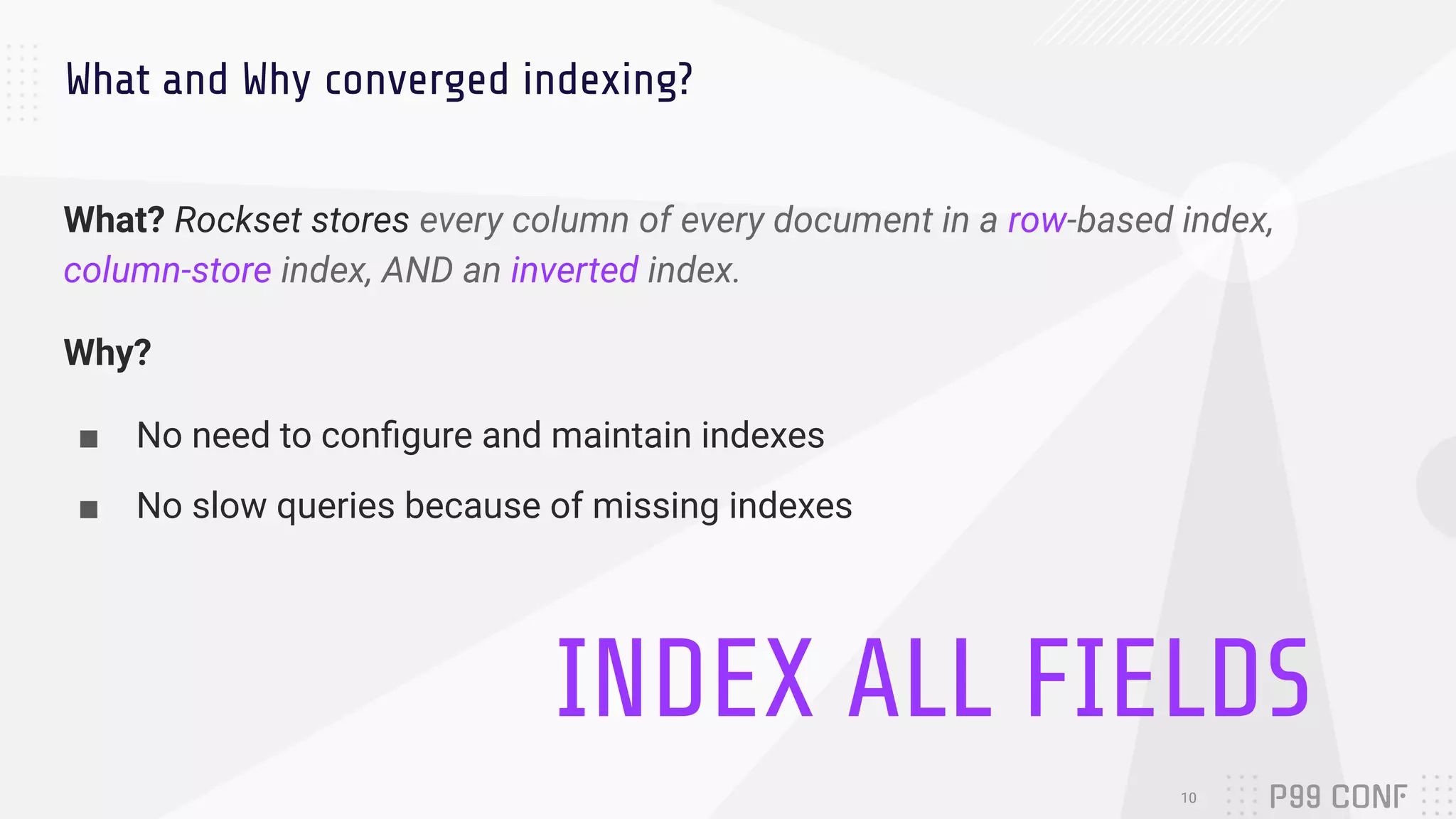
What and Why converged indexing?
What? Rockset stores every column of every document in a row-based index,
column-store index, AND an inverted index.
Why?
■ No need to configure and maintain indexes
■ No slow queries because of missing indexes
10
INDEX ALL FIELDS
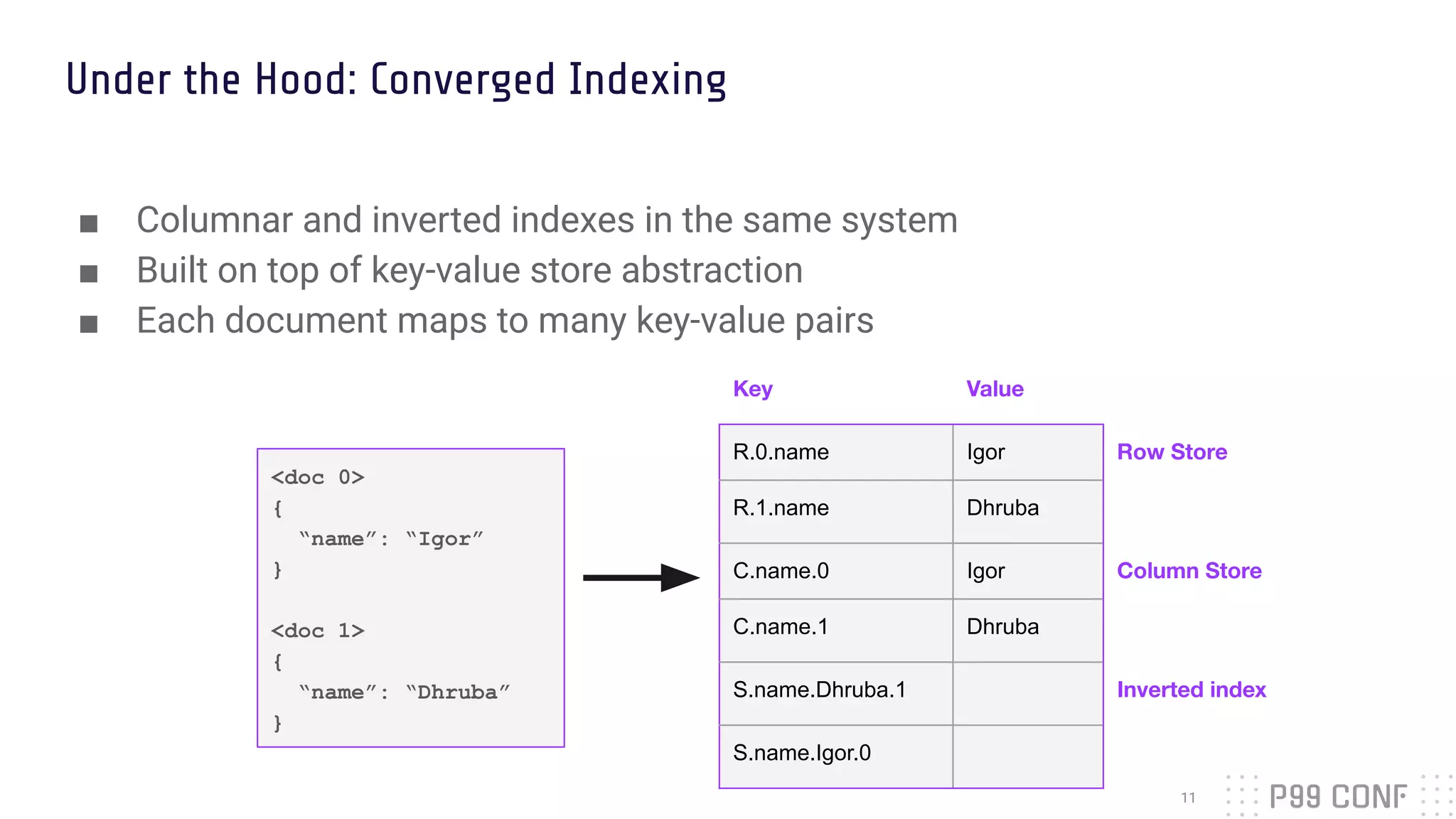
Under the Hood: Converged Indexing
■ Columnar and inverted indexes in the same system
■ Built on top of key-value store abstraction
■ Each document maps to many key-value pairs
11
<doc 0>
{
“name”: “Igor”
}
<doc 1>
{
“name”: “Dhruba”
}
Key Value
R.0.name Igor Row Store
R.1.name Dhruba
C.name.0 Igor Column Store
C.name.1 Dhruba
S.name.Dhruba.1 Inverted index
S.name.Igor.0
Inverted Indexing for point lookups
■ For each value, store documents containing that value (posting list)
■ Quickly retrieve a list of document IDs that match a predicate
“name”
“interests”
Dhruba 1
Igor 0
databases 0.0; 1.1
cars 1.0
snowboarding 0.1
“last_active”
2019/3/15 0
2019/3/22 1
<doc 0>
{
“name”: “Igor”,
“interests”: [“databases”, “snowboarding”],
“last_active”: 2019/3/15
}
<doc 1>
{
“name”: “Dhruba”,
“interests”: [“cars”, “databases”],
“last_active”: 2019/3/22
}
Columnar Store for aggregations
■ Store each column separately
■ Great compression
■ Only fetch columns the query needs
<doc 0>
{
“name”: “Igor”,
“interests”: [“databases”, “snowboarding”],
“last_active”: 2019/3/15
}
<doc 1>
{
“name”: “Dhruba”,
“interests”: [“cars”, “databases”],
“last_active”: 2019/3/22
}
“name”
“interests”
0 Igor
1 Dhruba
0.0 databases
0.1 snowboarding
1.0 cars
1.1 databases
“last_active”
0 2019/3/15
1 2019/3/22
SELECT keyword, count(*)
FROM search_logs
GROUP BY keyword
ORDER BY count(*) DESC
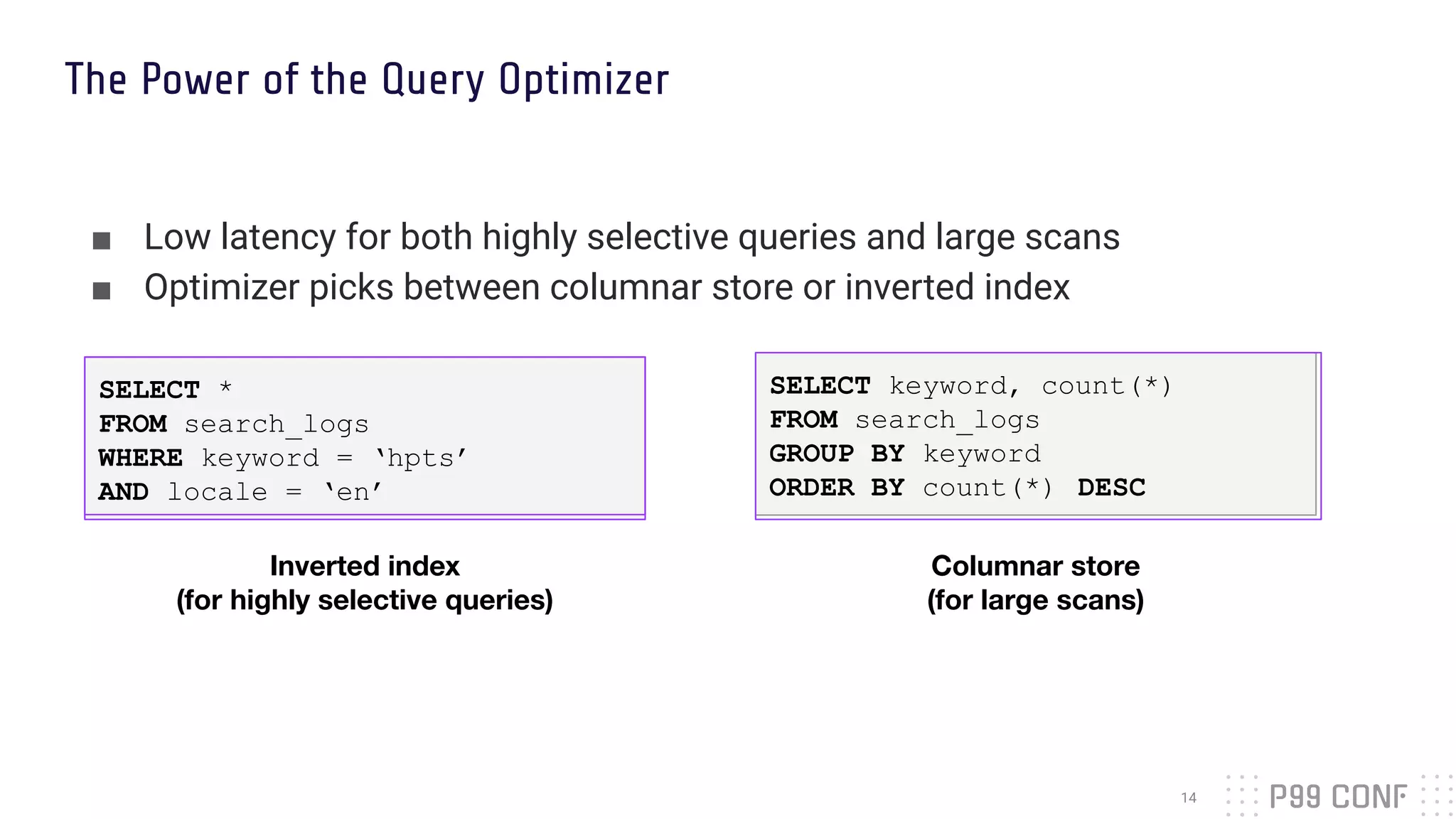
■ Low latency for both highly selective queries and large scans
■ Optimizer picks between columnar store or inverted index
The Power of the Query Optimizer
14
Inverted index
(for highly selective queries)
SELECT *
FROM search_logs
WHERE keyword = ‘hpts’
AND locale = ‘en’
Columnar store
(for large scans)
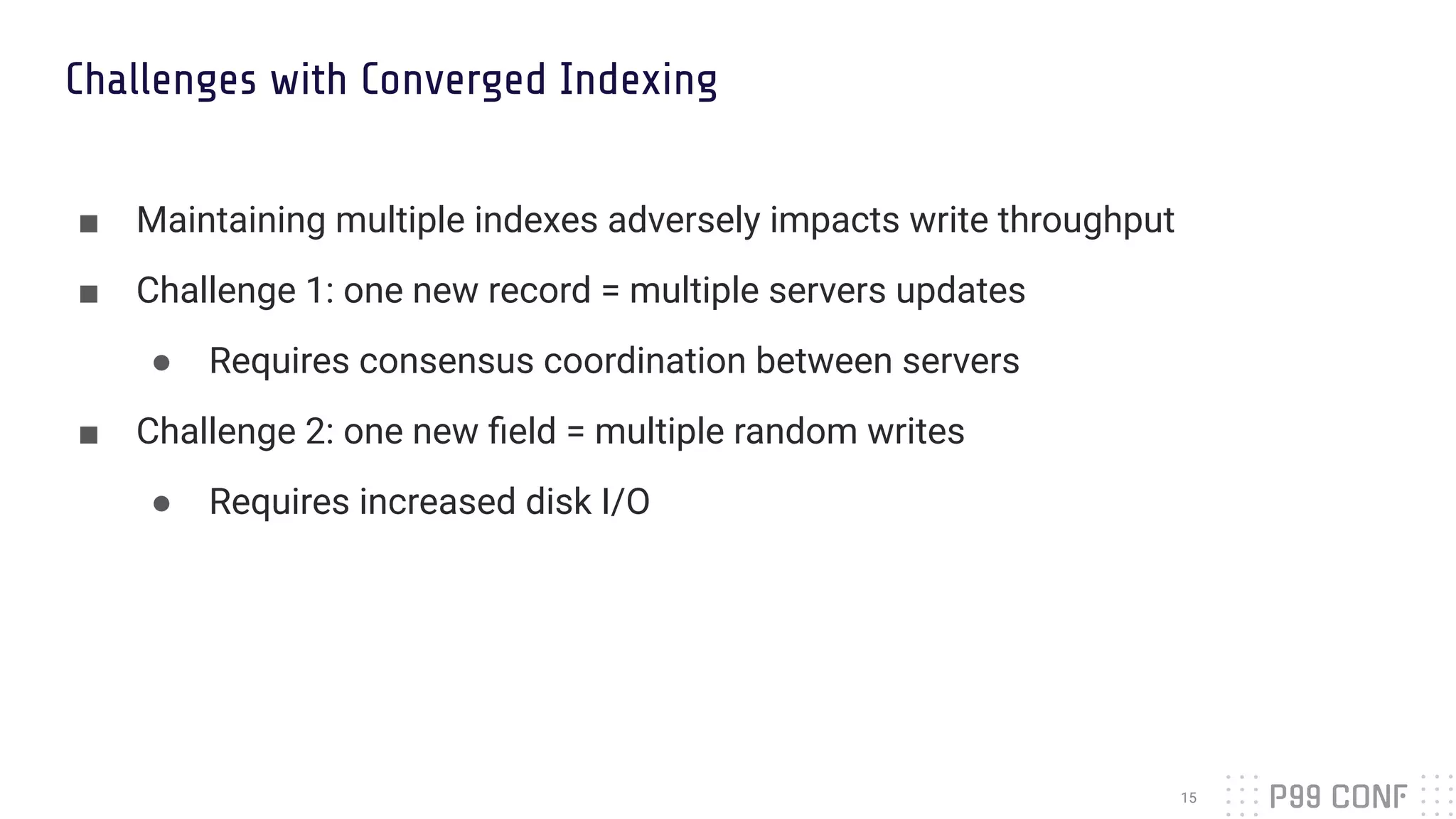
Challenges with Converged Indexing
■ Maintaining multiple indexes adversely impacts write throughput
■ Challenge 1: one new record = multiple servers updates
● Requires consensus coordination between servers
■ Challenge 2: one new field = multiple random writes
● Requires increased disk I/O
15
Challenge 1: one new record = multiple servers updates
■ In a traditional database with term sharding and n indexes, one write
incurs updates to n different indexes on n servers
■ Requires a distributed transaction (paxos, raft) between n servers
<doc 1>
{
“name”: “Dhruba”,
“interests”: [“cars”, “databases”],
“last_active”: 2019/3/22
}
“interests”
Dhruba 1
Igor 0
databases 0.0; 1.1
cars 1.0
snowboarding 0.1
“last_active”
2019/3/15 0
2019/3/22 1
“name”
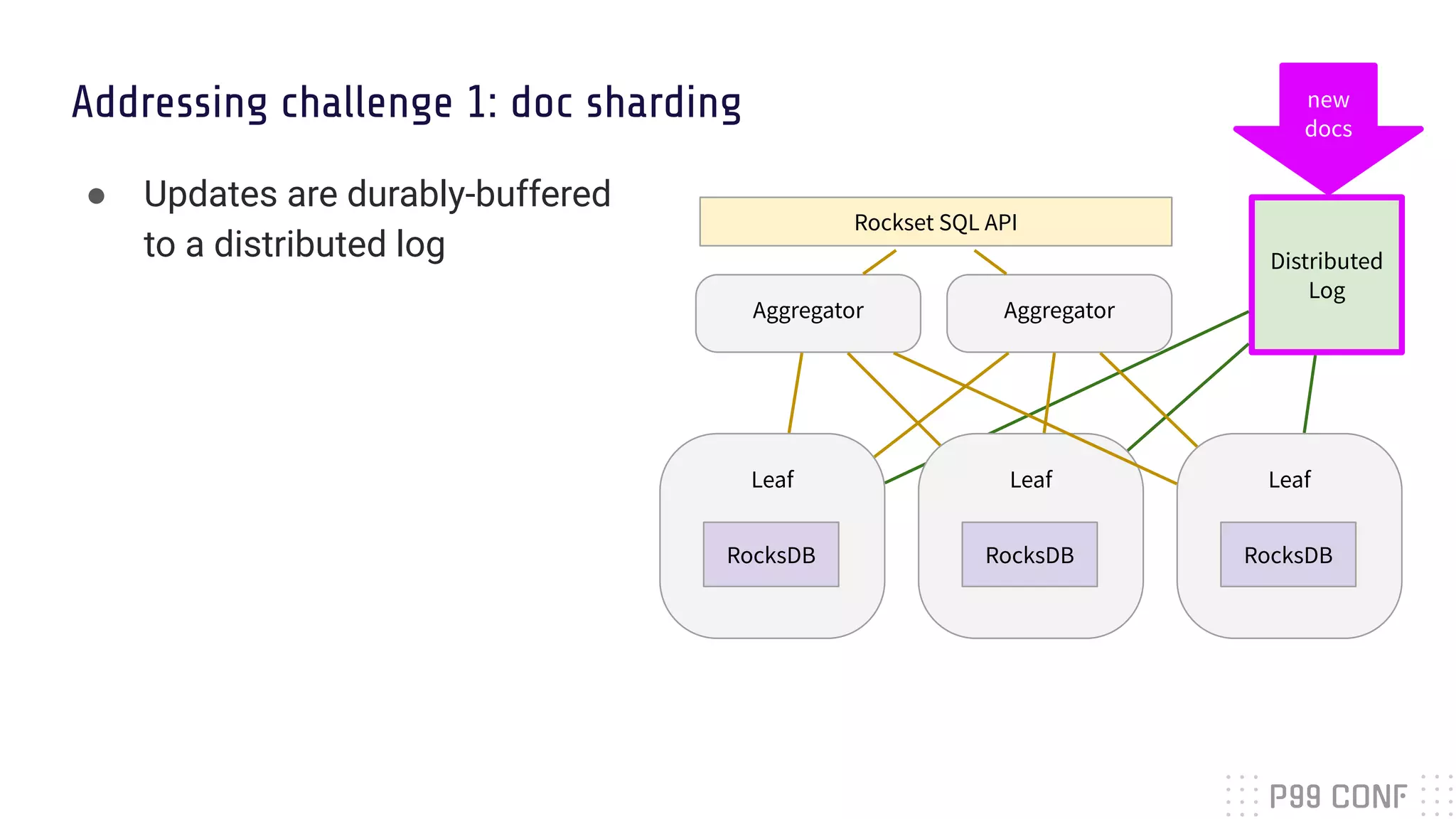
Addressing challenge 1: doc sharding
Distributed
Log
Rockset SQL API
Aggregator Aggregator
Leaf
RocksDB
Leaf
RocksDB
Leaf
RocksDB
new
docs
● Updates are durably-buffered
to a distributed log
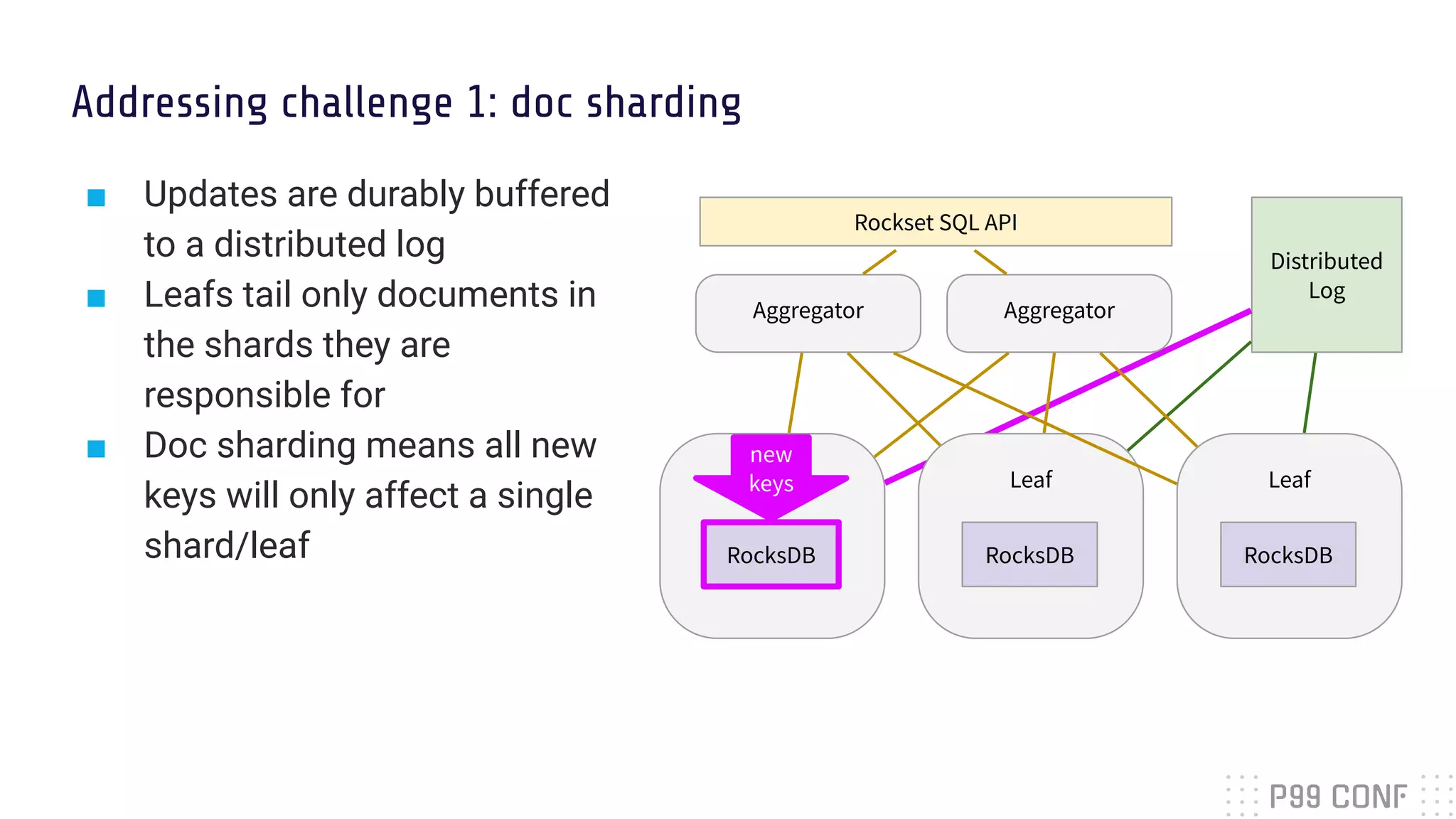
Addressing challenge 1: doc sharding
■ Updates are durably buffered
to a distributed log
■ Leafs tail only documents in
the shards they are
responsible for
■ Doc sharding means all new
keys will only affect a single
shard/leaf
Distributed
Log
Rockset SQL API
Aggregator Aggregator
Leaf
RocksDB
Leaf
RocksDB
Leaf
RocksDB
new
keys
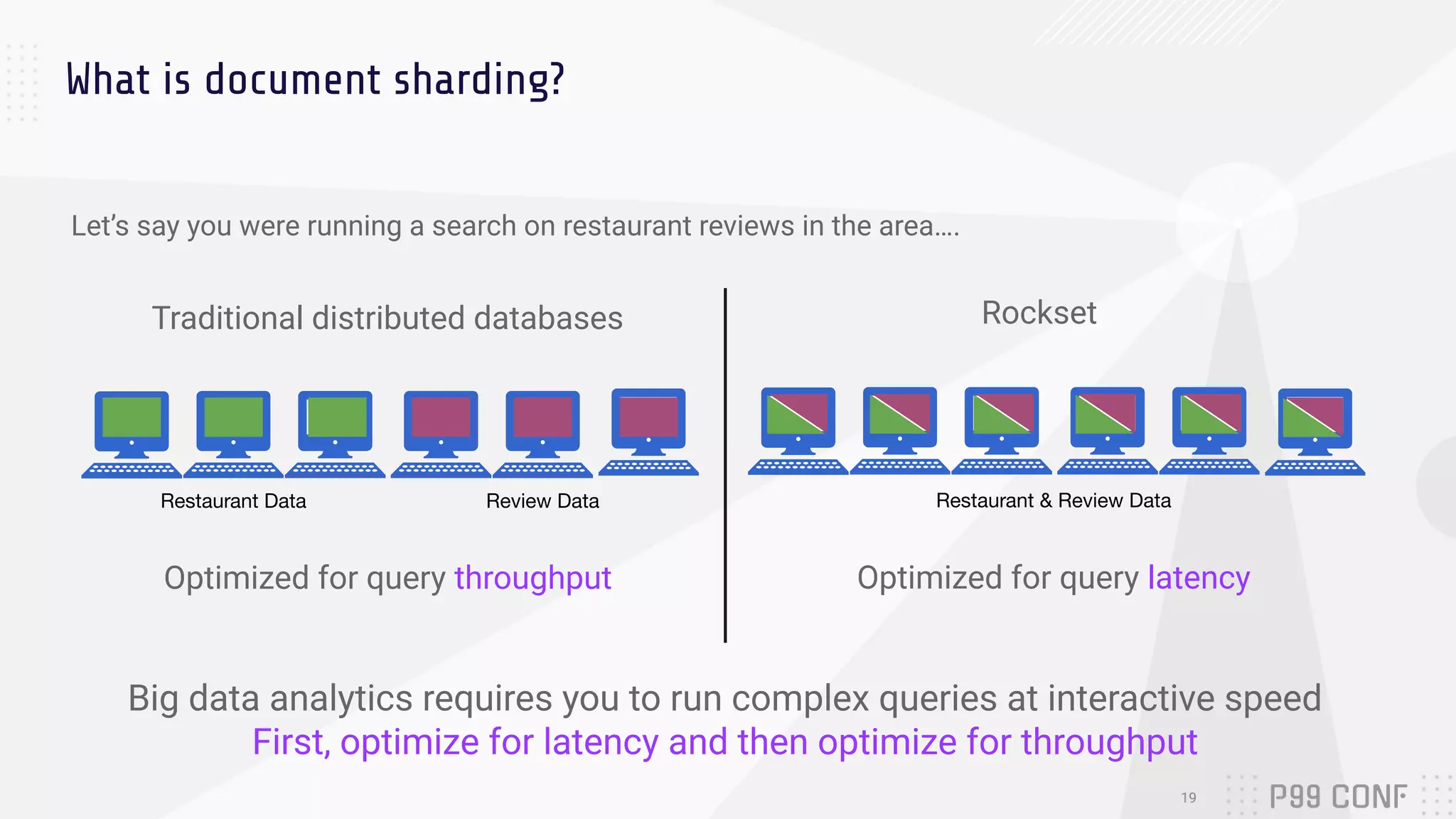
What is document sharding?
19
Let’s say you were running a search on restaurant reviews in the area….
Traditional distributed databases Rockset
Optimized for query throughput Optimized for query latency
Big data analytics requires you to run complex queries at interactive speed
First, optimize for latency and then optimize for throughput
Restaurant Data Restaurant & Review Data
Review Data
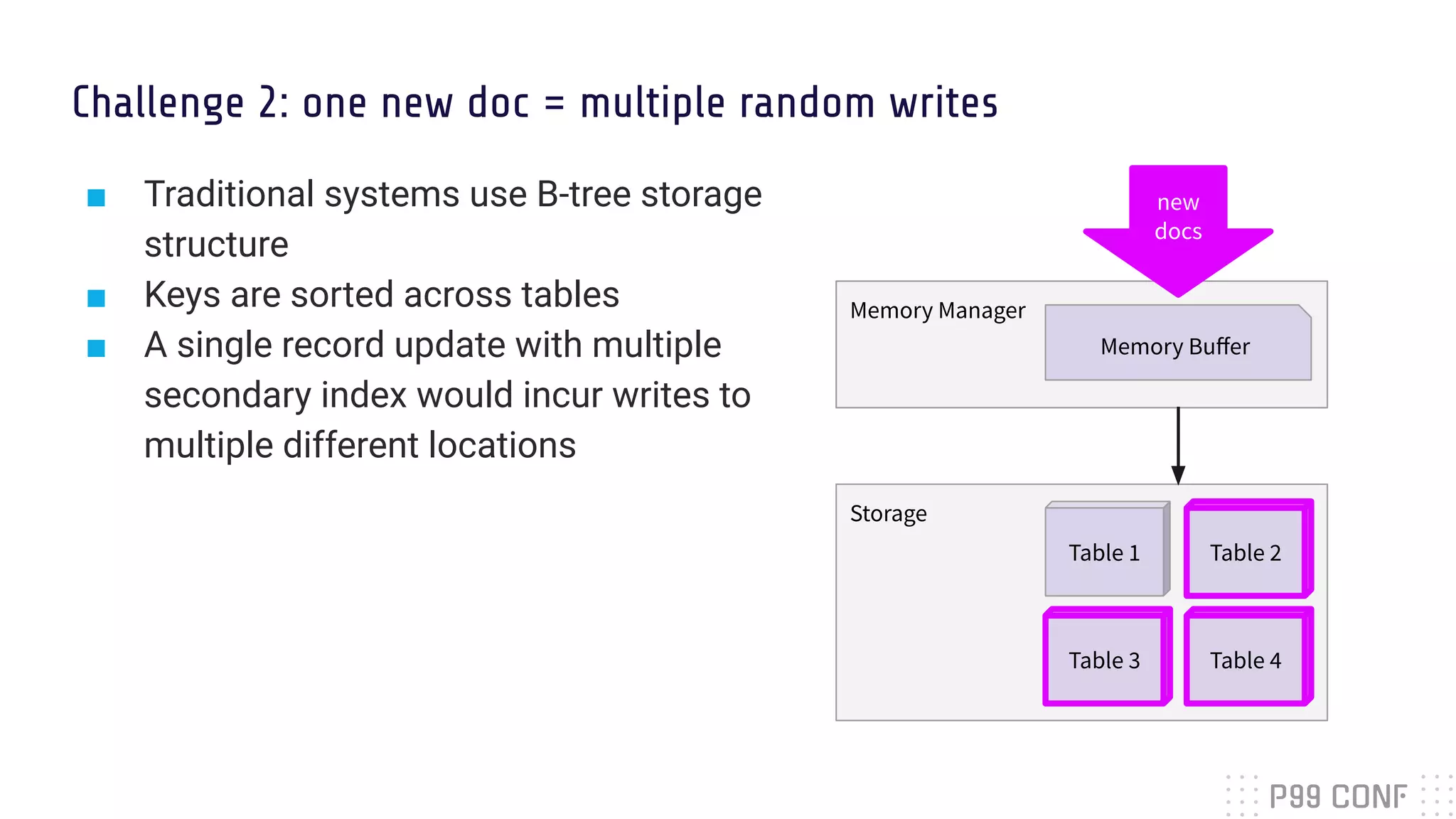
■ Traditional systems use B-tree storage
structure
■ Keys are sorted across tables
■ A single record update with multiple
secondary index would incur writes to
multiple different locations
Storage
Memory Manager
Challenge 2: one new doc = multiple random writes
Memory Buffer
Table 1 Table 2
Table 3 Table 4
new
docs
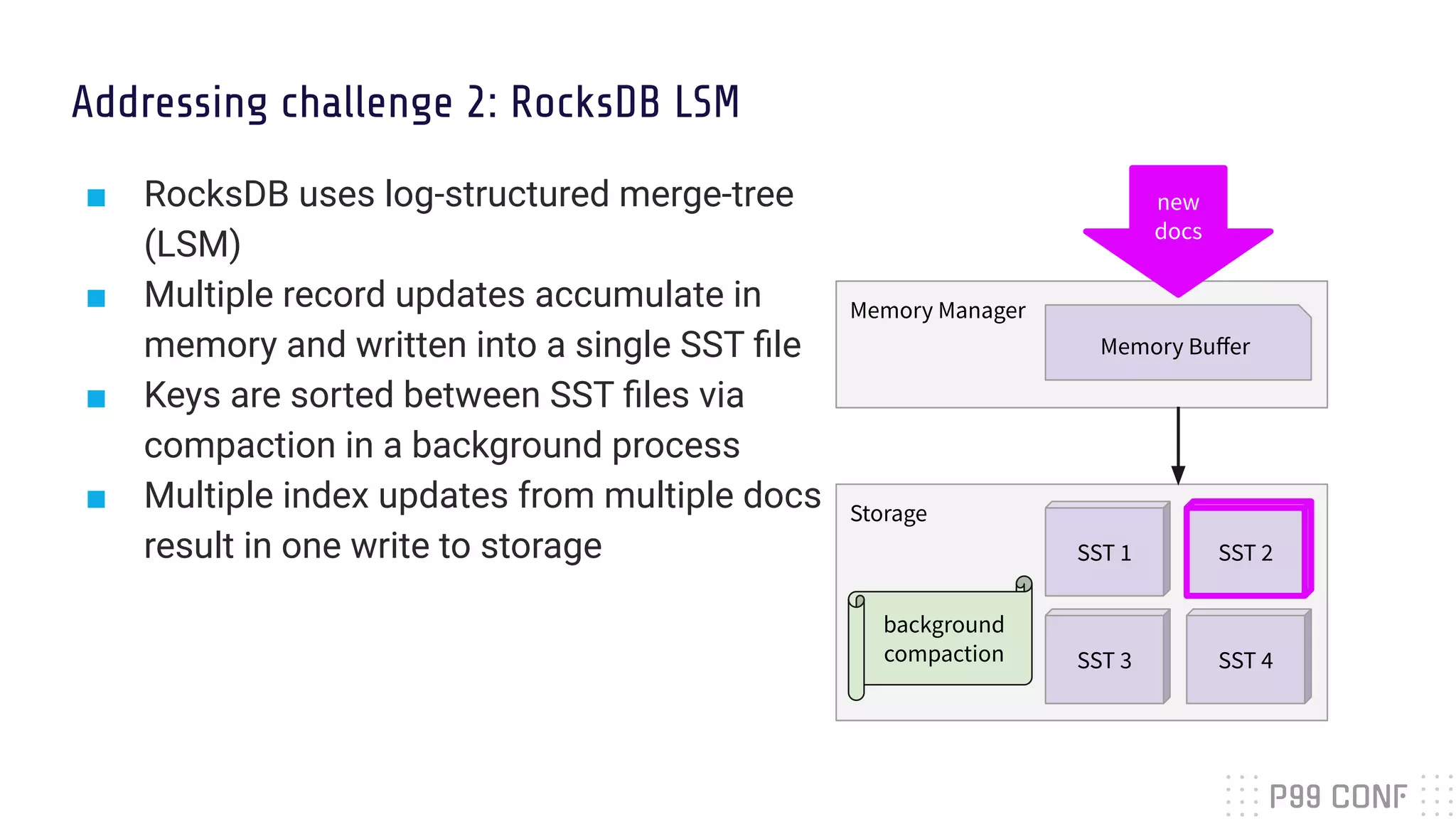
■ RocksDB uses log-structured merge-tree
(LSM)
■ Multiple record updates accumulate in
memory and written into a single SST file
■ Keys are sorted between SST files via
compaction in a background process
■ Multiple index updates from multiple docs
result in one write to storage
Storage
Memory Manager
Memory Buffer
SST 1 SST 2
SST 3 SST 4
new
docs
Addressing challenge 2: RocksDB LSM
background
compaction
Smart Schema SQL
22
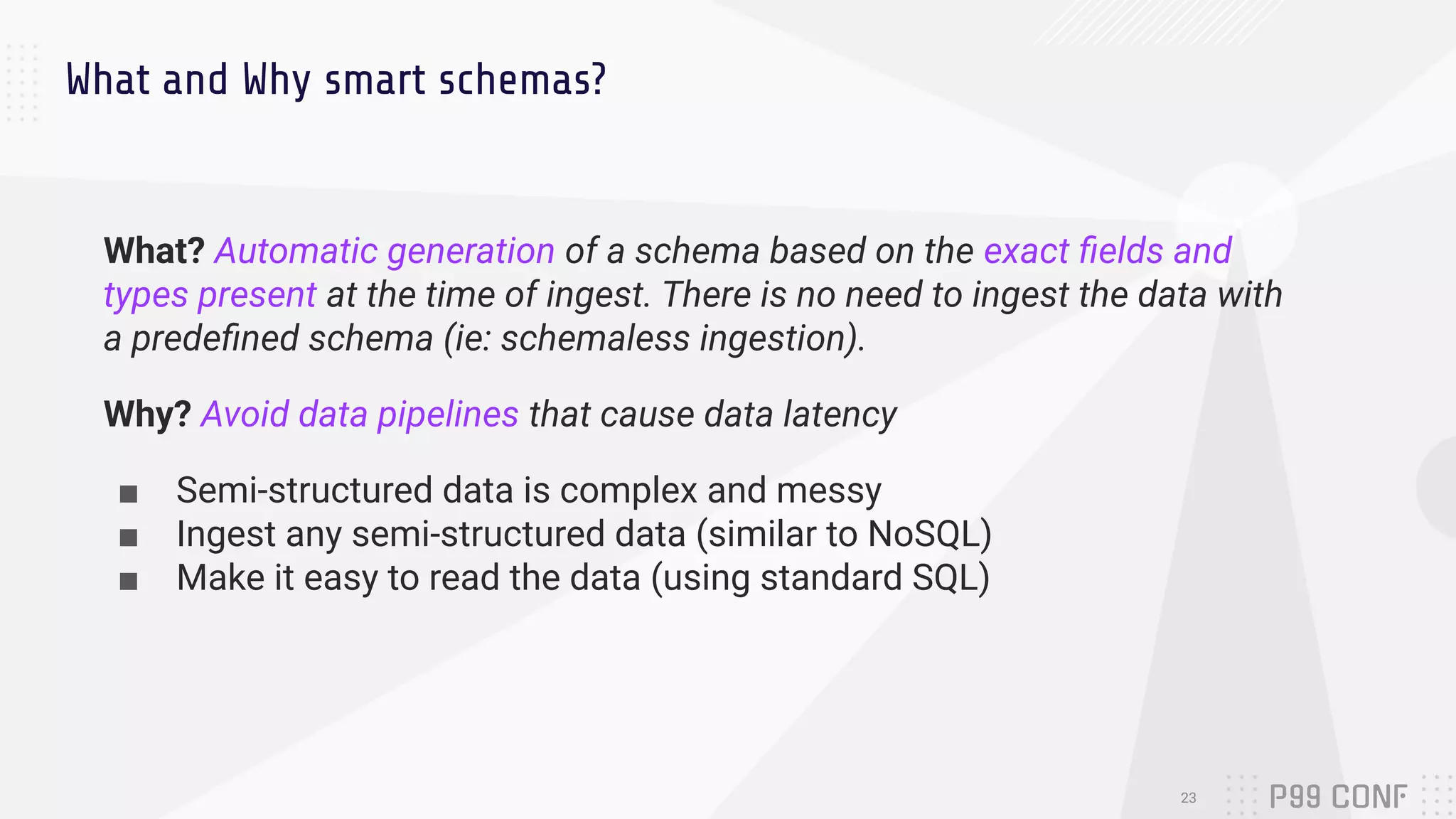
What and Why smart schemas?
What? Automatic generation of a schema based on the exact fields and
types present at the time of ingest. There is no need to ingest the data with
a predefined schema (ie: schemaless ingestion).
Why? Avoid data pipelines that cause data latency
■ Semi-structured data is complex and messy
■ Ingest any semi-structured data (similar to NoSQL)
■ Make it easy to read the data (using standard SQL)
23
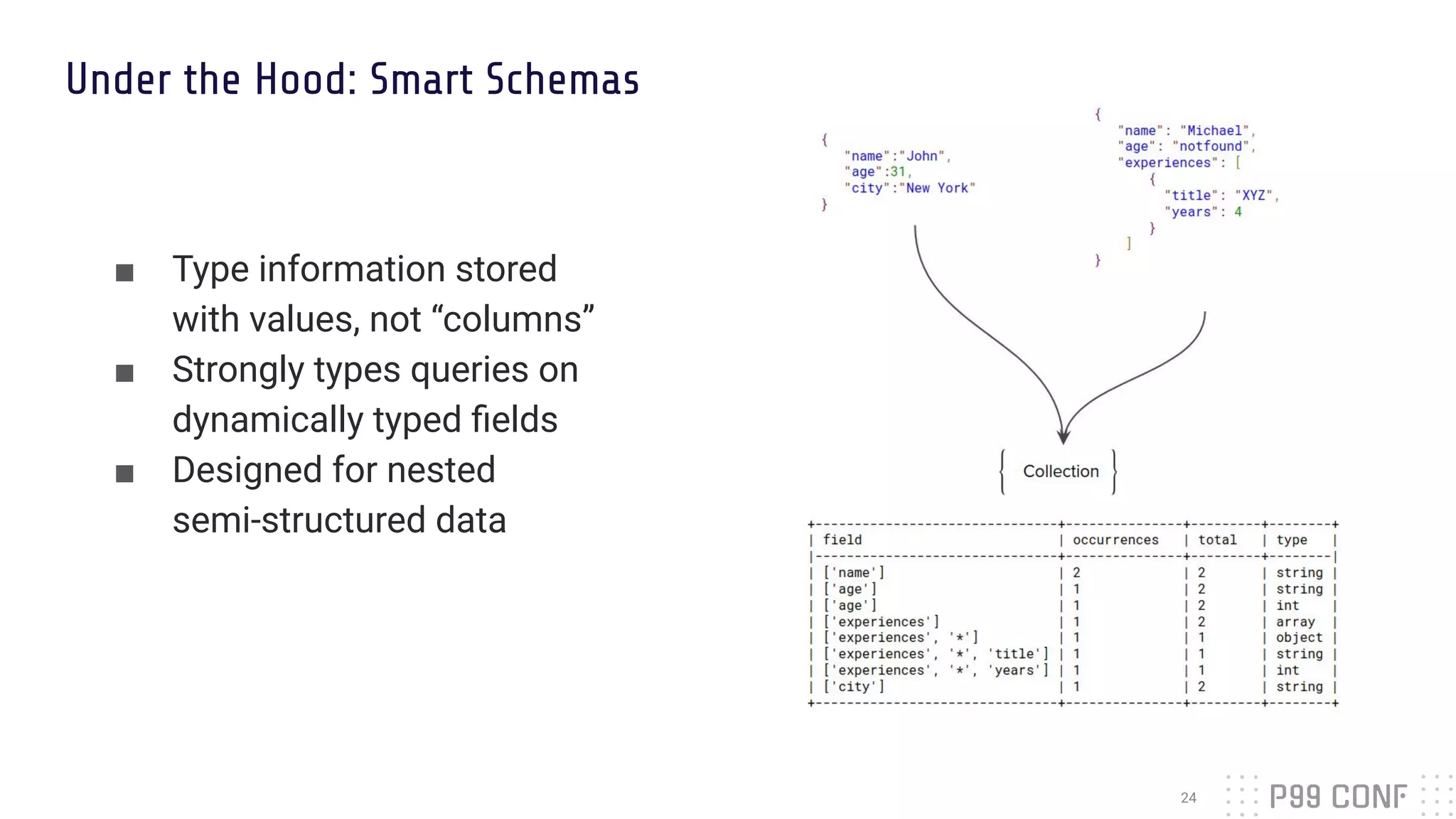
Under the Hood: Smart Schemas
■ Type information stored
with values, not “columns”
■ Strongly types queries on
dynamically typed fields
■ Designed for nested
semi-structured data
24
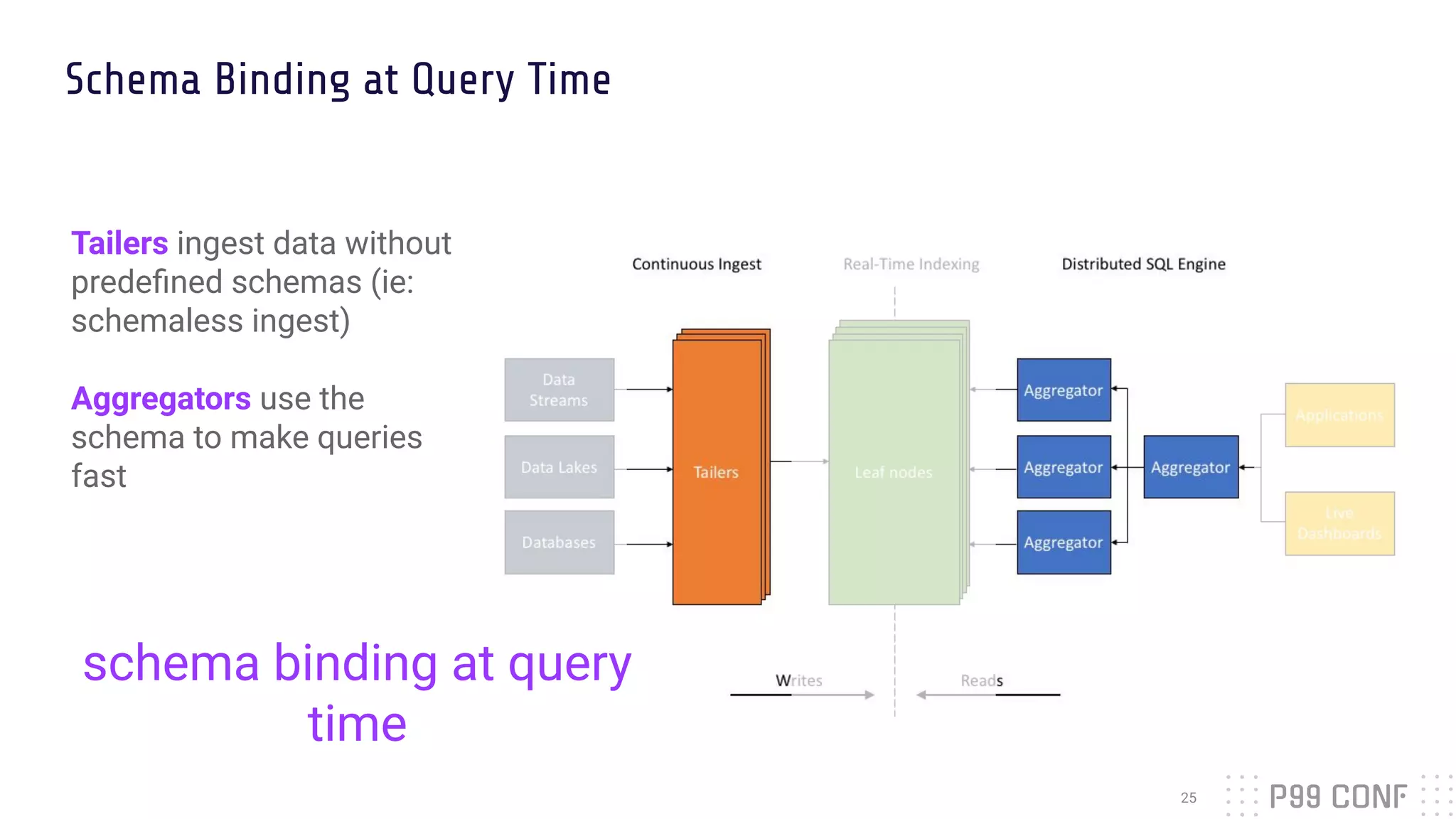
Schema Binding at Query Time
25
Tailers ingest data without
predefined schemas (ie:
schemaless ingest)
Aggregators use the
schema to make queries
fast
schema binding at query
time
Challenges with Smart Schemas
■ Challenge 1: Additional CPU usage for processing queries
■ Challenge 2: Requires increased disk space to store types
26
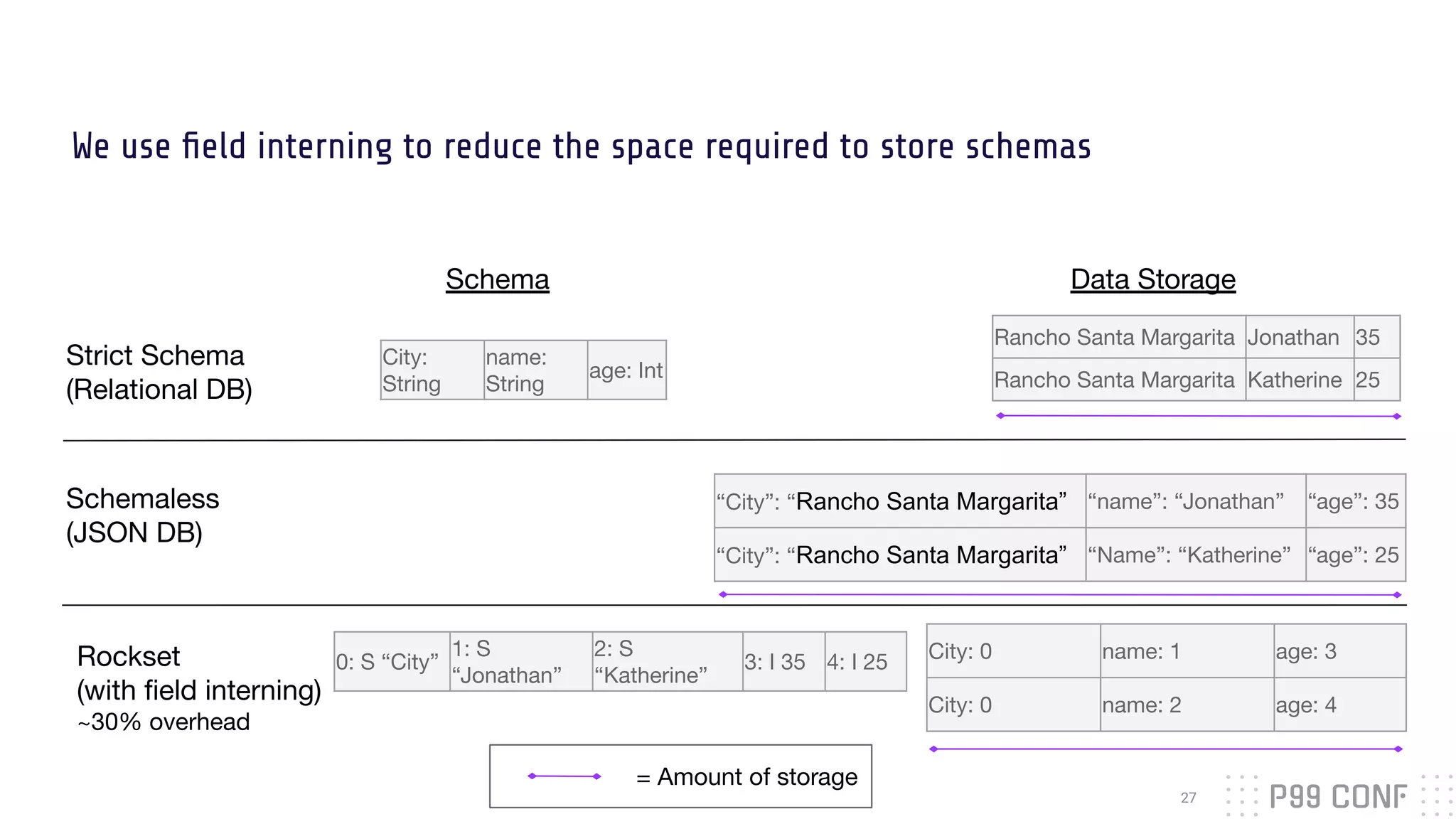
We use field interning to reduce the space required to store schemas
27
Strict Schema
(Relational DB)
Schema Data Storage
City:
String
name:
String
age: Int
Rancho Santa Margarita Jonathan 35
Rancho Santa Margarita Katherine 25
Schemaless
(JSON DB)
“City”: “Rancho Santa Margarita” “name”: “Jonathan” “age”: 35
“City”: “Rancho Santa Margarita” “Name”: “Katherine” “age”: 25
Rockset
(with field interning)
~30% overhead
0: S “City”
1: S
“Jonathan”
2: S
“Katherine”
3: I 35 4: I 25 City: 0 name: 1 age: 3
City: 0 name: 2 age: 4
= Amount of storage
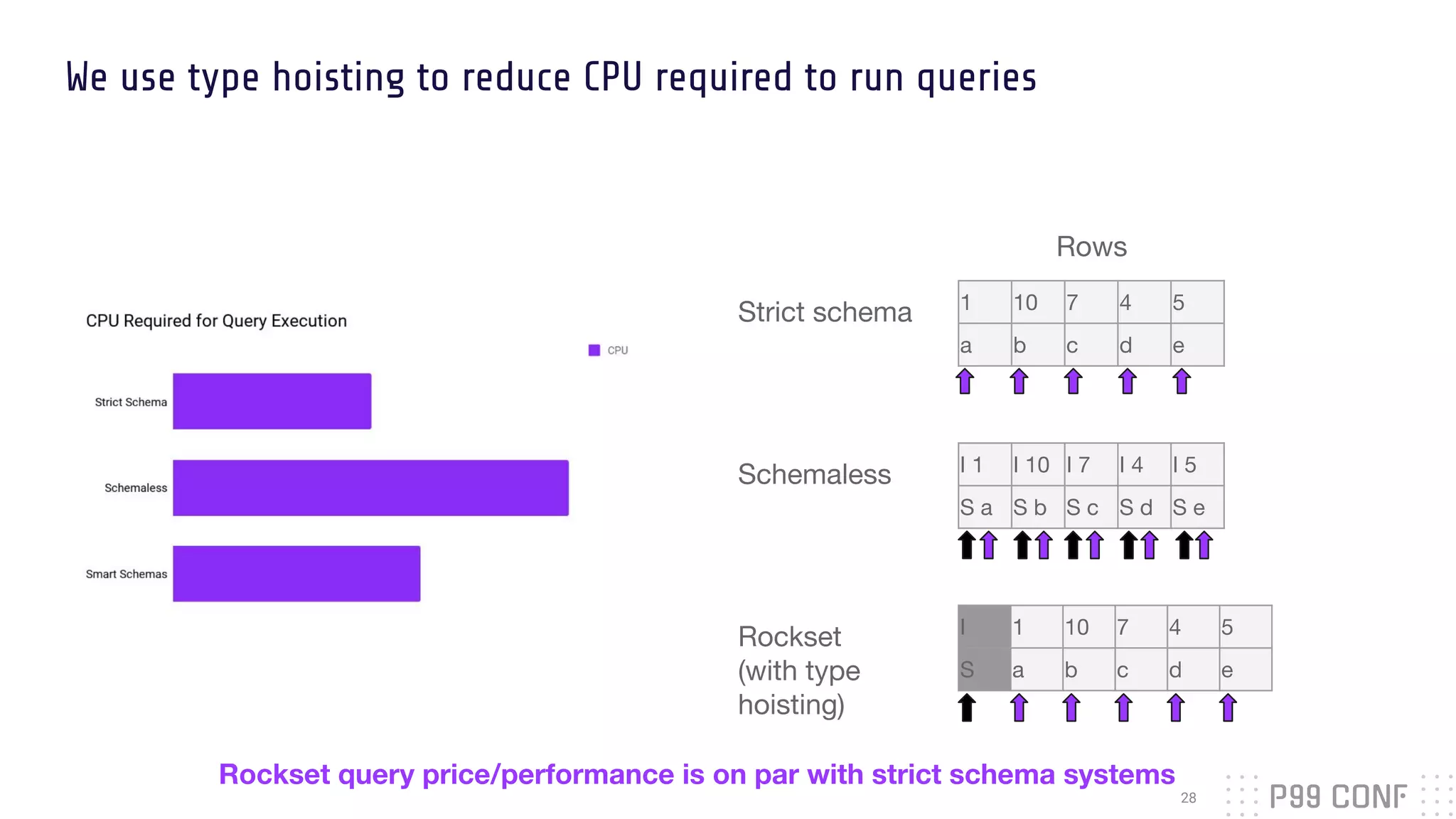
We use type hoisting to reduce CPU required to run queries
28
Strict schema 1 10 7 4 5
a b c d e
Schemaless
Rockset
(with type
hoisting)
Rows
I 1 I 10 I 7 I 4 I 5
S a S b S c S d S e
I 1 10 7 4 5
S a b c d e
Rockset query price/performance is on par with strict schema systems
Cloud Scaling Architecture
29
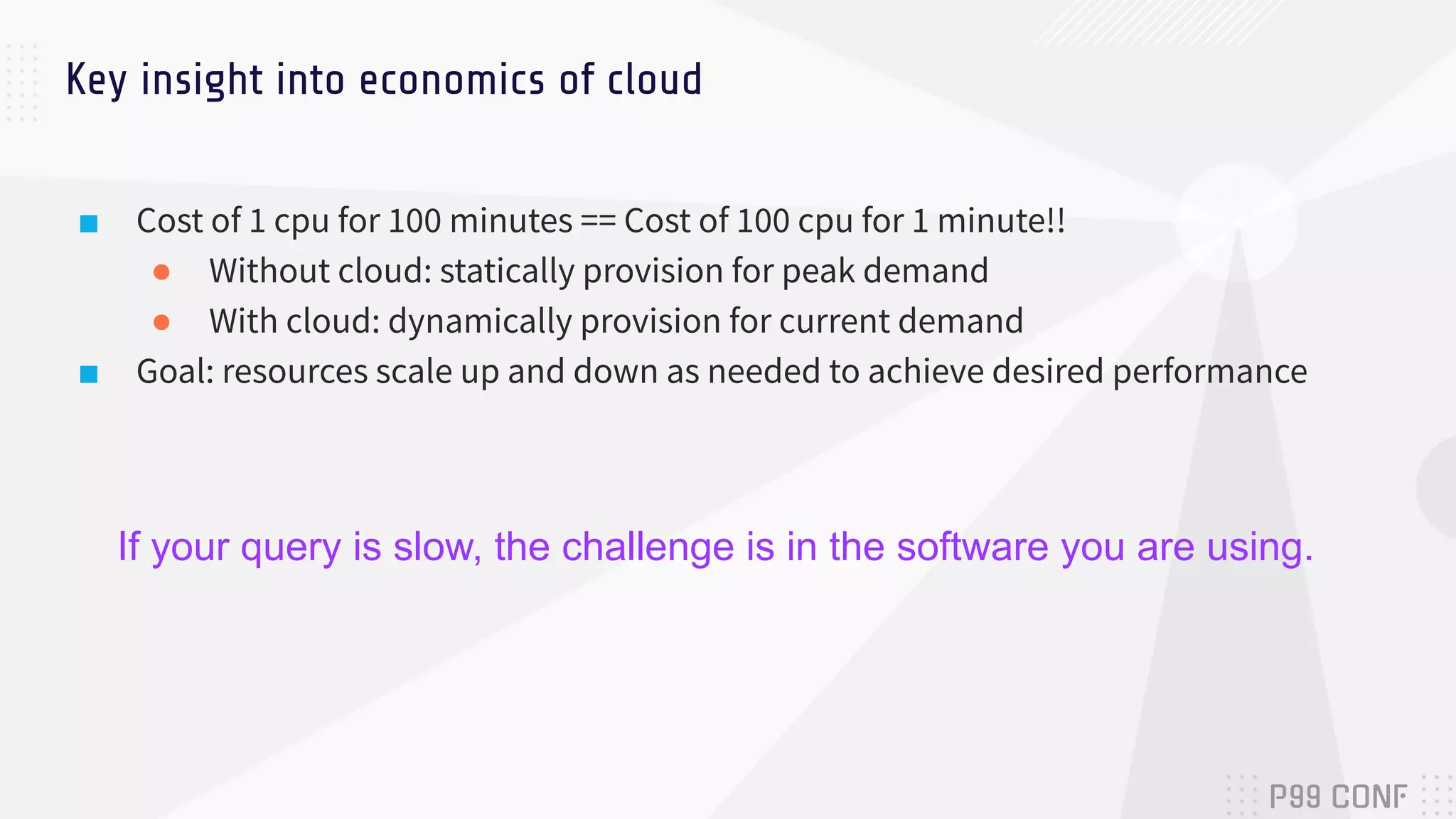
● Cost of 1 cpu for 100 minutes == Cost of 100 cpu for 1 minute!!
Key insight into economics of cloud
■ Cost of 1 cpu for 100 minutes == Cost of 100 cpu for 1 minute!!
● Without cloud: statically provision for peak demand
● With cloud: dynamically provision for current demand
Key insight into economics of cloud
■ Cost of 1 cpu for 100 minutes == Cost of 100 cpu for 1 minute!!
● Without cloud: statically provision for peak demand
● With cloud: dynamically provision for current demand
■ Goal: resources scale up and down as needed to achieve desired performance
Key insight into economics of cloud
If your query is slow, the challenge is in the software you are using.
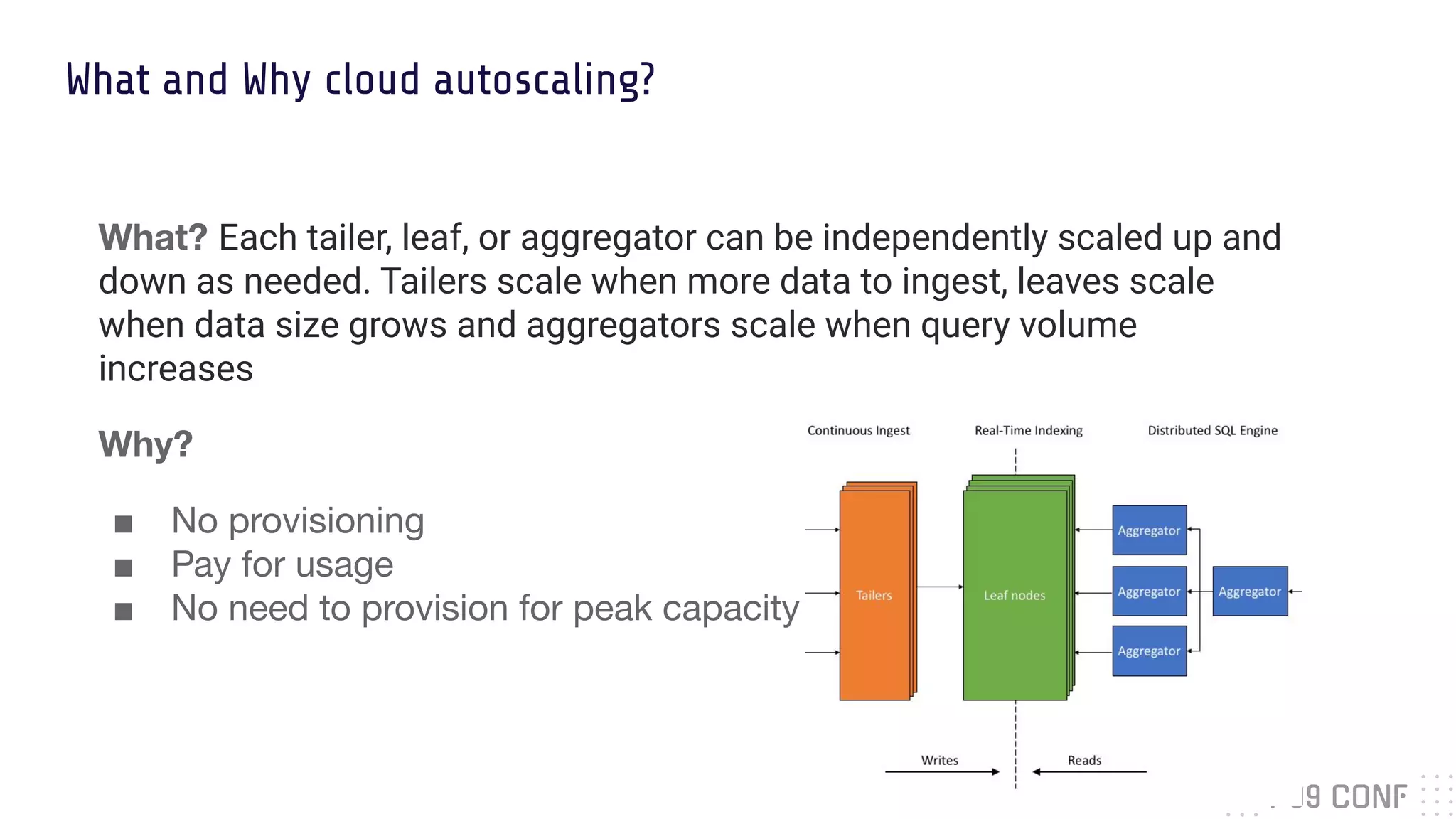
What and Why cloud autoscaling?
What? Each tailer, leaf, or aggregator can be independently scaled up and
down as needed. Tailers scale when more data to ingest, leaves scale
when data size grows and aggregators scale when query volume
increases
Why?
■ No provisioning
■ Pay for usage
■ No need to provision for peak capacity
33
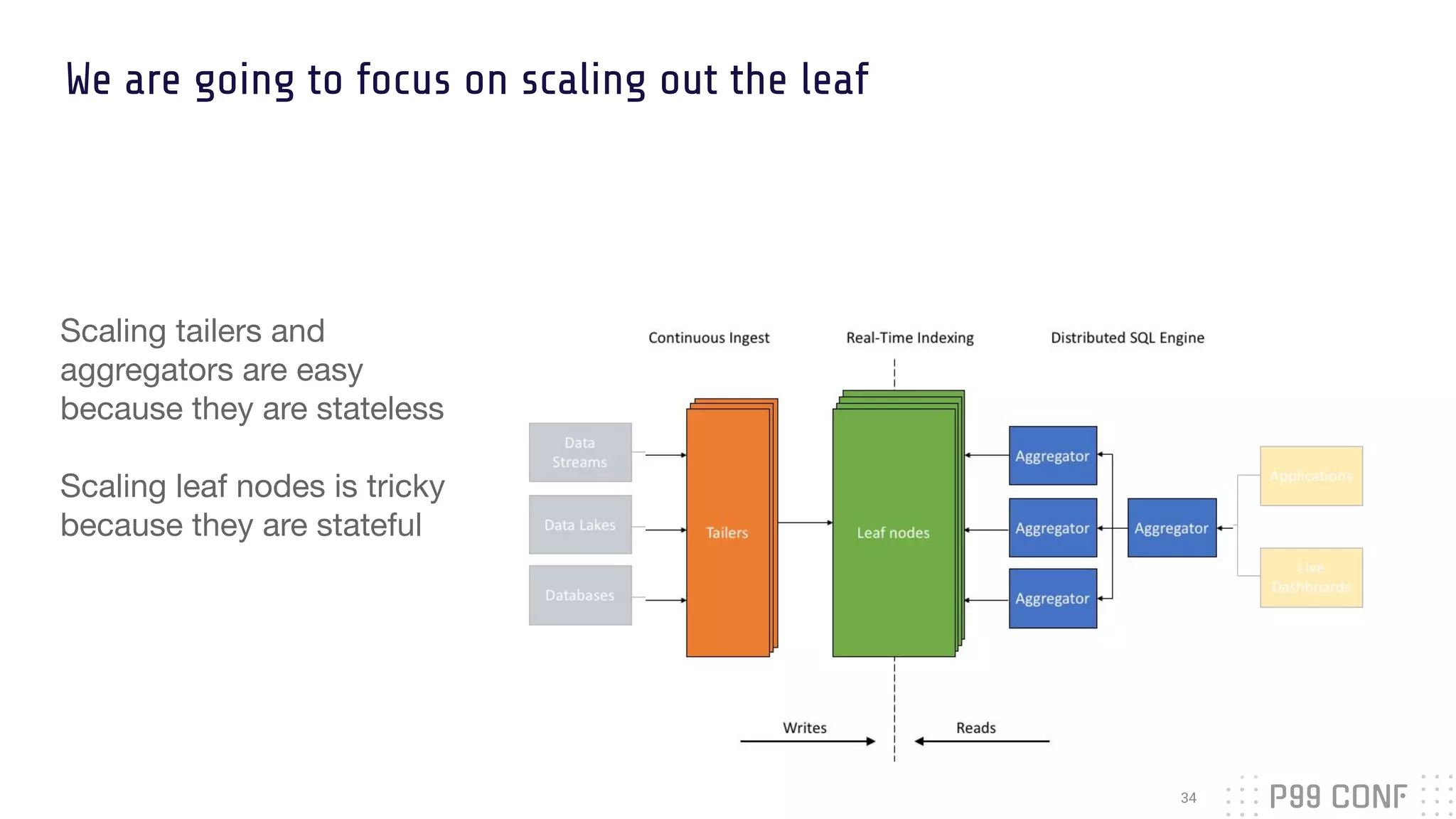
We are going to focus on scaling out the leaf
34
Scaling tailers and
aggregators are easy
because they are stateless
Scaling leaf nodes is tricky
because they are stateful
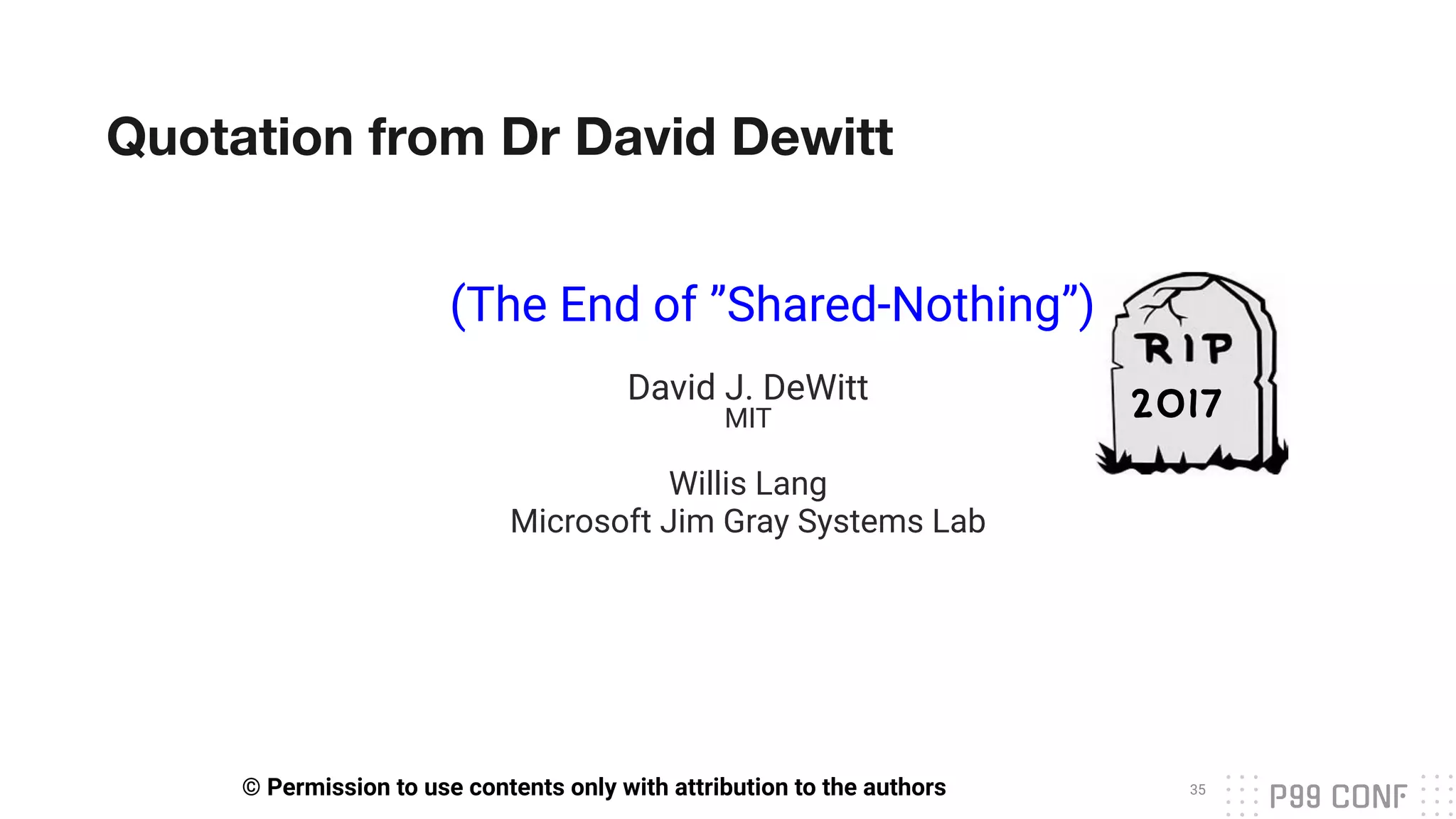
Quotation from Dr David Dewitt
David J. DeWitt
MIT
Willis Lang
Microsoft Jim Gray Systems Lab
35
© Permission to use contents only with attribution to the authors
(The End of ”Shared-Nothing”)
2017
Document Sharding Diagram in ALT
36
Rockset SQL API
Aggregator Aggregator
Leaf
RocksDB
Leaf
RocksDB
Leaf
RocksDB
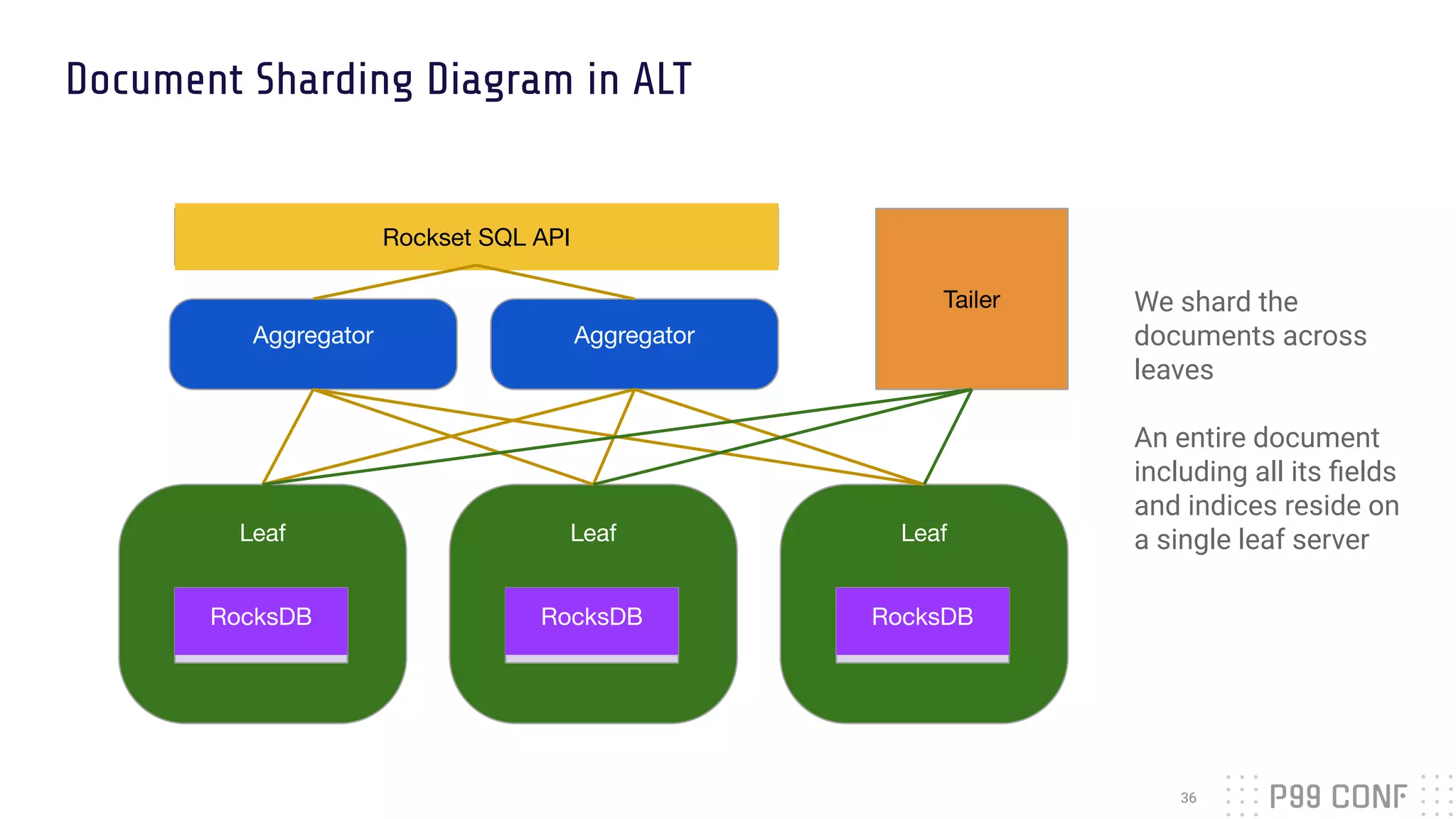
Tailer We shard the
documents across
leaves
An entire document
including all its fields
and indices reside on
a single leaf server
Scale down leaves: Use durability of cloud storage
37
Rockset SQL API
Aggregator Aggregator
Object Storage (AWS S3, GCS, ...)
Leaf
RocksDB-Cloud
RocksDB
Leaf
RocksDB-Cloud
RocksDB
Leaf
RocksDB-Cloud
RocksDB
Tailer
SST files
SST files SST files
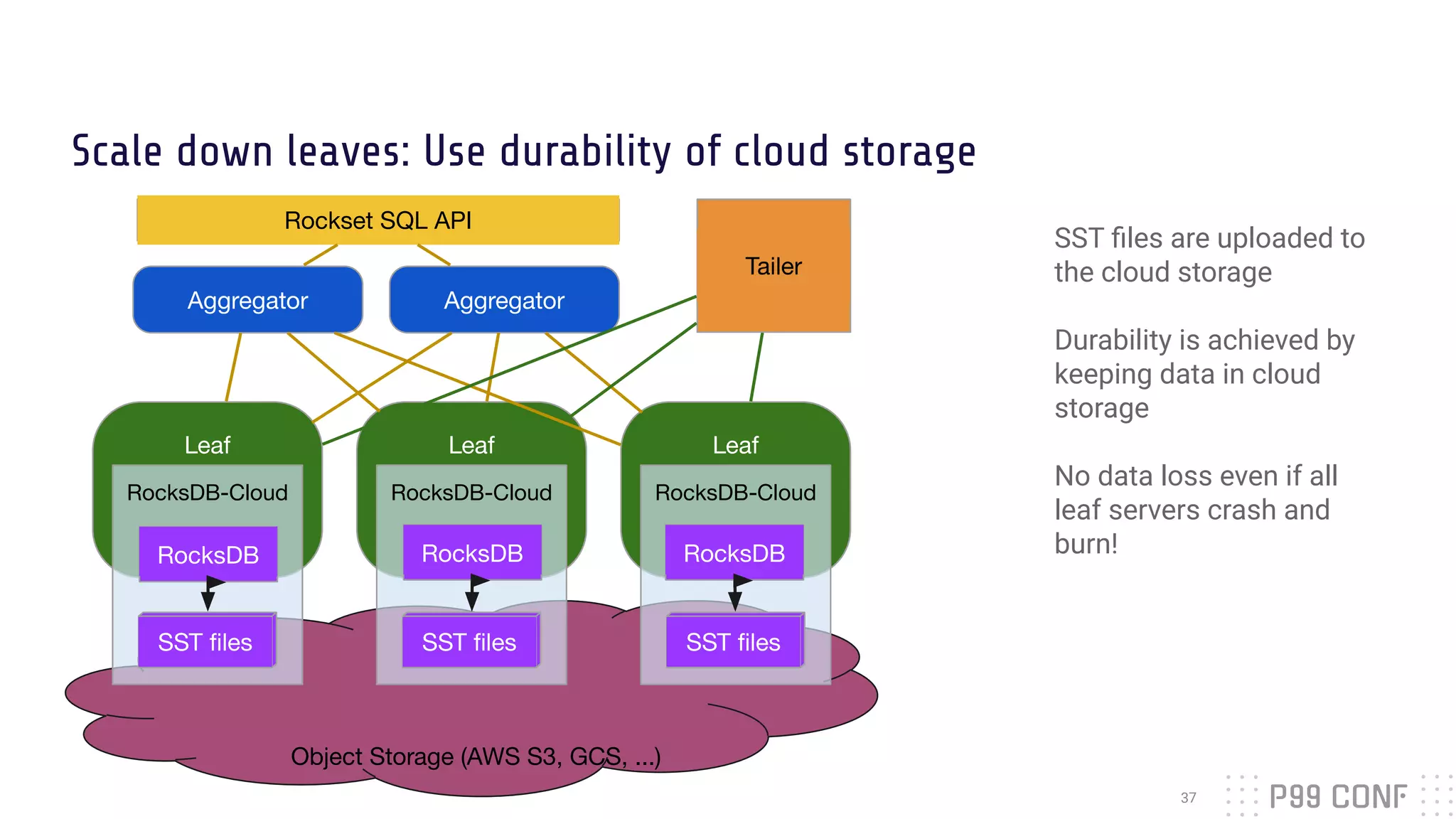
SST files are uploaded to
the cloud storage
Durability is achieved by
keeping data in cloud
storage
No data loss even if all
leaf servers crash and
burn!
Leaf
38
Leaf
RocksDB-Cloud
Object Storage (AWS S3, GCS, ...)
Rockset SQL API
Aggregator Aggregator
Leaf
RocksDB-Cloud
Leaf
RocksDB-Cloud
Tailer
RocksDB RocksDB RocksDB
SST files SST files
Scale up new leaves: use zero-copy clones of rocksdb-cloud
SST files
RocksDB
RocksDB-Cloud
SST files
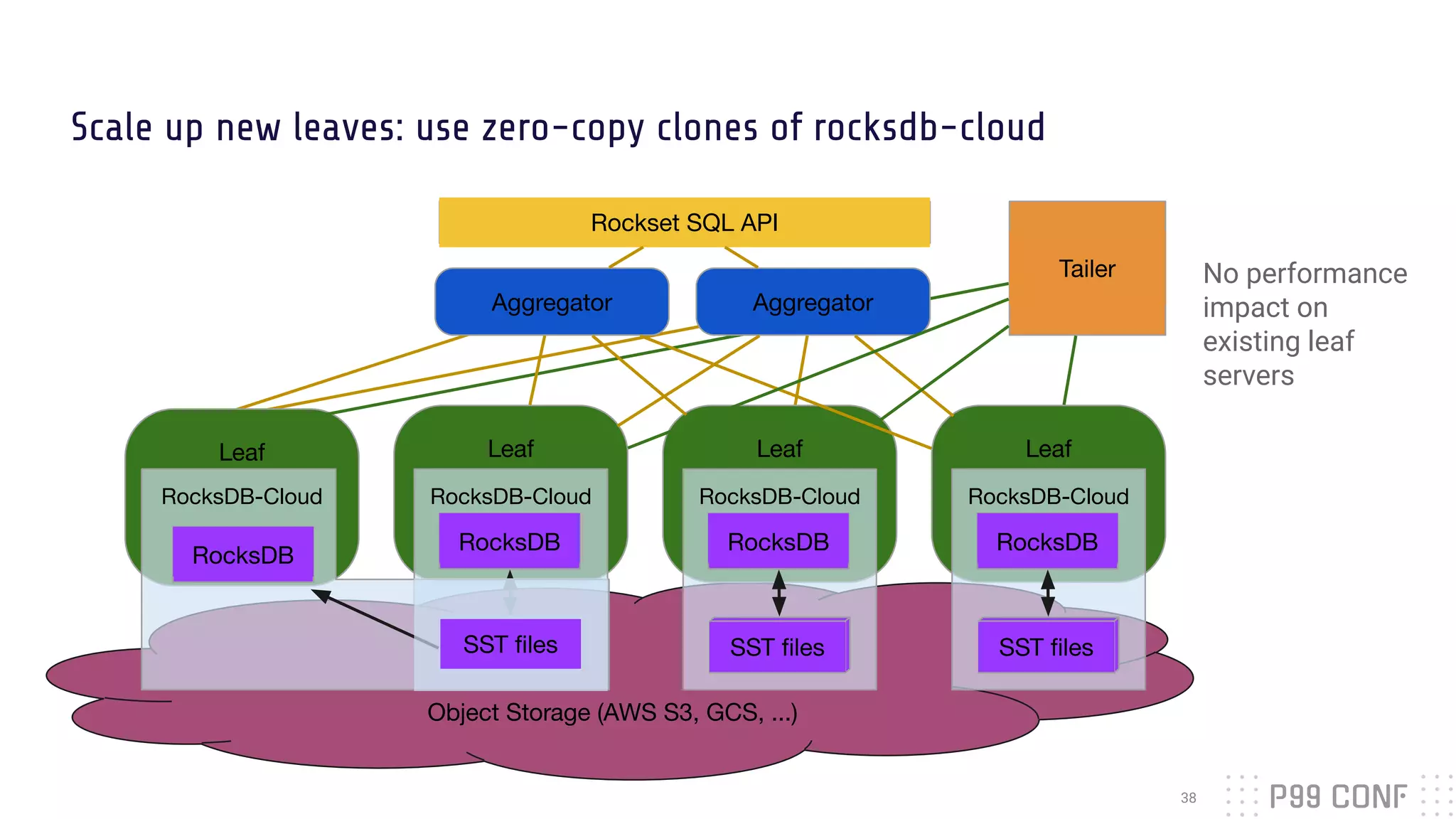
No performance
impact on
existing leaf
servers
Separate write compute from query compute
39
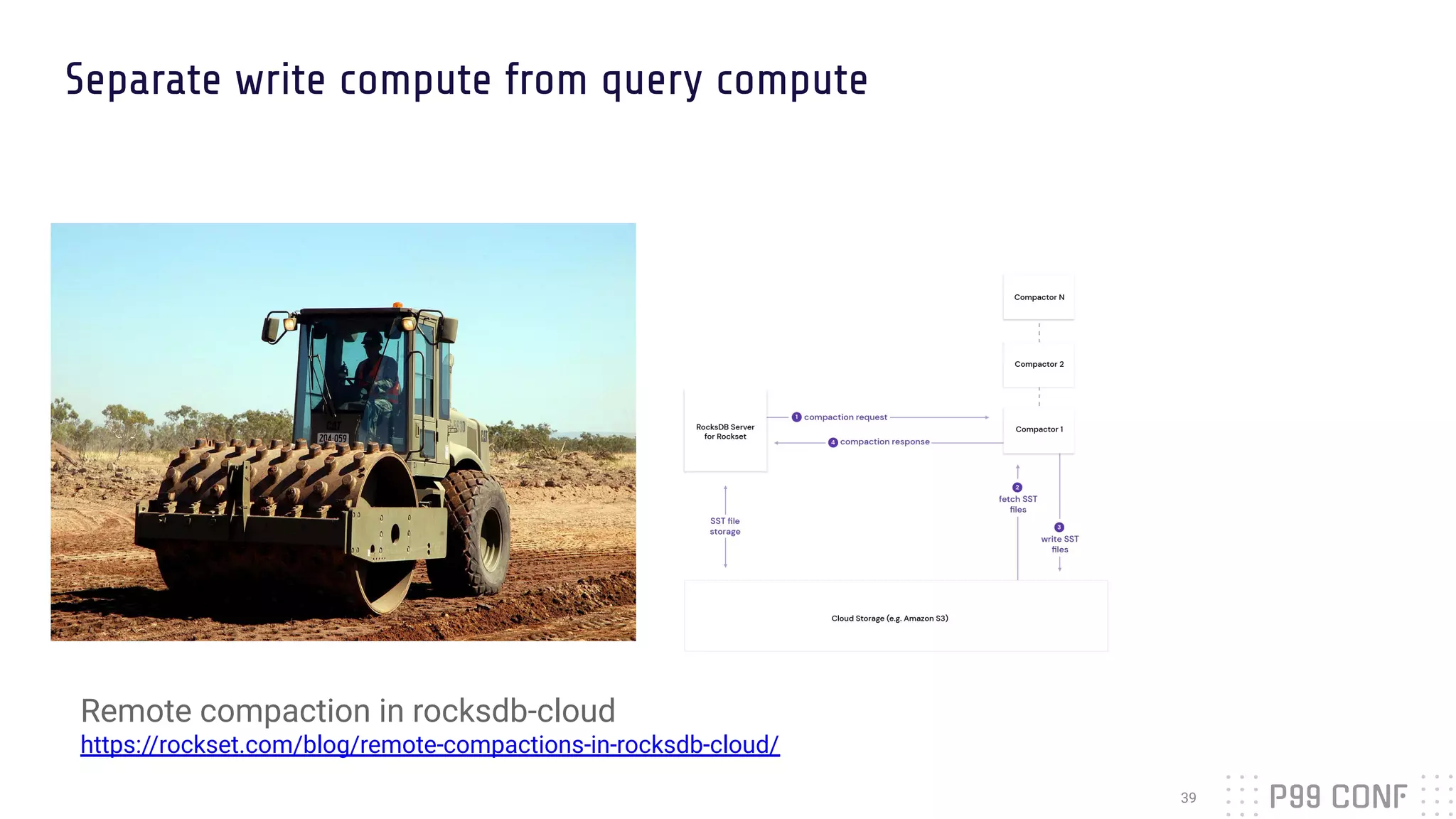
Remote compaction in rocksdb-cloud
https://rockset.com/blog/remote-compactions-in-rocksdb-cloud/
Recap: ALT Architecture provides SQL on json
40
No need to manage indexes with converged indexing
No need to pre-define schemas with smart schemas
No need to provision servers with cloud scaling architecture
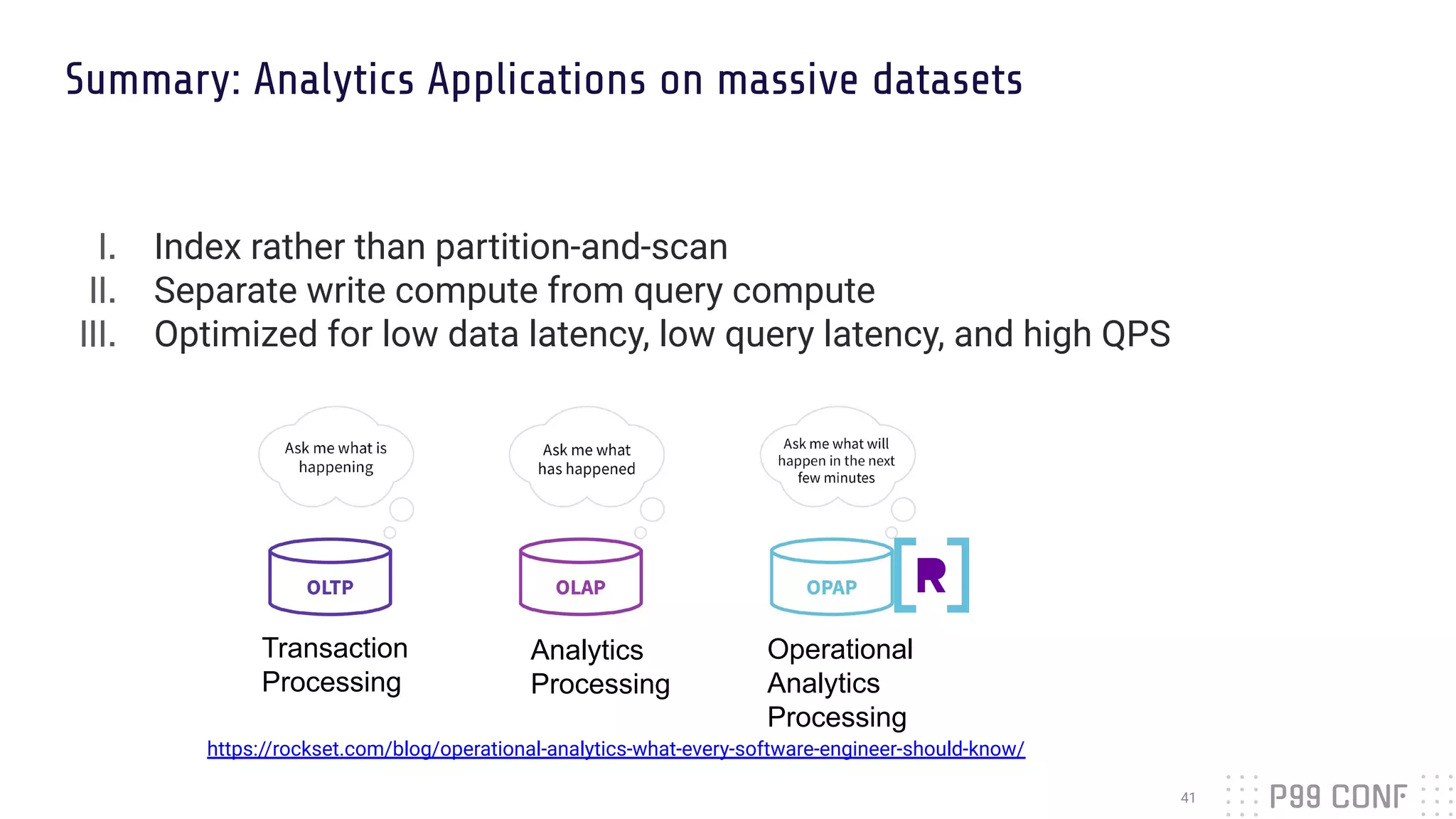
Summary: Analytics Applications on massive datasets
I. Index rather than partition-and-scan
II. Separate write compute from query compute
III. Optimized for low data latency, low query latency, and high QPS
41
Transaction
Processing
Analytics
Processing
Operational
Analytics
Processing
https://rockset.com/blog/operational-analytics-what-every-software-engineer-should-know/
Brought to you by
Dhruba Borthakur
dhruba@rockset.com
@dhruba_rocks
Community:
https://community.rockset.com/
Check us out: http://rockset.com

Realtime Indexing for Fast Queries on Massive Semi-Structured Data

  • 1.
    Brought to youby Rockset: Realtime Indexing for Fast Queries on Massive Semi-Structured Data Dhruba Borthakur CTO at
  • 2.
    About Me ■ CTOand Co-Founder of Rockset ■ RocksDB @ Facebook ■ Hadoop File System @ Yahoo ■ HBase & Hive ■ Andrew File System (AFS) 2
  • 3.
    Overview of theTalk I. Changing Landscape of Data Analytics II. Overview of Rockset’s Aggregator Leaf Tailer (ALT) Architecture III. Smart Schemas for SQL IV. Converged Indexing powers SQL V. Cloud Scaling Architecture 3
  • 4.
    Real-time Indexing onmassive datasets for building real-time apps on live data without ETL or pipelines. What is Rockset? 4
  • 5.
    How is Rocksetused? 5      
  • 6.
    The Aggregator LeafTailer (ALT) Architecture 6 https://rockset.com/blog/aggregator-leaf-tailer-an-architecture-for-live-analytics-on-event-streams/
  • 7.
    Key Benefits ofALT 1. Makes queries fast: Indexing all data at time of ingest 2. Runs complex queries on the fly: Distributed aggregator tier that scales compute and memory resources independently 3. It’s cost-effective: Tailer, Leaf, and Aggregator can be independently scaled up and down 4. Optimizes read & writes in isolation: CQRS ensures that database writes do not impact queries 7
  • 8.
    Key Design Principlesof Rockset 1. Converged Indexing 2. Smart Schemas 3. Cloud Native Architecture ● separate compute from storage ● separate write compute from query compute 8
  • 9.
  • 10.
    What and Whyconverged indexing? What? Rockset stores every column of every document in a row-based index, column-store index, AND an inverted index. Why? ■ No need to configure and maintain indexes ■ No slow queries because of missing indexes 10 INDEX ALL FIELDS
  • 11.
    Under the Hood:Converged Indexing ■ Columnar and inverted indexes in the same system ■ Built on top of key-value store abstraction ■ Each document maps to many key-value pairs 11 <doc 0> { “name”: “Igor” } <doc 1> { “name”: “Dhruba” } Key Value R.0.name Igor Row Store R.1.name Dhruba C.name.0 Igor Column Store C.name.1 Dhruba S.name.Dhruba.1 Inverted index S.name.Igor.0
  • 12.
    Inverted Indexing forpoint lookups ■ For each value, store documents containing that value (posting list) ■ Quickly retrieve a list of document IDs that match a predicate “name” “interests” Dhruba 1 Igor 0 databases 0.0; 1.1 cars 1.0 snowboarding 0.1 “last_active” 2019/3/15 0 2019/3/22 1 <doc 0> { “name”: “Igor”, “interests”: [“databases”, “snowboarding”], “last_active”: 2019/3/15 } <doc 1> { “name”: “Dhruba”, “interests”: [“cars”, “databases”], “last_active”: 2019/3/22 }
  • 13.
    Columnar Store foraggregations ■ Store each column separately ■ Great compression ■ Only fetch columns the query needs <doc 0> { “name”: “Igor”, “interests”: [“databases”, “snowboarding”], “last_active”: 2019/3/15 } <doc 1> { “name”: “Dhruba”, “interests”: [“cars”, “databases”], “last_active”: 2019/3/22 } “name” “interests” 0 Igor 1 Dhruba 0.0 databases 0.1 snowboarding 1.0 cars 1.1 databases “last_active” 0 2019/3/15 1 2019/3/22
  • 14.
    SELECT keyword, count(*) FROMsearch_logs GROUP BY keyword ORDER BY count(*) DESC ■ Low latency for both highly selective queries and large scans ■ Optimizer picks between columnar store or inverted index The Power of the Query Optimizer 14 Inverted index (for highly selective queries) SELECT * FROM search_logs WHERE keyword = ‘hpts’ AND locale = ‘en’ Columnar store (for large scans)
  • 15.
    Challenges with ConvergedIndexing ■ Maintaining multiple indexes adversely impacts write throughput ■ Challenge 1: one new record = multiple servers updates ● Requires consensus coordination between servers ■ Challenge 2: one new field = multiple random writes ● Requires increased disk I/O 15
  • 16.
    Challenge 1: onenew record = multiple servers updates ■ In a traditional database with term sharding and n indexes, one write incurs updates to n different indexes on n servers ■ Requires a distributed transaction (paxos, raft) between n servers <doc 1> { “name”: “Dhruba”, “interests”: [“cars”, “databases”], “last_active”: 2019/3/22 } “interests” Dhruba 1 Igor 0 databases 0.0; 1.1 cars 1.0 snowboarding 0.1 “last_active” 2019/3/15 0 2019/3/22 1 “name”
  • 17.
    Addressing challenge 1:doc sharding Distributed Log Rockset SQL API Aggregator Aggregator Leaf RocksDB Leaf RocksDB Leaf RocksDB new docs ● Updates are durably-buffered to a distributed log
  • 18.
    Addressing challenge 1:doc sharding ■ Updates are durably buffered to a distributed log ■ Leafs tail only documents in the shards they are responsible for ■ Doc sharding means all new keys will only affect a single shard/leaf Distributed Log Rockset SQL API Aggregator Aggregator Leaf RocksDB Leaf RocksDB Leaf RocksDB new keys
  • 19.
    What is documentsharding? 19 Let’s say you were running a search on restaurant reviews in the area…. Traditional distributed databases Rockset Optimized for query throughput Optimized for query latency Big data analytics requires you to run complex queries at interactive speed First, optimize for latency and then optimize for throughput Restaurant Data Restaurant & Review Data Review Data
  • 20.
    ■ Traditional systemsuse B-tree storage structure ■ Keys are sorted across tables ■ A single record update with multiple secondary index would incur writes to multiple different locations Storage Memory Manager Challenge 2: one new doc = multiple random writes Memory Buffer Table 1 Table 2 Table 3 Table 4 new docs
  • 21.
    ■ RocksDB useslog-structured merge-tree (LSM) ■ Multiple record updates accumulate in memory and written into a single SST file ■ Keys are sorted between SST files via compaction in a background process ■ Multiple index updates from multiple docs result in one write to storage Storage Memory Manager Memory Buffer SST 1 SST 2 SST 3 SST 4 new docs Addressing challenge 2: RocksDB LSM background compaction
  • 22.
  • 23.
    What and Whysmart schemas? What? Automatic generation of a schema based on the exact fields and types present at the time of ingest. There is no need to ingest the data with a predefined schema (ie: schemaless ingestion). Why? Avoid data pipelines that cause data latency ■ Semi-structured data is complex and messy ■ Ingest any semi-structured data (similar to NoSQL) ■ Make it easy to read the data (using standard SQL) 23
  • 24.
    Under the Hood:Smart Schemas ■ Type information stored with values, not “columns” ■ Strongly types queries on dynamically typed fields ■ Designed for nested semi-structured data 24
  • 25.
    Schema Binding atQuery Time 25 Tailers ingest data without predefined schemas (ie: schemaless ingest) Aggregators use the schema to make queries fast schema binding at query time
  • 26.
    Challenges with SmartSchemas ■ Challenge 1: Additional CPU usage for processing queries ■ Challenge 2: Requires increased disk space to store types 26
  • 27.
    We use fieldinterning to reduce the space required to store schemas 27 Strict Schema (Relational DB) Schema Data Storage City: String name: String age: Int Rancho Santa Margarita Jonathan 35 Rancho Santa Margarita Katherine 25 Schemaless (JSON DB) “City”: “Rancho Santa Margarita” “name”: “Jonathan” “age”: 35 “City”: “Rancho Santa Margarita” “Name”: “Katherine” “age”: 25 Rockset (with field interning) ~30% overhead 0: S “City” 1: S “Jonathan” 2: S “Katherine” 3: I 35 4: I 25 City: 0 name: 1 age: 3 City: 0 name: 2 age: 4 = Amount of storage
  • 28.
    We use typehoisting to reduce CPU required to run queries 28 Strict schema 1 10 7 4 5 a b c d e Schemaless Rockset (with type hoisting) Rows I 1 I 10 I 7 I 4 I 5 S a S b S c S d S e I 1 10 7 4 5 S a b c d e Rockset query price/performance is on par with strict schema systems
  • 29.
  • 30.
    ● Cost of1 cpu for 100 minutes == Cost of 100 cpu for 1 minute!! Key insight into economics of cloud
  • 31.
    ■ Cost of1 cpu for 100 minutes == Cost of 100 cpu for 1 minute!! ● Without cloud: statically provision for peak demand ● With cloud: dynamically provision for current demand Key insight into economics of cloud
  • 32.
    ■ Cost of1 cpu for 100 minutes == Cost of 100 cpu for 1 minute!! ● Without cloud: statically provision for peak demand ● With cloud: dynamically provision for current demand ■ Goal: resources scale up and down as needed to achieve desired performance Key insight into economics of cloud If your query is slow, the challenge is in the software you are using.
  • 33.
    What and Whycloud autoscaling? What? Each tailer, leaf, or aggregator can be independently scaled up and down as needed. Tailers scale when more data to ingest, leaves scale when data size grows and aggregators scale when query volume increases Why? ■ No provisioning ■ Pay for usage ■ No need to provision for peak capacity 33
  • 34.
    We are goingto focus on scaling out the leaf 34 Scaling tailers and aggregators are easy because they are stateless Scaling leaf nodes is tricky because they are stateful
  • 35.
    Quotation from DrDavid Dewitt David J. DeWitt MIT Willis Lang Microsoft Jim Gray Systems Lab 35 © Permission to use contents only with attribution to the authors (The End of ”Shared-Nothing”) 2017
  • 36.
    Document Sharding Diagramin ALT 36 Rockset SQL API Aggregator Aggregator Leaf RocksDB Leaf RocksDB Leaf RocksDB Tailer We shard the documents across leaves An entire document including all its fields and indices reside on a single leaf server
  • 37.
    Scale down leaves:Use durability of cloud storage 37 Rockset SQL API Aggregator Aggregator Object Storage (AWS S3, GCS, ...) Leaf RocksDB-Cloud RocksDB Leaf RocksDB-Cloud RocksDB Leaf RocksDB-Cloud RocksDB Tailer SST files SST files SST files SST files are uploaded to the cloud storage Durability is achieved by keeping data in cloud storage No data loss even if all leaf servers crash and burn!
  • 38.
    Leaf 38 Leaf RocksDB-Cloud Object Storage (AWSS3, GCS, ...) Rockset SQL API Aggregator Aggregator Leaf RocksDB-Cloud Leaf RocksDB-Cloud Tailer RocksDB RocksDB RocksDB SST files SST files Scale up new leaves: use zero-copy clones of rocksdb-cloud SST files RocksDB RocksDB-Cloud SST files No performance impact on existing leaf servers
  • 39.
    Separate write computefrom query compute 39 Remote compaction in rocksdb-cloud https://rockset.com/blog/remote-compactions-in-rocksdb-cloud/
  • 40.
    Recap: ALT Architectureprovides SQL on json 40 No need to manage indexes with converged indexing No need to pre-define schemas with smart schemas No need to provision servers with cloud scaling architecture
  • 41.
    Summary: Analytics Applicationson massive datasets I. Index rather than partition-and-scan II. Separate write compute from query compute III. Optimized for low data latency, low query latency, and high QPS 41 Transaction Processing Analytics Processing Operational Analytics Processing https://rockset.com/blog/operational-analytics-what-every-software-engineer-should-know/
  • 42.
    Brought to youby Dhruba Borthakur dhruba@rockset.com @dhruba_rocks Community: https://community.rockset.com/ Check us out: http://rockset.com