4/11/2014
Powers and Functions of
the Sanggunian
4/11/2014
Counc. Margie Lou Humilde
Presenter
Prof. Josefina B. Bitonio,DPA
PA 101 Local Governance and Administration
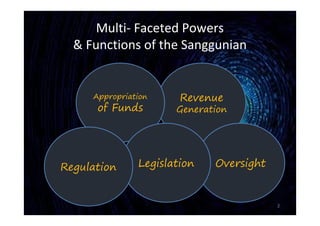
Multi- Faceted Powers
& Functions of the Sanggunian
2
Revenue
Generation
Appropriation
of Funds
OversightLegislationRegulation
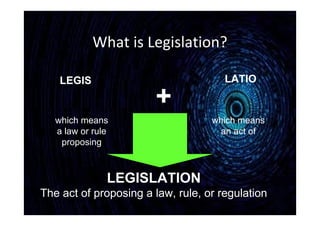
What is Legislation?
LEGIS LATIO
+
which means
a law or rule
proposing
which means
an act of
LEGISLATION
The act of proposing a law, rule, or regulation
Pertinent Provisions of the LGC
 General provisions on local legislation:
Sections 48-59
 Functions of the Sangguniang Barangay:
Section 391
 Functions of the Sangguniang Bayan:
Section 447
 Functions of the Sangguniang Panlungsod:
Section 458
 Functions of the Sangguniang Panlalawigan:
Section 468
Pertinent Provisions of the LGC
General Welfare Clause: Section 16
Service Delivery Areas: Section 17
Corporate Powers: Section 22
Roles of Local Governments:
Sections 384, 440, 448 and 459
Concept of Local Legislation
 As a POWER
The Sanggunian’s
authority toenact
ordinances, approve
resolutions, or
appropriate funds
designed to deliver basic
services and facilities, and
to promote the general
welfare
 As a PROCESS
The Sanggunian’s
continuous interaction with
LGU’s executive branch,
constituents, civil society
and other actors of
governance, resulting in
policy actions that promote
the development of the
locality
Local Legislative Power
Since time immemorial, LGUs can legislate
on purely local matters
Local legislators are more knowledgeable
than Congress on matters of purely local
concern, and in better position to enact
appropriate legislation
LGUs’ lawmaking powers are not merely by
Congress’ good graces; they have been
vested by the Constitution itself
Where is Local Legislative Power Vested
Section 48 of the LGC states that legislative
power is vested in the Sanggunian as a
collegial, collective body
Legislation therefore requires the
participation of all its members by voting
upon every question put upon the body
The term “Sanggunian” suggests more than
just a law-making body
Presiding Officer
 Section 49: the Vice Governor/ Vice Mayor shall be
the Sanggunian’s regular presiding officer
 Section 457: the Vice Governor/ Vice Mayor is an
integral part in the composition of the council
 To preserve neutrality, the Vice Governor/ Vice
Mayor shall vote only to break a tie
 The Vice Governor/Vice Mayor is not a mere spare
tire or decorative position ; he/she is the head
administrator of the legislative assembly
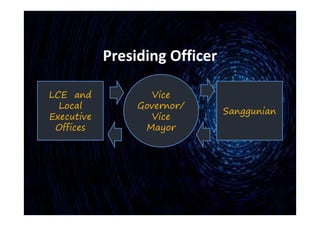
Presiding Officer
Vice
Governor/
Vice
Mayor
LCE and
Local
Executive
Offices
Sanggunian
Internal Rules of Procedure
 On the first regular session after the election
and within the 90 days, the Sanggunian must
adopt or update its house rules, providing for:
 Organization and election of Officers
 Creation of Committees
 Order and Calendar of Business
 The Legislative process
 Disciplinary sanctions on members for disorderly
behavior and unjustified absences
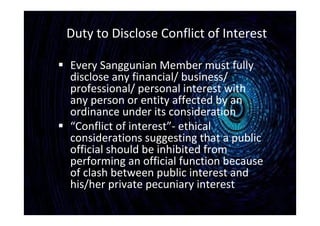
Duty to Disclose Conflict of Interest
 Every Sanggunian Member must fully
disclose any financial/ business/
professional/ personal interest with
any person or entity affected by an
ordinance under its consideration
 “Conflict of interest”- ethical
considerations suggesting that a public
official should be inhibited from
performing an official function because
of clash between public interest and
his/her private pecuniary interest
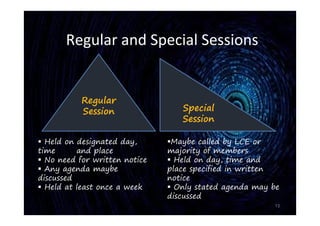
Regular and Special Sessions
13
Regular
Session Special
Session
 Held on designated day,
time and place
 No need for written notice
 Any agenda maybe
discussed
 Held at least once a week
Maybe called by LCE or
majority of members
 Held on day, time and
place specified in written
notice
 Only stated agenda may be
discussed
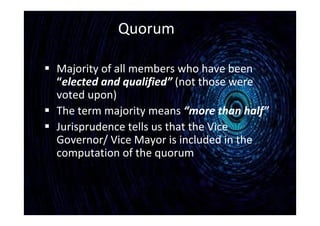
Quorum
 Majority of all members who have been
“elected and qualified” (not those were
voted upon)
 The term majority means “more than half”
 Jurisprudence tells us that the Vice
Governor/ Vice Mayor is included in the
computation of the quorum
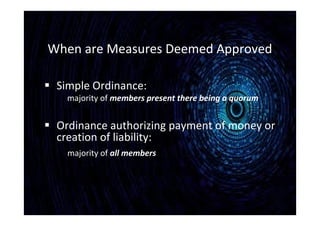
When are Measures Deemed Approved
 Simple Ordinance:
majority of members present there being a quorum
 Ordinance authorizing payment of money or
creation of liability:
majority of all members
When are Measures Deemed Approved
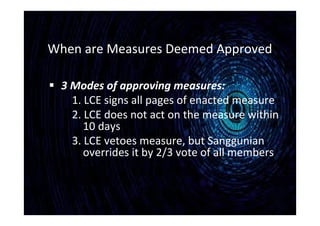
 3 Modes of approving measures:
1. LCE signs all pages of enacted measure
2. LCE does not act on the measure within
10 days
3. LCE vetoes measure, but Sanggunian
overrides it by 2/3 vote of all members
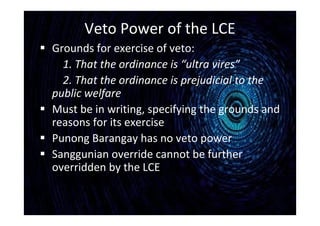
Veto Power of the LCE
 Grounds for exercise of veto:
1. That the ordinance is “ultra vires”
2. That the ordinance is prejudicial to the
public welfare
 Must be in writing, specifying the grounds and
reasons for its exercise
 Punong Barangay has no veto power
 Sanggunian override cannot be further
overridden by the LCE
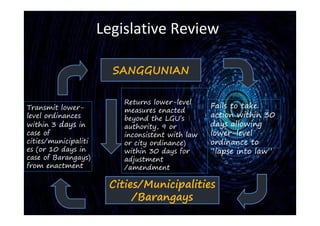
Legislative Review
SANGGUNIAN
Transmit lower-
level ordinances
within 3 days in
case of
cities/municipaliti
es (or 10 days in
case of Barangays)
from enactment
Fails to take
action within 30
days allowing
lower-level
ordinance to
“lapse into law”
Returns lower-level
measures enacted
beyond the LGU’s
authority, 9 or
inconsistent with law
or city ordinance)
within 30 days for
adjustment
/amendment
Cities/Municipalities
/Barangays
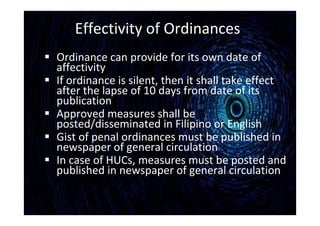
Effectivity of Ordinances
 Ordinance can provide for its own date of
affectivity
 If ordinance is silent, then it shall take effect
after the lapse of 10 days from date of its
publication
 Approved measures shall be
posted/disseminated in Filipino or English
 Gist of penal ordinances must be published in
newspaper of general circulation
 In case of HUCs, measures must be posted and
published in newspaper of general circulation
Specific Subjects of Legislation
 Delivery of basic services and facilities (Sec. 17)
 Review of Legislative measures and executive
orders from lower- level LGUs ( Sec. 447, 458,
and 468)
 Maintain peace and order
 Prescribe penalties for violations of ordinances
 Protect the environment
Specific Subjects of Legislation
 Protect inhabitants from man-made or
natural disasters and calamities
 Provide for creation of local offices
 Grant incentives to public servants
 Grant tax exemptions
 Grant franchises and licenses
Specific Subjects of Legislation
 Grant fishing privileges
 Grant scholarships
 Grant loans/ financial assistance to other
LGUs
 Provide for operation of vocational and
technical schools
 Provide for care of vulnerable persons
Areas of Regulation
 Regulate the establishment and operation of
identified businesses or enterprises
 Regulate practice of professions or
occupations not covered by government
licensing examinations
 Regulate land use, reclassify land, and enact
zoning ordinances
 Regulate use of property, e.g., land, buildings,
and structures
Areas of Regulation
 Regulate subdivisions
 Regulate construction/operation of private
markets, talipapas, etc.
 Regulate selling of food commodities
 Regulate streets and other public places
 Regulate tricycles and pedicabs
Legislative Oversight
 Refers to the review and monitoring of
executive agencies, programs, activities, and
policy implementation
 Exercised through legislative authorization,
appropriations, investigations, and hearings
 An implied power that derives from the
legislature’s “power of the purse”
 An integral part of the constitutional system
of checks and balances
Legislative Oversight
 An implied rather than an enumerated
power under the Constitution of the LGC
 The law does not explicitly grant local
councils the authority to conduct inquiries or
investigations of the executive, to have
access to records or materials held by the
executive, or to issue subpoenas for
documents or testimony from the executive
Legislative Oversight
 Derives from the many express powers of
the Sanggunian: to appropriate funds, to
enact laws, and to concur to executive
appointments
 The legislature could not reasonably or
responsibly exercise these powers without
knowing what the executives are doing; how
programs are being administered; by whom,
and at what cost, and whether officials are
complying with legislative intent
Purposes of Oversight
Improve the efficiency, economy and
effectiveness of governmental operations
Evaluate programs and performance
Detect and prevent poor administration,
waste, abuse and arbitrary behavior
Inform the general public and ensure that
executive policies reflect the public interest
Purposes of Oversight
 Gather information to develop new
legislative proposals or to amend exiting
statutes
 Ensure administrative compliance with
legislative intent
Legislative Oversight
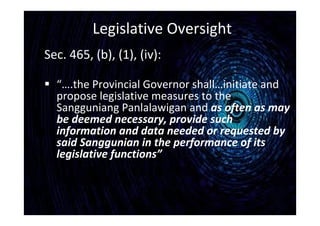
Sec. 465, (b), (1), (i):
“…the Provincial Governor shall….determine
the guidelines of provincial policies and be
responsible to the Sangguniang
Panlalawigan for the program of
Government,”
Legislative Oversight
Sec. 465, (b), (1), (iii):
 “…..the Provincial Governor shall….present the
program of the government and propose
policies and projects for the consideration of the
Sangguniang Panlalawigan at the opening of
the regular session of the Sangguniang
Panlalawigan every calendar year and as often as
may be deemed necessary as the general
welfare of the inhabitants and the needs of the
provincial government may require”
Legislative Oversight
Sec. 465, (b), (1), (iv):
 “….the Provincial Governor shall…initiate and
propose legislative measures to the
Sangguniang Panlalawigan and as often as may
be deemed necessary, provide such
information and data needed or requested by
said Sanggunian in the performance of its
legislative functions”
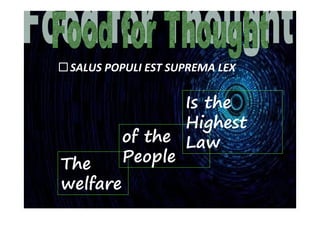
SALUS POPULI EST SUPREMA LEX
The
welfare
of the
People
Is the
Highest
Law

The Local Legislative Process

  • 1.
    4/11/2014 Powers and Functionsof the Sanggunian 4/11/2014 Counc. Margie Lou Humilde Presenter Prof. Josefina B. Bitonio,DPA PA 101 Local Governance and Administration
  • 2.
    Multi- Faceted Powers &Functions of the Sanggunian 2 Revenue Generation Appropriation of Funds OversightLegislationRegulation
  • 3.
    What is Legislation? LEGISLATIO + which means a law or rule proposing which means an act of LEGISLATION The act of proposing a law, rule, or regulation
  • 4.
    Pertinent Provisions ofthe LGC  General provisions on local legislation: Sections 48-59  Functions of the Sangguniang Barangay: Section 391  Functions of the Sangguniang Bayan: Section 447  Functions of the Sangguniang Panlungsod: Section 458  Functions of the Sangguniang Panlalawigan: Section 468
  • 5.
    Pertinent Provisions ofthe LGC General Welfare Clause: Section 16 Service Delivery Areas: Section 17 Corporate Powers: Section 22 Roles of Local Governments: Sections 384, 440, 448 and 459
  • 6.
    Concept of LocalLegislation  As a POWER The Sanggunian’s authority toenact ordinances, approve resolutions, or appropriate funds designed to deliver basic services and facilities, and to promote the general welfare  As a PROCESS The Sanggunian’s continuous interaction with LGU’s executive branch, constituents, civil society and other actors of governance, resulting in policy actions that promote the development of the locality
  • 7.
    Local Legislative Power Sincetime immemorial, LGUs can legislate on purely local matters Local legislators are more knowledgeable than Congress on matters of purely local concern, and in better position to enact appropriate legislation LGUs’ lawmaking powers are not merely by Congress’ good graces; they have been vested by the Constitution itself
  • 8.
    Where is LocalLegislative Power Vested Section 48 of the LGC states that legislative power is vested in the Sanggunian as a collegial, collective body Legislation therefore requires the participation of all its members by voting upon every question put upon the body The term “Sanggunian” suggests more than just a law-making body
  • 9.
    Presiding Officer  Section49: the Vice Governor/ Vice Mayor shall be the Sanggunian’s regular presiding officer  Section 457: the Vice Governor/ Vice Mayor is an integral part in the composition of the council  To preserve neutrality, the Vice Governor/ Vice Mayor shall vote only to break a tie  The Vice Governor/Vice Mayor is not a mere spare tire or decorative position ; he/she is the head administrator of the legislative assembly
  • 10.
  • 11.
    Internal Rules ofProcedure  On the first regular session after the election and within the 90 days, the Sanggunian must adopt or update its house rules, providing for:  Organization and election of Officers  Creation of Committees  Order and Calendar of Business  The Legislative process  Disciplinary sanctions on members for disorderly behavior and unjustified absences
  • 12.
    Duty to DiscloseConflict of Interest  Every Sanggunian Member must fully disclose any financial/ business/ professional/ personal interest with any person or entity affected by an ordinance under its consideration  “Conflict of interest”- ethical considerations suggesting that a public official should be inhibited from performing an official function because of clash between public interest and his/her private pecuniary interest
  • 13.
    Regular and SpecialSessions 13 Regular Session Special Session  Held on designated day, time and place  No need for written notice  Any agenda maybe discussed  Held at least once a week Maybe called by LCE or majority of members  Held on day, time and place specified in written notice  Only stated agenda may be discussed
  • 14.
    Quorum  Majority ofall members who have been “elected and qualified” (not those were voted upon)  The term majority means “more than half”  Jurisprudence tells us that the Vice Governor/ Vice Mayor is included in the computation of the quorum
  • 15.
    When are MeasuresDeemed Approved  Simple Ordinance: majority of members present there being a quorum  Ordinance authorizing payment of money or creation of liability: majority of all members
  • 16.
    When are MeasuresDeemed Approved  3 Modes of approving measures: 1. LCE signs all pages of enacted measure 2. LCE does not act on the measure within 10 days 3. LCE vetoes measure, but Sanggunian overrides it by 2/3 vote of all members
  • 17.
    Veto Power ofthe LCE  Grounds for exercise of veto: 1. That the ordinance is “ultra vires” 2. That the ordinance is prejudicial to the public welfare  Must be in writing, specifying the grounds and reasons for its exercise  Punong Barangay has no veto power  Sanggunian override cannot be further overridden by the LCE
  • 18.
    Legislative Review SANGGUNIAN Transmit lower- levelordinances within 3 days in case of cities/municipaliti es (or 10 days in case of Barangays) from enactment Fails to take action within 30 days allowing lower-level ordinance to “lapse into law” Returns lower-level measures enacted beyond the LGU’s authority, 9 or inconsistent with law or city ordinance) within 30 days for adjustment /amendment Cities/Municipalities /Barangays
  • 19.
    Effectivity of Ordinances Ordinance can provide for its own date of affectivity  If ordinance is silent, then it shall take effect after the lapse of 10 days from date of its publication  Approved measures shall be posted/disseminated in Filipino or English  Gist of penal ordinances must be published in newspaper of general circulation  In case of HUCs, measures must be posted and published in newspaper of general circulation
  • 20.
    Specific Subjects ofLegislation  Delivery of basic services and facilities (Sec. 17)  Review of Legislative measures and executive orders from lower- level LGUs ( Sec. 447, 458, and 468)  Maintain peace and order  Prescribe penalties for violations of ordinances  Protect the environment
  • 21.
    Specific Subjects ofLegislation  Protect inhabitants from man-made or natural disasters and calamities  Provide for creation of local offices  Grant incentives to public servants  Grant tax exemptions  Grant franchises and licenses
  • 22.
    Specific Subjects ofLegislation  Grant fishing privileges  Grant scholarships  Grant loans/ financial assistance to other LGUs  Provide for operation of vocational and technical schools  Provide for care of vulnerable persons
  • 23.
    Areas of Regulation Regulate the establishment and operation of identified businesses or enterprises  Regulate practice of professions or occupations not covered by government licensing examinations  Regulate land use, reclassify land, and enact zoning ordinances  Regulate use of property, e.g., land, buildings, and structures
  • 24.
    Areas of Regulation Regulate subdivisions  Regulate construction/operation of private markets, talipapas, etc.  Regulate selling of food commodities  Regulate streets and other public places  Regulate tricycles and pedicabs
  • 25.
    Legislative Oversight  Refersto the review and monitoring of executive agencies, programs, activities, and policy implementation  Exercised through legislative authorization, appropriations, investigations, and hearings  An implied power that derives from the legislature’s “power of the purse”  An integral part of the constitutional system of checks and balances
  • 26.
    Legislative Oversight  Animplied rather than an enumerated power under the Constitution of the LGC  The law does not explicitly grant local councils the authority to conduct inquiries or investigations of the executive, to have access to records or materials held by the executive, or to issue subpoenas for documents or testimony from the executive
  • 27.
    Legislative Oversight  Derivesfrom the many express powers of the Sanggunian: to appropriate funds, to enact laws, and to concur to executive appointments  The legislature could not reasonably or responsibly exercise these powers without knowing what the executives are doing; how programs are being administered; by whom, and at what cost, and whether officials are complying with legislative intent
  • 28.
    Purposes of Oversight Improvethe efficiency, economy and effectiveness of governmental operations Evaluate programs and performance Detect and prevent poor administration, waste, abuse and arbitrary behavior Inform the general public and ensure that executive policies reflect the public interest
  • 29.
    Purposes of Oversight Gather information to develop new legislative proposals or to amend exiting statutes  Ensure administrative compliance with legislative intent
  • 30.
    Legislative Oversight Sec. 465,(b), (1), (i): “…the Provincial Governor shall….determine the guidelines of provincial policies and be responsible to the Sangguniang Panlalawigan for the program of Government,”
  • 31.
    Legislative Oversight Sec. 465,(b), (1), (iii):  “…..the Provincial Governor shall….present the program of the government and propose policies and projects for the consideration of the Sangguniang Panlalawigan at the opening of the regular session of the Sangguniang Panlalawigan every calendar year and as often as may be deemed necessary as the general welfare of the inhabitants and the needs of the provincial government may require”
  • 32.
    Legislative Oversight Sec. 465,(b), (1), (iv):  “….the Provincial Governor shall…initiate and propose legislative measures to the Sangguniang Panlalawigan and as often as may be deemed necessary, provide such information and data needed or requested by said Sanggunian in the performance of its legislative functions”
  • 33.
    SALUS POPULI ESTSUPREMA LEX The welfare of the People Is the Highest Law