LOCAL
GOVERNME
NT UNIT
Content
Standards:
•DECENTRALIZATION
AND LOCAL
GOVERNANCE
MELCS: •Explain the roles
and functions of
Local
Government
unit.
SPECIFIC
OBJECTIVES
• Define local government;
• Identify the different levels of
Philippine Local Government;
• Differentiate each level of the
Philippine Local Government;
• Distinguish the criteria for the
creation, conversion, division,
merger and abolition of each
local government units; and
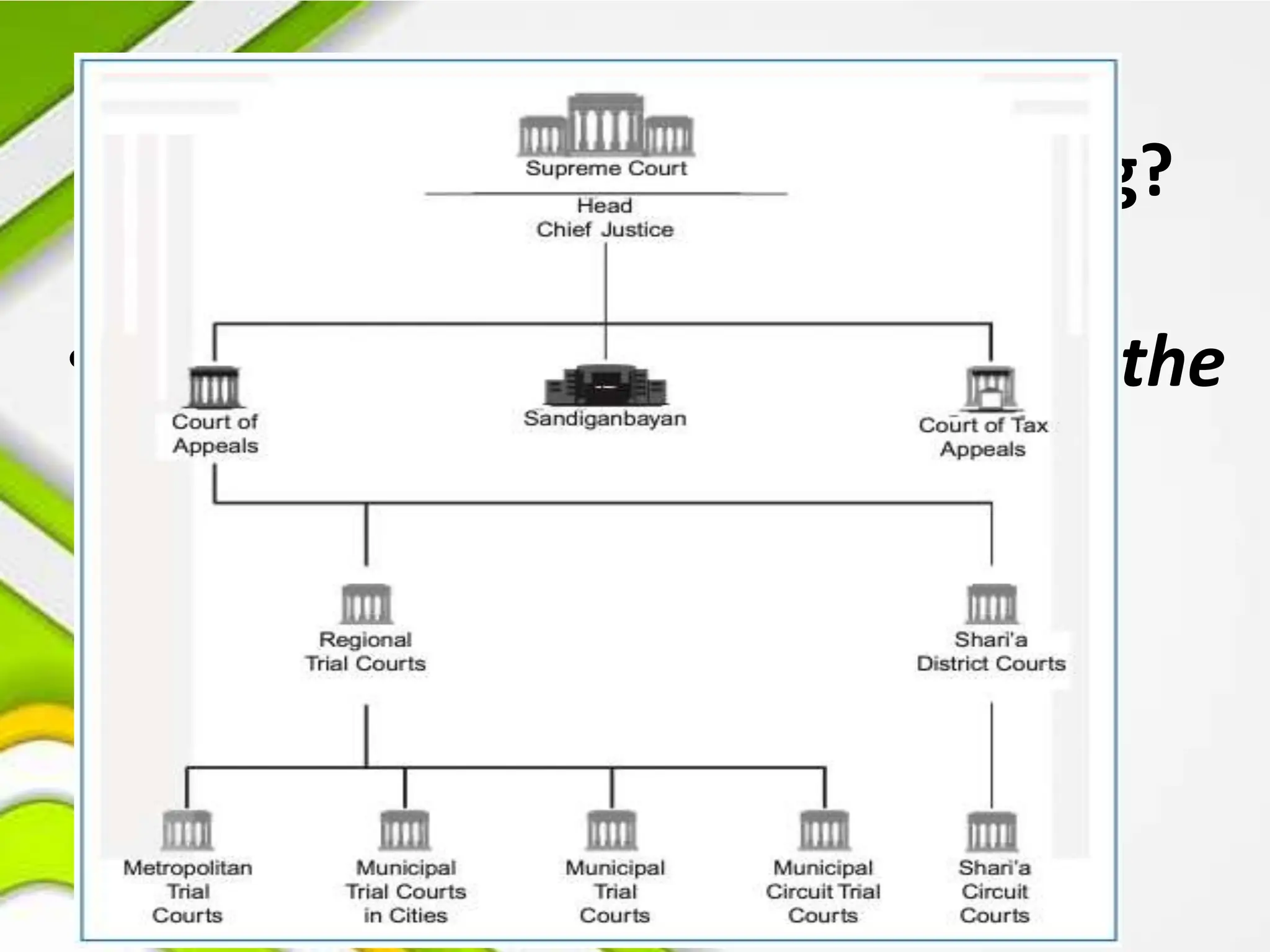
What was our topic last meeting?
• About the Judicial system in the
Philippines
What was our topic last meeting?
• About the Judicial system in the
Philippines
PRE-ASSESSMENT
1. What law constitutes the local
government unit?
a. R.A 7610
b. R.A 7160
c. R.A 9262
d. R.A. 6710
PRE-ASSESSMENT
2. Which of the following is the transfer
of powers and authorities to lower
level local government units?
a. Debueacratization
b. Deconcentration
c. DEvolution
PRE-ASSESSMENT
3. Who exercises both executive and
legislative functions?
a. governor
b. mayor
c. President
d. Punong barangay
PRE-ASSESSMENT
4. What is the annual income
requirement the creation of city ?
a. 2.5 million
b. 100 million
c. 200 million
d. 1 billion
PRE-ASSESSMENT
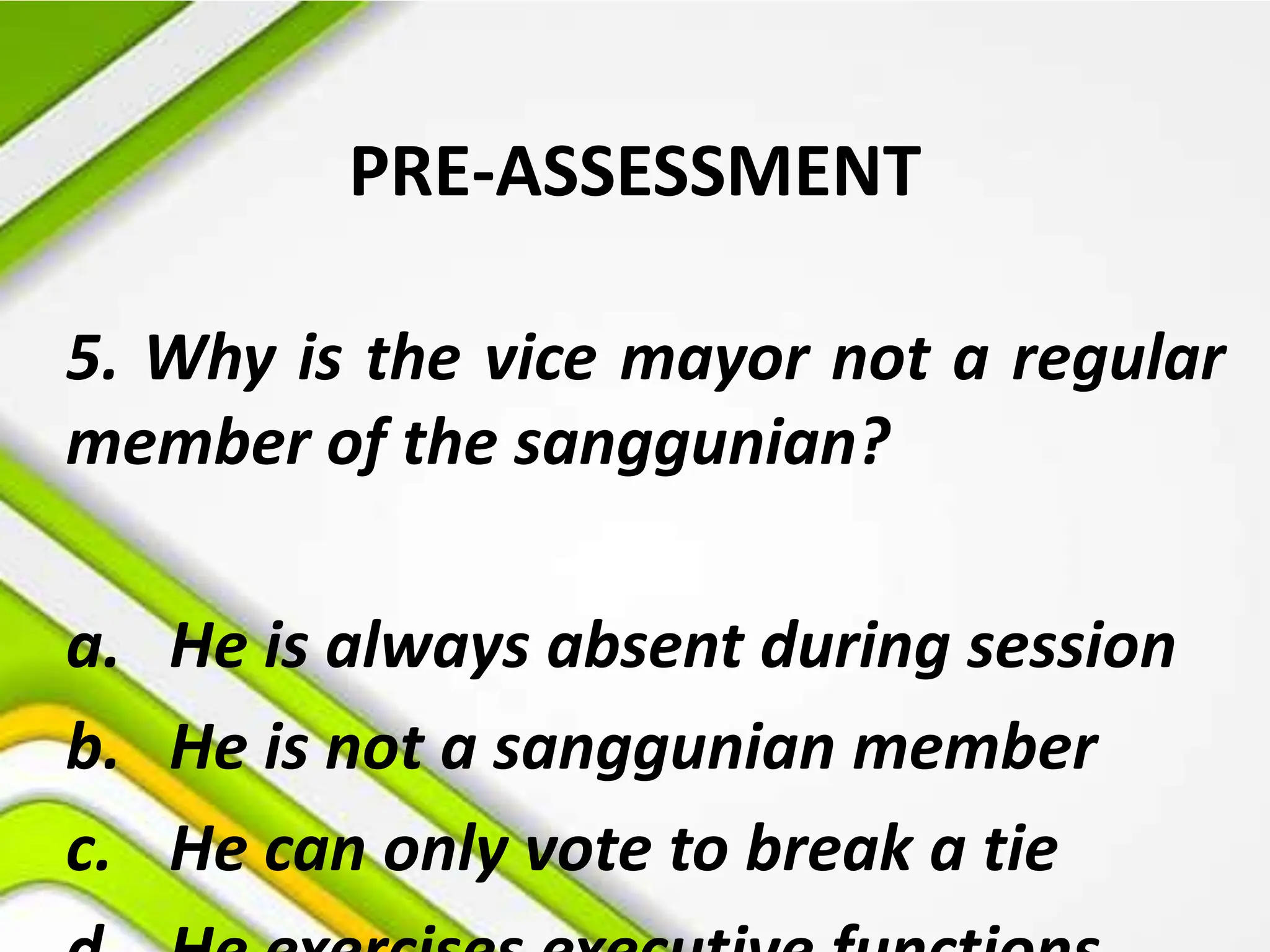
5. Why is the vice mayor not a regular
member of the sanggunian?
a. He is always absent during session
b. He is not a sanggunian member
c. He can only vote to break a tie
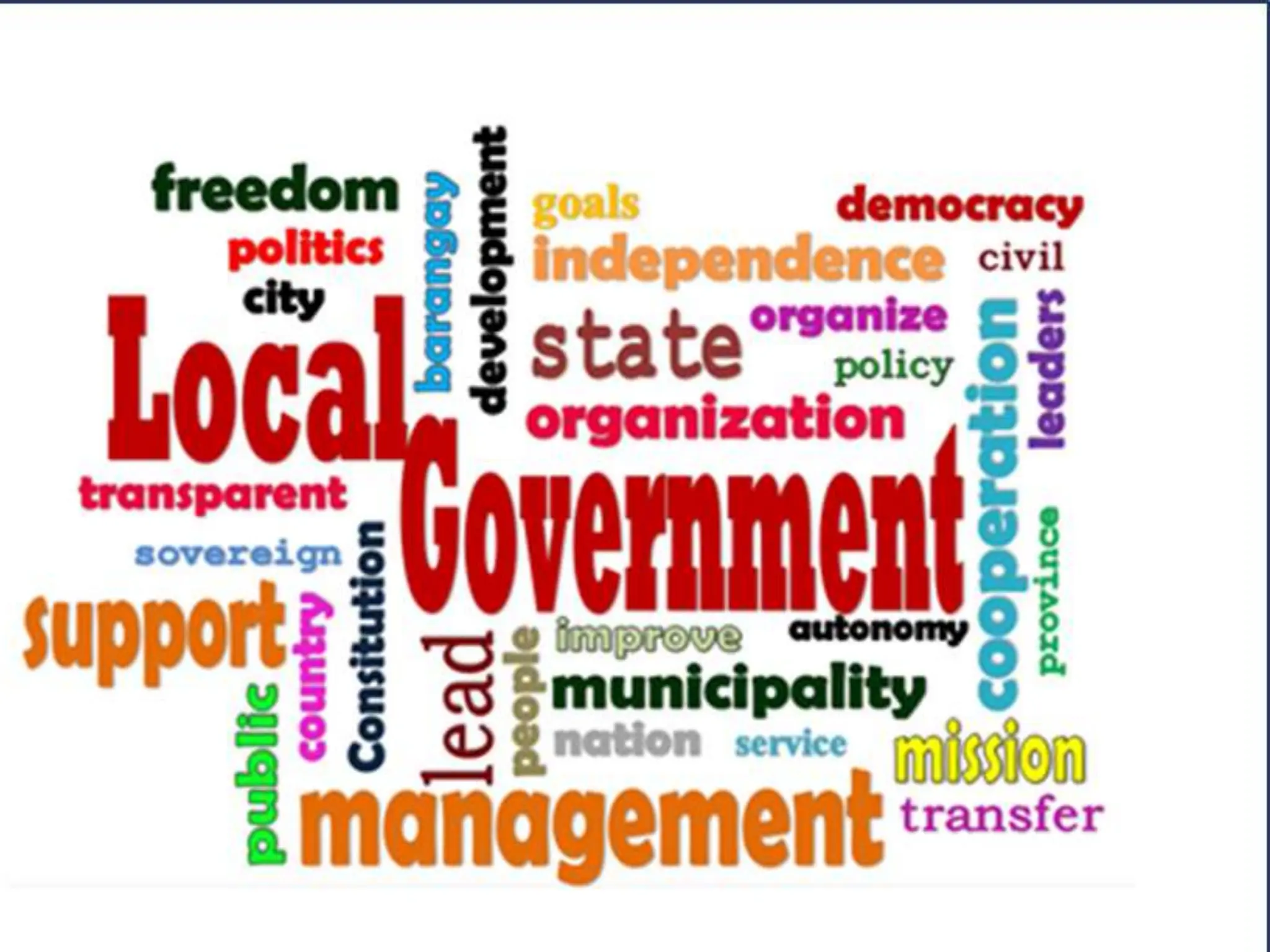
1. Pick three (3) words from the
box below that you think are
related to local government.
2. Write down other words that
are related to the words that
you chose.
Activity
Activity
ANALYSIS
ANALYSIS
ANALYSIS
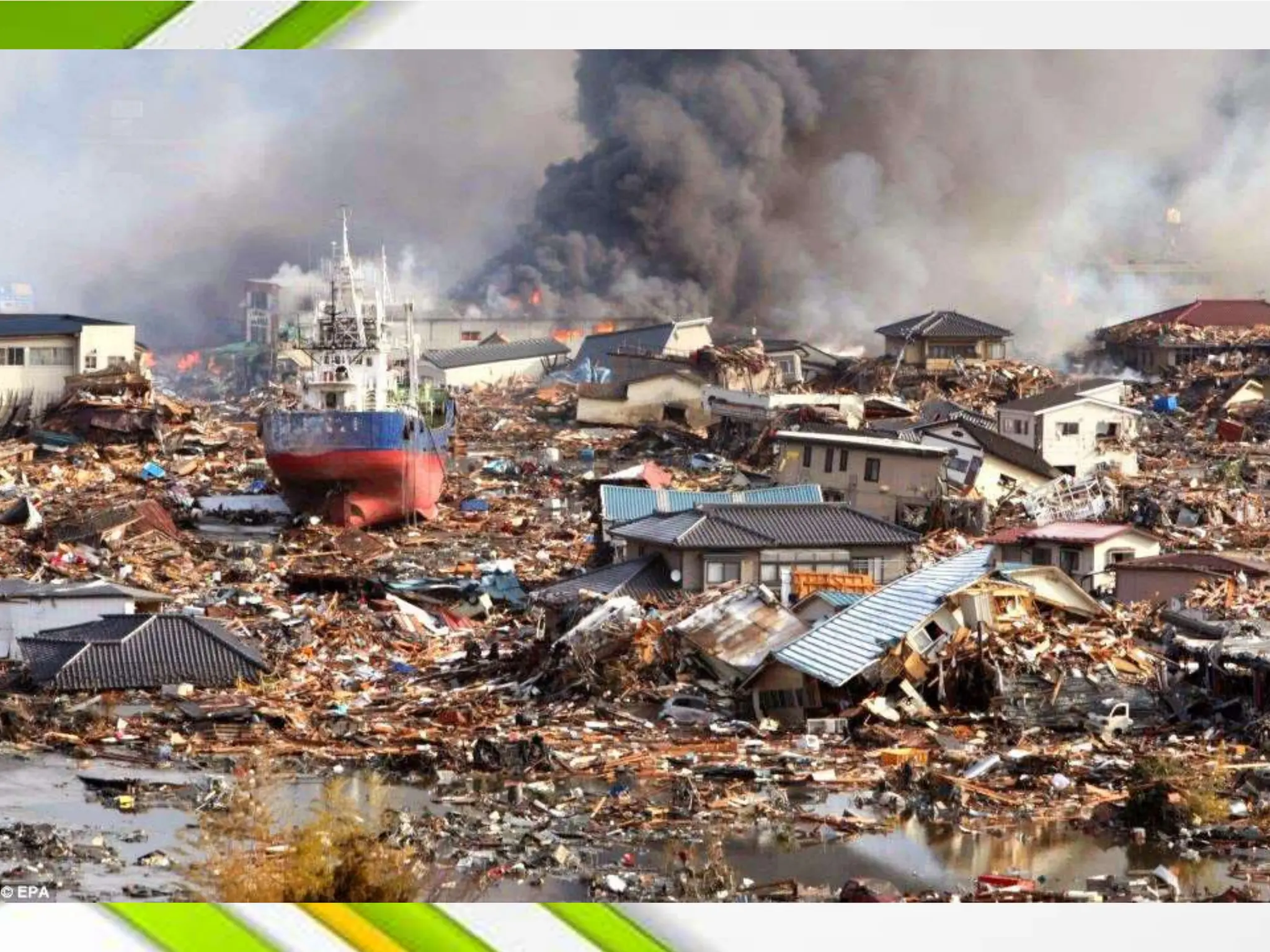
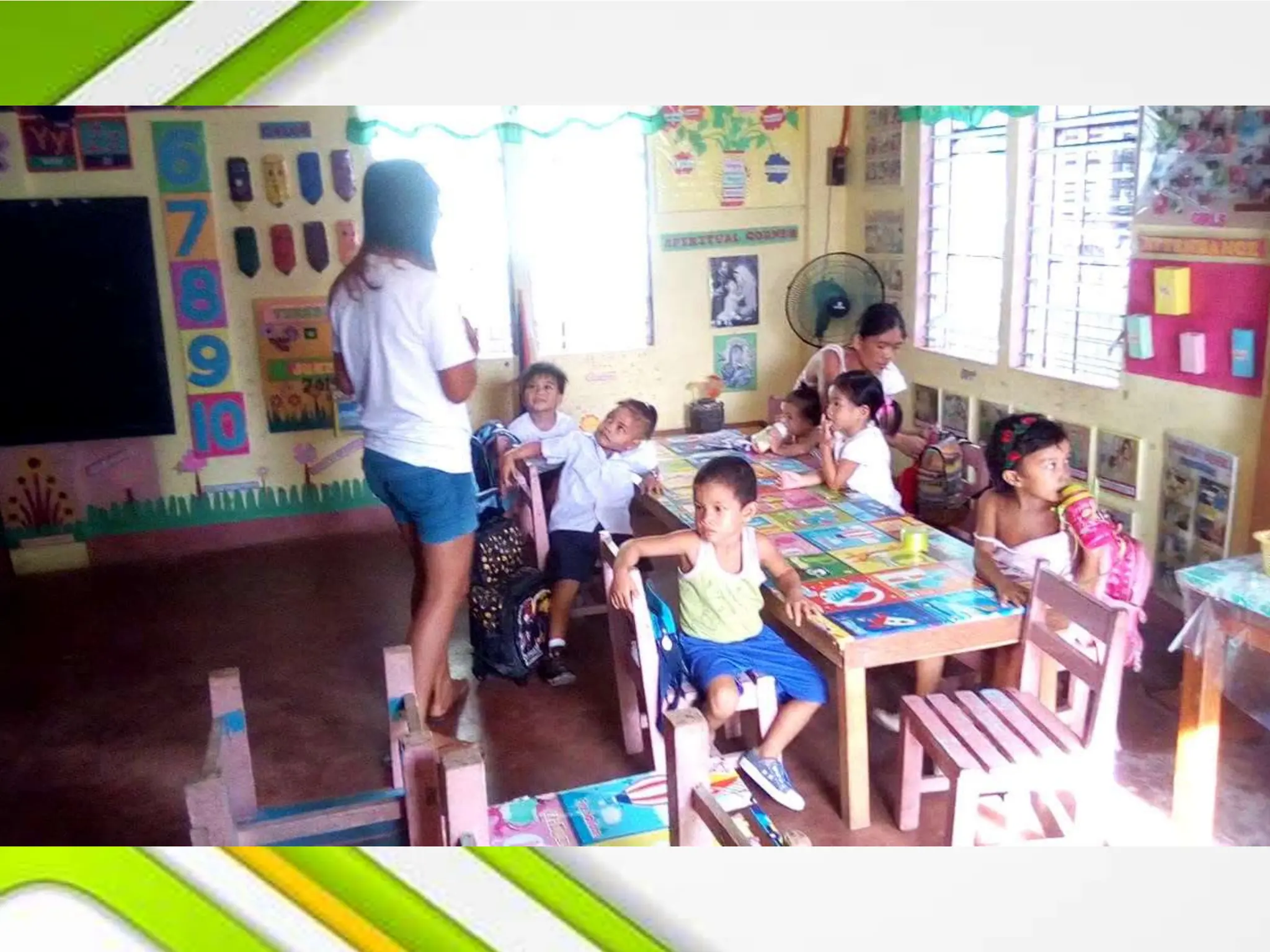
1. Based on the pictures presented,
what government immediately
reacts in disaster/calamities?
Local government or central
government?
2. Who responds immediately before,
during and after disaster/calamities?
What is Decentralization?
BSTRACTION:
- the transfer of authority and
responsibility for public functions
from the central government to
subordinate or quasi-independent
government organizations and/or
the private sector—is a complex
multifaceted concept.
What are the forms of
decentralization?
1. devolution,
2. deconcentration, and
3. debureaucratization
DEVOLUTION
- the transfer of powers and authorities to lower
level local government units.
A local government essentially has the following
major features:
-* it has an elected local executive;
- * it has an elected local legislative body that
passes local laws/ordinances;
-* it has specific taxing powers; and
-* it has jurisdiction over a certain defined
geographical area.
- The notion of devolution has always been related
to that of local autonomy. Devolution is political in
nature.
DECONSTRUCTION
- the transfer of functions to lower level
administrative units designated by the
central office. It is essentially a management
tool to decongest the central office and spare
it from having to act on matters, including
routine and administrative matters that may
best be addressed at the lower levels.
However, final and "substantive" authority
still rests in the central authorities.
* therefore is mostly administrative in nature.
DEBUCREAUCRATIZATION
- the transfer of certain powers and authorities to
nongovernmental organization (NGOs) and people’s
organization (POs), including private sectors, all of
which are sometimes collectively called “civil
society”.
It also harnesses the energies to private sector to
bring about good governance.
What is a local government unit?
• a political and corporate body
endowed with powers to be exercised
by it in conformity with law. (LGC
sec.15)
• a political subdivision of a nation or
state which is constituted by law and
substantial control of local affairs.
(supreme court)
What constitutes the local government
unit?
- R.A 7160 known as local government
code 0f 1991
- Sen. Aquilino “nene” Pimentel - the
father of local government code
What are the branches of government?
•Executive
•Legislative
•Judiciary
What are the three levels
of Local government unit
(LGU)?
Territorial subdivisions/ levels LGU
1. province,
2. city/municipality,
3. barangay
What is the difference
among the local
government units?
PROVINCE
is the intermediate unit
composed of a cluster of
municipalities and
component cities.
PROVINCE
As a political and corporate unit of the
government, it serves as a dynamic
mechanism for developmental
processes and effective governance of
the local government units within its
territorial jurisdiction
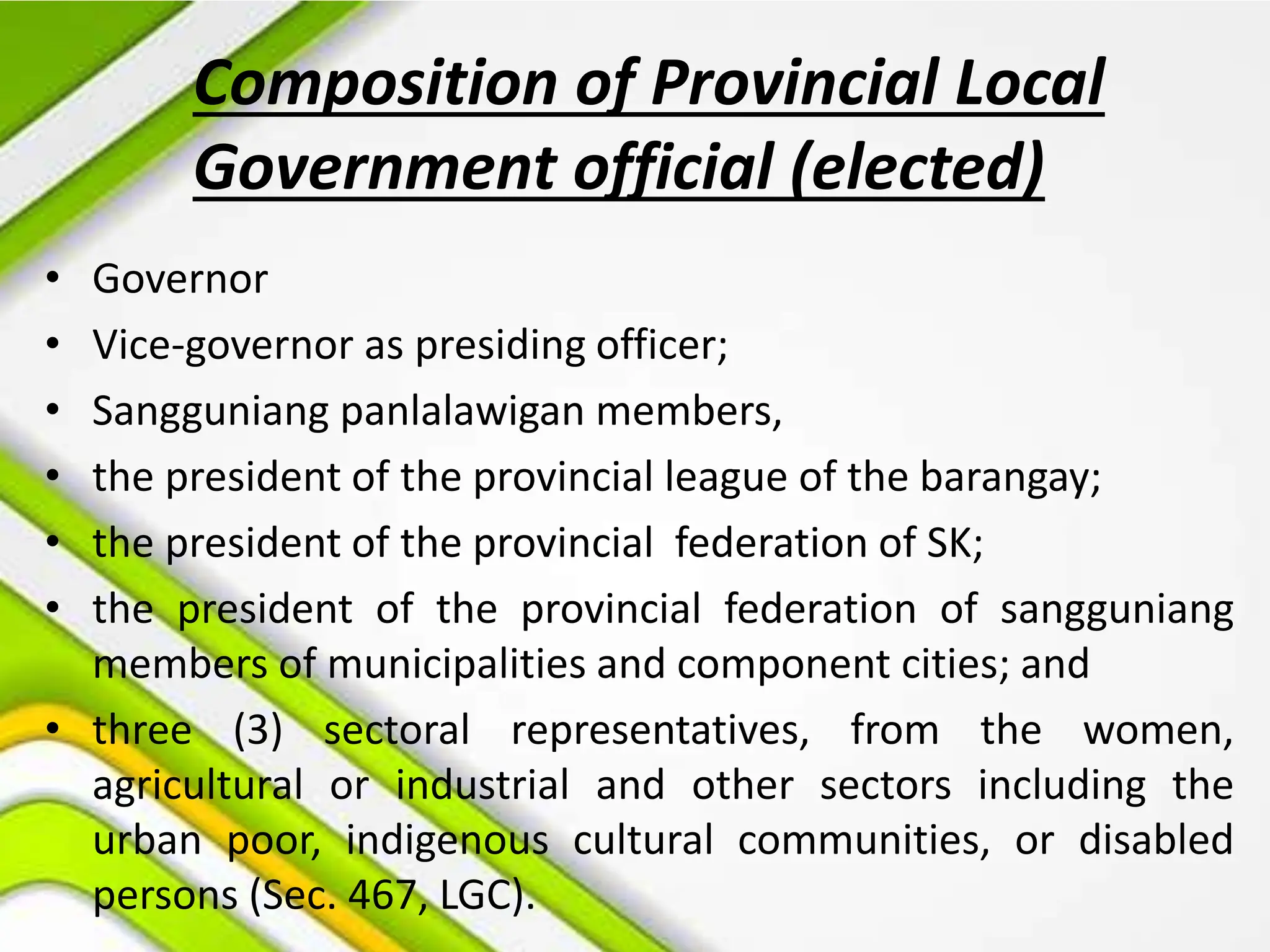
Composition of Provincial Local
Government official (elected)
• Governor
• Vice-governor as presiding officer;
• Sangguniang panlalawigan members,
• the president of the provincial league of the barangay;
• the president of the provincial federation of SK;
• the president of the provincial federation of sangguniang
members of municipalities and component cities; and
• three (3) sectoral representatives, from the women,
agricultural or industrial and other sectors including the
urban poor, indigenous cultural communities, or disabled
persons (Sec. 467, LGC).
CITY
serves as a general-purpose
government for the coordination and
delivery of basic, regular, and direct
services and effective governance of
the inhabitants within its territorial
jurisdiction (Sec. 448, LGC)
Types of city
1. Highly Urbanized City (200,000)
inhabitants, and the latest annual
income of at least Fifty Million Pesos
(P50,000,000) (Sec. 452[a], LGC).
Examples: Metro Manila, Quezon City,
Cebu City, and Butuan City.
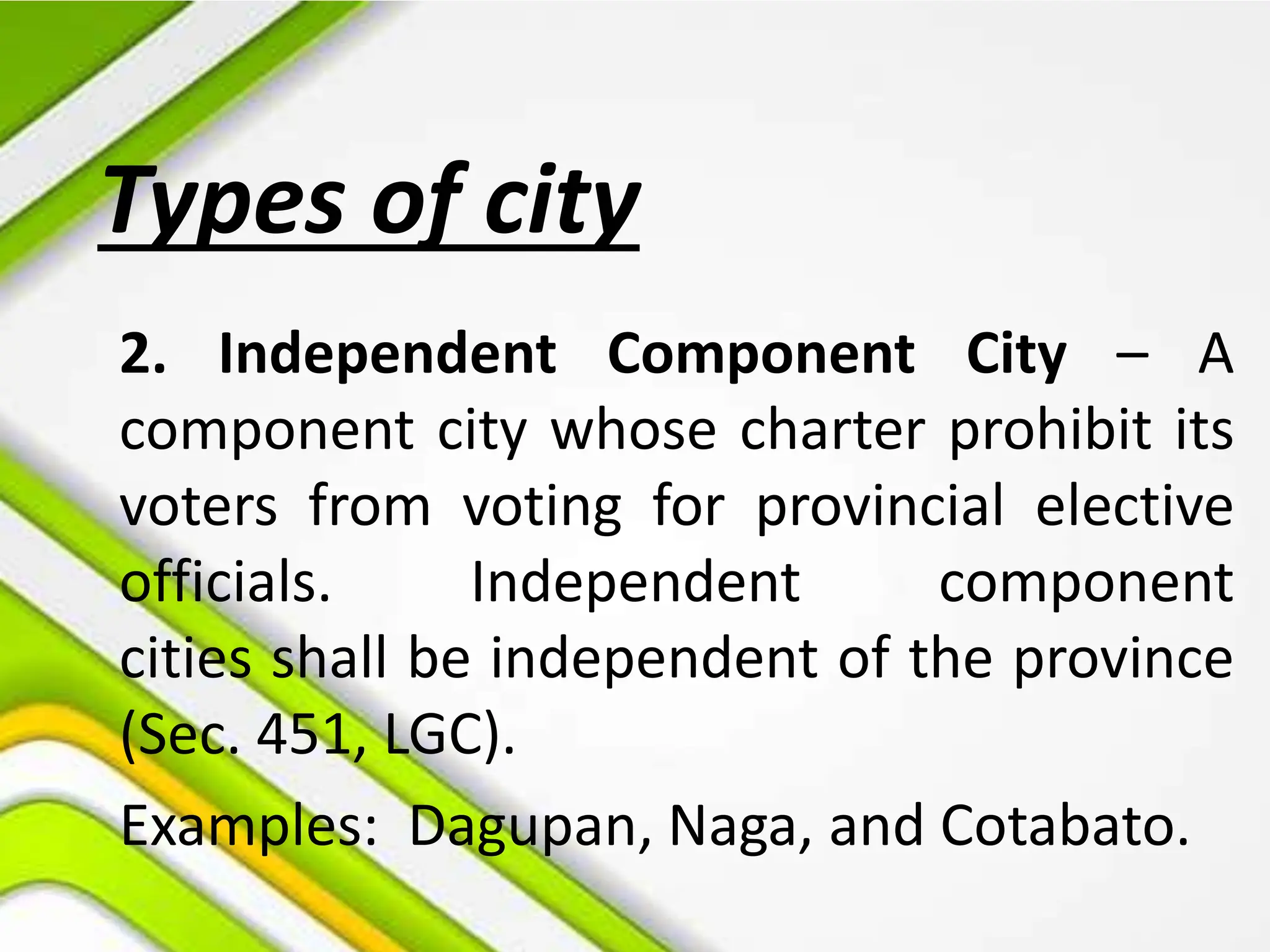
Types of city
2. Independent Component City – A
component city whose charter prohibit its
voters from voting for provincial elective
officials. Independent component
cities shall be independent of the province
(Sec. 451, LGC).
Examples: Dagupan, Naga, and Cotabato.
Types of city
• Component City – A city which did not meet
the requirements of a highly urbanized city
are deemed part of the province in which they
are geographically located. If a component
city is located along the boundaries of two or
more provinces, it shall be considered part of
the province of which it used to be a
municipality (Sec. 452[b], LGC).
• Example: Tarlac, Antipolo,
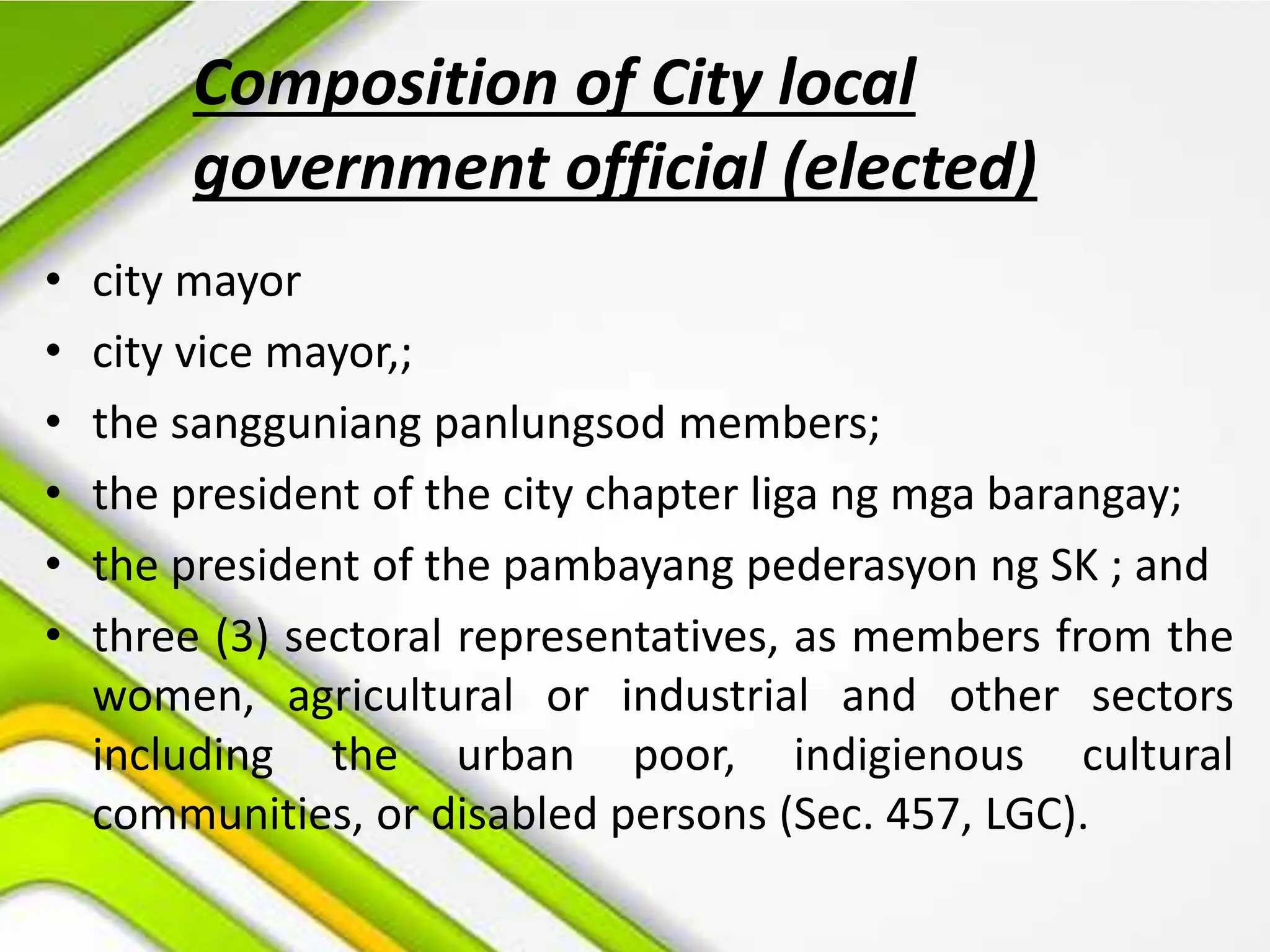
Composition of City local
government official (elected)
• city mayor
• city vice mayor,;
• the sangguniang panlungsod members;
• the president of the city chapter liga ng mga barangay;
• the president of the pambayang pederasyon ng SK ; and
• three (3) sectoral representatives, as members from the
women, agricultural or industrial and other sectors
including the urban poor, indigienous cultural
communities, or disabled persons (Sec. 457, LGC).
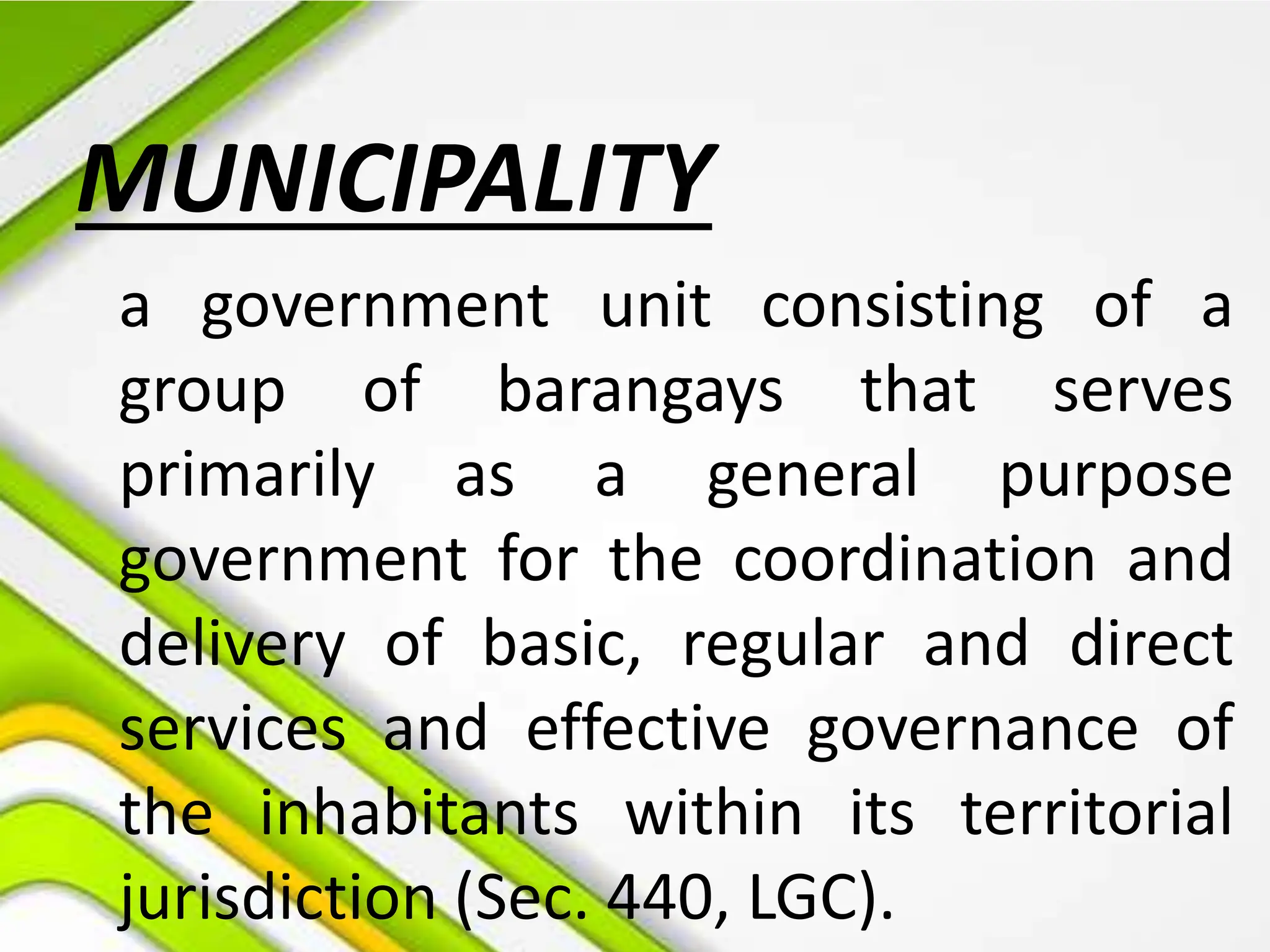
MUNICIPALITY
a government unit consisting of a
group of barangays that serves
primarily as a general purpose
government for the coordination and
delivery of basic, regular and direct
services and effective governance of
the inhabitants within its territorial
jurisdiction (Sec. 440, LGC).
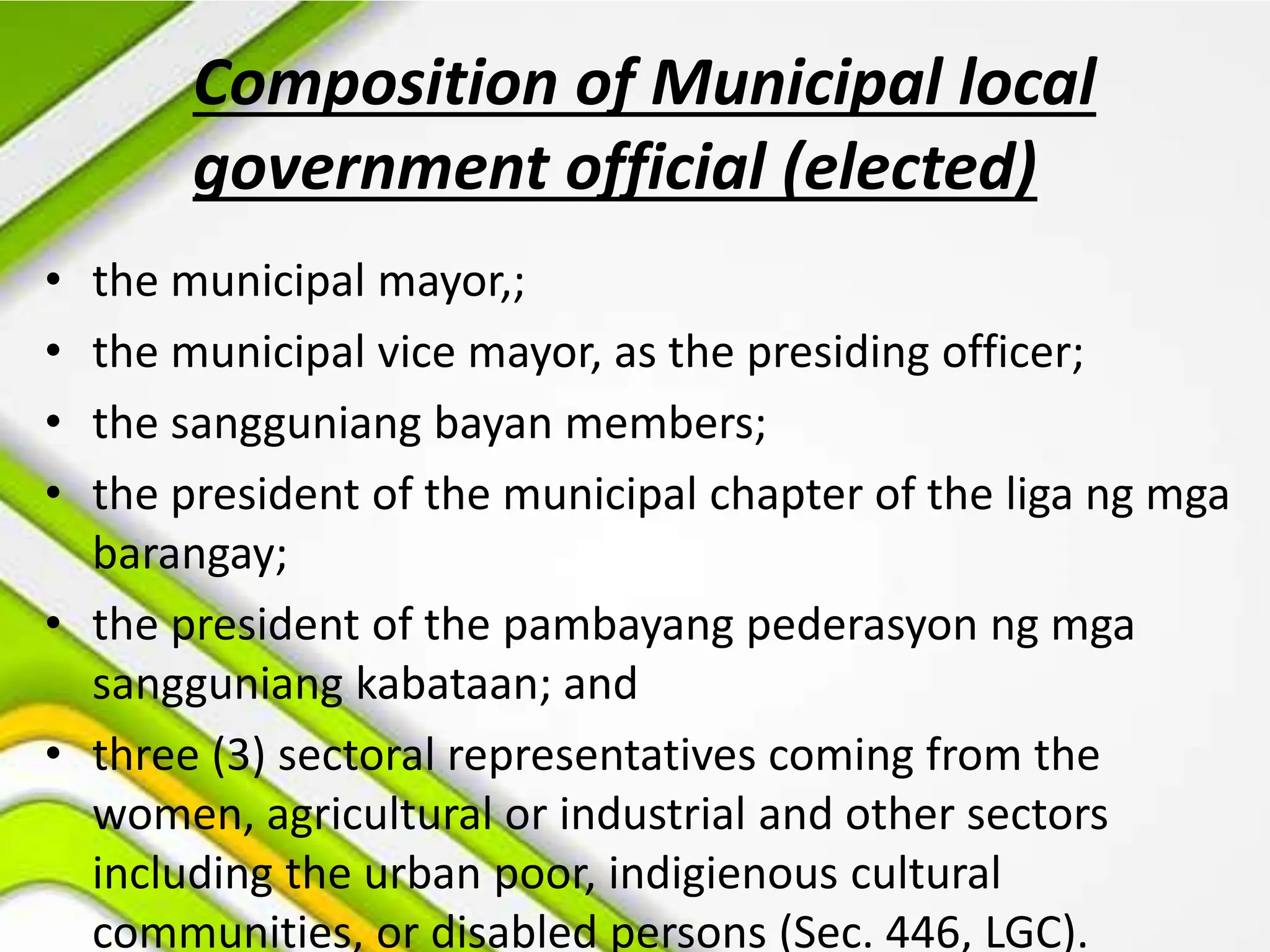
Composition of Municipal local
government official (elected)
• the municipal mayor,;
• the municipal vice mayor, as the presiding officer;
• the sangguniang bayan members;
• the president of the municipal chapter of the liga ng mga
barangay;
• the president of the pambayang pederasyon ng mga
sangguniang kabataan; and
• three (3) sectoral representatives coming from the
women, agricultural or industrial and other sectors
including the urban poor, indigienous cultural
communities, or disabled persons (Sec. 446, LGC).
How many branches are there in
the local government unit?
•Executive
•legislative
Who are the local chief executive
of these Local government?
•provinces,
•Cities/municipalities,
•and barangays
• exercises general
supervision and control over
all programs, projects,
services, and activities of the
provincial government
GOVERNOR
• it shall exercise general
supervision and control over all
programs, projects, services,
and activities of the municipal
government.
MAYOR
• It shall serve as chief executive
and presiding officer in the
sangguanian that serves as the
primary planning and
implementing unit of
government policies, plans,
programs, projects, and activities
in the community.
PUNONG BARANGAY
•Governor
•Mayor,
•Punong Barangay
Who are the law makers/ local
legislators of these Local government?
•provinces,
•Cities/municipalities,
•and barangays
• Sangguniang
Panlalawigan
• Sangguniang Panlungsod/
Bayan,
• Sangguniang Barangay
What composes this law making body?
•provinces,
•Cities/municipalities,
•and barangays
CREATION, CONVERSION, DIVISION,
MERGER AND ABOLITION OF LGUs
• a province, city, municipality, or barangay shall be
created, divided, merged, abolished or its boundary
substantially altered, in accordance with the criteria
established in the local government code and subject
to approval by a majority of the votes cast in a
plebiscite in the political units directly
affected. (Section 10, Article X of the 1987)
CRITERIA
• income,
• population, and
• land area
Barangay
• Population
• 2000
• 5000 urbanized cities
• Sections 385 and 386 LGC
Municipality
• Income – 2.5 M
• Population – at least 25 K
• land area – at least 50 sq
kilometers
• Sections 441 and 442 LGC
City
• Income – 100 M
• Population – at least 150 K
• land area – at least 100 sq.
kilometers
• (Sections 449 and 450)
Province
• Income – 20 M
• Population – at least 250 K
• land area – at least 2000 sq
kilometers
• Sections 460 and 461 LGC
POST ASSESSMENT
1. What law constitutes the local
government unit?
a. R.A 7610 (CHILD PROTECTION LAW)
b. R.A 7160 (Local government code)
c. R.A 9262 (vawc law)
d. R.A. 6710 (Baguio charter)
POST ASSESSMENT
2. Which of the following is the transfer
of powers and authorities to lower
level local government units?
a. Debueacratization (civil society org.)
b. Deconcentration ( appointed officials)
c. Devolution (elected officials)
POST ASSESSMENT
3. Who exercises both executive and
legislative functions?
a. Governor (executive)
b. Mayor (executive)
c. President (executive)
d. Punong barangay (executive and
POST ASSESSMENT
4. What is the annual income
requirement the creation of city ?
a. 2.5 million (municipality)
b. 100 million (city)
c. 200 million highly (Province)
d. 1 billion (not in the constitution)
POST ASSESSMENT
5. Why is the vice mayor not a regular
member of the sanggunian?
a. He is always absent during session (not
true)
b. He is not a sanggunian member (not
true)
c. He can only vote to break a tie (true)
d. He exercises executive functions (not
Thank
you

local government unit.pptx

  • 1.
  • 2.
  • 3.
    MELCS: •Explain theroles and functions of Local Government unit.
  • 4.
    SPECIFIC OBJECTIVES • Define localgovernment; • Identify the different levels of Philippine Local Government; • Differentiate each level of the Philippine Local Government; • Distinguish the criteria for the creation, conversion, division, merger and abolition of each local government units; and
  • 5.
    What was ourtopic last meeting?
  • 6.
    What was ourtopic last meeting? • About the Judicial system in the Philippines
  • 7.
    What was ourtopic last meeting? • About the Judicial system in the Philippines
  • 8.
    PRE-ASSESSMENT 1. What lawconstitutes the local government unit? a. R.A 7610 b. R.A 7160 c. R.A 9262 d. R.A. 6710
  • 9.
    PRE-ASSESSMENT 2. Which ofthe following is the transfer of powers and authorities to lower level local government units? a. Debueacratization b. Deconcentration c. DEvolution
  • 10.
    PRE-ASSESSMENT 3. Who exercisesboth executive and legislative functions? a. governor b. mayor c. President d. Punong barangay
  • 11.
    PRE-ASSESSMENT 4. What isthe annual income requirement the creation of city ? a. 2.5 million b. 100 million c. 200 million d. 1 billion
  • 12.
    PRE-ASSESSMENT 5. Why isthe vice mayor not a regular member of the sanggunian? a. He is always absent during session b. He is not a sanggunian member c. He can only vote to break a tie
  • 13.
    1. Pick three(3) words from the box below that you think are related to local government. 2. Write down other words that are related to the words that you chose. Activity
  • 14.
  • 15.
  • 16.
  • 17.
  • 18.
    1. Based onthe pictures presented, what government immediately reacts in disaster/calamities? Local government or central government? 2. Who responds immediately before, during and after disaster/calamities?
  • 19.
  • 20.
    - the transferof authority and responsibility for public functions from the central government to subordinate or quasi-independent government organizations and/or the private sector—is a complex multifaceted concept.
  • 21.
    What are theforms of decentralization?
  • 22.
    1. devolution, 2. deconcentration,and 3. debureaucratization
  • 23.
    DEVOLUTION - the transferof powers and authorities to lower level local government units. A local government essentially has the following major features: -* it has an elected local executive; - * it has an elected local legislative body that passes local laws/ordinances; -* it has specific taxing powers; and -* it has jurisdiction over a certain defined geographical area. - The notion of devolution has always been related to that of local autonomy. Devolution is political in nature.
  • 24.
    DECONSTRUCTION - the transferof functions to lower level administrative units designated by the central office. It is essentially a management tool to decongest the central office and spare it from having to act on matters, including routine and administrative matters that may best be addressed at the lower levels. However, final and "substantive" authority still rests in the central authorities. * therefore is mostly administrative in nature.
  • 25.
    DEBUCREAUCRATIZATION - the transferof certain powers and authorities to nongovernmental organization (NGOs) and people’s organization (POs), including private sectors, all of which are sometimes collectively called “civil society”. It also harnesses the energies to private sector to bring about good governance.
  • 26.
    What is alocal government unit?
  • 27.
    • a politicaland corporate body endowed with powers to be exercised by it in conformity with law. (LGC sec.15) • a political subdivision of a nation or state which is constituted by law and substantial control of local affairs. (supreme court)
  • 28.
    What constitutes thelocal government unit?
  • 29.
    - R.A 7160known as local government code 0f 1991 - Sen. Aquilino “nene” Pimentel - the father of local government code
  • 30.
    What are thebranches of government?
  • 31.
  • 32.
    What are thethree levels of Local government unit (LGU)?
  • 33.
    Territorial subdivisions/ levelsLGU 1. province, 2. city/municipality, 3. barangay
  • 34.
    What is thedifference among the local government units?
  • 35.
    PROVINCE is the intermediateunit composed of a cluster of municipalities and component cities.
  • 36.
    PROVINCE As a politicaland corporate unit of the government, it serves as a dynamic mechanism for developmental processes and effective governance of the local government units within its territorial jurisdiction
  • 37.
    Composition of ProvincialLocal Government official (elected) • Governor • Vice-governor as presiding officer; • Sangguniang panlalawigan members, • the president of the provincial league of the barangay; • the president of the provincial federation of SK; • the president of the provincial federation of sangguniang members of municipalities and component cities; and • three (3) sectoral representatives, from the women, agricultural or industrial and other sectors including the urban poor, indigenous cultural communities, or disabled persons (Sec. 467, LGC).
  • 38.
    CITY serves as ageneral-purpose government for the coordination and delivery of basic, regular, and direct services and effective governance of the inhabitants within its territorial jurisdiction (Sec. 448, LGC)
  • 39.
    Types of city 1.Highly Urbanized City (200,000) inhabitants, and the latest annual income of at least Fifty Million Pesos (P50,000,000) (Sec. 452[a], LGC). Examples: Metro Manila, Quezon City, Cebu City, and Butuan City.
  • 40.
    Types of city 2.Independent Component City – A component city whose charter prohibit its voters from voting for provincial elective officials. Independent component cities shall be independent of the province (Sec. 451, LGC). Examples: Dagupan, Naga, and Cotabato.
  • 41.
    Types of city •Component City – A city which did not meet the requirements of a highly urbanized city are deemed part of the province in which they are geographically located. If a component city is located along the boundaries of two or more provinces, it shall be considered part of the province of which it used to be a municipality (Sec. 452[b], LGC). • Example: Tarlac, Antipolo,
  • 42.
    Composition of Citylocal government official (elected) • city mayor • city vice mayor,; • the sangguniang panlungsod members; • the president of the city chapter liga ng mga barangay; • the president of the pambayang pederasyon ng SK ; and • three (3) sectoral representatives, as members from the women, agricultural or industrial and other sectors including the urban poor, indigienous cultural communities, or disabled persons (Sec. 457, LGC).
  • 43.
    MUNICIPALITY a government unitconsisting of a group of barangays that serves primarily as a general purpose government for the coordination and delivery of basic, regular and direct services and effective governance of the inhabitants within its territorial jurisdiction (Sec. 440, LGC).
  • 44.
    Composition of Municipallocal government official (elected) • the municipal mayor,; • the municipal vice mayor, as the presiding officer; • the sangguniang bayan members; • the president of the municipal chapter of the liga ng mga barangay; • the president of the pambayang pederasyon ng mga sangguniang kabataan; and • three (3) sectoral representatives coming from the women, agricultural or industrial and other sectors including the urban poor, indigienous cultural communities, or disabled persons (Sec. 446, LGC).
  • 45.
    How many branchesare there in the local government unit?
  • 46.
  • 47.
    Who are thelocal chief executive of these Local government? •provinces, •Cities/municipalities, •and barangays
  • 48.
    • exercises general supervisionand control over all programs, projects, services, and activities of the provincial government GOVERNOR
  • 49.
    • it shallexercise general supervision and control over all programs, projects, services, and activities of the municipal government. MAYOR
  • 50.
    • It shallserve as chief executive and presiding officer in the sangguanian that serves as the primary planning and implementing unit of government policies, plans, programs, projects, and activities in the community. PUNONG BARANGAY
  • 51.
  • 52.
    Who are thelaw makers/ local legislators of these Local government? •provinces, •Cities/municipalities, •and barangays
  • 53.
    • Sangguniang Panlalawigan • SangguniangPanlungsod/ Bayan, • Sangguniang Barangay
  • 54.
    What composes thislaw making body? •provinces, •Cities/municipalities, •and barangays
  • 55.
    CREATION, CONVERSION, DIVISION, MERGERAND ABOLITION OF LGUs • a province, city, municipality, or barangay shall be created, divided, merged, abolished or its boundary substantially altered, in accordance with the criteria established in the local government code and subject to approval by a majority of the votes cast in a plebiscite in the political units directly affected. (Section 10, Article X of the 1987)
  • 56.
  • 57.
    Barangay • Population • 2000 •5000 urbanized cities • Sections 385 and 386 LGC
  • 58.
    Municipality • Income –2.5 M • Population – at least 25 K • land area – at least 50 sq kilometers • Sections 441 and 442 LGC
  • 59.
    City • Income –100 M • Population – at least 150 K • land area – at least 100 sq. kilometers • (Sections 449 and 450)
  • 60.
    Province • Income –20 M • Population – at least 250 K • land area – at least 2000 sq kilometers • Sections 460 and 461 LGC
  • 61.
    POST ASSESSMENT 1. Whatlaw constitutes the local government unit? a. R.A 7610 (CHILD PROTECTION LAW) b. R.A 7160 (Local government code) c. R.A 9262 (vawc law) d. R.A. 6710 (Baguio charter)
  • 62.
    POST ASSESSMENT 2. Whichof the following is the transfer of powers and authorities to lower level local government units? a. Debueacratization (civil society org.) b. Deconcentration ( appointed officials) c. Devolution (elected officials)
  • 63.
    POST ASSESSMENT 3. Whoexercises both executive and legislative functions? a. Governor (executive) b. Mayor (executive) c. President (executive) d. Punong barangay (executive and
  • 64.
    POST ASSESSMENT 4. Whatis the annual income requirement the creation of city ? a. 2.5 million (municipality) b. 100 million (city) c. 200 million highly (Province) d. 1 billion (not in the constitution)
  • 65.
    POST ASSESSMENT 5. Whyis the vice mayor not a regular member of the sanggunian? a. He is always absent during session (not true) b. He is not a sanggunian member (not true) c. He can only vote to break a tie (true) d. He exercises executive functions (not
  • 66.