General Principles
Governing Public Officers
Executive Order No. 292
ADMINISTRATIVE CODE OF 1987
Reporter:
Luzelle M. Ferreras
MA (Educ. Mgt)
SECTION 32.
Nature of Public Office
Public office is a public trust. Public
officers and employees must at all times be
accountable to the people, serve them with
the utmost responsibility, integrity, loyalty
and efficiency, act with patriotism and
justice, and lead modest lives.
SECTION 33.
Policy on Change of Citizenship
Public officers and employees owe the
State and the Constitution allegiance at all
times, and any public officer or employee
who seeks to change his citizenship or
acquire the status of an immigrant of
another country during his tenure shall be
dealt with by law.
SECTION 34.
Declaration of Assets, Liabilities and Net
Worth
A public officer or employee shall, upon
assumption of office and as often thereafter
as may be required by law, submit a
declaration under oath of his assets,
liabilities, and net worth.
SECTION 35.
Ethics in Government
All public officers and employees shall
be bound by a Code of Ethics to be
promulgated by the Civil Service
Commission.
SECTION 36.
Inhibition Against Purchase of Property
at Tax Sale
No officer or employee of the
government shall purchase directly or
indirectly any property sold by the
government for the non-payment of any tax,
fee or other public charge. Any such
purchase by an officer or employee shall be
void.
SECTION 37.
Powers Incidental to Taking of
Testimony
When authority to take testimony or
receive evidence is conferred upon any
administrative officer or any non-judicial
person, committee, or other body, such
authority shall include the power to
administer oaths, summon witnesses, and
require the production of documents by a
subpoena duces tecum.
SECTION 38.
Liability of Superior Officers
(1) A public officer shall not be civilly
liable for acts done in the performance of his
official duties, unless there is a clear
showing of bad faith, malice or gross
negligence.
SECTION 38.
Liability of Superior Officers
(2) Any public officer who, without just
cause, neglects to perform a duty within a
period fixed by law or regulation, or within a
reasonable period if none is fixed, shall be
liable for damages to the private party
concerned without prejudice to such other
liability as may be prescribed by law.
SECTION 38.
Liability of Superior Officers
(3) A head of a department or a
superior officer shall not be civilly liable for
the wrongful acts, omissions of duty,
negligence, or misfeasance of his
subordinates, unless he has actually
authorized by written order the specific act
or misconduct complained of.
SECTION 39.
Liability of Subordinate Officers
No subordinate officer or employee
shall be civilly liable for acts done by him in
good faith in the performance of his duties.
However, he shall be liable for willful or
negligent acts done by him which are
contrary to law, morals, public policy and
good customs even if he acted under orders
or instructions of his superiors.
Eligibility
and
Qualifications
Definition
• Eligibility, which is the term usually used
in reference to the Civil Service Law, refers
to the endowment / requirement /
accomplishment that fits one for a public
office.
• Qualification generally refers to the
endowment / act which a person must do
before he can occupy a public office.
Power to Prescribe Qualifications
GENERAL RULE:
Congress is empowered to prescribe the
qualifications for holding public office,
subject to the following restrictions:
 Congress cannot exceed its constitutional
powers;
 Congress cannot impose conditions of eligibility
inconsistent with constitutional provisions;
 The qualification must be germane to the position
("reasonable relation" rule);
 Congress cannot prescribe qualifications so detailed
as to practically amount to making an
appointment. (Legislative appointments are
unconstitutional and therefore void for being a
usurpation of executive power.);
 Where the Constitution establishes specific eligibility
requirements for a particular constitutional office, the
constitutional criteria are exclusive, and Congress
cannot add to them except if the Constitution
expressly or impliedly gives the power to set
qualifications.
Qualifications usually prescribed
President (Sec. 2, Art. VI, Constitution)
Vice President (Sec. 3, Art. VII,
Constitution)
Natural-born citizen
40 years old on day of election
Resident of the Philippines for at least 10
years immediately preceding election
day.
Qualifications usually prescribed
Senator (Sec. 3, Art. VI, Constitution)
Natural-born citizen
35 years old on day of election
able to read and write
registered voter
resident of the Philippines for not less
than two years immediately preceding
election day
Qualifications usually prescribed
Congressmen (Sec. 6, Art. VI, Constitution)
Natural-born citizen
25 years old on day of election
able to read and write
registered voter in district in which he
shall be elected
resident thereof for not less than one
year immediately preceding election day
Qualifications usually prescribed
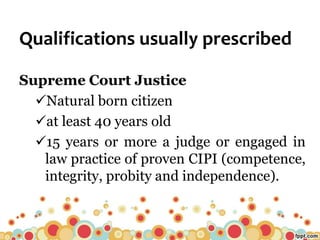
Supreme Court Justice
Natural born citizen
at least 40 years old
15 years or more a judge or engaged in
law practice of proven CIPI (competence,
integrity, probity and independence).
Qualifications usually prescribed
Civil Service Commissioners (Sec. 1 [1], Art.
IXB. Constitution)
 Natural-born citizen
35 years old at time of appointment
proven capacity for public administration
not a candidate for any elective position in
elections immediately preceding
appointment
Qualifications usually prescribed
COMELEC Comm. (Sec. 1[1], Art. IXC)
 Natural-born citizen
35 years old at time of appointment
college degree holder
not a candidate for elective position in election
immediately preceding appointment chairman
and majority should be members of the bar
who have been engaged in the practice of law
for at least 10 years
Qualifications usually prescribed
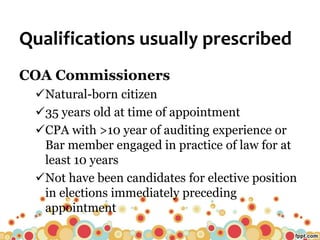
COA Commissioners
Natural-born citizen
35 years old at time of appointment
CPA with >10 year of auditing experience or
Bar member engaged in practice of law for at
least 10 years
Not have been candidates for elective position
in elections immediately preceding
appointment
Public officers ppt

Public officers ppt

  • 1.
    General Principles Governing PublicOfficers Executive Order No. 292 ADMINISTRATIVE CODE OF 1987 Reporter: Luzelle M. Ferreras MA (Educ. Mgt)
  • 2.
    SECTION 32. Nature ofPublic Office Public office is a public trust. Public officers and employees must at all times be accountable to the people, serve them with the utmost responsibility, integrity, loyalty and efficiency, act with patriotism and justice, and lead modest lives.
  • 3.
    SECTION 33. Policy onChange of Citizenship Public officers and employees owe the State and the Constitution allegiance at all times, and any public officer or employee who seeks to change his citizenship or acquire the status of an immigrant of another country during his tenure shall be dealt with by law.
  • 4.
    SECTION 34. Declaration ofAssets, Liabilities and Net Worth A public officer or employee shall, upon assumption of office and as often thereafter as may be required by law, submit a declaration under oath of his assets, liabilities, and net worth.
  • 5.
    SECTION 35. Ethics inGovernment All public officers and employees shall be bound by a Code of Ethics to be promulgated by the Civil Service Commission.
  • 6.
    SECTION 36. Inhibition AgainstPurchase of Property at Tax Sale No officer or employee of the government shall purchase directly or indirectly any property sold by the government for the non-payment of any tax, fee or other public charge. Any such purchase by an officer or employee shall be void.
  • 7.
    SECTION 37. Powers Incidentalto Taking of Testimony When authority to take testimony or receive evidence is conferred upon any administrative officer or any non-judicial person, committee, or other body, such authority shall include the power to administer oaths, summon witnesses, and require the production of documents by a subpoena duces tecum.
  • 8.
    SECTION 38. Liability ofSuperior Officers (1) A public officer shall not be civilly liable for acts done in the performance of his official duties, unless there is a clear showing of bad faith, malice or gross negligence.
  • 9.
    SECTION 38. Liability ofSuperior Officers (2) Any public officer who, without just cause, neglects to perform a duty within a period fixed by law or regulation, or within a reasonable period if none is fixed, shall be liable for damages to the private party concerned without prejudice to such other liability as may be prescribed by law.
  • 10.
    SECTION 38. Liability ofSuperior Officers (3) A head of a department or a superior officer shall not be civilly liable for the wrongful acts, omissions of duty, negligence, or misfeasance of his subordinates, unless he has actually authorized by written order the specific act or misconduct complained of.
  • 11.
    SECTION 39. Liability ofSubordinate Officers No subordinate officer or employee shall be civilly liable for acts done by him in good faith in the performance of his duties. However, he shall be liable for willful or negligent acts done by him which are contrary to law, morals, public policy and good customs even if he acted under orders or instructions of his superiors.
  • 12.
  • 13.
    Definition • Eligibility, whichis the term usually used in reference to the Civil Service Law, refers to the endowment / requirement / accomplishment that fits one for a public office. • Qualification generally refers to the endowment / act which a person must do before he can occupy a public office.
  • 14.
    Power to PrescribeQualifications GENERAL RULE: Congress is empowered to prescribe the qualifications for holding public office, subject to the following restrictions:  Congress cannot exceed its constitutional powers;
  • 15.
     Congress cannotimpose conditions of eligibility inconsistent with constitutional provisions;  The qualification must be germane to the position ("reasonable relation" rule);  Congress cannot prescribe qualifications so detailed as to practically amount to making an appointment. (Legislative appointments are unconstitutional and therefore void for being a usurpation of executive power.);  Where the Constitution establishes specific eligibility requirements for a particular constitutional office, the constitutional criteria are exclusive, and Congress cannot add to them except if the Constitution expressly or impliedly gives the power to set qualifications.
  • 16.
    Qualifications usually prescribed President(Sec. 2, Art. VI, Constitution) Vice President (Sec. 3, Art. VII, Constitution) Natural-born citizen 40 years old on day of election Resident of the Philippines for at least 10 years immediately preceding election day.
  • 17.
    Qualifications usually prescribed Senator(Sec. 3, Art. VI, Constitution) Natural-born citizen 35 years old on day of election able to read and write registered voter resident of the Philippines for not less than two years immediately preceding election day
  • 18.
    Qualifications usually prescribed Congressmen(Sec. 6, Art. VI, Constitution) Natural-born citizen 25 years old on day of election able to read and write registered voter in district in which he shall be elected resident thereof for not less than one year immediately preceding election day
  • 19.
    Qualifications usually prescribed SupremeCourt Justice Natural born citizen at least 40 years old 15 years or more a judge or engaged in law practice of proven CIPI (competence, integrity, probity and independence).
  • 20.
    Qualifications usually prescribed CivilService Commissioners (Sec. 1 [1], Art. IXB. Constitution)  Natural-born citizen 35 years old at time of appointment proven capacity for public administration not a candidate for any elective position in elections immediately preceding appointment
  • 21.
    Qualifications usually prescribed COMELECComm. (Sec. 1[1], Art. IXC)  Natural-born citizen 35 years old at time of appointment college degree holder not a candidate for elective position in election immediately preceding appointment chairman and majority should be members of the bar who have been engaged in the practice of law for at least 10 years
  • 22.
    Qualifications usually prescribed COACommissioners Natural-born citizen 35 years old at time of appointment CPA with >10 year of auditing experience or Bar member engaged in practice of law for at least 10 years Not have been candidates for elective position in elections immediately preceding appointment