SCHOOL OF ARCHITECTURE, BUILDING AND DESIGN
FOUNDATION IN NATURAL AND BUILT ENVIRONMENTS

NAME: KIMBERLEY EE SZE ANN

STUDENT ID: 0315319

CULTURE & CIVILIZATION (FDES 0815)

LECTURER: NORMAH SULAIMAN & DELLIYA MOHD. ZAIN

SUBMISSION DATE: 4/2/2014
Contents
Title
1) Assignment Brief
2) Concept and theme
- Introduction
- Defining ‘Kopitiam’
- The Origin of Kopitiams
- Traditional Kopitiams
- Modern Kopitiams
3) Research
- The Old Fashioned Kopitiams
- The Modern Kopitiams
4) Mapping
5) Images
6) Tutorial Sheet
7) Design of Graphical Book
- Design Ideas
- Mock up of Layout
- Final Layout

Page no.
Introduction
The concept that I chose to capture in my book was the Kopitiam Evolution, under the theme of
food culture. The reason I chose this theme and concept is because I have always been a coffee
enthusiast and was intrugued by the idea of finding out more about Malaysia’s coffee culture. If
we take the time to look around us today, we can find that time and technology have wrought
many changes on today’s modern society. However, amazingly, we can find that some past
traditions still live on even now and have become indisposable culture that symbolises our
identity as Malaysians. Thus, I took it upon myself to visit various kopitiams, both old and new
in order to compare and contrast what has changed and what has remained the same. My journey
has thought me that the kopitiam culture is still very much alive and many past tradition are still
going strong although certain things have changed to adapt with the modern society.
Defining ‘Kopitiam’

The word “kopitiam” is derived from the Malay word for coffee, “kopi” and the Hokkien term
for shop, “tiam”. Together, the phrase literally refers to being a coffee shop.
A kopitiam is to some extent a cross between a coffee shop and a breakfast
restaurant traditionally set in Southeast Asia, predominantly in Malaysia, Singapore, and
Indonesia. Kopitiams usually have a short menu of different dishes, but the foods that are
constantly present are eggs, bread, tea, and of course, coffee.

Kopitiams are often said to have originated in Malaysia and were most numerous in the city of
Penang. However, when Malaysians migrated to Singapore in the 1940s, taking kopitiams along
with them, the popularity of kopitiams in Singapore grew to be even greater than that of
Malaysia.

Kopitiams are commonly found in almost all residential areas as well as some industrial and
business districts in Malaysia. They often appear as an aggregate of small stalls or shops
however, some may be more reminiscent of food courts. All kopitiams share a similar
appearance and are steeped in tradition and nostalgic memories of the past.
The Origin of Kopitiams

In many ways the development of kopitiams are closely related to the early Hainanese migrants.
The Hainanese came to South East Asia as late migrants in the 1850s. At that time, other Chinese
migrants such as the Hokkiens and Teochews were already well rooted in agriculture, commerce
and trade. Thus, the Hainanese were forced to find employment in less lucrative trades.

As fate would have it, The Hainanese people discovered a niche for themselves in the service
sector. They worked as cook boys, waiters or servants in the local hotels, restaurants, bakeries
and bars and as cooks or domestic servants for wealthy European and Peranakan households. At
one time, some also worked as canteen operators in the military bases. Some of them became
seamen and sailors and worked as cooks on board the ships. Later, many Hainanese became
involved in the kopitiam or "coffee shop" business as stall holders or assistants. In fact, the
Hainanese community has been credited with introducing the kopitiam culture to Malaysia and
Singapore. (Bfsmagazine.com.my, 2013)
Traditional Kopitiams
A true kopitiam embraces a feeling of culture, time, tradition and permanence. Most old
fashioned kopitiams are steeped in tradition, with its own unique history. The atmosphere in a
kopitiam is uniquely Malaysian, meaning that it blends several different cultures. One similarity
is the kopitiam table and chairs. In general, the tables are marble topped and the chairs are made
of wood with round backs.

The traditional kopitiam is often-family owned and handed down from father to son from
generation to generation. In fact, in the 1960’s about 90% of the coffee shops in Malaysia were
operated by operators of Hainanese origins. However, these days for many old fashion kopitiam
owners, their craft ends the moment they retire because for a lot of them, their children have
been educated and are not willing to carry on the family business, (Bfsmagazine.com.my, 2013).

The traditional kopitiam serves as a social nucleus, where everybody knows your name, and the
“Ah-Soh” prepares your day’s caffeine fix the good old fashioned way, (Azrai, 2013). The
kopitiam is reminiscent of Old Malaya and still remains as an important part of our culture where
we spend hours socializing over a hot drink. Besides sipping a hot cup of freshly brewed “kopio” the kopitiam is also a favourite for savouring a variety of local delights. The Kopitiam’s menu
typically features eggs, toast and kaya, plus hot beverages such as coffee and tea.
Modern Kopitiams
Now, in the 21st century, branded coffee houses have emerged. Thus, evolving the humble
kopitiam in accordance to modern’s society’s desire to move forward without letting go of too
much of the past. This is a new age where a new breed of kopitiam has emerged, one that aims to
offer the classic food and drinks with modern conveniences such as piped in music, air
conditioning, smart interior design and the 21st century essential – WiFi.
The revival of the old kopitiam culture started in the early 2000s with the introduction of new
age kopitiams. These new kopitiams are similar to fast-food outlets which resemble old
kopitiams in terms of decor, but are usually built in more modern, hygienic settings such as
shopping malls rather than in traditional shop houses. However, many modern kopitiams do still
retain the old-fashioned marble-topped tables, wooden chairs and chunky crockery.
As for the menu, the new age kopitiams serve the usual local food, however they feature more
extensive menus which include a variety of western style cuisines. These modern kopitiams aim
to serve the nostalgic food and drinks of the past while catering to the demands of modern
society. Thus, you will find that many of these modern kopitiams emphasize on comfort while
maintaining prices right in between that of the local kopitiams and coffee giants.
This is how the Malaysian kopitiam culture has evolved, from the old fashioned kopitiams that
were the haunts of our grandparents, which have now fallen from their previous glories, to the
invasion of branded coffee houses that are favourited by Malaysian youths. However, these new
age kopitiams still remain truly Malaysian as despite the fact that they advertise and use modern
marketing practices, they still strive to create an atmosphere similar to that of a traditional
kopitiam.
The Old Fashioned Kopitiams
In order to experience the environment, food and culture of authentic kopitiams, I visited three
well known kopitiams that still preserve past traditions in their shops. These shops have
undergone little changes since they were first opened and still retain the old shop lots and modest
furnishings reminiscent of traditional kopitiams.

Chong Kok Kopitiam
Location: Jalan Stesen, Klang
Description:


a small traditional kopitiam



located in front of Klang’s KTM Station



opened in 1940



founded by Hainanese crewmen

Kluang Rail Coffee
Location: Kluang, Johor
Description:


a traditional kopitiam



founded in 1938 by Lim Huan Hee



a local favourite
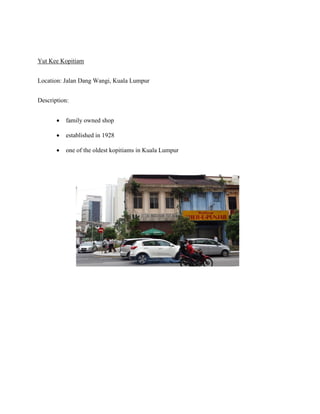
Yut Kee Kopitiam
Location: Jalan Dang Wangi, Kuala Lumpur
Description:


family owned shop



established in 1928



one of the oldest kopitiams in Kuala Lumpur
The Modern Kopitiams
Modern kopitiams have recently become very popular and can now be found located in many
shopping malls all around Malaysia. Air-conditioned, well furnished and equiped with Wi-Fi,
these modern kopitiam easily draw in large crowds. In order, to experience the atmosphere of
these kopitiams first hand, I visited three popular places.

Uncle Lim’s

Location: Ikano Power Centre, Petaling Jaya.

Description:


brand name kopitiam



serves traditonal foods



preserves the traditional kopitiam environment
Kluang Station
Location: Ikano Power Centre, Petaling Jaya

Description:


part of the Kluang Rail Coffee brand established by Lim Jit Chen



Lim Jit Chen is the grandson of the founder of the original Kluang Station in Johor

Pak Hailam Kopitiam
Location Aeon Big, Cheras Selatan
Description:


established in 1929



can be found in many shopping malls around Malaysia
Preparing coffee the traditional way

Toasting bread on a charcoal fire
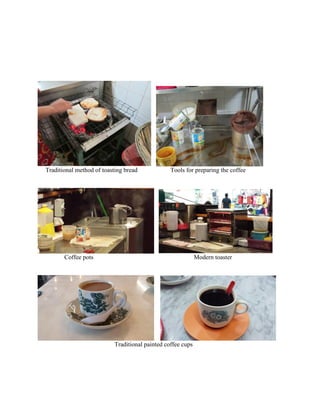
Traditional method of toasting bread

Tools for preparing the coffee

Coffee pots

Modern toaster

Traditional painted coffee cups
The traditional fare of coffee, eggs and toast
Bread served with kaya

Laughing and chatting happily

Acessing the internet during meal time
Design Ideas

Initial Ideas

1) Separate modern and old fashioned kopitiams .
2) All old fashioned kopitiam pictures are made black and white to show age.
3) New kopitiam pictures are left colourful and bright.

Final Changes

1) Modern and old fashioned kopitiam pictures are mixed together
2) All old fashioned kopitiam pictures are given a coffee stained colour (no longer black
and white)
3) Pictures are seperated according to the people, food preparation, locality and the food.

The Kopitiam Evolution report

  • 1.
    SCHOOL OF ARCHITECTURE,BUILDING AND DESIGN FOUNDATION IN NATURAL AND BUILT ENVIRONMENTS NAME: KIMBERLEY EE SZE ANN STUDENT ID: 0315319 CULTURE & CIVILIZATION (FDES 0815) LECTURER: NORMAH SULAIMAN & DELLIYA MOHD. ZAIN SUBMISSION DATE: 4/2/2014
  • 2.
    Contents Title 1) Assignment Brief 2)Concept and theme - Introduction - Defining ‘Kopitiam’ - The Origin of Kopitiams - Traditional Kopitiams - Modern Kopitiams 3) Research - The Old Fashioned Kopitiams - The Modern Kopitiams 4) Mapping 5) Images 6) Tutorial Sheet 7) Design of Graphical Book - Design Ideas - Mock up of Layout - Final Layout Page no.
  • 4.
    Introduction The concept thatI chose to capture in my book was the Kopitiam Evolution, under the theme of food culture. The reason I chose this theme and concept is because I have always been a coffee enthusiast and was intrugued by the idea of finding out more about Malaysia’s coffee culture. If we take the time to look around us today, we can find that time and technology have wrought many changes on today’s modern society. However, amazingly, we can find that some past traditions still live on even now and have become indisposable culture that symbolises our identity as Malaysians. Thus, I took it upon myself to visit various kopitiams, both old and new in order to compare and contrast what has changed and what has remained the same. My journey has thought me that the kopitiam culture is still very much alive and many past tradition are still going strong although certain things have changed to adapt with the modern society.
  • 5.
    Defining ‘Kopitiam’ The word“kopitiam” is derived from the Malay word for coffee, “kopi” and the Hokkien term for shop, “tiam”. Together, the phrase literally refers to being a coffee shop. A kopitiam is to some extent a cross between a coffee shop and a breakfast restaurant traditionally set in Southeast Asia, predominantly in Malaysia, Singapore, and Indonesia. Kopitiams usually have a short menu of different dishes, but the foods that are constantly present are eggs, bread, tea, and of course, coffee. Kopitiams are often said to have originated in Malaysia and were most numerous in the city of Penang. However, when Malaysians migrated to Singapore in the 1940s, taking kopitiams along with them, the popularity of kopitiams in Singapore grew to be even greater than that of Malaysia. Kopitiams are commonly found in almost all residential areas as well as some industrial and business districts in Malaysia. They often appear as an aggregate of small stalls or shops however, some may be more reminiscent of food courts. All kopitiams share a similar appearance and are steeped in tradition and nostalgic memories of the past.
  • 6.
    The Origin ofKopitiams In many ways the development of kopitiams are closely related to the early Hainanese migrants. The Hainanese came to South East Asia as late migrants in the 1850s. At that time, other Chinese migrants such as the Hokkiens and Teochews were already well rooted in agriculture, commerce and trade. Thus, the Hainanese were forced to find employment in less lucrative trades. As fate would have it, The Hainanese people discovered a niche for themselves in the service sector. They worked as cook boys, waiters or servants in the local hotels, restaurants, bakeries and bars and as cooks or domestic servants for wealthy European and Peranakan households. At one time, some also worked as canteen operators in the military bases. Some of them became seamen and sailors and worked as cooks on board the ships. Later, many Hainanese became involved in the kopitiam or "coffee shop" business as stall holders or assistants. In fact, the Hainanese community has been credited with introducing the kopitiam culture to Malaysia and Singapore. (Bfsmagazine.com.my, 2013)
  • 7.
    Traditional Kopitiams A truekopitiam embraces a feeling of culture, time, tradition and permanence. Most old fashioned kopitiams are steeped in tradition, with its own unique history. The atmosphere in a kopitiam is uniquely Malaysian, meaning that it blends several different cultures. One similarity is the kopitiam table and chairs. In general, the tables are marble topped and the chairs are made of wood with round backs. The traditional kopitiam is often-family owned and handed down from father to son from generation to generation. In fact, in the 1960’s about 90% of the coffee shops in Malaysia were operated by operators of Hainanese origins. However, these days for many old fashion kopitiam owners, their craft ends the moment they retire because for a lot of them, their children have been educated and are not willing to carry on the family business, (Bfsmagazine.com.my, 2013). The traditional kopitiam serves as a social nucleus, where everybody knows your name, and the “Ah-Soh” prepares your day’s caffeine fix the good old fashioned way, (Azrai, 2013). The kopitiam is reminiscent of Old Malaya and still remains as an important part of our culture where we spend hours socializing over a hot drink. Besides sipping a hot cup of freshly brewed “kopio” the kopitiam is also a favourite for savouring a variety of local delights. The Kopitiam’s menu typically features eggs, toast and kaya, plus hot beverages such as coffee and tea.
  • 8.
    Modern Kopitiams Now, inthe 21st century, branded coffee houses have emerged. Thus, evolving the humble kopitiam in accordance to modern’s society’s desire to move forward without letting go of too much of the past. This is a new age where a new breed of kopitiam has emerged, one that aims to offer the classic food and drinks with modern conveniences such as piped in music, air conditioning, smart interior design and the 21st century essential – WiFi. The revival of the old kopitiam culture started in the early 2000s with the introduction of new age kopitiams. These new kopitiams are similar to fast-food outlets which resemble old kopitiams in terms of decor, but are usually built in more modern, hygienic settings such as shopping malls rather than in traditional shop houses. However, many modern kopitiams do still retain the old-fashioned marble-topped tables, wooden chairs and chunky crockery. As for the menu, the new age kopitiams serve the usual local food, however they feature more extensive menus which include a variety of western style cuisines. These modern kopitiams aim to serve the nostalgic food and drinks of the past while catering to the demands of modern society. Thus, you will find that many of these modern kopitiams emphasize on comfort while maintaining prices right in between that of the local kopitiams and coffee giants. This is how the Malaysian kopitiam culture has evolved, from the old fashioned kopitiams that were the haunts of our grandparents, which have now fallen from their previous glories, to the invasion of branded coffee houses that are favourited by Malaysian youths. However, these new age kopitiams still remain truly Malaysian as despite the fact that they advertise and use modern marketing practices, they still strive to create an atmosphere similar to that of a traditional kopitiam.
  • 10.
    The Old FashionedKopitiams In order to experience the environment, food and culture of authentic kopitiams, I visited three well known kopitiams that still preserve past traditions in their shops. These shops have undergone little changes since they were first opened and still retain the old shop lots and modest furnishings reminiscent of traditional kopitiams. Chong Kok Kopitiam Location: Jalan Stesen, Klang Description:  a small traditional kopitiam  located in front of Klang’s KTM Station  opened in 1940  founded by Hainanese crewmen Kluang Rail Coffee Location: Kluang, Johor Description:  a traditional kopitiam  founded in 1938 by Lim Huan Hee  a local favourite
  • 11.
    Yut Kee Kopitiam Location:Jalan Dang Wangi, Kuala Lumpur Description:  family owned shop  established in 1928  one of the oldest kopitiams in Kuala Lumpur
  • 12.
    The Modern Kopitiams Modernkopitiams have recently become very popular and can now be found located in many shopping malls all around Malaysia. Air-conditioned, well furnished and equiped with Wi-Fi, these modern kopitiam easily draw in large crowds. In order, to experience the atmosphere of these kopitiams first hand, I visited three popular places. Uncle Lim’s Location: Ikano Power Centre, Petaling Jaya. Description:  brand name kopitiam  serves traditonal foods  preserves the traditional kopitiam environment
  • 13.
    Kluang Station Location: IkanoPower Centre, Petaling Jaya Description:  part of the Kluang Rail Coffee brand established by Lim Jit Chen  Lim Jit Chen is the grandson of the founder of the original Kluang Station in Johor Pak Hailam Kopitiam Location Aeon Big, Cheras Selatan Description:  established in 1929  can be found in many shopping malls around Malaysia
  • 16.
    Preparing coffee thetraditional way Toasting bread on a charcoal fire
  • 17.
    Traditional method oftoasting bread Tools for preparing the coffee Coffee pots Modern toaster Traditional painted coffee cups
  • 18.
    The traditional fareof coffee, eggs and toast
  • 19.
    Bread served withkaya Laughing and chatting happily Acessing the internet during meal time
  • 21.
    Design Ideas Initial Ideas 1)Separate modern and old fashioned kopitiams . 2) All old fashioned kopitiam pictures are made black and white to show age. 3) New kopitiam pictures are left colourful and bright. Final Changes 1) Modern and old fashioned kopitiam pictures are mixed together 2) All old fashioned kopitiam pictures are given a coffee stained colour (no longer black and white) 3) Pictures are seperated according to the people, food preparation, locality and the food.