QATAR NATIONAL LIBRARY
▪BY. MUNAZZAR SHAIKH
2ND YR B.ARCH R.P.COLLEGE OF ARCHITECTURE
OBJECTIVEOFSTUDY
▪ To study use and applicability of the library in modern
context.
▪ To study the modern concept related to library design.
▪ To study use of modern materials as a mode of expression of
architecture.
▪ To study play of light, ventilation forms, spaces, materials in
the contemporary context relating with library design.
BRIEF
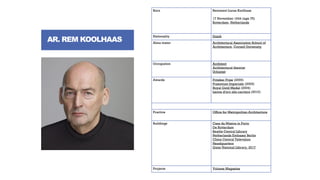
AR. REM KOOLHAAS
Born Remment Lucas Koolhaas
17 November 1944 (age 75)
Rotterdam, Netherlands
Nationality Dutch
Alma mater Architectural Association School of
Architecture, Cornell University
Occupation Architect
Architectural theorist
Urbanist
Awards Pritzker Prize (2000)
Praemium Imperiale (2003)
Royal Gold Medal (2004)
Leone d'oro alla carriera (2010)
Practice Office for Metropolitan Architecture
Buildings Casa da Música in Porto
De Rotterdam
Seattle Central Library
Netherlands Embassy Berlin
China Central Television
Headquarters
Qatar National Library, 2017
Projects Volume Magazine
PHILOSOPHY
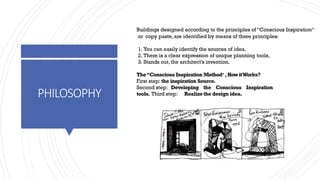
Buildings designed according to the principles of “Conscious Inspiration“
or copy paste, are identified by means of three principles:
1. You can easily identify the sources of idea,
2. There is a clear expression of unique planning tools,
3. Stands out, the architect’s invention.
The“Conscious Inspiration Method‘,HowitWorks?
First step: the inspiration Source.
Second step: Developing the Conscious Inspiration
tools. Third step: Realizethe design idea.
INFLUECEDBY
▪ Koolhaas was influenced by post modern Japanese
architectural theory as well as his experience in
reconstruction and invention in the Netherlands and
Indonesia
▪ Growing up in this period of rebuilding gave
▪ Koolhaas the understanding that architecture had to
accommodate modern needs. It left an indelible
impression on him, and he understood the
importance of planning architecture and
accommodating architecture to the needs of a
global world.
STYLE
Rem Koolhaasis, in fact, so different that scholars have difficulty
classifying him. Is he a :
DECONSTRUCTIVIST, MODERNIST, STRUCTURALIST
▪ Rem Koolhaas has been called in turns Modernist and
Deconstructivist, yet he leans toward Humanism. His work searches
for a link between technology and humanity. Koolhaas refused to
refer to past styles (he called for an “end to sentimentality”),
choosing instead to engage directly with the true gritty character of
the modern world.
▪ The combination of Koolhaas’s theoretical writings with his fondness
for asymmetry, challenging spatial explorations, and unexpected
uses of color led many to classify him as a deconstructivist.
However, his work, unlike that of other deconstructivists, does not
rely heavily on theory, and it is imbued with a strong sense of
humanity and a concern for the role that architecture plays in
everyday life, particularly in an urban context. This grounding in
reality was reflected in Koolhaas’s keen interest in urban planning,
most notably in a mastercity center in Lille, France (1985–95),
through which he transformed business, entertainment, and
residential centre. His celebrated Grand elliptical structure utilizing
plastic and aluminum,was at the centre of this plan
INTRODUCTION
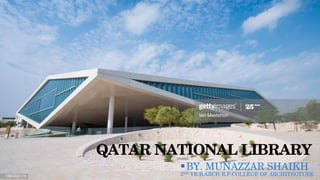
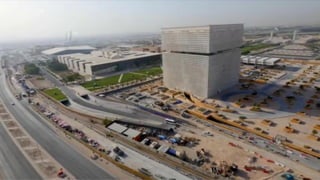
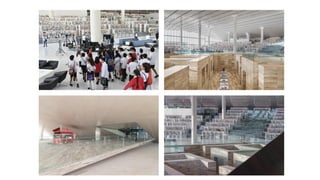
▪ Qatar National Library's state-of-the-art building, located in
the heart of Education City, is a community space for Qatar’s
residents and helps facilitate the effective exchange of ideas
and communal learning.
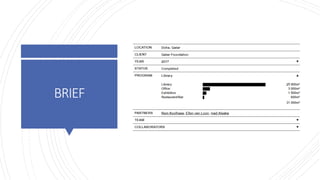
▪ The 45,000-square-meter building encourages visitors to
explore the progression of knowledge from the past to the
present. It achieves a delicate balance between information
availability and accessibility on the one hand, and content
preservation and conservation on the other.
CONCEPT
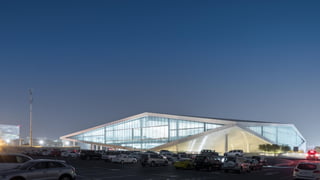
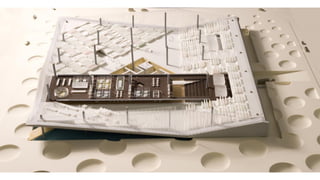
▪ World-renowned architect Rem Koolhaas's design
resembles two pieces of paper that are pulled apart and
folded diagonally at the corners to create a shell-like
structure, enclosing the open-plan interior.
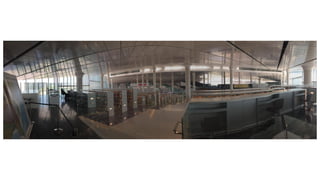
▪ The main interior space is designed to allow a precise
amount of daylight to enter and maintain a connection to the
world outside. Daylight filters through the glass façade,
providing natural light that is conducive to reading and
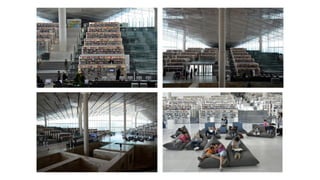
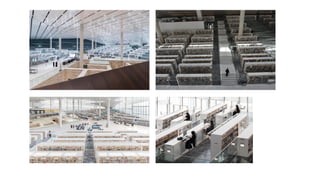
socializing.The bookshelves themselves are an integral part
of the building itself, rising out of the floor and highlighting
the value of books in Qatari culture.
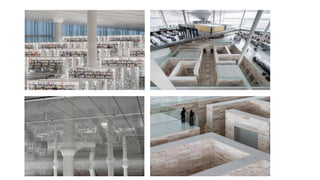
▪ A blend of classical materials, such as marble for the Heritage
Library, and modern materials, such as stainless steel for the
other collections, combine to emphasize the progression of
knowledge from the past to the present.
VIDEOCLIP
MATERIALS
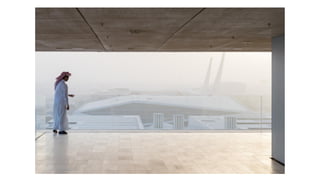
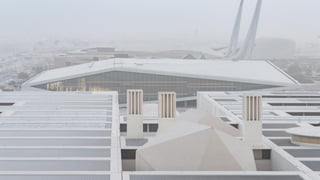
▪ From the exterior, the building’s concrete corners are folded
up off the ground, revealing a much smaller entrance
threshold while providing a transitional shaded space from
the Doha heat.
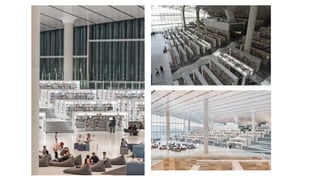
▪ A facade of corrugated glass and a reflective aluminium
ceiling are designed to filter and diffuse the bright sunlight to
create the optimum light level for reading. Outside, a sunken
patio allows light to filter to the basement levels .
▪ The bookshelves are meant to be part of the building both in
terms of materiality – they are made of the same white marble
as the floors – and of infrastructure – they incorporate
artificial lighting, ventilation, and the book return system.
TECHNOLOGY
Innovative technologies are seamlessly integrated
throughout the building, enhancing accessibility and
efficiency without detracting from the overall aesthetic.
These include:
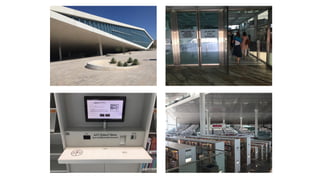
▪ Automated self-checkout and return stations, and a radio
frequency identification (RFID) book sorter system, allow for
convenient access to the Library's materials.
▪ A people mover system transports library users throughout
the shelving tiers, making the collection easily accessible for
all visitors.
▪ A wide range of computer systems, tablets, interactive
screens and audiovisual equipment throughout the building
PRESERVING
HERITAGE
As the repository for some of the nation and region's most
important cultural and historical items, the Library is
committed to providing an environment that will preserve
this information for generations to come.To achieve that,
the building includes:
Climate-controlled display cases in the Heritage Library and
throughout the building to showcase the collection.
The dedicated Conservation and Preservation Laboratory that
actively works to restore and protect items in the Heritage
Library.
The Digitization Laboratory, which digitizes items from the
Library and other collections and makes them available to
scholars worldwide
FUNCTION
The Library has numerous facilities for individual and
group collaboration, research and study.These include:
▪ Assistive technology room including 16 computer stations
with adjustable levelling,
▪ equipped with cutting-edge hardware and software
technologies
▪ A dedicated area for young adults
▪ A 686-square-meter Children’s Library
▪ 4-room Innovation Station
▪ 2 instruction rooms
▪ A computer lab
▪ 8 group study rooms
▪ 28 individual study carrels
▪ 3 media viewing rooms
▪ 26 large interactive screens and 465 computers
▪ A 200-seat Special Events Area with lights,an LED screen,
▪ speakers and noise-dampening curtains
▪ A 120-seat auditorium
▪ A restaurant and a café
PLANS
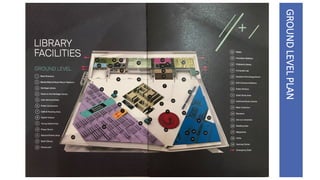
GROUNDLEVELPLAN
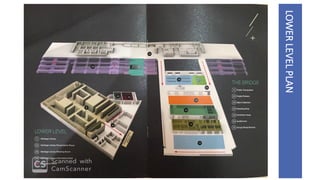
LOWERLEVELPLAN
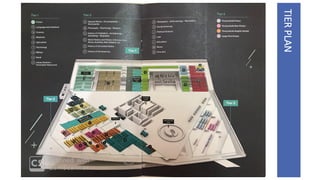
TIERPLAN
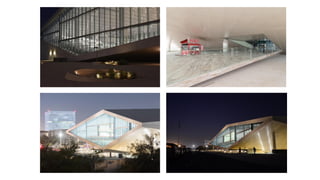
EXTERIORS
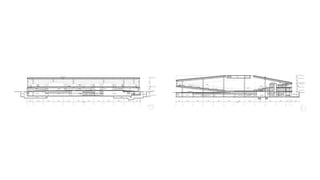
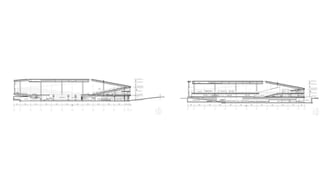
SECTIONS
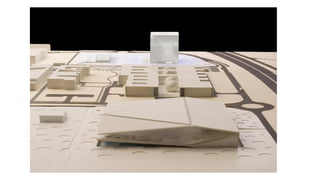
MODELS
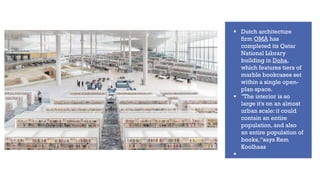
▪ Dutch architecture
firm OMA has
completed its Qatar
National Library
building in Doha,
which features tiers of
marble bookcases set
within a single open-
plan space.
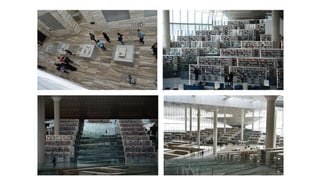
▪ "The interior is so
large it's on an almost
urban scale: it could
contain an entire
population, and also
an entire population of
books,“says Rem
Koolhaas
▪
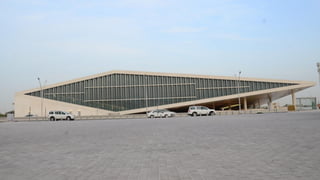
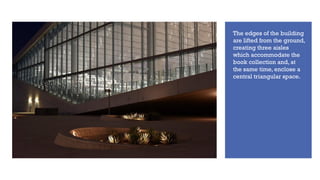
The edges of the building
are lifted from the ground,
creating three aisles
which accommodate the
book collection and, at
the same time, enclose a
central triangular space.
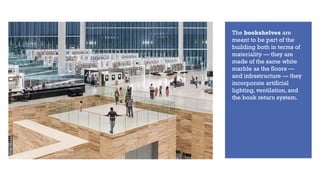
The bookshelves are
meant to be part of the
building both in terms of
materiality — they are
made of the same white
marble as the floors —
and infrastructure — they
incorporate artificial
lighting, ventilation, and
the book return system.
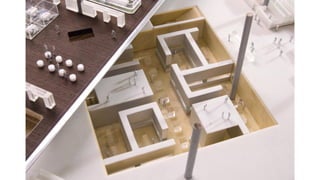
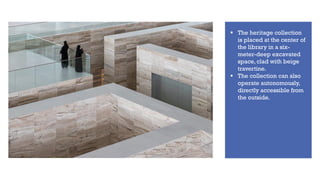
▪ The heritage collection
is placed at the center of
the library in a six-
meter-deep excavated
space, clad with beige
travertine.
▪ The collection can also
operate autonomously,
directly accessible from
the outside.
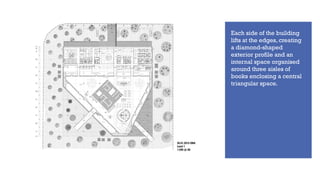
Each side of the building
lifts at the edges, creating
a diamond-shaped
exterior profile and an
internal space organised
around three aisles of
books enclosing a central
triangular space.
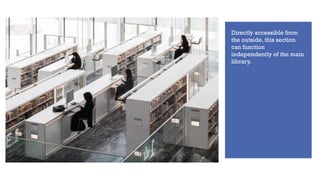
Directly accessible from
the outside, this section
can function
independently of the main
library.
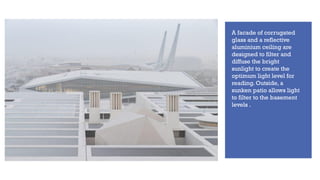
A facade of corrugated
glass and a reflective
aluminium ceiling are
designed to filter and
diffuse the bright
sunlight to create the
optimum light level for
reading. Outside, a
sunken patio allows light
to filter to the basement
levels .
▪ Inside, display shelves
stretch out across
terraces in every
corner of the 138-
metre-long library, and
platforms jut out over
the archives sunk into
the centre of the
structure.
▪ "We designed the
space so you can see all
the books in a
panorama," said OMA
co-founder Rem
Koolhaas.
The shelves are central to
the design and function of
the library. Each one is
made from the same
white marble as the floors
and infrastructure, and
incorporate the lighting,
ventilation and even the
book return system.
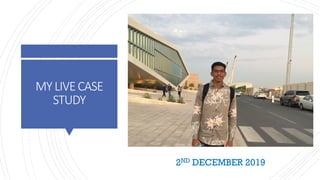
MYLIVECASE
STUDY
2ND DECEMBER 2019
StudyOutcome
▪ Understood modern concept of library design with
respect to fuction, climate and contemporary forms.
▪ Relate to changes in library design from international
perspective.
▪ Understood how a single space can contribute to
magnificient fuction of different types of spaces.
▪ Understood modern use of materials with respect to
climate.
StudyOutcome
▪ Planning is done in the manner that there is abundant
natural light present in the library, which allows the
reader to fully enjoy the reading time.
▪ The change of material for the heritage libray i.e.
Marble and stainless steel for the rest of the library
reflects the architects vision of progression of past to
present.
▪ The library is itself the transformation of Qatari culture
to the modern Qatar and their change with the time
which emphasizes one of the highly develop nation of
modern times.
THANKINGYOU

Qatar National Library

  • 1.
    QATAR NATIONAL LIBRARY ▪BY.MUNAZZAR SHAIKH 2ND YR B.ARCH R.P.COLLEGE OF ARCHITECTURE
  • 2.
    OBJECTIVEOFSTUDY ▪ To studyuse and applicability of the library in modern context. ▪ To study the modern concept related to library design. ▪ To study use of modern materials as a mode of expression of architecture. ▪ To study play of light, ventilation forms, spaces, materials in the contemporary context relating with library design.
  • 3.
  • 4.
    AR. REM KOOLHAAS BornRemment Lucas Koolhaas 17 November 1944 (age 75) Rotterdam, Netherlands Nationality Dutch Alma mater Architectural Association School of Architecture, Cornell University Occupation Architect Architectural theorist Urbanist Awards Pritzker Prize (2000) Praemium Imperiale (2003) Royal Gold Medal (2004) Leone d'oro alla carriera (2010) Practice Office for Metropolitan Architecture Buildings Casa da Música in Porto De Rotterdam Seattle Central Library Netherlands Embassy Berlin China Central Television Headquarters Qatar National Library, 2017 Projects Volume Magazine
  • 5.
    PHILOSOPHY Buildings designed accordingto the principles of “Conscious Inspiration“ or copy paste, are identified by means of three principles: 1. You can easily identify the sources of idea, 2. There is a clear expression of unique planning tools, 3. Stands out, the architect’s invention. The“Conscious Inspiration Method‘,HowitWorks? First step: the inspiration Source. Second step: Developing the Conscious Inspiration tools. Third step: Realizethe design idea.
  • 6.
    INFLUECEDBY ▪ Koolhaas wasinfluenced by post modern Japanese architectural theory as well as his experience in reconstruction and invention in the Netherlands and Indonesia ▪ Growing up in this period of rebuilding gave ▪ Koolhaas the understanding that architecture had to accommodate modern needs. It left an indelible impression on him, and he understood the importance of planning architecture and accommodating architecture to the needs of a global world.
  • 7.
    STYLE Rem Koolhaasis, infact, so different that scholars have difficulty classifying him. Is he a : DECONSTRUCTIVIST, MODERNIST, STRUCTURALIST ▪ Rem Koolhaas has been called in turns Modernist and Deconstructivist, yet he leans toward Humanism. His work searches for a link between technology and humanity. Koolhaas refused to refer to past styles (he called for an “end to sentimentality”), choosing instead to engage directly with the true gritty character of the modern world. ▪ The combination of Koolhaas’s theoretical writings with his fondness for asymmetry, challenging spatial explorations, and unexpected uses of color led many to classify him as a deconstructivist. However, his work, unlike that of other deconstructivists, does not rely heavily on theory, and it is imbued with a strong sense of humanity and a concern for the role that architecture plays in everyday life, particularly in an urban context. This grounding in reality was reflected in Koolhaas’s keen interest in urban planning, most notably in a mastercity center in Lille, France (1985–95), through which he transformed business, entertainment, and residential centre. His celebrated Grand elliptical structure utilizing plastic and aluminum,was at the centre of this plan
  • 8.
    INTRODUCTION ▪ Qatar NationalLibrary's state-of-the-art building, located in the heart of Education City, is a community space for Qatar’s residents and helps facilitate the effective exchange of ideas and communal learning. ▪ The 45,000-square-meter building encourages visitors to explore the progression of knowledge from the past to the present. It achieves a delicate balance between information availability and accessibility on the one hand, and content preservation and conservation on the other.
  • 9.
    CONCEPT ▪ World-renowned architectRem Koolhaas's design resembles two pieces of paper that are pulled apart and folded diagonally at the corners to create a shell-like structure, enclosing the open-plan interior. ▪ The main interior space is designed to allow a precise amount of daylight to enter and maintain a connection to the world outside. Daylight filters through the glass façade, providing natural light that is conducive to reading and socializing.The bookshelves themselves are an integral part of the building itself, rising out of the floor and highlighting the value of books in Qatari culture. ▪ A blend of classical materials, such as marble for the Heritage Library, and modern materials, such as stainless steel for the other collections, combine to emphasize the progression of knowledge from the past to the present.
  • 10.
  • 12.
    MATERIALS ▪ From theexterior, the building’s concrete corners are folded up off the ground, revealing a much smaller entrance threshold while providing a transitional shaded space from the Doha heat. ▪ A facade of corrugated glass and a reflective aluminium ceiling are designed to filter and diffuse the bright sunlight to create the optimum light level for reading. Outside, a sunken patio allows light to filter to the basement levels . ▪ The bookshelves are meant to be part of the building both in terms of materiality – they are made of the same white marble as the floors – and of infrastructure – they incorporate artificial lighting, ventilation, and the book return system.
  • 13.
    TECHNOLOGY Innovative technologies areseamlessly integrated throughout the building, enhancing accessibility and efficiency without detracting from the overall aesthetic. These include: ▪ Automated self-checkout and return stations, and a radio frequency identification (RFID) book sorter system, allow for convenient access to the Library's materials. ▪ A people mover system transports library users throughout the shelving tiers, making the collection easily accessible for all visitors. ▪ A wide range of computer systems, tablets, interactive screens and audiovisual equipment throughout the building
  • 14.
    PRESERVING HERITAGE As the repositoryfor some of the nation and region's most important cultural and historical items, the Library is committed to providing an environment that will preserve this information for generations to come.To achieve that, the building includes: Climate-controlled display cases in the Heritage Library and throughout the building to showcase the collection. The dedicated Conservation and Preservation Laboratory that actively works to restore and protect items in the Heritage Library. The Digitization Laboratory, which digitizes items from the Library and other collections and makes them available to scholars worldwide
  • 15.
    FUNCTION The Library hasnumerous facilities for individual and group collaboration, research and study.These include: ▪ Assistive technology room including 16 computer stations with adjustable levelling, ▪ equipped with cutting-edge hardware and software technologies ▪ A dedicated area for young adults ▪ A 686-square-meter Children’s Library ▪ 4-room Innovation Station ▪ 2 instruction rooms ▪ A computer lab ▪ 8 group study rooms ▪ 28 individual study carrels ▪ 3 media viewing rooms ▪ 26 large interactive screens and 465 computers ▪ A 200-seat Special Events Area with lights,an LED screen, ▪ speakers and noise-dampening curtains ▪ A 120-seat auditorium ▪ A restaurant and a café
  • 16.
  • 17.
  • 18.
  • 19.
  • 20.
  • 26.
  • 29.
  • 33.
    ▪ Dutch architecture firmOMA has completed its Qatar National Library building in Doha, which features tiers of marble bookcases set within a single open- plan space. ▪ "The interior is so large it's on an almost urban scale: it could contain an entire population, and also an entire population of books,“says Rem Koolhaas ▪
  • 34.
    The edges ofthe building are lifted from the ground, creating three aisles which accommodate the book collection and, at the same time, enclose a central triangular space.
  • 35.
    The bookshelves are meantto be part of the building both in terms of materiality — they are made of the same white marble as the floors — and infrastructure — they incorporate artificial lighting, ventilation, and the book return system.
  • 36.
    ▪ The heritagecollection is placed at the center of the library in a six- meter-deep excavated space, clad with beige travertine. ▪ The collection can also operate autonomously, directly accessible from the outside.
  • 37.
    Each side ofthe building lifts at the edges, creating a diamond-shaped exterior profile and an internal space organised around three aisles of books enclosing a central triangular space.
  • 38.
    Directly accessible from theoutside, this section can function independently of the main library.
  • 39.
    A facade ofcorrugated glass and a reflective aluminium ceiling are designed to filter and diffuse the bright sunlight to create the optimum light level for reading. Outside, a sunken patio allows light to filter to the basement levels .
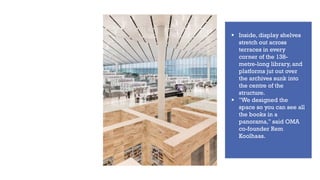
  • 40.
    ▪ Inside, displayshelves stretch out across terraces in every corner of the 138- metre-long library, and platforms jut out over the archives sunk into the centre of the structure. ▪ "We designed the space so you can see all the books in a panorama," said OMA co-founder Rem Koolhaas.
  • 41.
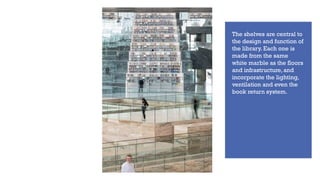
    The shelves arecentral to the design and function of the library. Each one is made from the same white marble as the floors and infrastructure, and incorporate the lighting, ventilation and even the book return system.
  • 42.
  • 51.
    StudyOutcome ▪ Understood modernconcept of library design with respect to fuction, climate and contemporary forms. ▪ Relate to changes in library design from international perspective. ▪ Understood how a single space can contribute to magnificient fuction of different types of spaces. ▪ Understood modern use of materials with respect to climate.
  • 52.
    StudyOutcome ▪ Planning isdone in the manner that there is abundant natural light present in the library, which allows the reader to fully enjoy the reading time. ▪ The change of material for the heritage libray i.e. Marble and stainless steel for the rest of the library reflects the architects vision of progression of past to present. ▪ The library is itself the transformation of Qatari culture to the modern Qatar and their change with the time which emphasizes one of the highly develop nation of modern times.
  • 53.