FRENCH NEW WAVE
CINEMA
 La Nouvelle Vague is a term coined by
critics for a group of French film makers of
the late 1950’s and 1960’s.
The New Wave filmmakers attacked classic
literary style of French cinema.
Director is the “Author” of the movie.
FRENCH NEW WAVE CINEMA
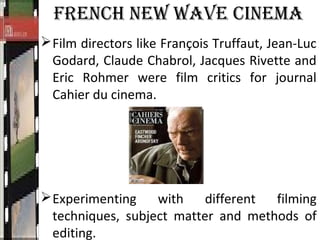
Film directors like François Truffaut, Jean-Luc
Godard, Claude Chabrol, Jacques Rivette and
Eric Rohmer were film critics for journal
Cahier du cinema.
Experimenting with different filming
techniques, subject matter and methods of
editing.
FILM TECHNIQUES
Jump cuts.
Existential themes.
Improvised dialogue and plotting.
Direct sound recording
FILM TECHNIQUES
Natural lighting.
Shooting on location.
Long takes.
Low budget approach.
Rapid changes of scenes.
IMPACTS
Veritable explosion of films that rejected old
subjects and old forms as well.
The films were increasingly politicized as the
1960’s progressed.
In German they attacked their own “Daddy’s
Cinema”.
This New Wave spread to countries like
Britain, Czechoslovakia, German, Brazil and
so on.
Le Quatre cents coups(The 400
Blows)
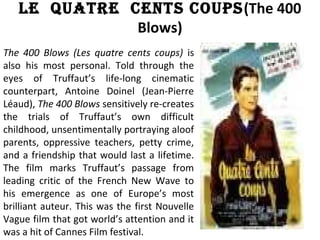
The 400 Blows (Les quatre cents coups) is
also his most personal. Told through the
eyes of Truffaut’s life-long cinematic
counterpart, Antoine Doinel (Jean-Pierre
Léaud), The 400 Blows sensitively re-creates
the trials of Truffaut’s own difficult
childhood, unsentimentally portraying aloof
parents, oppressive teachers, petty crime,
and a friendship that would last a lifetime.
The film marks Truffaut’s passage from
leading critic of the French New Wave to
his emergence as one of Europe’s most
brilliant auteur. This was the first Nouvelle
Vague film that got world’s attention and it
was a hit of Cannes Film festival.
thank you!

French new wave cinema

  • 2.
    FRENCH NEW WAVE CINEMA La Nouvelle Vague is a term coined by critics for a group of French film makers of the late 1950’s and 1960’s. The New Wave filmmakers attacked classic literary style of French cinema. Director is the “Author” of the movie.
  • 3.
    FRENCH NEW WAVECINEMA Film directors like François Truffaut, Jean-Luc Godard, Claude Chabrol, Jacques Rivette and Eric Rohmer were film critics for journal Cahier du cinema. Experimenting with different filming techniques, subject matter and methods of editing.
  • 4.
    FILM TECHNIQUES Jump cuts. Existentialthemes. Improvised dialogue and plotting. Direct sound recording
  • 5.
    FILM TECHNIQUES Natural lighting. Shootingon location. Long takes. Low budget approach. Rapid changes of scenes.
  • 6.
    IMPACTS Veritable explosion offilms that rejected old subjects and old forms as well. The films were increasingly politicized as the 1960’s progressed. In German they attacked their own “Daddy’s Cinema”. This New Wave spread to countries like Britain, Czechoslovakia, German, Brazil and so on.
  • 7.
    Le Quatre centscoups(The 400 Blows) The 400 Blows (Les quatre cents coups) is also his most personal. Told through the eyes of Truffaut’s life-long cinematic counterpart, Antoine Doinel (Jean-Pierre Léaud), The 400 Blows sensitively re-creates the trials of Truffaut’s own difficult childhood, unsentimentally portraying aloof parents, oppressive teachers, petty crime, and a friendship that would last a lifetime. The film marks Truffaut’s passage from leading critic of the French New Wave to his emergence as one of Europe’s most brilliant auteur. This was the first Nouvelle Vague film that got world’s attention and it was a hit of Cannes Film festival.
  • 8.