The Kidney
Controlling water levels
   The control of water levels is carried out by the
    KIDNEYS.
   It is closely linked to the excretion of urea.
   Urea is a waste product that is made when the
    LIVER breaks down proteins that are not
    needed by the body.
   Urea contains the element Nitrogen.
Kidneys
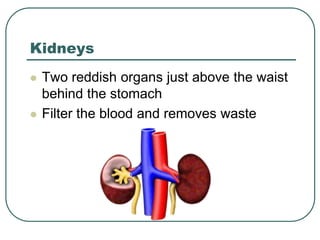
   Two reddish organs just above the waist
    behind the stomach
   Filter the blood and removes waste
The Human Kidney & Nephron
Ureter
   Connects the kidneys to the urinary
    bladder
Urinary Bladder
   Smooth muscle bag
   Stores waste solution - urine
Urethra
   Connects bladder to outside of the body
   Allows urine to pass out of the body
Nephron
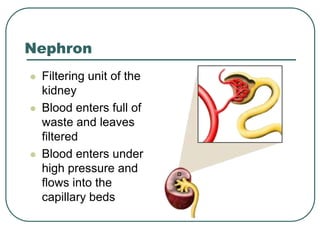
   Filtering unit of the
    kidney
   Blood enters full of
    waste and leaves
    filtered
   Blood enters under
    high pressure and
    flows into the
    capillary beds
The kidneys
The kidneys “clean” the blood of waste
products and control how much water
is kept in the body. The waste
products and water make up urine
which is excreted via the ureter.


                   “Dirty” blood enters the kidney
                   through the renal artery. Then,
                   several things happen to clean the
                   blood...
1. Filtration: Glomerulus and
 Renal Capsule

Blood enters the tubule area in
a capillary.
The capillary forms a small
“knot” near the kidney tubule.

The blood is filtered so all the
small particles go into the
tubule.

The capillary then carries on
to run next to the tubule.
The kidney tubule now contains
lots of blood components
including:

Glucose:
Ions:
Water:
Urea:
2. Reabsorb sugar: First
Convoluted Tubule

The body needs to have sugar
in the blood for cells to use in
respiration. So all the sugar is
reabsorbed back into the
capillary.

What sort of transport do you
think must be used if all sugar
is reabsorbed?
2. Reabsorb sugar

The body needs to have sugar
in the blood for cells to use in
respiration. So all the sugar is
reabsorbed back into the
capillary.
3. Reabsorb water: Loop of
Henle

Water and ions are the next to
be absorbed. It depends on
how much is needed by the
body.
3. Reabsorb Ions: Second
Convoluted Tubule

Ions are the next to be
absorbed. It depends on how
much is needed by the body.

If a lot of ions need to be
reabsorbed again active
transport is used.
Water content of                             Water content of
             the blood LOW                                the blood HIGH

                                                Too much water drunk
                                Too much salt
                                or sweating


Brain
                                                                                  Brain
produces                            Water content
                                                                                  produces
More ADH                            of the blood normal
                                                                                  Less ADH


 High volume of water                                                   Low volume of water
 reabsorbed by kidney                                                   reabsorbed by kidney


                Urine output                                 Urine output
                   LOW                                          HIGH

              (small volume of                              (large volume of
              Concentrated urine)                           dilute urine)
Reabsorbing water

If you have too         If you have too
little water in your    much water in your
blood, you will         blood, you will
produce very            produce very dilute
concentrated urine.     urine.

(very little water in   (lots of water in it)
it)
5. Excrete the waste

         Everything that is left in the
         kidney tubule is waste:

         •All the urea
         •Excess water

         This waste is called urine. It is
         excreted via the ureter and is
         stored in the bladder.
            Renal vein
         The “clean” blood leaves the
         kidney in the renal vein.
Ureter
Summary of urine production
   Urea is a waste product made in the LIVER
   Water content of the body is controlled in the
    KIDNEYS
   Urea, water and other waste makes up URINE.
   Urine travels down the URETER and is stored
    in the BLADDER
   Urine is excreted through the URETHRA.
Animation
   http://www.kscience.co.uk/animations/kidney.
    htm

The kidney triple

  • 1.
  • 2.
    Controlling water levels  The control of water levels is carried out by the KIDNEYS.  It is closely linked to the excretion of urea.  Urea is a waste product that is made when the LIVER breaks down proteins that are not needed by the body.  Urea contains the element Nitrogen.
  • 3.
    Kidneys  Two reddish organs just above the waist behind the stomach  Filter the blood and removes waste
  • 4.
  • 6.
    Ureter  Connects the kidneys to the urinary bladder
  • 7.
    Urinary Bladder  Smooth muscle bag  Stores waste solution - urine
  • 8.
    Urethra  Connects bladder to outside of the body  Allows urine to pass out of the body
  • 9.
    Nephron  Filtering unit of the kidney  Blood enters full of waste and leaves filtered  Blood enters under high pressure and flows into the capillary beds
  • 11.
    The kidneys The kidneys“clean” the blood of waste products and control how much water is kept in the body. The waste products and water make up urine which is excreted via the ureter. “Dirty” blood enters the kidney through the renal artery. Then, several things happen to clean the blood...
  • 12.
    1. Filtration: Glomerulusand Renal Capsule Blood enters the tubule area in a capillary. The capillary forms a small “knot” near the kidney tubule. The blood is filtered so all the small particles go into the tubule. The capillary then carries on to run next to the tubule.
  • 13.
    The kidney tubulenow contains lots of blood components including: Glucose: Ions: Water: Urea:
  • 14.
    2. Reabsorb sugar:First Convoluted Tubule The body needs to have sugar in the blood for cells to use in respiration. So all the sugar is reabsorbed back into the capillary. What sort of transport do you think must be used if all sugar is reabsorbed?
  • 15.
    2. Reabsorb sugar Thebody needs to have sugar in the blood for cells to use in respiration. So all the sugar is reabsorbed back into the capillary.
  • 16.
    3. Reabsorb water:Loop of Henle Water and ions are the next to be absorbed. It depends on how much is needed by the body.
  • 17.
    3. Reabsorb Ions:Second Convoluted Tubule Ions are the next to be absorbed. It depends on how much is needed by the body. If a lot of ions need to be reabsorbed again active transport is used.
  • 18.
    Water content of Water content of the blood LOW the blood HIGH Too much water drunk Too much salt or sweating Brain Brain produces Water content produces More ADH of the blood normal Less ADH High volume of water Low volume of water reabsorbed by kidney reabsorbed by kidney Urine output Urine output LOW HIGH (small volume of (large volume of Concentrated urine) dilute urine)
  • 19.
    Reabsorbing water If youhave too If you have too little water in your much water in your blood, you will blood, you will produce very produce very dilute concentrated urine. urine. (very little water in (lots of water in it) it)
  • 20.
    5. Excrete thewaste Everything that is left in the kidney tubule is waste: •All the urea •Excess water This waste is called urine. It is excreted via the ureter and is stored in the bladder. Renal vein The “clean” blood leaves the kidney in the renal vein. Ureter
  • 21.
    Summary of urineproduction  Urea is a waste product made in the LIVER  Water content of the body is controlled in the KIDNEYS  Urea, water and other waste makes up URINE.  Urine travels down the URETER and is stored in the BLADDER  Urine is excreted through the URETHRA.
  • 22.
    Animation  http://www.kscience.co.uk/animations/kidney. htm