The Islamic Golden Age
Brief History
Islamic Golden Age traditionally dated from the mid-7th
century to the mid 13th century
Many scholars tend to think that the Golden Age came to an end around
the 16th to 17th century
Much of the Arabic-speaking world was under rule of various
Caliphates
Caliphates (Arabic: “khilāfa)-- refers to a
person or religious successor of the prophet
Muhammad that was a leader of the Muslim
community
What did the Islamic Golden Age Have to Offer?
➢Advancements in:
○ Artistry
○ Engineering
○ Architecture
○ Poetry
○ Philosophy
○ Agriculture
○ Economics
○ Literature
○ Navigation
○ Sciences
○ Sociology
○ Technology
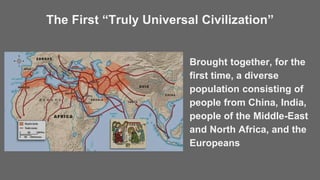
The First “Truly Universal Civilization”
Brought together, for the
first time, a diverse
population consisting of
people from China, India,
people of the Middle-East
and North Africa, and the
Europeans
How the Islamic Golden Age Came About
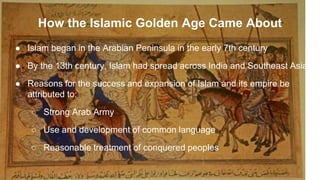
● Islam began in the Arabian Peninsula in the early 7th century
● By the 13th century, Islam had spread across India and Southeast Asia
● Reasons for the success and expansion of Islam and its empire be
attributed to:
○ Strong Arab Army
○ Use and development of common language
○ Reasonable treatment of conquered peoples
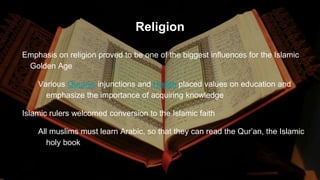
Religion
Emphasis on religion proved to be one of the biggest influences for the Islamic
Golden Age
Various Quranic injunctions and Hadith placed values on education and
emphasize the importance of acquiring knowledge
Islamic rulers welcomed conversion to the Islamic faith
All muslims must learn Arabic, so that they can read the Qur’an, the Islamic
holy book
Cultural Influence
Being that the Islamic empire had such strong trade routes,
the cultural influence could be considered a melting pot
Science, more specifically, medicine, was a central focus
and one of the biggest influences left behind by the
Islamic Golden Age
built on the legacies left behind by Greek and Roman
physicians and scholars
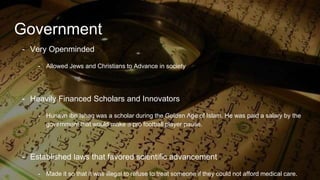
Government
- Very Openminded
- Allowed Jews and Christians to Advance in society
- Heavily Financed Scholars and Innovators
- Hunavn ibn Ishaq was a scholar during the Golden Age of Islam. He was paid a salary by the
government that would make a pro football player pause.
- Established laws that favored scientific advancement
- Made it so that it was illegal to refuse to treat someone if they could not afford medical care.
Technologies
- New Medical Technologies
- Vaccines
- New Farming Techniques
- Crop Rotation
- Incorporating foreign plants
- Hydropower/Wind power
- Used to power mills and factories
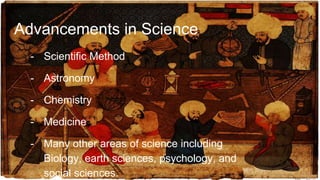
Advancements in Science
- Scientific Method
- Astronomy
- Chemistry
- Medicine
- Many other areas of science including
Biology, earth sciences, psychology, and
social sciences.
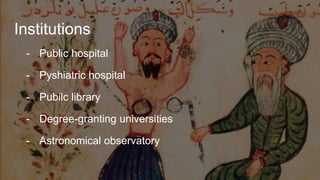
- Public hospital
- Pyshiatric hospital
- Pubilc library
- Degree-granting universities
- Astronomical observatory
Institutions
Commerce and Trade
- Contributed to globalization
- Extensive trade networks
- Monetary economy
- Industrial growth
- Labor
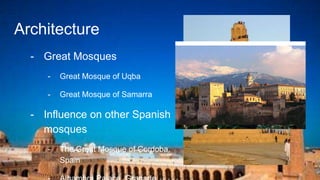
Architecture
- Great Mosques
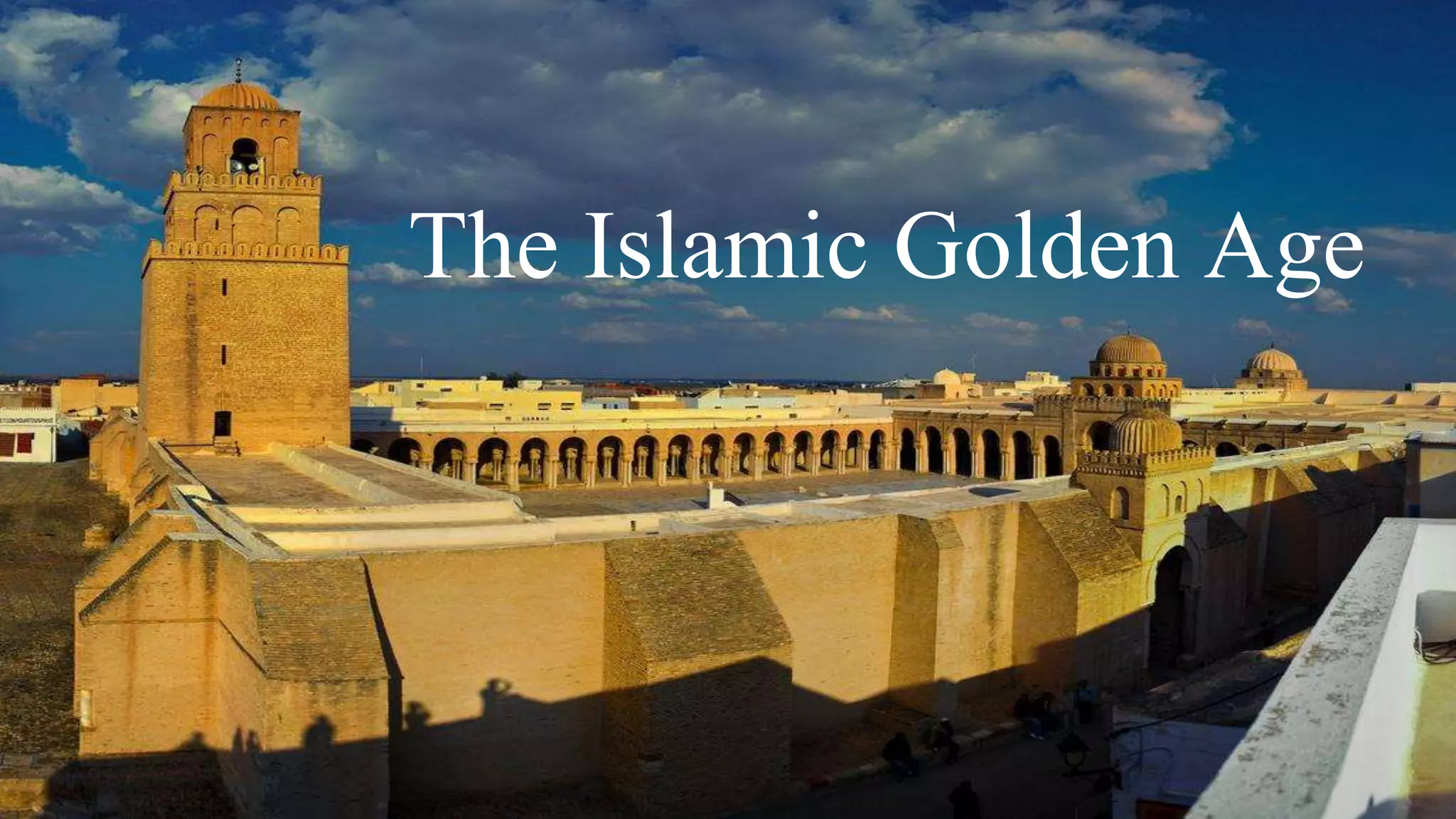
- Great Mosque of Uqba
- Great Mosque of Samarra
- Influence on other Spanish
mosques
- The Great Mosque of Cordoba,
Spain
Decline of the Golden Age
- Several Wars took their toll on the Islamic people
- The Crusades
- Mongol Empire’s conquest Westward
- Loss of Academic material
- Schools destroyed
- Books lost
- Anti-Rational schools established (Ash’ari Schools)
- Very strict and literal interpretation of the Qur’an and Hadith used.
Impact Today
- Many Technologies that originated in Islamic Golden Age persist today
- Farming techniques
- Vaccinations
- Islamic architecture used globally
- Spain
- Africa
- Trade Influcences world
- Asia

The islamic golden age

  • 1.
  • 2.
    Brief History Islamic GoldenAge traditionally dated from the mid-7th century to the mid 13th century Many scholars tend to think that the Golden Age came to an end around the 16th to 17th century Much of the Arabic-speaking world was under rule of various Caliphates Caliphates (Arabic: “khilāfa)-- refers to a person or religious successor of the prophet Muhammad that was a leader of the Muslim community
  • 3.
    What did theIslamic Golden Age Have to Offer? ➢Advancements in: ○ Artistry ○ Engineering ○ Architecture ○ Poetry ○ Philosophy ○ Agriculture ○ Economics ○ Literature ○ Navigation ○ Sciences ○ Sociology ○ Technology
  • 4.
    The First “TrulyUniversal Civilization” Brought together, for the first time, a diverse population consisting of people from China, India, people of the Middle-East and North Africa, and the Europeans
  • 5.
    How the IslamicGolden Age Came About ● Islam began in the Arabian Peninsula in the early 7th century ● By the 13th century, Islam had spread across India and Southeast Asia ● Reasons for the success and expansion of Islam and its empire be attributed to: ○ Strong Arab Army ○ Use and development of common language ○ Reasonable treatment of conquered peoples
  • 6.
    Religion Emphasis on religionproved to be one of the biggest influences for the Islamic Golden Age Various Quranic injunctions and Hadith placed values on education and emphasize the importance of acquiring knowledge Islamic rulers welcomed conversion to the Islamic faith All muslims must learn Arabic, so that they can read the Qur’an, the Islamic holy book
  • 7.
    Cultural Influence Being thatthe Islamic empire had such strong trade routes, the cultural influence could be considered a melting pot Science, more specifically, medicine, was a central focus and one of the biggest influences left behind by the Islamic Golden Age built on the legacies left behind by Greek and Roman physicians and scholars
  • 8.
    Government - Very Openminded -Allowed Jews and Christians to Advance in society - Heavily Financed Scholars and Innovators - Hunavn ibn Ishaq was a scholar during the Golden Age of Islam. He was paid a salary by the government that would make a pro football player pause. - Established laws that favored scientific advancement - Made it so that it was illegal to refuse to treat someone if they could not afford medical care.
  • 9.
    Technologies - New MedicalTechnologies - Vaccines - New Farming Techniques - Crop Rotation - Incorporating foreign plants - Hydropower/Wind power - Used to power mills and factories
  • 10.
    Advancements in Science -Scientific Method - Astronomy - Chemistry - Medicine - Many other areas of science including Biology, earth sciences, psychology, and social sciences.
  • 11.
    - Public hospital -Pyshiatric hospital - Pubilc library - Degree-granting universities - Astronomical observatory Institutions
  • 12.
    Commerce and Trade -Contributed to globalization - Extensive trade networks - Monetary economy - Industrial growth - Labor
  • 13.
    Architecture - Great Mosques -Great Mosque of Uqba - Great Mosque of Samarra - Influence on other Spanish mosques - The Great Mosque of Cordoba, Spain
  • 14.
    Decline of theGolden Age - Several Wars took their toll on the Islamic people - The Crusades - Mongol Empire’s conquest Westward - Loss of Academic material - Schools destroyed - Books lost - Anti-Rational schools established (Ash’ari Schools) - Very strict and literal interpretation of the Qur’an and Hadith used.
  • 15.
    Impact Today - ManyTechnologies that originated in Islamic Golden Age persist today - Farming techniques - Vaccinations - Islamic architecture used globally - Spain - Africa - Trade Influcences world - Asia

Editor's Notes

  • #8 Muslim scientists discovered the principles of flight, defined the theory of vision, originated trigonometry, pioneered quantitative chemistry, and began to uncover the mysteries of the universe, as well as made numerous discoveries in medicine Arab physicians is Spain made remarkable contributions in the fields of astronomy, agriculture, botany, medicine, and surgery. The achievements of Muslims during the golden age of their civilization and their transmission to Europe through Spain were responsible for the renaissance of Western Europe.