IBNU KHALDUN ابو زيد عبد الرحمن بن محمد بن خلدون الحضرمي   A PHILOSOPHER, SOCIOLOGIST AND SOCIAL SCIENTIST  Juffri Supa’at & Nurhazman Abdul Aziz
Scope As An Individual  A Muslim Scholar The Community  Structure, Norms and Development Nature of the Information Sources Orthodox, Philosophy & Intellectual Sciences Conclusion What can we learnt
As An Individual  A Muslim Scholar Ibnu Khaldun
Biography Arab Scholar  Medieval era Name Ibn Khaldun  [Abū Zayd ‘Abdu r-Raḥman bin Muḥammad bin Khaldūn al-Ḥaḍramī] Birth 27 May, 1332/732 AH  Death 19 March, 1406/808 AH  School / Tradition Ash'ari  [It was instrumental in drastically changing the direction of Islamic theology, separating its development radically from that of theology in the Christian world.] Main Interests Sociology, History, Historiography, Demography, Economics, Philosophy of History,  Notable Ideas Asabiyah  Influences Al-Razi  [a fundamental and enduring contributions to the fields of medicine, alchemy, and philosophy, recorded in over 184 books and articles in various fields of science.] Influenced Al-Maqrizi, Social sciences  [remarkable in this context for his unusually keen interest in the Ismaili Fatimid dynasty and its role in Egyptian history]
Quotation attributed to Ibn Khaldun  "He who finds a new path is a pathfinder, even if the trail has to be found again by others; and he who walks far ahead of his contemporaries is a leader, even though centuries pass before he is recognized as such."
About Ibnu Khaldun Abu Zayd 'Abd al-Rahman Ibnu Khaldun  received a good education.  served as assistant and secretary to several government officials.  career was dependent on the good will of his superiors,  changed jobs frequently when political winds shifted.  led an extremely eventful life, traveling to, among other places, Mecca, Damascus. Palestine and Seville, and occasionally finding enough leisure time to teach, study, and write.  Among the notable personalities Ibn Khaldun encountered in his adventures were King Pedro I of Castile and Timur.
Education & Early Years Family social and political activist received a classical Arabic education,  studying the Qur'an and Arabic linguistics, the basis for an understanding of the Qur'an, Hadith [1] and Fiqh [2] mathematics, logic and philosophy lost both his parents to an epidemic of the plague which hit Tunis, when he was 17 years old In a typical Muslim family, follow family tradition is common, that is where he strove for a political career And he life adventure begin, in which he spends time in prison, reaches the highest offices and falls again into exile. [1] Hadith relating to the words and deeds of Prophet Muhammad. [2] Fiqh  is an expansion of Islamic law, complemented by the rulings of Islamic jurists to direct the lives of Muslim
His writing most significant work is the  Muqaddimah.   "introduction" to history, he discussed historical method and provided the necessary criteria for distinguishing historical truth from error.  considered one of the most phenomenal works on the philosophy of history ever written where he related the social impact of a community or event. In this action, this play a big impact to the Muslim society, where we are going to share about the Muqaddimah and the sociological view.
His Adventure continued education, social and political began play an important role in the political leadership of Sevilla Become a judge and held post in may courts of the Maghrib & Andalunisa (Spain) one reasons why he have travel because he to find that scholar from that institution in order to fulfill his knowledge desire
The Community  Structure, Norms and Development Ibnu Khaldun
Muqaddimah  What is Muqaddima? Teaching is a Craft An important role in providing conceptual and paradigmatic frameworks as well as an epistemological foundation of the study of human society.
THE MAGNUM OPUS "AL-MUQADDIMAH" This impressive document is a gist of his wisdom and hard earned experience. use his political and first had knowledge of the people of Maghrib to formulate many of his ideas. discussion of Tribal societies and social forces would be the most interesting part of his thesis. His theories of the science of  Umran  (sociology) are all pearls of wisdom
The Structure of Muqaddimah Chap 1 : Human civilization in general Chap 2 : Bedouin civilization, savage nation and tribes and their condition of life, including several basic and explanatory statements Chap 3 : On dynasties, royal authority, the caliphate, government ranks and all the goes with these things (basic & supplementary propositions)
The Structure of Muqaddimah Chap 4 : Countries & cities  and all forms sedentary civilization. The conditions occuring there. Primary and secondary considerations in this connection Chap 5 : On the various aspects of making a living, such as profit and the crafts. The conditions that occur in this connection. A number of problems are connected with this subject. Chap 6 : The various kinds of sciences. The methods of instruction. The conditions that obtain in these condition
The Norms Sedentary cultural is the goal of civilisation. The end of its life span and brings about it corruption Cities that are the seats of royal authority fall into ruin when ruling dynasty crumbles and falls into ruin Certain Cities have crafts that others lack
The Norms The existence of group feeling in cities and the superiority of the inhabitants over others The dialects of the urban population
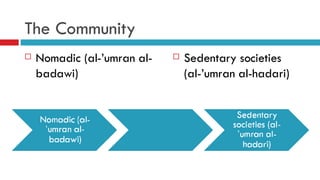
The Community Nomadic (al-’umran al-badawi) Sedentary societies (al-’umran al-hadari)
Relevance to Contemporary Sociology Ibnu Khaldun and Auguste Comte Both emphasized a historical method & did not propose statistical methods Both distinguished their sciences from what proceeded them  Both believed human nature in the same everywhere Both recognised the importance of social change
Nature of the Information Sources Ibnu Khaldun
Orthodox & Philosophy Orthodox Believe the ultimate truth about man and society must referred to the  Quran,  the prophetic tradition (hadith) and (fiqih) Philosophy Primary of rational inquiry over revelation in both the theoretical & practical sciences
The Various Kinds of Intellectual Sciences Logic Metaphysical & Spiritual Matters Physics Mathematical Sciences Geometry Arithmetic Music Astronomy
Conclusion & Discussion What can we learnt Ibnu Kaldun

Ibnu Khaldun

  • 1.
    IBNU KHALDUN ابوزيد عبد الرحمن بن محمد بن خلدون الحضرمي A PHILOSOPHER, SOCIOLOGIST AND SOCIAL SCIENTIST Juffri Supa’at & Nurhazman Abdul Aziz
  • 2.
    Scope As AnIndividual A Muslim Scholar The Community Structure, Norms and Development Nature of the Information Sources Orthodox, Philosophy & Intellectual Sciences Conclusion What can we learnt
  • 3.
    As An Individual A Muslim Scholar Ibnu Khaldun
  • 4.
    Biography Arab Scholar Medieval era Name Ibn Khaldun [Abū Zayd ‘Abdu r-Raḥman bin Muḥammad bin Khaldūn al-Ḥaḍramī] Birth 27 May, 1332/732 AH Death 19 March, 1406/808 AH School / Tradition Ash'ari [It was instrumental in drastically changing the direction of Islamic theology, separating its development radically from that of theology in the Christian world.] Main Interests Sociology, History, Historiography, Demography, Economics, Philosophy of History, Notable Ideas Asabiyah Influences Al-Razi [a fundamental and enduring contributions to the fields of medicine, alchemy, and philosophy, recorded in over 184 books and articles in various fields of science.] Influenced Al-Maqrizi, Social sciences [remarkable in this context for his unusually keen interest in the Ismaili Fatimid dynasty and its role in Egyptian history]
  • 5.
    Quotation attributed toIbn Khaldun "He who finds a new path is a pathfinder, even if the trail has to be found again by others; and he who walks far ahead of his contemporaries is a leader, even though centuries pass before he is recognized as such."
  • 6.
    About Ibnu KhaldunAbu Zayd 'Abd al-Rahman Ibnu Khaldun received a good education. served as assistant and secretary to several government officials. career was dependent on the good will of his superiors, changed jobs frequently when political winds shifted. led an extremely eventful life, traveling to, among other places, Mecca, Damascus. Palestine and Seville, and occasionally finding enough leisure time to teach, study, and write. Among the notable personalities Ibn Khaldun encountered in his adventures were King Pedro I of Castile and Timur.
  • 7.
    Education & EarlyYears Family social and political activist received a classical Arabic education, studying the Qur'an and Arabic linguistics, the basis for an understanding of the Qur'an, Hadith [1] and Fiqh [2] mathematics, logic and philosophy lost both his parents to an epidemic of the plague which hit Tunis, when he was 17 years old In a typical Muslim family, follow family tradition is common, that is where he strove for a political career And he life adventure begin, in which he spends time in prison, reaches the highest offices and falls again into exile. [1] Hadith relating to the words and deeds of Prophet Muhammad. [2] Fiqh is an expansion of Islamic law, complemented by the rulings of Islamic jurists to direct the lives of Muslim
  • 8.
    His writing mostsignificant work is the Muqaddimah. "introduction" to history, he discussed historical method and provided the necessary criteria for distinguishing historical truth from error. considered one of the most phenomenal works on the philosophy of history ever written where he related the social impact of a community or event. In this action, this play a big impact to the Muslim society, where we are going to share about the Muqaddimah and the sociological view.
  • 9.
    His Adventure continuededucation, social and political began play an important role in the political leadership of Sevilla Become a judge and held post in may courts of the Maghrib & Andalunisa (Spain) one reasons why he have travel because he to find that scholar from that institution in order to fulfill his knowledge desire
  • 10.
    The Community Structure, Norms and Development Ibnu Khaldun
  • 11.
    Muqaddimah Whatis Muqaddima? Teaching is a Craft An important role in providing conceptual and paradigmatic frameworks as well as an epistemological foundation of the study of human society.
  • 12.
    THE MAGNUM OPUS"AL-MUQADDIMAH" This impressive document is a gist of his wisdom and hard earned experience. use his political and first had knowledge of the people of Maghrib to formulate many of his ideas. discussion of Tribal societies and social forces would be the most interesting part of his thesis. His theories of the science of Umran (sociology) are all pearls of wisdom
  • 13.
    The Structure ofMuqaddimah Chap 1 : Human civilization in general Chap 2 : Bedouin civilization, savage nation and tribes and their condition of life, including several basic and explanatory statements Chap 3 : On dynasties, royal authority, the caliphate, government ranks and all the goes with these things (basic & supplementary propositions)
  • 14.
    The Structure ofMuqaddimah Chap 4 : Countries & cities and all forms sedentary civilization. The conditions occuring there. Primary and secondary considerations in this connection Chap 5 : On the various aspects of making a living, such as profit and the crafts. The conditions that occur in this connection. A number of problems are connected with this subject. Chap 6 : The various kinds of sciences. The methods of instruction. The conditions that obtain in these condition
  • 15.
    The Norms Sedentarycultural is the goal of civilisation. The end of its life span and brings about it corruption Cities that are the seats of royal authority fall into ruin when ruling dynasty crumbles and falls into ruin Certain Cities have crafts that others lack
  • 16.
    The Norms Theexistence of group feeling in cities and the superiority of the inhabitants over others The dialects of the urban population
  • 17.
    The Community Nomadic(al-’umran al-badawi) Sedentary societies (al-’umran al-hadari)
  • 18.
    Relevance to ContemporarySociology Ibnu Khaldun and Auguste Comte Both emphasized a historical method & did not propose statistical methods Both distinguished their sciences from what proceeded them Both believed human nature in the same everywhere Both recognised the importance of social change
  • 19.
    Nature of theInformation Sources Ibnu Khaldun
  • 20.
    Orthodox & PhilosophyOrthodox Believe the ultimate truth about man and society must referred to the Quran, the prophetic tradition (hadith) and (fiqih) Philosophy Primary of rational inquiry over revelation in both the theoretical & practical sciences
  • 21.
    The Various Kindsof Intellectual Sciences Logic Metaphysical & Spiritual Matters Physics Mathematical Sciences Geometry Arithmetic Music Astronomy
  • 22.
    Conclusion & DiscussionWhat can we learnt Ibnu Kaldun