Chapter 4  The Internal Assessment Strategic Management:  Concepts & Cases 10 th  Edition Fred David PowerPoint Slides by Anthony F. Chelte Western New England College
Chapter Outline The Nature of an Internal Audit The Resource-Based View (RBV) Integrating Strategy & Culture
Chapter Outline ( cont’d ) Management Marketing Opportunity Analysis
Chapter Outline ( cont’d ) Finance/Accounting Production/Operations Research & Development
Chapter Outline ( cont’d ) Management Information Systems The Internal Factor Evaluation (IFE) Matrix
The biggest levers you’ve got to change a company are strategy, structure, and culture.  If I could pick two, I’d pick strategy and culture. – Wayne Leonard, CEO, Entergy Internal Assessment Weak leadership can wreck the soundest strategy. –  Sun Zi
-- Strengths -- Weaknesses The Nature of an Internal Audit Functional Areas of Business
Internal strengths/weaknesses External opportunities/threats Clear statement of mission Nature of an Internal Audit Basis for Objectives & Strategies
Key Internal Forces Functional Business Areas: Vary by organization Divisions have differing strengths & weaknesses
Key Internal Forces Distinctive Competencies: Firm’s strengths that cannot be easily matched or imitated by competitors
Key Internal Forces Distinctive Competencies: Building competitive advantage involves taking advantage of distinctive competencies
Key Internal Forces Distinctive Competencies: Strategies designed to improve on a firm’s weaknesses and turn to strengths
Internal Audit Information from: Management Marketing Finance/accounting Production/operations Research & Development Management information Systems Parallels process of external audit
Internal Audit Involvement in performing an internal strategic-management audit provides vehicle for understanding nature and effect of decisions in other functional business areas of the firm
Internal Audit Coordination & understanding among managers from all functional areas Key to Organizational Success
Internal Audit Number and complexity increases relative to organization size Functional Relationships
Internal Audit Exemplifies complexity of relationships among functional areas of the business Financial Ratio Analysis
Resource Based View (RBV) Approach to Competitive Advantage Internal resources are more important than external factors
Resource Based View (RBV) 3 All Encompassing Categories Physical resources Human resources Organizational resources
Resource Based View (RBV) Empirical Indicators Rare Hard to imitate Not easily substitutable
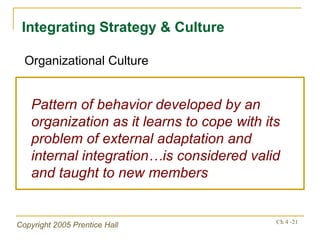
Integrating Strategy & Culture Pattern of behavior developed by an organization as it learns to cope with its problem of external adaptation and internal integration…is considered valid and taught to new members Organizational Culture
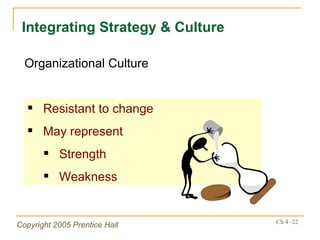
Integrating Strategy & Culture Organizational Culture Resistant to change May represent Strength Weakness
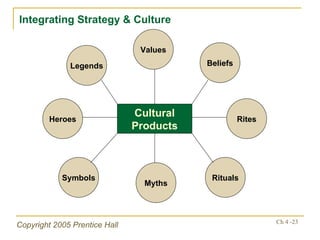
Cultural Products Values Legends Beliefs Heroes Rites Symbols Rituals Myths Integrating Strategy & Culture
Integrating Strategy & Culture Organizational Culture Can Inhibit Strategic Management Miss external changes due to strongly held beliefs Natural tendency to “hold the course” even during times of strategic change
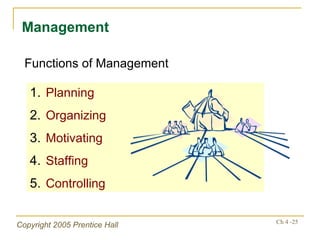
Management Functions of Management Planning Organizing Motivating Staffing Controlling
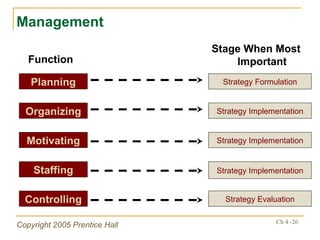
Management Planning Stage When Most Important Function Strategy Formulation Organizing Strategy Implementation Motivating Strategy Implementation Staffing Controlling Strategy Implementation Strategy Evaluation
Management Planning Beginning of management process Bridge between present & future Improves likelihood of attaining desired results
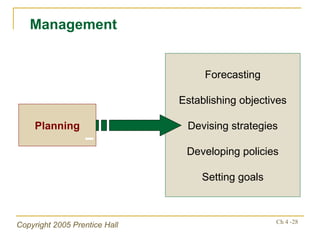
Planning Forecasting Establishing objectives Devising strategies Developing policies Setting goals Management
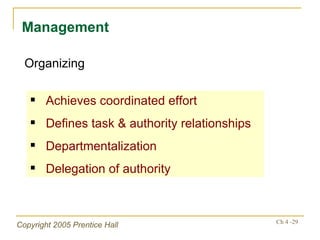
Management Organizing Achieves coordinated effort Defines task & authority relationships Departmentalization Delegation of authority
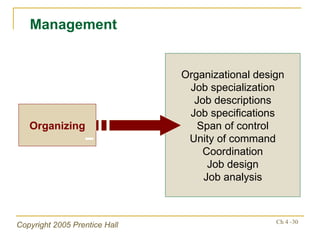
Organizing Organizational design Job specialization Job descriptions Job specifications Span of control Unity of command Coordination Job design Job analysis Management
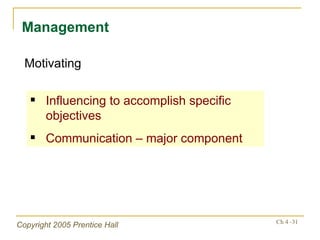
Management Motivating Influencing to accomplish specific objectives Communication – major component
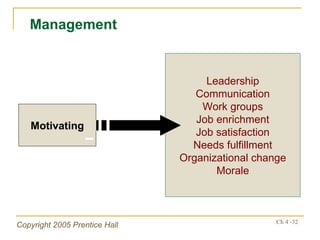
Motivating Leadership Communication Work groups Job enrichment Job satisfaction Needs fulfillment Organizational change Morale Management
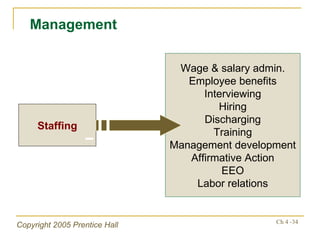
Management Staffing Personnel management Human resources management
Staffing Wage & salary admin. Employee benefits Interviewing Hiring Discharging Training Management development Affirmative Action EEO Labor relations Management
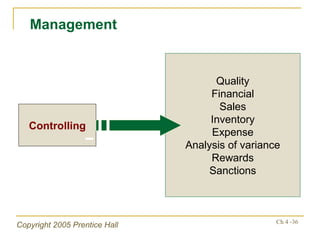
Management Controlling Establishing performance standards Ensure actual operations conform to planned operations Taking corrective actions
Controlling Quality Financial Sales Inventory Expense Analysis of variance Rewards Sanctions Management
Management Audit Checklist Does the firm use strategic management concepts? Are objectives/goals measurable?  Well communicated? Do managers at all levels plan effectively?
Management Audit Checklist Do managers delegate well? Is the organization’s structure appropriate? Are job descriptions clear? Are job specifications clear? Is employee morale high?
Management Audit Checklist Is employee absenteeism low? Is employee turnover low? Are the reward mechanisms effective? Are the organization’s control mechanisms effective?
Marketing Customer Needs/Wants for Products/Services Defining Anticipating Creating Fulfilling
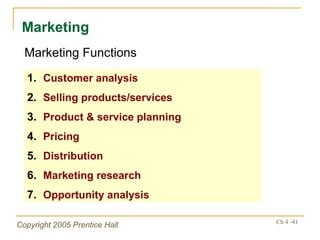
Marketing Marketing Functions Customer analysis Selling products/services Product & service planning Pricing Distribution Marketing research Opportunity analysis
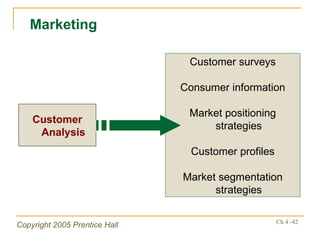
Customer Analysis Customer surveys Consumer information Market positioning strategies Customer profiles Market segmentation strategies Marketing
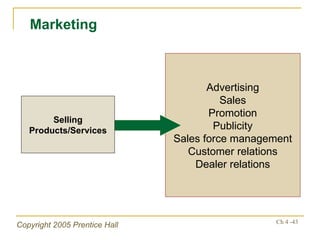
Advertising Sales Promotion Publicity Sales force management Customer relations Dealer relations Marketing Selling Products/Services
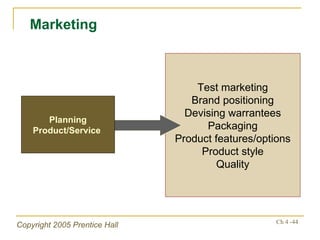
Test marketing Brand positioning Devising warrantees Packaging Product features/options Product style Quality Marketing Planning Product/Service
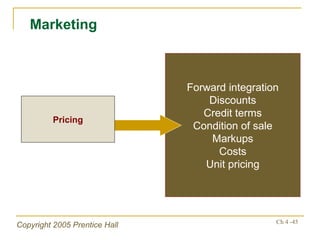
Forward integration Discounts Credit terms Condition of sale Markups Costs Unit pricing Marketing Pricing
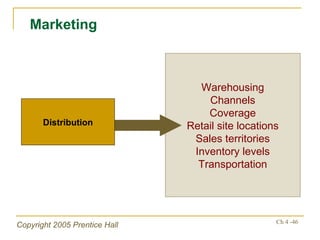
Warehousing Channels Coverage Retail site locations Sales territories Inventory levels Transportation Marketing Distribution
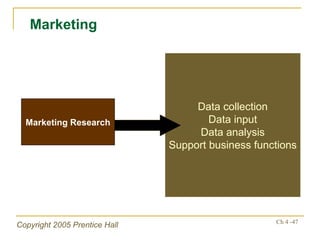
Data collection Data input Data analysis Support business functions Marketing Marketing Research
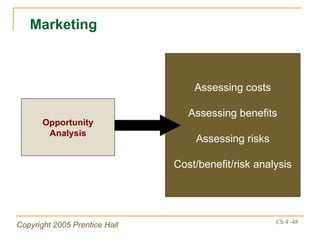
Assessing costs Assessing benefits Assessing risks Cost/benefit/risk analysis Marketing Opportunity Analysis
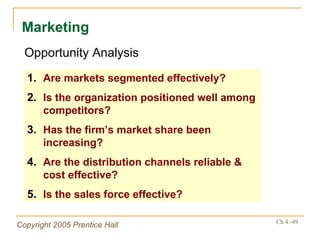
Marketing Opportunity Analysis Are markets segmented effectively? Is the organization positioned well among competitors? Has the firm’s market share been increasing? Are the distribution channels reliable & cost effective? Is the sales force effective?
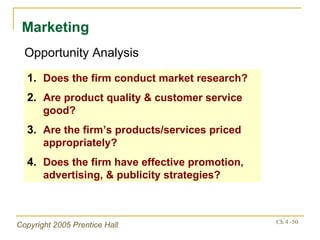
Marketing Opportunity Analysis Does the firm conduct market research? Are product quality & customer service good? Are the firm’s products/services priced appropriately? Does the firm have effective promotion, advertising, & publicity strategies?
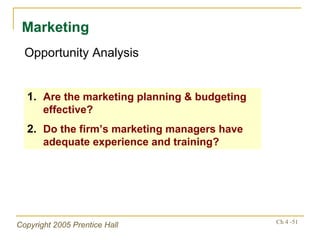
Marketing Opportunity Analysis Are the marketing planning & budgeting effective? Do the firm’s marketing managers have adequate experience and training?
Finance/Accounting Determining financial strengths & weaknesses key to strategy formation
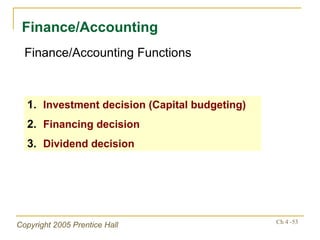
Finance/Accounting Finance/Accounting Functions Investment decision (Capital budgeting) Financing decision Dividend decision
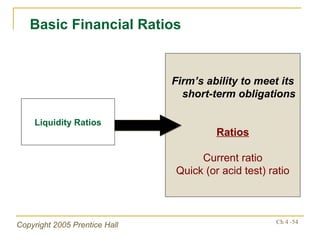
Firm’s ability to meet its short-term obligations Ratios Current ratio Quick (or acid test) ratio Basic Financial Ratios Liquidity Ratios
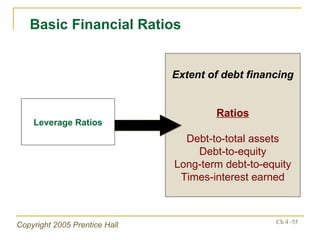
Extent of debt financing Ratios Debt-to-total assets Debt-to-equity Long-term debt-to-equity Times-interest earned Basic Financial Ratios Leverage Ratios
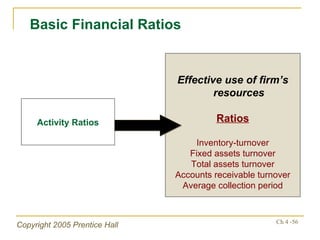
Effective use of firm’s resources Ratios Inventory-turnover Fixed assets turnover Total assets turnover Accounts receivable turnover Average collection period Basic Financial Ratios Activity Ratios
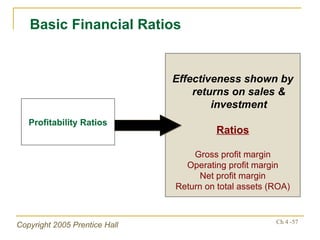
Effectiveness shown by returns on sales & investment Ratios Gross profit margin Operating profit margin Net profit margin Return on total assets (ROA) Basic Financial Ratios Profitability Ratios
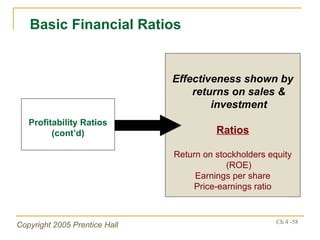
Effectiveness shown by returns on sales & investment Ratios Return on stockholders equity (ROE) Earnings per share Price-earnings ratio Basic Financial Ratios Profitability Ratios (cont’d)
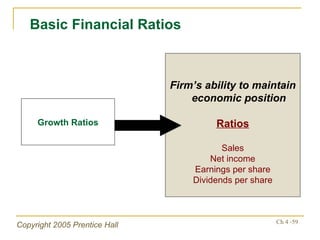
Firm’s ability to maintain economic position Ratios Sales Net income Earnings per share Dividends per share Basic Financial Ratios Growth Ratios
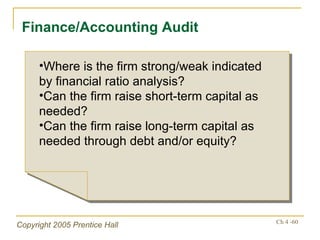
Finance/Accounting Audit Where is the firm strong/weak indicated by financial ratio analysis? Can the firm raise short-term capital as needed? Can the firm raise long-term capital as needed through debt and/or equity?
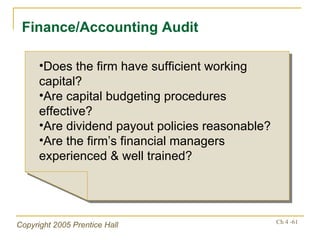
Finance/Accounting Audit Does the firm have sufficient working capital? Are capital budgeting procedures effective? Are dividend payout policies reasonable? Are the firm’s financial managers experienced & well trained?
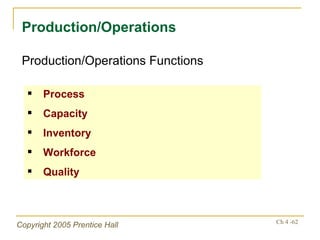
Production/Operations Production/Operations Functions Process Capacity Inventory Workforce Quality
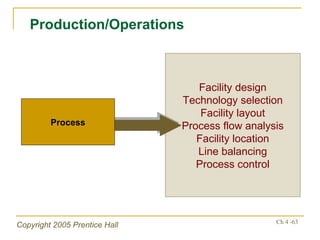
Facility design Technology selection Facility layout Process flow analysis Facility location Line balancing Process control Production/Operations Process
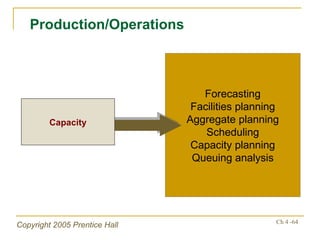
Forecasting Facilities planning Aggregate planning Scheduling Capacity planning Queuing analysis Production/Operations Capacity
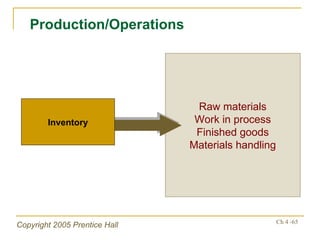
Raw materials Work in process Finished goods Materials handling Production/Operations Inventory
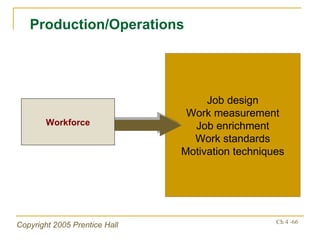
Job design Work measurement Job enrichment Work standards Motivation techniques Production/Operations Workforce
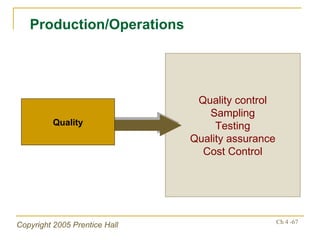
Quality control Sampling Testing Quality assurance Cost Control Production/Operations Quality
Production/Operations Audit Are suppliers of materials, parts, etc. reliable and reasonable? Are facilities, equipment & machinery in good condition? Are inventory-control policies and procedures effective?
Production/Operations Audit Are quality-control policies & procedures effective? Are facilities, resources, and markets strategically located? Does the firm have technological competencies?
Research & Development Research & Development Functions Development of new products  before  competitors Improving product quality Improving manufacturing processes to reduce costs
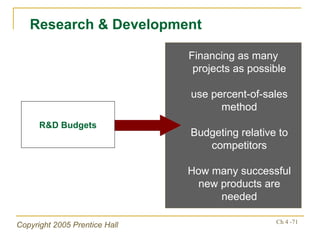
Financing as many projects as possible use percent-of-sales method Budgeting relative to competitors How many successful new products are needed Research & Development R&D Budgets
Research & Development Audit Are the R&D facilities adequate? If R&D is outsourced, is it cost effective? Are the R&D personnel well qualified? Are R&D resources allocated effectively?
Research & Development Audit Are MIS and computer systems adequate? Is communication between R&D & other organizational units effective? Are present products technologically competitive?
Management Information Systems Purpose Improve performance of an enterprise by improving the quality of managerial decisions.
Information Systems CIO/CTO Security User-friendly E-commerce Management Information Systems
Management Information Systems Audit Do managers use the information system to make decisions? Is there a CIO or Director of information systems position in the firm? Is data updated regularly?
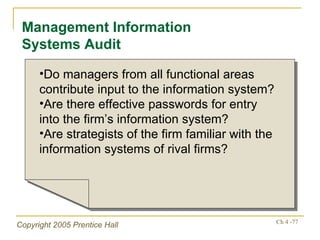
Management Information Systems Audit Do managers from all functional areas contribute input to the information system? Are there effective passwords for entry into the firm’s information system? Are strategists of the firm familiar with the information systems of rival firms?
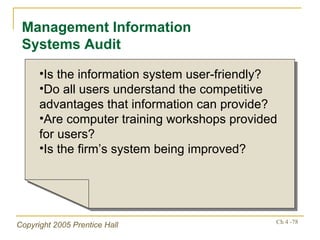
Management Information Systems Audit Is the information system user-friendly? Do all users understand the competitive advantages that information can provide? Are computer training workshops provided for users? Is the firm’s system being improved?
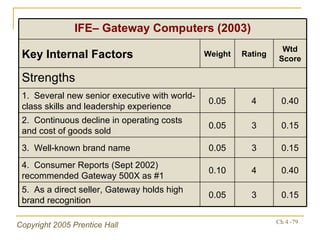
0.15 3 0.05 5.  As a direct seller, Gateway holds high brand recognition 0.40 4 0.10 4.  Consumer Reports (Sept 2002) recommended Gateway 500X as #1 0.15 3 0.05 3.  Well-known brand name 0.15 3 0.05 2.  Continuous decline in operating costs and cost of goods sold 0.40 4 0.05 1.  Several new senior executive with world-class skills and leadership experience Strengths Wtd Score Rating Weight Key Internal Factors IFE– Gateway Computers (2003)
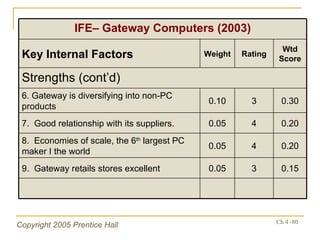
0.15 3 0.05 9.  Gateway retails stores excellent 0.20 4 0.05 8.  Economies of scale, the 6 th  largest PC maker I the world 0.20 4 0.05 7.  Good relationship with its suppliers.  0.30 3 0.10 6. Gateway is diversifying into non-PC products Strengths (cont’d) Wtd Score Rating Weight Key Internal Factors IFE– Gateway Computers (2003)
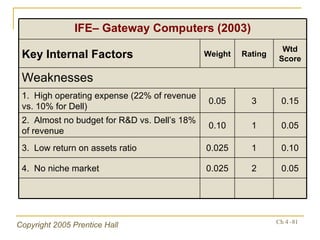
0.05 2 0.025 4.  No niche market 0.10 1 0.025 3.  Low return on assets ratio 0.05 1 0.10 2.  Almost no budget for R&D vs. Dell’s 18% of revenue 0.15 3 0.05 1.  High operating expense (22% of revenue vs. 10% for Dell) Weaknesses Wtd Score Rating Weight Key Internal Factors IFE– Gateway Computers (2003)
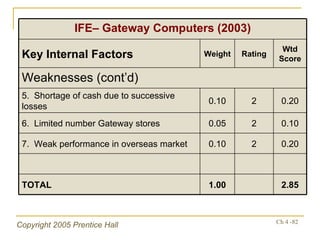
2.85 1.00 TOTAL 0.20 2 0.10 7.  Weak performance in overseas market 0.10 2 0.05 6.  Limited number Gateway stores 0.20 2 0.10 5.  Shortage of cash due to successive losses Weaknesses (cont’d) Wtd Score Rating Weight Key Internal Factors IFE– Gateway Computers (2003)
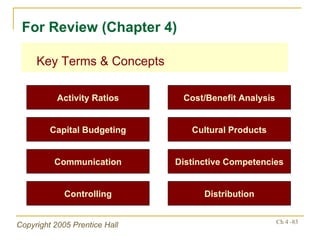
Key Terms & Concepts For Review (Chapter 4) Activity Ratios Cost/Benefit Analysis Capital Budgeting Cultural Products Communication Distinctive Competencies Controlling Distribution
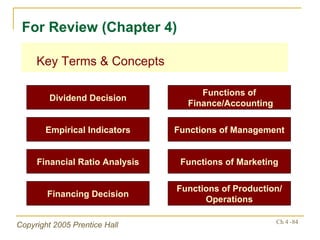
Key Terms & Concepts For Review (Chapter 4) Dividend Decision Functions of  Finance/Accounting Empirical Indicators Functions of Management Financial Ratio Analysis Functions of Marketing Financing Decision Functions of Production/ Operations
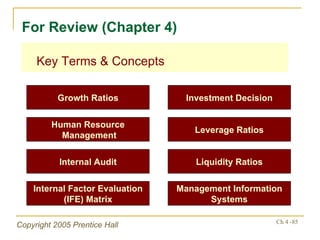
Key Terms & Concepts For Review (Chapter 4) Growth Ratios Investment Decision Human Resource  Management Leverage Ratios Internal Audit Liquidity Ratios Internal Factor Evaluation (IFE) Matrix Management Information Systems
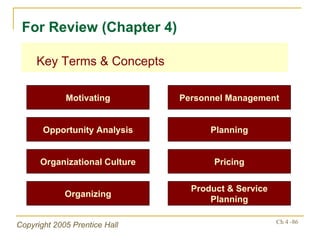
Key Terms & Concepts For Review (Chapter 4) Motivating Personnel Management Opportunity Analysis Planning Organizational Culture Pricing Organizing Product & Service Planning
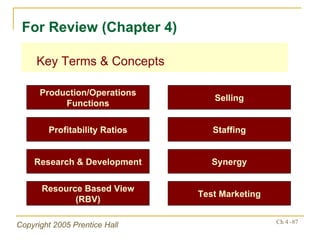
Key Terms & Concepts For Review (Chapter 4) Production/Operations Functions Selling Profitability Ratios Staffing Research & Development Synergy Resource Based View (RBV) Test Marketing
Key Terms & Concepts For Review (Chapter 4) Value Chain Analysis (VCA)

The Internal Assessment

  • 1.
    Chapter 4 The Internal Assessment Strategic Management: Concepts & Cases 10 th Edition Fred David PowerPoint Slides by Anthony F. Chelte Western New England College
  • 2.
    Chapter Outline TheNature of an Internal Audit The Resource-Based View (RBV) Integrating Strategy & Culture
  • 3.
    Chapter Outline (cont’d ) Management Marketing Opportunity Analysis
  • 4.
    Chapter Outline (cont’d ) Finance/Accounting Production/Operations Research & Development
  • 5.
    Chapter Outline (cont’d ) Management Information Systems The Internal Factor Evaluation (IFE) Matrix
  • 6.
    The biggest leversyou’ve got to change a company are strategy, structure, and culture. If I could pick two, I’d pick strategy and culture. – Wayne Leonard, CEO, Entergy Internal Assessment Weak leadership can wreck the soundest strategy. – Sun Zi
  • 7.
    -- Strengths --Weaknesses The Nature of an Internal Audit Functional Areas of Business
  • 8.
    Internal strengths/weaknesses Externalopportunities/threats Clear statement of mission Nature of an Internal Audit Basis for Objectives & Strategies
  • 9.
    Key Internal ForcesFunctional Business Areas: Vary by organization Divisions have differing strengths & weaknesses
  • 10.
    Key Internal ForcesDistinctive Competencies: Firm’s strengths that cannot be easily matched or imitated by competitors
  • 11.
    Key Internal ForcesDistinctive Competencies: Building competitive advantage involves taking advantage of distinctive competencies
  • 12.
    Key Internal ForcesDistinctive Competencies: Strategies designed to improve on a firm’s weaknesses and turn to strengths
  • 13.
    Internal Audit Informationfrom: Management Marketing Finance/accounting Production/operations Research & Development Management information Systems Parallels process of external audit
  • 14.
    Internal Audit Involvementin performing an internal strategic-management audit provides vehicle for understanding nature and effect of decisions in other functional business areas of the firm
  • 15.
    Internal Audit Coordination& understanding among managers from all functional areas Key to Organizational Success
  • 16.
    Internal Audit Numberand complexity increases relative to organization size Functional Relationships
  • 17.
    Internal Audit Exemplifiescomplexity of relationships among functional areas of the business Financial Ratio Analysis
  • 18.
    Resource Based View(RBV) Approach to Competitive Advantage Internal resources are more important than external factors
  • 19.
    Resource Based View(RBV) 3 All Encompassing Categories Physical resources Human resources Organizational resources
  • 20.
    Resource Based View(RBV) Empirical Indicators Rare Hard to imitate Not easily substitutable
  • 21.
    Integrating Strategy &Culture Pattern of behavior developed by an organization as it learns to cope with its problem of external adaptation and internal integration…is considered valid and taught to new members Organizational Culture
  • 22.
    Integrating Strategy &Culture Organizational Culture Resistant to change May represent Strength Weakness
  • 23.
    Cultural Products ValuesLegends Beliefs Heroes Rites Symbols Rituals Myths Integrating Strategy & Culture
  • 24.
    Integrating Strategy &Culture Organizational Culture Can Inhibit Strategic Management Miss external changes due to strongly held beliefs Natural tendency to “hold the course” even during times of strategic change
  • 25.
    Management Functions ofManagement Planning Organizing Motivating Staffing Controlling
  • 26.
    Management Planning StageWhen Most Important Function Strategy Formulation Organizing Strategy Implementation Motivating Strategy Implementation Staffing Controlling Strategy Implementation Strategy Evaluation
  • 27.
    Management Planning Beginningof management process Bridge between present & future Improves likelihood of attaining desired results
  • 28.
    Planning Forecasting Establishingobjectives Devising strategies Developing policies Setting goals Management
  • 29.
    Management Organizing Achievescoordinated effort Defines task & authority relationships Departmentalization Delegation of authority
  • 30.
    Organizing Organizational designJob specialization Job descriptions Job specifications Span of control Unity of command Coordination Job design Job analysis Management
  • 31.
    Management Motivating Influencingto accomplish specific objectives Communication – major component
  • 32.
    Motivating Leadership CommunicationWork groups Job enrichment Job satisfaction Needs fulfillment Organizational change Morale Management
  • 33.
    Management Staffing Personnelmanagement Human resources management
  • 34.
    Staffing Wage &salary admin. Employee benefits Interviewing Hiring Discharging Training Management development Affirmative Action EEO Labor relations Management
  • 35.
    Management Controlling Establishingperformance standards Ensure actual operations conform to planned operations Taking corrective actions
  • 36.
    Controlling Quality FinancialSales Inventory Expense Analysis of variance Rewards Sanctions Management
  • 37.
    Management Audit ChecklistDoes the firm use strategic management concepts? Are objectives/goals measurable? Well communicated? Do managers at all levels plan effectively?
  • 38.
    Management Audit ChecklistDo managers delegate well? Is the organization’s structure appropriate? Are job descriptions clear? Are job specifications clear? Is employee morale high?
  • 39.
    Management Audit ChecklistIs employee absenteeism low? Is employee turnover low? Are the reward mechanisms effective? Are the organization’s control mechanisms effective?
  • 40.
    Marketing Customer Needs/Wantsfor Products/Services Defining Anticipating Creating Fulfilling
  • 41.
    Marketing Marketing FunctionsCustomer analysis Selling products/services Product & service planning Pricing Distribution Marketing research Opportunity analysis
  • 42.
    Customer Analysis Customersurveys Consumer information Market positioning strategies Customer profiles Market segmentation strategies Marketing
  • 43.
    Advertising Sales PromotionPublicity Sales force management Customer relations Dealer relations Marketing Selling Products/Services
  • 44.
    Test marketing Brandpositioning Devising warrantees Packaging Product features/options Product style Quality Marketing Planning Product/Service
  • 45.
    Forward integration DiscountsCredit terms Condition of sale Markups Costs Unit pricing Marketing Pricing
  • 46.
    Warehousing Channels CoverageRetail site locations Sales territories Inventory levels Transportation Marketing Distribution
  • 47.
    Data collection Datainput Data analysis Support business functions Marketing Marketing Research
  • 48.
    Assessing costs Assessingbenefits Assessing risks Cost/benefit/risk analysis Marketing Opportunity Analysis
  • 49.
    Marketing Opportunity AnalysisAre markets segmented effectively? Is the organization positioned well among competitors? Has the firm’s market share been increasing? Are the distribution channels reliable & cost effective? Is the sales force effective?
  • 50.
    Marketing Opportunity AnalysisDoes the firm conduct market research? Are product quality & customer service good? Are the firm’s products/services priced appropriately? Does the firm have effective promotion, advertising, & publicity strategies?
  • 51.
    Marketing Opportunity AnalysisAre the marketing planning & budgeting effective? Do the firm’s marketing managers have adequate experience and training?
  • 52.
    Finance/Accounting Determining financialstrengths & weaknesses key to strategy formation
  • 53.
    Finance/Accounting Finance/Accounting FunctionsInvestment decision (Capital budgeting) Financing decision Dividend decision
  • 54.
    Firm’s ability tomeet its short-term obligations Ratios Current ratio Quick (or acid test) ratio Basic Financial Ratios Liquidity Ratios
  • 55.
    Extent of debtfinancing Ratios Debt-to-total assets Debt-to-equity Long-term debt-to-equity Times-interest earned Basic Financial Ratios Leverage Ratios
  • 56.
    Effective use offirm’s resources Ratios Inventory-turnover Fixed assets turnover Total assets turnover Accounts receivable turnover Average collection period Basic Financial Ratios Activity Ratios
  • 57.
    Effectiveness shown byreturns on sales & investment Ratios Gross profit margin Operating profit margin Net profit margin Return on total assets (ROA) Basic Financial Ratios Profitability Ratios
  • 58.
    Effectiveness shown byreturns on sales & investment Ratios Return on stockholders equity (ROE) Earnings per share Price-earnings ratio Basic Financial Ratios Profitability Ratios (cont’d)
  • 59.
    Firm’s ability tomaintain economic position Ratios Sales Net income Earnings per share Dividends per share Basic Financial Ratios Growth Ratios
  • 60.
    Finance/Accounting Audit Whereis the firm strong/weak indicated by financial ratio analysis? Can the firm raise short-term capital as needed? Can the firm raise long-term capital as needed through debt and/or equity?
  • 61.
    Finance/Accounting Audit Doesthe firm have sufficient working capital? Are capital budgeting procedures effective? Are dividend payout policies reasonable? Are the firm’s financial managers experienced & well trained?
  • 62.
    Production/Operations Production/Operations FunctionsProcess Capacity Inventory Workforce Quality
  • 63.
    Facility design Technologyselection Facility layout Process flow analysis Facility location Line balancing Process control Production/Operations Process
  • 64.
    Forecasting Facilities planningAggregate planning Scheduling Capacity planning Queuing analysis Production/Operations Capacity
  • 65.
    Raw materials Workin process Finished goods Materials handling Production/Operations Inventory
  • 66.
    Job design Workmeasurement Job enrichment Work standards Motivation techniques Production/Operations Workforce
  • 67.
    Quality control SamplingTesting Quality assurance Cost Control Production/Operations Quality
  • 68.
    Production/Operations Audit Aresuppliers of materials, parts, etc. reliable and reasonable? Are facilities, equipment & machinery in good condition? Are inventory-control policies and procedures effective?
  • 69.
    Production/Operations Audit Arequality-control policies & procedures effective? Are facilities, resources, and markets strategically located? Does the firm have technological competencies?
  • 70.
    Research & DevelopmentResearch & Development Functions Development of new products before competitors Improving product quality Improving manufacturing processes to reduce costs
  • 71.
    Financing as manyprojects as possible use percent-of-sales method Budgeting relative to competitors How many successful new products are needed Research & Development R&D Budgets
  • 72.
    Research & DevelopmentAudit Are the R&D facilities adequate? If R&D is outsourced, is it cost effective? Are the R&D personnel well qualified? Are R&D resources allocated effectively?
  • 73.
    Research & DevelopmentAudit Are MIS and computer systems adequate? Is communication between R&D & other organizational units effective? Are present products technologically competitive?
  • 74.
    Management Information SystemsPurpose Improve performance of an enterprise by improving the quality of managerial decisions.
  • 75.
    Information Systems CIO/CTOSecurity User-friendly E-commerce Management Information Systems
  • 76.
    Management Information SystemsAudit Do managers use the information system to make decisions? Is there a CIO or Director of information systems position in the firm? Is data updated regularly?
  • 77.
    Management Information SystemsAudit Do managers from all functional areas contribute input to the information system? Are there effective passwords for entry into the firm’s information system? Are strategists of the firm familiar with the information systems of rival firms?
  • 78.
    Management Information SystemsAudit Is the information system user-friendly? Do all users understand the competitive advantages that information can provide? Are computer training workshops provided for users? Is the firm’s system being improved?
  • 79.
    0.15 3 0.055. As a direct seller, Gateway holds high brand recognition 0.40 4 0.10 4. Consumer Reports (Sept 2002) recommended Gateway 500X as #1 0.15 3 0.05 3. Well-known brand name 0.15 3 0.05 2. Continuous decline in operating costs and cost of goods sold 0.40 4 0.05 1. Several new senior executive with world-class skills and leadership experience Strengths Wtd Score Rating Weight Key Internal Factors IFE– Gateway Computers (2003)
  • 80.
    0.15 3 0.059. Gateway retails stores excellent 0.20 4 0.05 8. Economies of scale, the 6 th largest PC maker I the world 0.20 4 0.05 7. Good relationship with its suppliers. 0.30 3 0.10 6. Gateway is diversifying into non-PC products Strengths (cont’d) Wtd Score Rating Weight Key Internal Factors IFE– Gateway Computers (2003)
  • 81.
    0.05 2 0.0254. No niche market 0.10 1 0.025 3. Low return on assets ratio 0.05 1 0.10 2. Almost no budget for R&D vs. Dell’s 18% of revenue 0.15 3 0.05 1. High operating expense (22% of revenue vs. 10% for Dell) Weaknesses Wtd Score Rating Weight Key Internal Factors IFE– Gateway Computers (2003)
  • 82.
    2.85 1.00 TOTAL0.20 2 0.10 7. Weak performance in overseas market 0.10 2 0.05 6. Limited number Gateway stores 0.20 2 0.10 5. Shortage of cash due to successive losses Weaknesses (cont’d) Wtd Score Rating Weight Key Internal Factors IFE– Gateway Computers (2003)
  • 83.
    Key Terms &Concepts For Review (Chapter 4) Activity Ratios Cost/Benefit Analysis Capital Budgeting Cultural Products Communication Distinctive Competencies Controlling Distribution
  • 84.
    Key Terms &Concepts For Review (Chapter 4) Dividend Decision Functions of Finance/Accounting Empirical Indicators Functions of Management Financial Ratio Analysis Functions of Marketing Financing Decision Functions of Production/ Operations
  • 85.
    Key Terms &Concepts For Review (Chapter 4) Growth Ratios Investment Decision Human Resource Management Leverage Ratios Internal Audit Liquidity Ratios Internal Factor Evaluation (IFE) Matrix Management Information Systems
  • 86.
    Key Terms &Concepts For Review (Chapter 4) Motivating Personnel Management Opportunity Analysis Planning Organizational Culture Pricing Organizing Product & Service Planning
  • 87.
    Key Terms &Concepts For Review (Chapter 4) Production/Operations Functions Selling Profitability Ratios Staffing Research & Development Synergy Resource Based View (RBV) Test Marketing
  • 88.
    Key Terms &Concepts For Review (Chapter 4) Value Chain Analysis (VCA)