
25 September 2014 
BUSINESS MODEL AND STRATEGY 
Sergejs Groskovs 
PhDcandidate 
Aarhus University 
sg@badm.au.dk 
MBA Strategy 
25 September 2014
BUSINESS MODEL AND STRATEGY 
SERGEJS GROSKOVS 
PHD CANDIDATE 
25 September 2014 
OBJECTIVES 
›UNDERSTAND 
›business model concept 
›link between business model and strategy 
SLIDE 2
BUSINESS MODEL AND STRATEGY 
SERGEJS GROSKOVS 
PHD CANDIDATE 
25 September 2014 
PSST, WHAT’S YOUR BUSINESS MODEL? 
›Think about your company’s business model(1 min) 
›Describe in 2-3 short sentences, on paper 
›Share with the class 
SLIDE 3
BUSINESS MODEL AND STRATEGY 
SERGEJS GROSKOVS 
PHD CANDIDATE 
25 September 2014 
HELP ME… 
›What is a business model? 
›What is business model good for? 
SLIDE 4
BUSINESS MODEL AND STRATEGY 
SERGEJS GROSKOVS 
PHD CANDIDATE 
25 September 2014 
BUSINESS MODELAS TECHNOLOGY COMMERCIALIZATION 
SLIDE 5 
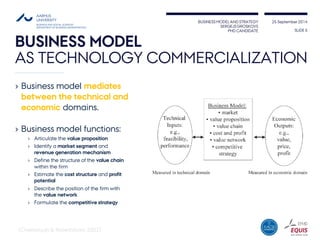
›Business model mediates between the technical and economic domains. 
›Business model functions: 
›Articulate the value proposition 
›Identify a market segment andrevenue generation mechanism 
›Define the structure of the value chain within the firm 
›Estimate the cost structure and profit potential 
›Describe the position of the firm with the value network 
›Formulate the competitive strategy 
(Chesbrough & Rosenbloom 2002)
BUSINESS MODEL AND STRATEGY 
SERGEJS GROSKOVS 
PHD CANDIDATE 
25 September 2014 
BUSINESS MODEL 
AS CONCEPTUAL MODEL OF BUSINESS 
SLIDE 6 
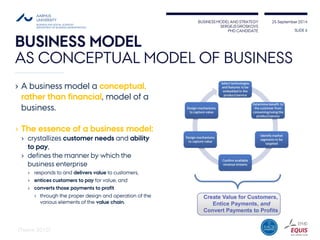
› A business model a conceptual, 
rather than financial, model of a 
business. 
› The essence of a business model: 
› crystallizes customer needs and ability 
to pay, 
› defines the manner by which the 
business enterprise 
› responds to and delivers value to customers, 
› entices customers to pay for value, and 
› converts those payments to profit 
› through the proper design and operation of the 
various elements of the value chain. 
(Teece 2010)
BUSINESS MODEL AND STRATEGY 
SERGEJS GROSKOVS 
PHD CANDIDATE 
25 September 2014 
BUSINESS MODELAS CONCEPTUAL TOOL 
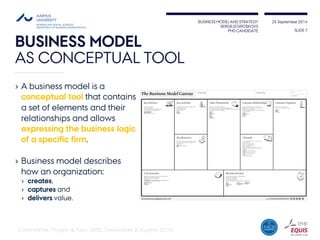
›A business model is a conceptual tool that contains a set of elements and their relationships and allows expressing the business logic of a specific firm. 
›Business model describes how an organization: 
›creates, 
›capturesand 
›deliversvalue. 
SLIDE 7 
(Osterwalder, Pigneur& Tucci2005; Osterwalder& Pigneur2010)
BUSINESS MODEL AND STRATEGY 
SERGEJS GROSKOVS 
PHD CANDIDATE 
25 September 2014 
BUSINESS MODEL 
AS SET OF COMPONENTS 
SLIDE 8 
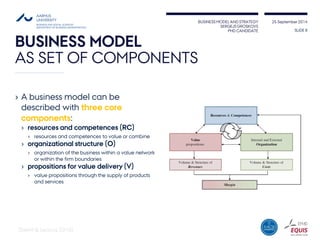
› A business model can be 
described with three core 
components: 
› resources and competences (RC) 
› resources and competences to value or combine 
› organizational structure (O) 
› organization of the business within a value network 
or within the firm boundaries 
› propositions for value delivery (V) 
› value propositions through the supply of products 
and services 
(Demil & Lecocq 2010)
BUSINESS MODEL AND STRATEGY 
SERGEJS GROSKOVS 
PHD CANDIDATE 
25 September 2014 
BUSINESS MODEL 
AS SET OF CHOICES & CONSEQUENCES 
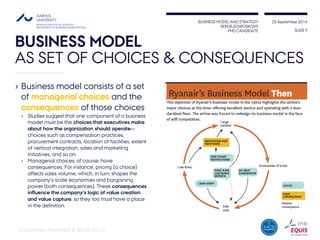
› Business model consists of a set 
of managerial choices and the 
consequences of those choices 
› Studies suggest that one component of a business 
model must be the choices that executives make 
about how the organization should operate— 
choices such as compensation practices, 
procurement contracts, location of facilities, extent 
of vertical integration, sales and marketing 
initiatives, and so on. 
› Managerial choices, of course, have 
consequences. For instance, pricing (a choice) 
affects sales volume, which, in turn, shapes the 
company’s scale economies and bargaining 
power (both consequences). These consequences 
influence the company’s logic of value creation 
and value capture, so they too must have a place 
in the definition. 
SLIDE 9 
(Casadesus-Masanelll & Ricart 2011)
BUSINESS MODEL AND STRATEGY 
SERGEJS GROSKOVS 
PHD CANDIDATE 
25 September 2014 
BUSINESS MODELAS ACTIVITY SYSTEM 
SLIDE 10 
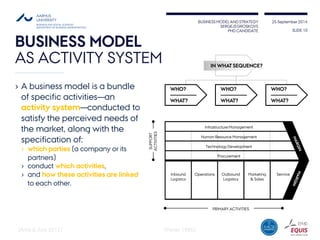
›A business model is a bundle of specific activities—an activity system—conducted to satisfy the perceived needs of the market, along with the specification of: 
›which parties(a company or its partners) 
›conductwhich activities, 
›and how these activities are linked to each other. 
WHO? —————— WHAT? 
WHO? —————— WHAT? 
WHO? —————— WHAT? 
IN WHAT SEQUENCE? 
Service 
Inbound Logistics 
Operations 
Outbound Logistics 
Marketing & Sales 
Infrastructure Management 
Human Resource Management 
Technology Development 
Procurement 
SUPPORT 
ACTIVITIES 
PRIMARY ACTIVITIES 
(Porter 1985) 
(Amit & Zott2012)
BUSINESS MODEL AND STRATEGY 
SERGEJS GROSKOVS 
PHD CANDIDATE 
25 September 2014 
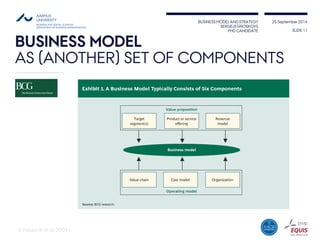
BUSINESS MODELAS (ANOTHER) SET OF COMPONENTS 
SLIDE 11 
(Lindgardtet al 2009)
BUSINESS MODEL AND STRATEGY 
SERGEJS GROSKOVS 
PHD CANDIDATE 
25 September 2014 
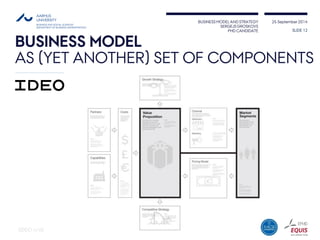
BUSINESS MODELAS (YET ANOTHER) SET OF COMPONENTS 
SLIDE 12 
(IDEO n/d)
BUSINESS MODEL AND STRATEGY 
SERGEJS GROSKOVS 
PHD CANDIDATE 
25 September 2014 
BUSINESS MODEL? 
›What is commonin all these definitions? Which definition do you prefer? 
›Discuss with neighbor(3 min) 
›Share with the class 
SLIDE 13
BUSINESS MODEL AND STRATEGY 
SERGEJS GROSKOVS 
PHD CANDIDATE 
25 September 2014 
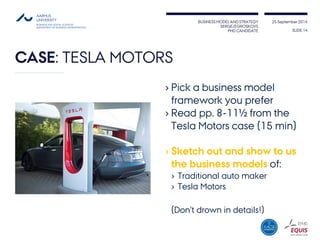
CASE: TESLA MOTORS 
›Pick a business model framework you prefer 
›Read pp. 8-11½ from the Tesla Motors case (15 min) 
›Sketch out and show to us the business models of: 
›Traditional auto maker 
›Tesla Motors 
(Don’t drown in details!) 
SLIDE 14
BUSINESS MODEL AND STRATEGY 
SERGEJS GROSKOVS 
PHD CANDIDATE 
25 September 2014 
BUSINESS MODEL AND STRATEGY 
›What is Tesla’s strategy? 
SLIDE 15
BUSINESS MODEL AND STRATEGY 
SERGEJS GROSKOVS 
PHD CANDIDATE 
25 September 2014 
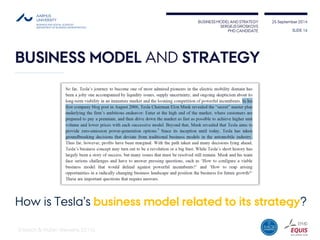
BUSINESS MODEL AND STRATEGY 
How is Tesla’s business model related to its strategy? 
SLIDE 16 
(Hettich& Müller-Stewens2014)
BUSINESS MODEL AND STRATEGY 
SERGEJS GROSKOVS 
PHD CANDIDATE 
25 September 2014 
BUSINESS MODEL ANDSTRATEGY 
SLIDE 17 
(Casadesus-Masanell& Ricart2010) 
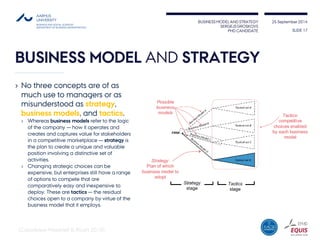
›No three concepts are of as much use to managers or as misunderstood as strategy, business models, and tactics. 
›Whereas business models refer to the logic of the company —how it operates and creates and captures value for stakeholders in a competitive marketplace —strategy is the plan to create a unique and valuable position involving a distinctive set of activities. 
›Changing strategic choices can be expensive, but enterprises still have a range of options to compete that are comparatively easy and inexpensive to deploy. These are tactics—the residual choices open to a company by virtue of the business model that it employs.
BUSINESS MODEL AND STRATEGY 
SERGEJS GROSKOVS 
PHD CANDIDATE 
25 September 2014 
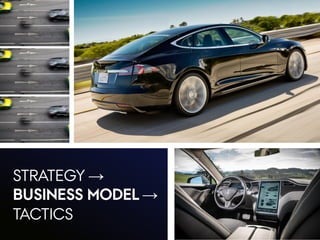
STRATEGY → BUSINESS MODEL → TACTICS
BUSINESS MODEL AND STRATEGY 
SERGEJS GROSKOVS 
PHD CANDIDATE 
25 September 2014 
BUSINESS MODEL ANDSTRATEGY 
›FINDINGS 
›Our theoretical and empirical analysis reveals that a firm’s product market strategy and its business model are distinct constructs that affect the firm’s market value. 
›Novelty-centered business models—coupled with product market strategies that emphasize differentiation, cost leadership, or early market entry—can enhance firm performance. 
›With respect to efficiency-centered business models, however, our analysis did not provide support for the expected positive interaction between an efficiency-centered business model and cost-leadership strategy. 
SLIDE 19 
›EMPIRICAL STUDY 
›To evaluate the implications of business model and product market strategy on firm performance, we consider two main business model design themes— novelty-centered and efficiency-centered—along with three product market strategy choices: cost leadership, differentiation, and the timing of entry into a market. 
›We collected data on a sample of firms that had gone public in Europe or in the United States between April 1996 and May 2000. 
›We randomly sampled 170 firms on their business model characteristics and product market strategies. 
›We developed a formal model in order to analyze the contingent effects of product market strategy and business model choices on firm performance. 
(Zott& Amit 2008)
BUSINESS MODEL AND STRATEGY 
SERGEJS GROSKOVS 
PHD CANDIDATE 
25 September 2014 
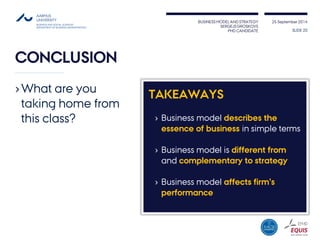
CONCLUSION 
TAKEAWAYS 
›Business model describes the essence of business in simple terms 
›Business model is different from andcomplementary to strategy 
›Business model affects firm’s performance 
SLIDE 20 
›What are you taking home from this class?
25 September 2014 
THANK YOU & KEEP IN TOUCH 
Sergejs Groskovs 
PhDcandidate 
Aarhus University 
sg@badm.au.dk 
http://www.linkedin.com/in/sergejsgroskovs 
http://www.twitter.com/sgroskovs
BUSINESS MODEL AND STRATEGY 
SERGEJS GROSKOVS 
PHD CANDIDATE 
25 September 2014 
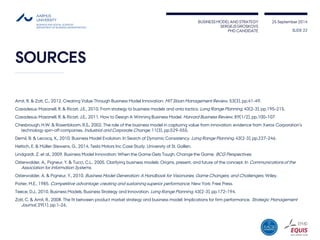
SOURCES 
Amit, R. & Zott, C., 2012. Creating Value Through Business Model Innovation. MIT Sloan Management Review, 53(3), pp.41–49. 
Casadesus-Masanell, R. & Ricart, J.E., 2010. From strategy to business models and onto tactics. Long Range Planning, 43(2-3), pp.195–215. 
Casadesus-Masanell, R. & Ricart, J.E., 2011. How to Design A Winning Business Model. Harvard Business Review, 89(1/2), pp.100–107. 
Chesbrough, H.W. & Rosenbloom, R.S., 2002. The role of the business model in capturing value from innovation: evidence from Xerox Corporation’s technology spin-off companies. Industrial and Corporate Change, 11(3), pp.529–555. 
Demil, B. & Lecocq, X., 2010. Business Model Evolution: In Search of Dynamic Consistency. Long Range Planning, 43(2-3), pp.227–246. 
Hettich, E. & Müller-Stewens, G., 2014. Tesla Motors IncCase Study. University of St. Gallen. 
Lindgardt, Z. et al., 2009. Business Model Innovation: When the Game Gets Tough, Change the Game. BCG Perspectives. 
Osterwalder, A., Pigneur, Y. & Tucci, C.L., 2005. Clarifying business models: Origins, present, and future of the concept. In Communications of the Association for Information Systems. 
Osterwalder, A. & Pigneur, Y., 2010. Business Model Generation: A Handbook for Visionaries, Game Changers, and Challengers, Wiley. 
Porter, M.E., 1985. Competitive advantage: creating and sustaining superior performance, New York: Free Press. 
Teece, D.J., 2010. Business Models, Business Strategy and Innovation. Long Range Planning, 43(2-3), pp.172–194. 
Zott, C. & Amit, R., 2008. The fit between product market strategy and business model: Implications for firm performance. Strategic Management Journal, 29(1), pp.1–26. 
SLIDE 22

Business Model and Strategy

  • 1.
    25 September 2014 BUSINESS MODEL AND STRATEGY Sergejs Groskovs PhDcandidate Aarhus University sg@badm.au.dk MBA Strategy 25 September 2014
  • 2.
    BUSINESS MODEL ANDSTRATEGY SERGEJS GROSKOVS PHD CANDIDATE 25 September 2014 OBJECTIVES ›UNDERSTAND ›business model concept ›link between business model and strategy SLIDE 2
  • 3.
    BUSINESS MODEL ANDSTRATEGY SERGEJS GROSKOVS PHD CANDIDATE 25 September 2014 PSST, WHAT’S YOUR BUSINESS MODEL? ›Think about your company’s business model(1 min) ›Describe in 2-3 short sentences, on paper ›Share with the class SLIDE 3
  • 4.
    BUSINESS MODEL ANDSTRATEGY SERGEJS GROSKOVS PHD CANDIDATE 25 September 2014 HELP ME… ›What is a business model? ›What is business model good for? SLIDE 4
  • 5.
    BUSINESS MODEL ANDSTRATEGY SERGEJS GROSKOVS PHD CANDIDATE 25 September 2014 BUSINESS MODELAS TECHNOLOGY COMMERCIALIZATION SLIDE 5 ›Business model mediates between the technical and economic domains. ›Business model functions: ›Articulate the value proposition ›Identify a market segment andrevenue generation mechanism ›Define the structure of the value chain within the firm ›Estimate the cost structure and profit potential ›Describe the position of the firm with the value network ›Formulate the competitive strategy (Chesbrough & Rosenbloom 2002)
  • 6.
    BUSINESS MODEL ANDSTRATEGY SERGEJS GROSKOVS PHD CANDIDATE 25 September 2014 BUSINESS MODEL AS CONCEPTUAL MODEL OF BUSINESS SLIDE 6 › A business model a conceptual, rather than financial, model of a business. › The essence of a business model: › crystallizes customer needs and ability to pay, › defines the manner by which the business enterprise › responds to and delivers value to customers, › entices customers to pay for value, and › converts those payments to profit › through the proper design and operation of the various elements of the value chain. (Teece 2010)
  • 7.
    BUSINESS MODEL ANDSTRATEGY SERGEJS GROSKOVS PHD CANDIDATE 25 September 2014 BUSINESS MODELAS CONCEPTUAL TOOL ›A business model is a conceptual tool that contains a set of elements and their relationships and allows expressing the business logic of a specific firm. ›Business model describes how an organization: ›creates, ›capturesand ›deliversvalue. SLIDE 7 (Osterwalder, Pigneur& Tucci2005; Osterwalder& Pigneur2010)
  • 8.
    BUSINESS MODEL ANDSTRATEGY SERGEJS GROSKOVS PHD CANDIDATE 25 September 2014 BUSINESS MODEL AS SET OF COMPONENTS SLIDE 8 › A business model can be described with three core components: › resources and competences (RC) › resources and competences to value or combine › organizational structure (O) › organization of the business within a value network or within the firm boundaries › propositions for value delivery (V) › value propositions through the supply of products and services (Demil & Lecocq 2010)
  • 9.
    BUSINESS MODEL ANDSTRATEGY SERGEJS GROSKOVS PHD CANDIDATE 25 September 2014 BUSINESS MODEL AS SET OF CHOICES & CONSEQUENCES › Business model consists of a set of managerial choices and the consequences of those choices › Studies suggest that one component of a business model must be the choices that executives make about how the organization should operate— choices such as compensation practices, procurement contracts, location of facilities, extent of vertical integration, sales and marketing initiatives, and so on. › Managerial choices, of course, have consequences. For instance, pricing (a choice) affects sales volume, which, in turn, shapes the company’s scale economies and bargaining power (both consequences). These consequences influence the company’s logic of value creation and value capture, so they too must have a place in the definition. SLIDE 9 (Casadesus-Masanelll & Ricart 2011)
  • 10.
    BUSINESS MODEL ANDSTRATEGY SERGEJS GROSKOVS PHD CANDIDATE 25 September 2014 BUSINESS MODELAS ACTIVITY SYSTEM SLIDE 10 ›A business model is a bundle of specific activities—an activity system—conducted to satisfy the perceived needs of the market, along with the specification of: ›which parties(a company or its partners) ›conductwhich activities, ›and how these activities are linked to each other. WHO? —————— WHAT? WHO? —————— WHAT? WHO? —————— WHAT? IN WHAT SEQUENCE? Service Inbound Logistics Operations Outbound Logistics Marketing & Sales Infrastructure Management Human Resource Management Technology Development Procurement SUPPORT ACTIVITIES PRIMARY ACTIVITIES (Porter 1985) (Amit & Zott2012)
  • 11.
    BUSINESS MODEL ANDSTRATEGY SERGEJS GROSKOVS PHD CANDIDATE 25 September 2014 BUSINESS MODELAS (ANOTHER) SET OF COMPONENTS SLIDE 11 (Lindgardtet al 2009)
  • 12.
    BUSINESS MODEL ANDSTRATEGY SERGEJS GROSKOVS PHD CANDIDATE 25 September 2014 BUSINESS MODELAS (YET ANOTHER) SET OF COMPONENTS SLIDE 12 (IDEO n/d)
  • 13.
    BUSINESS MODEL ANDSTRATEGY SERGEJS GROSKOVS PHD CANDIDATE 25 September 2014 BUSINESS MODEL? ›What is commonin all these definitions? Which definition do you prefer? ›Discuss with neighbor(3 min) ›Share with the class SLIDE 13
  • 14.
    BUSINESS MODEL ANDSTRATEGY SERGEJS GROSKOVS PHD CANDIDATE 25 September 2014 CASE: TESLA MOTORS ›Pick a business model framework you prefer ›Read pp. 8-11½ from the Tesla Motors case (15 min) ›Sketch out and show to us the business models of: ›Traditional auto maker ›Tesla Motors (Don’t drown in details!) SLIDE 14
  • 15.
    BUSINESS MODEL ANDSTRATEGY SERGEJS GROSKOVS PHD CANDIDATE 25 September 2014 BUSINESS MODEL AND STRATEGY ›What is Tesla’s strategy? SLIDE 15
  • 16.
    BUSINESS MODEL ANDSTRATEGY SERGEJS GROSKOVS PHD CANDIDATE 25 September 2014 BUSINESS MODEL AND STRATEGY How is Tesla’s business model related to its strategy? SLIDE 16 (Hettich& Müller-Stewens2014)
  • 17.
    BUSINESS MODEL ANDSTRATEGY SERGEJS GROSKOVS PHD CANDIDATE 25 September 2014 BUSINESS MODEL ANDSTRATEGY SLIDE 17 (Casadesus-Masanell& Ricart2010) ›No three concepts are of as much use to managers or as misunderstood as strategy, business models, and tactics. ›Whereas business models refer to the logic of the company —how it operates and creates and captures value for stakeholders in a competitive marketplace —strategy is the plan to create a unique and valuable position involving a distinctive set of activities. ›Changing strategic choices can be expensive, but enterprises still have a range of options to compete that are comparatively easy and inexpensive to deploy. These are tactics—the residual choices open to a company by virtue of the business model that it employs.
  • 18.
    BUSINESS MODEL ANDSTRATEGY SERGEJS GROSKOVS PHD CANDIDATE 25 September 2014 STRATEGY → BUSINESS MODEL → TACTICS
  • 19.
    BUSINESS MODEL ANDSTRATEGY SERGEJS GROSKOVS PHD CANDIDATE 25 September 2014 BUSINESS MODEL ANDSTRATEGY ›FINDINGS ›Our theoretical and empirical analysis reveals that a firm’s product market strategy and its business model are distinct constructs that affect the firm’s market value. ›Novelty-centered business models—coupled with product market strategies that emphasize differentiation, cost leadership, or early market entry—can enhance firm performance. ›With respect to efficiency-centered business models, however, our analysis did not provide support for the expected positive interaction between an efficiency-centered business model and cost-leadership strategy. SLIDE 19 ›EMPIRICAL STUDY ›To evaluate the implications of business model and product market strategy on firm performance, we consider two main business model design themes— novelty-centered and efficiency-centered—along with three product market strategy choices: cost leadership, differentiation, and the timing of entry into a market. ›We collected data on a sample of firms that had gone public in Europe or in the United States between April 1996 and May 2000. ›We randomly sampled 170 firms on their business model characteristics and product market strategies. ›We developed a formal model in order to analyze the contingent effects of product market strategy and business model choices on firm performance. (Zott& Amit 2008)
  • 20.
    BUSINESS MODEL ANDSTRATEGY SERGEJS GROSKOVS PHD CANDIDATE 25 September 2014 CONCLUSION TAKEAWAYS ›Business model describes the essence of business in simple terms ›Business model is different from andcomplementary to strategy ›Business model affects firm’s performance SLIDE 20 ›What are you taking home from this class?
  • 21.
    25 September 2014 THANK YOU & KEEP IN TOUCH Sergejs Groskovs PhDcandidate Aarhus University sg@badm.au.dk http://www.linkedin.com/in/sergejsgroskovs http://www.twitter.com/sgroskovs
  • 22.
    BUSINESS MODEL ANDSTRATEGY SERGEJS GROSKOVS PHD CANDIDATE 25 September 2014 SOURCES Amit, R. & Zott, C., 2012. Creating Value Through Business Model Innovation. MIT Sloan Management Review, 53(3), pp.41–49. Casadesus-Masanell, R. & Ricart, J.E., 2010. From strategy to business models and onto tactics. Long Range Planning, 43(2-3), pp.195–215. Casadesus-Masanell, R. & Ricart, J.E., 2011. How to Design A Winning Business Model. Harvard Business Review, 89(1/2), pp.100–107. Chesbrough, H.W. & Rosenbloom, R.S., 2002. The role of the business model in capturing value from innovation: evidence from Xerox Corporation’s technology spin-off companies. Industrial and Corporate Change, 11(3), pp.529–555. Demil, B. & Lecocq, X., 2010. Business Model Evolution: In Search of Dynamic Consistency. Long Range Planning, 43(2-3), pp.227–246. Hettich, E. & Müller-Stewens, G., 2014. Tesla Motors IncCase Study. University of St. Gallen. Lindgardt, Z. et al., 2009. Business Model Innovation: When the Game Gets Tough, Change the Game. BCG Perspectives. Osterwalder, A., Pigneur, Y. & Tucci, C.L., 2005. Clarifying business models: Origins, present, and future of the concept. In Communications of the Association for Information Systems. Osterwalder, A. & Pigneur, Y., 2010. Business Model Generation: A Handbook for Visionaries, Game Changers, and Challengers, Wiley. Porter, M.E., 1985. Competitive advantage: creating and sustaining superior performance, New York: Free Press. Teece, D.J., 2010. Business Models, Business Strategy and Innovation. Long Range Planning, 43(2-3), pp.172–194. Zott, C. & Amit, R., 2008. The fit between product market strategy and business model: Implications for firm performance. Strategic Management Journal, 29(1), pp.1–26. SLIDE 22