THE INSOLVENCY AND BANKRUPTCY CODE,
2016
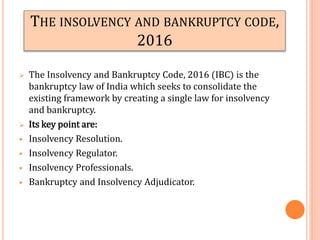
 The Insolvency and Bankruptcy Code, 2016 (IBC) is the
bankruptcy law of India which seeks to consolidate the
existing framework by creating a single law for insolvency
and bankruptcy.
 Its key point are:
 Insolvency Resolution.
 Insolvency Regulator.
 Insolvency Professionals.
 Bankruptcy and Insolvency Adjudicator.
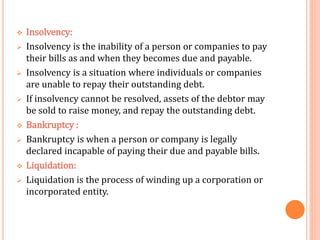
 Insolvency:
 Insolvency is the inability of a person or companies to pay
their bills as and when they becomes due and payable.
 Insolvency is a situation where individuals or companies
are unable to repay their outstanding debt.
 If insolvency cannot be resolved, assets of the debtor may
be sold to raise money, and repay the outstanding debt.
 Bankruptcy :
 Bankruptcy is when a person or company is legally
declared incapable of paying their due and payable bills.
 Liquidation:
 Liquidation is the process of winding up a corporation or
incorporated entity.
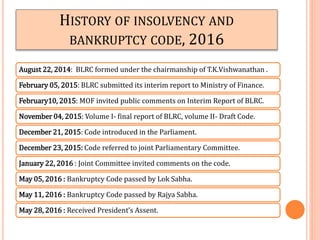
HISTORY OF INSOLVENCY AND
BANKRUPTCY CODE, 2016
August 22, 2014: BLRC formed under the chairmanship of T.K.Vishwanathan .
February 05, 2015: BLRC submitted its interim report to Ministry of Finance.
February10, 2015: MOF invited public comments on Interim Report of BLRC.
November 04, 2015: Volume I- final report of BLRC, volume II- Draft Code.
December 21, 2015: Code introduced in the Parliament.
December 23, 2015: Code referred to joint Parliamentary Committee.
January 22, 2016 : Joint Committee invited comments on the code.
May 05, 2016 : Bankruptcy Code passed by Lok Sabha.
May 11, 2016 : Bankruptcy Code passed by Rajya Sabha.
May 28, 2016 : Received President’s Assent.
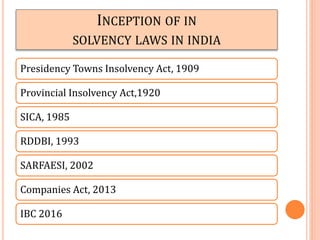
INCEPTION OF IN
SOLVENCY LAWS IN INDIA
Presidency Towns Insolvency Act, 1909
Provincial Insolvency Act,1920
SICA, 1985
RDDBI, 1993
SARFAESI, 2002
Companies Act, 2013
IBC 2016
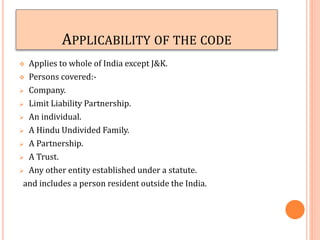
APPLICABILITY OF THE CODE
 Applies to whole of India except J&K.
 Persons covered:-
 Company.
 Limit Liability Partnership.
 An individual.
 A Hindu Undivided Family.
 A Partnership.
 A Trust.
 Any other entity established under a statute.
and includes a person resident outside the India.
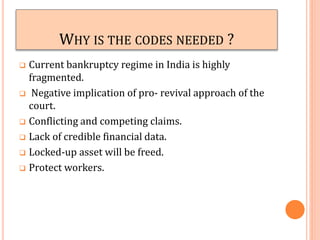
WHY IS THE CODES NEEDED ?
 Current bankruptcy regime in India is highly
fragmented.
 Negative implication of pro- revival approach of the
court.
 Conflicting and competing claims.
 Lack of credible financial data.
 Locked-up asset will be freed.
 Protect workers.
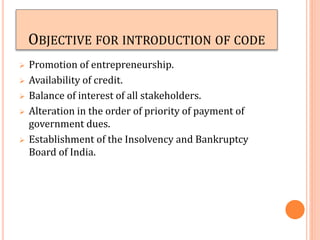
OBJECTIVE FOR INTRODUCTION OF CODE
 Promotion of entrepreneurship.
 Availability of credit.
 Balance of interest of all stakeholders.
 Alteration in the order of priority of payment of
government dues.
 Establishment of the Insolvency and Bankruptcy
Board of India.
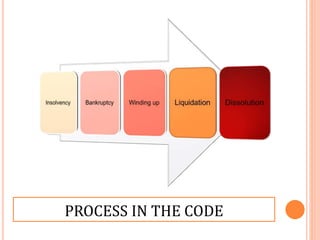
PROCESS IN THE CODE
INSOLVENCY RESOLUTION AND
LIQUIDATION PROCESS FOR CORPORATE
If the default is above Rs. 1,00,000 (may be increase up to Rs.
1core by the government, by notification), the creditor may
initiate insolvency resolution process
The codes proposed two independent stages:
 Insolvency Resolution Process:
• During which financial creditors assess whether the debtor’s
business is viable to continue and the options for its rescue and
resurrection: and
 Liquidation:
• If the insolvency resolution process fails or financial creditor
decide to wind down and distribute the assets of the debtor
CORPORATE INSOLVENCY PROCESS
o Application of Default to NCLT.
 Application may be Rejected or
 Accept of application (insolvency commencement date).
o Appointment of Interim Resolution Professional and Public
Announcement within 14 days.
o Initiation of Moratorium
o Constitution of committee of creditor which shall appoint
appoint the resolution professional within 7 days.
o To acceptance the resolution plan by creditors committee
it required minimum 75% Vote. Otherwise it may be
Rejection
o Submission of plan to NCLT.
o If the plan is accept then it can Implemented. Otherwise
the process of liquidation state.
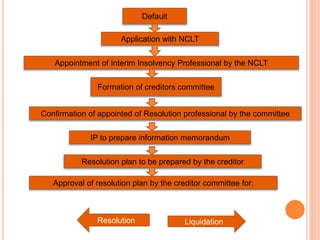
Default
Application with NCLT
Appointment of Interim Insolvency Professional by the NCLT
Formation of creditors committee
Confirmation of appointed of Resolution professional by the committee
IP to prepare information memorandum
Resolution plan to be prepared by the creditor
Approval of resolution plan by the creditor committee for:
Resolution Liquidation
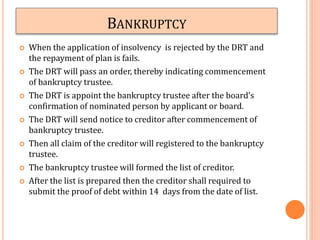
BANKRUPTCY
 When the application of insolvency is rejected by the DRT and
the repayment of plan is fails.
 The DRT will pass an order, thereby indicating commencement
of bankruptcy trustee.
 The DRT is appoint the bankruptcy trustee after the board’s
confirmation of nominated person by applicant or board.
 The DRT will send notice to creditor after commencement of
bankruptcy trustee.
 Then all claim of the creditor will registered to the bankruptcy
trustee.
 The bankruptcy trustee will formed the list of creditor.
 After the list is prepared then the creditor shall required to
submit the proof of debt within 14 days from the date of list.
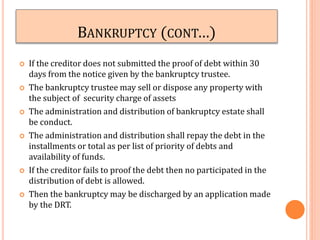
BANKRUPTCY (CONT…)
 If the creditor does not submitted the proof of debt within 30
days from the notice given by the bankruptcy trustee.
 The bankruptcy trustee may sell or dispose any property with
the subject of security charge of assets
 The administration and distribution of bankruptcy estate shall
be conduct.
 The administration and distribution shall repay the debt in the
installments or total as per list of priority of debts and
availability of funds.
 If the creditor fails to proof the debt then no participated in the
distribution of debt is allowed.
 Then the bankruptcy may be discharged by an application made
by the DRT.
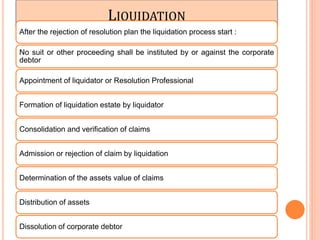
LIQUIDATION
After the rejection of resolution plan the liquidation process start :
No suit or other proceeding shall be instituted by or against the corporate
debtor
Appointment of liquidator or Resolution Professional
Formation of liquidation estate by liquidator
Consolidation and verification of claims
Admission or rejection of claim by liquidation
Determination of the assets value of claims
Distribution of assets
Dissolution of corporate debtor
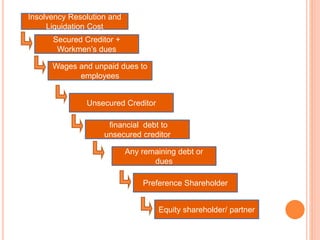
Insolvency Resolution and
Liquidation Cost
Secured Creditor +
Workmen’s dues
Wages and unpaid dues to
employees
Unsecured Creditor
financial debt to
unsecured creditor
Any remaining debt or
dues
Preference Shareholder
Equity shareholder/ partner
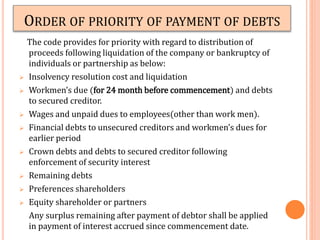
ORDER OF PRIORITY OF PAYMENT OF DEBTS
The code provides for priority with regard to distribution of
proceeds following liquidation of the company or bankruptcy of
individuals or partnership as below:
 Insolvency resolution cost and liquidation
 Workmen’s due (for 24 month before commencement) and debts
to secured creditor.
 Wages and unpaid dues to employees(other than work men).
 Financial debts to unsecured creditors and workmen’s dues for
earlier period
 Crown debts and debts to secured creditor following
enforcement of security interest
 Remaining debts
 Preferences shareholders
 Equity shareholder or partners
Any surplus remaining after payment of debtor shall be applied
in payment of interest accrued since commencement date.
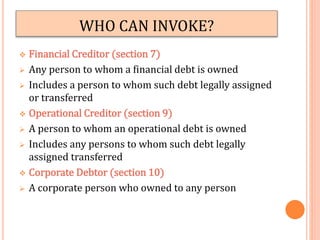
WHO CAN INVOKE?
 Financial Creditor (section 7)
 Any person to whom a financial debt is owned
 Includes a person to whom such debt legally assigned
or transferred
 Operational Creditor (section 9)
 A person to whom an operational debt is owned
 Includes any persons to whom such debt legally
assigned transferred
 Corporate Debtor (section 10)
 A corporate person who owned to any person
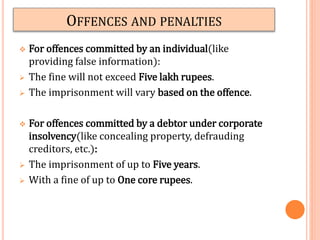
OFFENCES AND PENALTIES
 For offences committed by an individual(like
providing false information):
 The fine will not exceed Five lakh rupees.
 The imprisonment will vary based on the offence.
 For offences committed by a debtor under corporate
insolvency(like concealing property, defrauding
creditors, etc.):
 The imprisonment of up to Five years.
 With a fine of up to One core rupees.
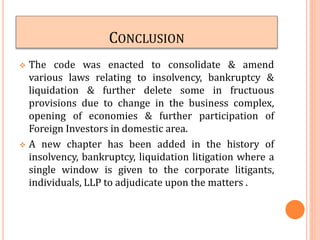
CONCLUSION
 The code was enacted to consolidate & amend
various laws relating to insolvency, bankruptcy &
liquidation & further delete some in fructuous
provisions due to change in the business complex,
opening of economies & further participation of
Foreign Investors in domestic area.
 A new chapter has been added in the history of
insolvency, bankruptcy, liquidation litigation where a
single window is given to the corporate litigants,
individuals, LLP to adjudicate upon the matters .
REFERENCES
 Tax Guru
 Insolvency and Bankruptcy Code 2016

The insolvency and bankruptcy code,2016

  • 2.
    THE INSOLVENCY ANDBANKRUPTCY CODE, 2016  The Insolvency and Bankruptcy Code, 2016 (IBC) is the bankruptcy law of India which seeks to consolidate the existing framework by creating a single law for insolvency and bankruptcy.  Its key point are:  Insolvency Resolution.  Insolvency Regulator.  Insolvency Professionals.  Bankruptcy and Insolvency Adjudicator.
  • 3.
     Insolvency:  Insolvencyis the inability of a person or companies to pay their bills as and when they becomes due and payable.  Insolvency is a situation where individuals or companies are unable to repay their outstanding debt.  If insolvency cannot be resolved, assets of the debtor may be sold to raise money, and repay the outstanding debt.  Bankruptcy :  Bankruptcy is when a person or company is legally declared incapable of paying their due and payable bills.  Liquidation:  Liquidation is the process of winding up a corporation or incorporated entity.
  • 4.
    HISTORY OF INSOLVENCYAND BANKRUPTCY CODE, 2016 August 22, 2014: BLRC formed under the chairmanship of T.K.Vishwanathan . February 05, 2015: BLRC submitted its interim report to Ministry of Finance. February10, 2015: MOF invited public comments on Interim Report of BLRC. November 04, 2015: Volume I- final report of BLRC, volume II- Draft Code. December 21, 2015: Code introduced in the Parliament. December 23, 2015: Code referred to joint Parliamentary Committee. January 22, 2016 : Joint Committee invited comments on the code. May 05, 2016 : Bankruptcy Code passed by Lok Sabha. May 11, 2016 : Bankruptcy Code passed by Rajya Sabha. May 28, 2016 : Received President’s Assent.
  • 5.
    INCEPTION OF IN SOLVENCYLAWS IN INDIA Presidency Towns Insolvency Act, 1909 Provincial Insolvency Act,1920 SICA, 1985 RDDBI, 1993 SARFAESI, 2002 Companies Act, 2013 IBC 2016
  • 6.
    APPLICABILITY OF THECODE  Applies to whole of India except J&K.  Persons covered:-  Company.  Limit Liability Partnership.  An individual.  A Hindu Undivided Family.  A Partnership.  A Trust.  Any other entity established under a statute. and includes a person resident outside the India.
  • 7.
    WHY IS THECODES NEEDED ?  Current bankruptcy regime in India is highly fragmented.  Negative implication of pro- revival approach of the court.  Conflicting and competing claims.  Lack of credible financial data.  Locked-up asset will be freed.  Protect workers.
  • 8.
    OBJECTIVE FOR INTRODUCTIONOF CODE  Promotion of entrepreneurship.  Availability of credit.  Balance of interest of all stakeholders.  Alteration in the order of priority of payment of government dues.  Establishment of the Insolvency and Bankruptcy Board of India.
  • 9.
  • 10.
    INSOLVENCY RESOLUTION AND LIQUIDATIONPROCESS FOR CORPORATE If the default is above Rs. 1,00,000 (may be increase up to Rs. 1core by the government, by notification), the creditor may initiate insolvency resolution process The codes proposed two independent stages:  Insolvency Resolution Process: • During which financial creditors assess whether the debtor’s business is viable to continue and the options for its rescue and resurrection: and  Liquidation: • If the insolvency resolution process fails or financial creditor decide to wind down and distribute the assets of the debtor
  • 11.
    CORPORATE INSOLVENCY PROCESS oApplication of Default to NCLT.  Application may be Rejected or  Accept of application (insolvency commencement date). o Appointment of Interim Resolution Professional and Public Announcement within 14 days. o Initiation of Moratorium o Constitution of committee of creditor which shall appoint appoint the resolution professional within 7 days. o To acceptance the resolution plan by creditors committee it required minimum 75% Vote. Otherwise it may be Rejection o Submission of plan to NCLT. o If the plan is accept then it can Implemented. Otherwise the process of liquidation state.
  • 12.
    Default Application with NCLT Appointmentof Interim Insolvency Professional by the NCLT Formation of creditors committee Confirmation of appointed of Resolution professional by the committee IP to prepare information memorandum Resolution plan to be prepared by the creditor Approval of resolution plan by the creditor committee for: Resolution Liquidation
  • 13.
    BANKRUPTCY  When theapplication of insolvency is rejected by the DRT and the repayment of plan is fails.  The DRT will pass an order, thereby indicating commencement of bankruptcy trustee.  The DRT is appoint the bankruptcy trustee after the board’s confirmation of nominated person by applicant or board.  The DRT will send notice to creditor after commencement of bankruptcy trustee.  Then all claim of the creditor will registered to the bankruptcy trustee.  The bankruptcy trustee will formed the list of creditor.  After the list is prepared then the creditor shall required to submit the proof of debt within 14 days from the date of list.
  • 14.
    BANKRUPTCY (CONT…)  Ifthe creditor does not submitted the proof of debt within 30 days from the notice given by the bankruptcy trustee.  The bankruptcy trustee may sell or dispose any property with the subject of security charge of assets  The administration and distribution of bankruptcy estate shall be conduct.  The administration and distribution shall repay the debt in the installments or total as per list of priority of debts and availability of funds.  If the creditor fails to proof the debt then no participated in the distribution of debt is allowed.  Then the bankruptcy may be discharged by an application made by the DRT.
  • 15.
    LIQUIDATION After the rejectionof resolution plan the liquidation process start : No suit or other proceeding shall be instituted by or against the corporate debtor Appointment of liquidator or Resolution Professional Formation of liquidation estate by liquidator Consolidation and verification of claims Admission or rejection of claim by liquidation Determination of the assets value of claims Distribution of assets Dissolution of corporate debtor
  • 16.
    Insolvency Resolution and LiquidationCost Secured Creditor + Workmen’s dues Wages and unpaid dues to employees Unsecured Creditor financial debt to unsecured creditor Any remaining debt or dues Preference Shareholder Equity shareholder/ partner
  • 17.
    ORDER OF PRIORITYOF PAYMENT OF DEBTS The code provides for priority with regard to distribution of proceeds following liquidation of the company or bankruptcy of individuals or partnership as below:  Insolvency resolution cost and liquidation  Workmen’s due (for 24 month before commencement) and debts to secured creditor.  Wages and unpaid dues to employees(other than work men).  Financial debts to unsecured creditors and workmen’s dues for earlier period  Crown debts and debts to secured creditor following enforcement of security interest  Remaining debts  Preferences shareholders  Equity shareholder or partners Any surplus remaining after payment of debtor shall be applied in payment of interest accrued since commencement date.
  • 18.
    WHO CAN INVOKE? Financial Creditor (section 7)  Any person to whom a financial debt is owned  Includes a person to whom such debt legally assigned or transferred  Operational Creditor (section 9)  A person to whom an operational debt is owned  Includes any persons to whom such debt legally assigned transferred  Corporate Debtor (section 10)  A corporate person who owned to any person
  • 19.
    OFFENCES AND PENALTIES For offences committed by an individual(like providing false information):  The fine will not exceed Five lakh rupees.  The imprisonment will vary based on the offence.  For offences committed by a debtor under corporate insolvency(like concealing property, defrauding creditors, etc.):  The imprisonment of up to Five years.  With a fine of up to One core rupees.
  • 20.
    CONCLUSION  The codewas enacted to consolidate & amend various laws relating to insolvency, bankruptcy & liquidation & further delete some in fructuous provisions due to change in the business complex, opening of economies & further participation of Foreign Investors in domestic area.  A new chapter has been added in the history of insolvency, bankruptcy, liquidation litigation where a single window is given to the corporate litigants, individuals, LLP to adjudicate upon the matters .
  • 21.
    REFERENCES  Tax Guru Insolvency and Bankruptcy Code 2016