Introduction
 State Bank of India(SBI) is an Indian Multinational, public sector
Banking and financial services company.
 It is a government-owned corporations with its headquarters in
Mumbai, Maharashtra.
 SBI has 14000 branches, including 191 foreign offices spread across
36 countries.
 SBI has ranked 232nd on the Fortune Global 500 list of the World’s
Biggest corporations as of 2016
 SBI has currently five associates namely State bank of Hyderabad,
State bank of Patiala, State bank of Mysore, State bank of
Travancore and State bank of Bikaner and Jaipur.
WHAT IS A MERGER?
 A merger is a transaction that result in the transfer of ownership
and control of a corporation.
 When one company purchases another company of an
approximately similar size. The two companies come together to
become one.
 Two companies usually agree to merge when they feel that they
can do something together that they can not do one their own.
 Mergers and acquisitions are commonly done to expand a
company’s reach, expand into new segments, or gain market
share. All of these are done to please shareholders and create
value.
Reasons of a Merger
Goodwill
Increase
market
share
Economy
of scale
Cost
maximizati
on
Expansion
of business
Mutual
benefits
Diversificat
ion of risks
Product
improveme
nt
Maximizin
g profits
SBI Merger
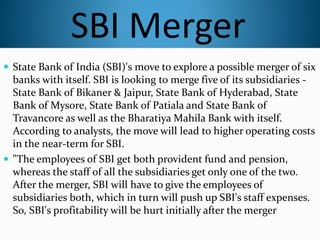
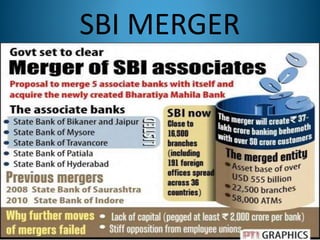
 State Bank of India (SBI)'s move to explore a possible merger of six
banks with itself. SBI is looking to merge five of its subsidiaries -
State Bank of Bikaner & Jaipur, State Bank of Hyderabad, State
Bank of Mysore, State Bank of Patiala and State Bank of
Travancore as well as the Bharatiya Mahila Bank with itself.
According to analysts, the move will lead to higher operating costs
in the near-term for SBI.
 "The employees of SBI get both provident fund and pension,
whereas the staff of all the subsidiaries get only one of the two.
After the merger, SBI will have to give the employees of
subsidiaries both, which in turn will push up SBI's staff expenses.
So, SBI's profitability will be hurt initially after the merger
SBI MERGER
Status of SBI after merger
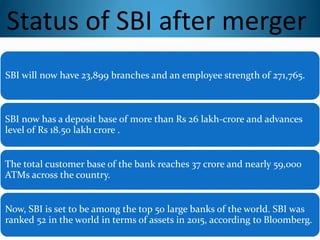
SBI will now have 23,899 branches and an employee strength of 271,765.
SBI now has a deposit base of more than Rs 26 lakh-crore and advances
level of Rs 18.50 lakh crore .
The total customer base of the bank reaches 37 crore and nearly 59,000
ATMs across the country.
Now, SBI is set to be among the top 50 large banks of the world. SBI was
ranked 52 in the world in terms of assets in 2015, according to Bloomberg.
Reason behind SBI-associate banks merger
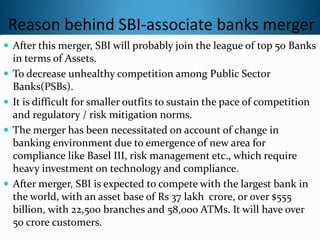
 After this merger, SBI will probably join the league of top 50 Banks
in terms of Assets.
 To decrease unhealthy competition among Public Sector
Banks(PSBs).
 It is difficult for smaller outfits to sustain the pace of competition
and regulatory / risk mitigation norms.
 The merger has been necessitated on account of change in
banking environment due to emergence of new area for
compliance like Basel III, risk management etc., which require
heavy investment on technology and compliance.
 After merger, SBI is expected to compete with the largest bank in
the world, with an asset base of Rs 37 lakh crore, or over $555
billion, with 22,500 branches and 58,000 ATMs. It will have over
50 crore customers.
 Biting off more than it can chew : So far SBI has merged only
two associate banks in the last 8-9 years. Bank of Saurashtra was
merged in 2008 followed by State Bank of Indore in 2010. The
merger proposal was discussed in later years, but was not pursued
further as other pressing issues came in. The merger of all the five
associate banks is too bold a decision. In fact, the government
also looks very keen to merge the newly set up Mahila Bank with
SBI.
 Capital and NPA challenges : Clearly, the PSBs are passing
through a difficult period with deteriorating asset quality and fast
receding capital base. The banks need capital for absorbing many
of the losses out of stressed assets. Given the merger of associate
banks , there is likely to be pressure on the bank's valuation in the
market in the medium to longer term. This would create newer
challenges for the SBI, which was so far much better than the
other PSBs in terms of performance.
Reason why merger of SBI’s associate bank with
parent is not a good idea at this juncture
 A Forced Merger : Clearly, this is a forced merger by the
government, which is pushing for consolidation in the public
sector banking space. The current chief Arundhati
Bhattacharya has earlier gone on record that the merger of
associate banks is not a priority at the current juncture.
 Not much gain in terms of size : While the SBI do get the
banks cheap as valuations are down , but in terms of balance
sheet, the SBI already has a size where the difference between
the SBI and the second player is as high as Rs 12 to Rs 13 lakh
crore. But a merger of associate banks brings all sorts of
challenges in terms of people, technology, product and
branch integration, which takes many years. The
entire management bandwidth would go on resolving the
merger pangs.
RESULT
The merger will result in the asset valuation of the
bank at 37 L Cr
That is 1/5th of the size of India’s GDP
It will be 1/4th of the total banking deposits in
India
It will have a Balance sheet size 5x that of ICICI
Bank
SBI merger

SBI merger

  • 2.
    Introduction  State Bankof India(SBI) is an Indian Multinational, public sector Banking and financial services company.  It is a government-owned corporations with its headquarters in Mumbai, Maharashtra.  SBI has 14000 branches, including 191 foreign offices spread across 36 countries.  SBI has ranked 232nd on the Fortune Global 500 list of the World’s Biggest corporations as of 2016  SBI has currently five associates namely State bank of Hyderabad, State bank of Patiala, State bank of Mysore, State bank of Travancore and State bank of Bikaner and Jaipur.
  • 3.
    WHAT IS AMERGER?  A merger is a transaction that result in the transfer of ownership and control of a corporation.  When one company purchases another company of an approximately similar size. The two companies come together to become one.  Two companies usually agree to merge when they feel that they can do something together that they can not do one their own.  Mergers and acquisitions are commonly done to expand a company’s reach, expand into new segments, or gain market share. All of these are done to please shareholders and create value.
  • 4.
    Reasons of aMerger Goodwill Increase market share Economy of scale Cost maximizati on Expansion of business Mutual benefits Diversificat ion of risks Product improveme nt Maximizin g profits
  • 5.
    SBI Merger  StateBank of India (SBI)'s move to explore a possible merger of six banks with itself. SBI is looking to merge five of its subsidiaries - State Bank of Bikaner & Jaipur, State Bank of Hyderabad, State Bank of Mysore, State Bank of Patiala and State Bank of Travancore as well as the Bharatiya Mahila Bank with itself. According to analysts, the move will lead to higher operating costs in the near-term for SBI.  "The employees of SBI get both provident fund and pension, whereas the staff of all the subsidiaries get only one of the two. After the merger, SBI will have to give the employees of subsidiaries both, which in turn will push up SBI's staff expenses. So, SBI's profitability will be hurt initially after the merger
  • 6.
  • 7.
    Status of SBIafter merger SBI will now have 23,899 branches and an employee strength of 271,765. SBI now has a deposit base of more than Rs 26 lakh-crore and advances level of Rs 18.50 lakh crore . The total customer base of the bank reaches 37 crore and nearly 59,000 ATMs across the country. Now, SBI is set to be among the top 50 large banks of the world. SBI was ranked 52 in the world in terms of assets in 2015, according to Bloomberg.
  • 8.
    Reason behind SBI-associatebanks merger  After this merger, SBI will probably join the league of top 50 Banks in terms of Assets.  To decrease unhealthy competition among Public Sector Banks(PSBs).  It is difficult for smaller outfits to sustain the pace of competition and regulatory / risk mitigation norms.  The merger has been necessitated on account of change in banking environment due to emergence of new area for compliance like Basel III, risk management etc., which require heavy investment on technology and compliance.  After merger, SBI is expected to compete with the largest bank in the world, with an asset base of Rs 37 lakh crore, or over $555 billion, with 22,500 branches and 58,000 ATMs. It will have over 50 crore customers.
  • 9.
     Biting offmore than it can chew : So far SBI has merged only two associate banks in the last 8-9 years. Bank of Saurashtra was merged in 2008 followed by State Bank of Indore in 2010. The merger proposal was discussed in later years, but was not pursued further as other pressing issues came in. The merger of all the five associate banks is too bold a decision. In fact, the government also looks very keen to merge the newly set up Mahila Bank with SBI.  Capital and NPA challenges : Clearly, the PSBs are passing through a difficult period with deteriorating asset quality and fast receding capital base. The banks need capital for absorbing many of the losses out of stressed assets. Given the merger of associate banks , there is likely to be pressure on the bank's valuation in the market in the medium to longer term. This would create newer challenges for the SBI, which was so far much better than the other PSBs in terms of performance.
  • 10.
    Reason why mergerof SBI’s associate bank with parent is not a good idea at this juncture  A Forced Merger : Clearly, this is a forced merger by the government, which is pushing for consolidation in the public sector banking space. The current chief Arundhati Bhattacharya has earlier gone on record that the merger of associate banks is not a priority at the current juncture.  Not much gain in terms of size : While the SBI do get the banks cheap as valuations are down , but in terms of balance sheet, the SBI already has a size where the difference between the SBI and the second player is as high as Rs 12 to Rs 13 lakh crore. But a merger of associate banks brings all sorts of challenges in terms of people, technology, product and branch integration, which takes many years. The entire management bandwidth would go on resolving the merger pangs.
  • 11.
    RESULT The merger willresult in the asset valuation of the bank at 37 L Cr That is 1/5th of the size of India’s GDP It will be 1/4th of the total banking deposits in India It will have a Balance sheet size 5x that of ICICI Bank