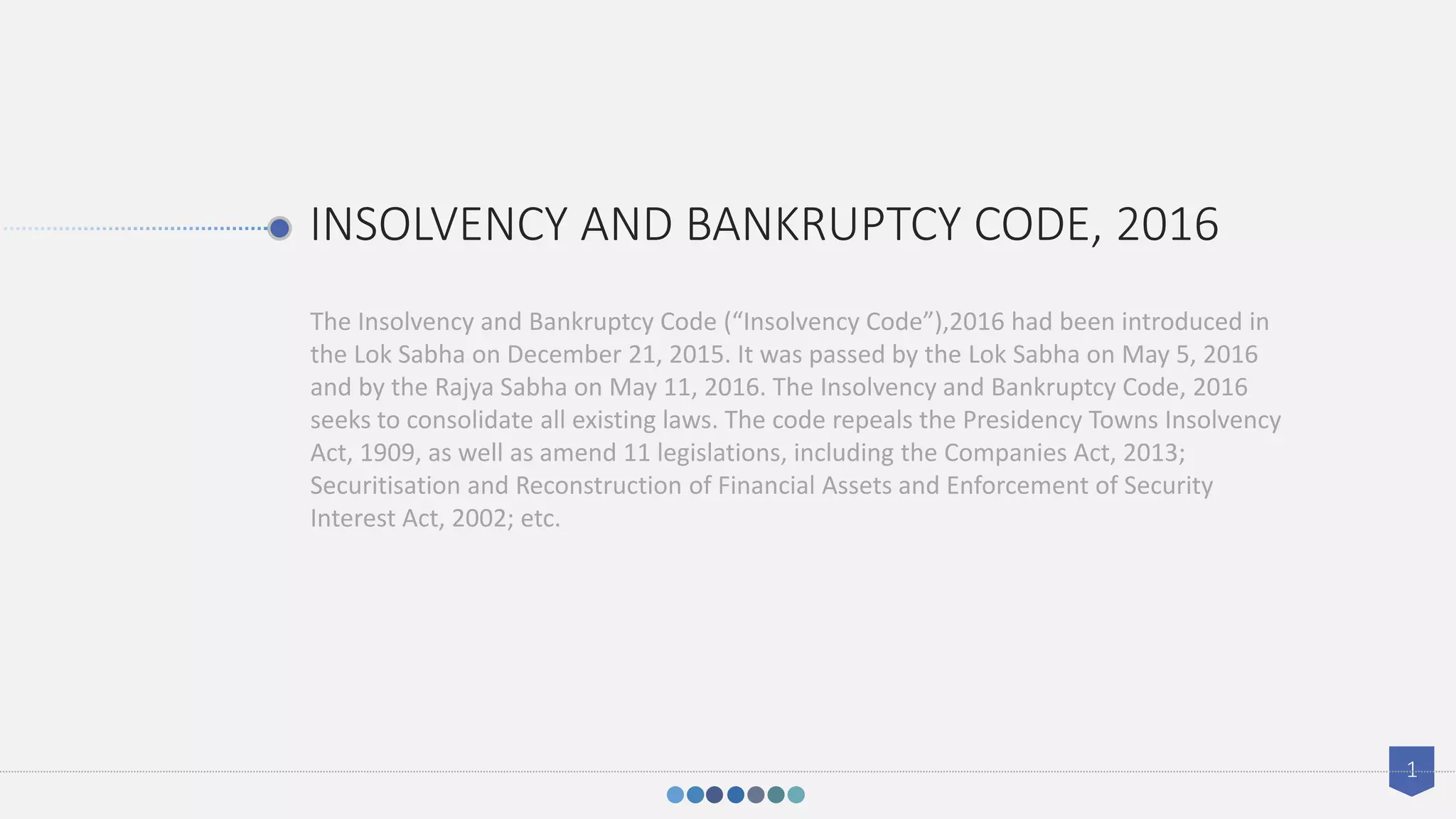
The Insolvency and Bankruptcy Code (“Insolvency Code”),2016 had been introduced in
the Lok Sabha on December 21, 2015. It was passed by the Lok Sabha on May 5, 2016
and by the Rajya Sabha on May 11, 2016. The Insolvency and Bankruptcy Code, 2016
seeks to consolidate all existing laws. The code repeals the Presidency Towns Insolvency
Act, 1909, as well as amend 11 legislations, including the Companies Act, 2013;
Securitisation and Reconstruction of Financial Assets and Enforcement of Security
Interest Act, 2002; etc.
INSOLVENCY AND BANKRUPTCY CODE, 2016
1
2
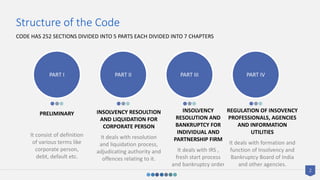
Structure of the Code
PART I
PRELIMINARY
It consist of definition
of various terms like
corporate person,
debt, default etc.
PART II
INSOLVENCY RESOULTION
AND LIQUIDATION FOR
CORPORATE PERSON
It deals with resolution
and liquidation process,
adjudicating authority and
offences relating to it.
PART III
INSOLVENCY
RESOLUTION AND
BANKRUPTCY FOR
INDIVIDUAL AND
PARTNERSHIP FIRM
It deals with IRS ,
fresh start process
and bankruptcy order
PART IV
REGULATION OF INSOVENCY
PROFESSIONALS, AGENCIES
AND INFORMATION
UTILITIES
It deals with formation and
function of Insolvency and
Bankruptcy Board of India
and other agencies.
CODE HAS 252 SECTIONS DIVIDED INTO 5 PARTS EACH DIVIDED INTO 7 CHAPTERS
3
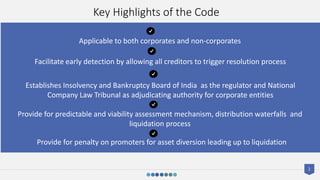
Facilitate early detection by allowing all creditors to trigger resolution process
Establishes Insolvency and Bankruptcy Board of India as the regulator and National
Company Law Tribunal as adjudicating authority for corporate entities
Provide for predictable and viability assessment mechanism, distribution waterfalls and
liquidation process
Key Highlights of the Code
Applicable to both corporates and non-corporates
Provide for penalty on promoters for asset diversion leading up to liquidation
4
To be continued…..
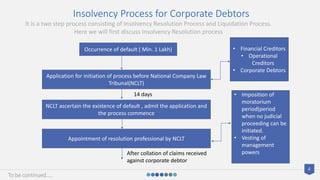
Insolvency Process for Corporate Debtors
It is a two step process consisting of Insolvency Resolution Process and Liquidation Process.
Here we will first discuss Insolvency Resolution process
Occurrence of default ( Min. 1 Lakh)
Application for initiation of process before National Company Law
Tribunal(NCLT)
• Financial Creditors
• Operational
Creditors
• Corporate Debtors
NCLT ascertain the existence of default , admit the application and
the process commence
14 days
Appointment of resolution professional by NCLT
• Imposition of
moratorium
period(period
when no judicial
proceeding can be
initiated.
• Vesting of
management
powersAfter collation of claims received
against corporate debtor
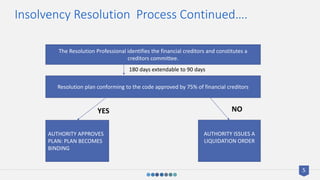
Insolvency Resolution Process Continued….
Resolution plan conforming to the code approved by 75% of financial creditors
AUTHORITY APPROVES
PLAN: PLAN BECOMES
BINDING
180 days extendable to 90 days
AUTHORITY ISSUES A
LIQUIDATION ORDER
The Resolution Professional identifies the financial creditors and constitutes a
creditors committee.
YES NO
5
6
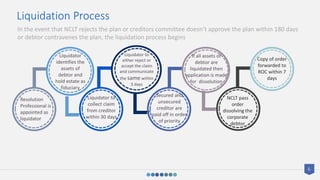
Liquidation Process
Liquidator to
either reject or
accept the claim
and communicate
the same within
3 days
Liquidator
identifies the
assets of
debtor and
hold estate as
fiduciary
Secured and
unsecured
creditor are
paid off in order
of priority
NCLT pass
order
dissolving the
corporate
debtor
If all assets of
debtor are
liquidated then
application is made
for dissolution
In the event that NCLT rejects the plan or creditors committee doesn’t approve the plan within 180 days
or debtor contravenes the plan, the liquidation process begins
Resolution
Professional is
appointed as
liquidator
Liquidator to
collect claim
from creditor
within 30 days
Copy of order
forwarded to
ROC within 7
days
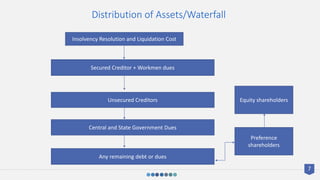
Distribution of Assets/Waterfall
Insolvency Resolution and Liquidation Cost
Secured Creditor + Workmen dues
Unsecured Creditors
Central and State Government Dues
Any remaining debt or dues
Preference
shareholders
Equity shareholders
7
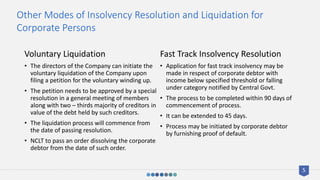
Voluntary Liquidation
• The directors of the Company can initiate the
voluntary liquidation of the Company upon
filing a petition for the voluntary winding up.
• The petition needs to be approved by a special
resolution in a general meeting of members
along with two – thirds majority of creditors in
value of the debt held by such creditors.
• The liquidation process will commence from
the date of passing resolution.
• NCLT to pass an order dissolving the corporate
debtor from the date of such order.
Fast Track Insolvency Resolution
• Application for fast track insolvency may be
made in respect of corporate debtor with
income below specified threshold or falling
under category notified by Central Govt.
• The process to be completed within 90 days of
commencement of process.
• It can be extended to 45 days.
• Process may be initiated by corporate debtor
by furnishing proof of default.
Other Modes of Insolvency Resolution and Liquidation for
Corporate Persons
5
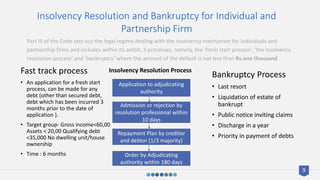
Part III of the Code sets out the legal regime dealing with the insolvency mechanism for individuals and
partnership firms and includes within its ambit, 3 processes, namely, the 'fresh start process', 'the insolvency
resolution process' and 'bankruptcy‘ where the amount of the default is not less than Rs.one thousand
Insolvency Resolution and Bankruptcy for Individual and
Partnership Firm
Fast track process
• An application for a fresh start
process, can be made for any
debt (other than secured debt,
debt which has been incurred 3
months prior to the date of
application ).
• Target group- Gross income<60,00
Assets < 20,00 Qualifying debt
<35,000 No dwelling unit/house
ownership
• Time : 6 months
Insolvency Resolution Process
Application to adjudicating
authority
Admission or rejection by
resolution professional within
10 days
Repayment Plan by creditor
and debtor (1/3 majority)
Order by Adjudicating
authority within 180 days
Bankruptcy Process
• Last resort
• Liquidation of estate of
bankrupt
• Public notice inviting claims
• Discharge in a year
• Priority in payment of debts
9
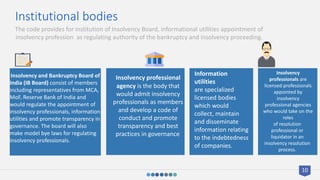
Institutional bodies
Insolvency and Bankruptcy Board of
India (IB Board) consist of members
including representatives from MCA,
MoF, Reserve Bank of India and
would regulate the appointment of
insolvency professionals, information
utilities and promote transparency in
governance. The board will also
make model bye laws for regulating
insolvency professionals.
Insolvency professional
agency is the body that
would admit insolvency
professionals as members
and develop a code of
conduct and promote
transparency and best
practices in governance.
Information
utilities
are specialized
licensed bodies
which would
collect, maintain
and disseminate
information relating
to the indebtedness
of companies.
Insolvency
professionals are
licensed professionals
appointed by
insolvency
professional agencies
who would take on the
roles
of resolution
professional or
liquidator in an
insolvency resolution
process.
The code provides for institution of Insolvency Board, informational utilities appointment of
insolvency profession as regulating authority of the bankruptcy and insolvency proceeding.
10
11
Conclusion
India's weak insolvency regime, its significant inefficiencies and systematic
abuse are some of the reasons for the distressed state of credit markets in
India today. The Code promises to bring about far-reaching reforms with a
thrust on creditor driven insolvency resolution. It aims at early identification
of financial failure and maximizing the asset value of insolvent firms. The
unified regime envisages a structured and time-bound process for
insolvency resolution and liquidation, which should significantly improve
debt recovery rates and revitalize the ailing Indian corporate bond markets.
Overall this legislation is a huge step towards the ease of doing business in
India and has the potential to bring business practices in India closer to
more developed markets over the long term.

Insolvency and bankuptcy code, 2016

  • 1.
    The Insolvency andBankruptcy Code (“Insolvency Code”),2016 had been introduced in the Lok Sabha on December 21, 2015. It was passed by the Lok Sabha on May 5, 2016 and by the Rajya Sabha on May 11, 2016. The Insolvency and Bankruptcy Code, 2016 seeks to consolidate all existing laws. The code repeals the Presidency Towns Insolvency Act, 1909, as well as amend 11 legislations, including the Companies Act, 2013; Securitisation and Reconstruction of Financial Assets and Enforcement of Security Interest Act, 2002; etc. INSOLVENCY AND BANKRUPTCY CODE, 2016 1
  • 2.
    2 Structure of theCode PART I PRELIMINARY It consist of definition of various terms like corporate person, debt, default etc. PART II INSOLVENCY RESOULTION AND LIQUIDATION FOR CORPORATE PERSON It deals with resolution and liquidation process, adjudicating authority and offences relating to it. PART III INSOLVENCY RESOLUTION AND BANKRUPTCY FOR INDIVIDUAL AND PARTNERSHIP FIRM It deals with IRS , fresh start process and bankruptcy order PART IV REGULATION OF INSOVENCY PROFESSIONALS, AGENCIES AND INFORMATION UTILITIES It deals with formation and function of Insolvency and Bankruptcy Board of India and other agencies. CODE HAS 252 SECTIONS DIVIDED INTO 5 PARTS EACH DIVIDED INTO 7 CHAPTERS
  • 3.
    3 Facilitate early detectionby allowing all creditors to trigger resolution process Establishes Insolvency and Bankruptcy Board of India as the regulator and National Company Law Tribunal as adjudicating authority for corporate entities Provide for predictable and viability assessment mechanism, distribution waterfalls and liquidation process Key Highlights of the Code Applicable to both corporates and non-corporates Provide for penalty on promoters for asset diversion leading up to liquidation
  • 4.
    4 To be continued….. InsolvencyProcess for Corporate Debtors It is a two step process consisting of Insolvency Resolution Process and Liquidation Process. Here we will first discuss Insolvency Resolution process Occurrence of default ( Min. 1 Lakh) Application for initiation of process before National Company Law Tribunal(NCLT) • Financial Creditors • Operational Creditors • Corporate Debtors NCLT ascertain the existence of default , admit the application and the process commence 14 days Appointment of resolution professional by NCLT • Imposition of moratorium period(period when no judicial proceeding can be initiated. • Vesting of management powersAfter collation of claims received against corporate debtor
  • 5.
    Insolvency Resolution ProcessContinued…. Resolution plan conforming to the code approved by 75% of financial creditors AUTHORITY APPROVES PLAN: PLAN BECOMES BINDING 180 days extendable to 90 days AUTHORITY ISSUES A LIQUIDATION ORDER The Resolution Professional identifies the financial creditors and constitutes a creditors committee. YES NO 5
  • 6.
    6 Liquidation Process Liquidator to eitherreject or accept the claim and communicate the same within 3 days Liquidator identifies the assets of debtor and hold estate as fiduciary Secured and unsecured creditor are paid off in order of priority NCLT pass order dissolving the corporate debtor If all assets of debtor are liquidated then application is made for dissolution In the event that NCLT rejects the plan or creditors committee doesn’t approve the plan within 180 days or debtor contravenes the plan, the liquidation process begins Resolution Professional is appointed as liquidator Liquidator to collect claim from creditor within 30 days Copy of order forwarded to ROC within 7 days
  • 7.
    Distribution of Assets/Waterfall InsolvencyResolution and Liquidation Cost Secured Creditor + Workmen dues Unsecured Creditors Central and State Government Dues Any remaining debt or dues Preference shareholders Equity shareholders 7
  • 8.
    Voluntary Liquidation • Thedirectors of the Company can initiate the voluntary liquidation of the Company upon filing a petition for the voluntary winding up. • The petition needs to be approved by a special resolution in a general meeting of members along with two – thirds majority of creditors in value of the debt held by such creditors. • The liquidation process will commence from the date of passing resolution. • NCLT to pass an order dissolving the corporate debtor from the date of such order. Fast Track Insolvency Resolution • Application for fast track insolvency may be made in respect of corporate debtor with income below specified threshold or falling under category notified by Central Govt. • The process to be completed within 90 days of commencement of process. • It can be extended to 45 days. • Process may be initiated by corporate debtor by furnishing proof of default. Other Modes of Insolvency Resolution and Liquidation for Corporate Persons 5
  • 9.
    Part III ofthe Code sets out the legal regime dealing with the insolvency mechanism for individuals and partnership firms and includes within its ambit, 3 processes, namely, the 'fresh start process', 'the insolvency resolution process' and 'bankruptcy‘ where the amount of the default is not less than Rs.one thousand Insolvency Resolution and Bankruptcy for Individual and Partnership Firm Fast track process • An application for a fresh start process, can be made for any debt (other than secured debt, debt which has been incurred 3 months prior to the date of application ). • Target group- Gross income<60,00 Assets < 20,00 Qualifying debt <35,000 No dwelling unit/house ownership • Time : 6 months Insolvency Resolution Process Application to adjudicating authority Admission or rejection by resolution professional within 10 days Repayment Plan by creditor and debtor (1/3 majority) Order by Adjudicating authority within 180 days Bankruptcy Process • Last resort • Liquidation of estate of bankrupt • Public notice inviting claims • Discharge in a year • Priority in payment of debts 9
  • 10.
    Institutional bodies Insolvency andBankruptcy Board of India (IB Board) consist of members including representatives from MCA, MoF, Reserve Bank of India and would regulate the appointment of insolvency professionals, information utilities and promote transparency in governance. The board will also make model bye laws for regulating insolvency professionals. Insolvency professional agency is the body that would admit insolvency professionals as members and develop a code of conduct and promote transparency and best practices in governance. Information utilities are specialized licensed bodies which would collect, maintain and disseminate information relating to the indebtedness of companies. Insolvency professionals are licensed professionals appointed by insolvency professional agencies who would take on the roles of resolution professional or liquidator in an insolvency resolution process. The code provides for institution of Insolvency Board, informational utilities appointment of insolvency profession as regulating authority of the bankruptcy and insolvency proceeding. 10
  • 11.
    11 Conclusion India's weak insolvencyregime, its significant inefficiencies and systematic abuse are some of the reasons for the distressed state of credit markets in India today. The Code promises to bring about far-reaching reforms with a thrust on creditor driven insolvency resolution. It aims at early identification of financial failure and maximizing the asset value of insolvent firms. The unified regime envisages a structured and time-bound process for insolvency resolution and liquidation, which should significantly improve debt recovery rates and revitalize the ailing Indian corporate bond markets. Overall this legislation is a huge step towards the ease of doing business in India and has the potential to bring business practices in India closer to more developed markets over the long term.