

The Insolvency and Bankruptcy
Code, 2016
A Step Forward
Confederation of Indian Industry
The Insolvency and Bankruptcy Code, 2016: A Step Forward
Foreword
1
I
ndian Banking scenario is going through unprecedented
times with stressed loan portfolio touching all-time high.
As per estimates stressed loan portfolio of all banks
put together, is around 17%-18% of total advances. There
is an apprehension that there could be further significant
additions as many stressed loan accounts have been disguised
as standard. Realizing the problem, RBI has attempted to
force banks to clean up balance sheets and come out with
many regulatory steps aimed at improving banks’ ability to
deal with such stressed accounts. Of them, Strategic Debt
Restructuring (SDR), 5:25 and (Scheme for Sustainable
Structuring of Stressed Assets (S4A) being the latest to be
added to the list. These frameworks, though unable to
address all situations, are a step forward towards an intent
of resolution. There is an all-round need for identifying the
problem well in time, focus on a comprehensive turnaround
and all stakeholders, be it creditors or borrowers, should be
actively engaged towards the objective.
India currently has multiple laws to deal with insolvency,
which leads to significant delays in winding up a company.
In this scenario, the Indian Government has introduced
the Bankruptcy and Insolvency Code, 2016 which will
consolidate the existing frameworks and create a new
institutional structure. The Code creates time-bound
processes for insolvency resolution of companies and
individuals which thereby will help India improve its World
Bank insolvency ranking.
The new bankruptcy law isn’t a “magic wand”. The main
challenge will be implementation-adequacy of infrastructure
and skilled pool of insolvency professionals, who will help
with the fast implementation of the law.
CII-Sumedha Fiscal has come out with this knowledge paper
with the objective to touch upon the key aspects of the Code
and lay bare the issues and challenges.
Vijay Maheshwari
Director,
Sumedha Fiscal Services Ltd.
&
Co-Chairman,
CII-ER Economic Affairs,
Finance & Taxation Sub-Committee
The Insolvency and Bankruptcy Code, 2016: A Step Forward
Contents
2
Introduction 3
Multiplicity of the existing laws – an issue 5
Current stress in the banking sector 7
Resolving insolvency – time and cost matter 9
Demystifying the Insolvency and Bankruptcy Code, 2016 11
Key Highlights 11
The Insolvency and Bankruptcy Code, 2016 11
New ecosystem of institutional infrastructure 11
Insolvency and Bankruptcy Board of India (IBBI) 12
Adjudicating Authority 12
Insolvency Professional Agencies 12
Insolvency Professionals 13
Information Utility 14
Insolvency resolution process for corporate 15
Liquidation and distribution of recovery proceeds 21
Fast track corporate resolution process 25
Voluntary liquidation of corporate person 25
Insolvency resolution and bankruptcy for individuals and partnership firms 26
Analysis and implication of the Code 28
Issues & challenges 30
Glossary 31
About CII 32
The Insolvency and Bankruptcy Code, 2016: A Step Forward
Introduction
3
I
n a simple dictionary term, insolvency is a
situation where liabilities of a person or a firm
exceed its assets. In practice, the insolvency
situation occurs when a person or a firm cannot
pay its financial obligations i.e. cannot pay the
debts it owes. Sometimes, a firm’s assets may be
higher than the liabilities, still it cannot pay debt
obligations as assets may be illiquid and cash
flows are not sufficient to pay debts. It may also
happen that a firm’s liabilities are higher than
assets, but generating enough cash flow to repay
obligations. So for a creditor, it is important to
examine the situation before taking any decision.
Sometimes, the phrase ‘technical insolvency’ and
‘actual insolvency’ are used to explain these two
situations (technical insolvency – when liability is
higher than the assets and actual insolvency when
cash flow is insufficient to pay the debts).
Bankruptcy is little different from insolvency. It
occurs when a court recognises the insolvency. It
is a legal status of a person or a firm. However,
in India, no law have defined bankruptcy (except
in the Insolvency and Bankruptcy Code, 2016).
Certain acts only define the term ‘winding up’,
which is different from bankruptcy. Bankruptcy
is a plan when an insolvent debtor seeks
relief. In accordance with new Insolvency and
Bankruptcy Code, 2016, a bankrupt entity is a
debtor who has been adjudged as bankrupt by an
Adjudicating Authority by passing a bankruptcy
order. In the bankruptcy proceeding, the court
appoints a trustee who is responsible for selling
the property and paying obligations to the
creditors.
According to the Law Commission of India,
the insolvency law has a two-fold purpose1
, (i)
to give relief to the debtor from the harassment
of his creditors, whose claims he is unable to
meet and, (ii) to provide a machinery by which
creditors, who are not secured in the payment of
their debts are to be satisfied. It is based on the
Roman principal ‘cessio bonorum’ that is to say,
surrender by the debtor of all his goods for the
benefit of his creditors, in return for immunity
from court process.
Indian economy has expanded at a very rapid
pace in the past one decade and crossed the two
trillion dollar mark. However, our credit system
is not vibrant and the corporate bond market is
at the nascent stage. Thus, banks are the main
source of corporate credit. Non-performing assets
in the banking system have been rising and have
reached to a level that is beyond the comfort
zone.
We have multiple laws that deal with insolvency
and bankruptcy for different entities under
different situations. Due to the complexity of
multiple laws, the entire resolution procedure
is fragmented, expensive and time-consuming
with very low recovery rate. All, out of the court,
debt restructuring processes like CDR, SDR,
S4A and 5:25 are not very successful, rather
bad loans have piled up in the system after their
implementation.
1
Law Commission of India, Report on Insolvency Laws/Objective of Insolvency Law.
The Insolvency and Bankruptcy Code, 2016: A Step Forward4
In this background, the new code has been
formed with the broad objective to consolidate
all existing laws relating to insolvency and
bankruptcy for companies and individual. The
code, on implementation, may enhance credit
availability, promote entrepreneurship and
balance the interest of all stakeholders. The code
will drastically reduce the insolvency resolution
time resulting in a low loss in recovery.
The code has proposed to set up a well-regulated
institutional framework under a new regulator,
the Insolvency and Bankruptcy Board of India.
Two Adjudicating Authorities, NCLT and DRT
are formed and that will perform the judicial
control during the process. Other entities like
insolvency professional and information utilities
will perform specific role during the process.
The Insolvency and Bankruptcy Code, 2016: A Step Forward
Multiplicity of the existing laws – an issue
5
I
n India, there is not a single law that
exclusively deals with bankruptcy and
insolvency. Rather, we have multiple rules
and regulations under different authorities that
ultimately delay the entire procedure.
There was no concrete law related to bankruptcy
or insolvency before the British came to India.
The first evidence of an insolvency legislation
can be traced to sections 23 and 24 of the
Government of India Act, 1800 (39 and 40
Geo III, c 79, in line with the Lord’s Act 1759,
England)2
.
The law empowered three courts (Fort William,
Madras, and Bombay) to make rules for relieving
the insolvent debtors. The special insolvency
legislation began in 1828 when Statue 9 (Geo IV c
73) was passed and the first insolvency courts were
formed in Presidency-towns3
with the objective to
relieve the insolvent debtors. In 1848, a revised
insolvency legislation, the Indian Insolvency Act,
1848 (11 and 12 Vict. c. 21) was passed. Later, the
act was found insufficient to address the changing
business environment and a new Insolvency Bill
was proposed for the entire India in line with the
Bankruptcy Laws in England.
However, the plan was dropped and the
Indian Insolvency Act, 1848 was continued
in Presidency-towns till the enactment of the
Presidency-Towns Insolvency Act, 1909. The
Presidency Towns Insolvency Act, 1909 was
enacted to resolve the same bankruptcy issues in
Presidency-Towns.
The above-mentioned acts were mainly focused
towards insolvency legislations in Presidency-
Towns and there was no separate law for the
mofussil, where the business environment was
different. Later, the Provincial Insolvency Act,
1907 was formed and it covered the mofussil.
In 1920, a new law ‘Provincial Insolvency Act,
1920’ was formed and replaced the old act.
2
Law Commission of India, 26th Report – Report on Insolvency Laws, Government of India, Ministry of Law.
3
Presidency-towns were the administrative divisions of British India. There were three Presidency-towns during the British
rule in India (Madras, Bombay and Calcutta).
Existing legal frameworks
The Presidency Towns Insolvency Act, 1909
The Provincial Insolvency Act, 1920
SARFAESI Act, 2002
Recovery of Debts due to Banks and Financial Institutions Act, 1993
Companies Act, 2013
Sick Industrial Companies (Special Provisions) Act, 1985
LLP Act, 2008
The Insolvency and Bankruptcy Code, 2016: A Step Forward6
Till date, both the laws viz. ‘Presidency Town
Insolvency Act 1907’ and ‘Provincial Insolvency
Act, 1920’ are sound in principle and have worked
satisfactorily, in practice. However, these two
acts have been brought within the scope of the
Insolvency and Bankruptcy Code 2016 (Code).
Earlier, banks and financial institutions used to
file civil suit in a court of law to recover dues
from the defaulter companies. However, this
process was extremely time-consuming and
sometimes it took five to fifteen years for getting
a judgement4
. The civil courts were burdened
with diverse types of cases and debt recovery
related cases were like other cases and did not get
any priority5
. In this background and based on
the recommendation of various committees on
financial market reform, ‘The Recovery of Debts
due to Banks and Financial Institutions Act, 1993
(or DRT Act) was enacted with the objective
to provide a platform to banks and financial
institutions for smooth and speedy recovery of
bad loans. A specialised Adjudicating Authority,
Debt Recovery Tribunal or DRT was formed
and that has been exclusively taking care of debt
recovery related issues of banks and financial
institutions. In spite of the involvement of DRT,
there has been no speedy recovery of debts. Even
debtors have identified several loopholes in the
DRT Act and they have misused it.
To address the issues faced by DRT Act and to
further strengthen the recovery process, The
Securitisation and Reconstruction of Financial
Assets and Enforcement of Security Interest Act,
2002 (SARFAESI Act), was designed. This act
empowers the banks and financial institution
to recover bad loans directly from the debtor
without Court’s intervention. The act allows
banks and financial institutions to auction
mortgaged assets of the defaulting borrowers and
sale may take place without the intervention of
courts. The act has certain limitations. It does not
consider the rights other than secured creditors.
The SARFASEI Act is a foreclosure and does not
consider a business as going concern.
Companies Act 1956, has the legal provision for
insolvency. According to chapter V of Companies
Act 1956, there can be arbitration, compromises,
arrangements or reconstructions between
companies and creditors and shareholders. The
act also deals with winding up of companies. The
companies Act 2013 has provisions for rescue
and rehabilitation and liquidation of all registered
entities (Chapter XIX and XX). The Companies
Act 2013 also has provision to merge domestic
companies with foreign companies.
The Sick Industrial Companies (Special Provision)
Act 1985 (SICA) was designed to rescue the sick
companies, whose accumulated loss is higher than
the net worth at the end of any financial year.
Under this act, BIFR (Board for Industrial and
Financial Reconstruction) reviews the viability
of a sick business. The act was also proved
inefficient.
The current insolvency procedures that are
governed either by Companies Act or SICA,
will be replaced by the procedure under the
Insolvency and Bankruptcy Code.
4
An Introduction to the Recovery of Debts Due to Banks and Financial Institutions Act, 1993 – A Study by G. S. Dubey,
Chartered Accountant Practice Journal.
5
Tiwari Committee Report.
The Insolvency and Bankruptcy Code, 2016: A Step Forward
Current stress in the banking sector
7
T
he RBI Published Financial Stability
Report highlights the increased stress in
the Indian Banking system arising out of
deteriorating asset quality and low profitability.
The previous RBI governor Dr. Raghuram Rajan
had opined that “Our intent is to have clean and
fully provisioned banks’ balance sheets by March
2017”.
Risks to India’s banking sector have increased mainly on account of deterioration in asset quality
and low profitability. The burden of NPAs continued to increase sharply;
79.7% y-o-y growth in gross non-performing assets (GNPA) as of March 31, 2016;
14.5% gross non-performing assets for public sector banks;
4.5% private sector banks and foreign banks, each reported GNPAs of 4.5%;
Stressed assets in the banking system
Source: RBI
Mar FY13 FY14 FY15 FY16 FY13 FY14 FY15 FY16 FY13 FY14 FY15 FY16
Total Public Sector Banks Private Sector Banks
Gross NPA Ratio (%) 3.27 3.86 4.37 7.61 3.59 4.34 4.94 9.6 1.86 1.82 2.14 2.7
Net NPA Ratio (%) 1.72 2.17 2.48 4.63 1.99 2.53 2.9 6.1 0.52 0.63 0.87 1.3
Stressed Assets/
advances (%)
NA 9.75 11.01 11.5 NA 11.04 12.68 14.5 NA 4.29 4.59 4.5
The framework for Corporate Debt Restructuring
was widely used till regulatory forbearance
towards asset classification benefit stands
withdrawn effective from 1st April 2015. The
current statistics as on 30th September 2016 for
CDR cases are:-
Particulars No. of cases Aggregate Debt
Total References received by CDR Cell 655 474002
Cases rejected before admission or approval 125 70998
Total cases approved 530 403004
Cases withdrawn on account of package failure 248 110772
Cases exited successfully 97 70660
Live Cases in CDR 185 221572
Rs. in crore
Source: www.CDRIndia.org
The Insolvency and Bankruptcy Code, 2016: A Step Forward8
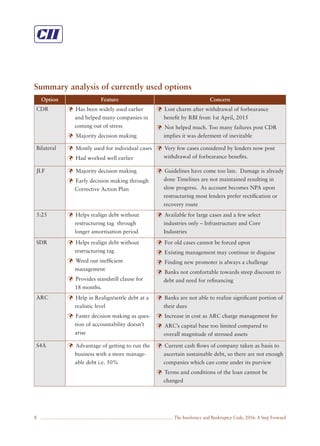
Option Feature Concern
CDR Has been widely used earlier
and helped many companies in
coming out of stress
Majority decision making
Lost charm after withdrawal of forbearance
benefit by RBI from 1st April, 2015
Not helped much. Too many failures post CDR
implies it was deferment of inevitable
Bilateral Mostly used for individual cases
Had worked well earlier
Very few cases considered by lenders now post
withdrawal of forbearance benefits.
JLF Majority decision making
Early decision making through
Corrective Action Plan
Guidelines have come too late. Damage is already
done Timelines are not maintained resulting in
slow progress. As account becomes NPA upon
restructuring most lenders prefer rectification or
recovery route
5:25 Helps realign debt without
restructuring tag through
longer amortisation period
Available for large cases and a few select
industries only – Infrastructure and Core
Industries
SDR Helps realign debt without
restructuring tag
Weed out inefficient
management
Provides standstill clause for
18 months.
For old cases cannot be forced upon
Existing management may continue in disguise
Finding new promoter is always a challenge
Banks not comfortable towards steep discount to
debt and need for refinancing
ARC Help in Realign/settle debt at a
realistic level
Faster decision making as ques-
tion of accountability doesn’t
arise
Banks are not able to realize significant portion of
their dues
Increase in cost as ARC charge management fee
ARC’s capital base too limited compared to
overall magnitude of stressed assets
S4A Advantage of getting to run the
business with a more manage-
able debt i.e. 50%
Current cash flows of company taken as basis to
ascertain sustainable debt, so there are not enough
companies which can come under its purview
Terms and conditions of the loan cannot be
changed
Summary analysis of currently used options
The Insolvency and Bankruptcy Code, 2016: A Step Forward
Resolving insolvency – time and cost matter
9
A
n efficient insolvency regime is a
topmost priority for a vibrant business
environment. The law should be such that
it should restrict the liquidation of a potential
business at a very early stage and at the same
time, it will discourage creditors to put money
into a relatively risky business. The law should
also restrict debtors to take improper business
and financial decision. Various studies have
shown that an efficient bankruptcy law can
reduce the cost of funds, increase wider access
to credit as well as timely recovery of loans6
.
If banks or financial institutions can recover a
major portion of its blocked money, it can again
reinvest them into more efficient business.
a
Recovery Rate: The recovery rate is recorded as cents on the dollar recovered by secured creditors through judicial
reorganization, liquidation or debt enforcement (foreclosure or receivership) proceedings.
b
Time: Time for creditors to recover their credit is recorded in years.
c
Cost: The cost of the proceedings is recorded as a percentage of the value of the debtor’s estate.
d
Outcome: Whether the business continues operating as a going concern or whether its assets are sold in piecemeal.
e
Strength of Insolvency Framework Index: The strength of insolvency framework index is the sum of the scores on the
commencement of proceedings index, management of debtor’s assets index, reorganization proceedings index and creditor
participation index. The index ranges from 0 to 16, with higher values indicating insolvency legislation that is better
designed for rehabilitating viable firms and liquidating nonviable ones.
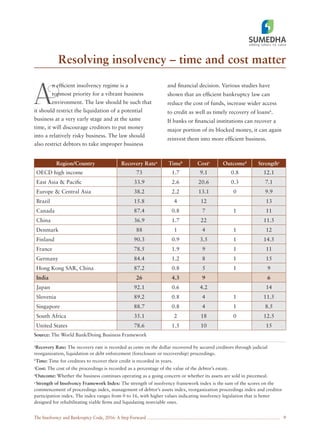
Region/Country Recovery Ratea
Timeb
Costc
Outcomed
Strengthe
OECD high income 73 1.7 9.1 0.8 12.1
East Asia & Pacific 33.9 2.6 20.6 0.3 7.1
Europe & Central Asia 38.2 2.2 13.1 0 9.9
Brazil 15.8 4 12 13
Canada 87.4 0.8 7 1 11
China 36.9 1.7 22 11.5
Denmark 88 1 4 1 12
Finland 90.3 0.9 3.5 1 14.5
France 78.5 1.9 9 1 11
Germany 84.4 1.2 8 1 15
Hong Kong SAR, China 87.2 0.8 5 1 9
India 26 4.3 9 6
Japan 92.1 0.6 4.2 14
Slovenia 89.2 0.8 4 1 11.5
Singapore 88.7 0.8 4 1 8.5
South Africa 35.1 2 18 0 12.5
United States 78.6 1.5 10 15
Source: The World Bank/Doing Business Framework
The Insolvency and Bankruptcy Code, 2016: A Step Forward10
In India, due to the presence of multiple laws, the
present insolvency resolution process is complex, time-
consuming and expensive. In India, it takes an average
of 4.3 years to resolve bankruptcy, which is extremely
high compared to countries like Japan, Singapore,
and Finland. In Japan, it takes only 6 months’ time to
resolve bankruptcy. The same run rate is 8 months, 10
months and 1.5 years in Singapore, Finland, and the
United States respectively. A complex judicial system in
India has restricted the use of formal legal bankruptcy
procedure to resolve financial distress. The usage of
legal bankruptcy procedure is only 0.04% in India
compared to 4% in the USA in 1990s7
.
The recovery rate, in terms of cents recovered
per dollar debt, is very low as it takes prolonged
resolution time. The figure is 26 cents/dollar in
India, much lower than many developed countries.
In countries like Finland, Japan, Germany and the
United States the recovery rate is extremely high at
90.3 cents, 92.1 cents, 84.4 cents and 78.6 cents
per dollar respectively. Many developing countries
like China, Brazil, and Russia have poor recovery
rate but better than India. The cost in terms of the
percentage of the value of the debtor’s estate is also
very high in India. It is 9% in our country against
3.5%-4.2% in Finland, Japan and Singapore.
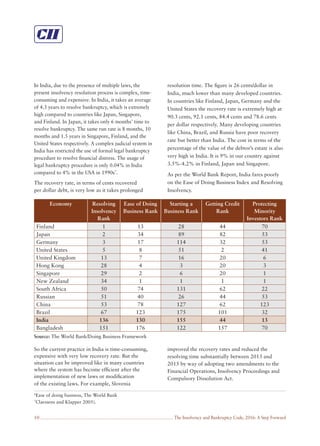
As per the World Bank Report, India fares poorly
on the Ease of Doing Business Index and Resolving
Insolvency.
So the current practice in India is time-consuming,
expensive with very low recovery rate. But the
situation can be improved like in many countries
where the system has become efficient after the
implementation of new laws or modification
of the existing laws. For example, Slovenia
improved the recovery rates and reduced the
resolving time substantially between 2013 and
2015 by way of adopting two amendments to the
Financial Operations, Insolvency Proceedings and
Compulsory Dissolution Act.
6
Ease of doing business, The World Bank
7
Claessens and Klapper 2005).
Economy Resolving
Insolvency
Rank
Ease of Doing
Business Rank
Starting a
Business Rank
Getting Credit
Rank
Protecting
Minority
Investors Rank
Finland 1 13 28 44 70
Japan 2 34 89 82 53
Germany 3 17 114 32 53
United States 5 8 51 2 41
United Kingdom 13 7 16 20 6
Hong Kong 28 4 3 20 3
Singapore 29 2 6 20 1
New Zealand 34 1 1 1 1
South Africa 50 74 131 62 22
Russian 51 40 26 44 53
China 53 78 127 62 123
Brazil 67 123 175 101 32
India 136 130 155 44 13
Bangladesh 151 176 122 157 70
Source: The World Bank/Doing Business Framework
The Insolvency and Bankruptcy Code, 2016: A Step Forward
Demystifying the Insolvency & Bankruptcy Code, 2016
11
8
Ministry of Finance, Government of India
Key Highlights
The Code brings a paradigm shift from
“Debtors” in possession to “Creditors in
Control”
Insolvency test moved from “erosion of net
worth” to “payment default”
Single insolvency and bankruptcy framework.
It replaces/modifies/amends certain existing
laws.
Time bound resolution process at each stage
Establishment of Insolvency and Bankruptcy
Board-a regulator as an independent body
A clearly defined distribution of recovery
proceeds
Insolvency Professional to take over
management and control of the Corporate
Debtor
Government dues would rank below the claims
of other creditors
Have provisions to deal with concealment,
fraud and /or manipulation leading to fine and/
or imprisonment
Provide confidence to Lenders and Investors in
the debt market
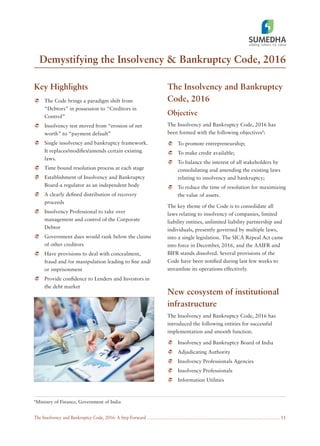
The Insolvency and Bankruptcy
Code, 2016
Objective
The Insolvency and Bankruptcy Code, 2016 has
been formed with the following objectives8
:
To promote entrepreneurship;
To make credit available;
To balance the interest of all stakeholders by
consolidating and amending the existing laws
relating to insolvency and bankruptcy;
To reduce the time of resolution for maximizing
the value of assets.
The key theme of the Code is to consolidate all
laws relating to insolvency of companies, limited
liability entities, unlimited liability partnership and
individuals, presently governed by multiple laws,
into a single legislation. The SICA Repeal Act came
into force in December, 2016, and the AAIFR and
BIFR stands dissolved. Several provisions of the
Code have been notified during last few weeks to
streamline its operations effectively.
New ecosystem of institutional
infrastructure
The Insolvency and Bankruptcy Code, 2016 has
introduced the following entities for successful
implementation and smooth function.
Insolvency and Bankruptcy Board of India
Adjudicating Authority
Insolvency Professionals Agencies
Insolvency Professionals
Information Utilities
The Insolvency and Bankruptcy Code, 2016: A Step Forward12
Insolvency and Bankruptcy
Board of India (IBBI)
The IBBI was established on 1st October 2016.
The Board has been given wide powers to regulate
the Insolvency Professional Agencies, Insolvency
Professionals and Information Utilities. The Code
also gives powers to the Board to make regulations
in respect of all the processes, appointments,
procedures, investigation, monitoring, etc. The
Board shall be a body corporate with perpetual
succession. The Board shall consist of 10 members
headed by Chairperson and at least three whole-
time members.
Adjudicating Authority
The Code prescribes that in case of corporates,
limited liability partnerships and other limited
liability entities as may be notified, NCLT shall be
the Adjudicating Authority. In case of individuals
and partnerships, DRT shall be the Adjudicating
Authority. All appeals from NCLT and DRT
shall lie with NCLAT and DRAT respectively.
The Supreme Court of India shall have Appellate
jurisdiction over NCLAT and DRAT. The NCLT
benches are already functional all over the country.
Further, the Code bans the jurisdiction of Civil
Courts over the related matter and this Code shall
have an overriding effect over all other laws.
Insolvency Professional Agencies
Insolvency Professional Agencies are those
specialized bodies/agencies that will be entrusted
with the task of registration and governance of
Insolvency Professionals.
Registration as an Insolvency
Professional Agency (Section 206
and 207 of the code)
In order to function as an Insolvency Professional
Agency, one has to be registered and obtain a
license from the Board.
Functions of an Insolvency Professional Agency (Section 204 of the Code)
Grant membership to persons who fulfil all requirements set out in its bye laws on
payment of membership fee
Lay down standards of professional conduct for its members
Monitor the performance of its members
Safeguard the rights, privileges and interests of insolvency professionals who are its
members
Suspend or cancel the membership of insolvency professionals who are its members
on the grounds set out in its bye-laws
Redress the grievances of consumers against insolvency professionals who are its members
Publish information about its functions, list of its members, performance of its
members and such other information as may be specified by regulations
The Insolvency and Bankruptcy Code, 2016: A Step Forward 13
Insolvency Professionals
Insolvency Professionals are those licensed
professionals who are appointed by Insolvency
Professional Agencies who would take on the
roles of Resolution Professional/Liquidator/
bankruptcy Trustee in the Insolvency Resolution
Process of different entities.
Enrolment and Registration of
Insolvency Professionals (Section
207 of the Code)
The Insolvency Professional has to be registered
with the following:
Insolvency Professional Agency
Insolvency and Bankruptcy Board of India
Functions and Obligations of
Insolvency Professionals (Section
208 of the Code)
Manage the affairs of the corporate debtors
as a going concern
Constitute the Code of Conduct, convene its
meetings and conduct such meetings
Conduct the corporate insolvency resolution
process
Prepare the information memorandum
Submit a resolution plan to the adjudicating
authority as approved by the Code of
Conduct
Conduct the liquidation process if the
resolution plan is rejected or fails after
approval
Code of Conduct to be followed
by Insolvency Professional
(Section 208 of the code)
Taking reasonable care and diligence while
performing his duties
Complying with all requirements and terms
and conditions specified under the bye-laws
of the insolvency professional agency of
which he is a member.
Allowing the insolvency professional agency
to inspect his records
Submitting a copy of the records of every
proceeding before the Adjudicating Authority
to the Board as well as to the insolvency
professional agency of which he is a member
Performing such functions in such manner
and subject to such conditions as may be
specified.
The Insolvency and Bankruptcy Code, 2016: A Step Forward14
Information Utility
An information utility is an agency that is in
charge of collecting, collating and disseminating
financial information. The business of the
information utility is primarily concerning
financial information.
Registration of the Information
Utility (Section 210 of the Code)
An information utility shall be registered with the
Board
Obligations and Functions of Information Utility (Section 214 of the code)
Create and store financial information in a universally accessible format.
Accept electronic submissions of financial information from persons who are under
obligations to submit financial information under sub-section (1) of section 215 in
such form and manner, as may be specified by regulations.
Accept, in specified form and manner, electronic submissions of financial
information from persons who intend to submit such information.
Meet such minimum service quality standards as may be specified by regulations.
Get the information received from various persons, authenticated by all concerned
parties before storing such information
Provide access to the financial information stored by it to any person who intends to
access such information in such manner, as may be specified by regulations
Publish such statistical information as may be specified by regulations
Have inter-operability with other information utilities
The Insolvency and Bankruptcy Code, 2016: A Step Forward
Insolvency resolution process for corporate
15
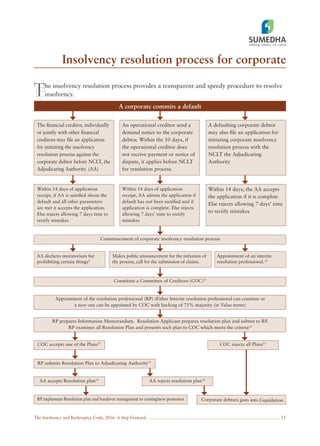
The insolvency resolution process provides a transparent and speedy procedure to resolve
insolvency.
A corporate commits a default
Commencement of corporate insolvency resolution process
COC accepts one of the Plans13
RP submits Resolution Plan to Adjudicating Authority13
AA accepts Resolution plan14
RP implements Resolution plan and handover management to existing/new promoters
AA rejects resolution plan14
COC rejects all Plans13
Corporate debtors goes into Liquidation
Constitute a Committee of Creditors (COC)11
Appointment of the resolution professional (RP) (Either Interim resolution professional can continue or
a new one can be appointed by COC with backing of 75% majority (in Value terms)
RP prepares Information Memorandum. Resolution Applicant prepares resolution plan and submit to RP.
RP examines all Resolution Plan and presents such plan to COC which meets the criteria12
Within 14 days of application
receipt, if AA is satisfied about the
default and all other parameters
are met it accepts the application.
Else rejects allowing 7 days time to
rectify mistakes
Within 14 days of application
receipt, AA admits the application if
default has not been rectified and if
application is complete. Else rejects
allowing 7 days’ time to rectify
mistakes
The financial creditor, individually
or jointly with other financial
creditors may file an application
for initiating the insolvency
resolution process against the
corporate debtor before NCLT, the
Adjudicating Authority. (AA)
An operational creditor send a
demand notice to the corporate
debtor. Within the 10 days, if
the operational creditor does
not receive payment or notice of
dispute, it applies before NCLT
for resolution process.
A defaulting corporate debtor
may also file an application for
initiating corporate insolvency
resolution process with the
NCLT the Adjudicating
Authority
AA declares moratorium for
prohibiting certain things9
Makes public announcement for the initiation of
the process, call for the submission of claims.
Appointment of an interim
resolution professional.10
Within 14 days, the AA accepts
the application if it is complete
Else rejects allowing 7 days’ time
to rectify mistakes
The Insolvency and Bankruptcy Code, 2016: A Step Forward16
The trigger
When a corporate debtor makes a payment default
of the debt it owes, then either financial creditor(s)
or operational creditor(s) or the corporate debtor
himself can initiate the process. The minimum
loan default amount to initiate the procedure is
Rs. 1 Lakh.
Entities not entitled to make
application (section 11 of the
Code)
For a corporate debtor
who is already undergoing insolvency
process; or
having completed insolvency resolution
process twelve months preceding the date
of making application; or
in respect to whom a liquidation order
has been made.
For a corporate debtor or a financial creditor
Who has violated any of the terms of
the resolution plan, which was approved
twelve months before the date of making
an application.
9
Moratorium
The Adjudicating Authority declare moratorium
for prohibiting the following (section 13 of the
Code)–
All legal issues, judgment, court orders,
tribunals, arbitration etc. against the
corporate debtor.
Transferring, encumbering, alienating or
disposing of any assets or any legal right or
beneficial interest therein.
Any action to foreclose, recover or enforce
any security interest created by the corporate
debtor in respect of its property.
The recovery of any property by an owner or
lessor where such property is occupied by or
in the possession of the corporate debtor.
Exclusion:
There should not be any termination of
supply of the essential goods or services
to the corporate debtor during the
moratorium period.
The moratorium shall not apply to any
transaction as notified by the Central
Government in consultation with any
financial sector regulator.
The order of moratorium shall be continued
until the completion of corporate insolvency
resolution process.
The Insolvency and Bankruptcy Code, 2016: A Step Forward 17
10
Appointment of an interim
resolution professional; to
manage the business initially
(section 16 and 17 of the code)
As soon as the interim resolution professional
gets appointed, the management of affairs of
the corporate debtor shall vest on him and the
power of the board of directors shall stand
suspended.
Financial institutions maintaining accounts
of the corporate debtor shall act on the
instruction of the interim resolution
professional.
The interim resolution profession has the
authority to access the books of accounts,
records and other relevant documents
of corporate debtor available with the
government authorities, statutory auditors,
accountants and such other persons as may be
specified.
The interim resolution professional shall
collect all information relating to the assets,
finance and operations of the corporate debtor
for determining the financial position of
the corporate debtor, including information
relating to –
Business operation for the previous two
years;
Financial and operational payments for
the previous two years;
List of assets and liabilities as on
initiation date; and
Such other matters as may be specified;
The interim resolution professional shall
constitute a committee of creditors. It shall
monitor all the assets of the corporate debtor
and manage its operations until a resolution
professional is appointed by the committee of
creditors.
It shall take control and custody of any
asset over which the corporate debtor has
ownership right as recorded in the balance
sheet, or with information utility or the
depository of securities or any other registry
that records the ownership of assets. However,
assets owned by a third party and assets of
any Indian and foreign subsidiary of the
corporate debtor shall not be included.
The interim resolution professional shall
collect all claims received against the
corporate debtor and determine the financial
position of the corporate debtor.
The Insolvency and Bankruptcy Code, 2016: A Step Forward18
11
Committee of creditors (section
21 of the Code)
Committee of creditors shall comprise of all
financial creditors except related parties to
whom a corporate debtor owes a financial
debt. If there is more than one financial
creditor, each of them shall be the part of
the committee and their voting shall be
determined on the basis of financial debts
owed to them.
An entity who is both a financial creditor,
as well as an operational creditor shall be
included in the committee of creditors with
voting share proportionate to the extent of
financial debts owed to them. It shall also
be considered as operational creditor to the
extent of the operational debt owed by the
corporate debtor to them.
When the debt is extended as a part of
consortium, syndicate or issued as securities
provided for a single trustee or agent to act
for all financial creditors, each financial
creditor may -
Authorise the trustee or agent to act on
his behalf in the committee of creditors to
the extent of his voting share;
Each financial creditor may represent
himself in the committee of creditors to
the extent of his voting share;
Appoint an insolvency professional
(other than the resolution professional)
at its own cost to represent itself in the
committee of creditors
Exercise his right to vote to the extent
of his voting share with one or more
financial creditors jointly or severally.
All decision of the committee of creditors shall
be taken by a vote of not less than 75% of the
voting share of the financial creditors.
The first meeting of the committee of creditors
shall be held within seven days of the
constitution of the committee.
The Insolvency and Bankruptcy Code, 2016: A Step Forward 19
12
Appointment of resolution
professional (section 22 of the code)
In the first meeting of the committee of
creditors, it decides by voting to appoint
the interim resolution professional as
resolution professional or to replace by
another resolution professional. In the case of
replacement, it has to apply before NCLT for
the appointment of the proposed resolution
professional.
Ultimately, the matter will go the Board for
final confirmation. In case, the Board delays
in confirming beyond ten days, the NCLT
should direct the existing interim resolution
professional to continue to function until
Board confirms the appointment.
Resolution professional to
manage the business
The resolution professional shall perform the
role and responsibilities vested on the interim
resolution profession (12appointment and role
of interim resolution professional)
In addition, the resolution professional
will conduct all meetings of the committee
of creditors and will submit the notice of
the same to members of the committee of
creditors, members of the suspended Board
of Directors and operational creditors (if the
amount of their aggregate dues is not less than
ten percent of the debt).
The committee of creditors may replace the
existing resolution professional by a vote of
75%, at any point of time under the process
(to follow the same appointment process).
Another important role of the resolution
professional is to prepare the information
memorandum specified by the Board for
formulating a resolution plan.
Limitation/restriction of the resolution
professional
During the corporate insolvency
resolution process, the resolution
professional cannot raise any additional
interim finance without prior approval
of the committee of creditors. It cannot
create any security interest over the asset
of the company also.
Without prior permission of the
Committee of Creditors, it cannot change
the capital and ownership structure.
In addition, it cannot undertake any related
party transaction, amend any constitutional
documents, make any change in the
management, transfer right of the financial
debts, or change the appointment terms of
auditors without the prior permission of the
Committee of Creditors.
13
Preparation and submission of
resolution plan
The resolution applicant shall prepare and submit
the resolution plan to resolution professional for
examination. Post examination, the resolution
professional shall submit the plan to the
committee of creditors for their reference. The
committee of creditors may approve the plan by
a vote (not less than 75% of the voting share
of financial creditors). Once it is approved,
the resolution professional submits it to the
Adjudicating Authority.
The Insolvency and Bankruptcy Code, 2016: A Step Forward20
14
Approval or rejection of the
plan by the Adjudicating Authority
(Section 31 of the code)
If the Adjudicating Authority is satisfied with
the resolution plan approved by the committee
of creditors, it shall by order, approve the plan.
If the Adjudicating Authority finds that the plan
does not conform to some requirements, it may by
order reject the plan. After the approval by the
Adjudicating Authority, the moratorium orders
passed under section 14 shall cease to have an
effect.
Timelines
Particulars Timeline (in days)
Filing an application with the NCLT for initiating corporate insolvency
resolution process.
X
NCLT admits the application (commencement of corporate insolvency
resolution process) or rejects the application.
X+14
Insolvency resolution professional appointment (X+14)+14
Constitution of Committee of Creditors (X+14)+14+10
Submission of Resolution plan
(X+14)+180
- On approval – moratorium ceases to have effect
- On reject – initiation of liquidation
Completion of Insolvency Resolution Process
Extension of the resolution Process (X+14)+180+90
The Insolvency and Bankruptcy Code, 2016: A Step Forward
Liquidation & distribution of recovery proceeds
21
Liquidation
The Insolvency and Bankruptcy Board of India
has framed new regulations under ‘Insolvency
and Bankruptcy Board of India (Liquidation
Process) Regulations 2016 [the regulation]’ to
deal with liquidation process (covers section 5,
33, 34, 35, 37, 38, 39, 40, 41, 43, 45, 49, 50,
51, 52, 54, 196 and 208 read with 240 of the
Insolvency and Bankruptcy Code, 2016).
Before the expiry of the insolvency resolution
process period or the maximum period permitted
for resolving insolvency process or the fast track
insolvency resolution process, if the Adjudicating
Authority does not receive any resolution plan or
the Adjudicating Authority rejects the resolution
plan, it will pass an order requiring the corporate
debtor to be liquidated (section 33).
Liquidation
Appointment of Liquidator
Submission of the preliminary record to the Adjudicating Authority (Y+75)
Submission of claims by different stakeholders. Verification of stakeholders’
claims and preparation of final list of stakeholders by the liquidator.
Asset memorandum by the liquidator and valuation by at least two independent valuers.
Asset sale either by auction or by private sale. Distribution of proceeds (Y+2 yrs)
To make public announcement - to call upon stakeholders to submit their claims
as on liquidation commencement date and to provide last date for submission of claim
(30 days from the liquidation commencement date16
-Y+30)
16
Liquidation commencement date: means the date on which proceedings for liquidation commence in accordance with
section 33 or section 59 of the Code (Y)
The Insolvency and Bankruptcy Code, 2016: A Step Forward22
Liquidator
In the process of liquidation, a liquidator
needs to be appointed. An insolvency
professional shall be eligible to become a
liquidator provided it/he is independent of
the corporate debtor.
A liquidator shall disclose the existence of
any pecuniary personal relationship with the
corporate debtor or any of its stakeholder as
soon as he becomes aware of it, the Board
and the Adjudicating Authority.
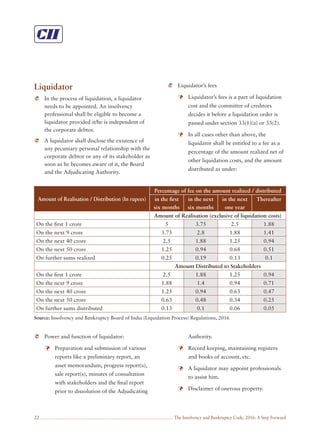
Liquidator’s fees
Liquidator’s fees is a part of liquidation
cost and the committee of creditors
decides it before a liquidation order is
passed under section 33(1)(a) or 33(2).
In all cases other than above, the
liquidator shall be entitled to a fee as a
percentage of the amount realized net of
other liquidation costs, and the amount
distributed as under:
Power and function of liquidator:
Preparation and submission of various
reports like a preliminary report, an
asset memorandum, progress report(s),
sale report(s), minutes of consultation
with stakeholders and the final report
prior to dissolution of the Adjudicating
Authority.
Record keeping, maintaining registers
and books of account, etc.
A liquidator may appoint professionals
to assist him.
Disclaimer of onerous property.
Amount of Realisation / Distribution (In rupees)
Percentage of fee on the amount realized / distributed
in the first
six months
in the next
six months
in the next
one year
Thereafter
Amount of Realisation (exclusive of liquidation costs)
On the first 1 crore 5 3.75 2.5 1.88
On the next 9 crore 3.75 2.8 1.88 1.41
On the next 40 crore 2.5 1.88 1.25 0.94
On the next 50 crore 1.25 0.94 0.68 0.51
On further sums realized 0.25 0.19 0.13 0.1
Amount Distributed to Stakeholders
On the first 1 crore 2.5 1.88 1.25 0.94
On the next 9 crore 1.88 1.4 0.94 0.71
On the next 40 crore 1.25 0.94 0.63 0.47
On the next 50 crore 0.63 0.48 0.34 0.25
On further sums distributed 0.13 0.1 0.06 0.05
Source: Insolvency and Bankruptcy Board of India (Liquidation Process) Regulations, 2016
The Insolvency and Bankruptcy Code, 2016: A Step Forward 23
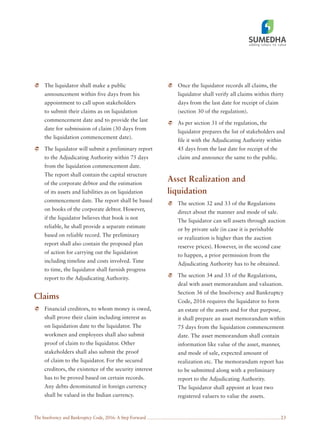
The liquidator shall make a public
announcement within five days from his
appointment to call upon stakeholders
to submit their claims as on liquidation
commencement date and to provide the last
date for submission of claim (30 days from
the liquidation commencement date).
The liquidator will submit a preliminary report
to the Adjudicating Authority within 75 days
from the liquidation commencement date.
The report shall contain the capital structure
of the corporate debtor and the estimation
of its assets and liabilities as on liquidation
commencement date. The report shall be based
on books of the corporate debtor. However,
if the liquidator believes that book is not
reliable, he shall provide a separate estimate
based on reliable record. The preliminary
report shall also contain the proposed plan
of action for carrying out the liquidation
including timeline and costs involved. Time
to time, the liquidator shall furnish progress
report to the Adjudicating Authority.
Claims
Financial creditors, to whom money is owed,
shall prove their claim including interest as
on liquidation date to the liquidator. The
workmen and employees shall also submit
proof of claim to the liquidator. Other
stakeholders shall also submit the proof
of claim to the liquidator. For the secured
creditors, the existence of the security interest
has to be proved based on certain records.
Any debts denominated in foreign currency
shall be valued in the Indian currency.
Once the liquidator records all claims, the
liquidator shall verify all claims within thirty
days from the last date for receipt of claim
(section 30 of the regulation).
As per section 31 of the regulation, the
liquidator prepares the list of stakeholders and
file it with the Adjudicating Authority within
45 days from the last date for receipt of the
claim and announce the same to the public.
Asset Realization and
liquidation
The section 32 and 33 of the Regulations
direct about the manner and mode of sale.
The liquidator can sell assets through auction
or by private sale (in case it is perishable
or realization is higher than the auction
reserve prices). However, in the second case
to happen, a prior permission from the
Adjudicating Authority has to be obtained.
The section 34 and 35 of the Regulations,
deal with asset memorandum and valuation.
Section 36 of the Insolvency and Bankruptcy
Code, 2016 requires the liquidator to form
an estate of the assets and for that purpose,
it shall prepare an asset memorandum within
75 days from the liquidation commencement
date. The asset memorandum shall contain
information like value of the asset, manner,
and mode of sale, expected amount of
realization etc. The memorandum report has
to be submitted along with a preliminary
report to the Adjudicating Authority.
The liquidator shall appoint at least two
registered valuers to value the assets.
The Insolvency and Bankruptcy Code, 2016: A Step Forward24
When a secured creditor wants to realize
its security interest, it shall intimate the
liquidator of the price at which he proposes
to realize (section 37 of the Regulation).
Accordingly, it shall be decided whether the
liquidator or the secure creditor shall sell the
asset.
If an asset remains unsold due to special
circumstances, the liquidator shall distribute
that unsold asset among stakeholders.
Distribution of proceeds
As per section 41 of the Regulations, the liquidator
shall open a bank account in the name of corporate
debtor, followed by the words ‘in liquidation’. The
liquidator shall deposit all considerations. The
liquidator then shall distribute the proceeds from
realization to the stakeholders within six months
from the receipt of the amount (section 42 of the
regulation). Ultimately, the liquidator shall liquidate
the corporate debtor within a period of two years
(44 of the Regulations).
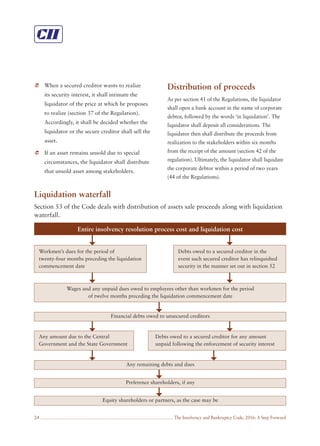
Liquidation waterfall
Section 53 of the Code deals with distribution of assets sale proceeds along with liquidation
waterfall.
Entire insolvency resolution process cost and liquidation cost
Wages and any unpaid dues owed to employees other than workmen for the period
of twelve months preceding the liquidation commencement date
Financial debts owed to unsecured creditors
Any remaining debts and dues
Preference shareholders, if any
Equity shareholders or partners, as the case may be
Workmen’s dues for the period of
twenty-four months preceding the liquidation
commencement date
Debts owed to a secured creditor in the
event such secured creditor has relinquished
security in the manner set out in section 52
Any amount due to the Central
Government and the State Government
Debts owed to a secured creditor for any amount
unpaid following the enforcement of security interest
The Insolvency and Bankruptcy Code, 2016: A Step Forward
Fast track corporate resolution process
Voluntary liquidation of corporate person
25
C
ompanies Act, 2013 has the provision of
voluntary liquidation or winding up of
companies and accordingly, both members
of a company or the creditors should initiate the
voluntary winding up process. However, there is a
new amendment in Companies Act, 2013, which
shall remove the voluntary winding up provision
from the Companies Act, 2013 and shall put the
same provision in the Insolvency and Bankruptcy
Code, 2016. According to the Code, a corporate
person, who has not committed any default, can
go for voluntary liquidation process.
T
here is provision for a fast track
resolution process for smaller
companies. Here, the resolution
process shall be completed within
90 days from the date of initiation.
However, it can be extended further by
a maximum of 45 days if more than
75% of the financial creditors agree. As
per section 55 of the Code, the process
is applicable to small debtors only.
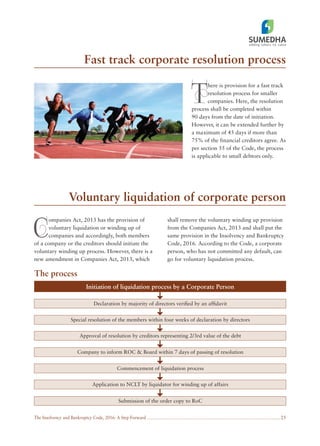
The process
Initiation of liquidation process by a Corporate Person
Declaration by majority of directors verified by an affidavit
Special resolution of the members within four weeks of declaration by directors
Approval of resolution by creditors representing 2/3rd value of the debt
Company to inform ROC & Board within 7 days of passing of resolution
Commencement of liquidation process
Application to NCLT by liquidator for winding up of affairs
Submission of the order copy to RoC
The Insolvency and Bankruptcy Code, 2016: A Step Forward
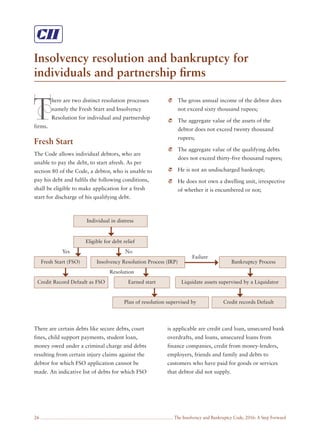
Insolvency resolution and bankruptcy for
individuals and partnership firms
26
T
here are two distinct resolution processes
namely the Fresh Start and Insolvency
Resolution for individual and partnership
firms.
Fresh Start
The Code allows individual debtors, who are
unable to pay the debt, to start afresh. As per
section 80 of the Code, a debtor, who is unable to
pay his debt and fulfils the following conditions,
shall be eligible to make application for a fresh
start for discharge of his qualifying debt.
The gross annual income of the debtor does
not exceed sixty thousand rupees;
The aggregate value of the assets of the
debtor does not exceed twenty thousand
rupees;
The aggregate value of the qualifying debts
does not exceed thirty-five thousand rupees;
He is not an undischarged bankrupt;
He does not own a dwelling unit, irrespective
of whether it is encumbered or not;
There are certain debts like secure debts, court
fines, child support payments, student loan,
money owed under a criminal charge and debts
resulting from certain injury claims against the
debtor for which FSO application cannot be
made. An indicative list of debts for which FSO
is applicable are credit card loan, unsecured bank
overdrafts, and loans, unsecured loans from
finance companies, credit from money-lenders,
employers, friends and family and debts to
customers who have paid for goods or services
that debtor did not supply.
Fresh Start (FSO)
Eligible for debt relief
Individual in distress
Credit Record Default as FSO Earned start
Bankruptcy Process
Credit records Default
Liquidate assets supervised by a Liquidator
Insolvency Resolution Process (IRP)
Plan of resolution supervised by
Yes No
Failure
Resolution
The Insolvency and Bankruptcy Code, 2016: A Step Forward 27
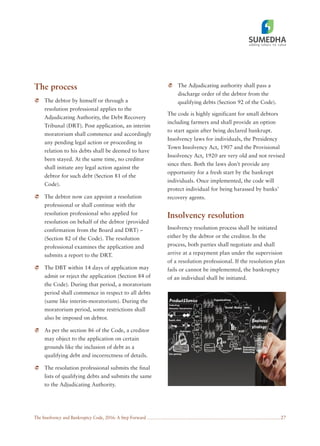
The process
The debtor by himself or through a
resolution professional applies to the
Adjudicating Authority, the Debt Recovery
Tribunal (DRT). Post application, an interim
moratorium shall commence and accordingly
any pending legal action or proceeding in
relation to his debts shall be deemed to have
been stayed. At the same time, no creditor
shall initiate any legal action against the
debtor for such debt (Section 81 of the
Code).
The debtor now can appoint a resolution
professional or shall continue with the
resolution professional who applied for
resolution on behalf of the debtor (provided
confirmation from the Board and DRT) –
(Section 82 of the Code). The resolution
professional examines the application and
submits a report to the DRT.
The DBT within 14 days of application may
admit or reject the application (Section 84 of
the Code). During that period, a moratorium
period shall commence in respect to all debts
(same like interim-moratorium). During the
moratorium period, some restrictions shall
also be imposed on debtor.
As per the section 86 of the Code, a creditor
may object to the application on certain
grounds like the inclusion of debt as a
qualifying debt and incorrectness of details.
The resolution professional submits the final
lists of qualifying debts and submits the same
to the Adjudicating Authority.
The Adjudicating authority shall pass a
discharge order of the debtor from the
qualifying debts (Section 92 of the Code).
The code is highly significant for small debtors
including farmers and shall provide an option
to start again after being declared bankrupt.
Insolvency laws for individuals, the Presidency
Town Insolvency Act, 1907 and the Provisional
Insolvency Act, 1920 are very old and not revised
since then. Both the laws don’t provide any
opportunity for a fresh start by the bankrupt
individuals. Once implemented, the code will
protect individual for being harassed by banks’
recovery agents.
Insolvency resolution
Insolvency resolution process shall be initiated
either by the debtor or the creditor. In the
process, both parties shall negotiate and shall
arrive at a repayment plan under the supervision
of a resolution professional. If the resolution plan
fails or cannot be implemented, the bankruptcy
of an individual shall be initiated.
The Insolvency and Bankruptcy Code, 2016: A Step Forward
Analysis and implication of the Code
28
Fast track process
The code proposes to initiate the insolvency
process at an early stage and the corporate
creditor takes indirect control of the business.
The resolution process takes 180 days (additional
90 days if required) and the liquidation process
requires a maximum two years’ time. So, the entire
procedure shall be completed in less than three
years’ time. At present the average time required
for creditors to recover their credit is 4.3 years.
Moratorium to restrict asset
strapping and siphoning off
assets
To deal with instances of assets strapping
and siphon off assets, the Adjudicating
Authority shall declare a moratorium to
prohibit transferring of any assets or legal
rights by the corporate debtor (Section 14 of
the Code). The violation of provision 14 shall
be punishable with a minimum three years
imprisonment term (Section 74 of the Code).
Management control by
insolvency professional
On commencement of the resolution
process, the management of affairs of the
corporate debtor shall vest on resolution
professional (Section 16, 17 and 25 of the
Code). The resolution professional can
bring expertise in his team to revamp the
business, which can save the business from
being liquidated.
Right of unsecured creditor
The code protects the interest of all
creditors, be it secure or unsecured and
allows them to vote as per their voting share.
The code allows unsecured creditor to trigger
insolvency resolution process. While distributing
asset sale proceeds, unsecured creditors get
priority and their order comes after workmen,
secure creditors and employees’ dues. Earlier,
certain unsecured creditor like vendors used to
get the least priority and the new law shall take
care of their interest.
The Insolvency and Bankruptcy Code, 2016: A Step Forward 29
Protecting workers and
employees
The new code shall protect the interest of the
workmen ahead of secured creditors. First, the
workmen will get the share from assets sale
proceeds and then the secured creditors and
employees respectively.
Abolition of the official
liquidator
The code abolishes the existing official liquidator
structure and the insolvency professional
shall perform the role of the liquidator in the
liquidation process. The official liquidators are
appointed by the Central Government and they
are attached to the High Courts of the respective
states. So far, the liquidation procedure managed
by the official liquidators is not very successful
and most of the time they are overburdened
with multiple assignment17
. Under the code, the
liquidation procedure will be completed in a time-
bound manner by a professional agency.
Opens up bond market
The Corporate Bond market activity has
relatively been low in India compared to other
countries in the world. The code brings in
much needed transformation towards rights of
other creditors and bond holders. Similarly, the
provision towards ranking down Government
Dues over other creditors in liquidation, shall
give desired confidence to all Investors.
17
Gujarat High Court; State Bank of India vs Pro. O.L. Of Volvo Steel Ltd, www.indiankanoon.org
The Insolvency and Bankruptcy Code, 2016: A Step Forward
Issues & challenges
30
1. Consequent to the dissolution of company
law Board and repealing of SICA Act, all
the matters pending with CLB shall stand
transferred to NCLT whereas all existing
registered BIFR cases stands abated and
such companies may file with NCLT afresh
within 180 days. This shall lead to NCLT
dealing with backlogs of CLB/SICA cases.
NCLT should possess adequate manpower
and infrastructure to deal their cases apart
from the responsibility of being Adjudicating
Authority under this Code.
2. The current 33 DRTs set up across the
country have huge pendency of recovery
proceedings and are currently beset with
inadequate infrastructure and manpower.
With more than 58,000 pending cases, need
to beef up its logistics is imminent.
3. Operationalisation of Information Utilities
so as to ensure that the data and the
information are complete and accurate.
4. SARFAESI may still be a preferred choice
for lenders having sufficiency of mortgaged
assets.
5. Secured creditors need to exercise
professional judgement towards resolution
process as liquidation itself may not be the
best choice.
6. Overall development of ecosystem may take
time for having adequately skilled insolvency
professionals, requisite infrastructure with
Adjudicating Authority, proactive training of
all intermediaries, development of corporate
Bond market, well capitalized ARCs,
investment in distressed securities etc.
The Insolvency and Bankruptcy Code, 2016: A Step Forward
Glossary
31
The Sick Industrial Companies Act,1985 SICA
Recovery of Debts due to Banks and Financial Institutions Act,1993 RDDBI
Securitisation and Reconstruction of Financial Assets & Enforcement of Security
Interest Act,2002
SARFAESI
National Company Law Tribunal NCLT
National Company Law Appellate Tribunal NCLAT
Debt Recovery Tribunal DRT
Debt Recovery Appellate Tribunal DRAT
Limited Liability Partnership Act,2008 LLP
Insolvency and Bankruptcy Board of India IBBI
Insolvency Professional IP
Non-Performing Asset NPA
Corporate Debt Restructuring CDR
Joint Lenders Forum JLF
Strategic Debt Restructuring SDR
Asset Reconstruction Company ARC
Reserve Bank of India RBI
The Insolvency and Bankruptcy Code,2016 CODE
Scheme for Sustainable Structuring of Stressed Assets S4A
The Insolvency and Bankruptcy Code, 2016: A Step Forward32
About CII
T
he Confederation of Indian Industry
(CII) works to create and sustain
an environment conducive to the
development of India, partnering industry,
Government, and civil society, through advisory
and consultative processes.
CII is a non-government, not-for-profit, industry-
led and industry-managed organization, playing
a proactive role in India’s development process.
Founded in 1895, India’s premier business
association has over 8000 members, from the
private as well as public sectors, including SMEs
and MNCs, and an indirect membership of over
200,000 enterprises from around 240 national
and regional sectoral industry bodies.
CII charts change by working closely with
Government on policy issues, interfacing with
thought leaders, and enhancing efficiency,
competitiveness and business opportunities for
industry through a range of specialized services
and strategic global linkages. It also provides a
platform for consensus-building and networking
on key issues.
Extending its agenda beyond business, CII
assists industry to identify and execute corporate
citizenship programmes. Partnerships with
civil society organizations carry forward
corporate initiatives for integrated and inclusive
development across diverse domains including
affirmative action, healthcare, education,
livelihood, diversity management, skill
development, empowerment of women, and
water, to name a few.
The CII theme for 2016-17, Building National
Competitiveness, emphasizes Industry’s role
in partnering Government to accelerate
competitiveness across sectors, with sustained
global competitiveness as the goal. The focus
is on six key enablers: Human Development;
Corporate Integrity and Good Citizenship; Ease
of Doing Business; Innovation and Technical
Capability; Sustainability; and Integration with
the World.
With 66 offices, including 9 Centres of
Excellence, in India, and 9 overseas offices
in Australia, Bahrain, China, Egypt, France,
Germany, Singapore, UK, and USA, as well as
institutional partnerships with 320 counterpart
organizations in 106 countries, CII serves as
a reference point for Indian industry and the
international business community.
Confederation of Indian Industry
Eastern Region Headquarters, 6 Netaji Subhas Road, Kolkata – 700 001
T: +91 33 22307727-28/1434/3354, F: +91 33 22301721, 22312700, E: ciier@cii.in, W: www.cii.in)
Sumedha Fiscal Services Ltd
Sumedha Fiscal Services Limited is a boutique
investment banking company with pan India
presence and corporate office at Kolkata. The
Company offers a wide bouquet of services
ranging from Corporate Finance, Turnaround
Solution, Equities, Commodities, Wealth
Advisory, Portfolio Management, Personal
Finance, Currency Futures, Investment Banking
and Institutional Broking Services.
The services are broadly clubbed across three key
business verticals:
Investment Banking
Wealth Management
Broking Services
Sumedha Fiscal focuses on creating viable solutions
for its clients as a trusted partner backed by an
experienced team of professionals. Sumedha Fiscal
is a listed company and further details can be
assessed at www.sumedhafiscal.com
Office
Kolkata (Registered & Corporate Office)
8 B, Middleton Street, 6 A, Geetanjali
Kolkata – 700071
Telephone: +91 33 2229 8936/6758 /3237/4473
Fax: +91 33 2226 4140 / 2265 5830
kolkata@sumedhafiscal.com
Bangalore
“Park Plaza” 1st Floor,No.1 Park Road
(Off Infantry Road), Tasker Town,
Bangalore – 560001
Telephone: +91 80 4124 2545 / 2546
Fax: +91 80 4124 2547
bangalore@sumedhafiscal.com
Hyderabad
309/1, “Krishna Plaza”, Khairatabad,
Opp: Shadan College,
Hyderabad-500 004
Telephone: +91 40 4020 2826 / 4026 7272
Fax: +91 40 4020 2826
hyderabad@sumedhafiscal.com
Mumbai
C-703, Marathon Innova,
Off Ganpatrao Kadam Marg
Opp Penninsula Corporate Park,
Lower Parel (West), Mumbai - 400 013.
Telephone: +91 22 4033 2400/ 4033 2416
Fax: +91 22 2498 2878
mumbai@sumedhafiscal.com
New Delhi
B1/12, Safdarjung Enclave, 2nd Floor
New Delhi - 110 029.
Telephone: +91 11 4165 4481 / 4482
Fax: +91 11 4165 4483
delhi@sumedhafiscal.com
Ahmedabad
A/82, Parisima Complex, Opp. IFCI Bhawan,
C.G. Road, Ahmedabad – 380 009
Telephone: +91 79 3002 3337
Fax: +91 79 2645 0394
ahmedabad@sumedhafiscal.com
Disclaimers
1. The information contained in this report is extracted from different public sources. Reasonable care has been
taken to ensure that the information contained herein is not misleading or untrue at the time of publication.
2. The report is for general information only and we are not soliciting any action based on this material.
3. The document is confidential and prepared for private circulation only. This is not an advertisement material.
4. Facts and views expressed in the document are subject to change without any notice to the recipient.
The Insolvency and Bankruptcy Code 2016 - A Step Forward

The Insolvency and Bankruptcy Code 2016 - A Step Forward

  • 1.
    The Insolvency andBankruptcy Code, 2016 A Step Forward Confederation of Indian Industry
  • 3.
    The Insolvency andBankruptcy Code, 2016: A Step Forward Foreword 1 I ndian Banking scenario is going through unprecedented times with stressed loan portfolio touching all-time high. As per estimates stressed loan portfolio of all banks put together, is around 17%-18% of total advances. There is an apprehension that there could be further significant additions as many stressed loan accounts have been disguised as standard. Realizing the problem, RBI has attempted to force banks to clean up balance sheets and come out with many regulatory steps aimed at improving banks’ ability to deal with such stressed accounts. Of them, Strategic Debt Restructuring (SDR), 5:25 and (Scheme for Sustainable Structuring of Stressed Assets (S4A) being the latest to be added to the list. These frameworks, though unable to address all situations, are a step forward towards an intent of resolution. There is an all-round need for identifying the problem well in time, focus on a comprehensive turnaround and all stakeholders, be it creditors or borrowers, should be actively engaged towards the objective. India currently has multiple laws to deal with insolvency, which leads to significant delays in winding up a company. In this scenario, the Indian Government has introduced the Bankruptcy and Insolvency Code, 2016 which will consolidate the existing frameworks and create a new institutional structure. The Code creates time-bound processes for insolvency resolution of companies and individuals which thereby will help India improve its World Bank insolvency ranking. The new bankruptcy law isn’t a “magic wand”. The main challenge will be implementation-adequacy of infrastructure and skilled pool of insolvency professionals, who will help with the fast implementation of the law. CII-Sumedha Fiscal has come out with this knowledge paper with the objective to touch upon the key aspects of the Code and lay bare the issues and challenges. Vijay Maheshwari Director, Sumedha Fiscal Services Ltd. & Co-Chairman, CII-ER Economic Affairs, Finance & Taxation Sub-Committee
  • 4.
    The Insolvency andBankruptcy Code, 2016: A Step Forward Contents 2 Introduction 3 Multiplicity of the existing laws – an issue 5 Current stress in the banking sector 7 Resolving insolvency – time and cost matter 9 Demystifying the Insolvency and Bankruptcy Code, 2016 11 Key Highlights 11 The Insolvency and Bankruptcy Code, 2016 11 New ecosystem of institutional infrastructure 11 Insolvency and Bankruptcy Board of India (IBBI) 12 Adjudicating Authority 12 Insolvency Professional Agencies 12 Insolvency Professionals 13 Information Utility 14 Insolvency resolution process for corporate 15 Liquidation and distribution of recovery proceeds 21 Fast track corporate resolution process 25 Voluntary liquidation of corporate person 25 Insolvency resolution and bankruptcy for individuals and partnership firms 26 Analysis and implication of the Code 28 Issues & challenges 30 Glossary 31 About CII 32
  • 5.
    The Insolvency andBankruptcy Code, 2016: A Step Forward Introduction 3 I n a simple dictionary term, insolvency is a situation where liabilities of a person or a firm exceed its assets. In practice, the insolvency situation occurs when a person or a firm cannot pay its financial obligations i.e. cannot pay the debts it owes. Sometimes, a firm’s assets may be higher than the liabilities, still it cannot pay debt obligations as assets may be illiquid and cash flows are not sufficient to pay debts. It may also happen that a firm’s liabilities are higher than assets, but generating enough cash flow to repay obligations. So for a creditor, it is important to examine the situation before taking any decision. Sometimes, the phrase ‘technical insolvency’ and ‘actual insolvency’ are used to explain these two situations (technical insolvency – when liability is higher than the assets and actual insolvency when cash flow is insufficient to pay the debts). Bankruptcy is little different from insolvency. It occurs when a court recognises the insolvency. It is a legal status of a person or a firm. However, in India, no law have defined bankruptcy (except in the Insolvency and Bankruptcy Code, 2016). Certain acts only define the term ‘winding up’, which is different from bankruptcy. Bankruptcy is a plan when an insolvent debtor seeks relief. In accordance with new Insolvency and Bankruptcy Code, 2016, a bankrupt entity is a debtor who has been adjudged as bankrupt by an Adjudicating Authority by passing a bankruptcy order. In the bankruptcy proceeding, the court appoints a trustee who is responsible for selling the property and paying obligations to the creditors. According to the Law Commission of India, the insolvency law has a two-fold purpose1 , (i) to give relief to the debtor from the harassment of his creditors, whose claims he is unable to meet and, (ii) to provide a machinery by which creditors, who are not secured in the payment of their debts are to be satisfied. It is based on the Roman principal ‘cessio bonorum’ that is to say, surrender by the debtor of all his goods for the benefit of his creditors, in return for immunity from court process. Indian economy has expanded at a very rapid pace in the past one decade and crossed the two trillion dollar mark. However, our credit system is not vibrant and the corporate bond market is at the nascent stage. Thus, banks are the main source of corporate credit. Non-performing assets in the banking system have been rising and have reached to a level that is beyond the comfort zone. We have multiple laws that deal with insolvency and bankruptcy for different entities under different situations. Due to the complexity of multiple laws, the entire resolution procedure is fragmented, expensive and time-consuming with very low recovery rate. All, out of the court, debt restructuring processes like CDR, SDR, S4A and 5:25 are not very successful, rather bad loans have piled up in the system after their implementation. 1 Law Commission of India, Report on Insolvency Laws/Objective of Insolvency Law.
  • 6.
    The Insolvency andBankruptcy Code, 2016: A Step Forward4 In this background, the new code has been formed with the broad objective to consolidate all existing laws relating to insolvency and bankruptcy for companies and individual. The code, on implementation, may enhance credit availability, promote entrepreneurship and balance the interest of all stakeholders. The code will drastically reduce the insolvency resolution time resulting in a low loss in recovery. The code has proposed to set up a well-regulated institutional framework under a new regulator, the Insolvency and Bankruptcy Board of India. Two Adjudicating Authorities, NCLT and DRT are formed and that will perform the judicial control during the process. Other entities like insolvency professional and information utilities will perform specific role during the process.
  • 7.
    The Insolvency andBankruptcy Code, 2016: A Step Forward Multiplicity of the existing laws – an issue 5 I n India, there is not a single law that exclusively deals with bankruptcy and insolvency. Rather, we have multiple rules and regulations under different authorities that ultimately delay the entire procedure. There was no concrete law related to bankruptcy or insolvency before the British came to India. The first evidence of an insolvency legislation can be traced to sections 23 and 24 of the Government of India Act, 1800 (39 and 40 Geo III, c 79, in line with the Lord’s Act 1759, England)2 . The law empowered three courts (Fort William, Madras, and Bombay) to make rules for relieving the insolvent debtors. The special insolvency legislation began in 1828 when Statue 9 (Geo IV c 73) was passed and the first insolvency courts were formed in Presidency-towns3 with the objective to relieve the insolvent debtors. In 1848, a revised insolvency legislation, the Indian Insolvency Act, 1848 (11 and 12 Vict. c. 21) was passed. Later, the act was found insufficient to address the changing business environment and a new Insolvency Bill was proposed for the entire India in line with the Bankruptcy Laws in England. However, the plan was dropped and the Indian Insolvency Act, 1848 was continued in Presidency-towns till the enactment of the Presidency-Towns Insolvency Act, 1909. The Presidency Towns Insolvency Act, 1909 was enacted to resolve the same bankruptcy issues in Presidency-Towns. The above-mentioned acts were mainly focused towards insolvency legislations in Presidency- Towns and there was no separate law for the mofussil, where the business environment was different. Later, the Provincial Insolvency Act, 1907 was formed and it covered the mofussil. In 1920, a new law ‘Provincial Insolvency Act, 1920’ was formed and replaced the old act. 2 Law Commission of India, 26th Report – Report on Insolvency Laws, Government of India, Ministry of Law. 3 Presidency-towns were the administrative divisions of British India. There were three Presidency-towns during the British rule in India (Madras, Bombay and Calcutta). Existing legal frameworks The Presidency Towns Insolvency Act, 1909 The Provincial Insolvency Act, 1920 SARFAESI Act, 2002 Recovery of Debts due to Banks and Financial Institutions Act, 1993 Companies Act, 2013 Sick Industrial Companies (Special Provisions) Act, 1985 LLP Act, 2008
  • 8.
    The Insolvency andBankruptcy Code, 2016: A Step Forward6 Till date, both the laws viz. ‘Presidency Town Insolvency Act 1907’ and ‘Provincial Insolvency Act, 1920’ are sound in principle and have worked satisfactorily, in practice. However, these two acts have been brought within the scope of the Insolvency and Bankruptcy Code 2016 (Code). Earlier, banks and financial institutions used to file civil suit in a court of law to recover dues from the defaulter companies. However, this process was extremely time-consuming and sometimes it took five to fifteen years for getting a judgement4 . The civil courts were burdened with diverse types of cases and debt recovery related cases were like other cases and did not get any priority5 . In this background and based on the recommendation of various committees on financial market reform, ‘The Recovery of Debts due to Banks and Financial Institutions Act, 1993 (or DRT Act) was enacted with the objective to provide a platform to banks and financial institutions for smooth and speedy recovery of bad loans. A specialised Adjudicating Authority, Debt Recovery Tribunal or DRT was formed and that has been exclusively taking care of debt recovery related issues of banks and financial institutions. In spite of the involvement of DRT, there has been no speedy recovery of debts. Even debtors have identified several loopholes in the DRT Act and they have misused it. To address the issues faced by DRT Act and to further strengthen the recovery process, The Securitisation and Reconstruction of Financial Assets and Enforcement of Security Interest Act, 2002 (SARFAESI Act), was designed. This act empowers the banks and financial institution to recover bad loans directly from the debtor without Court’s intervention. The act allows banks and financial institutions to auction mortgaged assets of the defaulting borrowers and sale may take place without the intervention of courts. The act has certain limitations. It does not consider the rights other than secured creditors. The SARFASEI Act is a foreclosure and does not consider a business as going concern. Companies Act 1956, has the legal provision for insolvency. According to chapter V of Companies Act 1956, there can be arbitration, compromises, arrangements or reconstructions between companies and creditors and shareholders. The act also deals with winding up of companies. The companies Act 2013 has provisions for rescue and rehabilitation and liquidation of all registered entities (Chapter XIX and XX). The Companies Act 2013 also has provision to merge domestic companies with foreign companies. The Sick Industrial Companies (Special Provision) Act 1985 (SICA) was designed to rescue the sick companies, whose accumulated loss is higher than the net worth at the end of any financial year. Under this act, BIFR (Board for Industrial and Financial Reconstruction) reviews the viability of a sick business. The act was also proved inefficient. The current insolvency procedures that are governed either by Companies Act or SICA, will be replaced by the procedure under the Insolvency and Bankruptcy Code. 4 An Introduction to the Recovery of Debts Due to Banks and Financial Institutions Act, 1993 – A Study by G. S. Dubey, Chartered Accountant Practice Journal. 5 Tiwari Committee Report.
  • 9.
    The Insolvency andBankruptcy Code, 2016: A Step Forward Current stress in the banking sector 7 T he RBI Published Financial Stability Report highlights the increased stress in the Indian Banking system arising out of deteriorating asset quality and low profitability. The previous RBI governor Dr. Raghuram Rajan had opined that “Our intent is to have clean and fully provisioned banks’ balance sheets by March 2017”. Risks to India’s banking sector have increased mainly on account of deterioration in asset quality and low profitability. The burden of NPAs continued to increase sharply; 79.7% y-o-y growth in gross non-performing assets (GNPA) as of March 31, 2016; 14.5% gross non-performing assets for public sector banks; 4.5% private sector banks and foreign banks, each reported GNPAs of 4.5%; Stressed assets in the banking system Source: RBI Mar FY13 FY14 FY15 FY16 FY13 FY14 FY15 FY16 FY13 FY14 FY15 FY16 Total Public Sector Banks Private Sector Banks Gross NPA Ratio (%) 3.27 3.86 4.37 7.61 3.59 4.34 4.94 9.6 1.86 1.82 2.14 2.7 Net NPA Ratio (%) 1.72 2.17 2.48 4.63 1.99 2.53 2.9 6.1 0.52 0.63 0.87 1.3 Stressed Assets/ advances (%) NA 9.75 11.01 11.5 NA 11.04 12.68 14.5 NA 4.29 4.59 4.5 The framework for Corporate Debt Restructuring was widely used till regulatory forbearance towards asset classification benefit stands withdrawn effective from 1st April 2015. The current statistics as on 30th September 2016 for CDR cases are:- Particulars No. of cases Aggregate Debt Total References received by CDR Cell 655 474002 Cases rejected before admission or approval 125 70998 Total cases approved 530 403004 Cases withdrawn on account of package failure 248 110772 Cases exited successfully 97 70660 Live Cases in CDR 185 221572 Rs. in crore Source: www.CDRIndia.org
  • 10.
    The Insolvency andBankruptcy Code, 2016: A Step Forward8 Option Feature Concern CDR Has been widely used earlier and helped many companies in coming out of stress Majority decision making Lost charm after withdrawal of forbearance benefit by RBI from 1st April, 2015 Not helped much. Too many failures post CDR implies it was deferment of inevitable Bilateral Mostly used for individual cases Had worked well earlier Very few cases considered by lenders now post withdrawal of forbearance benefits. JLF Majority decision making Early decision making through Corrective Action Plan Guidelines have come too late. Damage is already done Timelines are not maintained resulting in slow progress. As account becomes NPA upon restructuring most lenders prefer rectification or recovery route 5:25 Helps realign debt without restructuring tag through longer amortisation period Available for large cases and a few select industries only – Infrastructure and Core Industries SDR Helps realign debt without restructuring tag Weed out inefficient management Provides standstill clause for 18 months. For old cases cannot be forced upon Existing management may continue in disguise Finding new promoter is always a challenge Banks not comfortable towards steep discount to debt and need for refinancing ARC Help in Realign/settle debt at a realistic level Faster decision making as ques- tion of accountability doesn’t arise Banks are not able to realize significant portion of their dues Increase in cost as ARC charge management fee ARC’s capital base too limited compared to overall magnitude of stressed assets S4A Advantage of getting to run the business with a more manage- able debt i.e. 50% Current cash flows of company taken as basis to ascertain sustainable debt, so there are not enough companies which can come under its purview Terms and conditions of the loan cannot be changed Summary analysis of currently used options
  • 11.
    The Insolvency andBankruptcy Code, 2016: A Step Forward Resolving insolvency – time and cost matter 9 A n efficient insolvency regime is a topmost priority for a vibrant business environment. The law should be such that it should restrict the liquidation of a potential business at a very early stage and at the same time, it will discourage creditors to put money into a relatively risky business. The law should also restrict debtors to take improper business and financial decision. Various studies have shown that an efficient bankruptcy law can reduce the cost of funds, increase wider access to credit as well as timely recovery of loans6 . If banks or financial institutions can recover a major portion of its blocked money, it can again reinvest them into more efficient business. a Recovery Rate: The recovery rate is recorded as cents on the dollar recovered by secured creditors through judicial reorganization, liquidation or debt enforcement (foreclosure or receivership) proceedings. b Time: Time for creditors to recover their credit is recorded in years. c Cost: The cost of the proceedings is recorded as a percentage of the value of the debtor’s estate. d Outcome: Whether the business continues operating as a going concern or whether its assets are sold in piecemeal. e Strength of Insolvency Framework Index: The strength of insolvency framework index is the sum of the scores on the commencement of proceedings index, management of debtor’s assets index, reorganization proceedings index and creditor participation index. The index ranges from 0 to 16, with higher values indicating insolvency legislation that is better designed for rehabilitating viable firms and liquidating nonviable ones. Region/Country Recovery Ratea Timeb Costc Outcomed Strengthe OECD high income 73 1.7 9.1 0.8 12.1 East Asia & Pacific 33.9 2.6 20.6 0.3 7.1 Europe & Central Asia 38.2 2.2 13.1 0 9.9 Brazil 15.8 4 12 13 Canada 87.4 0.8 7 1 11 China 36.9 1.7 22 11.5 Denmark 88 1 4 1 12 Finland 90.3 0.9 3.5 1 14.5 France 78.5 1.9 9 1 11 Germany 84.4 1.2 8 1 15 Hong Kong SAR, China 87.2 0.8 5 1 9 India 26 4.3 9 6 Japan 92.1 0.6 4.2 14 Slovenia 89.2 0.8 4 1 11.5 Singapore 88.7 0.8 4 1 8.5 South Africa 35.1 2 18 0 12.5 United States 78.6 1.5 10 15 Source: The World Bank/Doing Business Framework
  • 12.
    The Insolvency andBankruptcy Code, 2016: A Step Forward10 In India, due to the presence of multiple laws, the present insolvency resolution process is complex, time- consuming and expensive. In India, it takes an average of 4.3 years to resolve bankruptcy, which is extremely high compared to countries like Japan, Singapore, and Finland. In Japan, it takes only 6 months’ time to resolve bankruptcy. The same run rate is 8 months, 10 months and 1.5 years in Singapore, Finland, and the United States respectively. A complex judicial system in India has restricted the use of formal legal bankruptcy procedure to resolve financial distress. The usage of legal bankruptcy procedure is only 0.04% in India compared to 4% in the USA in 1990s7 . The recovery rate, in terms of cents recovered per dollar debt, is very low as it takes prolonged resolution time. The figure is 26 cents/dollar in India, much lower than many developed countries. In countries like Finland, Japan, Germany and the United States the recovery rate is extremely high at 90.3 cents, 92.1 cents, 84.4 cents and 78.6 cents per dollar respectively. Many developing countries like China, Brazil, and Russia have poor recovery rate but better than India. The cost in terms of the percentage of the value of the debtor’s estate is also very high in India. It is 9% in our country against 3.5%-4.2% in Finland, Japan and Singapore. As per the World Bank Report, India fares poorly on the Ease of Doing Business Index and Resolving Insolvency. So the current practice in India is time-consuming, expensive with very low recovery rate. But the situation can be improved like in many countries where the system has become efficient after the implementation of new laws or modification of the existing laws. For example, Slovenia improved the recovery rates and reduced the resolving time substantially between 2013 and 2015 by way of adopting two amendments to the Financial Operations, Insolvency Proceedings and Compulsory Dissolution Act. 6 Ease of doing business, The World Bank 7 Claessens and Klapper 2005). Economy Resolving Insolvency Rank Ease of Doing Business Rank Starting a Business Rank Getting Credit Rank Protecting Minority Investors Rank Finland 1 13 28 44 70 Japan 2 34 89 82 53 Germany 3 17 114 32 53 United States 5 8 51 2 41 United Kingdom 13 7 16 20 6 Hong Kong 28 4 3 20 3 Singapore 29 2 6 20 1 New Zealand 34 1 1 1 1 South Africa 50 74 131 62 22 Russian 51 40 26 44 53 China 53 78 127 62 123 Brazil 67 123 175 101 32 India 136 130 155 44 13 Bangladesh 151 176 122 157 70 Source: The World Bank/Doing Business Framework
  • 13.
    The Insolvency andBankruptcy Code, 2016: A Step Forward Demystifying the Insolvency & Bankruptcy Code, 2016 11 8 Ministry of Finance, Government of India Key Highlights The Code brings a paradigm shift from “Debtors” in possession to “Creditors in Control” Insolvency test moved from “erosion of net worth” to “payment default” Single insolvency and bankruptcy framework. It replaces/modifies/amends certain existing laws. Time bound resolution process at each stage Establishment of Insolvency and Bankruptcy Board-a regulator as an independent body A clearly defined distribution of recovery proceeds Insolvency Professional to take over management and control of the Corporate Debtor Government dues would rank below the claims of other creditors Have provisions to deal with concealment, fraud and /or manipulation leading to fine and/ or imprisonment Provide confidence to Lenders and Investors in the debt market The Insolvency and Bankruptcy Code, 2016 Objective The Insolvency and Bankruptcy Code, 2016 has been formed with the following objectives8 : To promote entrepreneurship; To make credit available; To balance the interest of all stakeholders by consolidating and amending the existing laws relating to insolvency and bankruptcy; To reduce the time of resolution for maximizing the value of assets. The key theme of the Code is to consolidate all laws relating to insolvency of companies, limited liability entities, unlimited liability partnership and individuals, presently governed by multiple laws, into a single legislation. The SICA Repeal Act came into force in December, 2016, and the AAIFR and BIFR stands dissolved. Several provisions of the Code have been notified during last few weeks to streamline its operations effectively. New ecosystem of institutional infrastructure The Insolvency and Bankruptcy Code, 2016 has introduced the following entities for successful implementation and smooth function. Insolvency and Bankruptcy Board of India Adjudicating Authority Insolvency Professionals Agencies Insolvency Professionals Information Utilities
  • 14.
    The Insolvency andBankruptcy Code, 2016: A Step Forward12 Insolvency and Bankruptcy Board of India (IBBI) The IBBI was established on 1st October 2016. The Board has been given wide powers to regulate the Insolvency Professional Agencies, Insolvency Professionals and Information Utilities. The Code also gives powers to the Board to make regulations in respect of all the processes, appointments, procedures, investigation, monitoring, etc. The Board shall be a body corporate with perpetual succession. The Board shall consist of 10 members headed by Chairperson and at least three whole- time members. Adjudicating Authority The Code prescribes that in case of corporates, limited liability partnerships and other limited liability entities as may be notified, NCLT shall be the Adjudicating Authority. In case of individuals and partnerships, DRT shall be the Adjudicating Authority. All appeals from NCLT and DRT shall lie with NCLAT and DRAT respectively. The Supreme Court of India shall have Appellate jurisdiction over NCLAT and DRAT. The NCLT benches are already functional all over the country. Further, the Code bans the jurisdiction of Civil Courts over the related matter and this Code shall have an overriding effect over all other laws. Insolvency Professional Agencies Insolvency Professional Agencies are those specialized bodies/agencies that will be entrusted with the task of registration and governance of Insolvency Professionals. Registration as an Insolvency Professional Agency (Section 206 and 207 of the code) In order to function as an Insolvency Professional Agency, one has to be registered and obtain a license from the Board. Functions of an Insolvency Professional Agency (Section 204 of the Code) Grant membership to persons who fulfil all requirements set out in its bye laws on payment of membership fee Lay down standards of professional conduct for its members Monitor the performance of its members Safeguard the rights, privileges and interests of insolvency professionals who are its members Suspend or cancel the membership of insolvency professionals who are its members on the grounds set out in its bye-laws Redress the grievances of consumers against insolvency professionals who are its members Publish information about its functions, list of its members, performance of its members and such other information as may be specified by regulations
  • 15.
    The Insolvency andBankruptcy Code, 2016: A Step Forward 13 Insolvency Professionals Insolvency Professionals are those licensed professionals who are appointed by Insolvency Professional Agencies who would take on the roles of Resolution Professional/Liquidator/ bankruptcy Trustee in the Insolvency Resolution Process of different entities. Enrolment and Registration of Insolvency Professionals (Section 207 of the Code) The Insolvency Professional has to be registered with the following: Insolvency Professional Agency Insolvency and Bankruptcy Board of India Functions and Obligations of Insolvency Professionals (Section 208 of the Code) Manage the affairs of the corporate debtors as a going concern Constitute the Code of Conduct, convene its meetings and conduct such meetings Conduct the corporate insolvency resolution process Prepare the information memorandum Submit a resolution plan to the adjudicating authority as approved by the Code of Conduct Conduct the liquidation process if the resolution plan is rejected or fails after approval Code of Conduct to be followed by Insolvency Professional (Section 208 of the code) Taking reasonable care and diligence while performing his duties Complying with all requirements and terms and conditions specified under the bye-laws of the insolvency professional agency of which he is a member. Allowing the insolvency professional agency to inspect his records Submitting a copy of the records of every proceeding before the Adjudicating Authority to the Board as well as to the insolvency professional agency of which he is a member Performing such functions in such manner and subject to such conditions as may be specified.
  • 16.
    The Insolvency andBankruptcy Code, 2016: A Step Forward14 Information Utility An information utility is an agency that is in charge of collecting, collating and disseminating financial information. The business of the information utility is primarily concerning financial information. Registration of the Information Utility (Section 210 of the Code) An information utility shall be registered with the Board Obligations and Functions of Information Utility (Section 214 of the code) Create and store financial information in a universally accessible format. Accept electronic submissions of financial information from persons who are under obligations to submit financial information under sub-section (1) of section 215 in such form and manner, as may be specified by regulations. Accept, in specified form and manner, electronic submissions of financial information from persons who intend to submit such information. Meet such minimum service quality standards as may be specified by regulations. Get the information received from various persons, authenticated by all concerned parties before storing such information Provide access to the financial information stored by it to any person who intends to access such information in such manner, as may be specified by regulations Publish such statistical information as may be specified by regulations Have inter-operability with other information utilities
  • 17.
    The Insolvency andBankruptcy Code, 2016: A Step Forward Insolvency resolution process for corporate 15 The insolvency resolution process provides a transparent and speedy procedure to resolve insolvency. A corporate commits a default Commencement of corporate insolvency resolution process COC accepts one of the Plans13 RP submits Resolution Plan to Adjudicating Authority13 AA accepts Resolution plan14 RP implements Resolution plan and handover management to existing/new promoters AA rejects resolution plan14 COC rejects all Plans13 Corporate debtors goes into Liquidation Constitute a Committee of Creditors (COC)11 Appointment of the resolution professional (RP) (Either Interim resolution professional can continue or a new one can be appointed by COC with backing of 75% majority (in Value terms) RP prepares Information Memorandum. Resolution Applicant prepares resolution plan and submit to RP. RP examines all Resolution Plan and presents such plan to COC which meets the criteria12 Within 14 days of application receipt, if AA is satisfied about the default and all other parameters are met it accepts the application. Else rejects allowing 7 days time to rectify mistakes Within 14 days of application receipt, AA admits the application if default has not been rectified and if application is complete. Else rejects allowing 7 days’ time to rectify mistakes The financial creditor, individually or jointly with other financial creditors may file an application for initiating the insolvency resolution process against the corporate debtor before NCLT, the Adjudicating Authority. (AA) An operational creditor send a demand notice to the corporate debtor. Within the 10 days, if the operational creditor does not receive payment or notice of dispute, it applies before NCLT for resolution process. A defaulting corporate debtor may also file an application for initiating corporate insolvency resolution process with the NCLT the Adjudicating Authority AA declares moratorium for prohibiting certain things9 Makes public announcement for the initiation of the process, call for the submission of claims. Appointment of an interim resolution professional.10 Within 14 days, the AA accepts the application if it is complete Else rejects allowing 7 days’ time to rectify mistakes
  • 18.
    The Insolvency andBankruptcy Code, 2016: A Step Forward16 The trigger When a corporate debtor makes a payment default of the debt it owes, then either financial creditor(s) or operational creditor(s) or the corporate debtor himself can initiate the process. The minimum loan default amount to initiate the procedure is Rs. 1 Lakh. Entities not entitled to make application (section 11 of the Code) For a corporate debtor who is already undergoing insolvency process; or having completed insolvency resolution process twelve months preceding the date of making application; or in respect to whom a liquidation order has been made. For a corporate debtor or a financial creditor Who has violated any of the terms of the resolution plan, which was approved twelve months before the date of making an application. 9 Moratorium The Adjudicating Authority declare moratorium for prohibiting the following (section 13 of the Code)– All legal issues, judgment, court orders, tribunals, arbitration etc. against the corporate debtor. Transferring, encumbering, alienating or disposing of any assets or any legal right or beneficial interest therein. Any action to foreclose, recover or enforce any security interest created by the corporate debtor in respect of its property. The recovery of any property by an owner or lessor where such property is occupied by or in the possession of the corporate debtor. Exclusion: There should not be any termination of supply of the essential goods or services to the corporate debtor during the moratorium period. The moratorium shall not apply to any transaction as notified by the Central Government in consultation with any financial sector regulator. The order of moratorium shall be continued until the completion of corporate insolvency resolution process.
  • 19.
    The Insolvency andBankruptcy Code, 2016: A Step Forward 17 10 Appointment of an interim resolution professional; to manage the business initially (section 16 and 17 of the code) As soon as the interim resolution professional gets appointed, the management of affairs of the corporate debtor shall vest on him and the power of the board of directors shall stand suspended. Financial institutions maintaining accounts of the corporate debtor shall act on the instruction of the interim resolution professional. The interim resolution profession has the authority to access the books of accounts, records and other relevant documents of corporate debtor available with the government authorities, statutory auditors, accountants and such other persons as may be specified. The interim resolution professional shall collect all information relating to the assets, finance and operations of the corporate debtor for determining the financial position of the corporate debtor, including information relating to – Business operation for the previous two years; Financial and operational payments for the previous two years; List of assets and liabilities as on initiation date; and Such other matters as may be specified; The interim resolution professional shall constitute a committee of creditors. It shall monitor all the assets of the corporate debtor and manage its operations until a resolution professional is appointed by the committee of creditors. It shall take control and custody of any asset over which the corporate debtor has ownership right as recorded in the balance sheet, or with information utility or the depository of securities or any other registry that records the ownership of assets. However, assets owned by a third party and assets of any Indian and foreign subsidiary of the corporate debtor shall not be included. The interim resolution professional shall collect all claims received against the corporate debtor and determine the financial position of the corporate debtor.
  • 20.
    The Insolvency andBankruptcy Code, 2016: A Step Forward18 11 Committee of creditors (section 21 of the Code) Committee of creditors shall comprise of all financial creditors except related parties to whom a corporate debtor owes a financial debt. If there is more than one financial creditor, each of them shall be the part of the committee and their voting shall be determined on the basis of financial debts owed to them. An entity who is both a financial creditor, as well as an operational creditor shall be included in the committee of creditors with voting share proportionate to the extent of financial debts owed to them. It shall also be considered as operational creditor to the extent of the operational debt owed by the corporate debtor to them. When the debt is extended as a part of consortium, syndicate or issued as securities provided for a single trustee or agent to act for all financial creditors, each financial creditor may - Authorise the trustee or agent to act on his behalf in the committee of creditors to the extent of his voting share; Each financial creditor may represent himself in the committee of creditors to the extent of his voting share; Appoint an insolvency professional (other than the resolution professional) at its own cost to represent itself in the committee of creditors Exercise his right to vote to the extent of his voting share with one or more financial creditors jointly or severally. All decision of the committee of creditors shall be taken by a vote of not less than 75% of the voting share of the financial creditors. The first meeting of the committee of creditors shall be held within seven days of the constitution of the committee.
  • 21.
    The Insolvency andBankruptcy Code, 2016: A Step Forward 19 12 Appointment of resolution professional (section 22 of the code) In the first meeting of the committee of creditors, it decides by voting to appoint the interim resolution professional as resolution professional or to replace by another resolution professional. In the case of replacement, it has to apply before NCLT for the appointment of the proposed resolution professional. Ultimately, the matter will go the Board for final confirmation. In case, the Board delays in confirming beyond ten days, the NCLT should direct the existing interim resolution professional to continue to function until Board confirms the appointment. Resolution professional to manage the business The resolution professional shall perform the role and responsibilities vested on the interim resolution profession (12appointment and role of interim resolution professional) In addition, the resolution professional will conduct all meetings of the committee of creditors and will submit the notice of the same to members of the committee of creditors, members of the suspended Board of Directors and operational creditors (if the amount of their aggregate dues is not less than ten percent of the debt). The committee of creditors may replace the existing resolution professional by a vote of 75%, at any point of time under the process (to follow the same appointment process). Another important role of the resolution professional is to prepare the information memorandum specified by the Board for formulating a resolution plan. Limitation/restriction of the resolution professional During the corporate insolvency resolution process, the resolution professional cannot raise any additional interim finance without prior approval of the committee of creditors. It cannot create any security interest over the asset of the company also. Without prior permission of the Committee of Creditors, it cannot change the capital and ownership structure. In addition, it cannot undertake any related party transaction, amend any constitutional documents, make any change in the management, transfer right of the financial debts, or change the appointment terms of auditors without the prior permission of the Committee of Creditors. 13 Preparation and submission of resolution plan The resolution applicant shall prepare and submit the resolution plan to resolution professional for examination. Post examination, the resolution professional shall submit the plan to the committee of creditors for their reference. The committee of creditors may approve the plan by a vote (not less than 75% of the voting share of financial creditors). Once it is approved, the resolution professional submits it to the Adjudicating Authority.
  • 22.
    The Insolvency andBankruptcy Code, 2016: A Step Forward20 14 Approval or rejection of the plan by the Adjudicating Authority (Section 31 of the code) If the Adjudicating Authority is satisfied with the resolution plan approved by the committee of creditors, it shall by order, approve the plan. If the Adjudicating Authority finds that the plan does not conform to some requirements, it may by order reject the plan. After the approval by the Adjudicating Authority, the moratorium orders passed under section 14 shall cease to have an effect. Timelines Particulars Timeline (in days) Filing an application with the NCLT for initiating corporate insolvency resolution process. X NCLT admits the application (commencement of corporate insolvency resolution process) or rejects the application. X+14 Insolvency resolution professional appointment (X+14)+14 Constitution of Committee of Creditors (X+14)+14+10 Submission of Resolution plan (X+14)+180 - On approval – moratorium ceases to have effect - On reject – initiation of liquidation Completion of Insolvency Resolution Process Extension of the resolution Process (X+14)+180+90
  • 23.
    The Insolvency andBankruptcy Code, 2016: A Step Forward Liquidation & distribution of recovery proceeds 21 Liquidation The Insolvency and Bankruptcy Board of India has framed new regulations under ‘Insolvency and Bankruptcy Board of India (Liquidation Process) Regulations 2016 [the regulation]’ to deal with liquidation process (covers section 5, 33, 34, 35, 37, 38, 39, 40, 41, 43, 45, 49, 50, 51, 52, 54, 196 and 208 read with 240 of the Insolvency and Bankruptcy Code, 2016). Before the expiry of the insolvency resolution process period or the maximum period permitted for resolving insolvency process or the fast track insolvency resolution process, if the Adjudicating Authority does not receive any resolution plan or the Adjudicating Authority rejects the resolution plan, it will pass an order requiring the corporate debtor to be liquidated (section 33). Liquidation Appointment of Liquidator Submission of the preliminary record to the Adjudicating Authority (Y+75) Submission of claims by different stakeholders. Verification of stakeholders’ claims and preparation of final list of stakeholders by the liquidator. Asset memorandum by the liquidator and valuation by at least two independent valuers. Asset sale either by auction or by private sale. Distribution of proceeds (Y+2 yrs) To make public announcement - to call upon stakeholders to submit their claims as on liquidation commencement date and to provide last date for submission of claim (30 days from the liquidation commencement date16 -Y+30) 16 Liquidation commencement date: means the date on which proceedings for liquidation commence in accordance with section 33 or section 59 of the Code (Y)
  • 24.
    The Insolvency andBankruptcy Code, 2016: A Step Forward22 Liquidator In the process of liquidation, a liquidator needs to be appointed. An insolvency professional shall be eligible to become a liquidator provided it/he is independent of the corporate debtor. A liquidator shall disclose the existence of any pecuniary personal relationship with the corporate debtor or any of its stakeholder as soon as he becomes aware of it, the Board and the Adjudicating Authority. Liquidator’s fees Liquidator’s fees is a part of liquidation cost and the committee of creditors decides it before a liquidation order is passed under section 33(1)(a) or 33(2). In all cases other than above, the liquidator shall be entitled to a fee as a percentage of the amount realized net of other liquidation costs, and the amount distributed as under: Power and function of liquidator: Preparation and submission of various reports like a preliminary report, an asset memorandum, progress report(s), sale report(s), minutes of consultation with stakeholders and the final report prior to dissolution of the Adjudicating Authority. Record keeping, maintaining registers and books of account, etc. A liquidator may appoint professionals to assist him. Disclaimer of onerous property. Amount of Realisation / Distribution (In rupees) Percentage of fee on the amount realized / distributed in the first six months in the next six months in the next one year Thereafter Amount of Realisation (exclusive of liquidation costs) On the first 1 crore 5 3.75 2.5 1.88 On the next 9 crore 3.75 2.8 1.88 1.41 On the next 40 crore 2.5 1.88 1.25 0.94 On the next 50 crore 1.25 0.94 0.68 0.51 On further sums realized 0.25 0.19 0.13 0.1 Amount Distributed to Stakeholders On the first 1 crore 2.5 1.88 1.25 0.94 On the next 9 crore 1.88 1.4 0.94 0.71 On the next 40 crore 1.25 0.94 0.63 0.47 On the next 50 crore 0.63 0.48 0.34 0.25 On further sums distributed 0.13 0.1 0.06 0.05 Source: Insolvency and Bankruptcy Board of India (Liquidation Process) Regulations, 2016
  • 25.
    The Insolvency andBankruptcy Code, 2016: A Step Forward 23 The liquidator shall make a public announcement within five days from his appointment to call upon stakeholders to submit their claims as on liquidation commencement date and to provide the last date for submission of claim (30 days from the liquidation commencement date). The liquidator will submit a preliminary report to the Adjudicating Authority within 75 days from the liquidation commencement date. The report shall contain the capital structure of the corporate debtor and the estimation of its assets and liabilities as on liquidation commencement date. The report shall be based on books of the corporate debtor. However, if the liquidator believes that book is not reliable, he shall provide a separate estimate based on reliable record. The preliminary report shall also contain the proposed plan of action for carrying out the liquidation including timeline and costs involved. Time to time, the liquidator shall furnish progress report to the Adjudicating Authority. Claims Financial creditors, to whom money is owed, shall prove their claim including interest as on liquidation date to the liquidator. The workmen and employees shall also submit proof of claim to the liquidator. Other stakeholders shall also submit the proof of claim to the liquidator. For the secured creditors, the existence of the security interest has to be proved based on certain records. Any debts denominated in foreign currency shall be valued in the Indian currency. Once the liquidator records all claims, the liquidator shall verify all claims within thirty days from the last date for receipt of claim (section 30 of the regulation). As per section 31 of the regulation, the liquidator prepares the list of stakeholders and file it with the Adjudicating Authority within 45 days from the last date for receipt of the claim and announce the same to the public. Asset Realization and liquidation The section 32 and 33 of the Regulations direct about the manner and mode of sale. The liquidator can sell assets through auction or by private sale (in case it is perishable or realization is higher than the auction reserve prices). However, in the second case to happen, a prior permission from the Adjudicating Authority has to be obtained. The section 34 and 35 of the Regulations, deal with asset memorandum and valuation. Section 36 of the Insolvency and Bankruptcy Code, 2016 requires the liquidator to form an estate of the assets and for that purpose, it shall prepare an asset memorandum within 75 days from the liquidation commencement date. The asset memorandum shall contain information like value of the asset, manner, and mode of sale, expected amount of realization etc. The memorandum report has to be submitted along with a preliminary report to the Adjudicating Authority. The liquidator shall appoint at least two registered valuers to value the assets.
  • 26.
    The Insolvency andBankruptcy Code, 2016: A Step Forward24 When a secured creditor wants to realize its security interest, it shall intimate the liquidator of the price at which he proposes to realize (section 37 of the Regulation). Accordingly, it shall be decided whether the liquidator or the secure creditor shall sell the asset. If an asset remains unsold due to special circumstances, the liquidator shall distribute that unsold asset among stakeholders. Distribution of proceeds As per section 41 of the Regulations, the liquidator shall open a bank account in the name of corporate debtor, followed by the words ‘in liquidation’. The liquidator shall deposit all considerations. The liquidator then shall distribute the proceeds from realization to the stakeholders within six months from the receipt of the amount (section 42 of the regulation). Ultimately, the liquidator shall liquidate the corporate debtor within a period of two years (44 of the Regulations). Liquidation waterfall Section 53 of the Code deals with distribution of assets sale proceeds along with liquidation waterfall. Entire insolvency resolution process cost and liquidation cost Wages and any unpaid dues owed to employees other than workmen for the period of twelve months preceding the liquidation commencement date Financial debts owed to unsecured creditors Any remaining debts and dues Preference shareholders, if any Equity shareholders or partners, as the case may be Workmen’s dues for the period of twenty-four months preceding the liquidation commencement date Debts owed to a secured creditor in the event such secured creditor has relinquished security in the manner set out in section 52 Any amount due to the Central Government and the State Government Debts owed to a secured creditor for any amount unpaid following the enforcement of security interest
  • 27.
    The Insolvency andBankruptcy Code, 2016: A Step Forward Fast track corporate resolution process Voluntary liquidation of corporate person 25 C ompanies Act, 2013 has the provision of voluntary liquidation or winding up of companies and accordingly, both members of a company or the creditors should initiate the voluntary winding up process. However, there is a new amendment in Companies Act, 2013, which shall remove the voluntary winding up provision from the Companies Act, 2013 and shall put the same provision in the Insolvency and Bankruptcy Code, 2016. According to the Code, a corporate person, who has not committed any default, can go for voluntary liquidation process. T here is provision for a fast track resolution process for smaller companies. Here, the resolution process shall be completed within 90 days from the date of initiation. However, it can be extended further by a maximum of 45 days if more than 75% of the financial creditors agree. As per section 55 of the Code, the process is applicable to small debtors only. The process Initiation of liquidation process by a Corporate Person Declaration by majority of directors verified by an affidavit Special resolution of the members within four weeks of declaration by directors Approval of resolution by creditors representing 2/3rd value of the debt Company to inform ROC & Board within 7 days of passing of resolution Commencement of liquidation process Application to NCLT by liquidator for winding up of affairs Submission of the order copy to RoC
  • 28.
    The Insolvency andBankruptcy Code, 2016: A Step Forward Insolvency resolution and bankruptcy for individuals and partnership firms 26 T here are two distinct resolution processes namely the Fresh Start and Insolvency Resolution for individual and partnership firms. Fresh Start The Code allows individual debtors, who are unable to pay the debt, to start afresh. As per section 80 of the Code, a debtor, who is unable to pay his debt and fulfils the following conditions, shall be eligible to make application for a fresh start for discharge of his qualifying debt. The gross annual income of the debtor does not exceed sixty thousand rupees; The aggregate value of the assets of the debtor does not exceed twenty thousand rupees; The aggregate value of the qualifying debts does not exceed thirty-five thousand rupees; He is not an undischarged bankrupt; He does not own a dwelling unit, irrespective of whether it is encumbered or not; There are certain debts like secure debts, court fines, child support payments, student loan, money owed under a criminal charge and debts resulting from certain injury claims against the debtor for which FSO application cannot be made. An indicative list of debts for which FSO is applicable are credit card loan, unsecured bank overdrafts, and loans, unsecured loans from finance companies, credit from money-lenders, employers, friends and family and debts to customers who have paid for goods or services that debtor did not supply. Fresh Start (FSO) Eligible for debt relief Individual in distress Credit Record Default as FSO Earned start Bankruptcy Process Credit records Default Liquidate assets supervised by a Liquidator Insolvency Resolution Process (IRP) Plan of resolution supervised by Yes No Failure Resolution
  • 29.
    The Insolvency andBankruptcy Code, 2016: A Step Forward 27 The process The debtor by himself or through a resolution professional applies to the Adjudicating Authority, the Debt Recovery Tribunal (DRT). Post application, an interim moratorium shall commence and accordingly any pending legal action or proceeding in relation to his debts shall be deemed to have been stayed. At the same time, no creditor shall initiate any legal action against the debtor for such debt (Section 81 of the Code). The debtor now can appoint a resolution professional or shall continue with the resolution professional who applied for resolution on behalf of the debtor (provided confirmation from the Board and DRT) – (Section 82 of the Code). The resolution professional examines the application and submits a report to the DRT. The DBT within 14 days of application may admit or reject the application (Section 84 of the Code). During that period, a moratorium period shall commence in respect to all debts (same like interim-moratorium). During the moratorium period, some restrictions shall also be imposed on debtor. As per the section 86 of the Code, a creditor may object to the application on certain grounds like the inclusion of debt as a qualifying debt and incorrectness of details. The resolution professional submits the final lists of qualifying debts and submits the same to the Adjudicating Authority. The Adjudicating authority shall pass a discharge order of the debtor from the qualifying debts (Section 92 of the Code). The code is highly significant for small debtors including farmers and shall provide an option to start again after being declared bankrupt. Insolvency laws for individuals, the Presidency Town Insolvency Act, 1907 and the Provisional Insolvency Act, 1920 are very old and not revised since then. Both the laws don’t provide any opportunity for a fresh start by the bankrupt individuals. Once implemented, the code will protect individual for being harassed by banks’ recovery agents. Insolvency resolution Insolvency resolution process shall be initiated either by the debtor or the creditor. In the process, both parties shall negotiate and shall arrive at a repayment plan under the supervision of a resolution professional. If the resolution plan fails or cannot be implemented, the bankruptcy of an individual shall be initiated.
  • 30.
    The Insolvency andBankruptcy Code, 2016: A Step Forward Analysis and implication of the Code 28 Fast track process The code proposes to initiate the insolvency process at an early stage and the corporate creditor takes indirect control of the business. The resolution process takes 180 days (additional 90 days if required) and the liquidation process requires a maximum two years’ time. So, the entire procedure shall be completed in less than three years’ time. At present the average time required for creditors to recover their credit is 4.3 years. Moratorium to restrict asset strapping and siphoning off assets To deal with instances of assets strapping and siphon off assets, the Adjudicating Authority shall declare a moratorium to prohibit transferring of any assets or legal rights by the corporate debtor (Section 14 of the Code). The violation of provision 14 shall be punishable with a minimum three years imprisonment term (Section 74 of the Code). Management control by insolvency professional On commencement of the resolution process, the management of affairs of the corporate debtor shall vest on resolution professional (Section 16, 17 and 25 of the Code). The resolution professional can bring expertise in his team to revamp the business, which can save the business from being liquidated. Right of unsecured creditor The code protects the interest of all creditors, be it secure or unsecured and allows them to vote as per their voting share. The code allows unsecured creditor to trigger insolvency resolution process. While distributing asset sale proceeds, unsecured creditors get priority and their order comes after workmen, secure creditors and employees’ dues. Earlier, certain unsecured creditor like vendors used to get the least priority and the new law shall take care of their interest.
  • 31.
    The Insolvency andBankruptcy Code, 2016: A Step Forward 29 Protecting workers and employees The new code shall protect the interest of the workmen ahead of secured creditors. First, the workmen will get the share from assets sale proceeds and then the secured creditors and employees respectively. Abolition of the official liquidator The code abolishes the existing official liquidator structure and the insolvency professional shall perform the role of the liquidator in the liquidation process. The official liquidators are appointed by the Central Government and they are attached to the High Courts of the respective states. So far, the liquidation procedure managed by the official liquidators is not very successful and most of the time they are overburdened with multiple assignment17 . Under the code, the liquidation procedure will be completed in a time- bound manner by a professional agency. Opens up bond market The Corporate Bond market activity has relatively been low in India compared to other countries in the world. The code brings in much needed transformation towards rights of other creditors and bond holders. Similarly, the provision towards ranking down Government Dues over other creditors in liquidation, shall give desired confidence to all Investors. 17 Gujarat High Court; State Bank of India vs Pro. O.L. Of Volvo Steel Ltd, www.indiankanoon.org
  • 32.
    The Insolvency andBankruptcy Code, 2016: A Step Forward Issues & challenges 30 1. Consequent to the dissolution of company law Board and repealing of SICA Act, all the matters pending with CLB shall stand transferred to NCLT whereas all existing registered BIFR cases stands abated and such companies may file with NCLT afresh within 180 days. This shall lead to NCLT dealing with backlogs of CLB/SICA cases. NCLT should possess adequate manpower and infrastructure to deal their cases apart from the responsibility of being Adjudicating Authority under this Code. 2. The current 33 DRTs set up across the country have huge pendency of recovery proceedings and are currently beset with inadequate infrastructure and manpower. With more than 58,000 pending cases, need to beef up its logistics is imminent. 3. Operationalisation of Information Utilities so as to ensure that the data and the information are complete and accurate. 4. SARFAESI may still be a preferred choice for lenders having sufficiency of mortgaged assets. 5. Secured creditors need to exercise professional judgement towards resolution process as liquidation itself may not be the best choice. 6. Overall development of ecosystem may take time for having adequately skilled insolvency professionals, requisite infrastructure with Adjudicating Authority, proactive training of all intermediaries, development of corporate Bond market, well capitalized ARCs, investment in distressed securities etc.
  • 33.
    The Insolvency andBankruptcy Code, 2016: A Step Forward Glossary 31 The Sick Industrial Companies Act,1985 SICA Recovery of Debts due to Banks and Financial Institutions Act,1993 RDDBI Securitisation and Reconstruction of Financial Assets & Enforcement of Security Interest Act,2002 SARFAESI National Company Law Tribunal NCLT National Company Law Appellate Tribunal NCLAT Debt Recovery Tribunal DRT Debt Recovery Appellate Tribunal DRAT Limited Liability Partnership Act,2008 LLP Insolvency and Bankruptcy Board of India IBBI Insolvency Professional IP Non-Performing Asset NPA Corporate Debt Restructuring CDR Joint Lenders Forum JLF Strategic Debt Restructuring SDR Asset Reconstruction Company ARC Reserve Bank of India RBI The Insolvency and Bankruptcy Code,2016 CODE Scheme for Sustainable Structuring of Stressed Assets S4A
  • 34.
    The Insolvency andBankruptcy Code, 2016: A Step Forward32 About CII T he Confederation of Indian Industry (CII) works to create and sustain an environment conducive to the development of India, partnering industry, Government, and civil society, through advisory and consultative processes. CII is a non-government, not-for-profit, industry- led and industry-managed organization, playing a proactive role in India’s development process. Founded in 1895, India’s premier business association has over 8000 members, from the private as well as public sectors, including SMEs and MNCs, and an indirect membership of over 200,000 enterprises from around 240 national and regional sectoral industry bodies. CII charts change by working closely with Government on policy issues, interfacing with thought leaders, and enhancing efficiency, competitiveness and business opportunities for industry through a range of specialized services and strategic global linkages. It also provides a platform for consensus-building and networking on key issues. Extending its agenda beyond business, CII assists industry to identify and execute corporate citizenship programmes. Partnerships with civil society organizations carry forward corporate initiatives for integrated and inclusive development across diverse domains including affirmative action, healthcare, education, livelihood, diversity management, skill development, empowerment of women, and water, to name a few. The CII theme for 2016-17, Building National Competitiveness, emphasizes Industry’s role in partnering Government to accelerate competitiveness across sectors, with sustained global competitiveness as the goal. The focus is on six key enablers: Human Development; Corporate Integrity and Good Citizenship; Ease of Doing Business; Innovation and Technical Capability; Sustainability; and Integration with the World. With 66 offices, including 9 Centres of Excellence, in India, and 9 overseas offices in Australia, Bahrain, China, Egypt, France, Germany, Singapore, UK, and USA, as well as institutional partnerships with 320 counterpart organizations in 106 countries, CII serves as a reference point for Indian industry and the international business community. Confederation of Indian Industry Eastern Region Headquarters, 6 Netaji Subhas Road, Kolkata – 700 001 T: +91 33 22307727-28/1434/3354, F: +91 33 22301721, 22312700, E: ciier@cii.in, W: www.cii.in)
  • 35.
    Sumedha Fiscal ServicesLtd Sumedha Fiscal Services Limited is a boutique investment banking company with pan India presence and corporate office at Kolkata. The Company offers a wide bouquet of services ranging from Corporate Finance, Turnaround Solution, Equities, Commodities, Wealth Advisory, Portfolio Management, Personal Finance, Currency Futures, Investment Banking and Institutional Broking Services. The services are broadly clubbed across three key business verticals: Investment Banking Wealth Management Broking Services Sumedha Fiscal focuses on creating viable solutions for its clients as a trusted partner backed by an experienced team of professionals. Sumedha Fiscal is a listed company and further details can be assessed at www.sumedhafiscal.com Office Kolkata (Registered & Corporate Office) 8 B, Middleton Street, 6 A, Geetanjali Kolkata – 700071 Telephone: +91 33 2229 8936/6758 /3237/4473 Fax: +91 33 2226 4140 / 2265 5830 kolkata@sumedhafiscal.com Bangalore “Park Plaza” 1st Floor,No.1 Park Road (Off Infantry Road), Tasker Town, Bangalore – 560001 Telephone: +91 80 4124 2545 / 2546 Fax: +91 80 4124 2547 bangalore@sumedhafiscal.com Hyderabad 309/1, “Krishna Plaza”, Khairatabad, Opp: Shadan College, Hyderabad-500 004 Telephone: +91 40 4020 2826 / 4026 7272 Fax: +91 40 4020 2826 hyderabad@sumedhafiscal.com Mumbai C-703, Marathon Innova, Off Ganpatrao Kadam Marg Opp Penninsula Corporate Park, Lower Parel (West), Mumbai - 400 013. Telephone: +91 22 4033 2400/ 4033 2416 Fax: +91 22 2498 2878 mumbai@sumedhafiscal.com New Delhi B1/12, Safdarjung Enclave, 2nd Floor New Delhi - 110 029. Telephone: +91 11 4165 4481 / 4482 Fax: +91 11 4165 4483 delhi@sumedhafiscal.com Ahmedabad A/82, Parisima Complex, Opp. IFCI Bhawan, C.G. Road, Ahmedabad – 380 009 Telephone: +91 79 3002 3337 Fax: +91 79 2645 0394 ahmedabad@sumedhafiscal.com Disclaimers 1. The information contained in this report is extracted from different public sources. Reasonable care has been taken to ensure that the information contained herein is not misleading or untrue at the time of publication. 2. The report is for general information only and we are not soliciting any action based on this material. 3. The document is confidential and prepared for private circulation only. This is not an advertisement material. 4. Facts and views expressed in the document are subject to change without any notice to the recipient.