1
DISSERTATION PROJECT REPORT
On
“ANALYSIS OF INSOLVENCY AND BANKRUPTCY CODE, 2016”
By
ANAND PRATAP SINGH
130958009
BBA.LLB
Under the Supervision of
AADITYA VIKRAM SHARMA
School Of Law
In Partial Fulfillment of the Requirements for the Degree of
BBA LLB 5 YEAR INTEGRATED COURSE
At
SCHOOL OF LAW
SHARDA UNIVERSITY, GREATER NOIDA
2
DECLARATION
I hereby declare that this dissertation entitled “Analysis of Insolvency and Bankruptcy Code”
was made by me for the degree of B.B.A, LL.B under the supervision and guidance of Mr.
Aaditya Vikram Sharma, School of Law, Sharda University
The interpretations and analysis put forth are based on my knowledge and understanding of the
texts and they are not published anywhere in the form of books, monographs or articles. The
books, articles and websites, which I have use of are acknowledged at the respective place in the
text.
For the present dissertation, which I am submitting to the University, no degree or diploma or
distinction has been given to me before, either in this or in any other University.
DATE - 24TH APRIL, 2018
PLACE – GREATER NOIDA SCHOLAR- ANAND PRATAP SINGH
3
CERTIFICATE
This is to certify that this dissertation “ANALYSIS OF INSOLVENCY AND BANKRUPTCY
CODE” has been prepared by the candidate under my guidance. The sources used by the student
have been duly acknowledged in this work.
PLACE- GREATER NOIDA
DATE- 24TH APRIL, 2018 MR. AADITYA VIKRAM SHARMA
4
ACKNOWLEDGEMENT
I sincerely thank all people who have helped in making this dissertation directly or indirectly. I
would like to express my gratitude to my guide Mr. Aaditya Vikram Sharma Sir for his help in
making this entire dissertation, his suggestion and guidelines was extremely helpful. He has
supported me in making this report since beginning; he has corrected my many errors through
spending his precious time. Without the help of sir my dissertation would not have come in this
form. It was a great experience to work with him
Special thanks to my family for given me opportunity to study law. I also thank my all friends
that include Arya Vashist, Agam, Aayan, Urvashi, Sanchit, Vivek and those whose name is not
mention here for their encouragement and support.
Finally, I sincerely acknowledge the courtesy of the staffs of library of Sharda University’s for
their cooperation and to help me by providing resources for research regarding this dissertation.
Anand Pratap Singh
5
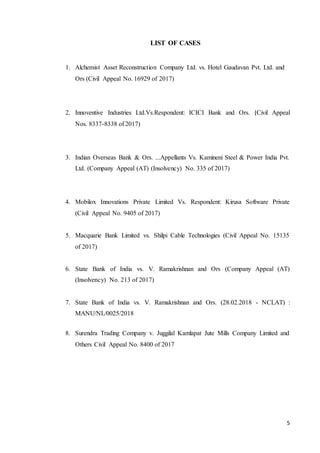
LIST OF CASES
1. Alchemist Asset Reconstruction Company Ltd. vs. Hotel Gaudavan Pvt. Ltd. and
Ors (Civil Appeal No. 16929 of 2017)
2. Innoventive Industries Ltd.Vs.Respondent: ICICI Bank and Ors. (Civil Appeal
Nos. 8337-8338 of 2017)
3. Indian Overseas Bank & Ors. ...Appellants Vs. Kamineni Steel & Power India Pvt.
Ltd. (Company Appeal (AT) (Insolvency) No. 335 of 2017)
4. Mobilox Innovations Private Limited Vs. Respondent: Kirusa Software Private
(Civil Appeal No. 9405 of 2017)
5. Macquarie Bank Limited vs. Shilpi Cable Technologies (Civil Appeal No. 15135
of 2017)
6. State Bank of India vs. V. Ramakrishnan and Ors (Company Appeal (AT)
(Insolvency) No. 213 of 2017)
7. State Bank of India vs. V. Ramakrishnan and Ors. (28.02.2018 - NCLAT) :
MANU/NL/0025/2018
8. Surendra Trading Company v. Juggilal Kamlapat Jute Mills Company Limited and
Others Civil Appeal No. 8400 of 2017
6
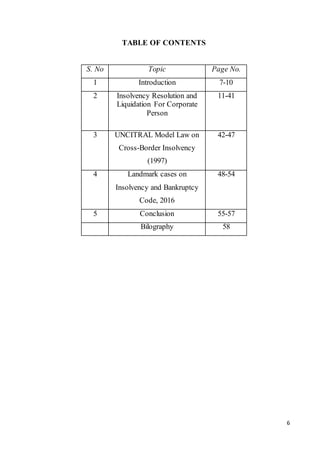
TABLE OF CONTENTS
S. No Topic Page No.
1 Introduction 7-10
2 Insolvency Resolution and
Liquidation For Corporate
Person
11-41
3 UNCITRAL Model Law on
Cross-Border Insolvency
(1997)
42-47
4 Landmark cases on
Insolvency and Bankruptcy
Code, 2016
48-54
5 Conclusion 55-57
Bilography 58
7
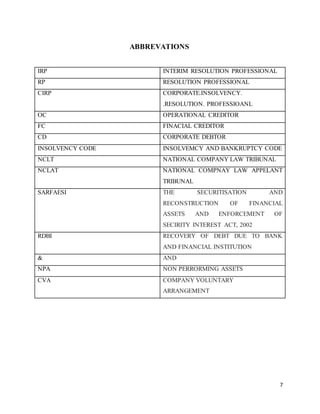
IRP INTERIM RESOLUTION PROFESSIONAL
RP RESOLUTION PROFESSIONAL
CIRP CORPORATE.INSOLVENCY.
.RESOLUTION. PROFESSIOANL
OC OPERATIONAL CREDITOR
FC FINACIAL CREDITOR
CD CORPORATE DEBTOR
INSOLVENCY CODE INSOLVEMCY AND BANKRUPTCY CODE
NCLT NATIONAL COMPANY LAW TRIBUNAL
NCLAT NATIONAL COMPNAY LAW APPELANT
TRIBUNAL
SARFAESI THE SECURITISATION AND
RECONSTRUCTION OF FINANCIAL
ASSETS AND ENFORCEMENT OF
SECIRITY INTEREST ACT, 2002
RDBI RECOVERY OF DEBT DUE TO BANK
AND FINANCIAL INSTITUTION
& AND
NPA NON PERRORMING ASSETS
CVA COMPANY VOLUNTARY
ARRANGEMENT
ABBREVATIONS
8
CHAPTER – 1
Introduction
Until 1985, the law to deal with corporate insolvency and bankruptcy consisted of only one law -
The Companies Act, 1956. On the recommendations of Bhabha Committee, the Companies Act,
1956 was enacted.
Bankruptcy of individual was dealt by two old laws - The Presidency Towns Insolvency Act,
1909 and The Provisional Insolvency Act, 1920. The Presidency Towns Insolvency Act, 1909
relates to individuals existing in the presidency towns—Calcutta, Bombay and Madras. The
Provisional Insolvency Act, 1920 dealt with all other individuals.
In 1980s, industrial sickness was reaching frightening propositions in many parts of India,
accompanied by massive downsizing, Government's tried towards the internal management of
sick industrial and nationalizing sick industries which proved futile.
Workmen's dues were rising, loan recovery was weak and unemployment was high. The
Companies Act 1956 was incapable of solving this issue. It was in this context that the first
legislative action to deal with insolvency and bankruptcy was promulgated in the form of The
Sick Industrial Companies Act, 1985 ("SICA"). SICA was an end product of reports by various
committees appointed by the Government and the Reserve Bank of India since 1975. These
included Tandon Committee of 1975, Rai Committee of 1976 and Tiwari Committee of 1981.
Unfortunately, SICA had several shortcomings, and abuse of Section 22 of SICA is often
highlighted as an example of the inherent deficiency in its provisions. Section 22 allowed
companies to seek a bar on proceedings for execution, arbitration, recovery suits, enforcement of
security interest etc. and was often misused by unscrupulous promoters
The reform process for legal framework related to insolvency and bankruptcy in the 1990s
started with the introduction of The Recovery of Debts Due to Banks and Financial Institutions
Act, 1993 ("RDDBI"). RDDBI Act was influenced by the findings of the Goswami Committee
that was working on proposed improvements to the regulatory framework for insolvency and
bankruptcy
9
RDDBI Act failed to make any improvements in the muddled insolvency landscape, primarily
due to the fact that SICA had precedence over RDDBI.
DRTs were found to be overburdened with a large number of pending cases considering these
impediments and with the intent to expedite resolution of nonperforming assets, the Government
introduced a new legislation called The Securitization and Reconstruction of Financial Assets
and Enforcement of Security Interest Act (SARFAESI) in 2002. The SARFAESI Act provided a
legal mechanism for expedited recovery of secured assets through empowering Banks and
Financial Institutions to recover their non-performing assets without intervention of the court.
Though SARFAESI did expedite the recovery process to some extent, its effect was limited to
secured assets.
To make Indian economy stable and developed, a single, comprehensive framework was needed
to effectively tackle delay in insolvency and bankruptcy proceedings. The process for a
comprehensive bankruptcy reform was initiated with the setting up of Financial Sector
Legislative Reforms Commission, led by Justice Srikrishna in 2011. In 2014, the Ministry of
Finance instituted the Bankruptcy Legislative Reforms Committee, led by T. K. Viswanathan.
The Viswanathan committee submitted a two-volume report in 2015. The economic rationale
and design features of a new legislative framework were covered in the first volume and the draft
bill was laid out in the second volume. A modified version of this bill, incorporating public
comments, was tabled in Parliament in late 2015. After the bill was tabled, a Joint Parliamentary
Committee was set up and the Joint Parliamentary Committee submitted its report which
included a new draft of the law that was passed in the form of the Insolvency and Bankruptcy
Code, 2016.”1
Before enactment of Insolvency and Bankruptcy Code the machinery to deal with debt recovery
was far behind from global standard. Even after having different laws because there were many
loopholes as we have discussed above. To remove all loopholes Indian government came with a
new comprehensive code, i.e. Insolvency and Bankruptcy Code, 2016.
1 Article The Indian Insolvency and Bankruptcy Bill: Sixty Years in the Making, Author Ashish Pandey
10
“This Code was introduced in Lok Sabha in 21 December 2015 and passed by Lok Sabha on 5
May 2016 and by the Rajya Sabha on 11 May 2016. The Code received the assent of the
President of India on 28 May 2016”2.
'I & B Code, 2016' is divided in three parts. Part I- 'Preliminary' including the definitions given
therein applies to both Part II 'Insolvency Resolution and Liquidation for Corporate Persons' and
Part III- 'Insolvency Resolution and Bankruptcy for Individuals and Partnership Firms'
“The main objective of this act is to consolidate and amend the laws relating to reorganization
and insolvency resolution in a time bound manner for maximization of value of assets of such
persons, to promote entrepreneurship, availability of credit and balance the interest of all the
stakeholder including changes in the order of priority of payment of government dues and the
most Important among all to establish an Insolvency and Bankruptcy Board of India.”3
“The salient features of this act are follows:
 To reduce Non Performing Assets (NPA) through speedy recovery process of debt.
 Two different methods for resolution of individuals, namely- “Fresh Start” and
“Insolvency Resolution”
 Debt Recovery Tribunal will act as an Adjudicating Authority under this act for
individual and partnership firm and National Company Law Tribunal to act as
Adjudicating Authority and deal with the cases related to insolvency, liquidation and
bankruptcy process in respect of companies and limited liabilities entities respectively.
 This Code mentioned two type of creditor i.e. Financial Creditor and Operational
Creditor
 This Code established the Insolvency and Bankruptcy Board of India to regulate
insolvency professionals, insolvency professional agencies etc.
 Insolvency professionals will handle the commercial aspects of insolvency resolution
process once the adjudicating authorities accept the application. Insolvency professional
agencies will develop professional ethics and code of conduct for insolvency professional
members.
2 PRS Bill track, Insolvency Bankruptcy Code, 2016
3 Insolvency and Bankruptcy Code, 2016
11
 This Code also deals with cross border insolvency.
This Code extends to whole of India only part three of this code will not apply to the State of
Jammu and Kashmir.
In relation to their insolvency, liquidation, voluntary liquidation or bankruptcy Section 2 of this
Code states that the provisions of this Code shall apply to any company incorporated under
Companies Act 2013, or previous company law and to any other company governed by any
special Act, this Code will also apply to Limited Liabilities Partnership incorporated under
Limited Liabilities Partnership Act, 2008; and to partnership firm and individuals.
In the case of Synergies-Dooray Automotive Ltd on 14 August 2017, the first insolvency
resolution order under this code was passed by National Company Law Tribunal (NCLT). The
plea for insolvency was submitted by company on 23 January 2017. The final order was
uploaded on 14 August 2017 on the NCLT website.
Let us understand the basic meaning of insolvency, bankruptcy and liquidation—
Insolvency refers to the inability of a person or corporate to pay up his debt /bills as and when
they become due. He may be able to pay at a later date some amount or even in full, but at the
promised date of payment, he is unable to make the payment.
“Insolvency leads to the state of default. Bereft of outright fraud, the default can happen due to
financial failure (as evidenced by “cash flow test”) or business failure (as determined by
“balance sheet test
“Bankruptcy is the next state of insolvency where an individual, company and partnership firm is
declared by the relevant authority under a specified law for the purpose, as incapable of paying
up his debt at any time in present as well as in the foreseeable future. Generally, failure of
resolution process leads to bankruptcy”
Liquidation is the winding up of a corporation or incorporated entity under the supervision of a
authorized person.”4
4 Ibid
12
CHAPTER - 2
Insolvency Resolution and Liquidation for Corporate Person
Insolvency and bankruptcy code provide procedure and manner to initiate corporate insolvency
resolution process, under this code IRP can be initiated by financial creditor, operational creditor
and corporate debtor.
Section 7, 9 and 10 of this code contain the provision to initiate Corporate Insolvency Resolution
Process. Now let us see the procedure mention under this Code related to insolvency and
Bankruptcy of Corporate person.
Part 2 of Insolvency and Bankruptcy Code deals with Insolvency Resolution and Liquidation of
Corporate Person .To initiate an insolvency process for corporate debtors, the default should be
at least one lakh rupees.
Following persons are authorized under this Code to initiate Corporate Insolvency Resolution
Process against Corporate Debtor i.e.
 Financial Creditor
 Operational Creditor
 Corporate Debtor itself
Following person are not authorized to file application for insolvency and bankruptcy
"A person shall not be eligible to submit a resolution plan, if such person5
 is an undischarged insolvent;
 is a wilful defaulter in accordance with the guidelines of the Reserve Bank of India issued
under the Banking Regulation Act, 1949;
 has an account, or an account of a corporate debtor under the management or control of
such person or of whom such person is a promoter, classified as non-performing asset in
accordance with the guidelines of the Reserve Bank of India issued under the Banking
Regulation Act, 1949 and at least a period of one year has lapsed from the date of such
5 Section 29(a) of Insolvency and Bankruptcy Code
13
classification till the date of commencement of the corporate insolvency resolution
process of the corporate debtor: Provided that the person shall be eligible to submit a
resolution plan if such person makes payment of all overdue amounts with interest
thereon and charges relating to non-performing asset accounts before submission of
resolution plan;
 has been convicted for any offence punishable with imprisonment for two years or more;
 is disqualified to act as a director under the Companies Act, 2013;
 is prohibited by the Securities and Exchange Board of India from trading in securities or
accessing the securities markets;
 has been a promoter or in the management or control of a corporate debtor in which a
preferential transaction, undervalued transaction, extortionate credit transaction or
fraudulent transaction has taken place and in respect of which an order has been made by
the Adjudicating Authority under this Code;
 has executed an enforceable guarantee in favour of a creditor in respect of a corporate
debtor against which an application for insolvency resolution made by such creditor has
been admitted under this Code;
 has been subject to any disability, corresponding to clauses (a) to (h), under any law in a
jurisdiction outside India;6
“Initiation of corporate insolvency resolution process by Financial creditor
A financial creditor either by itself or jointly with other financial creditors may file an
application for initiating corporate insolvency resolution process against a corporate debtor
before the National Company Law Tribunal (NCLT) when a default has occurred
Financial creditor along with application shall furnish record of default, name of resolution
professional proposed to act as an interim resolution professional
The adjudicating authority, within 14 days of the receipt of the application will find the existence
of a default from the record furnished by financial creditor, when adjudicating authority satisfied
that default has occurred and no disciplinary proceeding pending against the proposed resolution
professional then by order it may admit such application or if it find that default has not occurred
6 Section 29(a) of Insolvency and Bankruptcy Code
14
or the application is incomplete or disciplinary proceeding pending against proposed resolution
professionals then by order NCLT may reject the application but before rejecting the application
the adjudicating authority will give a notice to applicant to rectify the defect within 7 days.
Whether the application is accepted or rejected shall be communicated by the NCLT to the
financial creditor and the corporate debtor.”7
“Initiation of corporate insolvency resolution process by Operational creditor
"operational creditor" means a person to whom an operational debt is owed and includes any
person to whom such debt has been legally assigned or transferred; "operational debt" means a
claim in respect of the provision of goods or services including employment or a debt in respect
of the repayment of dues arising under any law for the time being in force and payable to the
Central Government, any State Government or any local authority;
There is very little difference between process of initiating application for insolvency resolution
between financial creditor and operational creditor
Operational creditor will deliver a demand notice on occurrence of default; with copy of an
invoice demanding payment of the amount involved in the default to the corporate.
The corporate debtor within a period of 10 days of the receipt of demand notice bring to the
notice of operational creditor that there is already existence of dispute suit is pending or the
payment can be made of operational debt
After the expiry of period of 10 days from the date of delivery of notice if operational creditor
does not received payment or notice of dispute then operational creditor can file an application to
adjudicating authority for initiation of insolvency resolution, application shall be filled with a
copy of invoice demanding payment or demand notice delivered to corporate debtor, an affidavit
with the declaration that no notice is being received from corporate debtor regarding payment of
debt or existence of dispute and with the certificate from financial institution that no payment is
made by corporate debtor.
Adjudicating authority within period of 14 days will either accept the application or reject the
application, provided that before rejecting application because of some error or because of
7 Section 7 of insolvency and Bankruptcy Code, 2016
15
incomplete application the operational creditor will get 7 days to remove that error. Once the
application is admitted the adjudicating authority shall communicate such decision to the
operational creditor and to the corporate debtor”8
“Initiation of corporate insolvency resolution process by Corporate Debtor
Where a corporate debtor has committed a default, a corporate applicant thereof may file an
application for initiating corporate insolvency resolution process with the Adjudicating Authority
Corporate applicant along with the application shall also furnish book of account and propose
interim resolution professional and after that adjudicating authority within period of 14 days of
the receipt of the application either accept the application if it is complete or reject it if it
incomplete.
Before rejecting application because of some error adjudicating authority will give 7 days to
corporate applicant to remove that defect”9
Next process-
“Adjudicating authority after admission of the application declare a moratorium and prohibit
institutions of suits or continuation of pending suits against the corporate debtor including
execution of any Judgment, degree or order in any court of law, tribunal, arbitration panel or
other authority”10 ;
and prohibit transferring, encumbering, alienating or disposing of by the corporate debtor any of
its assets or any legal right or beneficial interest therein and any action to foreclose, recover or
enforce any security interest created by the corporate debtor in respect of its property including
any action under the Securitization and Reconstruction of Financial Assets and Enforcement of
Security Interest Act, 2002; and prohibit the recovery of any property by an owner or lessor
where such property is occupied by or in the possession of the corporate debtor
8 Section 9, Insolvency and Bankruptcy Code, 2016
10Section 10, Insolvency and Bankruptcy Code, 2016
11 Section 13, Insolvency and Bankruptcy Code, 2016
16
The moratorium period shall have effect from the order till the completion of corporate
insolvency resolution process, provided that if during insolvency resolution process approve
resolution plan or approve liquidation of corporate debtor then moratorium shall cease to have
effect
A public announcement shall be made regarding initiation of insolvency resolution process and
invite people for submission of claim
The announcement shall contain the following information, namely:—
 name and address of the corporate debtor under the corporate insolvency resolution
process;
 name of the authority with which the corporate debtor is incorporated or registered;
 the last date for submission of claims;
 details of the interim resolution professional who shall be vested with the management of
the corporate debtor and be responsible for receiving claims;`
 penalties for false or misleading claims; and
 the date on which the corporate insolvency resolution process shall close, which shall be
the one hundred and eightieth day from the date of the admission of the application
The Adjudicating Authority shall appoint an interim resolution professional within fourteen days
from the insolvency commencement date
If the application for insolvency resolution process is submitted by financial creditor or corporate
debtor then the name proposed by them for interim resolution professional will be appointed as a
IRP if no disciplinary action pending against him.
For operational creditor it is not mandatory to proposed name of interim resolution professional
therefor if they does not proposed name then Adjudicating Authority shall make a reference to
Board for recommendation of insolvency professional who may act as interim resolution
professional, Board will recommend name of Interim resolution professional within 10 days from
the date of reference made by Adjudicating Authority.
Interim resolution professional shall only be appointed for maximum 30 days, a person cannot
remain IRP for more than 30 days
17
From the date of appointment Interim resolution professional shall vest with various
powers
 the management of the affairs of the corporate debtor shall vest in the interim resolution
professional;
 the powers of the board of directors or the partners of the corporate debtor, shall stand
suspended and be exercised by the interim resolution professional;
 the officers and managers of the corporate debtor shall report to the interim resolution
professional and provide access to such documents and records of the corporate debtor as
may be required by the interim resolution professional;
 the financial institutions maintaining accounts of the corporate debtor shall act on the
instructions of the interim resolution professional in relation to such accounts and furnish
all information relating to the corporate debtor available with them to the interim
resolution professional.
 act and execute in the name and on behalf of the corporate debtor all deeds, receipts, and
other documents, if any;
 take such actions, in the manner and subject to such restrictions, as may be specified by
the Board;
 have the authority to access the electronic records of corporate debtor from information
utility having financial information of the corporate debtor;
 have the authority to access the books of account, records and other relevant documents
of corporate debtor available with government authorities
“Duties of Interim Resolution Professional”11
Collect all information relating to the assets, finances and operations of the corporate debtor for
determining the financial position of the corporate debtor, including information relating to—
 business operations for the previous two years;
 financial and operational payments for the previous two years;
11 Section 18 of Insolvency and Bankruptcy Code, 2016
18
 list of assets and liabilities as on the initiation date; and
Receive all the claims submitted by creditors to him, pursuant to the public announcement
Constitute a committee of creditors;
Monitor the assets of the corporate debtor and manage its operations until a resolution
professional is appointed by the committee of creditors;
File information collected with the information utility, if necessary; and
Take control and custody of any asset over which the corporate debtor has ownership rights as
recorded in the balance sheet of the corporate debtor, or with information utility or the depository
of securities or any other registry that records the ownership of assets including—
 assets over which the corporate debtor has ownership rights which may be located in
a foreign country;
 assets that may or may not be in possession of the corporate debtor;
 tangible assets, whether movable or immovable;
 intangible assets including intellectual property;
 securities including shares held in any subsidiary of the corporate debtor, financial
instruments, insurance policies;
The interim resolution professional shall make every endeavour to protect and preserve the value
of the property of the corporate debtor and manage the operations of the corporate debtor as a
going concern. For this purpose insolvency resolution professional shall have following power
a) to appoint accountants, legal or other professionals as may be necessary;
b) to enter into contracts on behalf of the corporate debtor or to amend or modify the
contracts or transactions which were entered into before the commencement of
corporate insolvency resolution process;
c) to raise interim finance provided that no security interest shall be created over any
encumbered property of the corporate debtor without the prior consent of the creditors
whose debt is secured over such encumbered property: Provided that no prior consent
19
of the creditor shall be required where the value of such property is not less than the
amount equivalent to twice the amount of the debt.
d) to issue instructions to personnel of the corporate debtor as may be necessary for
keeping the corporate debtor as a going concern; and
e) to take all such actions as are necessary to keep the corporate debtor as a going
concern
One of the most important function of Interim resolution professional after receiving all claims
and after determining financial position is to constitute a committee of creditors, The committee
of creditors shall comprise all financial creditors of the corporate debtor:
The first meeting of the committee of creditors shall be held within seven days of the constitution
of the committee of creditors
The committee of creditors may in the first meeting, by a majority vote of not less than seventy-
five per cent of the voting share of the financial creditors, either appoint the interim resolution
professional as a resolution professional or to replace the interim resolution professional by
another resolution professional.
If they appoint interim resolution professional as a resolution professional then they will
communicate this decision to interim resolution professional, Adjudicating Authority and to
corporate debtor.
If they proposed to replace interim resolution professional with new resolution professional then
committee of creditor shall file an application to Adjudicating Authority to appoint proposed
resolution professional
Once the appointment of resolution professional is confirmed the resolution professional shall
conduct the entire corporate insolvency resolution process and manage the operations of the
corporate debtor during the corporate insolvency resolution process period, committee of creditor
can replace resolution professional with a new resolution professional during the period of
resolution period through the same manner as they elected the first resolution professional
The resolution professional shall have all the power and duties as interim resolution professional
possessed.
20
Resolution professional shall take prior approval of committee of creditor to take following
decisions12
 raise any interim finance in excess of the amount as may be decided by the committee of
creditors in their meeting;
 create any security interest over the assets of the corporate debtor;
 change the capital structure of the corporate debtor, including by way of issuance of
additional securities, creating a new class of securities or buying back or redemption of
issued securities in case the corporate debtor is a company;
 record any change in the ownership interest of the corporate debtor;
 give instructions to financial institutions maintaining accounts of the corporate debtor for
a debit transaction from any such accounts in excess of the amount as may be decided by
the committee of creditors in their meeting;
 undertake any related party transaction;
 amend any constitutional documents of the corporate debtor;
 delegate its authority to any other person;
 dispose of or permit the disposal of shares of any shareholder of the corporate debtor or
their nominees to third parties;
 make any change in the management of the corporate debtor or its subsidiary;
 transfer rights or financial debts or operational debts under material contracts otherwise
than in the ordinary course of business;
 make changes in the appointment or terms of contract of such personnel as specified by
the committee of creditors; or
 make changes in the appointment or terms of contract of statutory auditors or internal
auditors of the corporate debtor.
Resolution professional shall prepare an information memorandum that contain relevant
information which is required for resolution plan and resolution applicant shall have all the
access of relevant information which is required to make resolution plan.
12 Insolvency and bankruptcy code, 2016
21
Resolution applicant will prepare resolution plan and submit it to resolution professional and
resolution [professional will examine the resolution plan and after examine present it before
committee of creditor for approval and the committee of creditors may approve a resolution plan
by a vote of not less than seventy five per cent. of voting share of the financial creditor, once it is
approved by resolution professional then it will be submitted to adjudicating authority and if
adjudicating authority satisfy with the resolution plan then it may approve the plan.
Approval order shall be binding on the corporate debtor and its employees, members, creditors,
guarantors and other stakeholders involved in the resolution plan. After the order of approval of
resolution, moratorium order passed by the Adjudicating Authority under this code shall cease to
have effect; and the resolution professional shall forward all records relating to the conduct of
the corporate insolvency resolution process and the resolution plan to the Board to be recorded
on its database.
Liquidation Process13
Section 33 of the Code given the circumstances under which liquidation order in respect of the
corporate debtor shall be passed by the adjudicating authority, The circumstances are:
(i) Resolution plan is not received by the adjudicating authority from resolution
professional No resolution plan is received by the adjudicating authority from the
resolution professional before the expiry of the insolvency resolution
(ii) When the resolution plan received by the adjudicating authority from the resolution
professional fails to comply with the requirements of section 31;
(iii) The committee of creditors, decides to liquidate the corporate debtor at any time
before the confirmation of a resolution plan during the corporate insolvency
resolution period, , and the same is intimated by the resolution professional to the
adjudicating authority
(iv) The corporate debtor contravenes the resolution plan approved by the adjudicating
authority, and any person other than the corporate debtor prejudicially affected by
such contravention makes an application to the adjudicating authority for a
liquidation order in respect of the corporate debtor, and the adjudicating authority
13 Section 33 of insolvency and Bankruptcy Code, 2016
22
determines that the corporate debtor has contravened the provisions of the resolution
plan.
Moratorium will imposed
After passing of liquidation process, the moratorium shall commence. As such, no suit or
other legal proceeding shall be instituted by or against the corporate debtor. However, a suit
or other legal proceeding may be instituted by the liquidator, on behalf of the corporate
debtor, with the prior approval of NCLT. Important to note is that the moratorium provisions
do not affect the rights of secured creditor as envisaged under section 52.
Announcement to public
A public announcement will be made that the corporate debtor is in liquidation has to be
issued.
“Appointment of liquidator”14
‘Section 34 deals with the appointment of liquidator and fee to be paid to him. The resolution
professional appointed for the corporate insolvency resolution process shall act has liquidator
unless replaced by NCLT. The fee to the liquidator shall be paid from the proceeds of the
liquidation estate. Section 35 deals with powers and duties of the liquidator, and section 37
empowers the liquidator to access any information systems for the purpose of admission and
proof of claims and identification of the liquidation estate assets relating to the corporate
debtor from various sources’15.
Priority of payment after liquidation
 After the sale of the liquidation assets it shall be distributed in the following order of
priority
 The insolvency resolution process costs and the liquidation costs paid in full;
 Workmen's dues for the period of twenty-four months preceding the liquidation
commencement date; and debts owed to a secured
14 Section 34 of Insolvency and Bankruptcy Code, 2016
15 Section 34 of Insolvency and Bankruptcy Code, 2016
23
 Wages and any unpaid dues owed to employees other than workmen for the period of
twelve months preceding the liquidation commencement date;
 Financial debts owed to unsecured creditors;
 Any debt of Central Government and State Government including the amount to be
received on account of the Consolidated Fund of India and the Consolidated Fund of a
State, if any, in respect of the whole or any part of the period of two years preceding the
liquidation commencement date;
 Any other dues
 Preference shareholders and at last equity shareholder or partner
Fast Track Corporate Insolvency Resolution Process
A corporate insolvency resolution process carried under chapter 4 of Insolvency and Bankruptcy
Code shall be called as fast track corporate insolvency resolution process. An application for fast
track corporate insolvency resolution process may be made in respect of the following corporate
debtors, namely:—
A corporate debtor with assets and income below a level as may be notified by the Central
Government
A corporate debtor with such class of creditors or such amount of debt as may be notified by the
Central Government
The fast track corporate insolvency resolution process shall be completed within a period of
ninety days from the insolvency commencement date, in certain special circumstances it can be
extended but not more than 45 days.16
An application for fast track corporate insolvency resolution process may be filed by a creditor
or corporate debtor with the proof of the existence of default as evidenced by records available
with an information utility.
16 Section 55 and 56 of Insolvency and Bankruptcy Code, 2016
24
Insolvency and Bankruptcy Process of Corporate Debtor in Other Countries
Insolvency Laws Related to Companies in England
In UK, till 1985, the law for managing with bankruptcy was contained in the UK Companies Act
but In 1986 after the suggestions of the Insolvency Law Review Committee, led by Sir Kenneth
Cork, the Insolvency Act, 1986 was enacted. This Act consolidated all the provision of
insolvency law in single statue.
The provision of companies act was more focused on liquidation but this act introduces many
provisions which help in reorganization of companies. This act was amended many time in 1994,
2000, and in 2002.
The corporate insolvency process may be started by the following parties
The directors or shareholders can apply for insolvency process if they company is insolvent or it
is about to become insolvent. They can also appoint administrator or they can liquidate a
company by corporate voluntary liquidation or they can suggest financial creditor to appoint
administrator or receiver
A creditor can also apply for the liquidation in court; this is also known as compulsory
liquidation
A debenture holder for example bank, or other creditor, which has given some advances to bank
then it can appoint administrator or administrator receiver if they feel that it will be difficult to
get there payment from company
Government can also apply
There are five categories of insolvency procedure for companies in England,
Company Voluntary Arrangement (CVA)
• Administration
• Administrative Receivership
• Creditors’ Voluntary Liquidation (CVL)
25
• Compulsory Liquidation (winding up by the court)
Company Voluntary Arrangement (CVA)
A company voluntary arrangement is a procedure which enables a company to put a proposal to
its creditors for a composition in satisfaction of its debts or a scheme of arrangement of its
affairs. A composition is an agreement under which creditors agree to accept a certain sum of
money in settlement of the debts due to them. The procedure is extremely flexible and the form
which the voluntary arrangement takes will depend on the terms of the proposal agreed by the
creditors. For example, a CVA may involve delayed or reduced payments of debt, capital
restructuring or an orderly disposal of assets. The proposed arrangement requires the approval of
at least 75% in value of the creditors, and once approved is legally binding on the company and
all its creditors, whether or not they voted in favour of it. There is limited involvement by the
court, and the scheme is under the control of a licensed insolvency practitioner acting as a
supervisor. The CVA procedure was introduced by the Insolvency Act 1986 and was designed
primarily as a mechanism for business rescue. The procedure is also often used instead of
liquidation as a means of distributing funds on the conclusion of (and, occasionally, during) an
administration.
Administration
Administration is a procedure available to a company that is insolvent, or is likely to become so,
which places the company under the control of an insolvency practitioner and the protection of
the court with the following objectives: • rescuing the company as a going concern • achieving a
better result for the creditors as a whole than would be likely if the company were wound up
without first being in administration or, if the administrator thinks neither of these objectives is
reasonably practicable
Administrative receivers
Administrative receivers are normally appointed by a bank or other lending institution which has
as security for a loan, of a company’s property. This is often abbreviated simply to receivership.
26
The ability to appoint normally arises when the company is in default or in breach of the terms of
its borrowing.
Procedure of Insolvency
In insolvency process, assets will be controlled by the debtor, rests with the licensed insolvency
practitioner, but In case of voluntary arrangements control of assets will remain with company.
The insolvency practitioner may in some cases also exercise control over the business. After the
assets of company become available then that will be distributed in order of priority.
Any individual or organization holding fixed charge security over a company’s assets will be
paid first, after the cost is realized.
Next one is preferential creditors, which include mainly of employees’ arrears of wages and
holiday pay.
Next one is holders of floating charge securities
Next are unsecured creditors to the extent that they are not discharged as above. In insolvency
cases this may result in a percentage return by way of dividend or possibly no return at all for
this class of creditor, depending on the realizations and classes of creditor making a claim in the
proceedings. Shareholders will come last in the priority list.
Procedure For Compulsory Liquidation Of Companies In England
Application can be filled by the creditor on the ground of insolvency of company. Company can
also file application for insolvency or shareholders are also entitled to file application. If
application is filled it will be published in gazette
Then Court will pass winding up order.
Official receiver will become liquidator after the winding up order. Liquidator is responsible to
investigate companies details and sent it to creditor and advertise order in appropriate newspaper
and the official receiver may call meeting of creditor to appoint a new liquidator in his place
27
Creditors’ meeting Convened by the official receiver within four months of the winding-up
order. Liquidator is appointed by a straight majority, in value, of the creditors. Meeting may also
establish liquidation committee.
It is the duty of official receiver to realize assets. Check creditors’ claims and distribute money
by way of dividend and he is also responsible to call last meeting of creditor.
Provision of Indian Insolvency and Bankruptcy Law Which Has BeenAdopted From UK
Insolvency Law
Power Given To Creditor
Before enactment of Insolvency and Bankruptcy Code the debtor had the more power to control
the process of insolvency but this new code has changed the concept and now committee of
creditor control the resolution process. Now creditor can also file an application to adjudicating
authority for insolvency and bankruptcy of company if the companies are not paying its debt.
This concept is being taken from UK insolvency law, UK provide great protection to its financial
institution.
Professionals Will Controll The Management Of Company
During insolvency resolution process the control of company is vested to resolution professional,
this is also taken from UK insolvency law where professional deal with insolvency resolution
process of companies
Declaration of Moratorium
If the adjudicating authority accepted the application for insolvency resolution process than from
the date of accepting application the moratorium will be declared and as per the provision of the
code during moratorium period no suit can be initiated against the company, this provision is
also been adopted from UK insolvency law.
Priority in Payment
The Insolvency and Bankruptcy Code has given the provision that payment shall made in priority
basis this method is already in existence in UK insolvency law, during the liquidation of the
company. Depend on the vote of the committee of creditors, or when committee of creditor fail
to submit resolution plan within time period then liquidation process started. All the assets which
28
is held by the company are recovered during process of liquidation and it will be distributed by
the liquidator in strict sense of priority
“Insolvency and Bankruptcy law in USA
In the United States, the Bankruptcy Code is simply a federal law which protects creditors and
debtors.
In the United States, the term “insolvency” is not used; rather the Bankruptcy Code encompasses
all the statutory provisions on both personal bankruptcy and corporate insolvency.
The main law that governs insolvency proceedings and restructuring in the United States is the
Bankruptcy Code, which is codified as Title 11
People considered it as a debtor friendly but It is neither creditor friendly nor it is debtor friendly
but it maintain fare balance among both
It is different thing that the United States is mainly referred as debtor friendly country in case of
bankruptcy process but it is purely balance. The debtor control the possession of property under
Chapter 11 i.e., it remain under the control of its existing management), and for an initial period
debtor is having exclusive power to propose a plan of reorganization, is a the main reason that
the United States bankruptcy law is called as debtor friendly. In addition, the Bankruptcy Code
provides several tools that promote a fresh start, such as automatic stay, discharge and the ability
to cram down creditors and equity interest holders. However, balancing the powers of the debtor
is the protection of a creditor’s rights under the code, including through:
 Priority of distributions to creditors and maintain equality of distributions to similarly
situated creditors;
 Giving importance to agreement
 Debtor’s exclusive right to propose a plan is limited.
Article 1, Section 1, Clause 4 of the United States Constitution authorizes the Congress of the
United States to establish uniform laws concerning bankruptcy. In 1800, the U.S. Congress first
29
exercised its power under the Constitution and established the first bankruptcy law of the United
States. Since 1800, Congress has enacted different bankruptcy laws. Title 11 of the Code of the
United States is better known as the United States Bankruptcy Code (hereafter referred to as the
"Bankruptcy Code").17
“The Automatic Stay (Injunction): Section 362(a) permits a debtor a brief reprieve from the
actions of its creditors. Upon the commencement of a bankruptcy case, and without the necessity
of a formal order of the Bankruptcy Court, Section 362 of the Bankruptcy Code provides for an
automatic stay or injunction against acts of or by creditors against the debtor. The automatic stay
automatically stays numerous types of acts which creditors may take against the debtor; seven of
those automatically stayed are
 the commencement or continuation of judicial or administrative proceedings against the
debtor based on a claim which exists against the debtor prior to the commencement of the
bankruptcy proceedings [Section 362(a)(1)];
 the enforcement of a judgment contained prior to the commencement of the bankruptcy
case against the debtor or against property of the debtor [Section 362(a)(2)];
 any act to obtain possession or control over property of the debtor [Section 362(a)(3)];
 any act to create, perfect or enforce any lien against property of a debtor [Section
362(a)(4)];
 any act to collect or recover a claim against the debtor that arose prior to the
commencement of the bankruptcy case [Section 362(a)(6)];
 the set off of any debt owing to a debtor that arose prior to the commencement of the
bankruptcy proceeding [Section 362(a)(7)]; and
 the commencement or continuation of a proceeding before the United States Tax Court
[Section 362(a)(8)]. Section 362(b) excludes 17 acts from the provisions of the automatic
stay (injunction) covered under 362(a). Of the 17 acts which are not subject to the
automatic stay provisions, two (2) of the more important ones are: (1) criminal
proceedings against the debtor [Section 362(b)(1)] and (2) the commencement or
continuation of a proceeding for the collection of alimony, maintenance, or support
[Section 362(b)(2)]. In addition to accepting certain acts in the provisions of the
17 U.S. Bankruptcy/Insolvency Laws and foreign Proceedings, Author Rodolfo Pittaluga, Jr
30
automatic stay, the Bankruptcy Code also allows for the modification, termination, or
annulment of the automatic stay provisions under certain conditions. One such example
under which the automatic stay provisions may be modified, terminated, or annulled, is if
a bankruptcy petition is filed in "bad faith.”18
“Types of Bankruptcies in US: In general, there are two types of bankruptcies: (i) Liquidation
(Chapter 7) and (ii) Reorganization (Chapter 11).
“Liquidation (Chapter 7): In General, A Brief Overview: Chapter 7 of the
Bankruptcy Code is entitled "Liquidations." The majority of all bankruptcy cases
filed in the United States are Chapter 7 liquidations. In a Chapter 7 case, a trustee
(fiduciary) is automatically appointed by the Bankruptcy Court and is the person
responsible for collecting the non-exempt assets of the debtor, converts those
assets to cash, and distributes the cash to the creditors and shareholders of the
debtor in accordance with the distribution scheme set forth in the Bankruptcy
Code.
Section 109 (b) of the Bankruptcy Code provides that all "persons" can be debtors
under Chapter 7 provided they are not (1.) a railroad [Section 109(b)(1)]; (2) a
domestic insurance company, (3) bank or similar institution which is an insured
bank as defined in Section 3(h) of the Federal Deposit Insurance Act; or (4) a
foreign insurance company, bank, or credit union engaged in such business in the
United States [Section 109(b)(3)].
An example: a foreign corporation doing business in the United States is
ineligible to be a "debtor" under the Bankruptcy Code. However, if that foreign
corporation is not conducting business in the United States, but maintains a bank
account in the United States, then that foreign corporation is eligible to be a
debtor under Chapter 7 of the Bankruptcy Code.
Distributions to Creditors
18 Ibid
31
a) Secured Creditors: a creditor, which has a properly perfected lien against assets
of a debtor, is more commonly referred to as a "secured creditor" of the debtor
and that creditor is entitled to the proceeds from the liquidation of that collateral
or the collateral itself.
b) General Unsecured Creditors: Section 726 of the Bankruptcy Code governs the
manner in which proceeds form the liquidation of the sale of the debtors non-
exempt assets are to be distributed to general unsecured creditors.
That section requires that unless all creditors are to be paid in full, the proceeds
from the liquidation of the debtor's non-exempt assets are to be distributed in a
pro rata (proportional) manner.
At the same time, Section 726 provides that certain general unsecured creditors
have priority in terms of distribution and requires that those creditors be paid prior
to such time as other unsecured creditors are paid. Section 507 of the Bankruptcy
Code lists those general unsecured creditors that have priority, and those include:
1.) Administrative Claim Creditors, including those claims which arise during the
liquidation of the debtor's estate.
2.) Fees and Commissions to employees of the debtor earned during the 90 days
immediately preceding the filing of the bankruptcy which claims are not to exceed
the sum of $4,300 per individual [Section 507(a)(3)];
3.) Allowed Unsecured claims of individuals arising from the deposit of money in
connection with the purchase, lease or rental of personal property not delivered or
provided for, not to exceed the sum of $1,950 for each individual asserting such a
claim [Section 507(a)(6)]; and
4.) Certain unsecured tax claims of governmental units incurred prior to the
bankruptcy [Section 507(a)(8)].”19
19 Ibid
32
“Reorganizations (Chapters 9, 11, 12 and 13):
In General: Chapters 9, 11, 12 and 13 of the Bankruptcy Code address
reorganization by certain types of debtors. In reorganization cases, creditors look
to the debtor's future income to satisfy their claims. In most of these cases, the
debtor retains control and possession over its assets and pays its creditors based
upon future income.
All individuals, partnerships and corporations which may be debtors under
Chapter 7, with the exception of a stockbroker, commodity broker and railroad,
are eligible to be debtors under Chapter 11. The typical Chapter 11 case involves
a commercial enterprise.
Chapter 11: The typical Chapter 11 case involves the reorganization of a
commercial debtor and has five (5) stages.
a) The Commencement of the Case: A Chapter 11 case is commenced with the
filing of a bankruptcy petition under Chapter 11 with the Bankruptcy Court. The
petition may be voluntary or involuntary. (Sections 301 and 303).
b) Operation of the Debtor's Business: A successful reorganization of a
commercial enterprise generally requires that the debtor continue with the
operation and management of the debtor's affairs and business. In the majority of
the cases under Chapter 11, the debtor continues to operate the business and
manages its affairs on a day-to-day basis. [Section 1107(a)]. However, in certain
cases, the Bankruptcy Court, after notice and hearing and for "cause" (which
includes fraud, gross mismanagement or incompetence by debtor's management),
may appoint a trustee or an examiner to operate the business of the debtor.
[Section 1104(a)].
c) Formulation of the Plan of Reorganization: The principal document in a
Chapter 11 case is the Plan of Reorganization. The plan lists, among other things,
the claims that exist against the debtor and establishes the manner in which those
claims will be paid or satisfied.
33
Section 1123(a) specifies the elements which a plan must contain and Section
1123(b) specifies those elements that a plan may contain. If the court does not
appoint a trustee, then during the first 120 days after the filing of the bankruptcy
petition, the only person which may formulate and file a Plan or Reorganization is
the debtor. [Section 1121(b)]. If the debtor files its Plan of Reorganization in
those 120 days, no other plan may be filed during the next 60 days.
Thus, during the first 180 days of the case, the debtor is typically the only entity
which has the right to formulate, file, and negotiate the terms of a Plan or
Reorganization.
However, the Bankruptcy Court does have the power to reduce or extend the 120
day and 180 day time periods previously mentioned. However, if the court does
name a trustee, or if the debtor fails to file its Plan or Reorganization within the
first 120 days after the filing of the bankruptcy petition, any party of interest may
file a Plan of Reorganization with the court. [Section 1121(b)].
d) Acceptance of the Plan: In the majority of cases, after the plan has been filed
with the Bankruptcy Court, the plan proponent must obtain the acceptance of the
plan by the creditors and shareholders of the debtor entity.
However, before the plan proponent may solicit acceptance of the plan, the plan
proponent must provide to creditors and shareholders of the debtor with a copy of
the plan and a disclosure statement which must contain "adequate information" as
provided for in the Bankruptcy Code. (Section 1125).
e) Confirmation of the Plan: The acceptance of the plan by all creditors and
shareholders does not necessarily guarantee that the Bankruptcy Court will
confirm or approve the plan of Reorganization. Section 1129 of the Bankruptcy
Code establishes the requirements for confirmation of a plan.
Two of the more important requirements are 1) the plan must be in the "best
interest" of the creditors. In order to satisfy this test, the distributions to be made
to creditors in a Chapter 11 plan must be no less than the amount that creditors
34
would receive in the event that the debtor were to be liquidated and distributions
were to be made under a Chapter 7 proceedings. [Section 1129(a)(7)].
In addition, the plan must also be "fair and equitable" - the plan may not unfairly
discriminate against similarly situated creditors. [Section 1129(b)(2)]. More
importantly, the effect of confirmation of a plan discharges the debtor of all of its
debts that exist up to the date of confirmation and requires all creditors to comply
with the terms and conditions of the plan, including those creditors which may
have voted against the plan. [Section 1141(a)].”20
“Recognition Of Foreign Bankruptcy Proceedings
The International Problem with the ever increasing expansion in technology, many corporations
have extended their operations and markets overseas. This expansion into foreign markets has
resulted in the creation of many multinational corporations and has required that these
corporations maintain assets in many foreign countries. This situation has presented a unique and
difficult problem within the international bankruptcy arena; mainly, what legal affect, if any,
shall be given to foreign bankruptcy proceedings
Section 304 of the Bankruptcy Code In 1978, the Congress of the United States presented new
legislation, Section 304 of the Bankruptcy Code. This section is not only an acknowledgment by
the United States of the existence and validity of foreign bankruptcy proceedings, but is at the
same time an attempt to assist in the administration of those foreign bankruptcy proceedings
where assets of the foreign debtors are located in the U.S. Section 304 permits a "foreign
representative" of a debtor to file a petition under Section 304 with the bankruptcy court to
obtain orders to assist in the administration of those foreign bankruptcy proceedings. Cunard S.S.
Co. v. Salen Reefer Services A.B., 773 F.2d 452 (2d Cir. 1985) and In Re: Gee, 53 BRA 91
(Bankrtcy. 7th Dist. NY 1995).
Examples where Section 304 petitions may be of benefit include cases where it is necessary to
administer assets of a foreign debtor which has assets located within the United States, enjoining
legal actions pending in the United States against the debtor or property of the debtor, and obtain
20 Ibid
35
necessary assistance by the courts in the U.S. in the administration of the foreign bankruptcy
proceeding.”21
“Insolvency law and procedure in Bankruptcy Reform Act of 1978 (Singapore)
Corporate insolvency in Singapore is primarily governed by the Companies Act, which is
supplemented by the Companies (Winding-Up) Rules and the Companies Regulations. Certain
provisions of the Bankruptcy Act also apply to corporate insolvency in Singapore and the
Bankruptcy Rules are also relevant.
Apart from the general corporate insolvency provisions, Singapore has also provided for
industry-specific insolvency or winding-up rules for certain industries, including the banking
industry. These rules will apply to the relevant industry in addition to the insolvency provisions
under general company law.
Singapore’s insolvency laws have undergone substantial reformation following the Ministry of
Law’s appointment in December 2010 of the Insolvency Law Review Committee (ILRC) to
review Singapore’s existing personal bankruptcy and corporate insolvency regime and to provide
recommendations in relation to a new omnibus Insolvency Act.
In May 2017, the Companies Act was amended to implement significant changes to Singapore’s
insolvency regime with the stated objective of attracting more foreign debtors to restructure their
debts in Singapore, thereby positioning Singapore as an international centre for debt
restructuring. The scope of existing insolvency and pre-insolvency processes have not only been
widened and enhanced; familiar features from leading insolvency regimes worldwide, such as
the United States Title 11 debtor-in-possession regime, have also been adapted and incorporated.
“The Companies Act provides for a range of insolvency and reorganisation options for
companies in distress, namely: liquidation, judicial management and receivership, as well as
schemes of arrangement between companies and their creditors and shareholders
In October 2013, the ILRC issued a report (the ILRC Report), endorsing the enactment of a new
Insolvency Act and setting out various recommendations on the provisions of the new
Insolvency Act. The recommendations by the ILRC included proposals to enhance the existing
21 Ibid
36
insolvency and reorganisation mechanisms as well as the management of cross-border
insolvency issues.
Subsequently, the Committee to Strengthen Singapore as an International Centre for Debt
Restructuring (DRC) was established and issued its recommendations on 20 April 2016. Both the
ILRC’s and the DRC’s recommendations were eventually broadly accepted by the Singapore
government, culminating in some of the more significant amendments to the Companies Act in
May 2017, which include:”22
“Insolvency procedures
Liquidation is also referred to as ‘winding up’. There are two types of winding up currently
provided for under Singapore law: compulsory winding up (or winding up by the court) and
voluntary winding up (consisting of creditors’ voluntary winding up or members’ voluntary
winding up)
The objective of compulsory winding up is to realise a company’s assets and distribute them to
creditors in order of priority. Any company can be compulsorily wound up, regardless of
whether it is registered in Singapore, provided that it has some connection with Singapore and
meets the relevant criteria under the Companies Act. For example, a foreign company may be
wound up under the amended Companies Act if the creditor can demonstrate that the company’s
centre of main interests is in Singapore or that the company has substantial assets in Singapore.
On the other hand, the objective of a creditors’ voluntary winding up is to wind up a company
without reference to the courts. Any company registered in Singapore can be wound up in this
way. In a creditors’ voluntary winding up, the creditors have the right to nominate the liquidator.
If the creditors do not nominate a liquidator, the liquidator will be nominated by the company
The objective of a members’ voluntary winding up is to wind up a company when its
shareholders no longer wish it to continue in business (usually in a ‘deadlock’ scenario), to pay
all the company’s creditors in full and to distribute any surplus to the shareholders. Members’
voluntary winding up can only be effected when the company is solvent. The company has the
right to appoint the liquidator in a members’ voluntary winding up
22 Insolvency review (edition 5), Author Donald S Bernstein
37
Provisional liquidation
A provisional liquidator will be appointed by the High Court (the Court) pending determination
of the winding-up application if the applicant can demonstrate a prima facie case for the granting
of a winding-up order and the Court is satisfied in the circumstances of the case that a
provisional liquidator should be appointed.
The provisional liquidator is obliged to preserve the status quo so as to protect the company’s
assets. A provisional liquidator’s powers are prescribed by the court order appointing him or her
Upon the making of a winding-up order or the appointment of a provisional liquidator, all the
property of the company vests in the liquidator (or the provisional liquidator as the case may
be)23
“Judicial management
A company or its creditors may apply to the Court for an order that the company be placed under
judicial management if: the company is or is likely to become unable to pay its debts; and there
is a reasonable probability of rehabilitating the company or of preserving all or part of its
business as a going concern or that otherwise the interests of creditors would be better served
than by resorting to a winding up.
Any company, including foreign companies, can be placed under judicial management provided
that the Court is satisfied that the company is or is likely to become unable to pay its debts, and it
considers that the making of the judicial management order would be likely to achieve one or
more of the following purposes:
 the survival of the company, or the whole or part of its undertaking as a going concern;
 the approval under Sections 210 or 211I of the Companies Act of a compromise or
scheme of arrangement; or
 a more advantageous realization of the company’s assets than would be effected on a
winding up
23 Ibid
38
The judicial manager has the power to manage the business and property of the company. In
addition, during the period for which a judicial management order is in force:
 the company cannot be wound up;
 no receiver and manager of the whole of the company’s property can be appointed;
 there is a moratorium on legal proceedings against the company; and
 no security can be enforced against the company’s property except with the consent of
the judicial manager or with leave of the court.
An interim judicial manager may be appointed by the court pending determination of the judicial
management application if: the applicant can demonstrate a prima facie case for the granting of a
judicial management order; and the Court is satisfied in the circumstances of the case that an
interim judicial manager should be appointed.
Judicial management has become less popular as a corporate rescue mechanism in recent years,
as creditors are often wary of replacing a company’s management with individuals who are not
necessarily as familiar with the business
Receivership
The Court may order the appointment of a receiver or a receiver and manager in ‘all cases in
which it appears to the Court to be just and convenient’.The Court has relatively wide discretion
to make such appointments and usually does so where there is genuine concern that the
company’s assets are in jeopardy and may be dissipated to the detriment of the debenture
holders.
Often, a secured creditor may also enforce its security rights against the debtor company by
appointing a receiver, or a receiver and manager. The receiver’s primary duty is to realise the
assets for the benefit of the secured creditors that appointed him or her, or in the case of the
receiver and manager, to manage and realize the assets that come within the ambit of his or her
appointment.”24
24 Ibid
39
“Schemes of arrangement
A scheme of arrangement is often used as a means of corporate rescue. A scheme of arrangement
is a binding arrangement between the company and its creditors or shareholders, which may
among other things, seek to compromise the company’s debts and liabilities.
A scheme of arrangement is binding on all creditors or class of creditors or shareholders or class
of shareholders, as the case may be, if:
 a a majority in number representing three-quarters in value of those creditors or class of
creditors or shareholders or class of shareholders agrees to the scheme of arrangement
and if the Court approves the scheme of arrangement; or
 b a majority in number and representing three-quarters in value of the creditors meant to
be bound by the scheme of arrangement have agreed to the scheme of arrangement, and
the Court is satisfied that the compromise does not discriminate unfairly between two or
more classes of creditors, and is fair and equitable to each dissenting class.
A scheme of arrangement will not be fair and equitable to a dissenting class if among other
reasons, a creditor in the class that has dissented to the scheme would receive an amount that is
lower than what that creditor is estimated by the Court to receive in the most likely scenario if
the scheme of arrangement does not pass
“Compulsory winding up
An application may be presented to the Court for an order that a company be wound up
compulsorily if it is unable to pay its debts. A company is deemed to be unable to pay its debts
when:
 it is served with a statutory demand for a sum in excess of S$10,000 and it is unable to
within 21 days of the date of service of the statutory demand, pay the sum or to secure or
compound the sum to the reasonable satisfaction of the creditor; or
 it is unable to pay its debts if execution or other process issued on a judgment in favour of
a creditor of the debtor company is returned unsatisfied in whole or in part.
40
Generally, a winding-up application can be presented to the Court by: the company; the
company’s directors; or the company’s creditors. The winding-up application may provide for a
private liquidator or the Official Receiver to be appointed as a liquidator of the company.
Winding up is deemed to have commenced when the winding-up application is made.
After the winding-up application is made, the company, any creditor or contributory may apply
to the Court to stay any further proceedings in any pending actions against the company.
Creditors’ voluntary winding up
A company’s directors can begin the procedure to wind up the company voluntarily if they
believe that there is no real prospect of the company paying its debts. The directors must
convene an extraordinary general meeting (EGM) of shareholders, where the shareholders must
pass a special resolution for winding up by at least 75 per cent of votes cast. A creditors’ meeting
is held within one day of this resolution to appoint a liquidator (and possibly a committee of
inspection).
A statutory declaration of the company’s inability to carry on business by reason of its
liabilities and a statement of affairs pertaining to the company must be filed with the Accounting
and Corporate Regulatory Authority (ACRA) within seven days of the appointment of the
liquidator. Within one month of the date of the statutory declaration, an EGM of the company’s
shareholders and a meeting of the company’s creditors must be convened. Voluntary winding up
is deemed to have commenced when the resolution for voluntary winding up is passed or on the
date of the making of the statutory declaration in the situation where a provisional liquidator is
appointed.
Members’ voluntary winding up
The company’s directors must make a statutory declaration of solvency within the five weeks
before the EGM of the company’s shareholders is convened to consider and – if they think fit –
to pass the special resolution to wind up the company. The directors must also prepare a
statement of affairs. The EGM is convened (with at least 21 days’ notice). At this meeting, the
shareholders must pass a special resolution to resolve to wind up the company voluntarily and
appoint a liquidator.
41
In the event the liquidator in a members’ voluntary winding up forms the view that the company
is unable to make payment of its liabilities as originally envisaged in the statutory declaration of
solvency, the members’ voluntary winding up can no longer proceed as such.
The liquidator may then summon a meeting of the company’s creditors and lay before them the
company’s statement of assets and liabilities. At this meeting, the creditors will also have the
option to appoint some other person to act as liquidator. Thereafter, the winding up shall proceed
in the form of a creditors’ voluntary winding up.”25
Judicial management The application for a judicial management order may be made by the
company, a creditor (or creditors jointly) including a contingent or prospective creditor, or a
director of the company if authorised by a resolution of the members or of the board of directors.
There is an automatic moratorium on all proceedings against the company starting from the time
the application for judicial management is made until the Court makes a determination on the
application. The moratorium is wide-ranging and restrains, among others, the passing of a
resolution for winding up of the company and enforcement actions against any charge or security
held over the company’s property, except with the judicial manager’s consent or leave of the
Court.
“Control of insolvency proceedings
The Singapore courts have assigned certain judges with the requisite expertise as docketed
insolvency judges to hear insolvency and restructuring related applications, including on an
urgent basis. Generally, the various insolvency procedures will be administered by the respective
insolvency professionals appointed. However, the Court does retain a certain degree of
oversight.”26
25 Ibid
26 Ibid
42
CHAPTER- 3
“UNCITRAL Model Law on Cross-Border Insolvency (1997)”27
“The UNCITRAL Model Law on Cross-Border Insolvency, adopted in 1997, is designed to
assist States to equip their insolvency laws with a modern, harmonized and fair framework to
address more effectively instances of cross-border proceedings concerning debtors experiencing
severe financial distress or insolvency. Those instances include cases where the debtor has assets
in more than one State or where some of the creditors of the debtor are not from the State where
the insolvency proceeding is taking place. In principle, the proceeding pending in the debtor’s
centre of main interests is expected to have principal responsibility for managing the insolvency
of the debtor regardless of the number of States in which the debtor has assets and creditors,
subject to appropriate coordination procedures to accommodate local needs.
The Model Law reflects practices in cross-border insolvency matters that are characteristic of
modern, efficient insolvency systems. Thus, the States enacting the Model Law would be
introducing useful additions and improvements in national insolvency regimes designed to
resolve problems arising in cross-border insolvency cases. By adopting legislation based upon
the Model Law, States recognize that certain laws relating to insolvency may have to be or might
have been amended in order to meet internationally recognized standards.”28
“The Model Law respects the differences among national procedural laws and does not attempt a
substantive unification of insolvency law. Rather, it provides a framework for cooperation
between jurisdictions, offering solutions that help in several modest but significant ways and
facilitate and promote a uniform approach to cross-border insolvency. Those solutions include
the following:
(a) Providing the person administering a foreign insolvency proceeding (“foreign
representative”) with access to the courts of the enacting State,thereby permitting the foreign
representative to seek a temporary “breathing space”, and allowing the courts in the enacting
27 UNCITRAL Model Law on Cross-Border Insolvency with Guide to Enactment and Interpretation
28 Ibid
43
State to determine what coordination among the jurisdictions or other relief is warranted for
optimal disposition of the insolvency;
(b) Determining when a foreign insolvency proceeding should be accorded “recognition” and
what the consequences of recognition may be;
(c) Providing a transparent regime for the right of foreign creditors to commence, or participate
in, an insolvency proceeding in the enacting State;
(d) Permitting courts in the enacting State to cooperate more effectively with foreign courts and
foreign representatives involved in an insolvency matter;
(e) Authorizing courts in the enacting State and persons administering insolvency proceedings in
the enacting State to seek assistance abroad;
(f) Providing for court jurisdiction and establishing rules for coordination where an insolvency
proceeding in the enacting State is taking place concurrently with an insolvency proceeding in a
foreign State;
(g) Establishing rules for coordination of relief granted in the enacting State to assist two or more
insolvency proceedings that may take place in foreign States regarding the same debtor.”29
“For jurisdictions that currently have to deal with numerous cases of cross-border insolvency, as
well as jurisdictions that wish to be well prepared for the increasing likelihood of cases of cross-
border insolvency, the Model Law is an essential reference for developing an effective cross-
border cooperation framework.
Origin of the Model Law
The increasing incidence of cross-border insolvencies reflects the continuing global expansion of
trade and investment. However, national insolvency laws by and large have not kept pace with
the trend, and they are often ill-equipped to deal with cases of a cross-border nature. This
frequently results in inadequate and inharmonious legal approaches, which hamper the rescue of
financially troubled businesses, are not conducive to a fair and efficient administration of cross-
border insolvencies, impede the protection of the assets of the insolvent debtor against
29 Ibid
44
dissipation and hinder maximization of the value of those assets. Moreover, the absence of
predictability in the handling of cross-border insolvency cases can impede capital flow and be a
disincentive to cross-border investment.
6. Fraud by insolvent debtors, in particular by concealing assets or transferring them to foreign
jurisdictions, is an increasing problem, in terms of both its frequency and its magnitude. The
modern, interconnected world makes such fraud easier to conceive and carry out. The cross-
border cooperation mechanisms established by the Model Law are designed to confront such
international fraud.
7. Only a limited number of countries have a legislative framework for dealing with cross-border
insolvency that is well suited to the needs of international trade and investment. Various
techniques and notions are employed in the absence of a specific legislative or treaty framework
for dealing with cross-border insolvency. These include the following: application of the doctrine
of comity by courts in common-law jurisdictions; issuance for equivalent purposes of enabling
orders (exequatur) in civil-law jurisdictions; enforcement of foreign insolvency orders relying on
legislation for enforcement of foreign judgements; and techniques such as letters rogatory for
transmitting requests for judicial assistance.
8. Approaches based purely on the doctrine of comity or on exequatur do not provide the same
degree of predictability and reliability as can be provided by specific legislation, such as
contained in the Model Law, on judicial cooperation, recognition of foreign insolvency
proceedings and access for foreign representatives to courts. For example, in a given legal
system general legislation on reciprocal recognition of judgements, including exequatur, might
be confined to enforcement of specific money judgements or injunctive orders in two-party
disputes, thus excluding decisions opening collective insolvency proceedings. Furthermore,
recognition of foreign insolvency proceedings might not be considered as a matter of recognizing
a foreign “judgement”, for example, if the foreign bankruptcy order is considered to be merely a
declaration of status of the debtor or if the order is considered not to be final.
9. To the extent that there is a lack of communication and coordination among courts and
administrators from concerned jurisdictions, it is more likely that assets would be dissipated,
fraudulently concealed, or possibly liquidated without reference to other more advantageous
45
solutions. As a result, not only is the ability of creditors to receive payment diminished, but so is
the possibility of rescuing financially viable businesses and saving jobs. By contrast,
mechanisms in national legislation for coordinated administration of cases of cross-border
insolvency make it possible to adopt solutions that are sensible and in the best interest of the
creditors and the debtor; the presence of such mechanisms in the law of a State is therefore
perceived as advantageous for foreign investment and trade in that State.
10. The Model Law takes into account the results of other international efforts, including the
negotiations leading to the European Council (EC) Regulation No. 1346/2000 of 29 May 2000
on insolvency proceedings (the “EC Regulation”), the European Convention on Certain
International Aspects of Bankruptcy (1990),2 the Montevideo treaties on international
commercial law (1889 and 1940), the Convention regarding Bankruptcy between Nordic States
(1933) and the Convention on Private International Law (Bustamante Code) (1928).3 Proposals
from non-governmental organizations that have been taken into account include the Model
International Insolvency Cooperation Act and the Cross-Border Insolvency Concordat, both
developed by the former Committee J (Insolvency) of the Section on Business Law of the
International Bar Association.
11. The EC Regulation establishes a cross-border insolvency regime within the European Union
for cases where the debtor has the centre of its main interests in a State member of the Union.
The Regulation does not deal with cross-border insolvency matters extending beyond a State
member of the European Union into a non-member State. Thus, the Model Law offers to States
members of the European Union a complementary regime of considerable practical value that
could address the many cases of cross-border cooperation not covered by the EC Regulation.”30
“Main features of the model law
The text of the Model Law focuses on four key elements identified, through the studies and
consultations conducted in the early 1990s prior to the negotiation of the Model Law, as being
the areas upon which international agreement might be possible:
Access to local courts for representatives of foreign insolvency proceedings and for creditors and
authorization for representatives of local proceedings to seek assistance elsewhere;
30 Ibid
46
Recognition of certain orders issued by foreign courts;
Relief to assist foreign proceedings; and
Cooperation among the courts of States where the debtor’s assets are located and coordination of
concurrent proceedings”31
“(a) Access
These provisions give representatives of foreign insolvency proceedings and creditors a right of
access to the courts of an enacting State to seek assistance and authorize representatives of local
proceedings being conducted in the enacting State to seek assistance elsewhere.
(b) Recognition
One of the key objectives of the Model Law is to establish simplified procedures for recognition
of qualifying foreign proceedings in order to avoid time-consuming legalization or other
processes that often apply and to provide certainty with respect to the decision to recognize.
These core provisions accord recognition to orders issued by foreign courts commencing
qualifying foreign proceedings and appointing the foreign representative of those proceedings.
Provided it satisfies specified requirements, a qualifying foreign proceeding should be
recognized as either a main proceeding, taking place where the debtor had its centre of main
interests at the date of commencement of the foreign proceeding or a non-main proceeding,
taking place where the debtor has an establishment. Recognition of foreign proceedings under
the Model Law has several effects - principal amongst them is the relief accorded to assist the
foreign proceeding.
(c) Relief
A basic principle of the Model Law is that the relief considered necessary for the orderly and fair
conduct of cross-border insolvencies should be available to assist foreign proceedings. By
specifying the relief that is available, the Model Law neither imports the consequences of foreign
law into the insolvency system of the enacting State nor applies to the foreign proceedings the
relief that would be available under the law of the enacting State. Key elements of the relief
31 Ibid
47
available include interim relief at the discretion of the court between the making of an
application for recognition and the decision on that application, an automatic stay upon
recognition of main proceedings and relief at the discretion of the court for both main and non-
main proceedings following recognition.
(d) Cooperation and coordination
These provisions address cooperation among the courts of States where the debtor's assets are
located and coordination of concurrent proceedings concerning that debtor. The Model Law
expressly empowers courts to cooperate in the areas governed by the Model Law and to
communicate directly with foreign counterparts. Cooperation between courts and foreign
representatives and between representatives, both foreign and local, is also authorized. The
provisions addressing coordination of concurrent proceedings aim to foster decisions that would
best achieve the objectives of both proceedings, whether local and foreign proceedings or
multiple foreign proceedings.”32
32 UNCITRAL Model Law on Cross-Border Insolvency with Guide to Enactment and Interpretation
48
CHAPTER-4
Landmark cases on Insolvency and Bankruptcy Code, 2016
“In “Mobilox Innovations Private Limited Vs. Respondent: Kirusa Software Privated Limited”
33the apex court held on what qualifies as a ‘dispute’ under this code. The answer to this question
is important because the insolvency code bars initiation of insolvency proceedings by an
operational creditor if there is a pre-existing dispute between the parties.
“Court held that-
“Once the operational creditor has filed an application, which was otherwise complete, the
Adjudicating Authority must reject the application under Section 9(5)(2)(d) if notice of dispute
has been received by the operational creditor or there was a record of dispute in the information
utility.
It was clear that such notice must bring to the notice of the operational creditor the existence of a
dispute or the fact that a suit or arbitration proceeding relating to a dispute was pending between
the parties.
Therefore, all that the adjudicating Authority was to see at this stage was whether there was a
plausible contention which requires further investigation and that the dispute was not a patently
feeble legal argument or an assertion of fact unsupported by evidence. It was important to
separate the grain from the chaff and to reject a spurious defence which was mere bluster.
However, in doing so, the Court did not need to be satisfied that the defence was likely to
succeed. The Court did not at this stage examine the merits of the dispute.
So long as a dispute truly exists in fact and was not spurious, hypothetical or illusory, the
Adjudicating Authority has to reject the application.
The confirmation from a financial institution that there was no payment of an unpaid operational
debt by the corporate debtor was an important piece of information that needs to be placed before
the Adjudicating Authority, under Section 9 of the Code, but given the fact that the Adjudicating
33 Civil Appeal No. 9405 of 2017
49
Authority had not dismissed the application on this ground and that the Appellant had raised this
ground only at the Appellate stage, the application could not be dismissed at the threshold for
want of this certificate alone”34
“In Macquarie Bank Limited vs. Shilpi Cable Technologies Ltd35 two important issue came to
Supreme court through an appeal against the order of NCLAT, appeals raise two important
questions which arise under the Insolvency and Bankruptcy Code, 2016 (hereinafter referred to
as the "Code"). The first question is whether, in relation to an operational debt, the provision
contained in Section 9(3)(c) of the Code is mandatory; and secondly, whether a demand notice of
an unpaid operational debt can be issued by a lawyer on behalf of the operational creditor.
“While dealing with first issue Supreme Court held that the provision mention in Section 9(3) (c)
is directory and not mandatory and further court held that there may be situations of operational
creditors who may have dealings with a financial institution as defined in Section 3(14) of the
Code.
There may also be situations where an operational creditor may have as his banker a non-
scheduled bank, for example, in which case, it would be impossible for him to fulfill the
aforesaid condition. A foreign supplier or assignee of such supplier may have a foreign banker
who is not within Section 3(14) of the Code.
The fact that such foreign supplier is an operational creditor is established from a reading of the
definition of "person" contained in Section 3(23), as including persons resident outside India,
together with the definition of "operational creditor" contained in Section 5(20), which in turn is
defined as "a person to whom an operational debt is owed and includes any person to whom such
debt has been legally assigned or transferred".
That such person may have a bank/financial institution with whom it deals and which is not
contained within the definition of Section 3(14) of the Code would show that Section 9(3)(c) in
such a case would, if the Sub-section being a condition precedent, amount to a threshold bar to
proceeding further under the Code.
34 Ibid
35 CA No.15135 OF 2017.
50
The Code cannot be construed in a discriminatory fashion so as to include only those operational
creditors who are residents outside India who happen to bank with financial institutions which
may be included Under Section 3(14) of the Code. It is no answer to state that such person can
approach the Central Government to include its foreign banker Under Section 3(14) of the Code,
for the Central Government may never do so.
Such persons ought to be left out of the triggering of the Code against their corporate debtor,
despite being operational creditors as defined, would not sound well with Article 14 of the
Constitution, which applies to all persons including foreigners. Therefore, as the facts of these
cases show, a so called condition precedent impossible of compliance cannot be put as a
threshold bar to the processing of an application Under Section of the Code
While dealing with second issue court held that Considering the traditionally recognised role of
counsel in the common law system, and the evil sought to be remedied by Parliament by the
Code of Civil Procedure (Amendment) Act, 1976, namely, attainment of certainty and
expeditious disposal of cases by reducing the terms of compromise to writing signed by the
parties, and allowing the compromise decree to comprehend even matters falling outside the
subject matter of the suit, but relating to the parties, the legislature cannot, in the absence of
express words to such effect, be presumed to have disallowed the parties to enter into a
compromise by counsel in their cause or by their duly authorised agents.
Any such presumption would be inconsistent with the legislative object of attaining quick
reduction of arrears in court by elimination of uncertainties and enlargement of the scope of
compromise.
To insist upon the party himself personally signing the agreement or compromise would often
cause undue delay, loss and inconvenience, especially in the case of non-resident persons. It has
always been universally understood that a party can always act by his duly authorised
representative.
If a power-of-attorney holder can enter into an agreement or compromise on behalf of his
principal, so can counsel, possessed of the requisite authorisation by vakalatnama, act on behalf
of his client.
51
Not to recognise such capacity is not only to cause much inconvenience and loss to the parties
personally, but also to delay the progress of proceedings in court. If the legislature had intended
to make such a fundamental change, even at the risk of delay, inconvenience and needless
expenditure, it would have expressly so stated.”36
“In Surendra Trading Company v. Juggilal Kamlapat Jute Mills Company Limited and Others37
the court adjudicated on the dispute with respect to the Insolvency and Bankruptcy Code. The
issue was Whether the time limit prescribed in Insolvency & Bankruptcy Code, 2016 (hereinafter
referred to as Code 2016) for admitting or rejecting a petition or initiation of insolvency
resolution process is mandatory?
“While dealing with issue Court held that We are not able to decipher any valid reason given
while coming to the conclusion that the period mentioned in proviso is mandatory. The order of
the NCLAT, thereafter, proceeds to take note of the provisions of Section 12 of the Code and
points out the time limit for completion of insolvency resolution process is 180 days, which
period can be extended by another 90 days.
However, that can hardly provide any justification to construe the provisions of proviso to Sub-
section (5) of Section 9 in the manner in which it is done.
It is to be borne in mind that limit of 180 days mentioned in Section 12 also starts from the date
of admission of the application.
Period prior thereto which is consumed, after the filing of the application Under Section 9 (or for
that matter Under Section 7 or Section 10), whether by the Registry of the adjudicating authority
in scrutinizing the application or by the applicant in removing the defects or by the adjudicating
authority in admitting the application is not to be taken into account.
In fact, till the objections are removed it is not to be treated as application validly filed inasmuch
as only after the application is complete in every respect it is required to be entertained.
In this scenario, making the period of seven days contained in the proviso as mandatory does not
commend to us. No purpose is going to be served by treating this period as mandatory. In a given
36 Ibid
37 CA No. 15091 of 2017.
52
case there may be weighty, valid and justifiable reasons for not able to remove the defects within
seven days. Notwithstanding the same, the effect would be to reject the application.
Further, we are of the view that the judgments cited by the NCLAT and the principle contained
therein applied while deciding that period of fourteen days within which the adjudicating
authority has to pass the order is not mandatory but directory in nature would equally apply
while interpreting proviso to Sub-section (5) of Section 7, Section 9 or Sub-section (4) of Section
10 as well.
After all, the applicant does not gain anything by not removing the objections inasmuch as till
the objections are removed, such an application would not be entertained. Therefore, it is in the
interest of the applicant to remove the defects as early as possible
Court further held that we are also conscious of the fact that sometimes applicants or their
counsel may show laxity by not removing the objections within the time given and make take it
for granted that they would be given unlimited time for such a purpose.
There may also be cases where such applications are frivolous in nature which would be filed for
some oblique motives and the applicants may want those applications to remain pending and,
therefore, would not remove the defects. In order to take care of such cases, a balanced approach
is needed.
Thus, while interpreting the provisions to be directory in nature, at the same time, it can be laid
down that if the objections are not removed within seven days, the applicant while refiling the
application after removing the objections, file an application in writing showing sufficient case
as to why the applicant could not remove the objections within seven days.
When such an application comes up for admission/order before the adjudicating authority, it
would be for the adjudicating authority to decide as to whether sufficient cause is shown in not
removing the defects beyond the period of seven days.
Once the adjudicating authority is satisfied that such a case is shown, only then it would entertain
the application on merits, otherwise it will have right to dismiss the application”38
38 Ibid
53
“In Alchemist Asset Reconstruction Company Ltd. vs. Hotel Gaudavan Pvt. Ltd. and Ors”39
“Supreme Court resolve the issue whether arbitration proceeding can initiated against a corporate
debtor after imposition of moratorium
Supreme Court held that the mandate of the new Insolvency Code is that the moment an
insolvency petition is admitted, the moratorium that comes into effect under Section 14(1)(a)
expressly bans institution or continuation of undecided suits or proceedings against Corporate
Debtors.
Supreme Court held that once the moratorium is imposed then no suits or proceedings can be
initiated against the corporate debtor and that include arbitration proceeding also.”40
“In Indian Overseas Bank & Ors. v. Kamineni Steel & Power India Pvt. Ltd. & Ors., NCLAT
solved one of the important issues and quash the order of National Company Law Tribunal,
Hyderabad. The question arose for consideration in this appeal that whether for approval of a
resolution plan at least 75% of the voting share of the ‘Financial Creditors’ as prescribed under
sub-section (4) of Section 30 of the Insolvency and Bankruptcy Cod, 2016 is mandatory or not.
NCLAT passed a stay order against the decision of NCLT Hyderabad and prohibited the
resolution process. However, it must be noted that this case is still pending in the NCLA”
“Innoventive Industries Ltd.Vs.Respondent: ICICI Bank and Ors.”41
Issue: Whether state law prevails over Insolvency and Bankruptcy Code, 2016?
“By an order National Company Law Tribunal (NCLT) held that the Code would prevail against
the Maharashtra Act in view of the non-obstante Clause in Section 238 of the Code. It, therefore,
held that the Parliamentary statute would prevail over the State statute and this being so, it is
obvious that the corporate debtor had defaulted in making payments, as per the evidence placed
by the financial creditors.
Hence, the application was admitted and a moratorium was declared. By a separate order passed
by the NCLT, in which a clarification application was dismissed, it was held that the second
39 Civil Appeal No. 16929 of 2017
40 Ibid
41 Civil Appeal No. 8337 of 2017
54
application was raised belatedly and would not be maintainable for two reasons (i) because no
audience had been given to the corporate debtor in the Tribunal by the Code; and (ii) the
Corporate debtor had not taken the plea contained in the second application in the earlier
application. From the aforesaid order, an appeal was carried to the NCLAT, which met with the
same fate.
The National Company Law Appellate Tribunal (NCLAT), however, held that the Code and the
Maharashtra Act operate in different fields and, therefore, were not repugnant to each other.
Having recorded this, however, the NCLAT went on to hold that the Appellant cannot derive any
advantage from the Maharashtra Act to stall the insolvency resolution process under Section 7 of
the Code.
Supreme Court while dismissing above appeal held that:
The earlier State law was repugnant to the later Parliamentary enactment as under the said State
law, the State Government may take over the management of the relief undertaking, after which
a temporary moratorium in much the same manner as that contained in Sections 13 and 14 of the
Code takes place under Section 4 of the Maharashtra Act.
There was no doubt that by giving effect to the State law, the aforesaid plan or scheme which
may be adopted under the Parliamentary statute would directly be hindered and/or obstructed to
that extent in that the management of the relief undertaking, which, if taken over by the State
Government, would directly impede or come in the way of the taking over of the management of
the corporate body by the interim resolution professional.
Also, the moratorium imposed under Section 4 of the Maharashtra Act would directly clash with
the moratorium to be issued under Sections 13 and 14 of the Code.
It would be noticed that whereas the moratorium imposed under the Maharashtra Act was
discretionary and may relate to one or more of the matters contained in Section 4(1), the
moratorium imposed under the Code relates to all matters listed in Section 14 and follows as a
matter of course.
55
Unless the Maharashtra Act was out of the way, the Parliamentary enactment would be hindered
and obstructed in such a manner that it would not be possible to go ahead with the insolvency
resolution process outlined in the Code. Further, the non-obstante clause contained in Section 4
of the Maharashtra Act could not possibly be held to apply to the Central enactment, inasmuch as
a matter of constitutional law, the later Central enactment being repugnant to the earlier State
enactment, would operate to render the Maharashtra Act void vis-a-vis action taken under the
later Central enactment”42
“State Bank of India vs. V. Ramakrishnan and Ors43 In this case NCLAT held that-
'Moratorium' will not only be applicable to the property of the 'Corporate Debtor' but also on the
'Personal Guarantor44”45
42 Ibid
43 Company AppealNo. 213 of 2017
44 Ibid
45
56
CHAPTER-5
Conclusion and Suggestions
The World Bank Ease of Doing Business Index46 2018 recognized the efforts of the Government
of India and in ease of doing the ranking of India has improved rapidly and India has become on
the top 10 improver in the rank holding issued by World.
Even after improvement in ease of doing business ranking it is still not easy to economy of our
country because our economy is very large and complex. Enactment of Insolvency and
Bankruptcy Code is only the start.
The more important challenge is to ensuring that this law may achieve its objective for which it
has been enacted. It can be achieve through rechecking time to time the implementation of this
law.
After going through this law I would like to recommend some changes and some improvement in
this law.
To solve the issue of unintended eliminations under section 29A that disqualifies some category
of persons from submitting resolution plans under this Code, it has been recommended to update
it so that only those who contributed to defaults of the company or are otherwise undesirable are
rendered barred.
The amendment do not apply retrospectively it is my suggestion that a proviso should be added
that the amendment is applicable to only that resolution plan which is filed after coming into
force of the 2018 amendment.
Less number of NCLT seats The NCLT has just 11 seats and constrained legal and specialized
individuals, which is exceedingly deficient contrasted with the tremendous number of cases
effectively pending at BIFR and DRT which is transferred to NCLT. A report expresses that the
aggregate number of indebtedness would be around 25,000 and the NCLT even with an
expanded number of legal individuals from up to 50 would take roughly 7 years to mediate upon
46 World Bank Group, Ease of doing business index, (Last accessed on 26th April, 2018), at <
https://data.worldbank.org/indicator/IC.BUS.EASE.XQ?locations=AG-IN>
57
25,000 pending cases, accepting every one of them moved to NCLT. Besides the NCLT͛ s are
additionally required to mediate bargains and mergers and abuse fumble cases. Unless there are
committed seats to hear indebtedness cases, the quantity of seats are essentially expanded and are
all around prepared, and the change is better overseen, successful and quick transfer might be an
inaccessible dream
It is still in dilemma regarding assets of guarantor of corporate debtor. The assets shall not fall
under the scope of moratorium it should be kept outside the scope of moratorium which is
imposed under this code when application of resolution process is accepted by the adjudicating
authority.
It has been suggested that home buyers should be treated as financial creditors due to the unique
nature of financing in real estate projects and the treatment of home buyers by the Hon'ble
Supreme Court in ongoing cases.
If home buyer included in the category of resolution plan then they will get equitable chance to
participate in resolution process.
There is requirement to make some changes in voting method of committee of creditor it should
be regulated and some standardization should be made so that resolution plan can be achieved
which was the main objective of this code.
Many people can misuse Section 10 of this code and it can be prevented by bringing some new
rules and regulation, for example a rule can be made that a special resolution should be passed by
the shareholder of corporate debtor and that resolution shall be passed only if it is supported by
¾ majority votes
Non Co-operative Management
The success of a resolution plan rely upon the quality and adequacy of data contained in the
information memorandum, and adequate data can be prepared only if there is full co-operation
between management and resolution professional. Of course provision is mentioned in the code
that resolution professional can go to adjudicating authority if management is non-Co-operative
but that will only reduce the available time in which resolution professional is required to make
58
adequate data. To remove this problem we can come with some new idea so that management
will bound to remain co-operative for example we can use the method of pre pack arrangement.
Insolvency and bankruptcy code also contain provision on cross border insolvency and Section
234 and 235 contain provision of cross border insolvency but it is not exhaustive more provision
cab be added to make it more effective .On the basis of UNCITRAL model law on cross border
insolvency many changes can be made and cross border insolvency can become more effective
59
BIBLIOGRAPHY
Primary Sources
1- Constitution of India, 1950.
2- Insolvency and Bankruptcy Code, 2016 (India).
3- Insolvency Act, 1986 (United Kingdom).
4- Bankruptcy Reform Act of 1978 (USA).
5- Companies Act of Singapore.
6- UNCITRAL Model Law on Cross-Border Insolvency (1997).
Secondary Sources
1- Taxguru.com
2- Mondaq.com
3- Manupatra.com

INSOLVENCY AND BANKRUPTCY CODE, 2016

  • 1.
    1 DISSERTATION PROJECT REPORT On “ANALYSISOF INSOLVENCY AND BANKRUPTCY CODE, 2016” By ANAND PRATAP SINGH 130958009 BBA.LLB Under the Supervision of AADITYA VIKRAM SHARMA School Of Law In Partial Fulfillment of the Requirements for the Degree of BBA LLB 5 YEAR INTEGRATED COURSE At SCHOOL OF LAW SHARDA UNIVERSITY, GREATER NOIDA
  • 2.
    2 DECLARATION I hereby declarethat this dissertation entitled “Analysis of Insolvency and Bankruptcy Code” was made by me for the degree of B.B.A, LL.B under the supervision and guidance of Mr. Aaditya Vikram Sharma, School of Law, Sharda University The interpretations and analysis put forth are based on my knowledge and understanding of the texts and they are not published anywhere in the form of books, monographs or articles. The books, articles and websites, which I have use of are acknowledged at the respective place in the text. For the present dissertation, which I am submitting to the University, no degree or diploma or distinction has been given to me before, either in this or in any other University. DATE - 24TH APRIL, 2018 PLACE – GREATER NOIDA SCHOLAR- ANAND PRATAP SINGH
  • 3.
    3 CERTIFICATE This is tocertify that this dissertation “ANALYSIS OF INSOLVENCY AND BANKRUPTCY CODE” has been prepared by the candidate under my guidance. The sources used by the student have been duly acknowledged in this work. PLACE- GREATER NOIDA DATE- 24TH APRIL, 2018 MR. AADITYA VIKRAM SHARMA
  • 4.
    4 ACKNOWLEDGEMENT I sincerely thankall people who have helped in making this dissertation directly or indirectly. I would like to express my gratitude to my guide Mr. Aaditya Vikram Sharma Sir for his help in making this entire dissertation, his suggestion and guidelines was extremely helpful. He has supported me in making this report since beginning; he has corrected my many errors through spending his precious time. Without the help of sir my dissertation would not have come in this form. It was a great experience to work with him Special thanks to my family for given me opportunity to study law. I also thank my all friends that include Arya Vashist, Agam, Aayan, Urvashi, Sanchit, Vivek and those whose name is not mention here for their encouragement and support. Finally, I sincerely acknowledge the courtesy of the staffs of library of Sharda University’s for their cooperation and to help me by providing resources for research regarding this dissertation. Anand Pratap Singh
  • 5.
    5 LIST OF CASES 1.Alchemist Asset Reconstruction Company Ltd. vs. Hotel Gaudavan Pvt. Ltd. and Ors (Civil Appeal No. 16929 of 2017) 2. Innoventive Industries Ltd.Vs.Respondent: ICICI Bank and Ors. (Civil Appeal Nos. 8337-8338 of 2017) 3. Indian Overseas Bank & Ors. ...Appellants Vs. Kamineni Steel & Power India Pvt. Ltd. (Company Appeal (AT) (Insolvency) No. 335 of 2017) 4. Mobilox Innovations Private Limited Vs. Respondent: Kirusa Software Private (Civil Appeal No. 9405 of 2017) 5. Macquarie Bank Limited vs. Shilpi Cable Technologies (Civil Appeal No. 15135 of 2017) 6. State Bank of India vs. V. Ramakrishnan and Ors (Company Appeal (AT) (Insolvency) No. 213 of 2017) 7. State Bank of India vs. V. Ramakrishnan and Ors. (28.02.2018 - NCLAT) : MANU/NL/0025/2018 8. Surendra Trading Company v. Juggilal Kamlapat Jute Mills Company Limited and Others Civil Appeal No. 8400 of 2017
  • 6.
    6 TABLE OF CONTENTS S.No Topic Page No. 1 Introduction 7-10 2 Insolvency Resolution and Liquidation For Corporate Person 11-41 3 UNCITRAL Model Law on Cross-Border Insolvency (1997) 42-47 4 Landmark cases on Insolvency and Bankruptcy Code, 2016 48-54 5 Conclusion 55-57 Bilography 58
  • 7.
    7 IRP INTERIM RESOLUTIONPROFESSIONAL RP RESOLUTION PROFESSIONAL CIRP CORPORATE.INSOLVENCY. .RESOLUTION. PROFESSIOANL OC OPERATIONAL CREDITOR FC FINACIAL CREDITOR CD CORPORATE DEBTOR INSOLVENCY CODE INSOLVEMCY AND BANKRUPTCY CODE NCLT NATIONAL COMPANY LAW TRIBUNAL NCLAT NATIONAL COMPNAY LAW APPELANT TRIBUNAL SARFAESI THE SECURITISATION AND RECONSTRUCTION OF FINANCIAL ASSETS AND ENFORCEMENT OF SECIRITY INTEREST ACT, 2002 RDBI RECOVERY OF DEBT DUE TO BANK AND FINANCIAL INSTITUTION & AND NPA NON PERRORMING ASSETS CVA COMPANY VOLUNTARY ARRANGEMENT ABBREVATIONS
  • 8.
    8 CHAPTER – 1 Introduction Until1985, the law to deal with corporate insolvency and bankruptcy consisted of only one law - The Companies Act, 1956. On the recommendations of Bhabha Committee, the Companies Act, 1956 was enacted. Bankruptcy of individual was dealt by two old laws - The Presidency Towns Insolvency Act, 1909 and The Provisional Insolvency Act, 1920. The Presidency Towns Insolvency Act, 1909 relates to individuals existing in the presidency towns—Calcutta, Bombay and Madras. The Provisional Insolvency Act, 1920 dealt with all other individuals. In 1980s, industrial sickness was reaching frightening propositions in many parts of India, accompanied by massive downsizing, Government's tried towards the internal management of sick industrial and nationalizing sick industries which proved futile. Workmen's dues were rising, loan recovery was weak and unemployment was high. The Companies Act 1956 was incapable of solving this issue. It was in this context that the first legislative action to deal with insolvency and bankruptcy was promulgated in the form of The Sick Industrial Companies Act, 1985 ("SICA"). SICA was an end product of reports by various committees appointed by the Government and the Reserve Bank of India since 1975. These included Tandon Committee of 1975, Rai Committee of 1976 and Tiwari Committee of 1981. Unfortunately, SICA had several shortcomings, and abuse of Section 22 of SICA is often highlighted as an example of the inherent deficiency in its provisions. Section 22 allowed companies to seek a bar on proceedings for execution, arbitration, recovery suits, enforcement of security interest etc. and was often misused by unscrupulous promoters The reform process for legal framework related to insolvency and bankruptcy in the 1990s started with the introduction of The Recovery of Debts Due to Banks and Financial Institutions Act, 1993 ("RDDBI"). RDDBI Act was influenced by the findings of the Goswami Committee that was working on proposed improvements to the regulatory framework for insolvency and bankruptcy
  • 9.
    9 RDDBI Act failedto make any improvements in the muddled insolvency landscape, primarily due to the fact that SICA had precedence over RDDBI. DRTs were found to be overburdened with a large number of pending cases considering these impediments and with the intent to expedite resolution of nonperforming assets, the Government introduced a new legislation called The Securitization and Reconstruction of Financial Assets and Enforcement of Security Interest Act (SARFAESI) in 2002. The SARFAESI Act provided a legal mechanism for expedited recovery of secured assets through empowering Banks and Financial Institutions to recover their non-performing assets without intervention of the court. Though SARFAESI did expedite the recovery process to some extent, its effect was limited to secured assets. To make Indian economy stable and developed, a single, comprehensive framework was needed to effectively tackle delay in insolvency and bankruptcy proceedings. The process for a comprehensive bankruptcy reform was initiated with the setting up of Financial Sector Legislative Reforms Commission, led by Justice Srikrishna in 2011. In 2014, the Ministry of Finance instituted the Bankruptcy Legislative Reforms Committee, led by T. K. Viswanathan. The Viswanathan committee submitted a two-volume report in 2015. The economic rationale and design features of a new legislative framework were covered in the first volume and the draft bill was laid out in the second volume. A modified version of this bill, incorporating public comments, was tabled in Parliament in late 2015. After the bill was tabled, a Joint Parliamentary Committee was set up and the Joint Parliamentary Committee submitted its report which included a new draft of the law that was passed in the form of the Insolvency and Bankruptcy Code, 2016.”1 Before enactment of Insolvency and Bankruptcy Code the machinery to deal with debt recovery was far behind from global standard. Even after having different laws because there were many loopholes as we have discussed above. To remove all loopholes Indian government came with a new comprehensive code, i.e. Insolvency and Bankruptcy Code, 2016. 1 Article The Indian Insolvency and Bankruptcy Bill: Sixty Years in the Making, Author Ashish Pandey
  • 10.
    10 “This Code wasintroduced in Lok Sabha in 21 December 2015 and passed by Lok Sabha on 5 May 2016 and by the Rajya Sabha on 11 May 2016. The Code received the assent of the President of India on 28 May 2016”2. 'I & B Code, 2016' is divided in three parts. Part I- 'Preliminary' including the definitions given therein applies to both Part II 'Insolvency Resolution and Liquidation for Corporate Persons' and Part III- 'Insolvency Resolution and Bankruptcy for Individuals and Partnership Firms' “The main objective of this act is to consolidate and amend the laws relating to reorganization and insolvency resolution in a time bound manner for maximization of value of assets of such persons, to promote entrepreneurship, availability of credit and balance the interest of all the stakeholder including changes in the order of priority of payment of government dues and the most Important among all to establish an Insolvency and Bankruptcy Board of India.”3 “The salient features of this act are follows:  To reduce Non Performing Assets (NPA) through speedy recovery process of debt.  Two different methods for resolution of individuals, namely- “Fresh Start” and “Insolvency Resolution”  Debt Recovery Tribunal will act as an Adjudicating Authority under this act for individual and partnership firm and National Company Law Tribunal to act as Adjudicating Authority and deal with the cases related to insolvency, liquidation and bankruptcy process in respect of companies and limited liabilities entities respectively.  This Code mentioned two type of creditor i.e. Financial Creditor and Operational Creditor  This Code established the Insolvency and Bankruptcy Board of India to regulate insolvency professionals, insolvency professional agencies etc.  Insolvency professionals will handle the commercial aspects of insolvency resolution process once the adjudicating authorities accept the application. Insolvency professional agencies will develop professional ethics and code of conduct for insolvency professional members. 2 PRS Bill track, Insolvency Bankruptcy Code, 2016 3 Insolvency and Bankruptcy Code, 2016
  • 11.
    11  This Codealso deals with cross border insolvency. This Code extends to whole of India only part three of this code will not apply to the State of Jammu and Kashmir. In relation to their insolvency, liquidation, voluntary liquidation or bankruptcy Section 2 of this Code states that the provisions of this Code shall apply to any company incorporated under Companies Act 2013, or previous company law and to any other company governed by any special Act, this Code will also apply to Limited Liabilities Partnership incorporated under Limited Liabilities Partnership Act, 2008; and to partnership firm and individuals. In the case of Synergies-Dooray Automotive Ltd on 14 August 2017, the first insolvency resolution order under this code was passed by National Company Law Tribunal (NCLT). The plea for insolvency was submitted by company on 23 January 2017. The final order was uploaded on 14 August 2017 on the NCLT website. Let us understand the basic meaning of insolvency, bankruptcy and liquidation— Insolvency refers to the inability of a person or corporate to pay up his debt /bills as and when they become due. He may be able to pay at a later date some amount or even in full, but at the promised date of payment, he is unable to make the payment. “Insolvency leads to the state of default. Bereft of outright fraud, the default can happen due to financial failure (as evidenced by “cash flow test”) or business failure (as determined by “balance sheet test “Bankruptcy is the next state of insolvency where an individual, company and partnership firm is declared by the relevant authority under a specified law for the purpose, as incapable of paying up his debt at any time in present as well as in the foreseeable future. Generally, failure of resolution process leads to bankruptcy” Liquidation is the winding up of a corporation or incorporated entity under the supervision of a authorized person.”4 4 Ibid
  • 12.
    12 CHAPTER - 2 InsolvencyResolution and Liquidation for Corporate Person Insolvency and bankruptcy code provide procedure and manner to initiate corporate insolvency resolution process, under this code IRP can be initiated by financial creditor, operational creditor and corporate debtor. Section 7, 9 and 10 of this code contain the provision to initiate Corporate Insolvency Resolution Process. Now let us see the procedure mention under this Code related to insolvency and Bankruptcy of Corporate person. Part 2 of Insolvency and Bankruptcy Code deals with Insolvency Resolution and Liquidation of Corporate Person .To initiate an insolvency process for corporate debtors, the default should be at least one lakh rupees. Following persons are authorized under this Code to initiate Corporate Insolvency Resolution Process against Corporate Debtor i.e.  Financial Creditor  Operational Creditor  Corporate Debtor itself Following person are not authorized to file application for insolvency and bankruptcy "A person shall not be eligible to submit a resolution plan, if such person5  is an undischarged insolvent;  is a wilful defaulter in accordance with the guidelines of the Reserve Bank of India issued under the Banking Regulation Act, 1949;  has an account, or an account of a corporate debtor under the management or control of such person or of whom such person is a promoter, classified as non-performing asset in accordance with the guidelines of the Reserve Bank of India issued under the Banking Regulation Act, 1949 and at least a period of one year has lapsed from the date of such 5 Section 29(a) of Insolvency and Bankruptcy Code
  • 13.
    13 classification till thedate of commencement of the corporate insolvency resolution process of the corporate debtor: Provided that the person shall be eligible to submit a resolution plan if such person makes payment of all overdue amounts with interest thereon and charges relating to non-performing asset accounts before submission of resolution plan;  has been convicted for any offence punishable with imprisonment for two years or more;  is disqualified to act as a director under the Companies Act, 2013;  is prohibited by the Securities and Exchange Board of India from trading in securities or accessing the securities markets;  has been a promoter or in the management or control of a corporate debtor in which a preferential transaction, undervalued transaction, extortionate credit transaction or fraudulent transaction has taken place and in respect of which an order has been made by the Adjudicating Authority under this Code;  has executed an enforceable guarantee in favour of a creditor in respect of a corporate debtor against which an application for insolvency resolution made by such creditor has been admitted under this Code;  has been subject to any disability, corresponding to clauses (a) to (h), under any law in a jurisdiction outside India;6 “Initiation of corporate insolvency resolution process by Financial creditor A financial creditor either by itself or jointly with other financial creditors may file an application for initiating corporate insolvency resolution process against a corporate debtor before the National Company Law Tribunal (NCLT) when a default has occurred Financial creditor along with application shall furnish record of default, name of resolution professional proposed to act as an interim resolution professional The adjudicating authority, within 14 days of the receipt of the application will find the existence of a default from the record furnished by financial creditor, when adjudicating authority satisfied that default has occurred and no disciplinary proceeding pending against the proposed resolution professional then by order it may admit such application or if it find that default has not occurred 6 Section 29(a) of Insolvency and Bankruptcy Code
  • 14.
    14 or the applicationis incomplete or disciplinary proceeding pending against proposed resolution professionals then by order NCLT may reject the application but before rejecting the application the adjudicating authority will give a notice to applicant to rectify the defect within 7 days. Whether the application is accepted or rejected shall be communicated by the NCLT to the financial creditor and the corporate debtor.”7 “Initiation of corporate insolvency resolution process by Operational creditor "operational creditor" means a person to whom an operational debt is owed and includes any person to whom such debt has been legally assigned or transferred; "operational debt" means a claim in respect of the provision of goods or services including employment or a debt in respect of the repayment of dues arising under any law for the time being in force and payable to the Central Government, any State Government or any local authority; There is very little difference between process of initiating application for insolvency resolution between financial creditor and operational creditor Operational creditor will deliver a demand notice on occurrence of default; with copy of an invoice demanding payment of the amount involved in the default to the corporate. The corporate debtor within a period of 10 days of the receipt of demand notice bring to the notice of operational creditor that there is already existence of dispute suit is pending or the payment can be made of operational debt After the expiry of period of 10 days from the date of delivery of notice if operational creditor does not received payment or notice of dispute then operational creditor can file an application to adjudicating authority for initiation of insolvency resolution, application shall be filled with a copy of invoice demanding payment or demand notice delivered to corporate debtor, an affidavit with the declaration that no notice is being received from corporate debtor regarding payment of debt or existence of dispute and with the certificate from financial institution that no payment is made by corporate debtor. Adjudicating authority within period of 14 days will either accept the application or reject the application, provided that before rejecting application because of some error or because of 7 Section 7 of insolvency and Bankruptcy Code, 2016
  • 15.
    15 incomplete application theoperational creditor will get 7 days to remove that error. Once the application is admitted the adjudicating authority shall communicate such decision to the operational creditor and to the corporate debtor”8 “Initiation of corporate insolvency resolution process by Corporate Debtor Where a corporate debtor has committed a default, a corporate applicant thereof may file an application for initiating corporate insolvency resolution process with the Adjudicating Authority Corporate applicant along with the application shall also furnish book of account and propose interim resolution professional and after that adjudicating authority within period of 14 days of the receipt of the application either accept the application if it is complete or reject it if it incomplete. Before rejecting application because of some error adjudicating authority will give 7 days to corporate applicant to remove that defect”9 Next process- “Adjudicating authority after admission of the application declare a moratorium and prohibit institutions of suits or continuation of pending suits against the corporate debtor including execution of any Judgment, degree or order in any court of law, tribunal, arbitration panel or other authority”10 ; and prohibit transferring, encumbering, alienating or disposing of by the corporate debtor any of its assets or any legal right or beneficial interest therein and any action to foreclose, recover or enforce any security interest created by the corporate debtor in respect of its property including any action under the Securitization and Reconstruction of Financial Assets and Enforcement of Security Interest Act, 2002; and prohibit the recovery of any property by an owner or lessor where such property is occupied by or in the possession of the corporate debtor 8 Section 9, Insolvency and Bankruptcy Code, 2016 10Section 10, Insolvency and Bankruptcy Code, 2016 11 Section 13, Insolvency and Bankruptcy Code, 2016
  • 16.
    16 The moratorium periodshall have effect from the order till the completion of corporate insolvency resolution process, provided that if during insolvency resolution process approve resolution plan or approve liquidation of corporate debtor then moratorium shall cease to have effect A public announcement shall be made regarding initiation of insolvency resolution process and invite people for submission of claim The announcement shall contain the following information, namely:—  name and address of the corporate debtor under the corporate insolvency resolution process;  name of the authority with which the corporate debtor is incorporated or registered;  the last date for submission of claims;  details of the interim resolution professional who shall be vested with the management of the corporate debtor and be responsible for receiving claims;`  penalties for false or misleading claims; and  the date on which the corporate insolvency resolution process shall close, which shall be the one hundred and eightieth day from the date of the admission of the application The Adjudicating Authority shall appoint an interim resolution professional within fourteen days from the insolvency commencement date If the application for insolvency resolution process is submitted by financial creditor or corporate debtor then the name proposed by them for interim resolution professional will be appointed as a IRP if no disciplinary action pending against him. For operational creditor it is not mandatory to proposed name of interim resolution professional therefor if they does not proposed name then Adjudicating Authority shall make a reference to Board for recommendation of insolvency professional who may act as interim resolution professional, Board will recommend name of Interim resolution professional within 10 days from the date of reference made by Adjudicating Authority. Interim resolution professional shall only be appointed for maximum 30 days, a person cannot remain IRP for more than 30 days
  • 17.
    17 From the dateof appointment Interim resolution professional shall vest with various powers  the management of the affairs of the corporate debtor shall vest in the interim resolution professional;  the powers of the board of directors or the partners of the corporate debtor, shall stand suspended and be exercised by the interim resolution professional;  the officers and managers of the corporate debtor shall report to the interim resolution professional and provide access to such documents and records of the corporate debtor as may be required by the interim resolution professional;  the financial institutions maintaining accounts of the corporate debtor shall act on the instructions of the interim resolution professional in relation to such accounts and furnish all information relating to the corporate debtor available with them to the interim resolution professional.  act and execute in the name and on behalf of the corporate debtor all deeds, receipts, and other documents, if any;  take such actions, in the manner and subject to such restrictions, as may be specified by the Board;  have the authority to access the electronic records of corporate debtor from information utility having financial information of the corporate debtor;  have the authority to access the books of account, records and other relevant documents of corporate debtor available with government authorities “Duties of Interim Resolution Professional”11 Collect all information relating to the assets, finances and operations of the corporate debtor for determining the financial position of the corporate debtor, including information relating to—  business operations for the previous two years;  financial and operational payments for the previous two years; 11 Section 18 of Insolvency and Bankruptcy Code, 2016
  • 18.
    18  list ofassets and liabilities as on the initiation date; and Receive all the claims submitted by creditors to him, pursuant to the public announcement Constitute a committee of creditors; Monitor the assets of the corporate debtor and manage its operations until a resolution professional is appointed by the committee of creditors; File information collected with the information utility, if necessary; and Take control and custody of any asset over which the corporate debtor has ownership rights as recorded in the balance sheet of the corporate debtor, or with information utility or the depository of securities or any other registry that records the ownership of assets including—  assets over which the corporate debtor has ownership rights which may be located in a foreign country;  assets that may or may not be in possession of the corporate debtor;  tangible assets, whether movable or immovable;  intangible assets including intellectual property;  securities including shares held in any subsidiary of the corporate debtor, financial instruments, insurance policies; The interim resolution professional shall make every endeavour to protect and preserve the value of the property of the corporate debtor and manage the operations of the corporate debtor as a going concern. For this purpose insolvency resolution professional shall have following power a) to appoint accountants, legal or other professionals as may be necessary; b) to enter into contracts on behalf of the corporate debtor or to amend or modify the contracts or transactions which were entered into before the commencement of corporate insolvency resolution process; c) to raise interim finance provided that no security interest shall be created over any encumbered property of the corporate debtor without the prior consent of the creditors whose debt is secured over such encumbered property: Provided that no prior consent
  • 19.
    19 of the creditorshall be required where the value of such property is not less than the amount equivalent to twice the amount of the debt. d) to issue instructions to personnel of the corporate debtor as may be necessary for keeping the corporate debtor as a going concern; and e) to take all such actions as are necessary to keep the corporate debtor as a going concern One of the most important function of Interim resolution professional after receiving all claims and after determining financial position is to constitute a committee of creditors, The committee of creditors shall comprise all financial creditors of the corporate debtor: The first meeting of the committee of creditors shall be held within seven days of the constitution of the committee of creditors The committee of creditors may in the first meeting, by a majority vote of not less than seventy- five per cent of the voting share of the financial creditors, either appoint the interim resolution professional as a resolution professional or to replace the interim resolution professional by another resolution professional. If they appoint interim resolution professional as a resolution professional then they will communicate this decision to interim resolution professional, Adjudicating Authority and to corporate debtor. If they proposed to replace interim resolution professional with new resolution professional then committee of creditor shall file an application to Adjudicating Authority to appoint proposed resolution professional Once the appointment of resolution professional is confirmed the resolution professional shall conduct the entire corporate insolvency resolution process and manage the operations of the corporate debtor during the corporate insolvency resolution process period, committee of creditor can replace resolution professional with a new resolution professional during the period of resolution period through the same manner as they elected the first resolution professional The resolution professional shall have all the power and duties as interim resolution professional possessed.
  • 20.
    20 Resolution professional shalltake prior approval of committee of creditor to take following decisions12  raise any interim finance in excess of the amount as may be decided by the committee of creditors in their meeting;  create any security interest over the assets of the corporate debtor;  change the capital structure of the corporate debtor, including by way of issuance of additional securities, creating a new class of securities or buying back or redemption of issued securities in case the corporate debtor is a company;  record any change in the ownership interest of the corporate debtor;  give instructions to financial institutions maintaining accounts of the corporate debtor for a debit transaction from any such accounts in excess of the amount as may be decided by the committee of creditors in their meeting;  undertake any related party transaction;  amend any constitutional documents of the corporate debtor;  delegate its authority to any other person;  dispose of or permit the disposal of shares of any shareholder of the corporate debtor or their nominees to third parties;  make any change in the management of the corporate debtor or its subsidiary;  transfer rights or financial debts or operational debts under material contracts otherwise than in the ordinary course of business;  make changes in the appointment or terms of contract of such personnel as specified by the committee of creditors; or  make changes in the appointment or terms of contract of statutory auditors or internal auditors of the corporate debtor. Resolution professional shall prepare an information memorandum that contain relevant information which is required for resolution plan and resolution applicant shall have all the access of relevant information which is required to make resolution plan. 12 Insolvency and bankruptcy code, 2016
  • 21.
    21 Resolution applicant willprepare resolution plan and submit it to resolution professional and resolution [professional will examine the resolution plan and after examine present it before committee of creditor for approval and the committee of creditors may approve a resolution plan by a vote of not less than seventy five per cent. of voting share of the financial creditor, once it is approved by resolution professional then it will be submitted to adjudicating authority and if adjudicating authority satisfy with the resolution plan then it may approve the plan. Approval order shall be binding on the corporate debtor and its employees, members, creditors, guarantors and other stakeholders involved in the resolution plan. After the order of approval of resolution, moratorium order passed by the Adjudicating Authority under this code shall cease to have effect; and the resolution professional shall forward all records relating to the conduct of the corporate insolvency resolution process and the resolution plan to the Board to be recorded on its database. Liquidation Process13 Section 33 of the Code given the circumstances under which liquidation order in respect of the corporate debtor shall be passed by the adjudicating authority, The circumstances are: (i) Resolution plan is not received by the adjudicating authority from resolution professional No resolution plan is received by the adjudicating authority from the resolution professional before the expiry of the insolvency resolution (ii) When the resolution plan received by the adjudicating authority from the resolution professional fails to comply with the requirements of section 31; (iii) The committee of creditors, decides to liquidate the corporate debtor at any time before the confirmation of a resolution plan during the corporate insolvency resolution period, , and the same is intimated by the resolution professional to the adjudicating authority (iv) The corporate debtor contravenes the resolution plan approved by the adjudicating authority, and any person other than the corporate debtor prejudicially affected by such contravention makes an application to the adjudicating authority for a liquidation order in respect of the corporate debtor, and the adjudicating authority 13 Section 33 of insolvency and Bankruptcy Code, 2016
  • 22.
    22 determines that thecorporate debtor has contravened the provisions of the resolution plan. Moratorium will imposed After passing of liquidation process, the moratorium shall commence. As such, no suit or other legal proceeding shall be instituted by or against the corporate debtor. However, a suit or other legal proceeding may be instituted by the liquidator, on behalf of the corporate debtor, with the prior approval of NCLT. Important to note is that the moratorium provisions do not affect the rights of secured creditor as envisaged under section 52. Announcement to public A public announcement will be made that the corporate debtor is in liquidation has to be issued. “Appointment of liquidator”14 ‘Section 34 deals with the appointment of liquidator and fee to be paid to him. The resolution professional appointed for the corporate insolvency resolution process shall act has liquidator unless replaced by NCLT. The fee to the liquidator shall be paid from the proceeds of the liquidation estate. Section 35 deals with powers and duties of the liquidator, and section 37 empowers the liquidator to access any information systems for the purpose of admission and proof of claims and identification of the liquidation estate assets relating to the corporate debtor from various sources’15. Priority of payment after liquidation  After the sale of the liquidation assets it shall be distributed in the following order of priority  The insolvency resolution process costs and the liquidation costs paid in full;  Workmen's dues for the period of twenty-four months preceding the liquidation commencement date; and debts owed to a secured 14 Section 34 of Insolvency and Bankruptcy Code, 2016 15 Section 34 of Insolvency and Bankruptcy Code, 2016
  • 23.
    23  Wages andany unpaid dues owed to employees other than workmen for the period of twelve months preceding the liquidation commencement date;  Financial debts owed to unsecured creditors;  Any debt of Central Government and State Government including the amount to be received on account of the Consolidated Fund of India and the Consolidated Fund of a State, if any, in respect of the whole or any part of the period of two years preceding the liquidation commencement date;  Any other dues  Preference shareholders and at last equity shareholder or partner Fast Track Corporate Insolvency Resolution Process A corporate insolvency resolution process carried under chapter 4 of Insolvency and Bankruptcy Code shall be called as fast track corporate insolvency resolution process. An application for fast track corporate insolvency resolution process may be made in respect of the following corporate debtors, namely:— A corporate debtor with assets and income below a level as may be notified by the Central Government A corporate debtor with such class of creditors or such amount of debt as may be notified by the Central Government The fast track corporate insolvency resolution process shall be completed within a period of ninety days from the insolvency commencement date, in certain special circumstances it can be extended but not more than 45 days.16 An application for fast track corporate insolvency resolution process may be filed by a creditor or corporate debtor with the proof of the existence of default as evidenced by records available with an information utility. 16 Section 55 and 56 of Insolvency and Bankruptcy Code, 2016
  • 24.
    24 Insolvency and BankruptcyProcess of Corporate Debtor in Other Countries Insolvency Laws Related to Companies in England In UK, till 1985, the law for managing with bankruptcy was contained in the UK Companies Act but In 1986 after the suggestions of the Insolvency Law Review Committee, led by Sir Kenneth Cork, the Insolvency Act, 1986 was enacted. This Act consolidated all the provision of insolvency law in single statue. The provision of companies act was more focused on liquidation but this act introduces many provisions which help in reorganization of companies. This act was amended many time in 1994, 2000, and in 2002. The corporate insolvency process may be started by the following parties The directors or shareholders can apply for insolvency process if they company is insolvent or it is about to become insolvent. They can also appoint administrator or they can liquidate a company by corporate voluntary liquidation or they can suggest financial creditor to appoint administrator or receiver A creditor can also apply for the liquidation in court; this is also known as compulsory liquidation A debenture holder for example bank, or other creditor, which has given some advances to bank then it can appoint administrator or administrator receiver if they feel that it will be difficult to get there payment from company Government can also apply There are five categories of insolvency procedure for companies in England, Company Voluntary Arrangement (CVA) • Administration • Administrative Receivership • Creditors’ Voluntary Liquidation (CVL)
  • 25.
    25 • Compulsory Liquidation(winding up by the court) Company Voluntary Arrangement (CVA) A company voluntary arrangement is a procedure which enables a company to put a proposal to its creditors for a composition in satisfaction of its debts or a scheme of arrangement of its affairs. A composition is an agreement under which creditors agree to accept a certain sum of money in settlement of the debts due to them. The procedure is extremely flexible and the form which the voluntary arrangement takes will depend on the terms of the proposal agreed by the creditors. For example, a CVA may involve delayed or reduced payments of debt, capital restructuring or an orderly disposal of assets. The proposed arrangement requires the approval of at least 75% in value of the creditors, and once approved is legally binding on the company and all its creditors, whether or not they voted in favour of it. There is limited involvement by the court, and the scheme is under the control of a licensed insolvency practitioner acting as a supervisor. The CVA procedure was introduced by the Insolvency Act 1986 and was designed primarily as a mechanism for business rescue. The procedure is also often used instead of liquidation as a means of distributing funds on the conclusion of (and, occasionally, during) an administration. Administration Administration is a procedure available to a company that is insolvent, or is likely to become so, which places the company under the control of an insolvency practitioner and the protection of the court with the following objectives: • rescuing the company as a going concern • achieving a better result for the creditors as a whole than would be likely if the company were wound up without first being in administration or, if the administrator thinks neither of these objectives is reasonably practicable Administrative receivers Administrative receivers are normally appointed by a bank or other lending institution which has as security for a loan, of a company’s property. This is often abbreviated simply to receivership.
  • 26.
    26 The ability toappoint normally arises when the company is in default or in breach of the terms of its borrowing. Procedure of Insolvency In insolvency process, assets will be controlled by the debtor, rests with the licensed insolvency practitioner, but In case of voluntary arrangements control of assets will remain with company. The insolvency practitioner may in some cases also exercise control over the business. After the assets of company become available then that will be distributed in order of priority. Any individual or organization holding fixed charge security over a company’s assets will be paid first, after the cost is realized. Next one is preferential creditors, which include mainly of employees’ arrears of wages and holiday pay. Next one is holders of floating charge securities Next are unsecured creditors to the extent that they are not discharged as above. In insolvency cases this may result in a percentage return by way of dividend or possibly no return at all for this class of creditor, depending on the realizations and classes of creditor making a claim in the proceedings. Shareholders will come last in the priority list. Procedure For Compulsory Liquidation Of Companies In England Application can be filled by the creditor on the ground of insolvency of company. Company can also file application for insolvency or shareholders are also entitled to file application. If application is filled it will be published in gazette Then Court will pass winding up order. Official receiver will become liquidator after the winding up order. Liquidator is responsible to investigate companies details and sent it to creditor and advertise order in appropriate newspaper and the official receiver may call meeting of creditor to appoint a new liquidator in his place
  • 27.
    27 Creditors’ meeting Convenedby the official receiver within four months of the winding-up order. Liquidator is appointed by a straight majority, in value, of the creditors. Meeting may also establish liquidation committee. It is the duty of official receiver to realize assets. Check creditors’ claims and distribute money by way of dividend and he is also responsible to call last meeting of creditor. Provision of Indian Insolvency and Bankruptcy Law Which Has BeenAdopted From UK Insolvency Law Power Given To Creditor Before enactment of Insolvency and Bankruptcy Code the debtor had the more power to control the process of insolvency but this new code has changed the concept and now committee of creditor control the resolution process. Now creditor can also file an application to adjudicating authority for insolvency and bankruptcy of company if the companies are not paying its debt. This concept is being taken from UK insolvency law, UK provide great protection to its financial institution. Professionals Will Controll The Management Of Company During insolvency resolution process the control of company is vested to resolution professional, this is also taken from UK insolvency law where professional deal with insolvency resolution process of companies Declaration of Moratorium If the adjudicating authority accepted the application for insolvency resolution process than from the date of accepting application the moratorium will be declared and as per the provision of the code during moratorium period no suit can be initiated against the company, this provision is also been adopted from UK insolvency law. Priority in Payment The Insolvency and Bankruptcy Code has given the provision that payment shall made in priority basis this method is already in existence in UK insolvency law, during the liquidation of the company. Depend on the vote of the committee of creditors, or when committee of creditor fail to submit resolution plan within time period then liquidation process started. All the assets which
  • 28.
    28 is held bythe company are recovered during process of liquidation and it will be distributed by the liquidator in strict sense of priority “Insolvency and Bankruptcy law in USA In the United States, the Bankruptcy Code is simply a federal law which protects creditors and debtors. In the United States, the term “insolvency” is not used; rather the Bankruptcy Code encompasses all the statutory provisions on both personal bankruptcy and corporate insolvency. The main law that governs insolvency proceedings and restructuring in the United States is the Bankruptcy Code, which is codified as Title 11 People considered it as a debtor friendly but It is neither creditor friendly nor it is debtor friendly but it maintain fare balance among both It is different thing that the United States is mainly referred as debtor friendly country in case of bankruptcy process but it is purely balance. The debtor control the possession of property under Chapter 11 i.e., it remain under the control of its existing management), and for an initial period debtor is having exclusive power to propose a plan of reorganization, is a the main reason that the United States bankruptcy law is called as debtor friendly. In addition, the Bankruptcy Code provides several tools that promote a fresh start, such as automatic stay, discharge and the ability to cram down creditors and equity interest holders. However, balancing the powers of the debtor is the protection of a creditor’s rights under the code, including through:  Priority of distributions to creditors and maintain equality of distributions to similarly situated creditors;  Giving importance to agreement  Debtor’s exclusive right to propose a plan is limited. Article 1, Section 1, Clause 4 of the United States Constitution authorizes the Congress of the United States to establish uniform laws concerning bankruptcy. In 1800, the U.S. Congress first
  • 29.
    29 exercised its powerunder the Constitution and established the first bankruptcy law of the United States. Since 1800, Congress has enacted different bankruptcy laws. Title 11 of the Code of the United States is better known as the United States Bankruptcy Code (hereafter referred to as the "Bankruptcy Code").17 “The Automatic Stay (Injunction): Section 362(a) permits a debtor a brief reprieve from the actions of its creditors. Upon the commencement of a bankruptcy case, and without the necessity of a formal order of the Bankruptcy Court, Section 362 of the Bankruptcy Code provides for an automatic stay or injunction against acts of or by creditors against the debtor. The automatic stay automatically stays numerous types of acts which creditors may take against the debtor; seven of those automatically stayed are  the commencement or continuation of judicial or administrative proceedings against the debtor based on a claim which exists against the debtor prior to the commencement of the bankruptcy proceedings [Section 362(a)(1)];  the enforcement of a judgment contained prior to the commencement of the bankruptcy case against the debtor or against property of the debtor [Section 362(a)(2)];  any act to obtain possession or control over property of the debtor [Section 362(a)(3)];  any act to create, perfect or enforce any lien against property of a debtor [Section 362(a)(4)];  any act to collect or recover a claim against the debtor that arose prior to the commencement of the bankruptcy case [Section 362(a)(6)];  the set off of any debt owing to a debtor that arose prior to the commencement of the bankruptcy proceeding [Section 362(a)(7)]; and  the commencement or continuation of a proceeding before the United States Tax Court [Section 362(a)(8)]. Section 362(b) excludes 17 acts from the provisions of the automatic stay (injunction) covered under 362(a). Of the 17 acts which are not subject to the automatic stay provisions, two (2) of the more important ones are: (1) criminal proceedings against the debtor [Section 362(b)(1)] and (2) the commencement or continuation of a proceeding for the collection of alimony, maintenance, or support [Section 362(b)(2)]. In addition to accepting certain acts in the provisions of the 17 U.S. Bankruptcy/Insolvency Laws and foreign Proceedings, Author Rodolfo Pittaluga, Jr
  • 30.
    30 automatic stay, theBankruptcy Code also allows for the modification, termination, or annulment of the automatic stay provisions under certain conditions. One such example under which the automatic stay provisions may be modified, terminated, or annulled, is if a bankruptcy petition is filed in "bad faith.”18 “Types of Bankruptcies in US: In general, there are two types of bankruptcies: (i) Liquidation (Chapter 7) and (ii) Reorganization (Chapter 11). “Liquidation (Chapter 7): In General, A Brief Overview: Chapter 7 of the Bankruptcy Code is entitled "Liquidations." The majority of all bankruptcy cases filed in the United States are Chapter 7 liquidations. In a Chapter 7 case, a trustee (fiduciary) is automatically appointed by the Bankruptcy Court and is the person responsible for collecting the non-exempt assets of the debtor, converts those assets to cash, and distributes the cash to the creditors and shareholders of the debtor in accordance with the distribution scheme set forth in the Bankruptcy Code. Section 109 (b) of the Bankruptcy Code provides that all "persons" can be debtors under Chapter 7 provided they are not (1.) a railroad [Section 109(b)(1)]; (2) a domestic insurance company, (3) bank or similar institution which is an insured bank as defined in Section 3(h) of the Federal Deposit Insurance Act; or (4) a foreign insurance company, bank, or credit union engaged in such business in the United States [Section 109(b)(3)]. An example: a foreign corporation doing business in the United States is ineligible to be a "debtor" under the Bankruptcy Code. However, if that foreign corporation is not conducting business in the United States, but maintains a bank account in the United States, then that foreign corporation is eligible to be a debtor under Chapter 7 of the Bankruptcy Code. Distributions to Creditors 18 Ibid
  • 31.
    31 a) Secured Creditors:a creditor, which has a properly perfected lien against assets of a debtor, is more commonly referred to as a "secured creditor" of the debtor and that creditor is entitled to the proceeds from the liquidation of that collateral or the collateral itself. b) General Unsecured Creditors: Section 726 of the Bankruptcy Code governs the manner in which proceeds form the liquidation of the sale of the debtors non- exempt assets are to be distributed to general unsecured creditors. That section requires that unless all creditors are to be paid in full, the proceeds from the liquidation of the debtor's non-exempt assets are to be distributed in a pro rata (proportional) manner. At the same time, Section 726 provides that certain general unsecured creditors have priority in terms of distribution and requires that those creditors be paid prior to such time as other unsecured creditors are paid. Section 507 of the Bankruptcy Code lists those general unsecured creditors that have priority, and those include: 1.) Administrative Claim Creditors, including those claims which arise during the liquidation of the debtor's estate. 2.) Fees and Commissions to employees of the debtor earned during the 90 days immediately preceding the filing of the bankruptcy which claims are not to exceed the sum of $4,300 per individual [Section 507(a)(3)]; 3.) Allowed Unsecured claims of individuals arising from the deposit of money in connection with the purchase, lease or rental of personal property not delivered or provided for, not to exceed the sum of $1,950 for each individual asserting such a claim [Section 507(a)(6)]; and 4.) Certain unsecured tax claims of governmental units incurred prior to the bankruptcy [Section 507(a)(8)].”19 19 Ibid
  • 32.
    32 “Reorganizations (Chapters 9,11, 12 and 13): In General: Chapters 9, 11, 12 and 13 of the Bankruptcy Code address reorganization by certain types of debtors. In reorganization cases, creditors look to the debtor's future income to satisfy their claims. In most of these cases, the debtor retains control and possession over its assets and pays its creditors based upon future income. All individuals, partnerships and corporations which may be debtors under Chapter 7, with the exception of a stockbroker, commodity broker and railroad, are eligible to be debtors under Chapter 11. The typical Chapter 11 case involves a commercial enterprise. Chapter 11: The typical Chapter 11 case involves the reorganization of a commercial debtor and has five (5) stages. a) The Commencement of the Case: A Chapter 11 case is commenced with the filing of a bankruptcy petition under Chapter 11 with the Bankruptcy Court. The petition may be voluntary or involuntary. (Sections 301 and 303). b) Operation of the Debtor's Business: A successful reorganization of a commercial enterprise generally requires that the debtor continue with the operation and management of the debtor's affairs and business. In the majority of the cases under Chapter 11, the debtor continues to operate the business and manages its affairs on a day-to-day basis. [Section 1107(a)]. However, in certain cases, the Bankruptcy Court, after notice and hearing and for "cause" (which includes fraud, gross mismanagement or incompetence by debtor's management), may appoint a trustee or an examiner to operate the business of the debtor. [Section 1104(a)]. c) Formulation of the Plan of Reorganization: The principal document in a Chapter 11 case is the Plan of Reorganization. The plan lists, among other things, the claims that exist against the debtor and establishes the manner in which those claims will be paid or satisfied.
  • 33.
    33 Section 1123(a) specifiesthe elements which a plan must contain and Section 1123(b) specifies those elements that a plan may contain. If the court does not appoint a trustee, then during the first 120 days after the filing of the bankruptcy petition, the only person which may formulate and file a Plan or Reorganization is the debtor. [Section 1121(b)]. If the debtor files its Plan of Reorganization in those 120 days, no other plan may be filed during the next 60 days. Thus, during the first 180 days of the case, the debtor is typically the only entity which has the right to formulate, file, and negotiate the terms of a Plan or Reorganization. However, the Bankruptcy Court does have the power to reduce or extend the 120 day and 180 day time periods previously mentioned. However, if the court does name a trustee, or if the debtor fails to file its Plan or Reorganization within the first 120 days after the filing of the bankruptcy petition, any party of interest may file a Plan of Reorganization with the court. [Section 1121(b)]. d) Acceptance of the Plan: In the majority of cases, after the plan has been filed with the Bankruptcy Court, the plan proponent must obtain the acceptance of the plan by the creditors and shareholders of the debtor entity. However, before the plan proponent may solicit acceptance of the plan, the plan proponent must provide to creditors and shareholders of the debtor with a copy of the plan and a disclosure statement which must contain "adequate information" as provided for in the Bankruptcy Code. (Section 1125). e) Confirmation of the Plan: The acceptance of the plan by all creditors and shareholders does not necessarily guarantee that the Bankruptcy Court will confirm or approve the plan of Reorganization. Section 1129 of the Bankruptcy Code establishes the requirements for confirmation of a plan. Two of the more important requirements are 1) the plan must be in the "best interest" of the creditors. In order to satisfy this test, the distributions to be made to creditors in a Chapter 11 plan must be no less than the amount that creditors
  • 34.
    34 would receive inthe event that the debtor were to be liquidated and distributions were to be made under a Chapter 7 proceedings. [Section 1129(a)(7)]. In addition, the plan must also be "fair and equitable" - the plan may not unfairly discriminate against similarly situated creditors. [Section 1129(b)(2)]. More importantly, the effect of confirmation of a plan discharges the debtor of all of its debts that exist up to the date of confirmation and requires all creditors to comply with the terms and conditions of the plan, including those creditors which may have voted against the plan. [Section 1141(a)].”20 “Recognition Of Foreign Bankruptcy Proceedings The International Problem with the ever increasing expansion in technology, many corporations have extended their operations and markets overseas. This expansion into foreign markets has resulted in the creation of many multinational corporations and has required that these corporations maintain assets in many foreign countries. This situation has presented a unique and difficult problem within the international bankruptcy arena; mainly, what legal affect, if any, shall be given to foreign bankruptcy proceedings Section 304 of the Bankruptcy Code In 1978, the Congress of the United States presented new legislation, Section 304 of the Bankruptcy Code. This section is not only an acknowledgment by the United States of the existence and validity of foreign bankruptcy proceedings, but is at the same time an attempt to assist in the administration of those foreign bankruptcy proceedings where assets of the foreign debtors are located in the U.S. Section 304 permits a "foreign representative" of a debtor to file a petition under Section 304 with the bankruptcy court to obtain orders to assist in the administration of those foreign bankruptcy proceedings. Cunard S.S. Co. v. Salen Reefer Services A.B., 773 F.2d 452 (2d Cir. 1985) and In Re: Gee, 53 BRA 91 (Bankrtcy. 7th Dist. NY 1995). Examples where Section 304 petitions may be of benefit include cases where it is necessary to administer assets of a foreign debtor which has assets located within the United States, enjoining legal actions pending in the United States against the debtor or property of the debtor, and obtain 20 Ibid
  • 35.
    35 necessary assistance bythe courts in the U.S. in the administration of the foreign bankruptcy proceeding.”21 “Insolvency law and procedure in Bankruptcy Reform Act of 1978 (Singapore) Corporate insolvency in Singapore is primarily governed by the Companies Act, which is supplemented by the Companies (Winding-Up) Rules and the Companies Regulations. Certain provisions of the Bankruptcy Act also apply to corporate insolvency in Singapore and the Bankruptcy Rules are also relevant. Apart from the general corporate insolvency provisions, Singapore has also provided for industry-specific insolvency or winding-up rules for certain industries, including the banking industry. These rules will apply to the relevant industry in addition to the insolvency provisions under general company law. Singapore’s insolvency laws have undergone substantial reformation following the Ministry of Law’s appointment in December 2010 of the Insolvency Law Review Committee (ILRC) to review Singapore’s existing personal bankruptcy and corporate insolvency regime and to provide recommendations in relation to a new omnibus Insolvency Act. In May 2017, the Companies Act was amended to implement significant changes to Singapore’s insolvency regime with the stated objective of attracting more foreign debtors to restructure their debts in Singapore, thereby positioning Singapore as an international centre for debt restructuring. The scope of existing insolvency and pre-insolvency processes have not only been widened and enhanced; familiar features from leading insolvency regimes worldwide, such as the United States Title 11 debtor-in-possession regime, have also been adapted and incorporated. “The Companies Act provides for a range of insolvency and reorganisation options for companies in distress, namely: liquidation, judicial management and receivership, as well as schemes of arrangement between companies and their creditors and shareholders In October 2013, the ILRC issued a report (the ILRC Report), endorsing the enactment of a new Insolvency Act and setting out various recommendations on the provisions of the new Insolvency Act. The recommendations by the ILRC included proposals to enhance the existing 21 Ibid
  • 36.
    36 insolvency and reorganisationmechanisms as well as the management of cross-border insolvency issues. Subsequently, the Committee to Strengthen Singapore as an International Centre for Debt Restructuring (DRC) was established and issued its recommendations on 20 April 2016. Both the ILRC’s and the DRC’s recommendations were eventually broadly accepted by the Singapore government, culminating in some of the more significant amendments to the Companies Act in May 2017, which include:”22 “Insolvency procedures Liquidation is also referred to as ‘winding up’. There are two types of winding up currently provided for under Singapore law: compulsory winding up (or winding up by the court) and voluntary winding up (consisting of creditors’ voluntary winding up or members’ voluntary winding up) The objective of compulsory winding up is to realise a company’s assets and distribute them to creditors in order of priority. Any company can be compulsorily wound up, regardless of whether it is registered in Singapore, provided that it has some connection with Singapore and meets the relevant criteria under the Companies Act. For example, a foreign company may be wound up under the amended Companies Act if the creditor can demonstrate that the company’s centre of main interests is in Singapore or that the company has substantial assets in Singapore. On the other hand, the objective of a creditors’ voluntary winding up is to wind up a company without reference to the courts. Any company registered in Singapore can be wound up in this way. In a creditors’ voluntary winding up, the creditors have the right to nominate the liquidator. If the creditors do not nominate a liquidator, the liquidator will be nominated by the company The objective of a members’ voluntary winding up is to wind up a company when its shareholders no longer wish it to continue in business (usually in a ‘deadlock’ scenario), to pay all the company’s creditors in full and to distribute any surplus to the shareholders. Members’ voluntary winding up can only be effected when the company is solvent. The company has the right to appoint the liquidator in a members’ voluntary winding up 22 Insolvency review (edition 5), Author Donald S Bernstein
  • 37.
    37 Provisional liquidation A provisionalliquidator will be appointed by the High Court (the Court) pending determination of the winding-up application if the applicant can demonstrate a prima facie case for the granting of a winding-up order and the Court is satisfied in the circumstances of the case that a provisional liquidator should be appointed. The provisional liquidator is obliged to preserve the status quo so as to protect the company’s assets. A provisional liquidator’s powers are prescribed by the court order appointing him or her Upon the making of a winding-up order or the appointment of a provisional liquidator, all the property of the company vests in the liquidator (or the provisional liquidator as the case may be)23 “Judicial management A company or its creditors may apply to the Court for an order that the company be placed under judicial management if: the company is or is likely to become unable to pay its debts; and there is a reasonable probability of rehabilitating the company or of preserving all or part of its business as a going concern or that otherwise the interests of creditors would be better served than by resorting to a winding up. Any company, including foreign companies, can be placed under judicial management provided that the Court is satisfied that the company is or is likely to become unable to pay its debts, and it considers that the making of the judicial management order would be likely to achieve one or more of the following purposes:  the survival of the company, or the whole or part of its undertaking as a going concern;  the approval under Sections 210 or 211I of the Companies Act of a compromise or scheme of arrangement; or  a more advantageous realization of the company’s assets than would be effected on a winding up 23 Ibid
  • 38.
    38 The judicial managerhas the power to manage the business and property of the company. In addition, during the period for which a judicial management order is in force:  the company cannot be wound up;  no receiver and manager of the whole of the company’s property can be appointed;  there is a moratorium on legal proceedings against the company; and  no security can be enforced against the company’s property except with the consent of the judicial manager or with leave of the court. An interim judicial manager may be appointed by the court pending determination of the judicial management application if: the applicant can demonstrate a prima facie case for the granting of a judicial management order; and the Court is satisfied in the circumstances of the case that an interim judicial manager should be appointed. Judicial management has become less popular as a corporate rescue mechanism in recent years, as creditors are often wary of replacing a company’s management with individuals who are not necessarily as familiar with the business Receivership The Court may order the appointment of a receiver or a receiver and manager in ‘all cases in which it appears to the Court to be just and convenient’.The Court has relatively wide discretion to make such appointments and usually does so where there is genuine concern that the company’s assets are in jeopardy and may be dissipated to the detriment of the debenture holders. Often, a secured creditor may also enforce its security rights against the debtor company by appointing a receiver, or a receiver and manager. The receiver’s primary duty is to realise the assets for the benefit of the secured creditors that appointed him or her, or in the case of the receiver and manager, to manage and realize the assets that come within the ambit of his or her appointment.”24 24 Ibid
  • 39.
    39 “Schemes of arrangement Ascheme of arrangement is often used as a means of corporate rescue. A scheme of arrangement is a binding arrangement between the company and its creditors or shareholders, which may among other things, seek to compromise the company’s debts and liabilities. A scheme of arrangement is binding on all creditors or class of creditors or shareholders or class of shareholders, as the case may be, if:  a a majority in number representing three-quarters in value of those creditors or class of creditors or shareholders or class of shareholders agrees to the scheme of arrangement and if the Court approves the scheme of arrangement; or  b a majority in number and representing three-quarters in value of the creditors meant to be bound by the scheme of arrangement have agreed to the scheme of arrangement, and the Court is satisfied that the compromise does not discriminate unfairly between two or more classes of creditors, and is fair and equitable to each dissenting class. A scheme of arrangement will not be fair and equitable to a dissenting class if among other reasons, a creditor in the class that has dissented to the scheme would receive an amount that is lower than what that creditor is estimated by the Court to receive in the most likely scenario if the scheme of arrangement does not pass “Compulsory winding up An application may be presented to the Court for an order that a company be wound up compulsorily if it is unable to pay its debts. A company is deemed to be unable to pay its debts when:  it is served with a statutory demand for a sum in excess of S$10,000 and it is unable to within 21 days of the date of service of the statutory demand, pay the sum or to secure or compound the sum to the reasonable satisfaction of the creditor; or  it is unable to pay its debts if execution or other process issued on a judgment in favour of a creditor of the debtor company is returned unsatisfied in whole or in part.
  • 40.
    40 Generally, a winding-upapplication can be presented to the Court by: the company; the company’s directors; or the company’s creditors. The winding-up application may provide for a private liquidator or the Official Receiver to be appointed as a liquidator of the company. Winding up is deemed to have commenced when the winding-up application is made. After the winding-up application is made, the company, any creditor or contributory may apply to the Court to stay any further proceedings in any pending actions against the company. Creditors’ voluntary winding up A company’s directors can begin the procedure to wind up the company voluntarily if they believe that there is no real prospect of the company paying its debts. The directors must convene an extraordinary general meeting (EGM) of shareholders, where the shareholders must pass a special resolution for winding up by at least 75 per cent of votes cast. A creditors’ meeting is held within one day of this resolution to appoint a liquidator (and possibly a committee of inspection). A statutory declaration of the company’s inability to carry on business by reason of its liabilities and a statement of affairs pertaining to the company must be filed with the Accounting and Corporate Regulatory Authority (ACRA) within seven days of the appointment of the liquidator. Within one month of the date of the statutory declaration, an EGM of the company’s shareholders and a meeting of the company’s creditors must be convened. Voluntary winding up is deemed to have commenced when the resolution for voluntary winding up is passed or on the date of the making of the statutory declaration in the situation where a provisional liquidator is appointed. Members’ voluntary winding up The company’s directors must make a statutory declaration of solvency within the five weeks before the EGM of the company’s shareholders is convened to consider and – if they think fit – to pass the special resolution to wind up the company. The directors must also prepare a statement of affairs. The EGM is convened (with at least 21 days’ notice). At this meeting, the shareholders must pass a special resolution to resolve to wind up the company voluntarily and appoint a liquidator.
  • 41.
    41 In the eventthe liquidator in a members’ voluntary winding up forms the view that the company is unable to make payment of its liabilities as originally envisaged in the statutory declaration of solvency, the members’ voluntary winding up can no longer proceed as such. The liquidator may then summon a meeting of the company’s creditors and lay before them the company’s statement of assets and liabilities. At this meeting, the creditors will also have the option to appoint some other person to act as liquidator. Thereafter, the winding up shall proceed in the form of a creditors’ voluntary winding up.”25 Judicial management The application for a judicial management order may be made by the company, a creditor (or creditors jointly) including a contingent or prospective creditor, or a director of the company if authorised by a resolution of the members or of the board of directors. There is an automatic moratorium on all proceedings against the company starting from the time the application for judicial management is made until the Court makes a determination on the application. The moratorium is wide-ranging and restrains, among others, the passing of a resolution for winding up of the company and enforcement actions against any charge or security held over the company’s property, except with the judicial manager’s consent or leave of the Court. “Control of insolvency proceedings The Singapore courts have assigned certain judges with the requisite expertise as docketed insolvency judges to hear insolvency and restructuring related applications, including on an urgent basis. Generally, the various insolvency procedures will be administered by the respective insolvency professionals appointed. However, the Court does retain a certain degree of oversight.”26 25 Ibid 26 Ibid
  • 42.
    42 CHAPTER- 3 “UNCITRAL ModelLaw on Cross-Border Insolvency (1997)”27 “The UNCITRAL Model Law on Cross-Border Insolvency, adopted in 1997, is designed to assist States to equip their insolvency laws with a modern, harmonized and fair framework to address more effectively instances of cross-border proceedings concerning debtors experiencing severe financial distress or insolvency. Those instances include cases where the debtor has assets in more than one State or where some of the creditors of the debtor are not from the State where the insolvency proceeding is taking place. In principle, the proceeding pending in the debtor’s centre of main interests is expected to have principal responsibility for managing the insolvency of the debtor regardless of the number of States in which the debtor has assets and creditors, subject to appropriate coordination procedures to accommodate local needs. The Model Law reflects practices in cross-border insolvency matters that are characteristic of modern, efficient insolvency systems. Thus, the States enacting the Model Law would be introducing useful additions and improvements in national insolvency regimes designed to resolve problems arising in cross-border insolvency cases. By adopting legislation based upon the Model Law, States recognize that certain laws relating to insolvency may have to be or might have been amended in order to meet internationally recognized standards.”28 “The Model Law respects the differences among national procedural laws and does not attempt a substantive unification of insolvency law. Rather, it provides a framework for cooperation between jurisdictions, offering solutions that help in several modest but significant ways and facilitate and promote a uniform approach to cross-border insolvency. Those solutions include the following: (a) Providing the person administering a foreign insolvency proceeding (“foreign representative”) with access to the courts of the enacting State,thereby permitting the foreign representative to seek a temporary “breathing space”, and allowing the courts in the enacting 27 UNCITRAL Model Law on Cross-Border Insolvency with Guide to Enactment and Interpretation 28 Ibid
  • 43.
    43 State to determinewhat coordination among the jurisdictions or other relief is warranted for optimal disposition of the insolvency; (b) Determining when a foreign insolvency proceeding should be accorded “recognition” and what the consequences of recognition may be; (c) Providing a transparent regime for the right of foreign creditors to commence, or participate in, an insolvency proceeding in the enacting State; (d) Permitting courts in the enacting State to cooperate more effectively with foreign courts and foreign representatives involved in an insolvency matter; (e) Authorizing courts in the enacting State and persons administering insolvency proceedings in the enacting State to seek assistance abroad; (f) Providing for court jurisdiction and establishing rules for coordination where an insolvency proceeding in the enacting State is taking place concurrently with an insolvency proceeding in a foreign State; (g) Establishing rules for coordination of relief granted in the enacting State to assist two or more insolvency proceedings that may take place in foreign States regarding the same debtor.”29 “For jurisdictions that currently have to deal with numerous cases of cross-border insolvency, as well as jurisdictions that wish to be well prepared for the increasing likelihood of cases of cross- border insolvency, the Model Law is an essential reference for developing an effective cross- border cooperation framework. Origin of the Model Law The increasing incidence of cross-border insolvencies reflects the continuing global expansion of trade and investment. However, national insolvency laws by and large have not kept pace with the trend, and they are often ill-equipped to deal with cases of a cross-border nature. This frequently results in inadequate and inharmonious legal approaches, which hamper the rescue of financially troubled businesses, are not conducive to a fair and efficient administration of cross- border insolvencies, impede the protection of the assets of the insolvent debtor against 29 Ibid
  • 44.
    44 dissipation and hindermaximization of the value of those assets. Moreover, the absence of predictability in the handling of cross-border insolvency cases can impede capital flow and be a disincentive to cross-border investment. 6. Fraud by insolvent debtors, in particular by concealing assets or transferring them to foreign jurisdictions, is an increasing problem, in terms of both its frequency and its magnitude. The modern, interconnected world makes such fraud easier to conceive and carry out. The cross- border cooperation mechanisms established by the Model Law are designed to confront such international fraud. 7. Only a limited number of countries have a legislative framework for dealing with cross-border insolvency that is well suited to the needs of international trade and investment. Various techniques and notions are employed in the absence of a specific legislative or treaty framework for dealing with cross-border insolvency. These include the following: application of the doctrine of comity by courts in common-law jurisdictions; issuance for equivalent purposes of enabling orders (exequatur) in civil-law jurisdictions; enforcement of foreign insolvency orders relying on legislation for enforcement of foreign judgements; and techniques such as letters rogatory for transmitting requests for judicial assistance. 8. Approaches based purely on the doctrine of comity or on exequatur do not provide the same degree of predictability and reliability as can be provided by specific legislation, such as contained in the Model Law, on judicial cooperation, recognition of foreign insolvency proceedings and access for foreign representatives to courts. For example, in a given legal system general legislation on reciprocal recognition of judgements, including exequatur, might be confined to enforcement of specific money judgements or injunctive orders in two-party disputes, thus excluding decisions opening collective insolvency proceedings. Furthermore, recognition of foreign insolvency proceedings might not be considered as a matter of recognizing a foreign “judgement”, for example, if the foreign bankruptcy order is considered to be merely a declaration of status of the debtor or if the order is considered not to be final. 9. To the extent that there is a lack of communication and coordination among courts and administrators from concerned jurisdictions, it is more likely that assets would be dissipated, fraudulently concealed, or possibly liquidated without reference to other more advantageous
  • 45.
    45 solutions. As aresult, not only is the ability of creditors to receive payment diminished, but so is the possibility of rescuing financially viable businesses and saving jobs. By contrast, mechanisms in national legislation for coordinated administration of cases of cross-border insolvency make it possible to adopt solutions that are sensible and in the best interest of the creditors and the debtor; the presence of such mechanisms in the law of a State is therefore perceived as advantageous for foreign investment and trade in that State. 10. The Model Law takes into account the results of other international efforts, including the negotiations leading to the European Council (EC) Regulation No. 1346/2000 of 29 May 2000 on insolvency proceedings (the “EC Regulation”), the European Convention on Certain International Aspects of Bankruptcy (1990),2 the Montevideo treaties on international commercial law (1889 and 1940), the Convention regarding Bankruptcy between Nordic States (1933) and the Convention on Private International Law (Bustamante Code) (1928).3 Proposals from non-governmental organizations that have been taken into account include the Model International Insolvency Cooperation Act and the Cross-Border Insolvency Concordat, both developed by the former Committee J (Insolvency) of the Section on Business Law of the International Bar Association. 11. The EC Regulation establishes a cross-border insolvency regime within the European Union for cases where the debtor has the centre of its main interests in a State member of the Union. The Regulation does not deal with cross-border insolvency matters extending beyond a State member of the European Union into a non-member State. Thus, the Model Law offers to States members of the European Union a complementary regime of considerable practical value that could address the many cases of cross-border cooperation not covered by the EC Regulation.”30 “Main features of the model law The text of the Model Law focuses on four key elements identified, through the studies and consultations conducted in the early 1990s prior to the negotiation of the Model Law, as being the areas upon which international agreement might be possible: Access to local courts for representatives of foreign insolvency proceedings and for creditors and authorization for representatives of local proceedings to seek assistance elsewhere; 30 Ibid
  • 46.
    46 Recognition of certainorders issued by foreign courts; Relief to assist foreign proceedings; and Cooperation among the courts of States where the debtor’s assets are located and coordination of concurrent proceedings”31 “(a) Access These provisions give representatives of foreign insolvency proceedings and creditors a right of access to the courts of an enacting State to seek assistance and authorize representatives of local proceedings being conducted in the enacting State to seek assistance elsewhere. (b) Recognition One of the key objectives of the Model Law is to establish simplified procedures for recognition of qualifying foreign proceedings in order to avoid time-consuming legalization or other processes that often apply and to provide certainty with respect to the decision to recognize. These core provisions accord recognition to orders issued by foreign courts commencing qualifying foreign proceedings and appointing the foreign representative of those proceedings. Provided it satisfies specified requirements, a qualifying foreign proceeding should be recognized as either a main proceeding, taking place where the debtor had its centre of main interests at the date of commencement of the foreign proceeding or a non-main proceeding, taking place where the debtor has an establishment. Recognition of foreign proceedings under the Model Law has several effects - principal amongst them is the relief accorded to assist the foreign proceeding. (c) Relief A basic principle of the Model Law is that the relief considered necessary for the orderly and fair conduct of cross-border insolvencies should be available to assist foreign proceedings. By specifying the relief that is available, the Model Law neither imports the consequences of foreign law into the insolvency system of the enacting State nor applies to the foreign proceedings the relief that would be available under the law of the enacting State. Key elements of the relief 31 Ibid
  • 47.
    47 available include interimrelief at the discretion of the court between the making of an application for recognition and the decision on that application, an automatic stay upon recognition of main proceedings and relief at the discretion of the court for both main and non- main proceedings following recognition. (d) Cooperation and coordination These provisions address cooperation among the courts of States where the debtor's assets are located and coordination of concurrent proceedings concerning that debtor. The Model Law expressly empowers courts to cooperate in the areas governed by the Model Law and to communicate directly with foreign counterparts. Cooperation between courts and foreign representatives and between representatives, both foreign and local, is also authorized. The provisions addressing coordination of concurrent proceedings aim to foster decisions that would best achieve the objectives of both proceedings, whether local and foreign proceedings or multiple foreign proceedings.”32 32 UNCITRAL Model Law on Cross-Border Insolvency with Guide to Enactment and Interpretation
  • 48.
    48 CHAPTER-4 Landmark cases onInsolvency and Bankruptcy Code, 2016 “In “Mobilox Innovations Private Limited Vs. Respondent: Kirusa Software Privated Limited” 33the apex court held on what qualifies as a ‘dispute’ under this code. The answer to this question is important because the insolvency code bars initiation of insolvency proceedings by an operational creditor if there is a pre-existing dispute between the parties. “Court held that- “Once the operational creditor has filed an application, which was otherwise complete, the Adjudicating Authority must reject the application under Section 9(5)(2)(d) if notice of dispute has been received by the operational creditor or there was a record of dispute in the information utility. It was clear that such notice must bring to the notice of the operational creditor the existence of a dispute or the fact that a suit or arbitration proceeding relating to a dispute was pending between the parties. Therefore, all that the adjudicating Authority was to see at this stage was whether there was a plausible contention which requires further investigation and that the dispute was not a patently feeble legal argument or an assertion of fact unsupported by evidence. It was important to separate the grain from the chaff and to reject a spurious defence which was mere bluster. However, in doing so, the Court did not need to be satisfied that the defence was likely to succeed. The Court did not at this stage examine the merits of the dispute. So long as a dispute truly exists in fact and was not spurious, hypothetical or illusory, the Adjudicating Authority has to reject the application. The confirmation from a financial institution that there was no payment of an unpaid operational debt by the corporate debtor was an important piece of information that needs to be placed before the Adjudicating Authority, under Section 9 of the Code, but given the fact that the Adjudicating 33 Civil Appeal No. 9405 of 2017
  • 49.
    49 Authority had notdismissed the application on this ground and that the Appellant had raised this ground only at the Appellate stage, the application could not be dismissed at the threshold for want of this certificate alone”34 “In Macquarie Bank Limited vs. Shilpi Cable Technologies Ltd35 two important issue came to Supreme court through an appeal against the order of NCLAT, appeals raise two important questions which arise under the Insolvency and Bankruptcy Code, 2016 (hereinafter referred to as the "Code"). The first question is whether, in relation to an operational debt, the provision contained in Section 9(3)(c) of the Code is mandatory; and secondly, whether a demand notice of an unpaid operational debt can be issued by a lawyer on behalf of the operational creditor. “While dealing with first issue Supreme Court held that the provision mention in Section 9(3) (c) is directory and not mandatory and further court held that there may be situations of operational creditors who may have dealings with a financial institution as defined in Section 3(14) of the Code. There may also be situations where an operational creditor may have as his banker a non- scheduled bank, for example, in which case, it would be impossible for him to fulfill the aforesaid condition. A foreign supplier or assignee of such supplier may have a foreign banker who is not within Section 3(14) of the Code. The fact that such foreign supplier is an operational creditor is established from a reading of the definition of "person" contained in Section 3(23), as including persons resident outside India, together with the definition of "operational creditor" contained in Section 5(20), which in turn is defined as "a person to whom an operational debt is owed and includes any person to whom such debt has been legally assigned or transferred". That such person may have a bank/financial institution with whom it deals and which is not contained within the definition of Section 3(14) of the Code would show that Section 9(3)(c) in such a case would, if the Sub-section being a condition precedent, amount to a threshold bar to proceeding further under the Code. 34 Ibid 35 CA No.15135 OF 2017.
  • 50.
    50 The Code cannotbe construed in a discriminatory fashion so as to include only those operational creditors who are residents outside India who happen to bank with financial institutions which may be included Under Section 3(14) of the Code. It is no answer to state that such person can approach the Central Government to include its foreign banker Under Section 3(14) of the Code, for the Central Government may never do so. Such persons ought to be left out of the triggering of the Code against their corporate debtor, despite being operational creditors as defined, would not sound well with Article 14 of the Constitution, which applies to all persons including foreigners. Therefore, as the facts of these cases show, a so called condition precedent impossible of compliance cannot be put as a threshold bar to the processing of an application Under Section of the Code While dealing with second issue court held that Considering the traditionally recognised role of counsel in the common law system, and the evil sought to be remedied by Parliament by the Code of Civil Procedure (Amendment) Act, 1976, namely, attainment of certainty and expeditious disposal of cases by reducing the terms of compromise to writing signed by the parties, and allowing the compromise decree to comprehend even matters falling outside the subject matter of the suit, but relating to the parties, the legislature cannot, in the absence of express words to such effect, be presumed to have disallowed the parties to enter into a compromise by counsel in their cause or by their duly authorised agents. Any such presumption would be inconsistent with the legislative object of attaining quick reduction of arrears in court by elimination of uncertainties and enlargement of the scope of compromise. To insist upon the party himself personally signing the agreement or compromise would often cause undue delay, loss and inconvenience, especially in the case of non-resident persons. It has always been universally understood that a party can always act by his duly authorised representative. If a power-of-attorney holder can enter into an agreement or compromise on behalf of his principal, so can counsel, possessed of the requisite authorisation by vakalatnama, act on behalf of his client.
  • 51.
    51 Not to recognisesuch capacity is not only to cause much inconvenience and loss to the parties personally, but also to delay the progress of proceedings in court. If the legislature had intended to make such a fundamental change, even at the risk of delay, inconvenience and needless expenditure, it would have expressly so stated.”36 “In Surendra Trading Company v. Juggilal Kamlapat Jute Mills Company Limited and Others37 the court adjudicated on the dispute with respect to the Insolvency and Bankruptcy Code. The issue was Whether the time limit prescribed in Insolvency & Bankruptcy Code, 2016 (hereinafter referred to as Code 2016) for admitting or rejecting a petition or initiation of insolvency resolution process is mandatory? “While dealing with issue Court held that We are not able to decipher any valid reason given while coming to the conclusion that the period mentioned in proviso is mandatory. The order of the NCLAT, thereafter, proceeds to take note of the provisions of Section 12 of the Code and points out the time limit for completion of insolvency resolution process is 180 days, which period can be extended by another 90 days. However, that can hardly provide any justification to construe the provisions of proviso to Sub- section (5) of Section 9 in the manner in which it is done. It is to be borne in mind that limit of 180 days mentioned in Section 12 also starts from the date of admission of the application. Period prior thereto which is consumed, after the filing of the application Under Section 9 (or for that matter Under Section 7 or Section 10), whether by the Registry of the adjudicating authority in scrutinizing the application or by the applicant in removing the defects or by the adjudicating authority in admitting the application is not to be taken into account. In fact, till the objections are removed it is not to be treated as application validly filed inasmuch as only after the application is complete in every respect it is required to be entertained. In this scenario, making the period of seven days contained in the proviso as mandatory does not commend to us. No purpose is going to be served by treating this period as mandatory. In a given 36 Ibid 37 CA No. 15091 of 2017.
  • 52.
    52 case there maybe weighty, valid and justifiable reasons for not able to remove the defects within seven days. Notwithstanding the same, the effect would be to reject the application. Further, we are of the view that the judgments cited by the NCLAT and the principle contained therein applied while deciding that period of fourteen days within which the adjudicating authority has to pass the order is not mandatory but directory in nature would equally apply while interpreting proviso to Sub-section (5) of Section 7, Section 9 or Sub-section (4) of Section 10 as well. After all, the applicant does not gain anything by not removing the objections inasmuch as till the objections are removed, such an application would not be entertained. Therefore, it is in the interest of the applicant to remove the defects as early as possible Court further held that we are also conscious of the fact that sometimes applicants or their counsel may show laxity by not removing the objections within the time given and make take it for granted that they would be given unlimited time for such a purpose. There may also be cases where such applications are frivolous in nature which would be filed for some oblique motives and the applicants may want those applications to remain pending and, therefore, would not remove the defects. In order to take care of such cases, a balanced approach is needed. Thus, while interpreting the provisions to be directory in nature, at the same time, it can be laid down that if the objections are not removed within seven days, the applicant while refiling the application after removing the objections, file an application in writing showing sufficient case as to why the applicant could not remove the objections within seven days. When such an application comes up for admission/order before the adjudicating authority, it would be for the adjudicating authority to decide as to whether sufficient cause is shown in not removing the defects beyond the period of seven days. Once the adjudicating authority is satisfied that such a case is shown, only then it would entertain the application on merits, otherwise it will have right to dismiss the application”38 38 Ibid
  • 53.
    53 “In Alchemist AssetReconstruction Company Ltd. vs. Hotel Gaudavan Pvt. Ltd. and Ors”39 “Supreme Court resolve the issue whether arbitration proceeding can initiated against a corporate debtor after imposition of moratorium Supreme Court held that the mandate of the new Insolvency Code is that the moment an insolvency petition is admitted, the moratorium that comes into effect under Section 14(1)(a) expressly bans institution or continuation of undecided suits or proceedings against Corporate Debtors. Supreme Court held that once the moratorium is imposed then no suits or proceedings can be initiated against the corporate debtor and that include arbitration proceeding also.”40 “In Indian Overseas Bank & Ors. v. Kamineni Steel & Power India Pvt. Ltd. & Ors., NCLAT solved one of the important issues and quash the order of National Company Law Tribunal, Hyderabad. The question arose for consideration in this appeal that whether for approval of a resolution plan at least 75% of the voting share of the ‘Financial Creditors’ as prescribed under sub-section (4) of Section 30 of the Insolvency and Bankruptcy Cod, 2016 is mandatory or not. NCLAT passed a stay order against the decision of NCLT Hyderabad and prohibited the resolution process. However, it must be noted that this case is still pending in the NCLA” “Innoventive Industries Ltd.Vs.Respondent: ICICI Bank and Ors.”41 Issue: Whether state law prevails over Insolvency and Bankruptcy Code, 2016? “By an order National Company Law Tribunal (NCLT) held that the Code would prevail against the Maharashtra Act in view of the non-obstante Clause in Section 238 of the Code. It, therefore, held that the Parliamentary statute would prevail over the State statute and this being so, it is obvious that the corporate debtor had defaulted in making payments, as per the evidence placed by the financial creditors. Hence, the application was admitted and a moratorium was declared. By a separate order passed by the NCLT, in which a clarification application was dismissed, it was held that the second 39 Civil Appeal No. 16929 of 2017 40 Ibid 41 Civil Appeal No. 8337 of 2017
  • 54.
    54 application was raisedbelatedly and would not be maintainable for two reasons (i) because no audience had been given to the corporate debtor in the Tribunal by the Code; and (ii) the Corporate debtor had not taken the plea contained in the second application in the earlier application. From the aforesaid order, an appeal was carried to the NCLAT, which met with the same fate. The National Company Law Appellate Tribunal (NCLAT), however, held that the Code and the Maharashtra Act operate in different fields and, therefore, were not repugnant to each other. Having recorded this, however, the NCLAT went on to hold that the Appellant cannot derive any advantage from the Maharashtra Act to stall the insolvency resolution process under Section 7 of the Code. Supreme Court while dismissing above appeal held that: The earlier State law was repugnant to the later Parliamentary enactment as under the said State law, the State Government may take over the management of the relief undertaking, after which a temporary moratorium in much the same manner as that contained in Sections 13 and 14 of the Code takes place under Section 4 of the Maharashtra Act. There was no doubt that by giving effect to the State law, the aforesaid plan or scheme which may be adopted under the Parliamentary statute would directly be hindered and/or obstructed to that extent in that the management of the relief undertaking, which, if taken over by the State Government, would directly impede or come in the way of the taking over of the management of the corporate body by the interim resolution professional. Also, the moratorium imposed under Section 4 of the Maharashtra Act would directly clash with the moratorium to be issued under Sections 13 and 14 of the Code. It would be noticed that whereas the moratorium imposed under the Maharashtra Act was discretionary and may relate to one or more of the matters contained in Section 4(1), the moratorium imposed under the Code relates to all matters listed in Section 14 and follows as a matter of course.
  • 55.
    55 Unless the MaharashtraAct was out of the way, the Parliamentary enactment would be hindered and obstructed in such a manner that it would not be possible to go ahead with the insolvency resolution process outlined in the Code. Further, the non-obstante clause contained in Section 4 of the Maharashtra Act could not possibly be held to apply to the Central enactment, inasmuch as a matter of constitutional law, the later Central enactment being repugnant to the earlier State enactment, would operate to render the Maharashtra Act void vis-a-vis action taken under the later Central enactment”42 “State Bank of India vs. V. Ramakrishnan and Ors43 In this case NCLAT held that- 'Moratorium' will not only be applicable to the property of the 'Corporate Debtor' but also on the 'Personal Guarantor44”45 42 Ibid 43 Company AppealNo. 213 of 2017 44 Ibid 45
  • 56.
    56 CHAPTER-5 Conclusion and Suggestions TheWorld Bank Ease of Doing Business Index46 2018 recognized the efforts of the Government of India and in ease of doing the ranking of India has improved rapidly and India has become on the top 10 improver in the rank holding issued by World. Even after improvement in ease of doing business ranking it is still not easy to economy of our country because our economy is very large and complex. Enactment of Insolvency and Bankruptcy Code is only the start. The more important challenge is to ensuring that this law may achieve its objective for which it has been enacted. It can be achieve through rechecking time to time the implementation of this law. After going through this law I would like to recommend some changes and some improvement in this law. To solve the issue of unintended eliminations under section 29A that disqualifies some category of persons from submitting resolution plans under this Code, it has been recommended to update it so that only those who contributed to defaults of the company or are otherwise undesirable are rendered barred. The amendment do not apply retrospectively it is my suggestion that a proviso should be added that the amendment is applicable to only that resolution plan which is filed after coming into force of the 2018 amendment. Less number of NCLT seats The NCLT has just 11 seats and constrained legal and specialized individuals, which is exceedingly deficient contrasted with the tremendous number of cases effectively pending at BIFR and DRT which is transferred to NCLT. A report expresses that the aggregate number of indebtedness would be around 25,000 and the NCLT even with an expanded number of legal individuals from up to 50 would take roughly 7 years to mediate upon 46 World Bank Group, Ease of doing business index, (Last accessed on 26th April, 2018), at < https://data.worldbank.org/indicator/IC.BUS.EASE.XQ?locations=AG-IN>
  • 57.
    57 25,000 pending cases,accepting every one of them moved to NCLT. Besides the NCLT͛ s are additionally required to mediate bargains and mergers and abuse fumble cases. Unless there are committed seats to hear indebtedness cases, the quantity of seats are essentially expanded and are all around prepared, and the change is better overseen, successful and quick transfer might be an inaccessible dream It is still in dilemma regarding assets of guarantor of corporate debtor. The assets shall not fall under the scope of moratorium it should be kept outside the scope of moratorium which is imposed under this code when application of resolution process is accepted by the adjudicating authority. It has been suggested that home buyers should be treated as financial creditors due to the unique nature of financing in real estate projects and the treatment of home buyers by the Hon'ble Supreme Court in ongoing cases. If home buyer included in the category of resolution plan then they will get equitable chance to participate in resolution process. There is requirement to make some changes in voting method of committee of creditor it should be regulated and some standardization should be made so that resolution plan can be achieved which was the main objective of this code. Many people can misuse Section 10 of this code and it can be prevented by bringing some new rules and regulation, for example a rule can be made that a special resolution should be passed by the shareholder of corporate debtor and that resolution shall be passed only if it is supported by ¾ majority votes Non Co-operative Management The success of a resolution plan rely upon the quality and adequacy of data contained in the information memorandum, and adequate data can be prepared only if there is full co-operation between management and resolution professional. Of course provision is mentioned in the code that resolution professional can go to adjudicating authority if management is non-Co-operative but that will only reduce the available time in which resolution professional is required to make
  • 58.
    58 adequate data. Toremove this problem we can come with some new idea so that management will bound to remain co-operative for example we can use the method of pre pack arrangement. Insolvency and bankruptcy code also contain provision on cross border insolvency and Section 234 and 235 contain provision of cross border insolvency but it is not exhaustive more provision cab be added to make it more effective .On the basis of UNCITRAL model law on cross border insolvency many changes can be made and cross border insolvency can become more effective
  • 59.
    59 BIBLIOGRAPHY Primary Sources 1- Constitutionof India, 1950. 2- Insolvency and Bankruptcy Code, 2016 (India). 3- Insolvency Act, 1986 (United Kingdom). 4- Bankruptcy Reform Act of 1978 (USA). 5- Companies Act of Singapore. 6- UNCITRAL Model Law on Cross-Border Insolvency (1997). Secondary Sources 1- Taxguru.com 2- Mondaq.com 3- Manupatra.com