INTRODUCTION
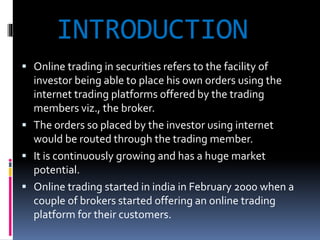
 Online trading in securities refers to the facility of
investor being able to place his own orders using the
internet trading platforms offered by the trading
members viz., the broker.
 The orders so placed by the investor using internet
would be routed through the trading member.
 It is continuously growing and has a huge market
potential.
 Online trading started in india in February 2000 when a
couple of brokers started offering an online trading
platform for their customers.
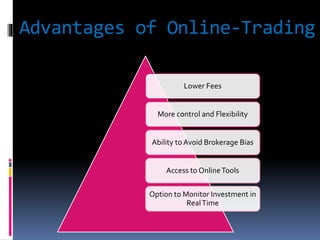
Advantages of Online-Trading
Lower Fees
More control and Flexibility
Ability to Avoid Brokerage Bias
Access to OnlineTools
Option to Monitor Investment in
RealTime
 Lower Fees: One of the clearest advantages of online trading is the
reduction in transaction costs and high fees associated with
traditional brick-and-mortar brokerage firms.Typically, you’ll pay
between $5 and $10 to buy and sell stocks and exchange-traded
funds at online discount brokerages.
 More Control and Flexibility: Time is often of the essence when
you trade stocks, so the speed of using online trading portals is a
benefit to many investors.With online trading, you can execute a
trade almost immediately.
 Ability to avoid Brokerage: By taking trading into your own hands,
you can eliminate brokerage bias. Bias sometimes occurs when a
broker gives financial advice that benefits the broker — such as in
the form of a commission for selling specific mutual funds and other
products.This kind of biased advice can be troublesome for any
investor and might even lead to investment decisions that are good
for the broker but bad for you.
 Access to OnlineTools: In the world of online trading, a lower cost
does not necessarily mean a shoddy product. Many of today’s online
trading companies offer customers an impressive suite of tools to
help optimize trades.
For example, sites such asTrade King, Interactive Brokers and Motif
offer a robust selection of tools designed to give customers
immediate access to valuable information, including interactive
investment performance charts
 Option to Monitor Investment in RealTime : Many online trading
sites offer stock quotes and trade information that make it easy for
people to see how their investments are doing in real time.
Companies such as Scot trade andTrade King, for example, offer
customers access to streaming data.You get real-time quotes, stock
market news and more. For some traders, this one-stop, at-a-glance
convenience trumps picking up the phone and calling a live broker,
turning on the television, or even going to a different website to get
market information.
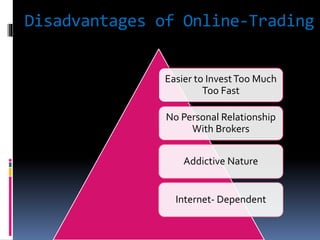
Disadvantages of Online-Trading
Easier to InvestToo Much
Too Fast
No Personal Relationship
With Brokers
Addictive Nature
Internet- Dependent
 Easier to InvestToo MuchToo Fast : Because online trading
is so easy — you basically push a button — there is the risk of
making poor investment choices or overinvesting.
The Securities and Exchange Commission warns investors
that although it takes just a nanosecond to make a trade, real
investment decisions require time. Investors who are not used
to fast-moving markets can get caught up in the excitement.
Before they know what hit them, they can end up losing a lot
of money.
 No Personal RelationshipWith Brokers : By and large, online
traders are on their own.They don’t have a broker to help
them navigate the uncertain waters of the stock market.
From getting help on how to create an investment strategy to
understanding how the results of feedback mechanisms
affect the market, online traders are left to their own devices.
For some, this kind of autonomy can be unsettling.
 Addictive Nature:Trading stocks can be like gambling for
some people.The trader speculates on the result of
something — such as a company’s performance — and then
bets money that the speculation will be correct.Online
traders can experience a certain high when trading that is
similar to what people experience when gambling, according
to a recent study on excessive trading published in the journal
Addictive Behaviors.
 Internet- Dependent :The nature of online trading means
that, ultimately, you’re at the mercy of your internet
connection. If the internet connection is too slow or is
interrupted, you can lose out on a potentially important or
lucrative trade.
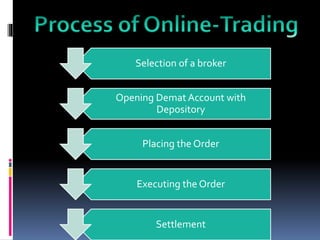
Selection of a broker
Opening Demat Account with
Depository
Placing the Order
Executing the Order
Settlement
 Selection of a Broker :The buying and selling of securities
can only be done through SEBI registered brokers who are
members of the Stock Exchange.The broker can be an
individual, partnership firms or corporate bodies. So the first
step is to select a broker who will buy/sell securities on behalf
of the investor or speculator.
 Opening Demat Account with Depository : Demat account
refer to an account which an Indian citizen must open with
the depository participant (banks or stock brokers) to trade in
listed securities in electronic form. Second step in trading
procedure is to open a Demat account.The securities are held
in the electronic form by a depository. Depository is an
institution or an organization which holds securities . At
present in India there are two depositories: NSDL (National
Securities Depository Ltd.) and CDSL (Central Depository
Services Ltd.)
 Placing the Order : After opening the DematAccount, the
investor can place the order.The order can be placed to the
broker either (DP) personally or through phone, email, etc.
Investor must place the order very clearly specifying the range of
price at which securities can be bought or sold. e.g. “Buy 100
equity shares of Reliance for not more than Rs 500 per share.”
 Executing the order : As per the Instructions of the investor, the
broker executes the order i.e. he buys or sells the securities.
Broker prepares a contract note for the order executed.The
contract note contains the name and the price of securities,
name of parties and brokerage (commission) charged by him.
Contract note is signed by the broker.
 Settlement :This means actual transfer of securities.This is the
last stage in the trading of securities done by the broker on
behalf of their clients.There can be two types of settlement.
a) On the Spot Settlement
b) Forward Settlement
Types ofOrders
Buy and sell orders placed with members of the stock exchange by the investor.
The orders are of different types:
Limit orders : Orders are limited by a fixed price. E.g. ‘buy Reliance Petroleum at
Rs.50. Here, the order has clearly indicated the price at which it has to be bought
and the investor is not willing to give more than Rs.50.
Best rate order : Here, the buyer or seller gives the freedom to the broker to
execute the order at the best possible rate quoted on the particular date for
buying. It may be lowest rate for buying and highest rate for selling.
Discretionary order :The investor gives the range of price for purchase and sale.
The broker can use his discretion to buy within the specified limit. Generally the
approximation price is fixed.The order stands as this ‘buy BRC 100 shares
around Rs.40
Stop loss order : the orders are given to limit the loss due to unfavorable price
movement in the market. A particular limit is given for waiting. If the price falls
below the limit, the broker is authorized to sell the shares to prevent further
loss. E.g. Sell BRC limited at Rs.24, stop loss at Rs.22
Traditional Trading Vs Online Trading
TraditionalTrading OnlineTrading
 In offline the investor has no
control on his demat and
trading A/C.
 It is a time consuming process.
 Offline trader needs to open
separate account
 Offline brokers charge a
considerable high amount as
fees.
 Chances of fraud increases if
you have offline account.
 In online trading mechanism
the customer has full control
on his demat and trading A/C.
 Online trading is time effective
 Online investors can directly
invest into IPO’s and mutual
Fund
 Online trading is much more
profitable as online brokerage
charges less fees.
 There are no chances of fraud
as it is you who has complete
control over your transaction
Why Online Trading Entered
Late in India?
 The Indian exchanges and brokering houses have
been very slow in moving their online transactions.
 The major reason has been the lot government
regulations.
 Connectivity related issue was perhaps the most
important technological factor.
 Many other issues like security, backup and
recovery procedural costs also acted as deterrents
in the process.
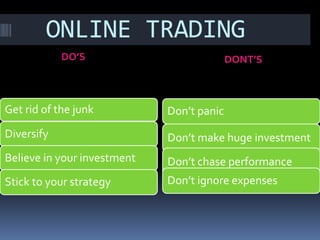
ONLINE TRADING
DO’S DONT’S
Get rid of the junk
Diversify
Believe in your investment
Stick to your strategy
Don’t panic
Don’t make huge investment
Don’t chase performance
Don’t ignore expenses
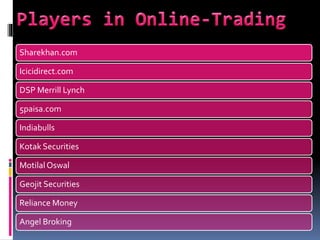
Sharekhan.com
Icicidirect.com
DSP Merrill Lynch
5paisa.com
Indiabulls
Kotak Securities
Motilal Oswal
Geojit Securities
Reliance Money
Angel Broking
 Slideshare.net
 Investopedia.com
 Economictimes.indiatimes.com
 Scienceandnature.org
Online trading

Online trading

  • 2.
    INTRODUCTION  Online tradingin securities refers to the facility of investor being able to place his own orders using the internet trading platforms offered by the trading members viz., the broker.  The orders so placed by the investor using internet would be routed through the trading member.  It is continuously growing and has a huge market potential.  Online trading started in india in February 2000 when a couple of brokers started offering an online trading platform for their customers.
  • 3.
    Advantages of Online-Trading LowerFees More control and Flexibility Ability to Avoid Brokerage Bias Access to OnlineTools Option to Monitor Investment in RealTime
  • 4.
     Lower Fees:One of the clearest advantages of online trading is the reduction in transaction costs and high fees associated with traditional brick-and-mortar brokerage firms.Typically, you’ll pay between $5 and $10 to buy and sell stocks and exchange-traded funds at online discount brokerages.  More Control and Flexibility: Time is often of the essence when you trade stocks, so the speed of using online trading portals is a benefit to many investors.With online trading, you can execute a trade almost immediately.  Ability to avoid Brokerage: By taking trading into your own hands, you can eliminate brokerage bias. Bias sometimes occurs when a broker gives financial advice that benefits the broker — such as in the form of a commission for selling specific mutual funds and other products.This kind of biased advice can be troublesome for any investor and might even lead to investment decisions that are good for the broker but bad for you.
  • 5.
     Access toOnlineTools: In the world of online trading, a lower cost does not necessarily mean a shoddy product. Many of today’s online trading companies offer customers an impressive suite of tools to help optimize trades. For example, sites such asTrade King, Interactive Brokers and Motif offer a robust selection of tools designed to give customers immediate access to valuable information, including interactive investment performance charts  Option to Monitor Investment in RealTime : Many online trading sites offer stock quotes and trade information that make it easy for people to see how their investments are doing in real time. Companies such as Scot trade andTrade King, for example, offer customers access to streaming data.You get real-time quotes, stock market news and more. For some traders, this one-stop, at-a-glance convenience trumps picking up the phone and calling a live broker, turning on the television, or even going to a different website to get market information.
  • 6.
    Disadvantages of Online-Trading Easierto InvestToo Much Too Fast No Personal Relationship With Brokers Addictive Nature Internet- Dependent
  • 7.
     Easier toInvestToo MuchToo Fast : Because online trading is so easy — you basically push a button — there is the risk of making poor investment choices or overinvesting. The Securities and Exchange Commission warns investors that although it takes just a nanosecond to make a trade, real investment decisions require time. Investors who are not used to fast-moving markets can get caught up in the excitement. Before they know what hit them, they can end up losing a lot of money.  No Personal RelationshipWith Brokers : By and large, online traders are on their own.They don’t have a broker to help them navigate the uncertain waters of the stock market. From getting help on how to create an investment strategy to understanding how the results of feedback mechanisms affect the market, online traders are left to their own devices. For some, this kind of autonomy can be unsettling.
  • 8.
     Addictive Nature:Tradingstocks can be like gambling for some people.The trader speculates on the result of something — such as a company’s performance — and then bets money that the speculation will be correct.Online traders can experience a certain high when trading that is similar to what people experience when gambling, according to a recent study on excessive trading published in the journal Addictive Behaviors.  Internet- Dependent :The nature of online trading means that, ultimately, you’re at the mercy of your internet connection. If the internet connection is too slow or is interrupted, you can lose out on a potentially important or lucrative trade.
  • 9.
    Selection of abroker Opening Demat Account with Depository Placing the Order Executing the Order Settlement
  • 10.
     Selection ofa Broker :The buying and selling of securities can only be done through SEBI registered brokers who are members of the Stock Exchange.The broker can be an individual, partnership firms or corporate bodies. So the first step is to select a broker who will buy/sell securities on behalf of the investor or speculator.  Opening Demat Account with Depository : Demat account refer to an account which an Indian citizen must open with the depository participant (banks or stock brokers) to trade in listed securities in electronic form. Second step in trading procedure is to open a Demat account.The securities are held in the electronic form by a depository. Depository is an institution or an organization which holds securities . At present in India there are two depositories: NSDL (National Securities Depository Ltd.) and CDSL (Central Depository Services Ltd.)
  • 11.
     Placing theOrder : After opening the DematAccount, the investor can place the order.The order can be placed to the broker either (DP) personally or through phone, email, etc. Investor must place the order very clearly specifying the range of price at which securities can be bought or sold. e.g. “Buy 100 equity shares of Reliance for not more than Rs 500 per share.”  Executing the order : As per the Instructions of the investor, the broker executes the order i.e. he buys or sells the securities. Broker prepares a contract note for the order executed.The contract note contains the name and the price of securities, name of parties and brokerage (commission) charged by him. Contract note is signed by the broker.  Settlement :This means actual transfer of securities.This is the last stage in the trading of securities done by the broker on behalf of their clients.There can be two types of settlement. a) On the Spot Settlement b) Forward Settlement
  • 12.
    Types ofOrders Buy andsell orders placed with members of the stock exchange by the investor. The orders are of different types: Limit orders : Orders are limited by a fixed price. E.g. ‘buy Reliance Petroleum at Rs.50. Here, the order has clearly indicated the price at which it has to be bought and the investor is not willing to give more than Rs.50. Best rate order : Here, the buyer or seller gives the freedom to the broker to execute the order at the best possible rate quoted on the particular date for buying. It may be lowest rate for buying and highest rate for selling. Discretionary order :The investor gives the range of price for purchase and sale. The broker can use his discretion to buy within the specified limit. Generally the approximation price is fixed.The order stands as this ‘buy BRC 100 shares around Rs.40 Stop loss order : the orders are given to limit the loss due to unfavorable price movement in the market. A particular limit is given for waiting. If the price falls below the limit, the broker is authorized to sell the shares to prevent further loss. E.g. Sell BRC limited at Rs.24, stop loss at Rs.22
  • 13.
    Traditional Trading VsOnline Trading TraditionalTrading OnlineTrading  In offline the investor has no control on his demat and trading A/C.  It is a time consuming process.  Offline trader needs to open separate account  Offline brokers charge a considerable high amount as fees.  Chances of fraud increases if you have offline account.  In online trading mechanism the customer has full control on his demat and trading A/C.  Online trading is time effective  Online investors can directly invest into IPO’s and mutual Fund  Online trading is much more profitable as online brokerage charges less fees.  There are no chances of fraud as it is you who has complete control over your transaction
  • 14.
    Why Online TradingEntered Late in India?  The Indian exchanges and brokering houses have been very slow in moving their online transactions.  The major reason has been the lot government regulations.  Connectivity related issue was perhaps the most important technological factor.  Many other issues like security, backup and recovery procedural costs also acted as deterrents in the process.
  • 15.
    ONLINE TRADING DO’S DONT’S Getrid of the junk Diversify Believe in your investment Stick to your strategy Don’t panic Don’t make huge investment Don’t chase performance Don’t ignore expenses
  • 16.
    Sharekhan.com Icicidirect.com DSP Merrill Lynch 5paisa.com Indiabulls KotakSecurities Motilal Oswal Geojit Securities Reliance Money Angel Broking
  • 17.
     Slideshare.net  Investopedia.com Economictimes.indiatimes.com  Scienceandnature.org