CONCEPT OF GST
The term GST stands for “Goods and Service tax “, and it is a
comprehensive indirect tax levy on manufacture, sale and consumption
of Goods as well as services at national level.
GST may be defined as:
 Tax on supply of goods and services
 Leviable on value addition at each point of sale of goods and services
 Where the seller of goods and provider of services may claim credit of
input tax paid at previous stages
 Final consumer will bear the burden of GST
HISTORY OF GST
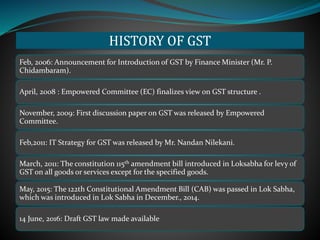
Feb, 2006: Announcement for Introduction of GST by Finance Minister (Mr. P.
Chidambaram).
April, 2008 : Empowered Committee (EC) finalizes view on GST structure .
November, 2009: First discussion paper on GST was released by Empowered
Committee.
Feb,2011: IT Strategy for GST was released by Mr. Nandan Nilekani.
March, 2011: The constitution 115th amendment bill introduced in Loksabha for levy of
GST on all goods or services except for the specified goods.
May, 2015: The 122th Constitutional Amendment Bill (CAB) was passed in Lok Sabha,
which was introduced in Lok Sabha in December., 2014.
14 June, 2016: Draft GST law made available
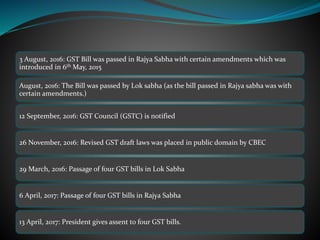
3 August, 2016: GST Bill was passed in Rajya Sabha with certain amendments which was
introduced in 6th May, 2015
August, 2016: The Bill was passed by Lok sabha (as the bill passed in Rajya sabha was with
certain amendments.)
12 September, 2016: GST Council (GSTC) is notified
26 November, 2016: Revised GST draft laws was placed in public domain by CBEC
29 March, 2016: Passage of four GST bills in Lok Sabha
6 April, 2017: Passage of four GST bills in Rajya Sabha
13 April, 2017: President gives assent to four GST bills.
Features of GST
 GST Act extends to whole of India.
 GST is destination based and consumption based tax.
 Indirect taxes subsumed under GST except custom
duty.
 GST acts as uniformity in Provisions and Tax rate.
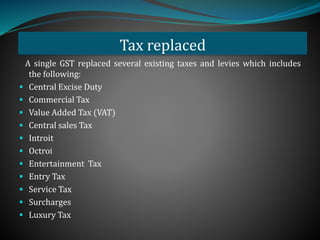
Tax replaced
A single GST replaced several existing taxes and levies which includes
the following:
 Central Excise Duty
 Commercial Tax
 Value Added Tax (VAT)
 Central sales Tax
 Introit
 Octroi
 Entertainment Tax
 Entry Tax
 Service Tax
 Surcharges
 Luxury Tax
GST BENEFITS
For trade
 Reduction in multiplicity of taxes.
 Mitigation of cascading/ double taxation.
 More efficient neutralization of taxes especially for export.
 Development of common national market.
 Simpler tax regime.
 Fewer rate and exemptions.
 Distinction between goods and services no longer required.
For consumers
• Simpler Tax system
• Reduction in prices of goods and services due to
elimination of cascading
• Uniform prices throughout the country
• Increase in employment opportunities
• Transparency in taxation system
Registration- Threshold Limit
North East
India NE,
Uttarkhand
and J&K
Aggregate
Turnover
exceeds
Rs. 10 Lakhs
for
Registration
Rest of India
Aggregate
Turnover
exceeds
Rs. 20 lakhs
for
Registration
Composition
levy
Aggregate
Turnover
does not
exceeds
Rs. 75 lakhs
for
registration
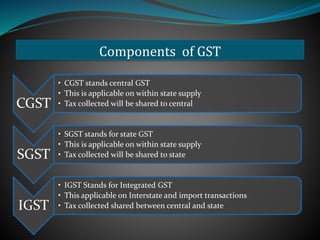
Components of GST
CGST
• CGST stands central GST
• This is applicable on within state supply
• Tax collected will be shared to central
SGST
• SGST stands for state GST
• This is applicable on within state supply
• Tax collected will be shared to state
IGST
• IGST Stands for Integrated GST
• This applicable on Interstate and import transactions
• Tax collected shared between central and state
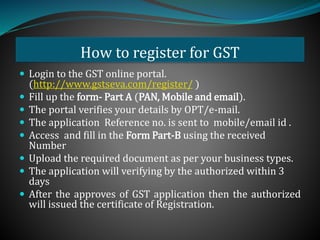
How to register for GST
 Login to the GST online portal.
(http://www.gstseva.com/register/ )
 Fill up the form- Part A (PAN, Mobile and email).
 The portal verifies your details by OPT/e-mail.
 The application Reference no. is sent to mobile/email id .
 Access and fill in the Form Part-B using the received
Number
 Upload the required document as per your business types.
 The application will verifying by the authorized within 3
days
 After the approves of GST application then the authorized
will issued the certificate of Registration.
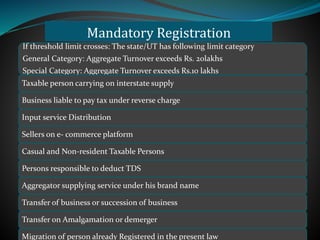
Mandatory Registration
If threshold limit crosses: The state/UT has following limit category
General Category: Aggregate Turnover exceeds Rs. 20lakhs
Special Category: Aggregate Turnover exceeds Rs.10 lakhs
Taxable person carrying on interstate supply
Business liable to pay tax under reverse charge
Input service Distribution
Sellers on e- commerce platform
Casual and Non-resident Taxable Persons
Persons responsible to deduct TDS
Aggregator supplying service under his brand name
Transfer of business or succession of business
Transfer on Amalgamation or demerger
Migration of person already Registered in the present law
Amending your Registration details
 Any change in details furnished at time of registration
must submitted within 15 days.
 In Form GST REG-13.
 Specific change in Form GST REG-11 relating to the
name, partner, managing committee details of
business.
 An approval order by the officer is sent in Form GST
REG-14 to amend the details.
 Change in business details that result in change of PAN
number of the registered tax payer.
 A fresh registration in Form GST REG-01.
When can GST registration get cancelled
 The business has been discontinued.
 The business has been transferred fully by
amalgamated, demerged.
 There is any change in the constitution of the business.
 The taxable person is no longer liable to be registered.
 The registered taxable person has contravened
provisions of GST.
 Any registration has been obtained by fraud the proper
officer may cancel the registration with the
retrospective effect.
Who can cancel GST registration
Cancellation of GST registration can be done by :
 A proper officer
 Request by the concerned person himself
 On all application filed by his legal heirs, in case of
death of such person
However, application for cancellation of registration by
the concerned person who has registered voluntarily
will be only after one year from the date of registration
GST Mechanism
SGST
Inter StateIntra State
IGSTCGST
Input tax credit concepts
Input means- section 2(54):
 Any goods(subject to certain exception) other than capital
goods
 Used or intended to be used by supplier
 For making an outward supply in the course of business
activity
Input service means – section 2 (55):
 Any service (subject to certain exception)
 Used or intended to be used by supplier
 For making an outward supply in the course of business
activity.
Manner of issuing tax invoice
• Original copy “Original for Recipient”
• Duplicate copy “Duplicate for
Transporter”
• Triplicate copy “Triplicate for
Supplier”
Supply of taxable
goods
• Original copy “ Original for Recipient”
• Duplicate copy “Duplicate for
Supplier”
Supply of taxable
service
Condition for claiming input tax credit
 Input tax credit is available only against “Tax invoice” issued by the
registered dealer.
 Tax invoice shall contain the following details :
a. Consecutive serial number
b. Date of issue
c. Name and address of the tax payer with TIN number
d. Buyer name and address with TIN number
e. Description of the goods
f. Quantity or volume of the goods
g. Value of the goods
h. Rate and amount of tax paid
Time limit of claiming ITC
A taxable person shall not be entitled to take input tax credit in respect of
any invoice or debit note for supply of goods and service
A. After furnishing of the return for the month of September following
the end of financial year to which such invoice pertains or
B. Furnishing of the relevant annual return,
whichever is earlier. [section 16(4)]
The reason for this restriction is that no change in return is permitted
after September of next financial year. If the annual return is filed
before September then no change can be made after filing of annual
return.
Rate Slab of CGST, SGST and IGST
Rate structure
Exempt supplies : Nil-rate, zero percent supplies
Zero- Rated Supplies: Exports and supplies to SEZ
Supplies taxable at 5%
Supplies taxable at 12%
Supplies taxable at 18%
Supplies taxable at 28%

What is gst

  • 2.
    CONCEPT OF GST Theterm GST stands for “Goods and Service tax “, and it is a comprehensive indirect tax levy on manufacture, sale and consumption of Goods as well as services at national level. GST may be defined as:  Tax on supply of goods and services  Leviable on value addition at each point of sale of goods and services  Where the seller of goods and provider of services may claim credit of input tax paid at previous stages  Final consumer will bear the burden of GST
  • 3.
    HISTORY OF GST Feb,2006: Announcement for Introduction of GST by Finance Minister (Mr. P. Chidambaram). April, 2008 : Empowered Committee (EC) finalizes view on GST structure . November, 2009: First discussion paper on GST was released by Empowered Committee. Feb,2011: IT Strategy for GST was released by Mr. Nandan Nilekani. March, 2011: The constitution 115th amendment bill introduced in Loksabha for levy of GST on all goods or services except for the specified goods. May, 2015: The 122th Constitutional Amendment Bill (CAB) was passed in Lok Sabha, which was introduced in Lok Sabha in December., 2014. 14 June, 2016: Draft GST law made available
  • 4.
    3 August, 2016:GST Bill was passed in Rajya Sabha with certain amendments which was introduced in 6th May, 2015 August, 2016: The Bill was passed by Lok sabha (as the bill passed in Rajya sabha was with certain amendments.) 12 September, 2016: GST Council (GSTC) is notified 26 November, 2016: Revised GST draft laws was placed in public domain by CBEC 29 March, 2016: Passage of four GST bills in Lok Sabha 6 April, 2017: Passage of four GST bills in Rajya Sabha 13 April, 2017: President gives assent to four GST bills.
  • 5.
    Features of GST GST Act extends to whole of India.  GST is destination based and consumption based tax.  Indirect taxes subsumed under GST except custom duty.  GST acts as uniformity in Provisions and Tax rate.
  • 6.
    Tax replaced A singleGST replaced several existing taxes and levies which includes the following:  Central Excise Duty  Commercial Tax  Value Added Tax (VAT)  Central sales Tax  Introit  Octroi  Entertainment Tax  Entry Tax  Service Tax  Surcharges  Luxury Tax
  • 7.
    GST BENEFITS For trade Reduction in multiplicity of taxes.  Mitigation of cascading/ double taxation.  More efficient neutralization of taxes especially for export.  Development of common national market.  Simpler tax regime.  Fewer rate and exemptions.  Distinction between goods and services no longer required.
  • 8.
    For consumers • SimplerTax system • Reduction in prices of goods and services due to elimination of cascading • Uniform prices throughout the country • Increase in employment opportunities • Transparency in taxation system
  • 9.
    Registration- Threshold Limit NorthEast India NE, Uttarkhand and J&K Aggregate Turnover exceeds Rs. 10 Lakhs for Registration Rest of India Aggregate Turnover exceeds Rs. 20 lakhs for Registration Composition levy Aggregate Turnover does not exceeds Rs. 75 lakhs for registration
  • 10.
    Components of GST CGST •CGST stands central GST • This is applicable on within state supply • Tax collected will be shared to central SGST • SGST stands for state GST • This is applicable on within state supply • Tax collected will be shared to state IGST • IGST Stands for Integrated GST • This applicable on Interstate and import transactions • Tax collected shared between central and state
  • 11.
    How to registerfor GST  Login to the GST online portal. (http://www.gstseva.com/register/ )  Fill up the form- Part A (PAN, Mobile and email).  The portal verifies your details by OPT/e-mail.  The application Reference no. is sent to mobile/email id .  Access and fill in the Form Part-B using the received Number  Upload the required document as per your business types.  The application will verifying by the authorized within 3 days  After the approves of GST application then the authorized will issued the certificate of Registration.
  • 12.
    Mandatory Registration If thresholdlimit crosses: The state/UT has following limit category General Category: Aggregate Turnover exceeds Rs. 20lakhs Special Category: Aggregate Turnover exceeds Rs.10 lakhs Taxable person carrying on interstate supply Business liable to pay tax under reverse charge Input service Distribution Sellers on e- commerce platform Casual and Non-resident Taxable Persons Persons responsible to deduct TDS Aggregator supplying service under his brand name Transfer of business or succession of business Transfer on Amalgamation or demerger Migration of person already Registered in the present law
  • 13.
    Amending your Registrationdetails  Any change in details furnished at time of registration must submitted within 15 days.  In Form GST REG-13.  Specific change in Form GST REG-11 relating to the name, partner, managing committee details of business.  An approval order by the officer is sent in Form GST REG-14 to amend the details.  Change in business details that result in change of PAN number of the registered tax payer.  A fresh registration in Form GST REG-01.
  • 14.
    When can GSTregistration get cancelled  The business has been discontinued.  The business has been transferred fully by amalgamated, demerged.  There is any change in the constitution of the business.  The taxable person is no longer liable to be registered.  The registered taxable person has contravened provisions of GST.  Any registration has been obtained by fraud the proper officer may cancel the registration with the retrospective effect.
  • 15.
    Who can cancelGST registration Cancellation of GST registration can be done by :  A proper officer  Request by the concerned person himself  On all application filed by his legal heirs, in case of death of such person However, application for cancellation of registration by the concerned person who has registered voluntarily will be only after one year from the date of registration
  • 16.
  • 17.
    Input tax creditconcepts Input means- section 2(54):  Any goods(subject to certain exception) other than capital goods  Used or intended to be used by supplier  For making an outward supply in the course of business activity Input service means – section 2 (55):  Any service (subject to certain exception)  Used or intended to be used by supplier  For making an outward supply in the course of business activity.
  • 18.
    Manner of issuingtax invoice • Original copy “Original for Recipient” • Duplicate copy “Duplicate for Transporter” • Triplicate copy “Triplicate for Supplier” Supply of taxable goods • Original copy “ Original for Recipient” • Duplicate copy “Duplicate for Supplier” Supply of taxable service
  • 19.
    Condition for claiminginput tax credit  Input tax credit is available only against “Tax invoice” issued by the registered dealer.  Tax invoice shall contain the following details : a. Consecutive serial number b. Date of issue c. Name and address of the tax payer with TIN number d. Buyer name and address with TIN number e. Description of the goods f. Quantity or volume of the goods g. Value of the goods h. Rate and amount of tax paid
  • 20.
    Time limit ofclaiming ITC A taxable person shall not be entitled to take input tax credit in respect of any invoice or debit note for supply of goods and service A. After furnishing of the return for the month of September following the end of financial year to which such invoice pertains or B. Furnishing of the relevant annual return, whichever is earlier. [section 16(4)] The reason for this restriction is that no change in return is permitted after September of next financial year. If the annual return is filed before September then no change can be made after filing of annual return.
  • 21.
    Rate Slab ofCGST, SGST and IGST Rate structure Exempt supplies : Nil-rate, zero percent supplies Zero- Rated Supplies: Exports and supplies to SEZ Supplies taxable at 5% Supplies taxable at 12% Supplies taxable at 18% Supplies taxable at 28%