
Commonwealth Educational
Media Centre for Asia
Understanding Open
Educational Resources (OER)
Manas Ranjan Panigrahi, Programme officer, CEMCA, New Delhi
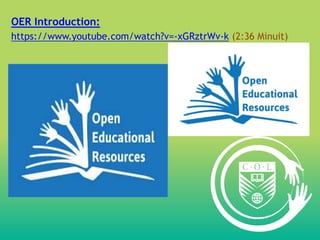
OER Introduction:
https://www.youtube.com/watch?v=-xGRztrWv-k (2:36 Minuit)
Open Educational Resources
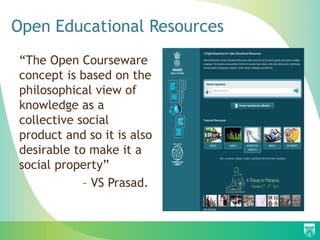
“The Open Courseware
concept is based on the
philosophical view of
knowledge as a
collective social
product and so it is also
desirable to make it a
social property”
– VS Prasad.
What is OER?
Source: http://bit.ly/oerinfokit
Open Educational Resources are teaching and learning
materials that are freely available online for every one
to use, whether you are an instructor, student or self-
learner.
Examples of OER include: full courses, course modules,
syllabi, lectures, homework assignments, games,
simulations, and many more resources contained in
digital media collections from around the world.
OER Commons
OER Concept
 Digital teaching, learning, research
resources in public domain or released
under intellectual property license permit
free use/re-purposing by educators,
students, self-learners and others
 OER includes learning content, software
tools to develop, use and distribute
content, and implementation of resources
such as open licenses
Role of OER in Teaching and Learning
 OER will be playing an important role in the future in
dissemination of learning resources. The advantages of
use of OER are many viz.
i.) Grab learners’ attention;
ii.) Focus concentration;
iii.) Generate interest;
iv.) Create a sense of anticipation;
v.) Energize or relax for learning exercise;
vi.) Draw imagination;
vii.) Improve attitudes toward content and learning;
viii.) Build a connection with other scholars, educators
and instructors;
ix.) Increase memory of content;
x.) Increase understanding of subject/content;
xi.) Foster creativity;
xii.) Stimulate the flow of ideas;
xiii.) Foster deeper learning;
xiv.) Provide an opportunity for freedom of expression;
xv.) Serve as a vehicle for collaboration;
xvi.) Inspire and motivate;
xvii.) Make learning fun;
xviii.) Set an appropriate mood or tone;
xiv.) Decrease anxiety and tension on scary topics; xx.)
Create memorable visual images.
Role of OER in Teaching and Learning
 Three kinds of ‘openness’ cover a range of
academic functions, from production to
organization to distribution, and their
development and use in the academy offer great
potential for shaping practices in teaching,
research and management.
 Open Sources: Whether a matter of structure
 Open Access: Protocols for informational
organization
 Open Content: Pure content
Indicators in OER
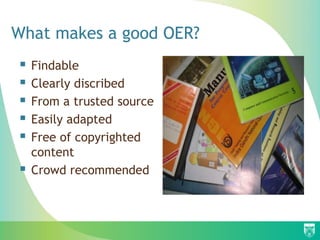
What makes a good OER?
 Findable
 Clearly discribed
 From a trusted source
 Easily adapted
 Free of copyrighted
content
 Crowd recommended
OER making process
 Get resources
 Create
 Localise
 Remix
 Licensing
 Use
 Redistribute
4R-framework of four
rights:
1.Reuse;
2.Revise;
3.Remix;
4.Redistribute
(Wiley, 2009)
Benefits of OER
 Engagement of students worldwide
 Enhancing marketing
 Engagement with employers
 Brokering collaboration and partnerships
 Sustaining vulnerable subjects
 Enrichment of contents and courses
OER: Guidance and Policy
 Make the formal decision to use OER in
the curriculum
 Develop a strategy to ascertain where
OER would work
 Promote, provide training and support to
staff to use OER in course design and
development
 Measure the effects of using OER and
incorporate findings to strengthen the
message
CHALLENGES AND
LIMITATIONS OF OER
Copyright issues
 Copyright is the right of the originator to control the
publication and replication of work.
 Open licensing is a solution to the copy right worries
of academicians. It offers a way out for controlled
sharing with some rights confined to authors.
 There are several open content licenses such as
Creative Commons and the GNU Free Documentation
Licence which introduces a certainty and clarity in
the process of obtaining permission to use the work of
others.
 Finally, open licenses establish a body of works
licensed as “open content” that may be freely
shared.
Quality assurance
 Quality Approaches:
 Branding: Before releasing the resources on to
the web, through internal check the institutions
make sure the quality.
 Peer review: this technique is one of the most
used quality assurance processes in academia.
There are also arguments for using peer review
schemes to guarantee the quality of resources in
a repository.
 Quality management: let individual users decide
on whatever ground they like whether a learning
resource is of high quality, useful, or good in any
other respect.
Sustainability of OER
 Some of the aspects need to consider are:
 Technical considerations such as discoverability of the
resources;
 The kind of openness and constraints on access and use that
is given users;
 Different content models (the possibility to localise
content) and issues of licensing;
 Different staffing models and incentives for people to
contribute resources;
 Alternative workflows to the traditional design—use—
evaluation model, to models without a clear distinction
between production and use or between the user and the
producer. The concept of co-production is important here.
 Maintenance and updating of resources.
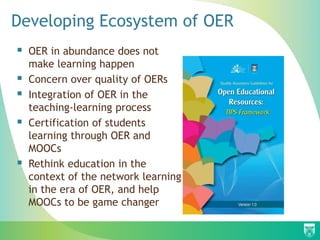
Developing Ecosystem of OER
 OER in abundance does not
make learning happen
 Concern over quality of OERs
 Integration of OER in the
teaching-learning process
 Certification of students
learning through OER and
MOOCs
 Rethink education in the
context of the network learning
in the era of OER, and help
MOOCs to be game changer
Concluding Remarks
 OERs will increase access to knowledge resources
 Publicly funded organisations have a
responsibility to share and disseminate
information for the benefit of all. It should be
their ethics to the knowledge community.
 For individual academicians/users this is their
ethics, to participate in a community of practice
around OER in which sharing of resources and
expertise is expected and valued.
 We need to have collective thinking on ways to
further democratise education with OER-Quality.
Thank You

Understanding oer

  • 1.
    Commonwealth Educational Media Centrefor Asia Understanding Open Educational Resources (OER) Manas Ranjan Panigrahi, Programme officer, CEMCA, New Delhi
  • 2.
  • 3.
    Open Educational Resources “TheOpen Courseware concept is based on the philosophical view of knowledge as a collective social product and so it is also desirable to make it a social property” – VS Prasad.
  • 4.
    What is OER? Source:http://bit.ly/oerinfokit Open Educational Resources are teaching and learning materials that are freely available online for every one to use, whether you are an instructor, student or self- learner. Examples of OER include: full courses, course modules, syllabi, lectures, homework assignments, games, simulations, and many more resources contained in digital media collections from around the world. OER Commons
  • 5.
    OER Concept  Digitalteaching, learning, research resources in public domain or released under intellectual property license permit free use/re-purposing by educators, students, self-learners and others  OER includes learning content, software tools to develop, use and distribute content, and implementation of resources such as open licenses
  • 6.
    Role of OERin Teaching and Learning  OER will be playing an important role in the future in dissemination of learning resources. The advantages of use of OER are many viz. i.) Grab learners’ attention; ii.) Focus concentration; iii.) Generate interest; iv.) Create a sense of anticipation; v.) Energize or relax for learning exercise; vi.) Draw imagination; vii.) Improve attitudes toward content and learning; viii.) Build a connection with other scholars, educators and instructors;
  • 7.
    ix.) Increase memoryof content; x.) Increase understanding of subject/content; xi.) Foster creativity; xii.) Stimulate the flow of ideas; xiii.) Foster deeper learning; xiv.) Provide an opportunity for freedom of expression; xv.) Serve as a vehicle for collaboration; xvi.) Inspire and motivate; xvii.) Make learning fun; xviii.) Set an appropriate mood or tone; xiv.) Decrease anxiety and tension on scary topics; xx.) Create memorable visual images. Role of OER in Teaching and Learning
  • 8.
     Three kindsof ‘openness’ cover a range of academic functions, from production to organization to distribution, and their development and use in the academy offer great potential for shaping practices in teaching, research and management.  Open Sources: Whether a matter of structure  Open Access: Protocols for informational organization  Open Content: Pure content Indicators in OER
  • 9.
    What makes agood OER?  Findable  Clearly discribed  From a trusted source  Easily adapted  Free of copyrighted content  Crowd recommended
  • 10.
    OER making process Get resources  Create  Localise  Remix  Licensing  Use  Redistribute 4R-framework of four rights: 1.Reuse; 2.Revise; 3.Remix; 4.Redistribute (Wiley, 2009)
  • 11.
    Benefits of OER Engagement of students worldwide  Enhancing marketing  Engagement with employers  Brokering collaboration and partnerships  Sustaining vulnerable subjects  Enrichment of contents and courses
  • 12.
    OER: Guidance andPolicy  Make the formal decision to use OER in the curriculum  Develop a strategy to ascertain where OER would work  Promote, provide training and support to staff to use OER in course design and development  Measure the effects of using OER and incorporate findings to strengthen the message
  • 13.
  • 14.
    Copyright issues  Copyrightis the right of the originator to control the publication and replication of work.  Open licensing is a solution to the copy right worries of academicians. It offers a way out for controlled sharing with some rights confined to authors.  There are several open content licenses such as Creative Commons and the GNU Free Documentation Licence which introduces a certainty and clarity in the process of obtaining permission to use the work of others.  Finally, open licenses establish a body of works licensed as “open content” that may be freely shared.
  • 15.
    Quality assurance  QualityApproaches:  Branding: Before releasing the resources on to the web, through internal check the institutions make sure the quality.  Peer review: this technique is one of the most used quality assurance processes in academia. There are also arguments for using peer review schemes to guarantee the quality of resources in a repository.  Quality management: let individual users decide on whatever ground they like whether a learning resource is of high quality, useful, or good in any other respect.
  • 16.
    Sustainability of OER Some of the aspects need to consider are:  Technical considerations such as discoverability of the resources;  The kind of openness and constraints on access and use that is given users;  Different content models (the possibility to localise content) and issues of licensing;  Different staffing models and incentives for people to contribute resources;  Alternative workflows to the traditional design—use— evaluation model, to models without a clear distinction between production and use or between the user and the producer. The concept of co-production is important here.  Maintenance and updating of resources.
  • 17.
    Developing Ecosystem ofOER  OER in abundance does not make learning happen  Concern over quality of OERs  Integration of OER in the teaching-learning process  Certification of students learning through OER and MOOCs  Rethink education in the context of the network learning in the era of OER, and help MOOCs to be game changer
  • 18.
    Concluding Remarks  OERswill increase access to knowledge resources  Publicly funded organisations have a responsibility to share and disseminate information for the benefit of all. It should be their ethics to the knowledge community.  For individual academicians/users this is their ethics, to participate in a community of practice around OER in which sharing of resources and expertise is expected and valued.  We need to have collective thinking on ways to further democratise education with OER-Quality.
  • 19.