From Idea to Production
Rolin Moe, EdD
Director of Academic Innovation
Seattle Pacific University
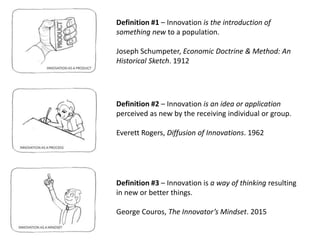
Definition #1 – Innovation is the introduction of
something new to a population.
Joseph Schumpeter, Economic Doctrine & Method: An
Historical Sketch. 1912
Definition #2 – Innovation is an idea or application
perceived as new by the receiving individual or group.
Everett Rogers, Diffusion of Innovations. 1962
Definition #3 – Innovation is a way of thinking resulting
in new or better things.
George Couros, The Innovator’s Mindset. 2015
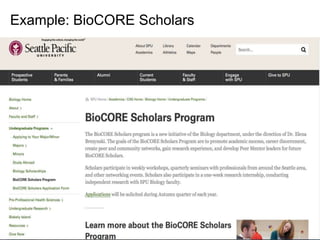
Example: BioCORE Scholars
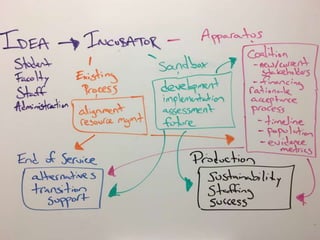
Step 1 – Idea
What is the obstacle the innovation will address?
Ideas come from all stakeholders:
*Students
*Faculty
*Staff
*Administration
Step 2 – Incubation
Where is the best space to grow the innovation?
How can a unique process be cultivated amidst
day to day operations?
Three areas to house an academic innovation:
*Existing Process
*Sandbox
*New Apparatus
Innovative learning is, by design,
a broad definition, requiring
flexibility for buy-in and process.
An innovation can be small or
large, and each requires different
operational requirements. It
recognizes the local environment,
the distributed network of
stakeholders, and the campus
community. An academic
innovation is typically Essential,
Effective, & Efficient.
Step 3 – Development
What are the objectives of the innovation?
Who and what must work together to realize
objectives?
*Set common goals and realistic timelines
*Ensure operational congruence
*Ensure buy-in and support from directly
and indirectly affected stakeholders
Step 4 – Implementation
What needs to happen so this innovation puts
its best foot forward, and the results can be
properly measured?
*Support innovation with staffing and
needed funds
*Support innovators with assistance,
workflow necessities & shared vision
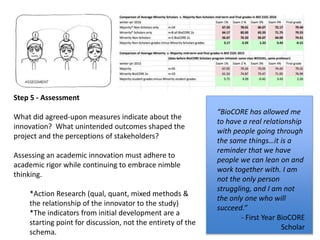
Step 5 - Assessment
What did agreed-upon measures indicate about the
innovation? What unintended outcomes shaped the
project and the perceptions of stakeholders?
Assessing an academic innovation must adhere to
academic rigor while continuing to embrace nimble
thinking.
*Action Research (qual, quant, mixed methods &
the relationship of the innovator to the study)
*The indicators from initial development are a
starting point for discussion, not the entirety of the
schema.
“BioCORE has allowed me
to have a real relationship
with people going through
the same things…it is a
reminder that we have
people we can lean on and
work together with. I am
not the only person
struggling, and I am not
the only one who will
succeed.”
- First Year BioCORE
Scholar
Step 6 – Future Iterations
After the first iteration, what does the future hold for the
innovation?
1) End of Service – decision that the innovation will
not significantly and/or practically address the obstacle.
Wind up the project, supporting stakeholders through the
process.
2) Continued Testing – whether a sandbox or an
apparatus, make a decision to invest more time in
the research & development. Use design thinking to
further shape the process.
3) Production – Make a commitment to the innovation as
an operational process on campus.
How to do Production
*Build a coalition of new and existing
stakeholders around a rationale for the innovation.
*Develop an operational plan years 1-3: financing, staffing,
benchmarks, evidence metrics.
*Organize staffing – evidence of benefit for existing staff.
*Herald the innovation and its uses
The Innovation Process

The Innovation Process

  • 1.
    From Idea toProduction Rolin Moe, EdD Director of Academic Innovation Seattle Pacific University
  • 2.
    Definition #1 –Innovation is the introduction of something new to a population. Joseph Schumpeter, Economic Doctrine & Method: An Historical Sketch. 1912 Definition #2 – Innovation is an idea or application perceived as new by the receiving individual or group. Everett Rogers, Diffusion of Innovations. 1962 Definition #3 – Innovation is a way of thinking resulting in new or better things. George Couros, The Innovator’s Mindset. 2015
  • 4.
  • 5.
    Step 1 –Idea What is the obstacle the innovation will address? Ideas come from all stakeholders: *Students *Faculty *Staff *Administration Step 2 – Incubation Where is the best space to grow the innovation? How can a unique process be cultivated amidst day to day operations? Three areas to house an academic innovation: *Existing Process *Sandbox *New Apparatus Innovative learning is, by design, a broad definition, requiring flexibility for buy-in and process. An innovation can be small or large, and each requires different operational requirements. It recognizes the local environment, the distributed network of stakeholders, and the campus community. An academic innovation is typically Essential, Effective, & Efficient.
  • 6.
    Step 3 –Development What are the objectives of the innovation? Who and what must work together to realize objectives? *Set common goals and realistic timelines *Ensure operational congruence *Ensure buy-in and support from directly and indirectly affected stakeholders Step 4 – Implementation What needs to happen so this innovation puts its best foot forward, and the results can be properly measured? *Support innovation with staffing and needed funds *Support innovators with assistance, workflow necessities & shared vision
  • 7.
    Step 5 -Assessment What did agreed-upon measures indicate about the innovation? What unintended outcomes shaped the project and the perceptions of stakeholders? Assessing an academic innovation must adhere to academic rigor while continuing to embrace nimble thinking. *Action Research (qual, quant, mixed methods & the relationship of the innovator to the study) *The indicators from initial development are a starting point for discussion, not the entirety of the schema. “BioCORE has allowed me to have a real relationship with people going through the same things…it is a reminder that we have people we can lean on and work together with. I am not the only person struggling, and I am not the only one who will succeed.” - First Year BioCORE Scholar
  • 8.
    Step 6 –Future Iterations After the first iteration, what does the future hold for the innovation? 1) End of Service – decision that the innovation will not significantly and/or practically address the obstacle. Wind up the project, supporting stakeholders through the process. 2) Continued Testing – whether a sandbox or an apparatus, make a decision to invest more time in the research & development. Use design thinking to further shape the process. 3) Production – Make a commitment to the innovation as an operational process on campus. How to do Production *Build a coalition of new and existing stakeholders around a rationale for the innovation. *Develop an operational plan years 1-3: financing, staffing, benchmarks, evidence metrics. *Organize staffing – evidence of benefit for existing staff. *Herald the innovation and its uses

Editor's Notes

  • #3 1 – Schumpeter, the most recognizable approach to innovation, bringing something new into an environment 2 – Rogers, the social approach, bringing a new idea into a space 3 – Couros, the most aligned with education, fostering a space for new ideas for things and approaches Creating a campus space nimble enough to do all three allows a situated environment, harnessing the interest in innovation with the practical requirements to turn ideas into processes
  • #6 In 2012, Hispanics made up less than 8 percent of medical students and less than 6 percent of practicing physicians; Blacks made up less than 6 percent of medical students and less than 4 percent practicing physicians (JAMA 2015). Combine this with the anecdotal evidence seen by campus Pre-Professional Health faculty, noticing a significant number of first-year dropouts coming from first-generation or historically underrepresented populations. To test, Biology faculty set up an algorithm of 13 indicators from high school academic records to identify who by academic history would be most likely to drop out. The results were incongruent; first gen and historically underrepresented were more likely to drop out than what the algorithm dictated. The shift from HS to college was without the proper scaffolding.
  • #7 The problem was brought to the Innovation Institute and it was determined a sandbox approach would be the best idea – the problem was evident and while there were some existing remedies on campus we felt a specific engagement was necessary around the STEM culture. We looked at existing practices around learning assistants, research showing greatest gains were for the assistant; we needed a system which would provide for the learner as well. Access was part of the issue, so we scaffolded connection in the effort of developing community. Worked with registrar to provide break time in schedules for BioCORE scholars as well as learning assistants. We worked with CIS to develop an LTI to enable a real-time chat window for courses. We also engaged the energy of the College Promise campaign and provided scholarships – a pledge to the program would be met with a scholarship.