Ian P. McCarthy
Canadian College of Health Leaders
BC Lower Mainland Chapter Event:
Entrepreneurial Leadership: How do you
create the culture and context for innovation
in healthcare?
November 27, 2015
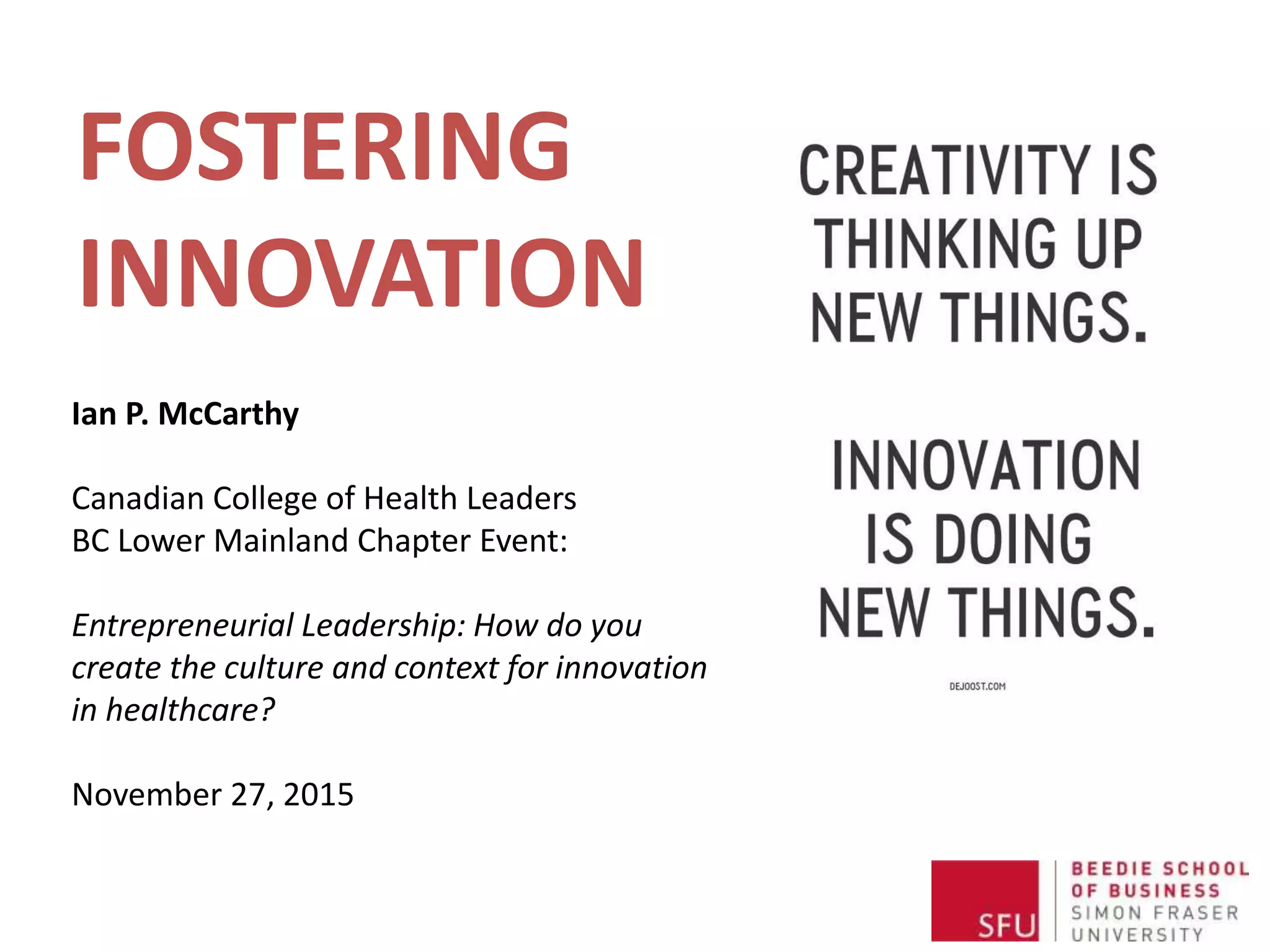
FOSTERING
INNOVATION
INTRODUCTION
@Toffeemen68
Ian_mccarthy@sfu.ca
www.slideshare.net/IanMcCarthy
2
INTRODUCTION
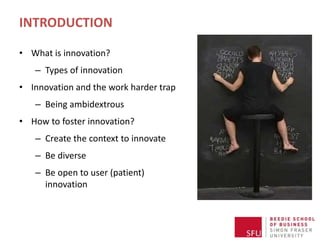
• What is innovation?
– Types of innovation
• Innovation and the work harder trap
– Being ambidextrous
• How to foster innovation?
– Create the context to innovate
– Be diverse
– Be open to user (patient)
innovation
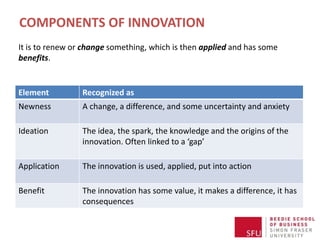
COMPONENTS OF INNOVATION
Element Recognized as
Newness A change, a difference, and some uncertainty and anxiety
Ideation The idea, the spark, the knowledge and the origins of the
innovation. Often linked to a ‘gap’
Application The innovation is used, applied, put into action
Benefit The innovation has some value, it makes a difference, it has
consequences
It is to renew or change something, which is then applied and has some
benefits.
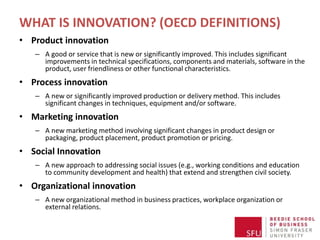
WHAT IS INNOVATION? (OECD DEFINITIONS)
• Product innovation
– A good or service that is new or significantly improved. This includes significant
improvements in technical specifications, components and materials, software in the
product, user friendliness or other functional characteristics.
• Process innovation
– A new or significantly improved production or delivery method. This includes
significant changes in techniques, equipment and/or software.
• Marketing innovation
– A new marketing method involving significant changes in product design or
packaging, product placement, product promotion or pricing.
• Social Innovation
– A new approach to addressing social issues (e.g., working conditions and education
to community development and health) that extend and strengthen civil society.
• Organizational innovation
– A new organizational method in business practices, workplace organization or
external relations.
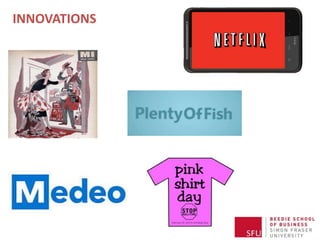
INNOVATIONS
THE WORK HARDER TRAP
• Is it better to work harder or work
smarter (differently)?
• So why is it more common to
work harder?
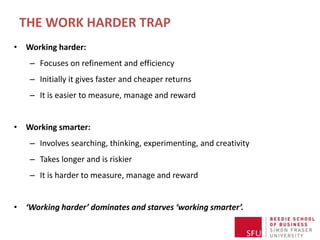
THE WORK HARDER TRAP
• Working harder:
– Focuses on refinement and efficiency
– Initially it gives faster and cheaper returns
– It is easier to measure, manage and reward
• Working smarter:
– Involves searching, thinking, experimenting, and creativity
– Takes longer and is riskier
– It is harder to measure, manage and reward
• ‘Working harder’ dominates and starves ‘working smarter’.
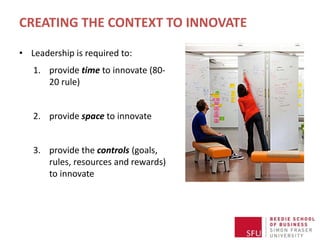
CREATING THE CONTEXT TO INNOVATE
• Leadership is required to:
1. provide time to innovate (80-
20 rule)
2. provide space to innovate
3. provide the controls (goals,
rules, resources and rewards)
to innovate
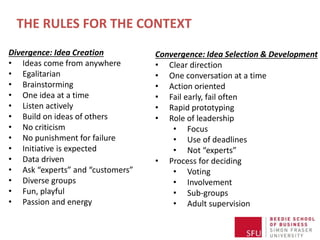
THE RULES FOR THE CONTEXT
Divergence: Idea Creation
• Ideas come from anywhere
• Egalitarian
• Brainstorming
• One idea at a time
• Listen actively
• Build on ideas of others
• No criticism
• No punishment for failure
• Initiative is expected
• Data driven
• Ask “experts” and “customers”
• Diverse groups
• Fun, playful
• Passion and energy
Convergence: Idea Selection & Development
• Clear direction
• One conversation at a time
• Action oriented
• Fail early, fail often
• Rapid prototyping
• Role of leadership
• Focus
• Use of deadlines
• Not “experts”
• Process for deciding
• Voting
• Involvement
• Sub-groups
• Adult supervision
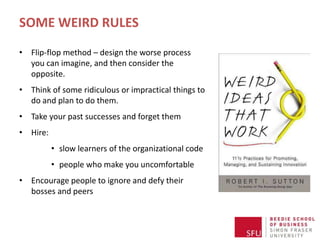
SOME WEIRD RULES
• Flip-flop method – design the worse process
you can imagine, and then consider the
opposite.
• Think of some ridiculous or impractical things to
do and plan to do them.
• Take your past successes and forget them
• Hire:
• slow learners of the organizational code
• people who make you uncomfortable
• Encourage people to ignore and defy their
bosses and peers
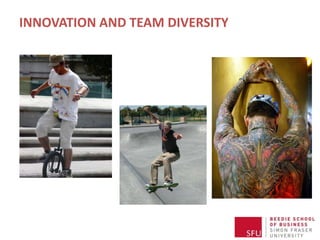
INNOVATION AND TEAM DIVERSITY
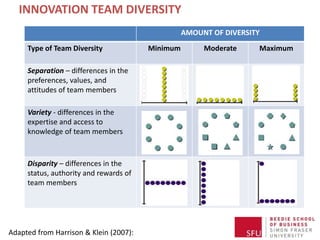
INNOVATION TEAM DIVERSITY
AMOUNT OF DIVERSITY
Type of Team Diversity Minimum Moderate Maximum
Separation – differences in the
preferences, values, and
attitudes of team members
Variety - differences in the
expertise and access to
knowledge of team members
Disparity – differences in the
status, authority and rewards of
team members
Adapted from Harrison & Klein (2007):
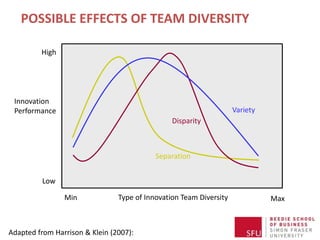
POSSIBLE EFFECTS OF TEAM DIVERSITY
Type of Innovation Team Diversity
Innovation
Performance
Low
High
Min Max
Separation
Disparity
Variety
Adapted from Harrison & Klein (2007):
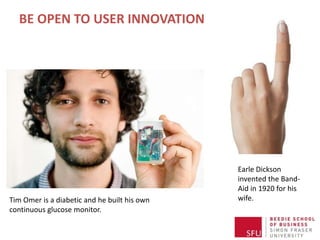
BE OPEN TO USER INNOVATION
Earle Dickson
invented the Band-
Aid in 1920 for his
wife.Tim Omer is a diabetic and he built his own
continuous glucose monitor.
16
SUMMARY AND REFLECTION
• What types of innovation do you
need?
– Different types require different
contexts
• What is your work harder – work
smarter balance?
– If you need to change the
balance, what could you do?
• How “open” are you to innovation?
• If everybody likes your idea for
innovation it is probably not that
innovative.

Fostering innovation

  • 1.
    Ian P. McCarthy CanadianCollege of Health Leaders BC Lower Mainland Chapter Event: Entrepreneurial Leadership: How do you create the culture and context for innovation in healthcare? November 27, 2015 FOSTERING INNOVATION
  • 2.
  • 3.
    INTRODUCTION • What isinnovation? – Types of innovation • Innovation and the work harder trap – Being ambidextrous • How to foster innovation? – Create the context to innovate – Be diverse – Be open to user (patient) innovation
  • 4.
    COMPONENTS OF INNOVATION ElementRecognized as Newness A change, a difference, and some uncertainty and anxiety Ideation The idea, the spark, the knowledge and the origins of the innovation. Often linked to a ‘gap’ Application The innovation is used, applied, put into action Benefit The innovation has some value, it makes a difference, it has consequences It is to renew or change something, which is then applied and has some benefits.
  • 5.
    WHAT IS INNOVATION?(OECD DEFINITIONS) • Product innovation – A good or service that is new or significantly improved. This includes significant improvements in technical specifications, components and materials, software in the product, user friendliness or other functional characteristics. • Process innovation – A new or significantly improved production or delivery method. This includes significant changes in techniques, equipment and/or software. • Marketing innovation – A new marketing method involving significant changes in product design or packaging, product placement, product promotion or pricing. • Social Innovation – A new approach to addressing social issues (e.g., working conditions and education to community development and health) that extend and strengthen civil society. • Organizational innovation – A new organizational method in business practices, workplace organization or external relations.
  • 6.
  • 7.
    THE WORK HARDERTRAP • Is it better to work harder or work smarter (differently)? • So why is it more common to work harder?
  • 8.
    THE WORK HARDERTRAP • Working harder: – Focuses on refinement and efficiency – Initially it gives faster and cheaper returns – It is easier to measure, manage and reward • Working smarter: – Involves searching, thinking, experimenting, and creativity – Takes longer and is riskier – It is harder to measure, manage and reward • ‘Working harder’ dominates and starves ‘working smarter’.
  • 9.
    CREATING THE CONTEXTTO INNOVATE • Leadership is required to: 1. provide time to innovate (80- 20 rule) 2. provide space to innovate 3. provide the controls (goals, rules, resources and rewards) to innovate
  • 10.
    THE RULES FORTHE CONTEXT Divergence: Idea Creation • Ideas come from anywhere • Egalitarian • Brainstorming • One idea at a time • Listen actively • Build on ideas of others • No criticism • No punishment for failure • Initiative is expected • Data driven • Ask “experts” and “customers” • Diverse groups • Fun, playful • Passion and energy Convergence: Idea Selection & Development • Clear direction • One conversation at a time • Action oriented • Fail early, fail often • Rapid prototyping • Role of leadership • Focus • Use of deadlines • Not “experts” • Process for deciding • Voting • Involvement • Sub-groups • Adult supervision
  • 11.
    SOME WEIRD RULES •Flip-flop method – design the worse process you can imagine, and then consider the opposite. • Think of some ridiculous or impractical things to do and plan to do them. • Take your past successes and forget them • Hire: • slow learners of the organizational code • people who make you uncomfortable • Encourage people to ignore and defy their bosses and peers
  • 12.
  • 13.
    INNOVATION TEAM DIVERSITY AMOUNTOF DIVERSITY Type of Team Diversity Minimum Moderate Maximum Separation – differences in the preferences, values, and attitudes of team members Variety - differences in the expertise and access to knowledge of team members Disparity – differences in the status, authority and rewards of team members Adapted from Harrison & Klein (2007):
  • 14.
    POSSIBLE EFFECTS OFTEAM DIVERSITY Type of Innovation Team Diversity Innovation Performance Low High Min Max Separation Disparity Variety Adapted from Harrison & Klein (2007):
  • 15.
    BE OPEN TOUSER INNOVATION Earle Dickson invented the Band- Aid in 1920 for his wife.Tim Omer is a diabetic and he built his own continuous glucose monitor.
  • 16.
    16 SUMMARY AND REFLECTION •What types of innovation do you need? – Different types require different contexts • What is your work harder – work smarter balance? – If you need to change the balance, what could you do? • How “open” are you to innovation? • If everybody likes your idea for innovation it is probably not that innovative.