INTRODUCTION
 Innovation has long been argued to be the
engine of growth. if the idea seems new and
different to the individual it is an innovation
 The success or even survival of an institution
depends on making necessary changes and
innovations
DEFINITION
 Innovation is defined as the generation of new
ideas or application of existing ideas to a new
situation resulting in improvement in
organization
(Huber 1996)
DEFINITION
 Innovation is the action of introducing a new
method, idea or product
(Ducker 1992)
NEED OF INNOVATION
Continuous improvement in nursing
Fulfilling the demand for health services
Rendering holistic and high-quality care
Compensating shortage of workforce
NEED OF INNOVATION
Replacing traditional methods of teaching and
practices
Coping with the changing needs of clients
Solving work-related problems.
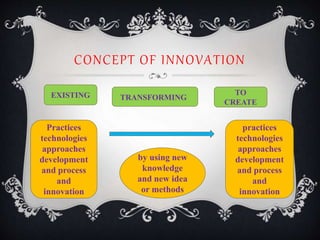
CONCEPT OF INNOVATION
EXISTING TRANSFORMING
TO
CREATE
Practices
technologies
approaches
development
and process
and
innovation
practices
technologies
approaches
development
and process
and
innovation
by using new
knowledge
and new idea
or methods
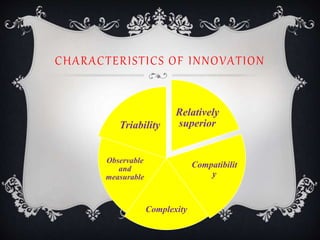
CHARACTERISTICS OF INNOVATION
Relatively
superior
Compatibilit
y
Complexity
Observable
and
measurable
Triability
RELATIVELY SUPERIOR
With regard to its utility and outcome,
the Innovation must be superior to the
existing one, It must focus on the needs
and satisfaction of the client and be cost-
effective,
COMPATIBILITY
The new ideas must be compatible with the existing
values, norms, skills and practices, and cost.
It must also fit with the needs, experiences, and benefits
of clients.
COMPLEXITY
 Innovations if challenging in understanding and
sophisticated to practice may lose its adaptability.
Therefore, Innovation must satisfy the needs of the
client,
OBSERVABLE AND MEASURABLE
 Creative ideas must be able to observe
and measure their outcomes without any
adverse effects. The effectiveness of an
innovation must be checked.
TRIALABILITY
Creative Ideas/products and processes need to
be tested for its efficiency and effectiveness,
generating positive effects and reducing the
chances of adaptability.
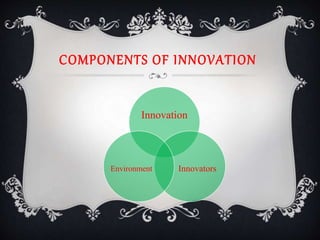
COMPONENTS OF INNOVATION
Innovation
Innovators
Environment
INNOVATION
 Changes can be accounted for by
Implementing new ideas or creating new
technology, tools or products, policies, services,
procedures, or devices. Clients should adapt
and customize an innovation based on their
individual need.
INNOVATORS
Individuals/innovators comprise individuals or groups
of people who solve the problems or create well-accepted
technology, tools, products, or intervention of novelty. The
innovator must be sensitive to each opportunity.
 The we-feeling among the team members allow free
communication and exchange of ideas from different
perspectives.
ENVIRONMENT:
 Environmental-structural support is critical to give shape to
innovation. It constitutes the culture, physical, social, and psychological
and organizational atmosphere essential to facilitate and support
creative ideas.
 The favorable and positive attitude of the supervisor is critical for
the development and implementation of creative ideas.
TYPES OF INNOVATION
Process innovations: Process innovations
are the novelties within services,
interventions, approaches ,etc
Product innovations: These innovations
concern products, tools, and standard
procedures required to carry out the
processes.
Incremental innovations: Incremental innovations
create new practices by minor modification in the existing
methods, knowledge, and resources. It enhances
competency on a small scale and considers lifeblood of
innovation.
Radical innovations: Radical innovations are
significant changes in the existing practices and require
new knowledge and resources. It varies from organization
to organization. The current competencies lose value and
show a substantial shift in performance.
Competence-enhancing innovations:
These innovations build by improving the existing
knowledge base
Component innovation: It refers to changes in one part
of the system without changing the overall strategy.
Architectural innovation:It refers to changes in the
overall design or all parts of a system.
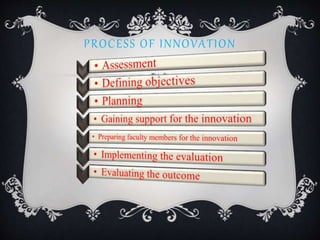
PROCESS OF INNOVATION
ASSESSMENT
 It is the first step of process and it requires a
look at both the strength and problems.
 An administrator must focus on what is specific
content requirement the expected outcome.
 Specific content requirement changes often in
the health care, as new technologies and
research bring new knowledge needs.
DEFINING OBJECTIVES
The administrator should search for research or
technique that could address the identical needs.
Asking the peers for the suggestion is also
helpful.
This is the place where the creativity begins.
It is important to look at many different ways to
address the learning objectives before selecting
one
PLANNING
 Once a strategy has been selected the third step, planning is important.
 Understand who the stakeholders are and what their investment is in the
status quo or in
 change can be helpful in planning the strategies to bring them on board.
 Many stake holders do not like the changes and will resist the new
approaches.
 Using the change theory it can assist in demonstrating the needs and
provide information that can make resistors more amenable to change.
 It‘s important to take time to develop a support for the strategy.
 In more complex strategies it may be important to bring
other administrators.
GAINING SUPPORT FOR THE
INNOVATION
 Some strategies require little or resources to implement where
as others require
 significant physical and financial resources. If resources are
needed then gaining support
 for the accusation of those resources are essential. Grants can
provide good funding
 sources but require time and effort to secure and may be for a
limited time.
 Administrative support may be required but administrators may
also be an excellent
 resource to tap to discuss the potential funding or acquisitions of
the physical resource.
PREPARING FACULTY MEMBERS FOR
THE INNOVATION
Rehearsal time may be required or additional
education may be required. Planning
sufficient for those activities will agrees how
the strategy will be in run.
 Use of perception,
validate and clarification can be a valuable
tool.
IMPLEMENTING THE
EVALUATION
In this step it is hope that the things will be going well,
but flexibility may be required if problems arise.
Sometimes unintended consequences, such as surfacing
of emotional issues can occur.
Administrator should be alert to the need for the follow
up or referral if problem arise.
EVALUATING THE OUTCOME
It is the final step of the process. It may be
possible to measure short term attainment goals.
A strong evaluation process provides an
opportunity to evaluate the outcome of the change.
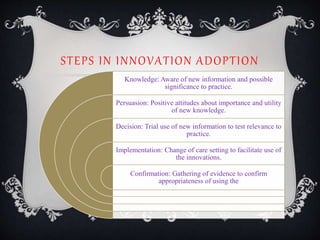
STEPS IN INNOVATION ADOPTION
Knowledge: Aware of new information and possible
significance to practice.
Persuasion: Positive attitudes about importance and utility
of new knowledge.
Decision: Trial use of new information to test relevance to
practice.
Implementation: Change of care setting to facilitate use of
the innovations.
Confirmation: Gathering of evidence to confirm
appropriateness of using the
INNOVATION IN NURSING
EDUCATION
 Simulation and virtual simulations:
 Personal digital assistants:
 Distance and online education:
 Videoconferencing
 Microteaching
 E-learning
 Problem-based learning
 Objective structured clinical examination:
INNOVATION IN CLINICAL PRACTICE
AREA
 Health Information technology
 Electronic health record (EHR)
 Mobile technologies
 Bar coding and incidence reporting system:
 Automated dispensing machines
 Virtual nurse avatars
 Telenursing/Telehealth
 Wireless and handheld technologies
INNOVATION IN CLINICAL PRACTICE
AREA
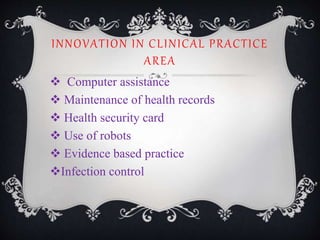
 Computer assistance
 Maintenance of health records
 Health security card
 Use of robots
 Evidence based practice
Infection control
INNOVATION IN CLINICAL PRACTICE
AREA
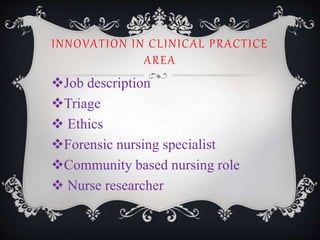
Job description
Triage
 Ethics
Forensic nursing specialist
Community based nursing role
 Nurse researcher
INNOVATION INADMINISTRATIONAND
MANAGEMENT
 Use of computer
 Computerized physician order entry (CPOE)
 Clinical decision support system (CDSS)
 Electronic medical.
 Leadership for change
 Staffing Structure
 Benchmarking
 Personal Management
CONCLUSION
 Everyday nurse are developing new
and innovative approaches to improve
healthcare services and healthcare
outcome for local people.
 Nursing innovation are key to
improvement and progress in health
systems worldwide.
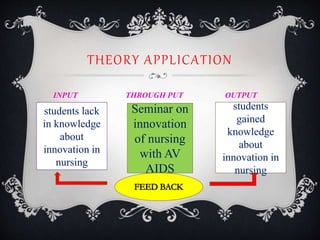
THEORY APPLICATION
INPUT THROUGH PUT OUTPUT
students lack
in knowledge
about
innovation in
nursing
Seminar on
innovation
of nursing
with AV
AIDS
students
gained
knowledge
about
innovation in
nursing
ASSIGNMENT
Write an assignment on your own new
idea about innovation in nursing
education , nursing practice and
management
JOURNAL REFERENCE
Yıldız Ayvaz, M.,Akyol Y.E.,Demiral M. (2019) Innovation in Nursing
and Innovative Attitudes of Nurses, International Health Administration
and Education (Sanitas Magisterium), 5(2), 52-59.
As a professional health discipline, it should develop
innovative thinking skills in order to keep up with the rapidly
changing and developing science in nursing, to manage global
competition well, and to benefit from innovative methods
especially in health care practices.
Compared to other health care professionals, nurses who spend the most
time with patients are more likely to recognize inadequacies and
deficiencies in patient care and are more likely to develop innovative
practices for them. In literature, it is stated that nurses should have
creative, equipped, leadership role and risk-taking personality traits in
order to produce innovative solutions. In addition, it has been determined
that manager support has great importance in the development of
innovation culture. It was emphasized that nurses supported and guided
by managers were more successful in innovation. Increased workload is
one of the leading factors that negatively affect the nurses' innovative
attitudes. Although in recent years innovative ideas and innovation
studies in Turkey has increased, a limited number of studies were
found for the nursing profession. In this review, it is aimed to draw
attention to the importance of nursing innovation and nurses'
innovative attitudes.
INNOVATIONS IN NURSING( nursing Management)

INNOVATIONS IN NURSING( nursing Management)

  • 4.
    INTRODUCTION  Innovation haslong been argued to be the engine of growth. if the idea seems new and different to the individual it is an innovation  The success or even survival of an institution depends on making necessary changes and innovations
  • 5.
    DEFINITION  Innovation isdefined as the generation of new ideas or application of existing ideas to a new situation resulting in improvement in organization (Huber 1996)
  • 6.
    DEFINITION  Innovation isthe action of introducing a new method, idea or product (Ducker 1992)
  • 7.
    NEED OF INNOVATION Continuousimprovement in nursing Fulfilling the demand for health services Rendering holistic and high-quality care Compensating shortage of workforce
  • 8.
    NEED OF INNOVATION Replacingtraditional methods of teaching and practices Coping with the changing needs of clients Solving work-related problems.
  • 9.
    CONCEPT OF INNOVATION EXISTINGTRANSFORMING TO CREATE Practices technologies approaches development and process and innovation practices technologies approaches development and process and innovation by using new knowledge and new idea or methods
  • 10.
  • 11.
  • 12.
    RELATIVELY SUPERIOR With regardto its utility and outcome, the Innovation must be superior to the existing one, It must focus on the needs and satisfaction of the client and be cost- effective,
  • 13.
    COMPATIBILITY The new ideasmust be compatible with the existing values, norms, skills and practices, and cost. It must also fit with the needs, experiences, and benefits of clients.
  • 14.
    COMPLEXITY  Innovations ifchallenging in understanding and sophisticated to practice may lose its adaptability. Therefore, Innovation must satisfy the needs of the client,
  • 15.
    OBSERVABLE AND MEASURABLE Creative ideas must be able to observe and measure their outcomes without any adverse effects. The effectiveness of an innovation must be checked.
  • 16.
    TRIALABILITY Creative Ideas/products andprocesses need to be tested for its efficiency and effectiveness, generating positive effects and reducing the chances of adaptability.
  • 17.
  • 18.
  • 19.
    INNOVATION  Changes canbe accounted for by Implementing new ideas or creating new technology, tools or products, policies, services, procedures, or devices. Clients should adapt and customize an innovation based on their individual need.
  • 20.
    INNOVATORS Individuals/innovators comprise individualsor groups of people who solve the problems or create well-accepted technology, tools, products, or intervention of novelty. The innovator must be sensitive to each opportunity.  The we-feeling among the team members allow free communication and exchange of ideas from different perspectives.
  • 21.
    ENVIRONMENT:  Environmental-structural supportis critical to give shape to innovation. It constitutes the culture, physical, social, and psychological and organizational atmosphere essential to facilitate and support creative ideas.  The favorable and positive attitude of the supervisor is critical for the development and implementation of creative ideas.
  • 22.
  • 23.
    Process innovations: Processinnovations are the novelties within services, interventions, approaches ,etc Product innovations: These innovations concern products, tools, and standard procedures required to carry out the processes.
  • 24.
    Incremental innovations: Incrementalinnovations create new practices by minor modification in the existing methods, knowledge, and resources. It enhances competency on a small scale and considers lifeblood of innovation. Radical innovations: Radical innovations are significant changes in the existing practices and require new knowledge and resources. It varies from organization to organization. The current competencies lose value and show a substantial shift in performance.
  • 25.
    Competence-enhancing innovations: These innovationsbuild by improving the existing knowledge base Component innovation: It refers to changes in one part of the system without changing the overall strategy. Architectural innovation:It refers to changes in the overall design or all parts of a system.
  • 26.
  • 27.
    ASSESSMENT  It isthe first step of process and it requires a look at both the strength and problems.  An administrator must focus on what is specific content requirement the expected outcome.  Specific content requirement changes often in the health care, as new technologies and research bring new knowledge needs.
  • 28.
    DEFINING OBJECTIVES The administratorshould search for research or technique that could address the identical needs. Asking the peers for the suggestion is also helpful. This is the place where the creativity begins. It is important to look at many different ways to address the learning objectives before selecting one
  • 29.
    PLANNING  Once astrategy has been selected the third step, planning is important.  Understand who the stakeholders are and what their investment is in the status quo or in  change can be helpful in planning the strategies to bring them on board.  Many stake holders do not like the changes and will resist the new approaches.  Using the change theory it can assist in demonstrating the needs and provide information that can make resistors more amenable to change.  It‘s important to take time to develop a support for the strategy.  In more complex strategies it may be important to bring other administrators.
  • 30.
    GAINING SUPPORT FORTHE INNOVATION  Some strategies require little or resources to implement where as others require  significant physical and financial resources. If resources are needed then gaining support  for the accusation of those resources are essential. Grants can provide good funding  sources but require time and effort to secure and may be for a limited time.  Administrative support may be required but administrators may also be an excellent  resource to tap to discuss the potential funding or acquisitions of the physical resource.
  • 31.
    PREPARING FACULTY MEMBERSFOR THE INNOVATION Rehearsal time may be required or additional education may be required. Planning sufficient for those activities will agrees how the strategy will be in run.  Use of perception, validate and clarification can be a valuable tool.
  • 32.
    IMPLEMENTING THE EVALUATION In thisstep it is hope that the things will be going well, but flexibility may be required if problems arise. Sometimes unintended consequences, such as surfacing of emotional issues can occur. Administrator should be alert to the need for the follow up or referral if problem arise.
  • 33.
    EVALUATING THE OUTCOME Itis the final step of the process. It may be possible to measure short term attainment goals. A strong evaluation process provides an opportunity to evaluate the outcome of the change.
  • 34.
    STEPS IN INNOVATIONADOPTION Knowledge: Aware of new information and possible significance to practice. Persuasion: Positive attitudes about importance and utility of new knowledge. Decision: Trial use of new information to test relevance to practice. Implementation: Change of care setting to facilitate use of the innovations. Confirmation: Gathering of evidence to confirm appropriateness of using the
  • 35.
    INNOVATION IN NURSING EDUCATION Simulation and virtual simulations:  Personal digital assistants:  Distance and online education:  Videoconferencing  Microteaching  E-learning  Problem-based learning  Objective structured clinical examination:
  • 36.
    INNOVATION IN CLINICALPRACTICE AREA  Health Information technology  Electronic health record (EHR)  Mobile technologies  Bar coding and incidence reporting system:  Automated dispensing machines  Virtual nurse avatars  Telenursing/Telehealth  Wireless and handheld technologies
  • 37.
    INNOVATION IN CLINICALPRACTICE AREA  Computer assistance  Maintenance of health records  Health security card  Use of robots  Evidence based practice Infection control
  • 38.
    INNOVATION IN CLINICALPRACTICE AREA Job description Triage  Ethics Forensic nursing specialist Community based nursing role  Nurse researcher
  • 39.
    INNOVATION INADMINISTRATIONAND MANAGEMENT  Useof computer  Computerized physician order entry (CPOE)  Clinical decision support system (CDSS)  Electronic medical.  Leadership for change  Staffing Structure  Benchmarking  Personal Management
  • 41.
    CONCLUSION  Everyday nurseare developing new and innovative approaches to improve healthcare services and healthcare outcome for local people.  Nursing innovation are key to improvement and progress in health systems worldwide.
  • 42.
    THEORY APPLICATION INPUT THROUGHPUT OUTPUT students lack in knowledge about innovation in nursing Seminar on innovation of nursing with AV AIDS students gained knowledge about innovation in nursing
  • 43.
    ASSIGNMENT Write an assignmenton your own new idea about innovation in nursing education , nursing practice and management
  • 44.
    JOURNAL REFERENCE Yıldız Ayvaz,M.,Akyol Y.E.,Demiral M. (2019) Innovation in Nursing and Innovative Attitudes of Nurses, International Health Administration and Education (Sanitas Magisterium), 5(2), 52-59. As a professional health discipline, it should develop innovative thinking skills in order to keep up with the rapidly changing and developing science in nursing, to manage global competition well, and to benefit from innovative methods especially in health care practices.
  • 45.
    Compared to otherhealth care professionals, nurses who spend the most time with patients are more likely to recognize inadequacies and deficiencies in patient care and are more likely to develop innovative practices for them. In literature, it is stated that nurses should have creative, equipped, leadership role and risk-taking personality traits in order to produce innovative solutions. In addition, it has been determined that manager support has great importance in the development of innovation culture. It was emphasized that nurses supported and guided by managers were more successful in innovation. Increased workload is one of the leading factors that negatively affect the nurses' innovative attitudes. Although in recent years innovative ideas and innovation studies in Turkey has increased, a limited number of studies were found for the nursing profession. In this review, it is aimed to draw attention to the importance of nursing innovation and nurses' innovative attitudes.