The imbalanced antiferromagnet
      in an optical lattice

  Arnaud                        Henk Stoof
  Koetsier


             Floris van Liere
Introduction

• Fermions in an optical lattice
      • Described by the Hubbard model
      • Realised experimentally [Esslinger ’05]
      • Fermionic Mott insulator recently seen [Esslinger ’08, Bloch
      ’08]
      • There is currently a race to create the Néel state


• Imbalanced Fermi gases
      • Experimentally realised [Ketterle ’06, Hulet ’06]
      • High relevance to other areas of physics (particle
      physics, neutron stars, etc.)

• Imbalanced Fermi gases in an optical lattice ??


                                                                       2
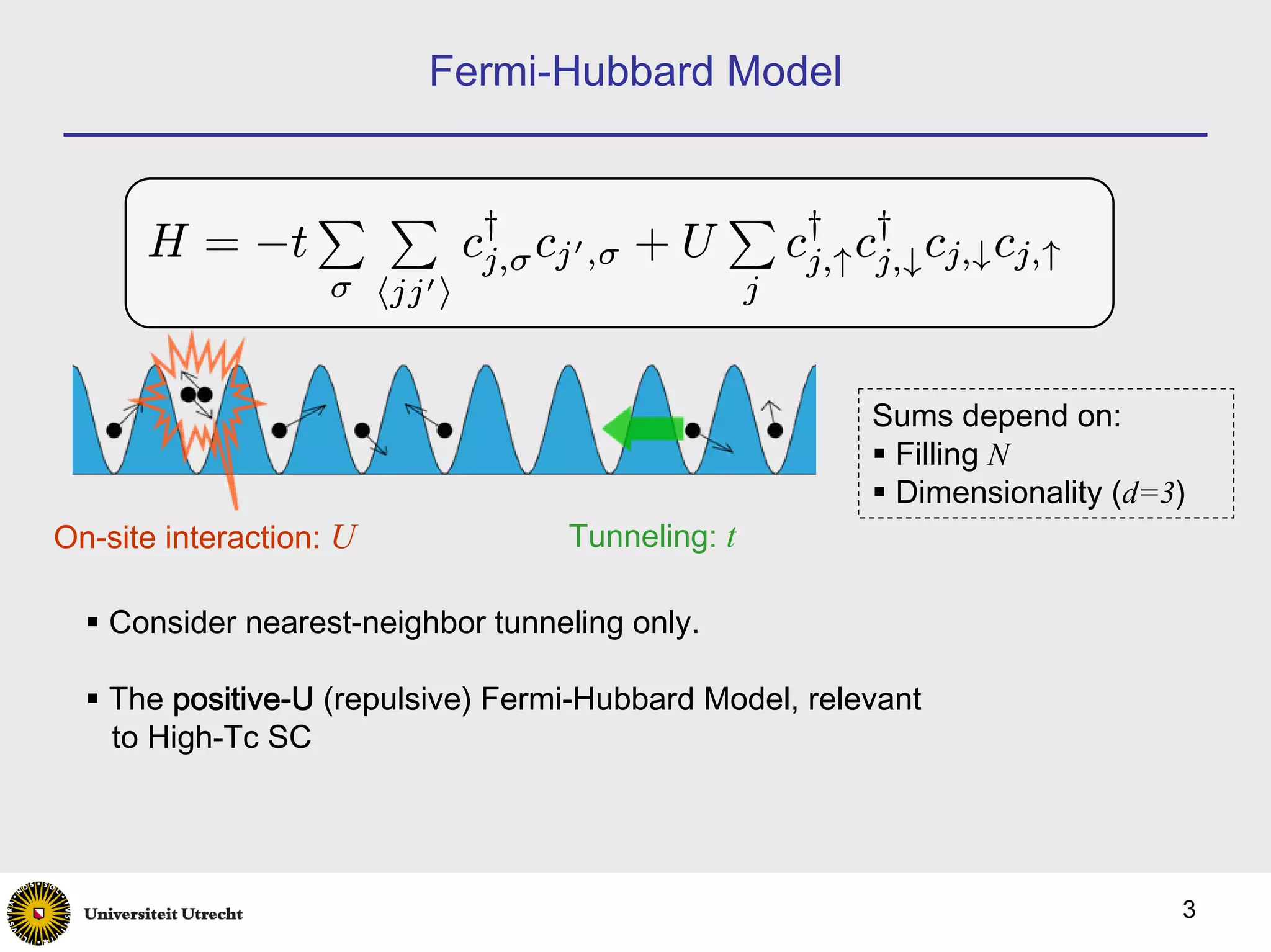
Fermi-Hubbard Model


                   P P                            P
      H = −t                    c† cj 0 ,σ
                                 j,σ         +U          c† c† cj,↓ cj,↑
                                                          j,↑ j,↓
                    σ hjj 0 i                        j


                                                             Sums depend on:
                                                              Filling N
                                                              Dimensionality (d=3)
On-site interaction: U                Tunneling: t

    Consider nearest-neighbor tunneling only.

    The positive-U (repulsive) Fermi-Hubbard Model, relevant
    to High-Tc SC


                                                                                 3
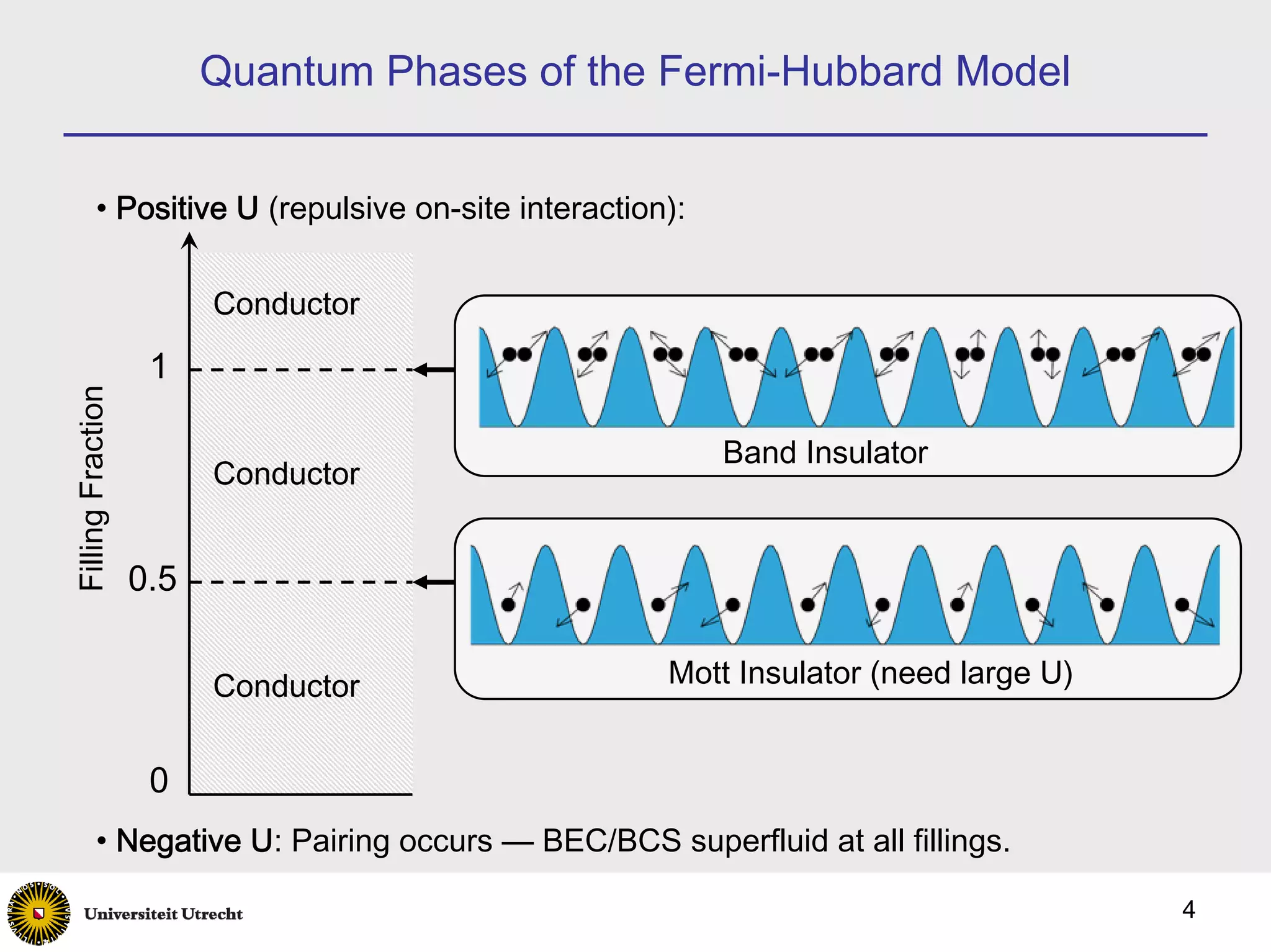
Quantum Phases of the Fermi-Hubbard Model


          • Positive U (repulsive on-site interaction):


                         Conductor

                    1
Filling Fraction


                                                          Band Insulator
                         Conductor


                   0.5


                         Conductor                   Mott Insulator (need large U)


                    0
          • Negative U: Pairing occurs — BEC/BCS superfluid at all fillings.

                                                                                     4
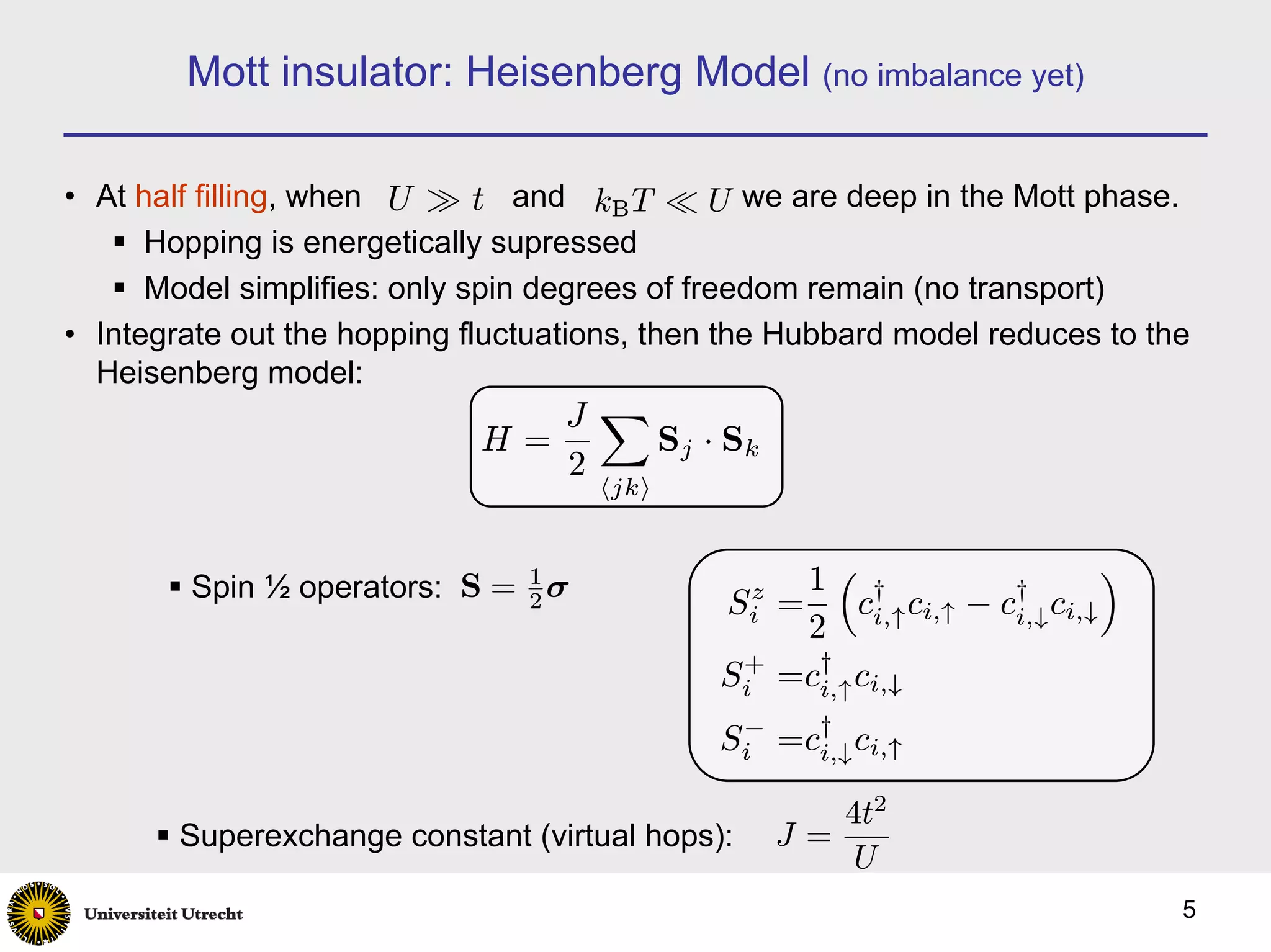
Mott insulator: Heisenberg Model (no imbalance yet)

• At half filling, when U À t and kB T ¿ U we are deep in the Mott phase.
      Hopping is energetically supressed
      Model simplifies: only spin degrees of freedom remain (no transport)
• Integrate out the hopping fluctuations, then the Hubbard model reduces to the
  Heisenberg model:
                                J X
                             H=     S j · Sk
                                2
                                     hjki


        Spin ½ operators: S = 1 σ              z   1³ †              †
                                                                              ´
                              2               Si =      ci,↑ ci,↑ − ci,↓ ci,↓
                                                   2
                                              Si =c† ci,↓
                                               +
                                                    i,↑

                                             Si =c† ci,↑
                                              −
                                                  i,↓

                                                      4t2
        Superexchange constant (virtual hops):     J=
                                                       U
                                                                                  5
Néel State (no imbalance yet)


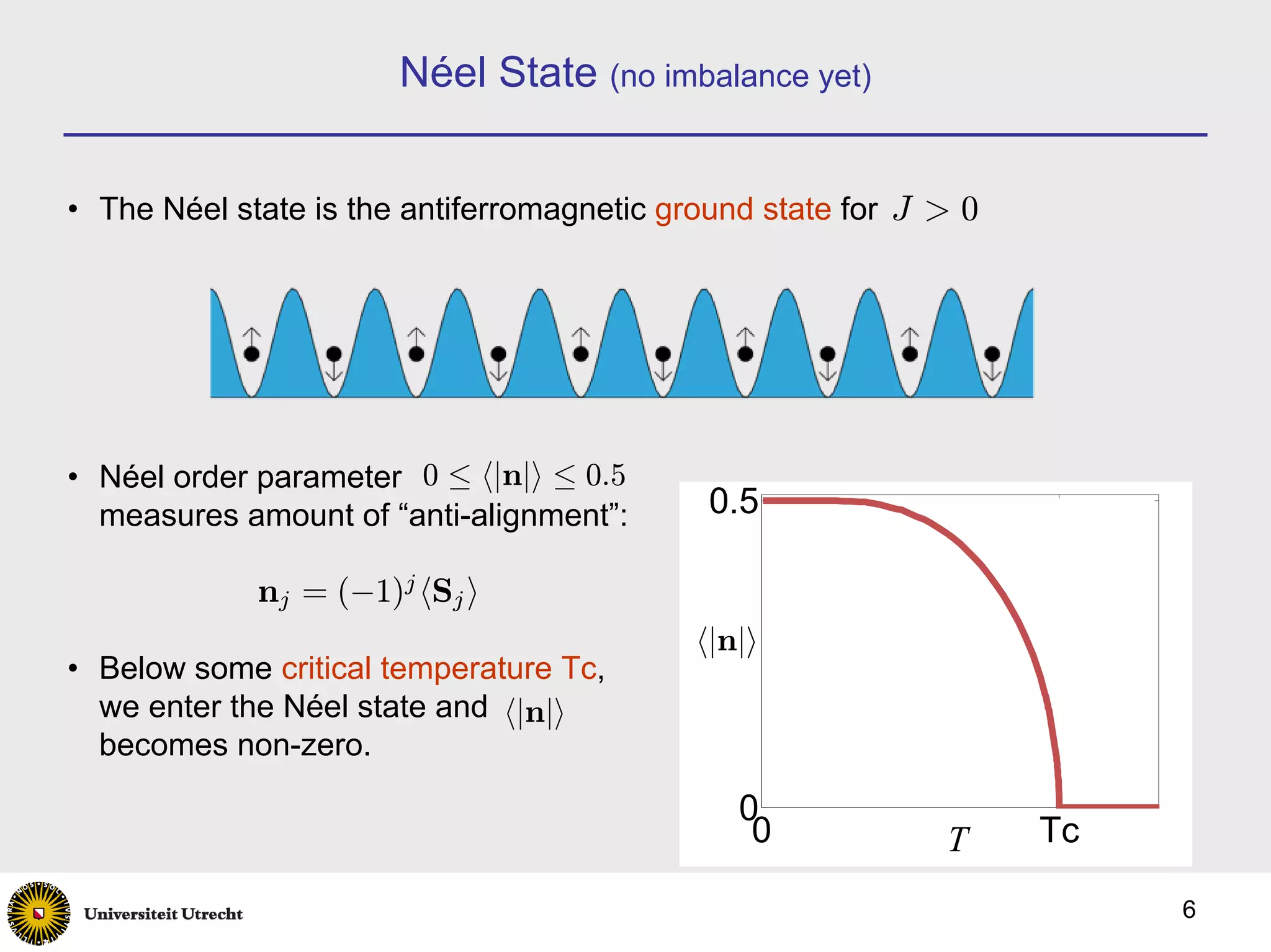
• The Néel state is the antiferromagnetic ground state for J > 0


• Néel order parameter 0 ≤ h|n|i ≤ 0.5
  measures amount of “anti-alignment”:       0.5

             nj = (−1)j hSj i


                                            〈n〉
                                            h|n|i
• Below some critical temperature Tc,
  we enter the Néel state and h|n|i
  becomes non-zero.

                                               0
                                                0            T     Tc

                                                                        6
Heisenberg Model with imbalance

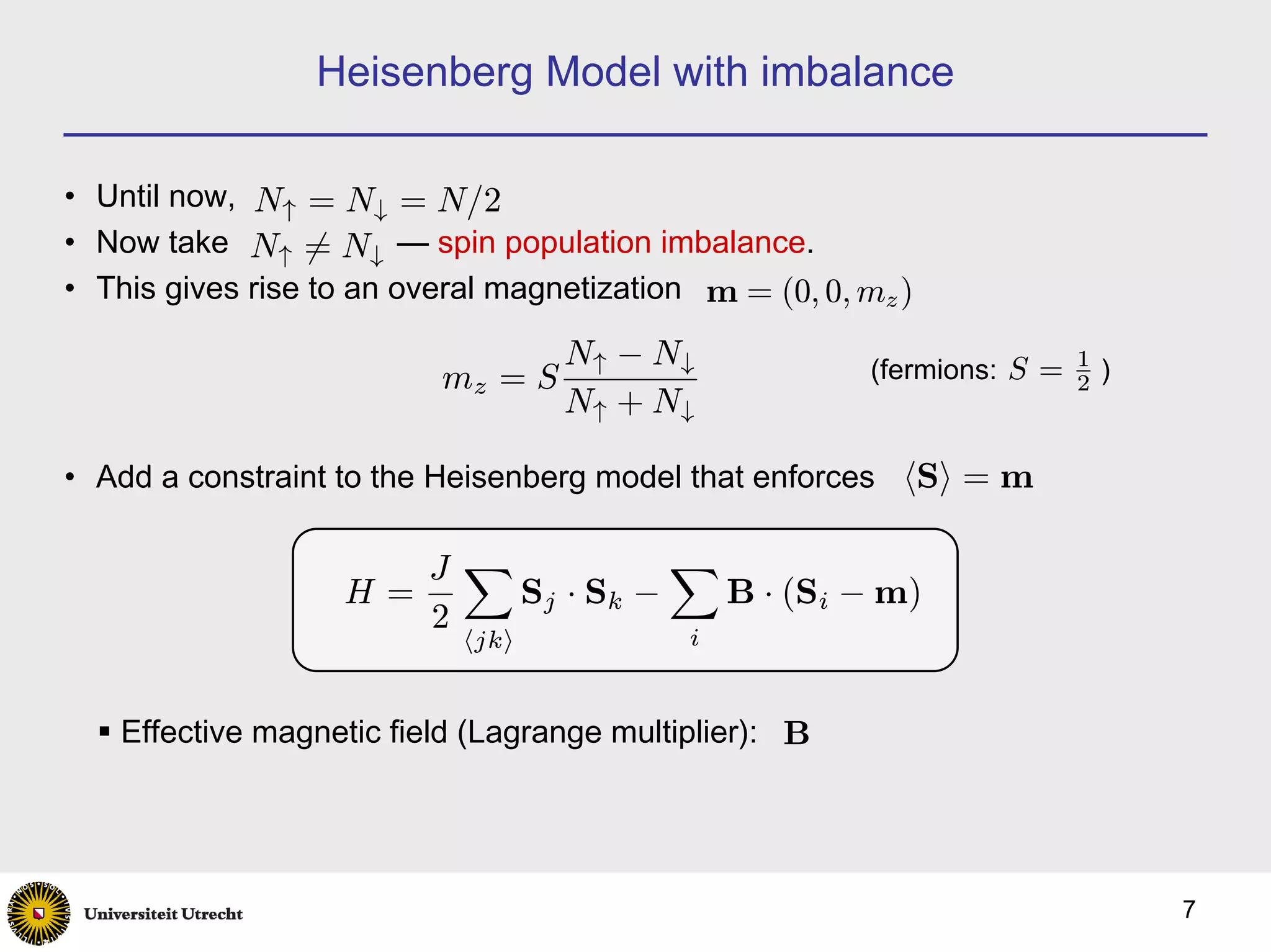
• Until now, N↑ = N↓ = N/2
• Now take N↑ 6= N↓ — spin population imbalance.
• This gives rise to an overal magnetization m = (0, 0, mz )

                                   N↑ − N↓              (fermions: S = 1 )
                          mz = S                                       2
                                   N↑ + N↓

• Add a constraint to the Heisenberg model that enforces hSi = m

                      J X            X
                   H=     S j · Sk −   B · (Si − m)
                      2
                            hjki            i


    Effective magnetic field (Lagrange multiplier): B


                                                                             7
Mean field analysis

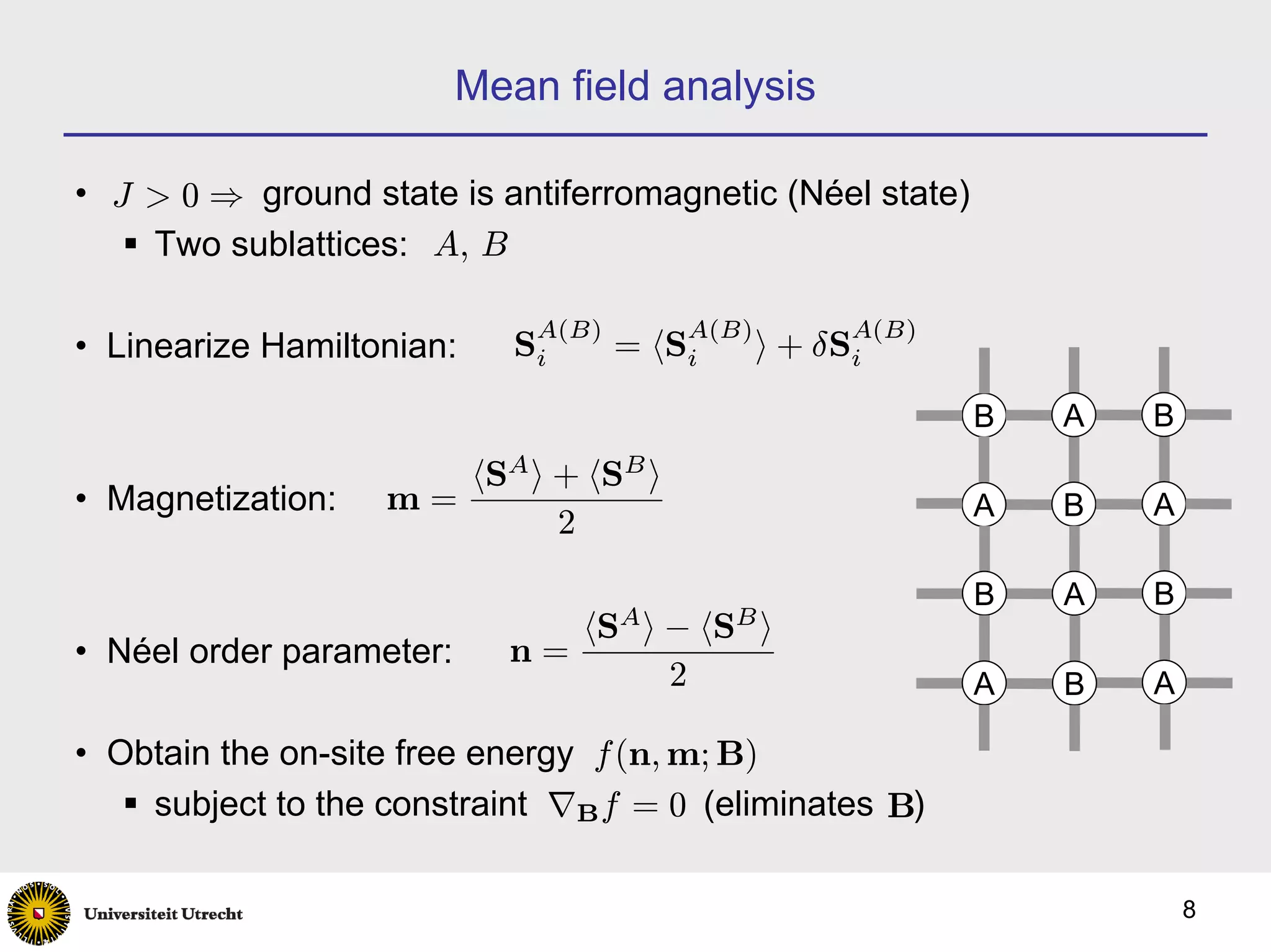
• J > 0 ⇒ ground state is antiferromagnetic (Néel state)
    Two sublattices: A, B

                              A(B)       A(B)         A(B)
• Linearize Hamiltonian:     Si      = hSi      i + δSi

                                                             B   A   B
                      hSA i + hSB i
• Magnetization:   m=                                        A   B   A
                            2

                                                             B   A   B
                                     A       B
                                  hS i − hS i
• Néel order parameter:     n=
                                       2                     A   B   A

• Obtain the on-site free energy f (n, m; B)
    subject to the constraint ∇B f = 0 (eliminates B)

                                                                         8
Phase Diagram in three dimensions

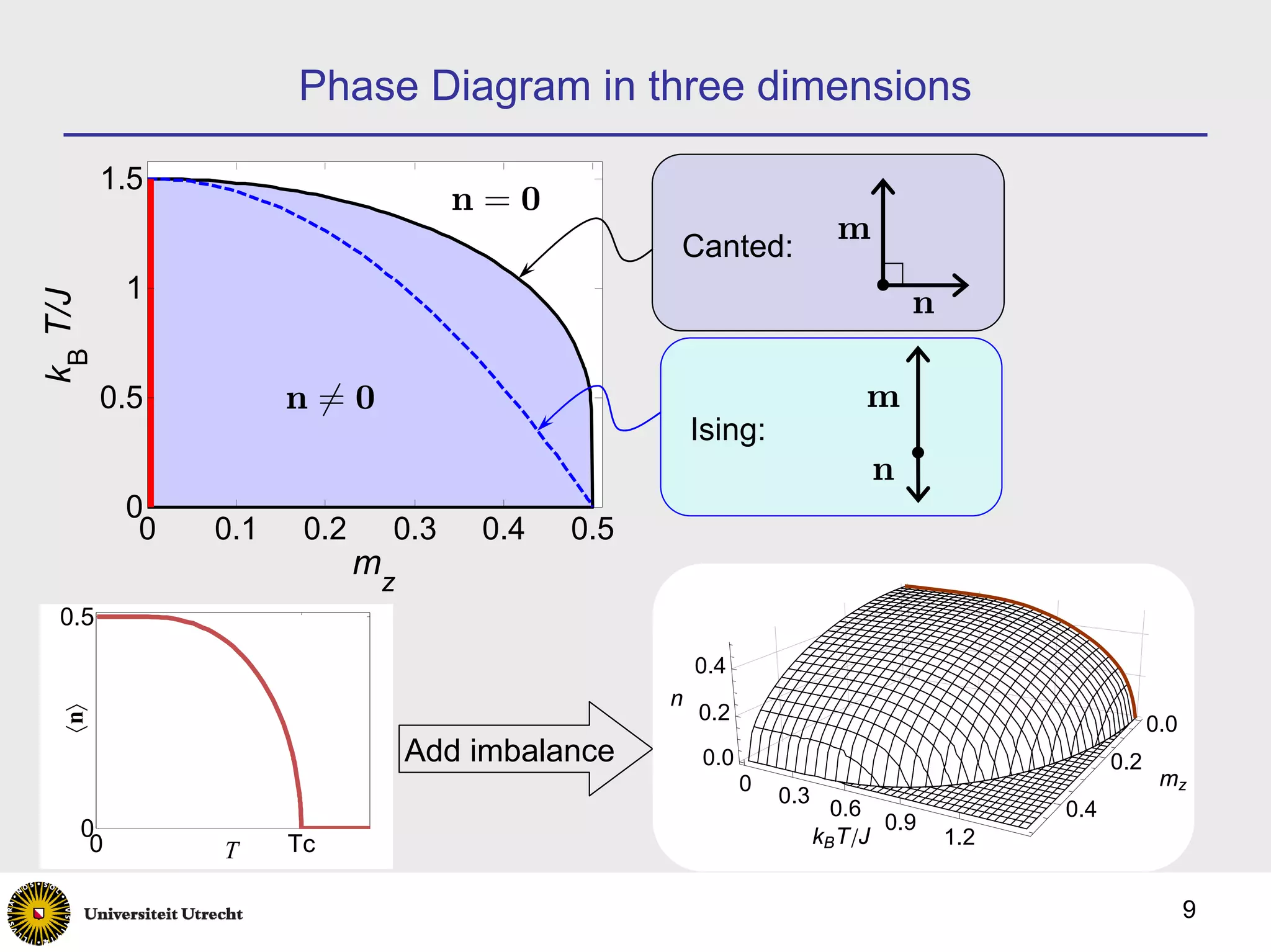
         1.5
                                    n=0
                                                                       m
                                                 Canted:
          1                                                                    n
kB T/J


         0.5         n 6= 0                                               m
                                                     Ising:
                                                                           n
          0
           0   0.1    0.2     0.3    0.4   0.5
                            mz
  0.5
                                                     0.4
                                                 n
  〈n〉


                                                     0.2
                                                                                                     0.0
                                 Add imbalance       0.0                                       0.2
                                                           0                                          mz
                                                               0.3
                                                                       0.6               0.4
    0                                                                       0.9
     0               Tc                                              kB T J        1.2
               T

                                                                                                           9
Spin waves (magnons)
                                                   dS  i
  • Spin dynamics can be found from:                  = [H, S]
                                                   dt  ~


No imbalance: Doubly                     0.5
degenerate antiferromagnetic
dispersion
                                         0.4
  • Imbalance splits the
                               ¯ ω/J z
                                         0.3
    degeneracy:
                                         0.2                            Gap:
                               h

        Ferromagnetic                                                 (Larmor
        magnons: ω ∝ k2                  0.1                          precession
                                                                      of n)
                                          0 π                                      π
        Antiferromagnetic
                                          −                      0
        magnons: ω ∝ |k|                       2                 kd                2
                                                                               10
Long-wavelength dynamics: NLσM

• Dynamics are summarised a non-linear sigma model with an action
            Z     Z     ½          µ                           ¶2
                        dx     1      ∂n(x, t)
S[n(x, t)] = dt                     ~          − 2Jzm × n(x, t)
                        dD 4Jzn2         ∂t
                                                             2
                                                                            ¾
                                                          Jd
                                                        −       [∇n(x, t)]2
          • lattice spacing: d = λ/2                       2
          • number of nearest neighbours: z = 2D
          • local staggered magnetization: n(x, t)

• The equilibrium value of n(x, t) is found from the Landau free energy:
                     Z      ½ 2                          ¾
                        dx Jd               2
       F [n(x), m] =                [∇n(x)] + f [n(x), m]
                        dD     2

• NLσM admits spin waves but also topologically stable excitations in
  the local staggered magnetisation n(x, t).
                                                                         11
Topological excitations

• The topological excitaitons are vortices; Néel vector has an out-of-
  easy-plane component in the core
• In two dimensions, these are merons:
• Spin texture of a meron:
       ⎛ p                     ⎞
          n 2 − [n (r)]2 cos φ
          p       z
   n = ⎝nv n2 − [nz (r)]2 sin φ⎠
                nz (r)                     nv = 1

                           n
• Ansatz: nz (r) =
                     [(r/λ)2 + 1]2

• Merons characterised by:
    Pontryagin index ±½
    Vorticity nv = ±1
    Core size λ                           nv = −1
                                                                         12
Meron size

• Core size λ of meron found by plugging the spin texture into F [n(x), m]
  and minimizing (below Tc):
         1.5                                                                     Meron core size
                                                     6
          1                                      Λ
kB T/J


                     Merons                          4
                                                 d 2
         0.5         present                                                                 1.5
                                                                                           1.2
                                                     0                                   0.9
          0                                           0                                       kB T J
           0   0.1    0.2    0.3   0.4   0.5              0.1                          0.6
                            mz                                  0.2
                                                                     0.3            0.3
                                                                  mz       0.4

• The energy of a single meron diverges logarithmically with the
  system area A at low temperature as
                                                Jn2 π    A
                                                      ln 2
                                                 2      πλ
     merons must be created in pairs.
                                                                                                13
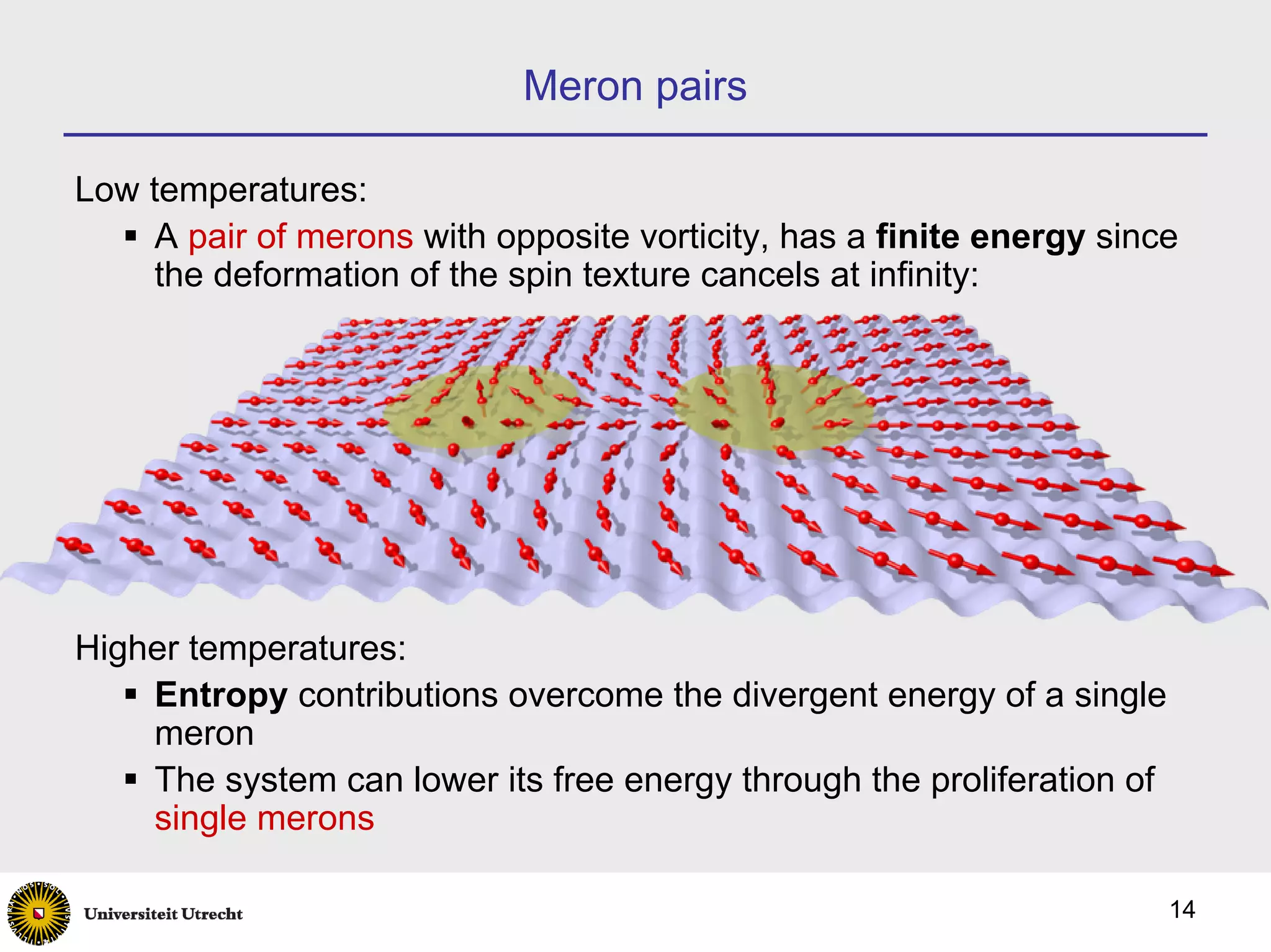
Meron pairs

Low temperatures:
     A pair of merons with opposite vorticity, has a finite energy since
     the deformation of the spin texture cancels at infinity:


Higher temperatures:
    Entropy contributions overcome the divergent energy of a single
    meron
    The system can lower its free energy through the proliferation of
    single merons

                                                                        14
Kosterlitz-Thouless transition

• The unbinding of meron pairs in 2D signals a KT transition. This
  drives down Tc compared with MFT:
            1                  MFT in 2D
           0.8                                      0.06

           0.6
  kB T/J


                                           kB T/J
                                                    0.04
                                                            n 6= 0
           0.4
                         KT transition              0.02
           0.2

            0                                         0
                                                       0   0.05      0.1
             0    0.2           0.4
                                                             mz
                        mz
• New Tc obtained by analogy to an anisotropic O(3) model (Monte
  Carlo results: [Klomfass et al, Nucl. Phys. B360, 264 (1991)] )


                                                                           15
Experimental feasibility

• Experimental realisation:
    Imbalance: drive spin transitions with RF field
    Néel state in optical lattice: adiabatic cooling [AK et al. PRA77,
     023623 (2008)]

• Observation of Néel state
    Correlations in atom shot noise
    Bragg reflection (also probes spin waves)

• Observation of KT transition
    Interference experiment [Hadzibabic et al. Nature 441, 1118 (2006)]
    In situ imaging [Gericke et al. Nat. Phys. 4, 949 (2008); Würtz et al.
     arXiv:0903.4837]


                                                                             16
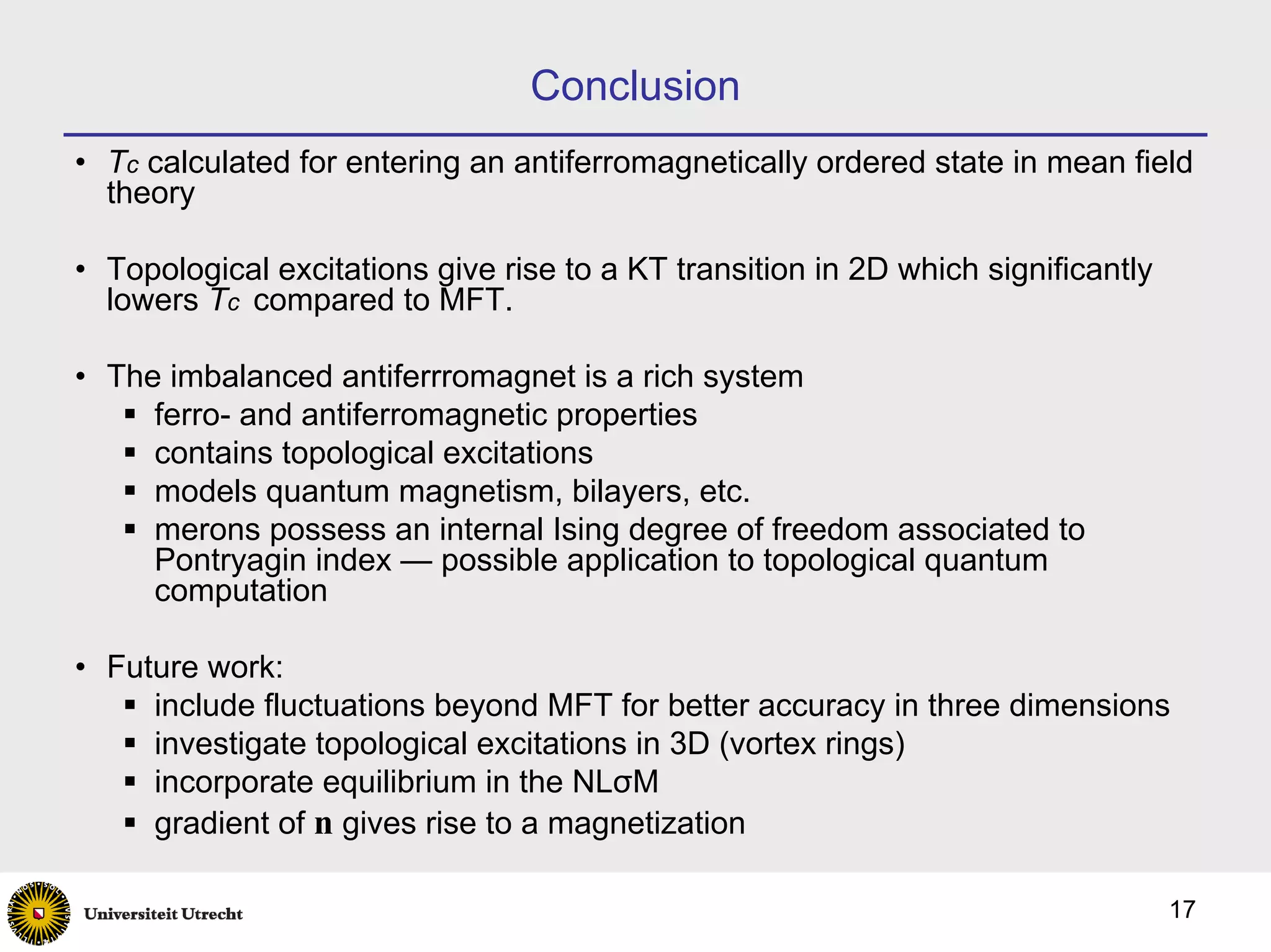
Conclusion
• Tc calculated for entering an antiferromagnetically ordered state in mean field
  theory

• Topological excitations give rise to a KT transition in 2D which significantly
  lowers Tc compared to MFT.

• The imbalanced antiferrromagnet is a rich system
     ferro- and antiferromagnetic properties
     contains topological excitations
     models quantum magnetism, bilayers, etc.
     merons possess an internal Ising degree of freedom associated to
     Pontryagin index — possible application to topological quantum
     computation

• Future work:
     include fluctuations beyond MFT for better accuracy in three dimensions
     investigate topological excitations in 3D (vortex rings)
     incorporate equilibrium in the NLσM
     gradient of n gives rise to a magnetization

                                                                                   17
Results

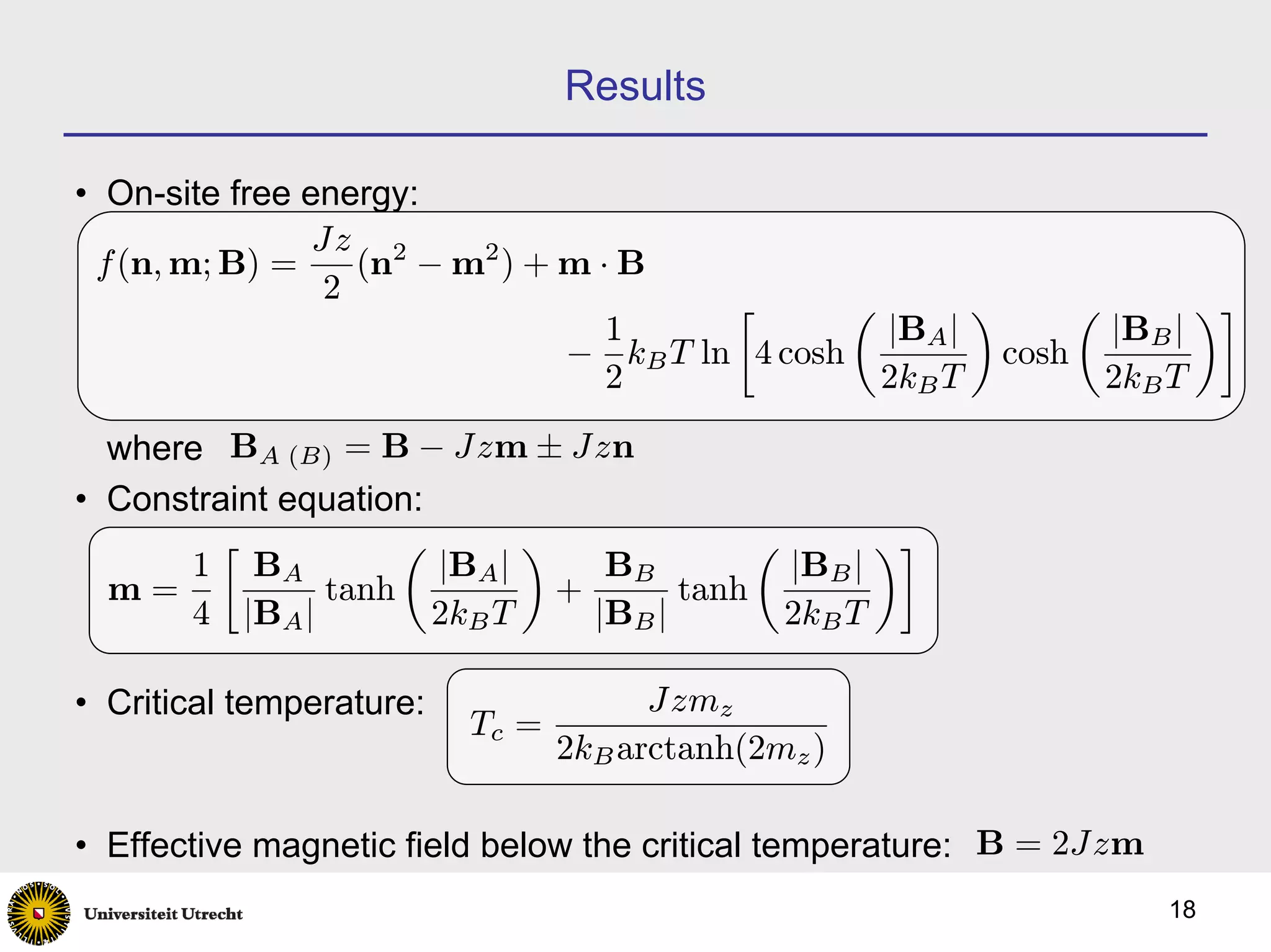
• On-site free energy:
                Jz 2
 f (n, m; B) =     (n − m2 ) + m · B
                 2                      ∙       µ       ¶      µ       ¶¸
                                  1               |BA |          |BB |
                               − kB T ln 4 cosh           cosh
                                  2               2kB T          2kB T

  where BA (B) = B − Jzm ± Jzn
• Constraint equation:
        ∙           µ        ¶              µ       ¶¸
      1 BA             |BA |      BB          |BB |
  m=           tanh            +       tanh
      4 |BA |          2kB T     |BB |        2kB T

• Critical temperature:                Jzmz
                          Tc =
                                 2kB arctanh(2mz )

• Effective magnetic field below the critical temperature: B = 2Jzm
                                                                      18
Anisotropic O(3) model

• Dimensionless free energy of the anisotropic O(3) model [Klomfass et al, Nucl.
  Phys. B360, 264 (1991)] :
                                 X                    X
                    βf3 = −β3            Si · Sj + γ3  (Si )2
                                                         z

                                 hi,ji                  i
• KT transition:
                       1.0

                       0.8
                   g3êH1+g3L


                       0.6

                       0.4

                       0.2

                       0.0
                         1.0      1.2        1.4        1.6     1.8   2.0
                                                   b3

                                  β3
• Numerical fit:    γ3 (β3 ) =           exp[−5.6(β3 − 1.085)].
                               β3 − 1.06
                                                                                   19
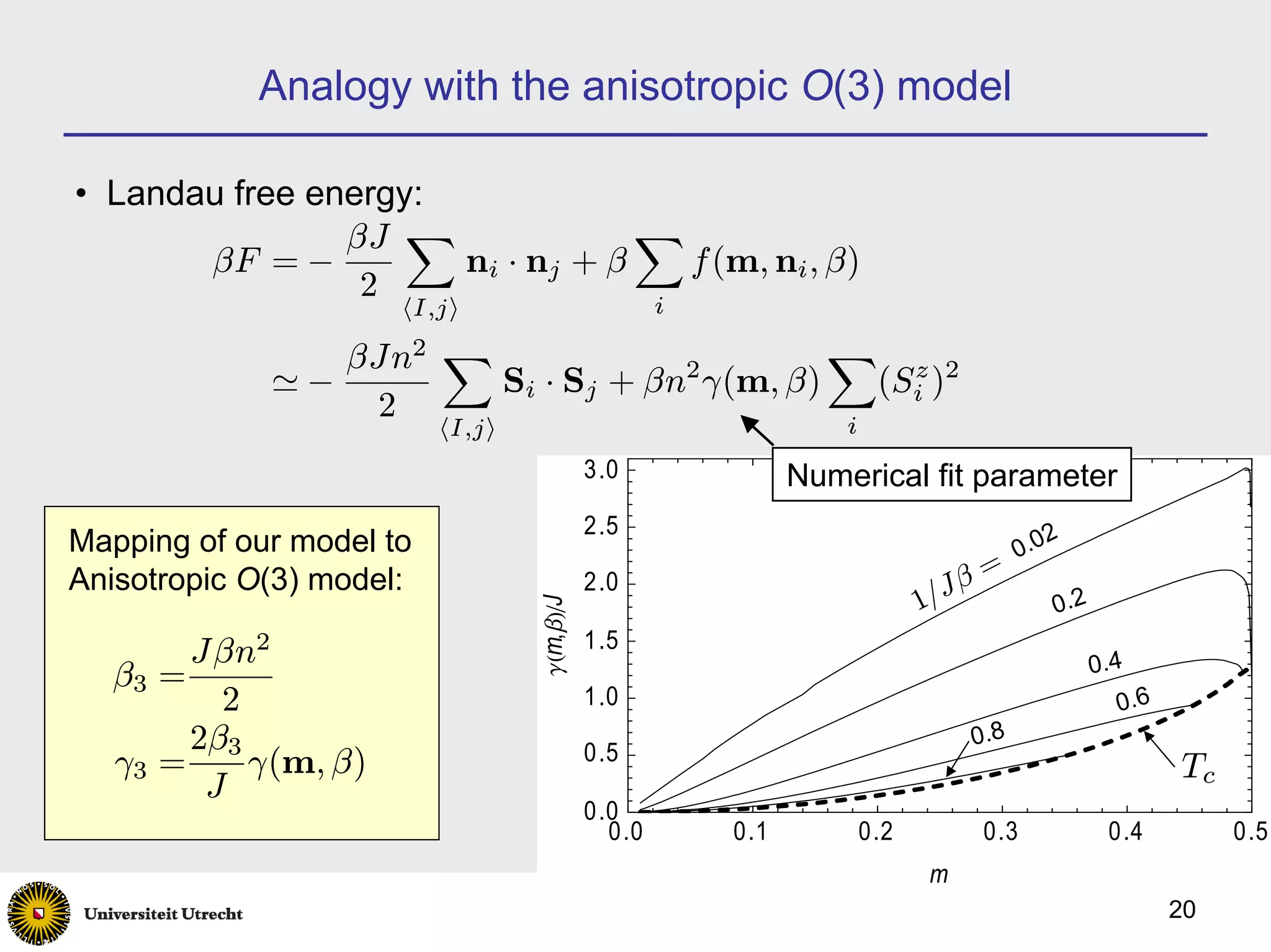
Analogy with the anisotropic O(3) model

• Landau free energy:
                βJ X              X
       βF = −         ni · nj + β   f (m, ni , β)
                 2                i
                      hI,ji

                βJn2 X             2
                                            X
             '−        Si · Sj + βn γ(m, β)   (Si )2
                                                z
                 2                          i
                          hI,ji
                                       3.0           Numerical fit parameter
                                       2.5                                     2
Mapping of our model to                                                     0.0
Anisotropic O(3) model:                2.0                          β   =
                                                                1/J            0.2
                                  g Hm, bLêJ


                                       1.5
       Jβn2                                                                          0.4
  β3 =
         2                             1.0                                             0.6
       2β3                                                           0.8
  γ3 =     γ(m, β)                     0.5
                                                                                             Tc
        J
                                       0.0
                                         0.0   0.1        0.2           0.3           0.4         0.5
                                                                 m
                                                                                             20

The imbalanced antiferromagnet in an optical lattice

  • 1.
    The imbalanced antiferromagnet in an optical lattice Arnaud Henk Stoof Koetsier Floris van Liere
  • 2.
    Introduction • Fermions inan optical lattice • Described by the Hubbard model • Realised experimentally [Esslinger ’05] • Fermionic Mott insulator recently seen [Esslinger ’08, Bloch ’08] • There is currently a race to create the Néel state • Imbalanced Fermi gases • Experimentally realised [Ketterle ’06, Hulet ’06] • High relevance to other areas of physics (particle physics, neutron stars, etc.) • Imbalanced Fermi gases in an optical lattice ?? 2
  • 3.
    Fermi-Hubbard Model P P P H = −t c† cj 0 ,σ j,σ +U c† c† cj,↓ cj,↑ j,↑ j,↓ σ hjj 0 i j Sums depend on: Filling N Dimensionality (d=3) On-site interaction: U Tunneling: t Consider nearest-neighbor tunneling only. The positive-U (repulsive) Fermi-Hubbard Model, relevant to High-Tc SC 3
  • 4.
    Quantum Phases ofthe Fermi-Hubbard Model • Positive U (repulsive on-site interaction): Conductor 1 Filling Fraction Band Insulator Conductor 0.5 Conductor Mott Insulator (need large U) 0 • Negative U: Pairing occurs — BEC/BCS superfluid at all fillings. 4
  • 5.
    Mott insulator: HeisenbergModel (no imbalance yet) • At half filling, when U À t and kB T ¿ U we are deep in the Mott phase. Hopping is energetically supressed Model simplifies: only spin degrees of freedom remain (no transport) • Integrate out the hopping fluctuations, then the Hubbard model reduces to the Heisenberg model: J X H= S j · Sk 2 hjki Spin ½ operators: S = 1 σ z 1³ † † ´ 2 Si = ci,↑ ci,↑ − ci,↓ ci,↓ 2 Si =c† ci,↓ + i,↑ Si =c† ci,↑ − i,↓ 4t2 Superexchange constant (virtual hops): J= U 5
  • 6.
    Néel State (noimbalance yet) • The Néel state is the antiferromagnetic ground state for J > 0 • Néel order parameter 0 ≤ h|n|i ≤ 0.5 measures amount of “anti-alignment”: 0.5 nj = (−1)j hSj i 〈n〉 h|n|i • Below some critical temperature Tc, we enter the Néel state and h|n|i becomes non-zero. 0 0 T Tc 6
  • 7.
    Heisenberg Model withimbalance • Until now, N↑ = N↓ = N/2 • Now take N↑ 6= N↓ — spin population imbalance. • This gives rise to an overal magnetization m = (0, 0, mz ) N↑ − N↓ (fermions: S = 1 ) mz = S 2 N↑ + N↓ • Add a constraint to the Heisenberg model that enforces hSi = m J X X H= S j · Sk − B · (Si − m) 2 hjki i Effective magnetic field (Lagrange multiplier): B 7
  • 8.
    Mean field analysis •J > 0 ⇒ ground state is antiferromagnetic (Néel state) Two sublattices: A, B A(B) A(B) A(B) • Linearize Hamiltonian: Si = hSi i + δSi B A B hSA i + hSB i • Magnetization: m= A B A 2 B A B A B hS i − hS i • Néel order parameter: n= 2 A B A • Obtain the on-site free energy f (n, m; B) subject to the constraint ∇B f = 0 (eliminates B) 8
  • 9.
    Phase Diagram inthree dimensions 1.5 n=0 m Canted: 1 n kB T/J 0.5 n 6= 0 m Ising: n 0 0 0.1 0.2 0.3 0.4 0.5 mz 0.5 0.4 n 〈n〉 0.2 0.0 Add imbalance 0.0 0.2 0 mz 0.3 0.6 0.4 0 0.9 0 Tc kB T J 1.2 T 9
  • 10.
    Spin waves (magnons) dS i • Spin dynamics can be found from: = [H, S] dt ~ No imbalance: Doubly 0.5 degenerate antiferromagnetic dispersion 0.4 • Imbalance splits the ¯ ω/J z 0.3 degeneracy: 0.2 Gap: h Ferromagnetic (Larmor magnons: ω ∝ k2 0.1 precession of n) 0 π π Antiferromagnetic − 0 magnons: ω ∝ |k| 2 kd 2 10
  • 11.
    Long-wavelength dynamics: NLσM •Dynamics are summarised a non-linear sigma model with an action Z Z ½ µ ¶2 dx 1 ∂n(x, t) S[n(x, t)] = dt ~ − 2Jzm × n(x, t) dD 4Jzn2 ∂t 2 ¾ Jd − [∇n(x, t)]2 • lattice spacing: d = λ/2 2 • number of nearest neighbours: z = 2D • local staggered magnetization: n(x, t) • The equilibrium value of n(x, t) is found from the Landau free energy: Z ½ 2 ¾ dx Jd 2 F [n(x), m] = [∇n(x)] + f [n(x), m] dD 2 • NLσM admits spin waves but also topologically stable excitations in the local staggered magnetisation n(x, t). 11
  • 12.
    Topological excitations • Thetopological excitaitons are vortices; Néel vector has an out-of- easy-plane component in the core • In two dimensions, these are merons: • Spin texture of a meron: ⎛ p ⎞ n 2 − [n (r)]2 cos φ p z n = ⎝nv n2 − [nz (r)]2 sin φ⎠ nz (r) nv = 1 n • Ansatz: nz (r) = [(r/λ)2 + 1]2 • Merons characterised by: Pontryagin index ±½ Vorticity nv = ±1 Core size λ nv = −1 12
  • 13.
    Meron size • Coresize λ of meron found by plugging the spin texture into F [n(x), m] and minimizing (below Tc): 1.5 Meron core size 6 1 Λ kB T/J Merons 4 d 2 0.5 present 1.5 1.2 0 0.9 0 0 kB T J 0 0.1 0.2 0.3 0.4 0.5 0.1 0.6 mz 0.2 0.3 0.3 mz 0.4 • The energy of a single meron diverges logarithmically with the system area A at low temperature as Jn2 π A ln 2 2 πλ merons must be created in pairs. 13
  • 14.
    Meron pairs Low temperatures: A pair of merons with opposite vorticity, has a finite energy since the deformation of the spin texture cancels at infinity: Higher temperatures: Entropy contributions overcome the divergent energy of a single meron The system can lower its free energy through the proliferation of single merons 14
  • 15.
    Kosterlitz-Thouless transition • Theunbinding of meron pairs in 2D signals a KT transition. This drives down Tc compared with MFT: 1 MFT in 2D 0.8 0.06 0.6 kB T/J kB T/J 0.04 n 6= 0 0.4 KT transition 0.02 0.2 0 0 0 0.05 0.1 0 0.2 0.4 mz mz • New Tc obtained by analogy to an anisotropic O(3) model (Monte Carlo results: [Klomfass et al, Nucl. Phys. B360, 264 (1991)] ) 15
  • 16.
    Experimental feasibility • Experimentalrealisation: Imbalance: drive spin transitions with RF field Néel state in optical lattice: adiabatic cooling [AK et al. PRA77, 023623 (2008)] • Observation of Néel state Correlations in atom shot noise Bragg reflection (also probes spin waves) • Observation of KT transition Interference experiment [Hadzibabic et al. Nature 441, 1118 (2006)] In situ imaging [Gericke et al. Nat. Phys. 4, 949 (2008); Würtz et al. arXiv:0903.4837] 16
  • 17.
    Conclusion • Tc calculatedfor entering an antiferromagnetically ordered state in mean field theory • Topological excitations give rise to a KT transition in 2D which significantly lowers Tc compared to MFT. • The imbalanced antiferrromagnet is a rich system ferro- and antiferromagnetic properties contains topological excitations models quantum magnetism, bilayers, etc. merons possess an internal Ising degree of freedom associated to Pontryagin index — possible application to topological quantum computation • Future work: include fluctuations beyond MFT for better accuracy in three dimensions investigate topological excitations in 3D (vortex rings) incorporate equilibrium in the NLσM gradient of n gives rise to a magnetization 17
  • 18.
    Results • On-site freeenergy: Jz 2 f (n, m; B) = (n − m2 ) + m · B 2 ∙ µ ¶ µ ¶¸ 1 |BA | |BB | − kB T ln 4 cosh cosh 2 2kB T 2kB T where BA (B) = B − Jzm ± Jzn • Constraint equation: ∙ µ ¶ µ ¶¸ 1 BA |BA | BB |BB | m= tanh + tanh 4 |BA | 2kB T |BB | 2kB T • Critical temperature: Jzmz Tc = 2kB arctanh(2mz ) • Effective magnetic field below the critical temperature: B = 2Jzm 18
  • 19.
    Anisotropic O(3) model •Dimensionless free energy of the anisotropic O(3) model [Klomfass et al, Nucl. Phys. B360, 264 (1991)] : X X βf3 = −β3 Si · Sj + γ3 (Si )2 z hi,ji i • KT transition: 1.0 0.8 g3êH1+g3L 0.6 0.4 0.2 0.0 1.0 1.2 1.4 1.6 1.8 2.0 b3 β3 • Numerical fit: γ3 (β3 ) = exp[−5.6(β3 − 1.085)]. β3 − 1.06 19
  • 20.
    Analogy with theanisotropic O(3) model • Landau free energy: βJ X X βF = − ni · nj + β f (m, ni , β) 2 i hI,ji βJn2 X 2 X '− Si · Sj + βn γ(m, β) (Si )2 z 2 i hI,ji 3.0 Numerical fit parameter 2.5 2 Mapping of our model to 0.0 Anisotropic O(3) model: 2.0 β = 1/J 0.2 g Hm, bLêJ 1.5 Jβn2 0.4 β3 = 2 1.0 0.6 2β3 0.8 γ3 = γ(m, β) 0.5 Tc J 0.0 0.0 0.1 0.2 0.3 0.4 0.5 m 20