Dressing actions on integrable surfaces

This is a joint work with Nick Schmitt at T¨bingen University.
                                           u
             Shimpei Kobayashi, Hirosaki University


                         6/21, 2011
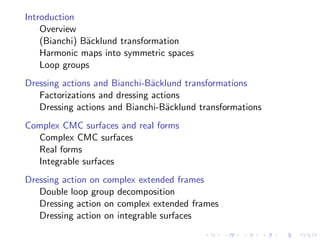
Introduction
    Overview
    (Bianchi) B¨cklund transformation
               a
    Harmonic maps into symmetric spaces
    Loop groups
Dressing actions and Bianchi-B¨cklund transformations
                               a
   Factorizations and dressing actions
   Dressing actions and Bianchi-B¨cklund transformations
                                   a
Complex CMC surfaces and real forms
  Complex CMC surfaces
  Real forms
  Integrable surfaces
Dressing action on complex extended frames
   Double loop group decomposition
   Dressing action on complex extended frames
   Dressing action on integrable surfaces
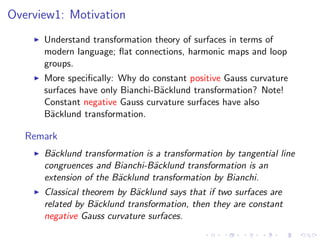
Overview1: Motivation
    ◮   Understand transformation theory of surfaces in terms of
        modern language; flat connections, harmonic maps and loop
        groups.
    ◮   More specifically: Why do constant positive Gauss curvature
        surfaces have only Bianchi-B¨cklund transformation? Note!
                                    a
        Constant negative Gauss curvature surfaces have also
        B¨cklund transformation.
          a

   Remark
    ◮   B¨cklund transformation is a transformation by tangential line
         a
        congruences and Bianchi-B¨cklund transformation is an
                                  a
        extension of the B¨cklund transformation by Bianchi.
                          a
    ◮   Classical theorem by B¨cklund says that if two surfaces are
                              a
        related by B¨cklund transformation, then they are constant
                     a
        negative Gauss curvature surfaces.
Overview 2: Previous works


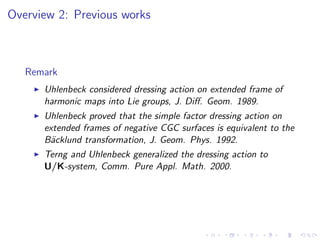
   Remark
    ◮   Uhlenbeck considered dressing action on extended frame of
        harmonic maps into Lie groups, J. Diff. Geom. 1989.
    ◮   Uhlenbeck proved that the simple factor dressing action on
        extended frames of negative CGC surfaces is equivalent to the
        B¨cklund transformation, J. Geom. Phys. 1992.
         a
    ◮   Terng and Uhlenbeck generalized the dressing action to
        U/K-system, Comm. Pure Appl. Math. 2000.
B¨cklund transformation
 a

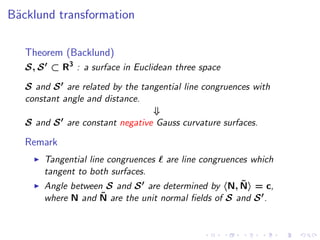
   Theorem (Backlund)
   S, S ′ ⊂ R3 : a surface in Euclidean three space

   S and S ′ are related by the tangential line congruences with
   constant angle and distance.
                                   ⇓
   S and S ′ are constant negative Gauss curvature surfaces.

   Remark
     ◮   Tangential line congruences ℓ are line congruences which
         tangent to both surfaces.
     ◮                                                    ˜
         Angle between S and S ′ are determined by N, N = c,
                       ˜
         where N and N are the unit normal fields of S and S ′ .
Bianchi-B¨cklund transformation
         a


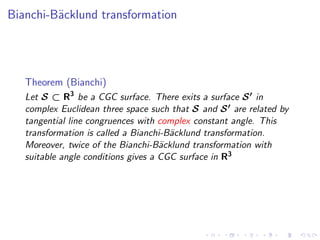
   Theorem (Bianchi)
   Let S ⊂ R3 be a CGC surface. There exits a surface S ′ in
   complex Euclidean three space such that S and S ′ are related by
   tangential line congruences with complex constant angle. This
   transformation is called a Bianchi-B¨cklund transformation.
                                       a
   Moreover, twice of the Bianchi-B¨cklund transformation with
                                     a
   suitable angle conditions gives a CGC surface in R3
Permutability and superposition formula

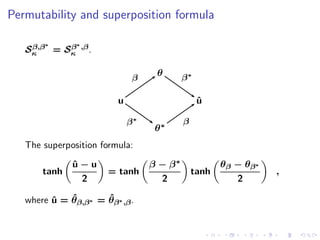
       ∗
    β,β = S β  ∗ ,β
   Sκ      κ          .

                                β
                                     θ       β∗

                           u                      u
                                                  ˆ

                               β∗            β
                                     θ∗
   The superposition formula:

              u−u
              ˆ                     β − β∗              θβ − θβ∗
       tanh               = tanh                 tanh              ,
                2                     2                    2
             ˆ       ˆ
   where u = θβ,β∗ = θβ∗ ,β .
         ˆ
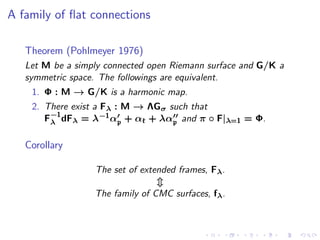
A family of flat connections

   Theorem (Pohlmeyer 1976)
   Let M be a simply connected open Riemann surface and G/K a
   symmetric space. The followings are equivalent.
    1. Φ : M → G/K is a harmonic map.
    2. There exist a Fλ : M → ΛGσ such that
       F−1 dFλ = λ−1 α′ + αk + λα′′ and π ◦ F|λ=1 = Φ.
        λ                p         p


   Corollary

                  The set of extended frames, Fλ.

                  The family of CMC surfaces, fλ.
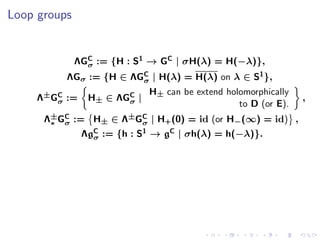
Loop groups


              ΛGC := {H : S1 → GC | σH(λ) = H(−λ)},
                σ
          ΛGσ := {H ∈ ΛGC | H(λ) = H(λ) on λ ∈ S1 },
                        σ
                             H± can be extend holomorphically
     Λ±GC :=
        σ       H± ∈ ΛGC |
                       σ                                        ,
                                                 to D (or E).
      Λ±GC := H± ∈ Λ±GC | H+ (0) = id (or H−(∞) = id) ,
       ∗ σ            σ
               ΛgC := {h : S1 → gC | σh(λ) = h(−λ)}.
                 σ
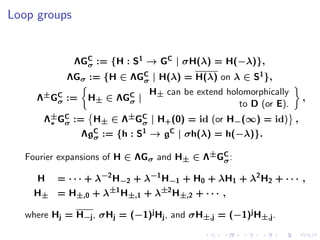
Loop groups


              ΛGC := {H : S1 → GC | σH(λ) = H(−λ)},
                σ
            ΛGσ := {H ∈ ΛGC | H(λ) = H(λ) on λ ∈ S1 },
                          σ
                               H± can be extend holomorphically
     Λ±GC :=
        σ        H± ∈ ΛGC |
                        σ                                         ,
                                                   to D (or E).
       Λ±GC := H± ∈ Λ±GC | H+ (0) = id (or H−(∞) = id) ,
        ∗ σ            σ
                ΛgC := {h : S1 → gC | σh(λ) = h(−λ)}.
                  σ

   Fourier expansions of H ∈ ΛGσ and H± ∈ Λ±GC :
                                             σ

     H    = · · · + λ−2 H−2 + λ−1 H−1 + H0 + λH1 + λ2 H2 + · · · ,
     H± = H±,0 + λ±1 H±,1 + λ±2 H±,2 + · · · ,

   where Hj = H−j , σHj = (−1)j Hj , and σH±,j = (−1)j H±,j .
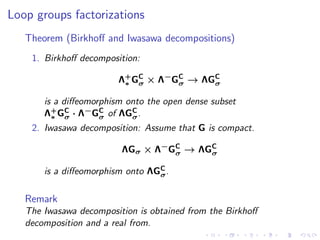
Loop groups factorizations
   Theorem (Birkhoff and Iwasawa decompositions)
    1. Birkhoff decomposition:

                        Λ+ GC × Λ−GC → ΛGC
                         ∗ σ       σ     σ

       is a diffeomorphism onto the open dense subset
       Λ+ GC · Λ−GC of ΛGC .
         ∗ σ        σ      σ
    2. Iwasawa decomposition: Assume that G is compact.

                         ΛGσ × Λ−GC → ΛGC
                                  σ     σ

                                 C
       is a diffeomorphism onto ΛGσ .

   Remark
   The Iwasawa decomposition is obtained from the Birkhoff
   decomposition and a real from.
Dressing actions and Bianchi-B¨cklund transformations 1
                              a
   Let F be an extended framing and g an element in Λ+ GC .
                                                        σ
   Decompose gF according to the Iwasawa decomposition as

                              ˜
                   ΛGC ∋ gF = FV+ ∈ ΛGσ × Λ+ GC .
                     σ                        σ

   Then
       ˜
    ◮ F is again the extended framing. Thus Λ+ GC acts, the
                                                σ
       dressing action, that is, Id#F = F and
                                              ˜      −1
       g(#(f#F)) = (gf)#F, where g#F = F = gFV+ .
     ◮   Bianchi permutability theorem is just associativity of the
         action:
                        g2 #(g1 #F) = g2 #(ˆ1 #F),
                                         ˆ     g
         where g2 g1 = ˆ2 g1 .
                       g ˆ
     ◮   The dressing action by rational loops with simple pole is called
         the simple type dressing action.
Dressing actions and Bianchi-B¨cklund transformations 2
                              a
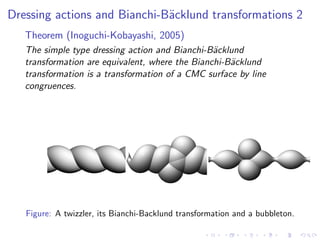
   Theorem (Inoguchi-Kobayashi, 2005)
   The simple type dressing action and Bianchi-B¨cklund
                                                 a
   transformation are equivalent, where the Bianchi-B¨cklund
                                                     a
   transformation is a transformation of a CMC surface by line
   congruences.


   Figure: A twizzler, its Bianchi-Backlund transformation and a bubbleton.
Recall that a simple factor dressing by g:
                                     −1
                            g#F = gFV+ .

This action corresponds to the twice of Bianchi-B¨cklund
                                                   a
transformation.
The g has two simple poles at λ1 , λ2 , which are related
         ¯
λ2 = 1/λ1 ∈ C×  S1 .
  ◮   Is is possible to factor g to

                                  g = g2 g1

      so that each gj corresponds to once Bianchi-B¨cklund?
                                                   a
  ◮   Answer: Yes, but one needs an extension of the dressing
      action.
Constant negative Gauss curvature surfaces


   Fact
   There exists a similar dressing action on constant negative Gauss
   curvature surfaces. Try to unify negative and positive Gauss
   curvature surfaces.
                                    ⇓
     ◮    Complex CMC surfaces (Dorfmeister-Kobayashi-Pedit 2010).
     ◮    Real form surfaces (Kobayashi 2011).
Ruh-Vilms type theorem


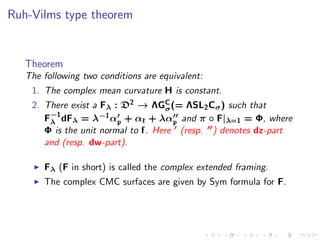
   Theorem
   The following two conditions are equivalent:
    1. The complex mean curvature H is constant.
    2. There exist a Fλ : D2 → ΛGσ (= ΛSL2 Cσ ) such that
                                     C

       F−1 dFλ = λ−1 α′ + αk + λα′′ and π ◦ F|λ=1 = Φ, where
        λ                p             p
       Φ is the unit normal to f. Here ′ (resp. ′′) denotes dz-part
       and (resp. dw-part).

     ◮   Fλ (F in short) is called the complex extended framing.
     ◮   The complex CMC surfaces are given by Sym formula for F.
Almost compact real forms


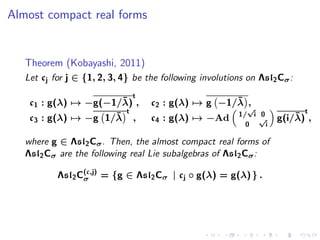
   Theorem (Kobayashi, 2011)
   Let cj for j ∈ {1, 2, 3, 4} be the following involutions on Λsl2 Cσ :
                              t
                       ¯
    c1 : g(λ) → −g(−1/λ) ,                          ¯
                                   c2 : g(λ) → g −1/λ ,
                        t                                   √              t
                     ¯                                    1/ i 0         ¯
    c3 : g(λ) → −g 1/λ ,           c4 : g(λ) → −Ad             √     g(i/λ) ,
                                                            0    i

   where g ∈ Λsl2 Cσ . Then, the almost compact real forms of
   Λsl2 Cσ are the following real Lie subalgebras of Λsl2 Cσ :

           Λsl2 C(c,j) = {g ∈ Λsl2 Cσ | cj ◦ g(λ) = g(λ) } .
                 σ
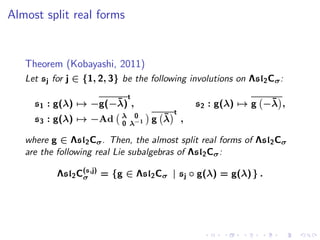
Almost split real forms


   Theorem (Kobayashi, 2011)
   Let sj for j ∈ {1, 2, 3} be the following involutions on Λsl2 Cσ :
                             t
                     ¯
     s1 : g(λ) → −g(−λ) ,                                       ¯
                                                 s2 : g(λ) → g −λ ,
                                         t
     s3 : g(λ) → −Ad       λ 0       ¯
                                   g λ       ,
                           0 λ−1

   where g ∈ Λsl2 Cσ . Then, the almost split real forms of Λsl2 Cσ
   are the following real Lie subalgebras of Λsl2 Cσ :

           Λsl2 C(s,j) = {g ∈ Λsl2 Cσ | sj ◦ g(λ) = g(λ) } .
                 σ
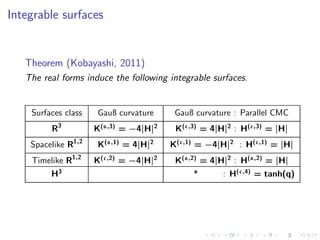
Integrable surfaces


   Theorem (Kobayashi, 2011)
   The real forms induce the following integrable surfaces.

    Surfaces class   Gauß curvature     Gauß curvature : Parallel CMC
         R3          K(s,3) = −4|H|2    K(c,3) = 4|H|2 : H(c,3) = |H|
    Spacelike R1,2   K(s,1) = 4|H|2    K(c,1) = −4|H|2 : H(c,1) = |H|
    Timelike R1,2    K(c,2) = −4|H|2    K(s,2) = 4|H|2 : H(s,2) = |H|
         H3                                  *      : H(c,4) = tanh(q)
Double loop group decomposition


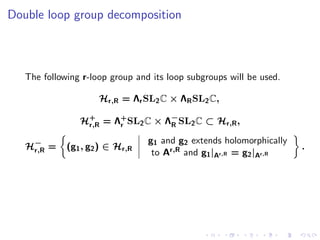
   The following r-loop group and its loop subgroups will be used.

                     Hr,R = Λr SL2 C × ΛR SL2 C,

                H+ = Λ+ SL2 C × Λ−SL2 C ⊂ Hr,R ,
                 r,R  r          R

                                 g1 and g2 extends holomorphically
   H− =      (g1 , g2 ) ∈ Hr,R                                       .
    r,R                           to Ar,R and g1 |Ar,R = g2 |Ar,R
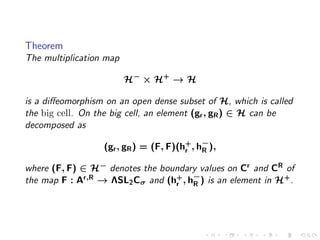
Theorem
The multiplication map

                         H− × H+ → H

is a diffeomorphism on an open dense subset of H, which is called
the big cell. On the big cell, an element (gr , gR ) ∈ H can be
decomposed as

                  (gr , gR ) = (F, F)(h+ , h−),
                                       r    R

where (F, F) ∈ H− denotes the boundary values on Cr and CR of
the map F : Ar,R → ΛSL2 Cσ and (hr , h−) is an element in H+ .
                                 +
                                      R
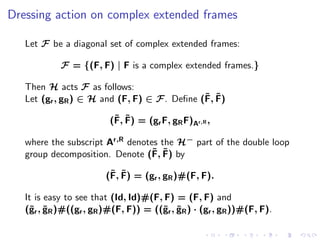
Dressing action on complex extended frames

   Let F be a diagonal set of complex extended frames:

            F = {(F, F) | F is a complex extended frames.}

   Then H acts F as follows:
                                             ˜ ˜
   Let (gr , gR ) ∈ H and (F, F) ∈ F. Define (F, F)

                          ˜ ˜
                         (F, F) = (gr F, gR F)Ar,R ,

   where the subscript Ar,R denotes the H− part of the double loop
                                  ˜ ˜
   group decomposition. Denote (F, F) by

                         ˜ ˜
                        (F, F) = (gr , gR )#(F, F).

   It is easy to see that (Id, Id)#(F, F) = (F, F) and
   (˜r , gR )#((gr , gR )#(F, F)) = ((˜r , gR ) · (gr , gR ))#(F, F).
    g ˜                               g ˜
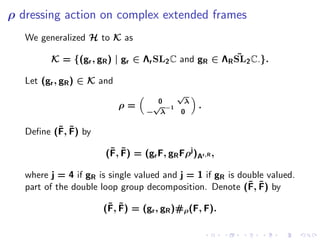
ρ dressing action on complex extended frames
   We generalized H to K as

                                                      ˜
         K = {(gr , gR ) | gr ∈ Λr SL2 C and gR ∈ ΛR SL2 C.}.

   Let (gr , gR ) ∈ K and
                                          √
                                    0       λ
                            ρ=     √ −1         .
                                  − λ      0

          ˜ ˜
   Define (F, F) by

                        ˜ ˜
                       (F, F) = (gr F, gR Fρj )Ar,R ,

   where j = 4 if gR is single valued and j = 1 if gR is double valued.
                                                           ˜ ˜
   part of the double loop group decomposition. Denote (F, F) by

                       ˜ ˜
                      (F, F) = (gr , gR )#ρ(F, F).
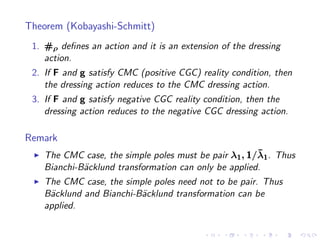
Theorem (Kobayashi-Schmitt)
 1. #ρ defines an action and it is an extension of the dressing
    action.
 2. If F and g satisfy CMC (positive CGC) reality condition, then
    the dressing action reduces to the CMC dressing action.
 3. If F and g satisfy negative CGC reality condition, then the
    dressing action reduces to the negative CGC dressing action.

Remark
 ◮                                                      ¯
     The CMC case, the simple poles must be pair λ1 , 1/λ1 . Thus
     Bianchi-B¨cklund transformation can only be applied.
              a
 ◮   The CMC case, the simple poles need not to be pair. Thus
     B¨cklund and Bianchi-B¨cklund transformation can be
      a                    a
     applied.

Dressing2011

  • 1.
    Dressing actions onintegrable surfaces This is a joint work with Nick Schmitt at T¨bingen University. u Shimpei Kobayashi, Hirosaki University 6/21, 2011
  • 2.
    Introduction Overview (Bianchi) B¨cklund transformation a Harmonic maps into symmetric spaces Loop groups Dressing actions and Bianchi-B¨cklund transformations a Factorizations and dressing actions Dressing actions and Bianchi-B¨cklund transformations a Complex CMC surfaces and real forms Complex CMC surfaces Real forms Integrable surfaces Dressing action on complex extended frames Double loop group decomposition Dressing action on complex extended frames Dressing action on integrable surfaces
  • 3.
    Overview1: Motivation ◮ Understand transformation theory of surfaces in terms of modern language; flat connections, harmonic maps and loop groups. ◮ More specifically: Why do constant positive Gauss curvature surfaces have only Bianchi-B¨cklund transformation? Note! a Constant negative Gauss curvature surfaces have also B¨cklund transformation. a Remark ◮ B¨cklund transformation is a transformation by tangential line a congruences and Bianchi-B¨cklund transformation is an a extension of the B¨cklund transformation by Bianchi. a ◮ Classical theorem by B¨cklund says that if two surfaces are a related by B¨cklund transformation, then they are constant a negative Gauss curvature surfaces.
  • 4.
    Overview 2: Previousworks Remark ◮ Uhlenbeck considered dressing action on extended frame of harmonic maps into Lie groups, J. Diff. Geom. 1989. ◮ Uhlenbeck proved that the simple factor dressing action on extended frames of negative CGC surfaces is equivalent to the B¨cklund transformation, J. Geom. Phys. 1992. a ◮ Terng and Uhlenbeck generalized the dressing action to U/K-system, Comm. Pure Appl. Math. 2000.
  • 5.
    B¨cklund transformation a Theorem (Backlund) S, S ′ ⊂ R3 : a surface in Euclidean three space S and S ′ are related by the tangential line congruences with constant angle and distance. ⇓ S and S ′ are constant negative Gauss curvature surfaces. Remark ◮ Tangential line congruences ℓ are line congruences which tangent to both surfaces. ◮ ˜ Angle between S and S ′ are determined by N, N = c, ˜ where N and N are the unit normal fields of S and S ′ .
  • 6.
    Bianchi-B¨cklund transformation a Theorem (Bianchi) Let S ⊂ R3 be a CGC surface. There exits a surface S ′ in complex Euclidean three space such that S and S ′ are related by tangential line congruences with complex constant angle. This transformation is called a Bianchi-B¨cklund transformation. a Moreover, twice of the Bianchi-B¨cklund transformation with a suitable angle conditions gives a CGC surface in R3
  • 7.
    Permutability and superpositionformula ∗ β,β = S β ∗ ,β Sκ κ . β θ β∗ u u ˆ β∗ β θ∗ The superposition formula: u−u ˆ β − β∗ θβ − θβ∗ tanh = tanh tanh , 2 2 2 ˆ ˆ where u = θβ,β∗ = θβ∗ ,β . ˆ
  • 8.
    A family offlat connections Theorem (Pohlmeyer 1976) Let M be a simply connected open Riemann surface and G/K a symmetric space. The followings are equivalent. 1. Φ : M → G/K is a harmonic map. 2. There exist a Fλ : M → ΛGσ such that F−1 dFλ = λ−1 α′ + αk + λα′′ and π ◦ F|λ=1 = Φ. λ p p Corollary The set of extended frames, Fλ. The family of CMC surfaces, fλ.
  • 9.
    Loop groups ΛGC := {H : S1 → GC | σH(λ) = H(−λ)}, σ ΛGσ := {H ∈ ΛGC | H(λ) = H(λ) on λ ∈ S1 }, σ H± can be extend holomorphically Λ±GC := σ H± ∈ ΛGC | σ , to D (or E). Λ±GC := H± ∈ Λ±GC | H+ (0) = id (or H−(∞) = id) , ∗ σ σ ΛgC := {h : S1 → gC | σh(λ) = h(−λ)}. σ
  • 10.
    Loop groups ΛGC := {H : S1 → GC | σH(λ) = H(−λ)}, σ ΛGσ := {H ∈ ΛGC | H(λ) = H(λ) on λ ∈ S1 }, σ H± can be extend holomorphically Λ±GC := σ H± ∈ ΛGC | σ , to D (or E). Λ±GC := H± ∈ Λ±GC | H+ (0) = id (or H−(∞) = id) , ∗ σ σ ΛgC := {h : S1 → gC | σh(λ) = h(−λ)}. σ Fourier expansions of H ∈ ΛGσ and H± ∈ Λ±GC : σ H = · · · + λ−2 H−2 + λ−1 H−1 + H0 + λH1 + λ2 H2 + · · · , H± = H±,0 + λ±1 H±,1 + λ±2 H±,2 + · · · , where Hj = H−j , σHj = (−1)j Hj , and σH±,j = (−1)j H±,j .
  • 11.
    Loop groups factorizations Theorem (Birkhoff and Iwasawa decompositions) 1. Birkhoff decomposition: Λ+ GC × Λ−GC → ΛGC ∗ σ σ σ is a diffeomorphism onto the open dense subset Λ+ GC · Λ−GC of ΛGC . ∗ σ σ σ 2. Iwasawa decomposition: Assume that G is compact. ΛGσ × Λ−GC → ΛGC σ σ C is a diffeomorphism onto ΛGσ . Remark The Iwasawa decomposition is obtained from the Birkhoff decomposition and a real from.
  • 12.
    Dressing actions andBianchi-B¨cklund transformations 1 a Let F be an extended framing and g an element in Λ+ GC . σ Decompose gF according to the Iwasawa decomposition as ˜ ΛGC ∋ gF = FV+ ∈ ΛGσ × Λ+ GC . σ σ Then ˜ ◮ F is again the extended framing. Thus Λ+ GC acts, the σ dressing action, that is, Id#F = F and ˜ −1 g(#(f#F)) = (gf)#F, where g#F = F = gFV+ . ◮ Bianchi permutability theorem is just associativity of the action: g2 #(g1 #F) = g2 #(ˆ1 #F), ˆ g where g2 g1 = ˆ2 g1 . g ˆ ◮ The dressing action by rational loops with simple pole is called the simple type dressing action.
  • 13.
    Dressing actions andBianchi-B¨cklund transformations 2 a Theorem (Inoguchi-Kobayashi, 2005) The simple type dressing action and Bianchi-B¨cklund a transformation are equivalent, where the Bianchi-B¨cklund a transformation is a transformation of a CMC surface by line congruences. Figure: A twizzler, its Bianchi-Backlund transformation and a bubbleton.
  • 14.
    Recall that asimple factor dressing by g: −1 g#F = gFV+ . This action corresponds to the twice of Bianchi-B¨cklund a transformation. The g has two simple poles at λ1 , λ2 , which are related ¯ λ2 = 1/λ1 ∈ C× S1 . ◮ Is is possible to factor g to g = g2 g1 so that each gj corresponds to once Bianchi-B¨cklund? a ◮ Answer: Yes, but one needs an extension of the dressing action.
  • 15.
    Constant negative Gausscurvature surfaces Fact There exists a similar dressing action on constant negative Gauss curvature surfaces. Try to unify negative and positive Gauss curvature surfaces. ⇓ ◮ Complex CMC surfaces (Dorfmeister-Kobayashi-Pedit 2010). ◮ Real form surfaces (Kobayashi 2011).
  • 16.
    Ruh-Vilms type theorem Theorem The following two conditions are equivalent: 1. The complex mean curvature H is constant. 2. There exist a Fλ : D2 → ΛGσ (= ΛSL2 Cσ ) such that C F−1 dFλ = λ−1 α′ + αk + λα′′ and π ◦ F|λ=1 = Φ, where λ p p Φ is the unit normal to f. Here ′ (resp. ′′) denotes dz-part and (resp. dw-part). ◮ Fλ (F in short) is called the complex extended framing. ◮ The complex CMC surfaces are given by Sym formula for F.
  • 17.
    Almost compact realforms Theorem (Kobayashi, 2011) Let cj for j ∈ {1, 2, 3, 4} be the following involutions on Λsl2 Cσ : t ¯ c1 : g(λ) → −g(−1/λ) , ¯ c2 : g(λ) → g −1/λ , t √ t ¯ 1/ i 0 ¯ c3 : g(λ) → −g 1/λ , c4 : g(λ) → −Ad √ g(i/λ) , 0 i where g ∈ Λsl2 Cσ . Then, the almost compact real forms of Λsl2 Cσ are the following real Lie subalgebras of Λsl2 Cσ : Λsl2 C(c,j) = {g ∈ Λsl2 Cσ | cj ◦ g(λ) = g(λ) } . σ
  • 18.
    Almost split realforms Theorem (Kobayashi, 2011) Let sj for j ∈ {1, 2, 3} be the following involutions on Λsl2 Cσ : t ¯ s1 : g(λ) → −g(−λ) , ¯ s2 : g(λ) → g −λ , t s3 : g(λ) → −Ad λ 0 ¯ g λ , 0 λ−1 where g ∈ Λsl2 Cσ . Then, the almost split real forms of Λsl2 Cσ are the following real Lie subalgebras of Λsl2 Cσ : Λsl2 C(s,j) = {g ∈ Λsl2 Cσ | sj ◦ g(λ) = g(λ) } . σ
  • 19.
    Integrable surfaces Theorem (Kobayashi, 2011) The real forms induce the following integrable surfaces. Surfaces class Gauß curvature Gauß curvature : Parallel CMC R3 K(s,3) = −4|H|2 K(c,3) = 4|H|2 : H(c,3) = |H| Spacelike R1,2 K(s,1) = 4|H|2 K(c,1) = −4|H|2 : H(c,1) = |H| Timelike R1,2 K(c,2) = −4|H|2 K(s,2) = 4|H|2 : H(s,2) = |H| H3 * : H(c,4) = tanh(q)
  • 20.
    Double loop groupdecomposition The following r-loop group and its loop subgroups will be used. Hr,R = Λr SL2 C × ΛR SL2 C, H+ = Λ+ SL2 C × Λ−SL2 C ⊂ Hr,R , r,R r R g1 and g2 extends holomorphically H− = (g1 , g2 ) ∈ Hr,R . r,R to Ar,R and g1 |Ar,R = g2 |Ar,R
  • 21.
    Theorem The multiplication map H− × H+ → H is a diffeomorphism on an open dense subset of H, which is called the big cell. On the big cell, an element (gr , gR ) ∈ H can be decomposed as (gr , gR ) = (F, F)(h+ , h−), r R where (F, F) ∈ H− denotes the boundary values on Cr and CR of the map F : Ar,R → ΛSL2 Cσ and (hr , h−) is an element in H+ . + R
  • 22.
    Dressing action oncomplex extended frames Let F be a diagonal set of complex extended frames: F = {(F, F) | F is a complex extended frames.} Then H acts F as follows: ˜ ˜ Let (gr , gR ) ∈ H and (F, F) ∈ F. Define (F, F) ˜ ˜ (F, F) = (gr F, gR F)Ar,R , where the subscript Ar,R denotes the H− part of the double loop ˜ ˜ group decomposition. Denote (F, F) by ˜ ˜ (F, F) = (gr , gR )#(F, F). It is easy to see that (Id, Id)#(F, F) = (F, F) and (˜r , gR )#((gr , gR )#(F, F)) = ((˜r , gR ) · (gr , gR ))#(F, F). g ˜ g ˜
  • 23.
    ρ dressing actionon complex extended frames We generalized H to K as ˜ K = {(gr , gR ) | gr ∈ Λr SL2 C and gR ∈ ΛR SL2 C.}. Let (gr , gR ) ∈ K and √ 0 λ ρ= √ −1 . − λ 0 ˜ ˜ Define (F, F) by ˜ ˜ (F, F) = (gr F, gR Fρj )Ar,R , where j = 4 if gR is single valued and j = 1 if gR is double valued. ˜ ˜ part of the double loop group decomposition. Denote (F, F) by ˜ ˜ (F, F) = (gr , gR )#ρ(F, F).
  • 24.
    Theorem (Kobayashi-Schmitt) 1.#ρ defines an action and it is an extension of the dressing action. 2. If F and g satisfy CMC (positive CGC) reality condition, then the dressing action reduces to the CMC dressing action. 3. If F and g satisfy negative CGC reality condition, then the dressing action reduces to the negative CGC dressing action. Remark ◮ ¯ The CMC case, the simple poles must be pair λ1 , 1/λ1 . Thus Bianchi-B¨cklund transformation can only be applied. a ◮ The CMC case, the simple poles need not to be pair. Thus B¨cklund and Bianchi-B¨cklund transformation can be a a applied.