The story so far………
ITS HISTORICAL BACKGROUND

1660 end of Commonwealth and
Restoration (House of Stuart)
Charles II
James II

1689 The Glorious Revolution:
William of Orange (dutch)+
Mary (protestant daughter of
James II) rule jointly

1702 Queen Anne (Mary’s sister)
1714 House of Hanover (descendants
of William of Orange)

THE ROMANTIC MOVEMENT

The period goes from 1798
(publishing of Lyrical
Ballads)
to 1837 (crowning of
Queen Victoria).
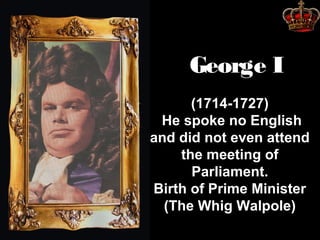
George I
(1714-1727)
He spoke no English
and did not even attend
the meeting of
Parliament.
Birth of Prime Minister
(The Whig Walpole)
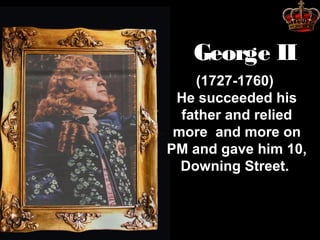
George II
(1727-1760)
He succeeded his
father and relied
more and more on
PM and gave him 10,
Downing Street.
THE ROMANTIC MOVEMENT

1789 “Songs of Innocence”
by William
Blake
1794 “Songs of Experience”
by William Blake
1798 “Lyrical Ballads”
1818 “Frankenstein”
by Mary Shelley
1819 “Ode to the West wind”
and “England in 1819”
by P. B. Shelley

George III
(1760-1820)
The grandson of George II, he was the first
Hanoverian king to be born in England and
the first to speak English as his native
tongue. As a king, he soon dismissed the
PM and surrounded himself with
incompetent ministers (“the King’s friends”).
During his reign American colonies rebelled:
they had to pay taxes but had no right to
elect their members in Parliament (“no
taxation without representation”- Boston
Tea Party). Their rebellion culminated in the
American revolution and declaration of
Indipendence (signed in 1776 and
recognised by the Treaty of Versailles in
1783).
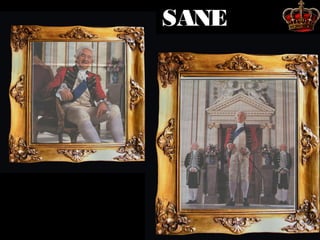
SANE
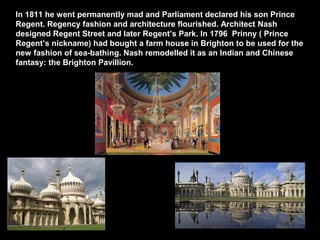
In 1811 he went permanently mad and Parliament declared his son Prince
Regent. Regency fashion and architecture flourished. Architect Nash
designed Regent Street and later Regent’s Park. In 1796 Prinny ( Prince
Regent’s nickname) had bought a farm house in Brighton to be used for the
new fashion of sea-bathing. Nash remodelled it as an Indian and Chinese
fantasy: the Brighton Pavillion.

In
To know more: when George III was crowned, during the
ceremony, a jewel fell out of his crown. This is regarded as a for
telling the loss of America. In 1761 George III married Princess
Charlotte Mecklemburg Strelitz. Charlotte bears him 15 children,
but this doesn’t prevent him from fathering 53 illegitimate
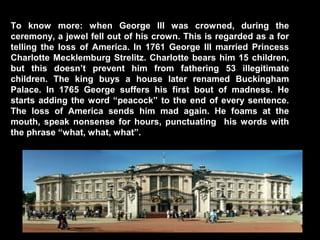
children. The king buys a house later renamed Buckingham
Palace. In 1765 George suffers his first bout of madness. He
starts adding the word “peacock” to the end of every sentence.
The loss of America sends him mad again. He foams at the
mouth, speak nonsense for hours, punctuating his words with
the phrase “what, what, what”.
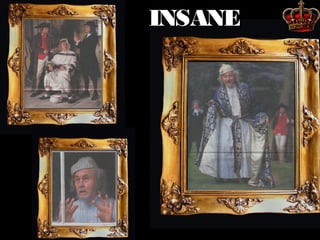
INSANE
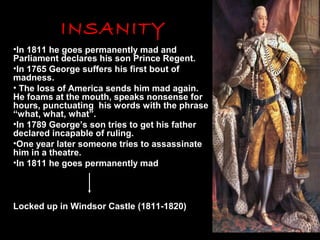
INSANITY
•In 1811 he goes permanently mad and
Parliament declares his son Prince Regent.
•In 1765 George suffers his first bout of
madness.
• The loss of America sends him mad again.
He foams at the mouth, speaks nonsense for
hours, punctuating his words with the phrase
“what, what, what”.
•In 1789 George’s son tries to get his father
declared incapable of ruling.
•One year later someone tries to assassinate
him in a theatre.
•In 1811 he goes permanently mad

Locked up in Windsor Castle (1811-1820)
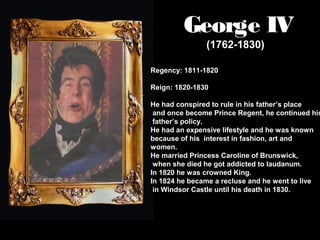
George IV
(1762-1830)

Regency: 1811-1820
Reign: 1820-1830

He had conspired to rule in his father’s place
and once become Prince Regent, he continued his
father’s policy.
He had an expensive lifestyle and he was known
because of his interest in fashion, art and
women.
He married Princess Caroline of Brunswick,
when she died he got addicted to laudanum.
In 1820 he was crowned King.
In 1824 he became a recluse and he went to live
in Windsor Castle until his death in 1830.
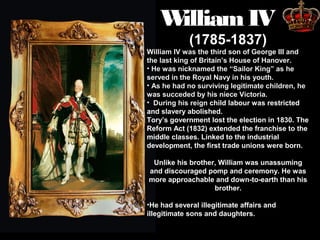
W
illiam IV
(1785-1837)

William IV was the third son of George III and
the last king of Britain’s House of Hanover.
• He was nicknamed the “Sailor King” as he
served in the Royal Navy in his youth.
• As he had no surviving legitimate children, he
was succeded by his niece Victoria.
• During his reign child labour was restricted
and slavery abolished.
Tory’s government lost the election in 1830. The
Reform Act (1832) extended the franchise to the
middle classes. Linked to the industrial
development, the first trade unions were born.
Unlike his brother, William was unassuming
and discouraged pomp and ceremony. He was
more approachable and down-to-earth than his
brother.
•He had several illegitimate affairs and
illegitimate sons and daughters.
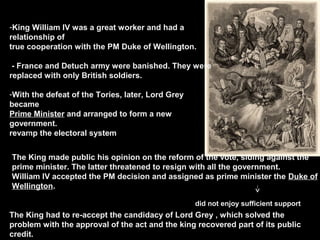
-King William IV was a great worker and had a
relationship of
true cooperation with the PM Duke of Wellington.
- France and Detuch army were banished. They were
replaced with only British soldiers.
-With the defeat of the Tories, later, Lord Grey
became
Prime Minister and arranged to form a new
government.
revamp the electoral system
The King made public his opinion on the reform of the vote, siding against the
prime minister. The latter threatened to resign with all the government.
William IV accepted the PM decision and assigned as prime minister the Duke of
Wellington.
did not enjoy sufficient support

The King had to re-accept the candidacy of Lord Grey , which solved the
problem with the approval of the act and the king recovered part of its public
credit.

The Georges (1714-1837)

  • 1.
    The story sofar……… ITS HISTORICAL BACKGROUND 1660 end of Commonwealth and Restoration (House of Stuart) Charles II James II 1689 The Glorious Revolution: William of Orange (dutch)+ Mary (protestant daughter of James II) rule jointly 1702 Queen Anne (Mary’s sister) 1714 House of Hanover (descendants of William of Orange) THE ROMANTIC MOVEMENT The period goes from 1798 (publishing of Lyrical Ballads) to 1837 (crowning of Queen Victoria).
  • 2.
    George I (1714-1727) He spokeno English and did not even attend the meeting of Parliament. Birth of Prime Minister (The Whig Walpole)
  • 3.
    George II (1727-1760) He succeededhis father and relied more and more on PM and gave him 10, Downing Street.
  • 4.
    THE ROMANTIC MOVEMENT 1789“Songs of Innocence” by William Blake 1794 “Songs of Experience” by William Blake 1798 “Lyrical Ballads” 1818 “Frankenstein” by Mary Shelley 1819 “Ode to the West wind” and “England in 1819” by P. B. Shelley George III (1760-1820) The grandson of George II, he was the first Hanoverian king to be born in England and the first to speak English as his native tongue. As a king, he soon dismissed the PM and surrounded himself with incompetent ministers (“the King’s friends”). During his reign American colonies rebelled: they had to pay taxes but had no right to elect their members in Parliament (“no taxation without representation”- Boston Tea Party). Their rebellion culminated in the American revolution and declaration of Indipendence (signed in 1776 and recognised by the Treaty of Versailles in 1783).
  • 5.
  • 6.
    In 1811 hewent permanently mad and Parliament declared his son Prince Regent. Regency fashion and architecture flourished. Architect Nash designed Regent Street and later Regent’s Park. In 1796 Prinny ( Prince Regent’s nickname) had bought a farm house in Brighton to be used for the new fashion of sea-bathing. Nash remodelled it as an Indian and Chinese fantasy: the Brighton Pavillion. In
  • 7.
    To know more:when George III was crowned, during the ceremony, a jewel fell out of his crown. This is regarded as a for telling the loss of America. In 1761 George III married Princess Charlotte Mecklemburg Strelitz. Charlotte bears him 15 children, but this doesn’t prevent him from fathering 53 illegitimate children. The king buys a house later renamed Buckingham Palace. In 1765 George suffers his first bout of madness. He starts adding the word “peacock” to the end of every sentence. The loss of America sends him mad again. He foams at the mouth, speak nonsense for hours, punctuating his words with the phrase “what, what, what”.
  • 8.
  • 9.
    INSANITY •In 1811 hegoes permanently mad and Parliament declares his son Prince Regent. •In 1765 George suffers his first bout of madness. • The loss of America sends him mad again. He foams at the mouth, speaks nonsense for hours, punctuating his words with the phrase “what, what, what”. •In 1789 George’s son tries to get his father declared incapable of ruling. •One year later someone tries to assassinate him in a theatre. •In 1811 he goes permanently mad Locked up in Windsor Castle (1811-1820)
  • 10.
    George IV (1762-1830) Regency: 1811-1820 Reign:1820-1830 He had conspired to rule in his father’s place and once become Prince Regent, he continued his father’s policy. He had an expensive lifestyle and he was known because of his interest in fashion, art and women. He married Princess Caroline of Brunswick, when she died he got addicted to laudanum. In 1820 he was crowned King. In 1824 he became a recluse and he went to live in Windsor Castle until his death in 1830.
  • 11.
    W illiam IV (1785-1837) William IVwas the third son of George III and the last king of Britain’s House of Hanover. • He was nicknamed the “Sailor King” as he served in the Royal Navy in his youth. • As he had no surviving legitimate children, he was succeded by his niece Victoria. • During his reign child labour was restricted and slavery abolished. Tory’s government lost the election in 1830. The Reform Act (1832) extended the franchise to the middle classes. Linked to the industrial development, the first trade unions were born. Unlike his brother, William was unassuming and discouraged pomp and ceremony. He was more approachable and down-to-earth than his brother. •He had several illegitimate affairs and illegitimate sons and daughters.
  • 12.
    -King William IVwas a great worker and had a relationship of true cooperation with the PM Duke of Wellington. - France and Detuch army were banished. They were replaced with only British soldiers. -With the defeat of the Tories, later, Lord Grey became Prime Minister and arranged to form a new government. revamp the electoral system The King made public his opinion on the reform of the vote, siding against the prime minister. The latter threatened to resign with all the government. William IV accepted the PM decision and assigned as prime minister the Duke of Wellington. did not enjoy sufficient support The King had to re-accept the candidacy of Lord Grey , which solved the problem with the approval of the act and the king recovered part of its public credit.