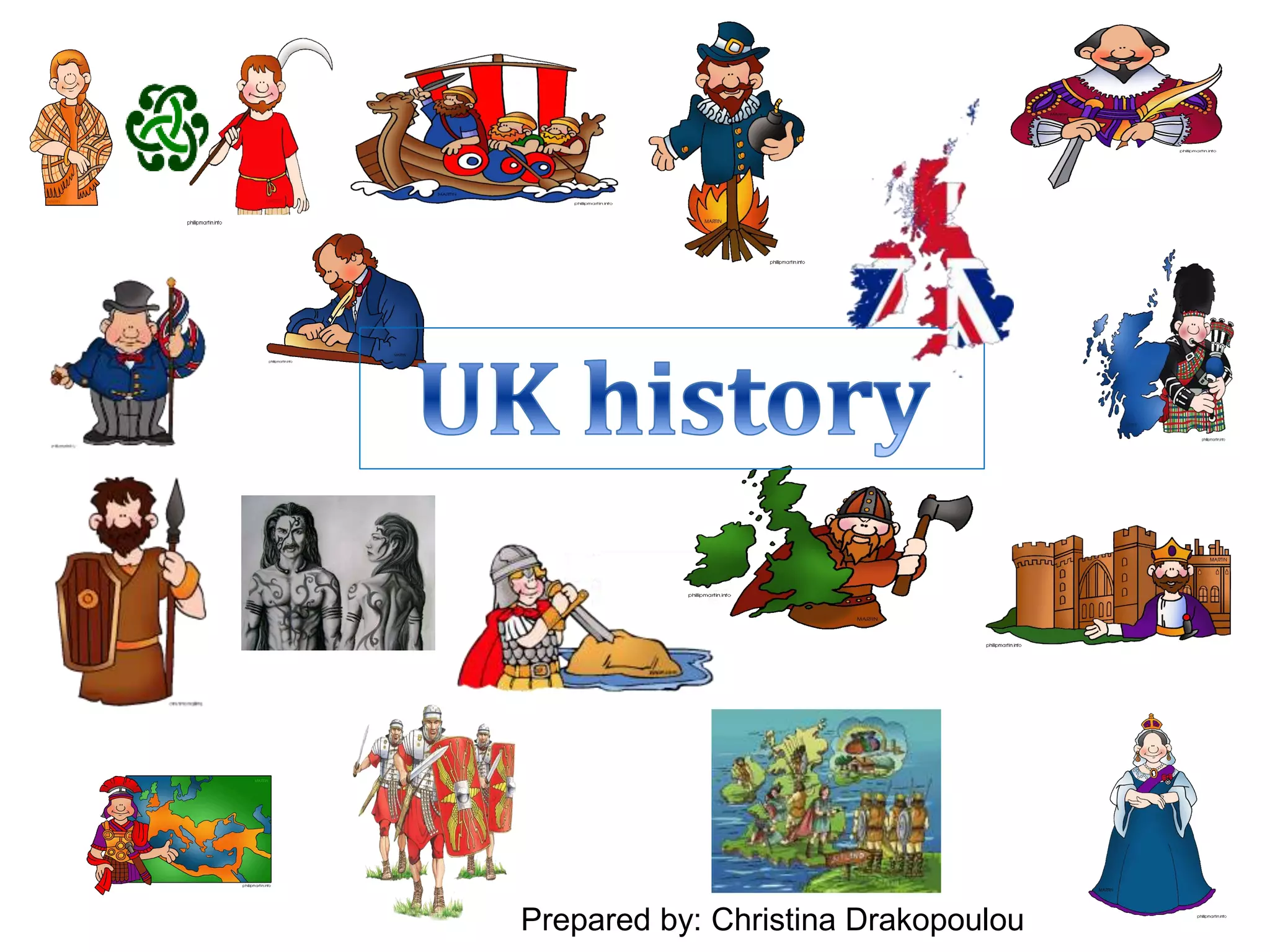
Prepared by: Christina Drakopoulou
3,000 BC
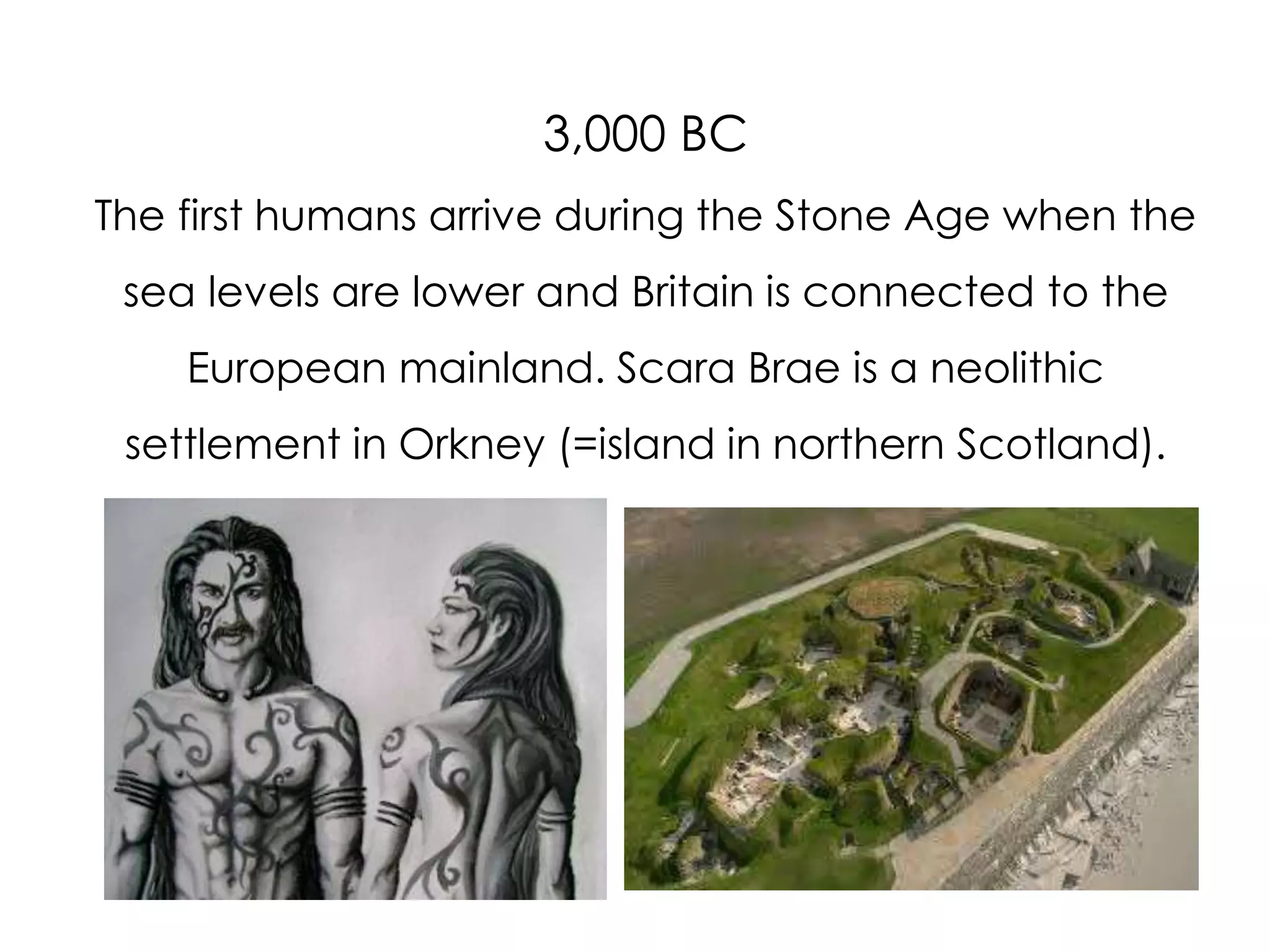
The first humans arrive during the Stone Age when the
sea levels are lower and Britain is connected to the
European mainland. Scara Brae is a neolithic
settlement in Orkney (=island in northern Scotland).
2,800 BC – Stonehenge
No one knows its true purpose; it is believed to be a
temple for sun worship or an observatory.
750 BC – The Celts
They come through France, possibly from Spain, but
they are soon pushed out to Wales, Cornwall,
Scotland and Ireland. The tribes were the Picts, the
Scots and the Britons.
The Romans
55 BC – Romans under Julius
Caesar come to Britain to
conquer it but they fail due
to bad weather.
However, 100 years later, in
43 AD, they come back
under Claudius and conquer
the British isles.
The Romans settle and build a lot of cities:
London(=Londinium), York, Bath, Manchester. They
construct roads, baths and walls in the north.
Queen Boudicca
AD 60 – The Britons in
England led by Queen
Boudicca revolt. They burn
down the temples and
massacre every Roman
they can find. But the
Romans win in the end. It is
said that Boudicca poisons
herself.
AD 409 –The Romans leave Britannia as their empire
needs protection from barbarians.
6th cent – Germanic peoples, the Angles, the Saxons
and the Jutes come and found their kingdoms. They
become known as the Anglo-Saxons and give the
south of Britain its new name: England.
The different tribes start fighting among themselves and
that allows the Saxons to win. King Arthur leads the Celtic
Britons in a fight against the Angles and Saxons. The British
believe he’s sleeping and will be back when Britain is in
danger.
9th century – The Vikings
The Norse from Scandinavia start invading Europe. The
Danes invade the North-East of England. They kill and
steal but they soon settle. Another group of Danes
takes over Paris and become known as Normans.
A Saxon leader, Alfred the Great fights back and
defeats the Vikings. As a result, the Vikings keep the
north and east which is called Danelaw. The Saxons
keep the south and west which is called Wessex. There
is peace for some years.
1066: William the Conqueror
William, Duke of Normandy (northern part of France)
with 12,000 soldiers defeat the Anglo-Saxons at Hastings
and conquer the land using scorched earth policy.
1,5 million English are ruled by just 20,000 Normans who
build castles. The King, William the Conqueror, owns all
the land and shares it out among his barons. Only one
of these barons is English – the rest are Norman
French. The English people become peasants and
workers.
French becomes the official language and remains
for three centuries. English remains the language of
the populace and the fusion of English with French
and Latin (used by the clergy)slowly evolves into
modern English.
12th cent: Richard I, “Lionheart” is rarely at home,
always fighting at the Crusades. His brother John,
“Lackland” usurps the throne and becomes a very
strict ruler. That’s how the legend of Robin Hood
emerges.
1215 – Magna Carta
King John starts another civil war. He goes against
everyone – the barons, the Pope, the people. In the
end, he is forced to sign the Great Charter (Magna
Carta) which gives some power to the people.
13th century
Edward I, is always fighting, too. However, he
manages to annex Wales. He also fights against the
Scots, whose proud resistance is portrayed in the film
“Braveheart”.
1337
The Hundred Years’ War between England and
France during the reign of Edward III begins.
The bubonic plague (“Black Death”) kills one third of
the English population.
1415
The battle of Agincourt:
The French are defeated
by Henry V. His son lost
most of the English
possessions in France to a
17-year-old girl: Joan of
Arc.
1455 – The War of the Roses.
This civil war between the House of Lancaster (red
rose) and the House of York (white rose) ends in favour
of the former. This is the beginning of the Tudor era.
1485 – 1603 The Tudors
The Tudor dynasty comes to power and England
becomes economically healthier and stronger. It is the
time to start colonising different parts of the world.
1534 – Henry VIII
Henry VIII Tudor is one of the
most powerful kings. He
passes the Acts of Union
with Wales. He gets married
six times. He doesn’t get
along with the head of the
Catholic Church, the Pope,
so he proclaims himself
head of the Church of
England.
1558 - 1603 Elizabeth I
Elisabeth is the last of the Tudors.
She doesn’t get married. During
her reign there are conflicts with
France and Scotland. When her
cousin Mary Stuart tries to take
over the throne, she keeps her in
prison for 19 years and then
executes her. However, this is also
an age of enlightenment with
philosophers and playwrights.
Shakespeare (1564-1616)
Great writers like Shakespeare
create plays which are
performed all around the world
to this day. Shakespeare
touches upon his favourite
subjects as crime and revenge,
witches and ghosts and tales of
horror. However, he never writes
about religious matters.
James I (1566-1625)
James is a Protestant king who
doesn’t like Catholics. As a result
of his strict ruling, a group of
Catholic extremists led by Guy
Fawkes attempt to blow up the
Parliament. The conspirators are
betrayed and the failure of the
Gunpowder Plot is still celebrated
on the 5th of November.
English Civil War (1642-1651)
The country is torn between Royalist and
Parliamentarian troops. Most of the Norman castles
are destroyed. King Charles is beheaded and Oliver
Cromwell rules the country as a dictator. In 1660
monarchy is restored.
1630 – 1685: Charles II
During his reign the Whig and Tory parties are created.
The Dutch colony of New Amsterdam becomes
English and is renamed New York after his brother who
is Duke of York. He sponsors Sir Christopher Wren who
rebuilds the City of London after the Great Fire of
1666. He is succeeded by his brother James II.
1688 – The Glorious Revolution
James II is quickly removed
from power. His daughter
Mary and her husband
William of Orange ascend
to the throne. The
Parliament ratifies that all
kings and queens have to
be Protestant from now on.
1707 – The Act of Union
English and Scottish Parliaments
are joined. This is not very
popular in Scotland. It was said
that the English bribed the
Scottish to make a deal. The
Act of Union creates one
kingdom of England, Wales
and Scotland and centralises
political power in London.
The House of Hanover
George I arrives in England in 1714 and can’t speak a
word of English, so he appoints a Prime Minister:
Robert Walpole. This marks a turning point as
monarchs become passive figures letting the reins of
the government to the Prime Minister.
The British empire expanded
considerably and the song
“God save the King” also
developed during this period.
The American War of Independence
In 1776, the American War of Independence broke out
when the British imposed a series of taxes on the
colonies. The 13 American colonies were finally granted
their independence in 1782 and formed the United
States of America.
1800 – The Act of Union
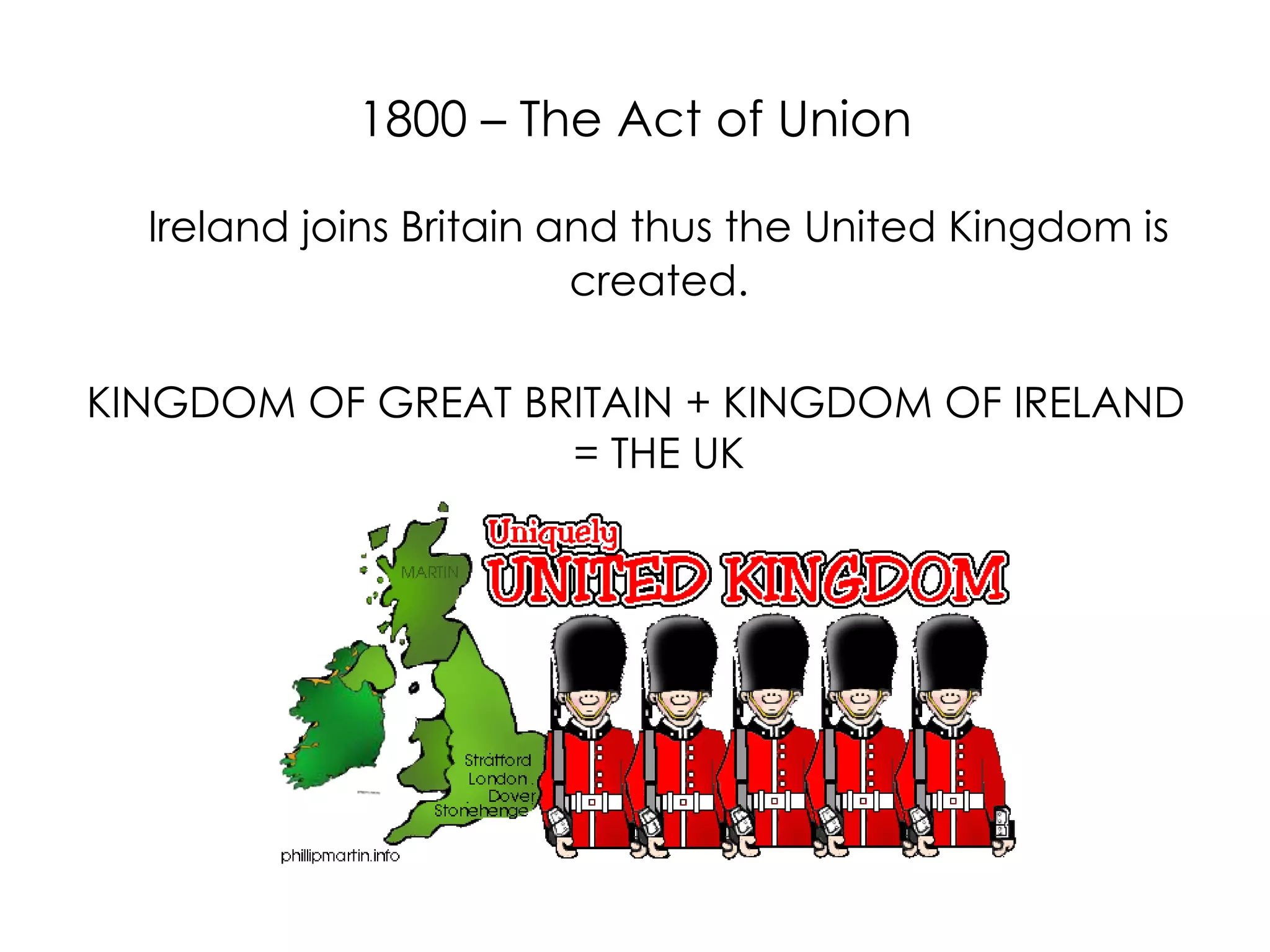
Ireland joins Britain and thus the United Kingdom is
created.
KINGDOM OF GREAT BRITAIN + KINGDOM OF IRELAND
= THE UK
19th century
During the reign of King George
III Britain has to face Napoleon
and his ambition to conquer
the whole of Europe. Admiral
Nelson’s naval victory at
Trafalgar in 1805 and
Wellington’s victory at Waterloo
saves the UK and reinforces its
international position.
1750 – 1840 Industrial Revolution
During the Industrial Revolution many machines are
invented which change people’s lives. People
migrate from the countryside to towns. Great industrial
cities such as Manchester and Liverpool emerge.
Hard times for poor people
The factory owners become very rich and live well,
but the factory workers are very poor. They work long
hours and live in tiny, crowded houses with no
bathroom or clean water. Children as young as 5
years old have to work 12 or more hours each day
and life is really hard.
Charles Dickens (1812-1870)
Charles Dickens is one of
the most popular writers of
all time. He writes about the
gap between the rich and
the poor as well as about
child labour. His novels
include Oliver Twist and
David Copperfield.
1837 – 1901 Queen Victoria
The Victorian period is the time of
prosperity for the British people as a
result of profits from overseas
colonies and industrial revolution at
home. However, this position of
hegemony results in wars with China
and the Boers of South Africa. She
has the longest reign of any British
monarch (64 years).
1914 – 1918: The Great War
At the beginning of the 20th cent
two major alliances were formed:
the Triple Entente (UK, France,
Russia) and the Triple Alliance
(Germany, Italy, Austro-Hungary).
The differences between these
countries led to the Great War in
1914. About 9 million people died
during the four years of the war.
1922 – The Irish fight for freedom
Over the time the Irish become unhappy and they
rebel, fighting for their freedom. After many bloody
battles, Ireland finally separates from the UK in 1922.
However, Northern Ireland stays in the union.
1939 – 1945: WWII in Europe
Another war against Germany.
By March 1940 Britain is led by
the charismatic Prime Minister
Winston Churchill who
encourages the British to fight
off the attempted German
invasion and promises them
‘blood, toil, tears and sweat’.
Post-war UK
In 1945, the UK is bankrupt and
its industry destroyed. The British
empire is dismantled little by
little. The colonies are granted
independence and most of
them form the British
Commonwealth. Elisabeth II
ascends the throne in 1952 at
the age of 26.
Post-war UK
In 1979, Margaret Thatcher becomes the first
woman Prime Minister.
In 1982, Argentina invades the Falkland Islands. The
conflict ends after two months.
In 1994, the Channel Tunnel (=Chunnel) opens.
21st century

UK history

  • 1.
  • 2.
    3,000 BC The firsthumans arrive during the Stone Age when the sea levels are lower and Britain is connected to the European mainland. Scara Brae is a neolithic settlement in Orkney (=island in northern Scotland).
  • 3.
    2,800 BC –Stonehenge No one knows its true purpose; it is believed to be a temple for sun worship or an observatory.
  • 4.
    750 BC –The Celts They come through France, possibly from Spain, but they are soon pushed out to Wales, Cornwall, Scotland and Ireland. The tribes were the Picts, the Scots and the Britons.
  • 5.
    The Romans 55 BC– Romans under Julius Caesar come to Britain to conquer it but they fail due to bad weather. However, 100 years later, in 43 AD, they come back under Claudius and conquer the British isles.
  • 6.
    The Romans settleand build a lot of cities: London(=Londinium), York, Bath, Manchester. They construct roads, baths and walls in the north.
  • 7.
    Queen Boudicca AD 60– The Britons in England led by Queen Boudicca revolt. They burn down the temples and massacre every Roman they can find. But the Romans win in the end. It is said that Boudicca poisons herself.
  • 8.
    AD 409 –TheRomans leave Britannia as their empire needs protection from barbarians.
  • 9.
    6th cent –Germanic peoples, the Angles, the Saxons and the Jutes come and found their kingdoms. They become known as the Anglo-Saxons and give the south of Britain its new name: England.
  • 10.
    The different tribesstart fighting among themselves and that allows the Saxons to win. King Arthur leads the Celtic Britons in a fight against the Angles and Saxons. The British believe he’s sleeping and will be back when Britain is in danger.
  • 11.
    9th century –The Vikings The Norse from Scandinavia start invading Europe. The Danes invade the North-East of England. They kill and steal but they soon settle. Another group of Danes takes over Paris and become known as Normans.
  • 12.
    A Saxon leader,Alfred the Great fights back and defeats the Vikings. As a result, the Vikings keep the north and east which is called Danelaw. The Saxons keep the south and west which is called Wessex. There is peace for some years.
  • 13.
    1066: William theConqueror William, Duke of Normandy (northern part of France) with 12,000 soldiers defeat the Anglo-Saxons at Hastings and conquer the land using scorched earth policy.
  • 14.
    1,5 million Englishare ruled by just 20,000 Normans who build castles. The King, William the Conqueror, owns all the land and shares it out among his barons. Only one of these barons is English – the rest are Norman French. The English people become peasants and workers.
  • 15.
    French becomes theofficial language and remains for three centuries. English remains the language of the populace and the fusion of English with French and Latin (used by the clergy)slowly evolves into modern English.
  • 16.
    12th cent: RichardI, “Lionheart” is rarely at home, always fighting at the Crusades. His brother John, “Lackland” usurps the throne and becomes a very strict ruler. That’s how the legend of Robin Hood emerges.
  • 17.
    1215 – MagnaCarta King John starts another civil war. He goes against everyone – the barons, the Pope, the people. In the end, he is forced to sign the Great Charter (Magna Carta) which gives some power to the people.
  • 18.
    13th century Edward I,is always fighting, too. However, he manages to annex Wales. He also fights against the Scots, whose proud resistance is portrayed in the film “Braveheart”.
  • 19.
    1337 The Hundred Years’War between England and France during the reign of Edward III begins. The bubonic plague (“Black Death”) kills one third of the English population.
  • 20.
    1415 The battle ofAgincourt: The French are defeated by Henry V. His son lost most of the English possessions in France to a 17-year-old girl: Joan of Arc.
  • 21.
    1455 – TheWar of the Roses. This civil war between the House of Lancaster (red rose) and the House of York (white rose) ends in favour of the former. This is the beginning of the Tudor era.
  • 22.
    1485 – 1603The Tudors The Tudor dynasty comes to power and England becomes economically healthier and stronger. It is the time to start colonising different parts of the world.
  • 23.
    1534 – HenryVIII Henry VIII Tudor is one of the most powerful kings. He passes the Acts of Union with Wales. He gets married six times. He doesn’t get along with the head of the Catholic Church, the Pope, so he proclaims himself head of the Church of England.
  • 24.
    1558 - 1603Elizabeth I Elisabeth is the last of the Tudors. She doesn’t get married. During her reign there are conflicts with France and Scotland. When her cousin Mary Stuart tries to take over the throne, she keeps her in prison for 19 years and then executes her. However, this is also an age of enlightenment with philosophers and playwrights.
  • 25.
    Shakespeare (1564-1616) Great writerslike Shakespeare create plays which are performed all around the world to this day. Shakespeare touches upon his favourite subjects as crime and revenge, witches and ghosts and tales of horror. However, he never writes about religious matters.
  • 26.
    James I (1566-1625) Jamesis a Protestant king who doesn’t like Catholics. As a result of his strict ruling, a group of Catholic extremists led by Guy Fawkes attempt to blow up the Parliament. The conspirators are betrayed and the failure of the Gunpowder Plot is still celebrated on the 5th of November.
  • 27.
    English Civil War(1642-1651) The country is torn between Royalist and Parliamentarian troops. Most of the Norman castles are destroyed. King Charles is beheaded and Oliver Cromwell rules the country as a dictator. In 1660 monarchy is restored.
  • 28.
    1630 – 1685:Charles II During his reign the Whig and Tory parties are created. The Dutch colony of New Amsterdam becomes English and is renamed New York after his brother who is Duke of York. He sponsors Sir Christopher Wren who rebuilds the City of London after the Great Fire of 1666. He is succeeded by his brother James II.
  • 29.
    1688 – TheGlorious Revolution James II is quickly removed from power. His daughter Mary and her husband William of Orange ascend to the throne. The Parliament ratifies that all kings and queens have to be Protestant from now on.
  • 30.
    1707 – TheAct of Union English and Scottish Parliaments are joined. This is not very popular in Scotland. It was said that the English bribed the Scottish to make a deal. The Act of Union creates one kingdom of England, Wales and Scotland and centralises political power in London.
  • 31.
    The House ofHanover George I arrives in England in 1714 and can’t speak a word of English, so he appoints a Prime Minister: Robert Walpole. This marks a turning point as monarchs become passive figures letting the reins of the government to the Prime Minister. The British empire expanded considerably and the song “God save the King” also developed during this period.
  • 32.
    The American Warof Independence In 1776, the American War of Independence broke out when the British imposed a series of taxes on the colonies. The 13 American colonies were finally granted their independence in 1782 and formed the United States of America.
  • 33.
    1800 – TheAct of Union Ireland joins Britain and thus the United Kingdom is created. KINGDOM OF GREAT BRITAIN + KINGDOM OF IRELAND = THE UK
  • 34.
    19th century During thereign of King George III Britain has to face Napoleon and his ambition to conquer the whole of Europe. Admiral Nelson’s naval victory at Trafalgar in 1805 and Wellington’s victory at Waterloo saves the UK and reinforces its international position.
  • 35.
    1750 – 1840Industrial Revolution During the Industrial Revolution many machines are invented which change people’s lives. People migrate from the countryside to towns. Great industrial cities such as Manchester and Liverpool emerge.
  • 36.
    Hard times forpoor people The factory owners become very rich and live well, but the factory workers are very poor. They work long hours and live in tiny, crowded houses with no bathroom or clean water. Children as young as 5 years old have to work 12 or more hours each day and life is really hard.
  • 37.
    Charles Dickens (1812-1870) CharlesDickens is one of the most popular writers of all time. He writes about the gap between the rich and the poor as well as about child labour. His novels include Oliver Twist and David Copperfield.
  • 38.
    1837 – 1901Queen Victoria The Victorian period is the time of prosperity for the British people as a result of profits from overseas colonies and industrial revolution at home. However, this position of hegemony results in wars with China and the Boers of South Africa. She has the longest reign of any British monarch (64 years).
  • 39.
    1914 – 1918:The Great War At the beginning of the 20th cent two major alliances were formed: the Triple Entente (UK, France, Russia) and the Triple Alliance (Germany, Italy, Austro-Hungary). The differences between these countries led to the Great War in 1914. About 9 million people died during the four years of the war.
  • 40.
    1922 – TheIrish fight for freedom Over the time the Irish become unhappy and they rebel, fighting for their freedom. After many bloody battles, Ireland finally separates from the UK in 1922. However, Northern Ireland stays in the union.
  • 41.
    1939 – 1945:WWII in Europe Another war against Germany. By March 1940 Britain is led by the charismatic Prime Minister Winston Churchill who encourages the British to fight off the attempted German invasion and promises them ‘blood, toil, tears and sweat’.
  • 42.
    Post-war UK In 1945,the UK is bankrupt and its industry destroyed. The British empire is dismantled little by little. The colonies are granted independence and most of them form the British Commonwealth. Elisabeth II ascends the throne in 1952 at the age of 26.
  • 43.
    Post-war UK In 1979,Margaret Thatcher becomes the first woman Prime Minister. In 1982, Argentina invades the Falkland Islands. The conflict ends after two months. In 1994, the Channel Tunnel (=Chunnel) opens.
  • 44.