Marc Rubner


Product Globalization and the Future of
         Product Management
               August, 2012
The Challenge

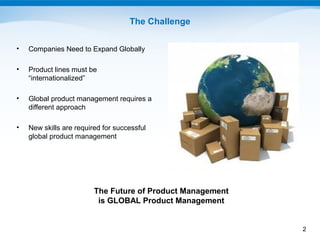
•   Companies Need to Expand Globally

•   Product lines must be
    “internationalized”

•   Global product management requires a
    different approach

•   New skills are required for successful
    global product management


                         The Future of Product Management
                          is GLOBAL Product Management


                                                            2
Executives are Focused on Global Expansion


•     The percentage of U.S. mid-market
      executives who say their companies
      are very focused on overseas
      expansion has nearly doubled since
      2007*


•    Similarly, the number of U.S. mid-
     market executives who say that global
     expansion in integral to their company’s
     growth strategy has more than doubled
     since 2007*


    *Source: KPMG LLP Study, 2012

                                                                3
Global Expansion Requires Global Products


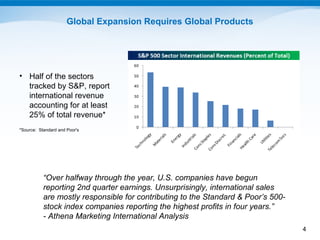
• Half of the sectors
  tracked by S&P, report
  international revenue
  accounting for at least
  25% of total revenue*
*Source: Standard and Poor's


           “Over halfway through the year, U.S. companies have begun
           reporting 2nd quarter earnings. Unsurprisingly, international sales
           are mostly responsible for contributing to the Standard & Poor’s 500-
           stock index companies reporting the highest profits in four years.”
           - Athena Marketing International Analysis
                                                                                   4
A New Decision Point

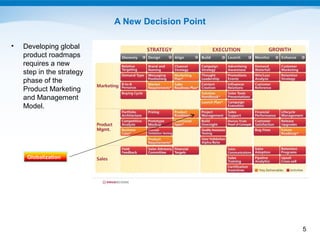
•   Developing global
    product roadmaps
    requires a new
    step in the strategy
    phase of the
    Product Marketing
    and Management
    Model.


     Globalization


                                                  5
Global Product Strategy:
               Centralized Products vs. Market-based Product


           Centralized Products                    Market-Based Products


•   Supported from a single region        •   Support infrastructure in each market
•   Technology hosted in 1 region         •   Hosted in various markets or regions
•   All transactions come to 1 location   •   Transactions stay within each market
•   Sales management in HQ                •   Sales management in each market


                                                                                      6
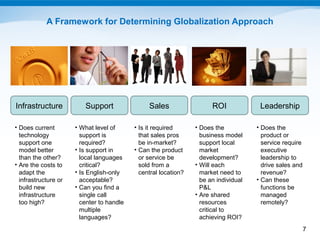
A Framework for Determining Globalization Approach


Infrastructure           Support                Sales                  ROI             Leadership

• Does current        • What level of      • Is it required      • Does the           • Does the
  technology            support is           that sales pros       business model       product or
  support one           required?            be in-market?         support local        service require
  model better        • Is support in      • Can the product       market               executive
  than the other?       local languages      or service be         development?         leadership to
• Are the costs to      critical?            sold from a         • Will each            drive sales and
  adapt the           • Is English-only      central location?     market need to       revenue?
  infrastructure or     acceptable?                                be an individual   • Can these
  build new           • Can you find a                             P&L                  functions be
  infrastructure        single call                              • Are shared           managed
  too high?             center to handle                           resources            remotely?
                        multiple                                   critical to
                        languages?                                 achieving ROI?
                                                                                                          7
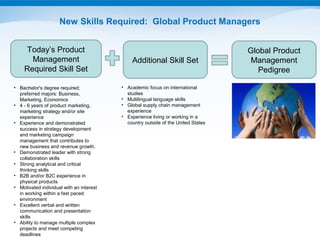
New Skills Required: Global Product Managers


    Today’s Product                                                                Global Product
      Management                              Additional Skill Set                  Management
    Required Skill Set                                                                Pedigree

• Bachelor's degree required;             • Academic focus on international
  preferred majors: Business,               studies
  Marketing, Economics                    • Multilingual language skills
• 4 - 6 years of product marketing,       • Global supply chain management
  marketing strategy and/or site            experience
  experience                              • Experience living or working in a
• Experience and demonstrated               country outside of the United States
  success in strategy development
  and marketing campaign
  management that contributes to
  new business and revenue growth.
• Demonstrated leader with strong
  collaboration skills
• Strong analytical and critical
  thinking skills
• B2B and/or B2C experience in
  physical products
• Motivated individual with an interest
  in working within a fast paced
  environment
• Excellent verbal and written
  communication and presentation
  skills
• Ability to manage multiple complex
  projects and meet competing
  deadlines
Conclusions

•   Executives must expand product lines
    Globally

•   Product globalization will be a key
    driver in successful global expansion

•   Global product management requires a
    different approach with a new decision
    point focused on a centralized product
    strategy versus a market-based product
    strategy

•   Global product managers – who bring
    different skill sets to the discipline will
    be key assets in driving product
    globalization


                                                        9

The future of product management

  • 1.
    Marc Rubner Product Globalizationand the Future of Product Management August, 2012
  • 2.
    The Challenge • Companies Need to Expand Globally • Product lines must be “internationalized” • Global product management requires a different approach • New skills are required for successful global product management The Future of Product Management is GLOBAL Product Management 2
  • 3.
    Executives are Focusedon Global Expansion • The percentage of U.S. mid-market executives who say their companies are very focused on overseas expansion has nearly doubled since 2007* • Similarly, the number of U.S. mid- market executives who say that global expansion in integral to their company’s growth strategy has more than doubled since 2007* *Source: KPMG LLP Study, 2012 3
  • 4.
    Global Expansion RequiresGlobal Products • Half of the sectors tracked by S&P, report international revenue accounting for at least 25% of total revenue* *Source: Standard and Poor's “Over halfway through the year, U.S. companies have begun reporting 2nd quarter earnings. Unsurprisingly, international sales are mostly responsible for contributing to the Standard & Poor’s 500- stock index companies reporting the highest profits in four years.” - Athena Marketing International Analysis 4
  • 5.
    A New DecisionPoint • Developing global product roadmaps requires a new step in the strategy phase of the Product Marketing and Management Model. Globalization 5
  • 6.
    Global Product Strategy: Centralized Products vs. Market-based Product Centralized Products Market-Based Products • Supported from a single region • Support infrastructure in each market • Technology hosted in 1 region • Hosted in various markets or regions • All transactions come to 1 location • Transactions stay within each market • Sales management in HQ • Sales management in each market 6
  • 7.
    A Framework forDetermining Globalization Approach Infrastructure Support Sales ROI Leadership • Does current • What level of • Is it required • Does the • Does the technology support is that sales pros business model product or support one required? be in-market? support local service require model better • Is support in • Can the product market executive than the other? local languages or service be development? leadership to • Are the costs to critical? sold from a • Will each drive sales and adapt the • Is English-only central location? market need to revenue? infrastructure or acceptable? be an individual • Can these build new • Can you find a P&L functions be infrastructure single call • Are shared managed too high? center to handle resources remotely? multiple critical to languages? achieving ROI? 7
  • 8.
    New Skills Required:Global Product Managers Today’s Product Global Product Management Additional Skill Set Management Required Skill Set Pedigree • Bachelor's degree required; • Academic focus on international preferred majors: Business, studies Marketing, Economics • Multilingual language skills • 4 - 6 years of product marketing, • Global supply chain management marketing strategy and/or site experience experience • Experience living or working in a • Experience and demonstrated country outside of the United States success in strategy development and marketing campaign management that contributes to new business and revenue growth. • Demonstrated leader with strong collaboration skills • Strong analytical and critical thinking skills • B2B and/or B2C experience in physical products • Motivated individual with an interest in working within a fast paced environment • Excellent verbal and written communication and presentation skills • Ability to manage multiple complex projects and meet competing deadlines
  • 9.
    Conclusions • Executives must expand product lines Globally • Product globalization will be a key driver in successful global expansion • Global product management requires a different approach with a new decision point focused on a centralized product strategy versus a market-based product strategy • Global product managers – who bring different skill sets to the discipline will be key assets in driving product globalization 9

Editor's Notes

  • #2 This presentation focuses on the role of product management in global product expansion as well as the required expanding skill set required for successful global product managers.
  • #3 As more and more pressure is put on executives to find new revenue sources, corporate leaders are increasingly turning to international markets to grow business. A key driver of this growth will be the globalization (or “internationalization”) of products. Product managers will lead the strategic and tactical initiatives that will ultimately drive revenue from global markets. They will develop and refine the roadmap that gets their product line from U.S. centric to globally focused.
  • #4 In a recent KPMG survey, 74 percent of executives from mid-market companies, U.S. respondents say company leadership is very focused on overseas expansion (up from 52 percent in 2009 and 39 percent in 2007). Similarly, 75 percent say that global expansion is integral to their company's growth strategy (up from 53 percent in 2009 and 37 percent in 2007). (Source: KPMG LLP, August, 2012)   In doing so, it’s fair to assume that these companies will need to create products for new international markets. Therefore, the implication here is that the future of product management is global product management.
  • #5 More data from Standard and Poor’s supports the focus on revenue generation from international markets.
  • #6 Global expansion requires global products. Developing global product roadmaps requires a new step in the Strategy phase of the Product Marketing and Management Model. Product managers have to decide whether their product will be architected as a centralized product offering or a market based product offering.   A centralized product is built, marketed and supported from a central architecture regardless of where in the world the product is sold and used. For example, American Express’s 150 year-old Travelers Cheque product is sold and redeemed in more than 100 countries. However, the infrastructure behind the processing of Travelers Cheques has a technical and operations team that operates out of Salt Lake City, UT. No matter where a Traveler’s Cheque is used in the world, every single one in created, authorized validated and serviced out of Salt Lake City.   A market-based product is built, marketed and supported within each market (or a defined region consisting of several markets) in which the product is sold and used. Sticking with and example from American Express, their core point of sale product (the means by which merchants authorize and settle American Express cards) operates independently in each of four regions which cover all of the countries in which American Express does business. Furthermore, a support infrastructure is set up in nearly every country.
  • #7 A centralized product is built, marketed and supported from a central architecture regardless of where in the world the product is sold and used. For example, American Express’s 150 year-old Travelers Cheque product is sold and redeemed in more than 100 countries. However, the infrastructure behind the processing of Travelers Cheques has a technical and operations team that operates out of Salt Lake City, UT. No matter where a Traveler’s Cheque is used in the world, every single one in created, authorized validated and serviced out of Salt Lake City.   A market-based product is built, marketed and supported within each market (or a defined region consisting of several markets) in which the product is sold and used. Sticking with and example from American Express, their core point of sale product (the means by which merchants authorize and settle American Express cards) operates independently in each of four regions which cover all of the countries in which American Express does business. Furthermore, a support infrastructure is set up in nearly every country.
  • #8 The following is a high-level framework for guiding this distinction.   Technology infrastructure (including legacy system capabilities): Does your current technology architecture support one model better than the other? Are the costs to adapt the infrastructure or build new infrastructure too high?   Support requirements (i.e., language localization): What level of support is required? Is support in local language critical or can it be provided in English only? Is it possible to find a call center that can provide support in multiple languages from a centralized location?   Local sales and market talent requirements: Is it required that sales professionals be in-market, or can the product or service be sold and marketed from a central location? Can local distributors be leveraged?   Market ROI: From a purely economic perspective, will an acceptable ROI be achievable only through centralized (shared) resources or does the business model support local market development, support and sales? Will each market need to be an individual P&L or can you achieve localization through some shared resources to lower costs?   Need for local executive leadership: Does the product or service require executive leadership to drive sales, revenue, support and product lifecycle processes? Can these functions be managed remotely or is in-market leadership required?  
  • #9 A review of recent U.S. job postings from various online job boards shows little difference in required skills between product manager jobs and global product manager jobs. Typical requirements for product managers include: Bachelor's degree required; preferred majors: Business, Marketing, Economics 4 - 6 years of product marketing, marketing strategy and/or site experience Experience and demonstrated success in strategy development and marketing campaign management that contributes to new business and revenue growth. Demonstrated leader with strong collaboration skills Strong analytical and critical thinking skills B2B and/or B2C experience in physical products Motivated individual with an interest in working within a fast paced environment Excellent verbal and written communication and presentation skills Ability to manage multiple complex projects and meet competing deadlines In examining requirements for jobs titled “Global Product Manager,” the requirements are eerily similar. However, this is likely to change as the ability to develop, market and support products globally will be predicated on job skills not prevalent in U.S. product managers today. These include: Academic focus on international studies Multilingual language skills Global supply chain management experience Experience living or working in a country outside of the United States
  • #10 With executives already focused on global expansion, product globalization will emerge as a leading factor in driving overall company growth. In other words, there is not debate regarding whether or not to seek international markets for domestic products. The remaining question centers on the roadmap to getting there. As owners of that road map, global product managers will be tasked with deciding if their product is best globalized through a centralized product approach or a market-based approach. The key factors in determining this decision include technology infrastructure, support requirements, sales and marketing requirements and overall ROI. Product managers can take comfort in knowing there are success stories for each approach. The common theme, however, is coming to terms with the components of the framework. Just as important is the evolution of skills required for global product managers. This skill set includes all of the common requirements including experience and demonstrated success in strategy development and marketing campaign management that contributes to new business and revenue growth, demonstrated leader with strong collaboration skills and strong analytical and critical thinking skills. However, also required are Academic focus on international studies, multilingual language skills, global supply chain management experience and experience living or working in a country outside of the United States.